What a company brain needs before agents can act on it
A company brain built from documents, transcripts and exports helps agents answer questions. Agents that do work need more: the company's records, the rules for changing them, who may see and change what, and the history of every change, open to any model. Here is what that is made of, and how to start.
Constantine Yurevich · Updated 28 October 2026 · 5 min read
On this page
A company brain that agents can act on is not a pile of documents. It is the company's records, the rules for changing them, who may see and change what, and the history of every change, kept in one place the company owns and open to any model.
"Company brain" has become the name for whatever gives agents context about a business. Most of what is sold under the name is search: a layer over the wiki, the drive, the chat history and the CRM, so an assistant can find the right paragraph. That is useful, and it is enough for answering questions. It is not enough for an agent that moves a deal, approves an invoice or tells a customer when their order ships.
Two kinds of company brain
| A knowledge brain | An operational brain | |
|---|---|---|
| Made of | Documents, wikis, transcripts, exports | Records, relationships, actions, roles, history |
| Good for | Answering "what did we decide about X?" | Doing "move this deal", "approve this bill" |
| Truth | Whatever the latest document says | One record, changed only through its rules |
| Permissions | Usually the document's sharing settings | Per person, per role, per record |
| When it is wrong | The agent quotes an old paragraph | The change is refused, with the reason |
Most companies need both. The mistake is to expect the first to do the job of the second.
Why exports and transcripts are not enough
Call transcripts, Slack exports, CRM dumps and a shared drive full of PDFs are inputs. They have three problems as a basis for action:
- They disagree. The export from Monday and the spreadsheet from Wednesday hold two versions of the same customer. An agent can't tell which is true.
- They have no rules. Nothing in a document says that a lost deal needs a reason, or that an invoice above a limit needs a second approver.
- They have no permissions that fit. Either the agent sees everything in the folder or nothing, and it can't act as the person who asked.
An agent working from inputs can draft and suggest. To let it act, it needs the governed version.
What an operational company brain is made of
Records
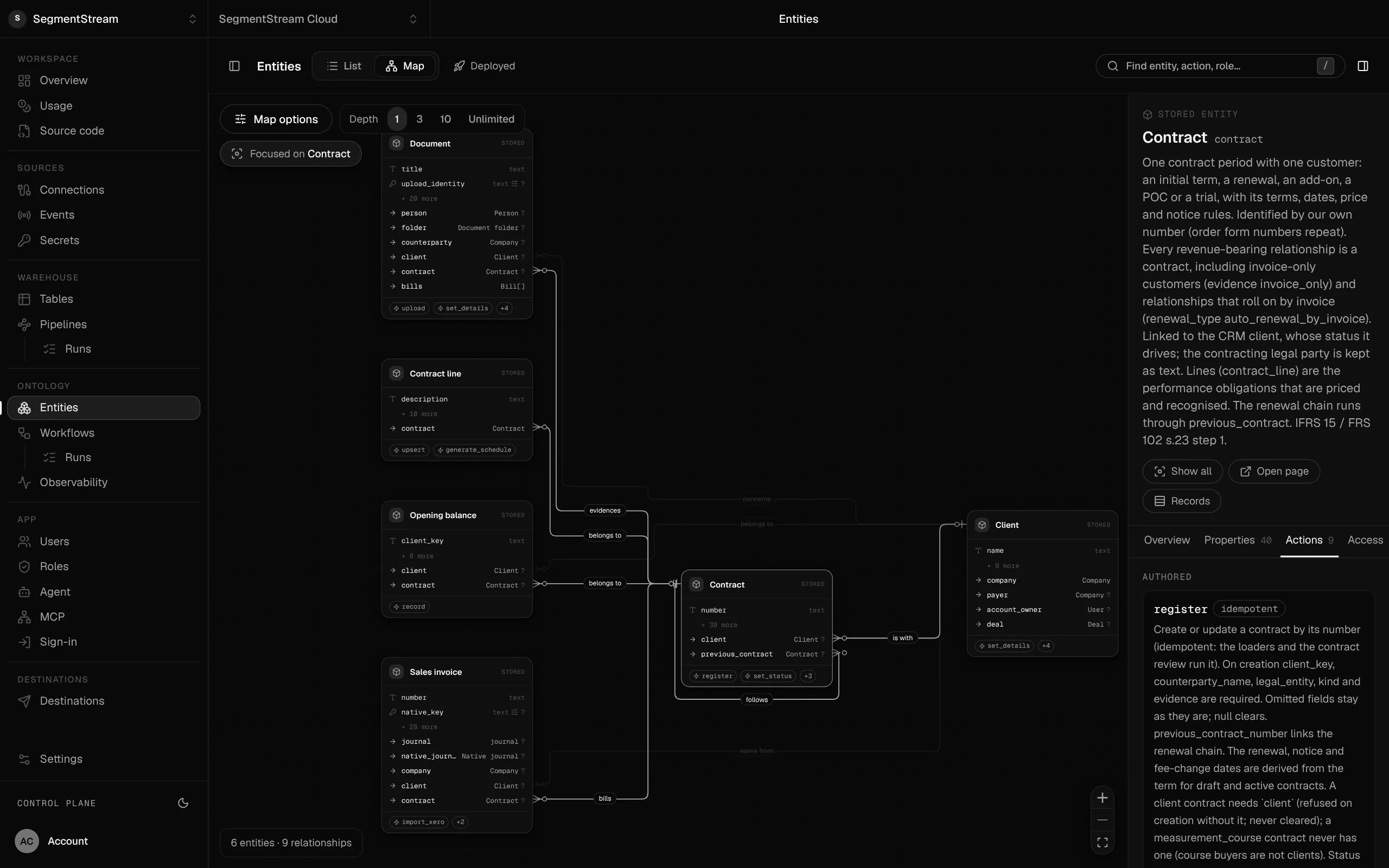
The things your business runs on, with their properties and how they relate: clients, contacts, deals, contracts, invoices, orders, tickets, and whatever is particular to you. One record per thing, not one per tool. When the same client lives in the CRM, the billing tool and a spreadsheet, the brain is the place where they become one.
Rules
Every change goes through a named action with its own checks: "move a deal to a stage", "approve an invoice", "mark an order shipped". The rule lives in one place, so a person in the app, an integration and an agent are all held to it. When an agent's change is refused, it gets the action's own message and can fix its input.
Permissions
Who may see which records and run which actions, by role, and where needed by record: a salesperson sees their own accounts, finance sees all invoices. An agent acting for a person gets exactly that person's permissions, never a shared key with access to everything.
History
Every change kept with the action that made it, the person or agent who ran it and when. History is what lets you trust work an agent did, and undo it when it was wrong.
Measures
A number over many records, such as pipeline value, revenue this quarter or days sales outstanding, defined once. Every app, report and agent then gives the same answer, instead of each one adding things up its own way.
Documents, attached to records
Documents still matter. Keep contracts, statements and briefs, but attach them to the records they belong to, so an agent reading a contract knows which client and which deal it is about.
Keep the models interchangeable
The brain should live outside any one agent. Models and agent products change every few months; your records and rules shouldn't have to move with them.
That is what open protocols are for. The Model Context Protocol is "an open-source standard for connecting AI applications to external systems", supported by Claude, ChatGPT, Cursor and many others. Serve your records and actions over MCP with per-person sign-in, and any of them can work on the same brain under the same rules. Switching models becomes a setting, not a migration.
Where the agent's own memory fits
Agents also keep memory: instructions, preferences, what was said in a conversation. That belongs with the agent. Facts about the business, such as who the client is, what was agreed and what is owed, belong in the records, where every agent and every person sees the same thing and changes go through the rules.
A simple test: if a fact should be true for everyone in the company tomorrow, it is a record, not an agent's memory.
How to start
- Pick one process where agents could do real work, such as qualifying leads, chasing unpaid invoices or reconciling payments.
- Model its records: the things involved and how they relate.
- Write its actions: every way those records change, with the checks.
- Set the roles: who may see and do what, including the agents.
- Connect the sources it needs, with credentials held outside the code.
- Connect the agents: the AI tools your team uses, each acting as its person, and a company agent for the team's chats.
On SegmentStream, this is the workspace's data model, which we call the ontology: records, actions, roles and history in your own database, written as code in a repository you own, and served to Claude, ChatGPT and your own agents over MCP and an API. The company agent works on the same records in Slack, Teams, WhatsApp, Telegram and email.
For the access side in detail, see how to give AI agents access to company data safely.
Frequently asked questions
What is a company brain for AI agents?
A company brain is the shared context agents work from. A knowledge brain is documents and search, good for answering questions. An operational brain is the company's records, the rules for changing them, permissions and history, which agents need before they can act.
Is a company brain the same as a knowledge base or RAG?
Not quite. Retrieval over documents helps an agent find information. An agent that changes data also needs records with rules, permissions per person and a history of every change. Most companies need both, attached to each other.
How do agents get permission to change company data?
The safest way is for the agent to act as the person it works for, with exactly their roles, and to change data only through actions that check their own rules. Unattended work gets its own identity with a narrow role.
Can I switch AI models without rebuilding my company brain?
Yes, if the brain lives outside the agent. Serve your records and actions over an open protocol such as MCP, with per-person sign-in, and any compatible model or agent can use them.