
Internal tools and dashboards on the records and data you already own.
Your agent writes pages in app/. Invited members sign in with an email code. Pages read records through the ontology as the signed-in person and query the warehouse with bound parameters. No BI seats, no admin-panel licence, no secrets in the app.
Recognised revenue per client and month, by legal entity and currency, from the approved contract schedules.
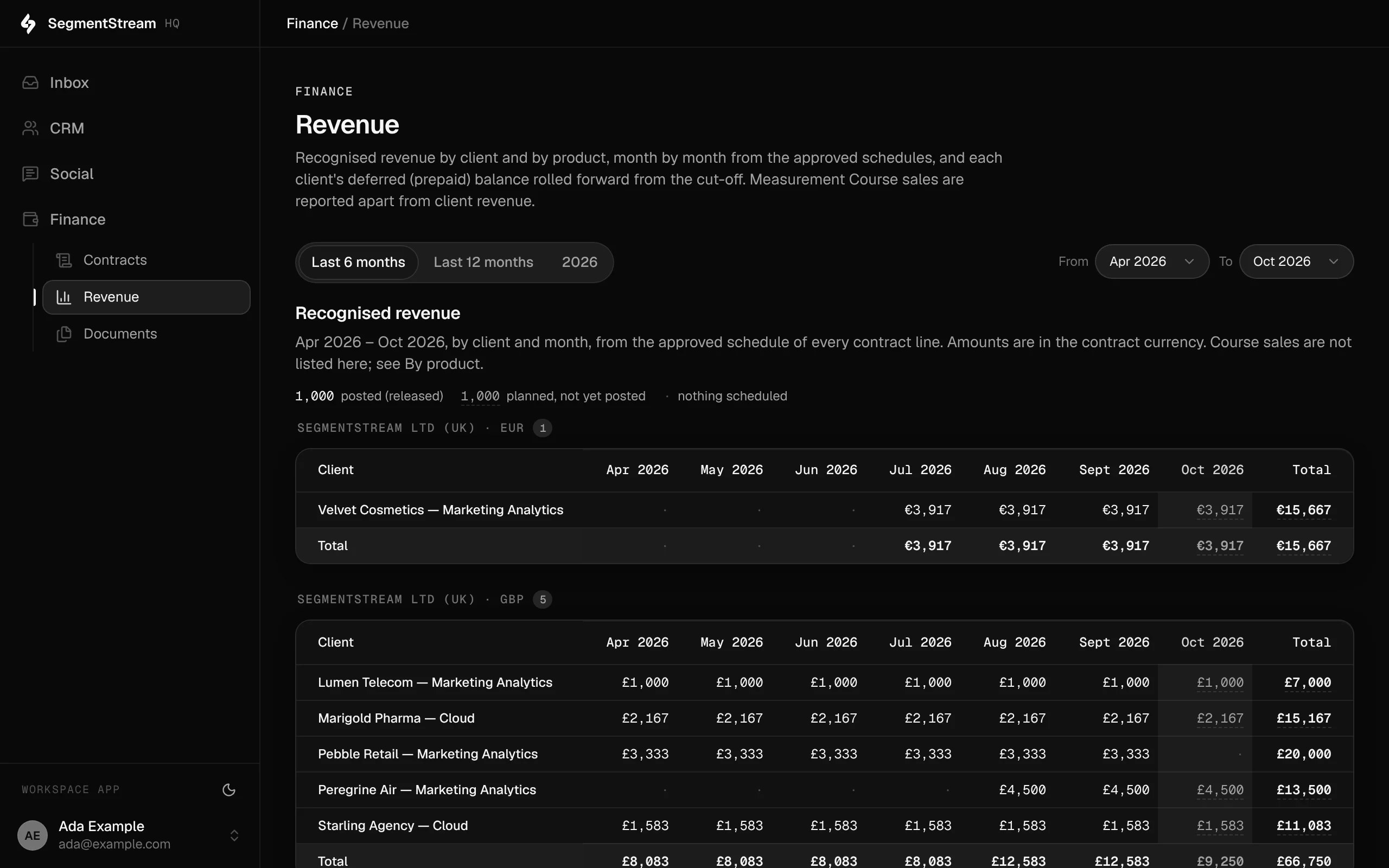
The dashboards we run on
The Revenue page in SegmentStream HQ and the lead-scoring dashboard at an AI video company are both built this way.
How we run SegmentStream on SegmentStream →- Your agent writes pages in app/. SegmentStream hosts them with sign-in.
- People sign in with an email code, only invited members get in, and nobody needs a SegmentStream account.
- Pages read records through the ontology as the signed-in person, and query the warehouse with bound parameters.
- Totals come from measures declared on entities, so every page counts the same way.
- Buttons hide with <Can permission>, and the ontology refuses the action anyway.
What it covers
Pages with sign-in →
Pages your agent writes, hosted with sign-in. Only invited members get in, with an email code.
Records with permissions
Records read and changed through the ontology as the signed-in person, so each page shows what that role allows.
Reports from the warehouse
Warehouse queries with bound parameters, in server code, with the workspace's app credential.
One definition of every number
Totals come from measures declared on entities, so every page and every agent counts revenue, deals or orders the same way.
Built from typed blocks
No new product to buy: the blocks below, written by an agent into your workspace's repository and deployed with one command.
None required.
None required.
$ segmentstream deploy
Every block ships together from one git repository your company owns. SegmentStream runs it.
- Retool
- Airtable interfaces
- Looker, Tableau or Power BI seats for operational dashboards
- hand-built admin panels
Our engineers build the first tools with your team on the records and data you already have, then hand over a repository your own agents keep extending.
Enterprise, with our engineers
Our engineers build the first tools with your team on the records and data you already have, then hand over a repository your own agents keep extending.
Self-serve, with your own agent
Tell your agent which page you need. It writes it in app/ against your ontology and warehouse, and segmentstream deploy puts it online with sign-in.
Related solutions
Read more
- 8 October 2026Agent sprawl: how to run a company on one AI agent instead of 3,000Companies are building AI agents by the thousand, each with its own instructions, its own keys and its own copy of the rules. Vercel went the other way and moved hundreds of internal agents behind one. Here is how a company runs on a single agent, and what has to sit behind it.
- 8 October 2026MCP gateway vs raw MCP servers: how to run a company through any agentEvery tool your company uses now has an MCP server, and the usual way to give an agent access is to plug them all in. It demos well and breaks on permissions, rules, context and the next agent you try. An MCP gateway over your company's ontology gives every agent one door, with your own actions, roles and history behind it.
- 7 October 2026Read this before you cancel HubSpot or SalesforceCompanies are cancelling CRM contracts and having AI agents write their own. Writing the CRM is now the easy part. What decides whether it survives is the layer underneath it: objects, permissions, actions, history and safe access for agents. That layer is called an ontology.
- 3 October 2026AI agents can build your BI. Here's why they get the numbers wrong.Benchmarks keep finding that agents writing SQL against raw tables give confident wrong answers, while the same agents answering through a semantic layer get nearly everything right. What that means for how you build analytics now.
Questions
Do people need a SegmentStream account?
No. Invited members sign in with an email code, or an emailed link the first time. Who gets in and what they may do is decided in the ontology.
Does the app hold any secrets?
No. The app reads records through the ontology as the signed-in person and queries the warehouse through the platform. There are no database or warehouse credentials in the app.
Does this replace our BI tool?
For dashboards on your own operations, yes. For ad-hoc exploration by analysts, keep the BI tool you like; it can read the same warehouse.
Rather have it built for you? Start a pilot.
Our engineers build the first tools with your team on the records and data you already have, then hand over a repository your own agents keep extending.
- One solution, on your data, in your own workspace
- First version live in two weeks
- Parity proven before anything is switched off
- Fixed scope and price, credited to your contract if you continue
Not ready for a pilot? Send the form anyway with your question. An engineer will reply, not a sales rep.
How the pilot worksYour company’s software, built by agents, owned by you.
$ segmentstream workspace create acme --region eu --subdomain acme
▸ Created workspace acme · database, warehouse and a private git repository
$ segmentstream workspace WORKSPACE-ID clone acme && cd acme
▸ your agent writes the five folders and runs the checks
$ git add -A && git commit -m "First version"
$ segmentstream deploy
▸ app, ontology API and MCP tools live for your invited members
Our engineers build the first version on your data in two weeks, at a fixed price.
Or join the waitlist for self-serve:
Self-serve opens to the waitlist first.