
Your CRM, shaped to how you sell. Owned by you.
Companies, contacts, leads, deals and clients, written by your agent from your own stages and rules. The same records are an app your team opens, an API, and MCP tools for any agent.
Inbound requests, newest first, with their form and product. Someone takes each one, then qualifies or disqualifies it.
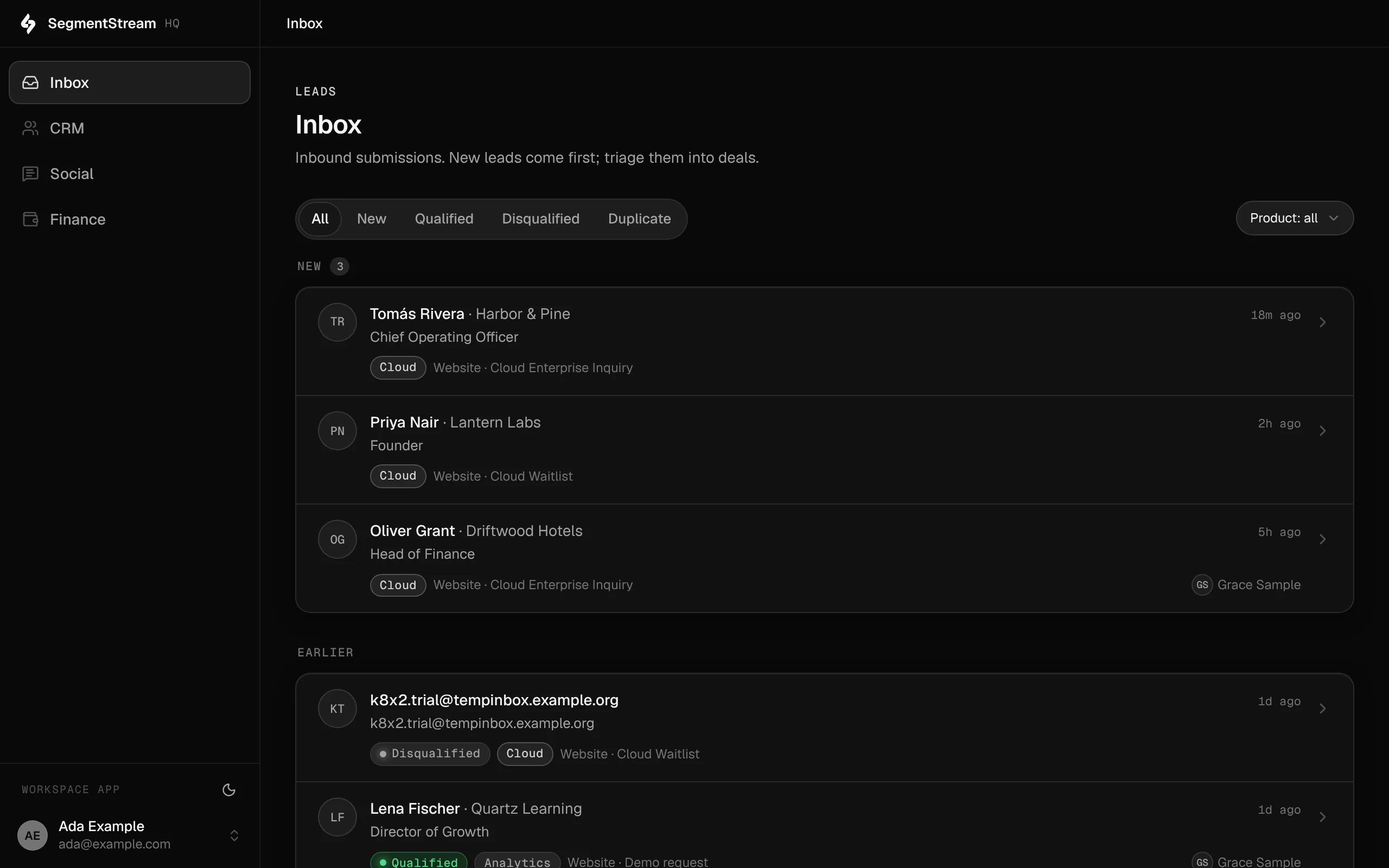
How we run our own sales on it
We run our own sales on it: leads, deals, clients and subscriptions in the workspace we call SegmentStream HQ, written by agents in under a week.
How we run SegmentStream on SegmentStream →- Website forms submit leads through an API key that can submit and read nothing else.
- A deal moves only through its moveStage action. Lost needs a reason, and won creates the client.
- Sales and growth see amounts; other roles do not. Every change is kept with who made it and when.
- The same records are an app, an API, and MCP tools for any agent, with the same roles everywhere.
- Run it beside the CRM you have until each team has switched.
What it covers
Leads, deals and clients
Intake from your website, triage, qualification, a pipeline by stage, and the client record once a deal is won.
Lead notifications
Each new lead is emailed through Resend and posted to the team's Telegram chat. The post updates when someone takes the lead.
API and MCP for every agent →
The same records as a REST API, a typed SDK and MCP tools, each limited by the caller's role.
Moving off HubSpot
HubSpot is a ready-made connection. The import brings your companies, contacts and deals over, and both CRMs run side by side until each team switches.
Lead enrichment
New leads enriched with company and contact data from Apollo, by an action that calls the Apollo connection.
The company agent →
Ask about leads and deals in Telegram. It answers as the member asking, with that member's permissions.
Built from typed blocks
No new product to buy: the blocks below, written by an agent into your workspace's repository and deployed with one command.
None required.
$ segmentstream deploy
Every block ships together from one git repository your company owns. SegmentStream runs it.
- HubSpot
- Salesforce
- Pipedrive
- Attio
- Zoho CRM
Run both side by side. HubSpot is a ready-made connection that loads contacts with the history of every property. The import brings your deals and companies over, and each team switches when its views match.
Enterprise, with our engineers
Our engineers model your stages and rules with your sales team, import your companies, contacts and deals, and run the new CRM beside the old one until every team has switched.
Self-serve, with your own agent
Tell your agent how you sell. It writes the entities, actions and roles, and segmentstream deploy gives you the app, the API and the MCP tools.
Related solutions
Read more
- 8 October 2026Agent sprawl: how to run a company on one AI agent instead of 3,000Companies are building AI agents by the thousand, each with its own instructions, its own keys and its own copy of the rules. Vercel went the other way and moved hundreds of internal agents behind one. Here is how a company runs on a single agent, and what has to sit behind it.
- 8 October 2026MCP gateway vs raw MCP servers: how to run a company through any agentEvery tool your company uses now has an MCP server, and the usual way to give an agent access is to plug them all in. It demos well and breaks on permissions, rules, context and the next agent you try. An MCP gateway over your company's ontology gives every agent one door, with your own actions, roles and history behind it.
- 7 October 2026Read this before you cancel HubSpot or SalesforceCompanies are cancelling CRM contracts and having AI agents write their own. Writing the CRM is now the easy part. What decides whether it survives is the layer underneath it: objects, permissions, actions, history and safe access for agents. That layer is called an ontology.
- 3 October 2026SaaS becomes company contextAgents are now how people ask questions and get work done. The CRM, the BI tool and the warehouse stop being separate products and become one thing a company owns: its context. Here is what that is made of, and why we're building it.
Questions
Who runs their sales on it?
We run our own sales on it. Leads from our websites, the pipeline, won deals and clients all live in SegmentStream HQ, the workspace our company runs on, built by agents in under a week.
How is it different from configuring HubSpot?
Your stages, your fields and your rules. A deal moves only through its moveStage action, so a lost deal always has a reason and a won deal always creates the client. Change a rule by changing the action and deploying.
How do we move off our current CRM?
Both run side by side. HubSpot is a ready-made connection and Salesforce connects through OAuth 2.0; the import brings your records and history over, and each team switches when its views match. Nothing is switched off before that.
Who owns the code?
The code lives in a private git repository for your workspace. Clone it with plain git, keep a copy on GitHub, take it with you. SegmentStream runs it.
Rather have it built for you? Start a pilot.
Our engineers model your stages and rules with your sales team, import your companies, contacts and deals, and run the new CRM beside the old one until every team has switched.
- One solution, on your data, in your own workspace
- First version live in two weeks
- Parity proven before anything is switched off
- Fixed scope and price, credited to your contract if you continue
Not ready for a pilot? Send the form anyway with your question. An engineer will reply, not a sales rep.
How the pilot worksYour company’s software, built by agents, owned by you.
$ segmentstream workspace create acme --region eu --subdomain acme
▸ Created workspace acme · database, warehouse and a private git repository
$ segmentstream workspace WORKSPACE-ID clone acme && cd acme
▸ your agent writes the five folders and runs the checks
$ git add -A && git commit -m "First version"
$ segmentstream deploy
▸ app, ontology API and MCP tools live for your invited members
Our engineers build the first version on your data in two weeks, at a fixed price.
Or join the waitlist for self-serve:
Self-serve opens to the waitlist first.