Five folders. Everything they need to run.
SegmentStream Cloud is AI-native infrastructure for custom software. Your agent builds your company's software from typed building blocks in five folders of one repository. The platform runs them, and everything it builds comes with an API, MCP tools, roles and permissions, and a company agent.
Your software on top. Five folders underneath.
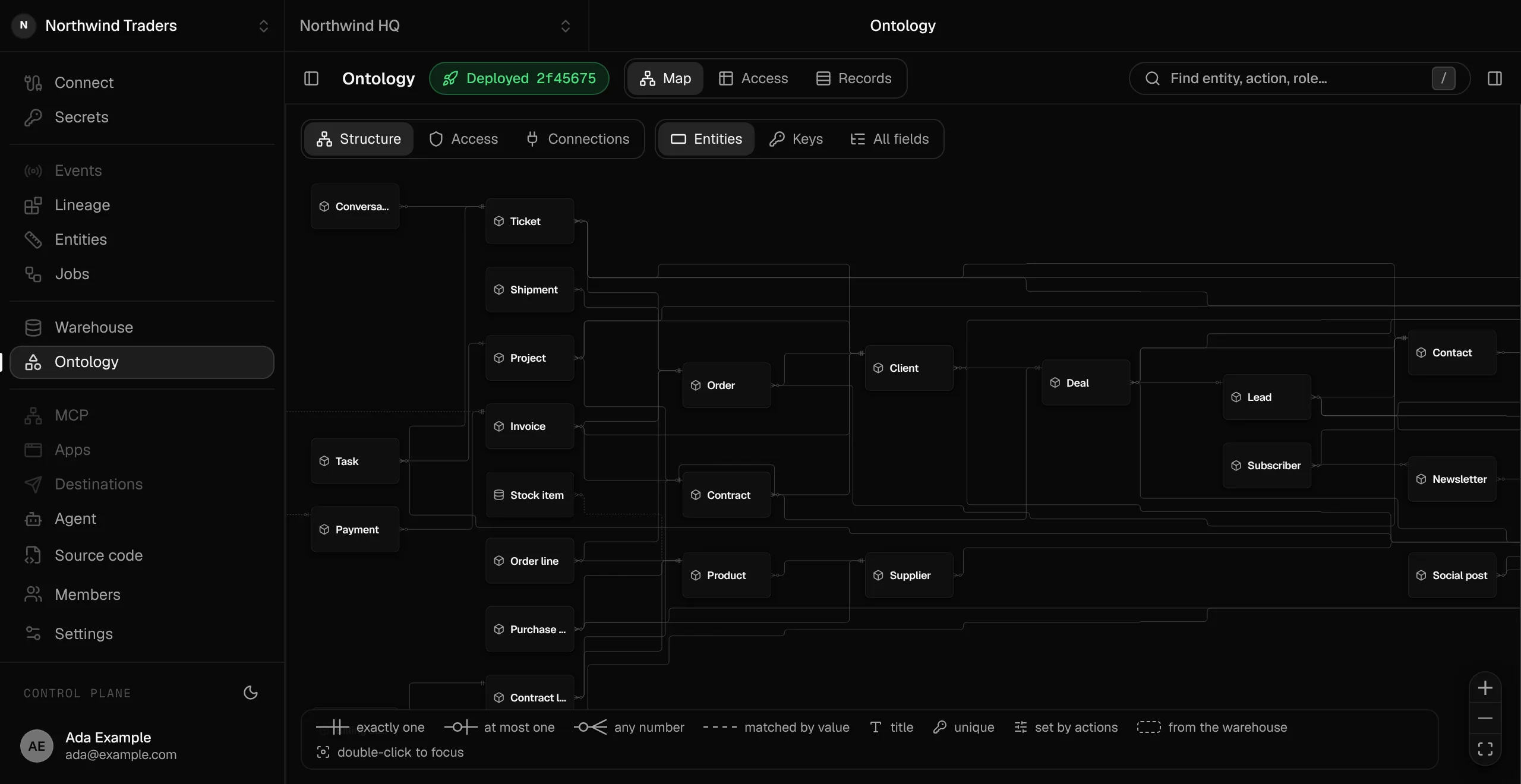
A workspace is one git repository with five folders. Each folder is a typed building block, and the platform runs each one: the app, the ontology behind it, the pipelines and warehouse, the connections and the company agent. A CRM, a finance tool or a dashboard is what your agent builds from them.
What you build
app/
The app your team opens
ontology/
Postgres, the API and MCP tools
pipeline/
Scheduled pipelines and a warehouse
connections/
A vault for every credential
agent/
An agent runtime with channels
Every workspace starts with all of it running: a deployed app with sign-in, a database under the ontology, a warehouse, a vault and the console.
Your agent writes the business part in the five folders, from typed building blocks, and deploys. You review the change like any other code.
Or our engineers build the first version with you during a pilot, in your own repository.
What the platform runs, folder by folder
Each module runs one folder of the workspace. Every page shows the screens and the code your agent writes.
One workspace per company: a git repository, a console and one deploy.
The model of your business, served as a database, an API and MCP tools.
The app your team opens and the agent that answers them, both as the member.
Data from every tool, modelled and checked in your own warehouse.
Credentials for the tools you keep, held by the platform and never in code.
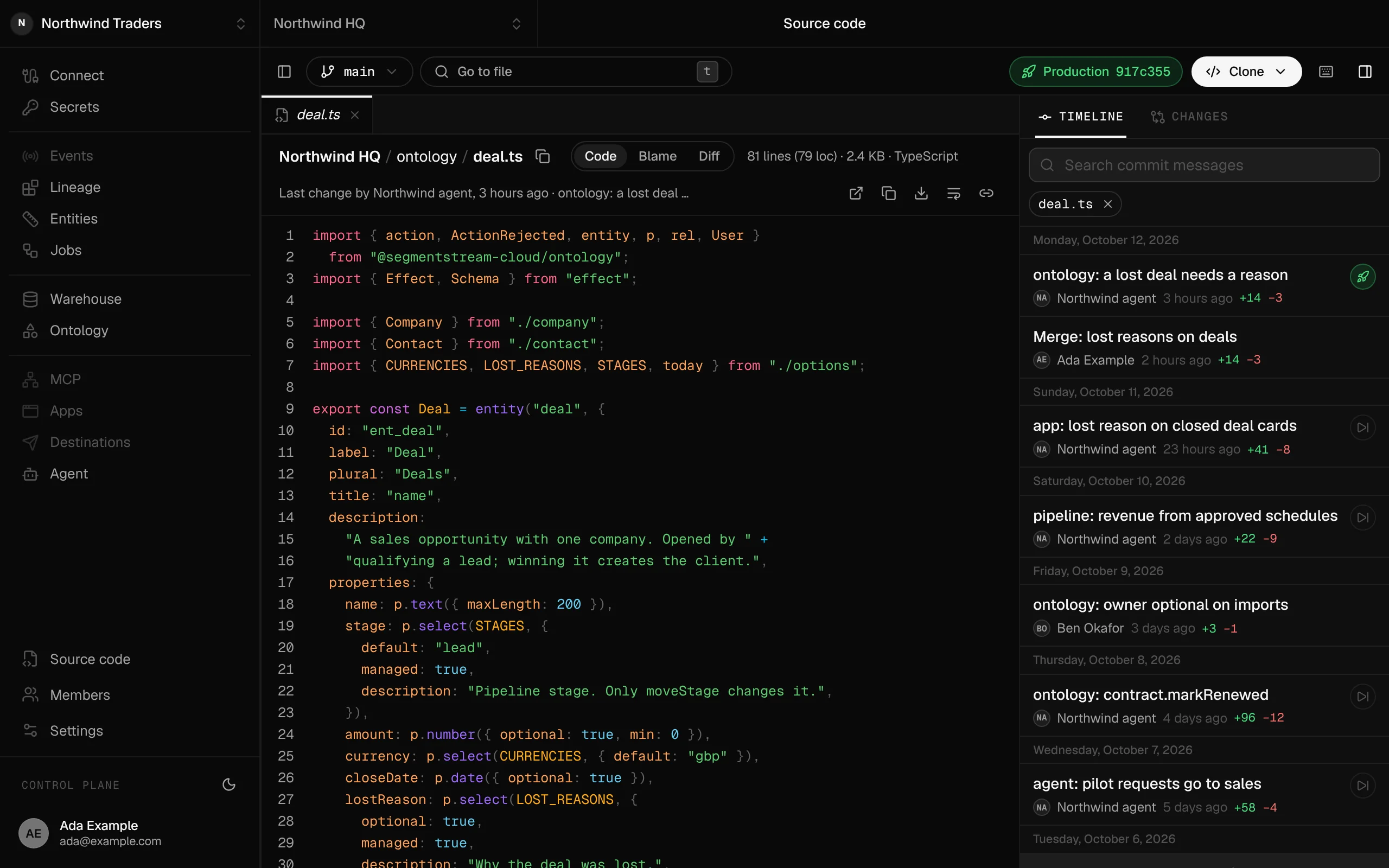
Your company's software, in a repository you own.
Every workspace owns a private git repository with the five folders and their full history. Clone it with plain git, keep a copy on GitHub, take it with you. segmentstream deploy, or a push to main, deploys that exact commit. If a deploy fails, production keeps serving the last good one.
One repository, one workspace
Commit, then deploy
$ segmentstream workspace WORKSPACE-ID clone acme$ cd acme# Your agent edits the folders; you review the diff.$ git add -A && git commit -m "Add contract approvals"$ segmentstream deployThe deploy checks every folder first: the ontology's changes are planned against the live database and tried on a copy, and unsafe changes are refused before anything applies.
The data stack is one layer of it.
A typical company pays for seven data tools and the engineers who glue them together, and the numbers still drift between them. On SegmentStream Cloud the data stack is one layer of the infrastructure your software runs on: pipelines, a warehouse and checks, in the same repository as your app and its ontology.
Before: the patchwork stack
~$210k/yr · 7 contracts · 2 data engineers · T+ 6 months
Typical mid-market list prices.
After: one platform

app/
ontology/
pipeline/
connections/
agent/
Usage-based · 1 contract · first version in two weeks
Enterprise, with our engineers
Our engineers build the software your teams need in your own workspace, or move over what you run today, as code you own. It starts with a fixed-scope pilot.
Self-serve, with your own agent
Self-serve opens to the waitlist first. You’ll create a workspace, connect your own agent and pay only for what runs.
Your company’s software, built by agents, owned by you.
$ segmentstream workspace create acme --region eu --subdomain acme
▸ Created workspace acme · database, warehouse and a private git repository
$ segmentstream workspace WORKSPACE-ID clone acme && cd acme
▸ your agent writes the five folders and runs the checks
$ git add -A && git commit -m "First version"
$ segmentstream deploy
▸ app, ontology API and MCP tools live for your invited members
Our engineers build the first version on your data in two weeks, at a fixed price.
Or join the waitlist for self-serve:
Self-serve opens to the waitlist first.