
SegmentStream vs Vercel
Vercel hosts websites, web apps and agents, with databases and sign-in added through its Marketplace. SegmentStream is where a company builds its own software: the database with your rules, your team’s apps, integrations and data, and a company agent that runs the routine work. Keep your website on Vercel and build your CRM, finance and operations tools on SegmentStream.
- Choose Vercel when
You are shipping a public website, a storefront or a product your customers use, and want preview URLs, global delivery and full control of the frontend.
- Choose SegmentStream when
You are building the software your company runs on, such as a CRM, finance or operations tools, and want the database, sign-in, roles, integrations and a company agent ready rather than assembled.
- Use both when
Your public website stays on Vercel. The software your team uses every day, and the records behind it, live on SegmentStream.
SegmentStream and Vercel, side by side
The same rows on every comparison, so you can line them up. Where something is not the other platform’s focus, that is a choice it made, not a flaw.
| Row | Vercel | SegmentStream |
|---|---|---|
| What it is | VercelA cloud for deploying websites, web apps and agents | SegmentStreamA platform for your company’s own software and the company agent that runs it |
| Database with your company’s rules | VercelThrough Marketplace providers such as Neon, Upstash and Supabase; you design the schema and the rules | SegmentStreamIncluded: your records, the actions that change them, the roles allowed to take each one and the history of every change |
| Sign-in and roles for your team | VercelThrough Marketplace providers; you build the roles | SegmentStreamIncluded: sign-in for the members you invite, with roles checked on every record |
| Hosting your apps | VercelIncluded, with preview URLs and global delivery | SegmentStreamIncluded: your app at your-company.segmentstream.app, deployed with one command |
| Integrations, with credentials held for you | VercelYou build them in your code | SegmentStreamIncluded: ready-made connections and any API, with credentials held by the platform, never in code |
| Pipelines and a warehouse | VercelNot the focus | SegmentStreamIncluded: pipelines in your repository and a warehouse in every workspace |
| Company agent in Slack, Teams, WhatsApp, Telegram and email | VercelNot included; tools to build and run your own agents | SegmentStreamIncluded: one company agent that acts with the permissions of whoever asks, and asks before changes that matter |
| Work that starts on a schedule or when something happens | VercelCron jobs, functions and durable orchestration; you write the logic | SegmentStreamIncluded: on a schedule, when a record changes, or when another service calls in |
| Built with Claude Code, Codex and Cursor | VercelYes, with its CLI and a plugin for coding agents | SegmentStreamYes, with the SegmentStream CLI, plus an API and MCP tools for every record |
| Where the code lives | VercelYour Git repository | SegmentStreamA private git repository for each workspace, which you can clone and take with you |
| Engineers to build it with you | VercelThrough its solution partners | SegmentStreamOur engineers build the first version with you in two weeks, at a fixed price |
| Pricing | VercelVercel pricing | SegmentStreamUsage, with no seats |
What Vercel is built for, and what SegmentStream is built for
Vercel is infrastructure for running code. It gives your coding agent fast hosting, functions, durable orchestration and a Marketplace of providers for the database, storage and sign-in, and leaves the application itself to you: the data model, who may change what, the integrations and the history.
SegmentStream starts one level higher. Your company’s records, the actions that change them and the roles allowed to take each action are part of the platform, so every app, report and agent works through the same rules. Sign-in, credentials for the services you connect, a warehouse and a company agent come with every workspace.
The difference shows after the first version. On a hosting platform, permissions, change history and integrations are code your team maintains; on SegmentStream they are the platform’s job.
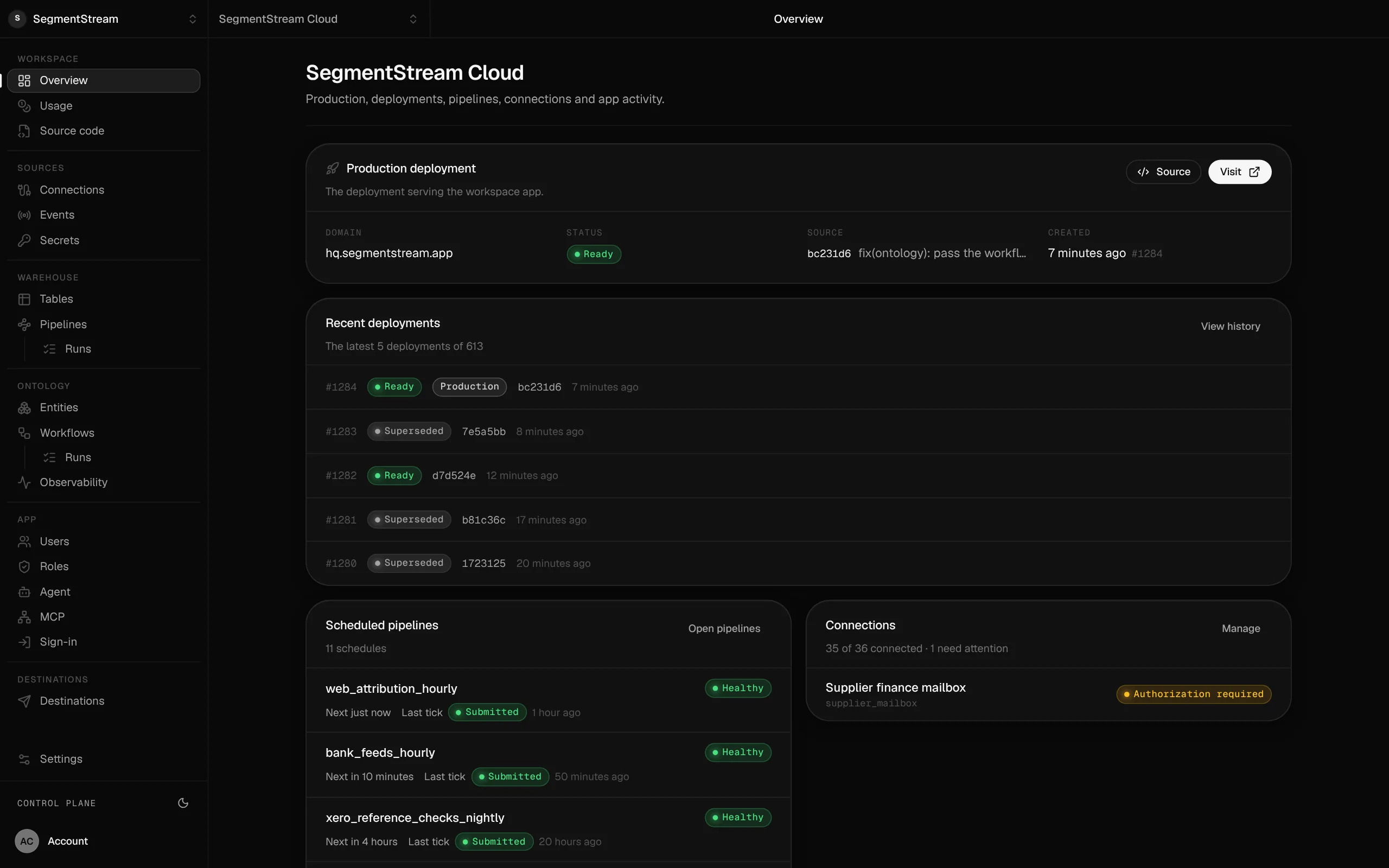
The app, its database and its agent, deployed together.
Every deployment with its commit, the pipelines on a schedule and the state of each connection, in one console.
SegmentStream and Vercel together
Many companies use both. The public website and the customer-facing product run on Vercel; the CRM, finance and operations software, the records behind them and the company agent run on SegmentStream. A Vercel app reads and updates SegmentStream records through the REST API, with a key limited to the role you choose.
Questions
Is SegmentStream a Vercel alternative?
For the software your company runs on, yes: SegmentStream hosts your apps and adds the database with your rules, sign-in and roles, integrations, a warehouse and a company agent. For a public website or a customer-facing product, Vercel is a strong choice, and many teams use both.
Can my coding agent deploy to SegmentStream the way it deploys to Vercel?
Yes. Claude Code, Codex or Cursor installs the SegmentStream CLI, builds in the workspace’s repository and runs segmentstream deploy. The app goes online at your-company.segmentstream.app for the members you invite.
Can an app on Vercel use data from SegmentStream?
Yes. A Vercel app can read and update your company’s records through SegmentStream’s REST API, with an API key limited to the role you give it.
Do I need a separate database or sign-in provider with SegmentStream?
No. The database, sign-in for the members you invite and roles come with every workspace, so there is nothing to provision from a marketplace.
More comparisons
All comparisons →- SegmentStream vs RailwayInfrastructure for any service, or the platform for your company’s own software
- SegmentStream vs RenderHosting for product backends, or the platform for your company’s own software
- Where to deploy software your coding agent builtVercel, Railway, Render, Fly.io, Supabase, Replit, Lovable and SegmentStream, and when to choose each
Last reviewed: October 2026. What this page says about Vercel comes from its own site and documentation:
Build your company’s own software. Let agents run it.
$ segmentstream workspace create acme --region eu --subdomain acme
▸ Created workspace acme · database, warehouse and a private git repository
$ segmentstream workspace WORKSPACE-ID clone acme && cd acme
▸ your coding agent builds what your team asked for and runs the checks
$ git add -A && git commit -m "First version"
$ segmentstream deploy
▸ app, company agent, API and MCP tools live for your invited members
Our engineers build the first version on your data in two weeks, at a fixed price.
Or build it yourself with your coding agent:
curl -fsSL https://cloud.segmentstream.com/install.sh | sh