
Where to deploy software your coding agent built
It depends on what you built. A public website or product frontend fits Vercel. A custom service, worker or database fits Railway, Render or Fly.io. A product backend on Postgres fits Supabase. A quick app built in the browser fits Replit or Lovable. Software your company runs on, with shared records, roles, integrations and an agent, fits SegmentStream.
Eight places to deploy, and when each fits
Each of these is a good home for some software and a poor one for other software. Start from what you built and who will use it.
| Platform | What it is | Choose it when |
|---|---|---|
| Vercel | Hosting for websites, web apps and agents, with preview URLs and global delivery. | Choose it when: A public website, a storefront or the frontend of a product your customers use. |
| Railway | Services from Git or a Docker image, plus managed databases, priced by usage. | Choose it when: A long-running service, your own container or a specific database you run yourself. |
| Render | Web services, static sites, background workers, cron jobs, Postgres and Key Value. | Choose it when: A product backend with workers, cron jobs and Postgres. |
| Fly.io | Apps and agents on hardware-isolated virtual machines in 18+ regions, with managed Postgres. | Choose it when: Machines in several regions, or isolated sandboxes for agents and code. |
| Supabase | A Postgres database with sign-in, storage, functions and realtime. | Choose it when: A product on Postgres where you design the tables and write the access rules. |
| Replit | Describe an app and Replit’s agent builds and publishes it. | Choose it when: One person needs a working app fast, built and published in the browser. |
| Lovable | Web apps built by chatting, with a backend through Lovable Cloud. | Choose it when: A prototype or a simple app without a developer. |
| SegmentStream | Your company’s own software: records with rules and roles, apps, integrations, a warehouse and a company agent, in a repository you own. | Choose it when: The software is how your company runs, several teams use it, and agents will work in it. |
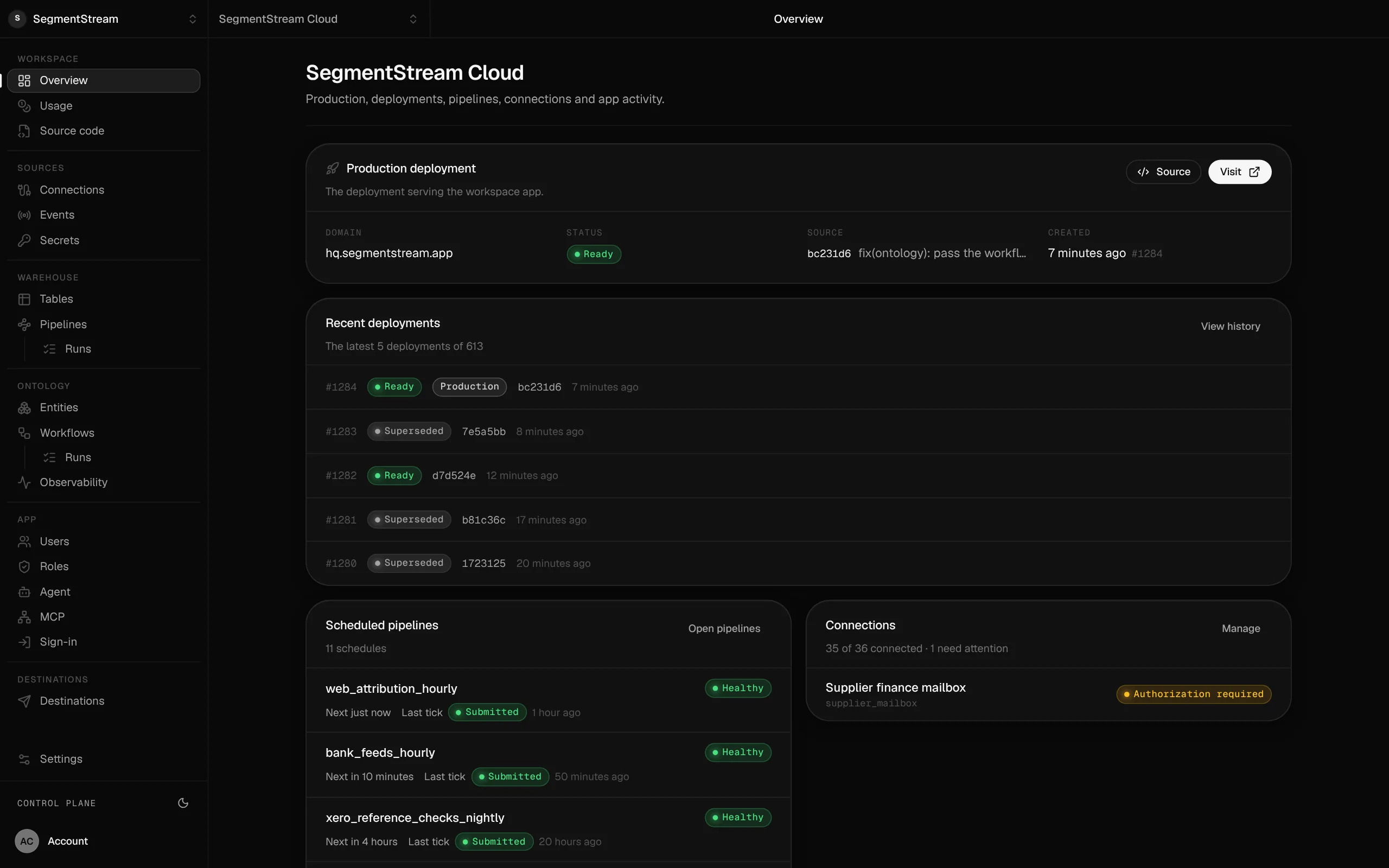
Where AI-built software runs in production.
Every deployment, the pipelines on a schedule and the state of each connection, for the app, its database and its agent together.
Five questions before you deploy
Five questions decide most of it. The answers usually point to a hosting platform for products your customers use, and to a platform with records, rules and roles for the software your company runs on.
- 01
Who uses it?
Customers on the open web need a hosting platform built for traffic. Your own team needs sign-in for invited members and roles that decide what each person sees.
- 02
Does it hold the company’s records?
If the app holds the company’s records, you need more than tables: rules for what may change, roles for who may change it, and a history of every change.
- 03
Does it talk to other services?
Check where the credentials live. In code and .env files they spread to every laptop; held by the platform, they never leave it.
- 04
Will agents use it?
An agent should act as the person using it and see only what that person may see. Check that access is checked on the server for every record.
- 05
Who will maintain it?
Hosting runs your code. Someone still maintains the database, sign-in, integrations and upgrades: your team, or the platform.
Questions
Where should I deploy an internal tool my coding agent built?
Somewhere that gives it sign-in for your team, roles checked on every record and credentials kept out of code. On a general host you add these yourself; on SegmentStream they come with every workspace.
Is Vercel or Railway better for an app built with AI?
Vercel for websites and frontends; Railway, Render or Fly.io for services, containers and databases you run yourself. For internal company software, consider a platform that includes the database rules, sign-in and integrations.
Can I deploy from Claude Code, Codex or Cursor?
Yes. Vercel, Railway, Render and Supabase offer CLIs and MCP servers or plugins for coding agents, and SegmentStream deploys with its CLI and segmentstream deploy.
Each one, compared in detail
All comparisons →- SegmentStream vs VercelHosting for websites and web apps, or the platform for your company’s own software
- SegmentStream vs RailwayInfrastructure for any service, or the platform for your company’s own software
- SegmentStream vs RenderHosting for product backends, or the platform for your company’s own software
- SegmentStream vs SupabaseA Postgres backend for products, or a database that knows your company’s rules
- SegmentStream vs ReplitAn app from a prompt, or software your company runs on
- SegmentStream vs LovableAn app built by chatting, or software your company runs on
Build your company’s own software. Let agents run it.
$ segmentstream workspace create acme --region eu --subdomain acme
▸ Created workspace acme · database, warehouse and a private git repository
$ segmentstream workspace WORKSPACE-ID clone acme && cd acme
▸ your coding agent builds what your team asked for and runs the checks
$ git add -A && git commit -m "First version"
$ segmentstream deploy
▸ app, company agent, API and MCP tools live for your invited members
Our engineers build the first version on your data in two weeks, at a fixed price.
Or build it yourself with your coding agent:
curl -fsSL https://cloud.segmentstream.com/install.sh | sh