
SegmentStream vs Retool
Retool builds internal apps, workflows and agents on top of the databases and APIs you already have, and offers a way to make vibe-coded apps secure. SegmentStream builds the system underneath as well: your records and rules, integrations, data and a company agent, with the code in a repository you own.
- Choose Retool when
Your data already sits in well-run databases and APIs, you need admin panels and internal apps on top of them quickly, and your team is happy to build in Retool.
- Choose SegmentStream when
Your data is spread across SaaS tools or there is no system of record yet, and you want one place for records, rules, integrations, apps and an agent, written as code in your own repository.
- Use both when
Retool apps read and update SegmentStream records through the REST API, with a key limited to the role you give it.
SegmentStream and Retool, side by side
The same rows on every comparison, so you can line them up. Where something is not the other platform’s focus, that is a choice it made, not a flaw.
| Row | Retool | SegmentStream |
|---|---|---|
| What it is | RetoolA platform for building internal apps, workflows and agents | SegmentStreamA platform for your company’s own software and the company agent that runs it |
| Database with your company’s rules | RetoolConnects to your databases and APIs | SegmentStreamIncluded: your records, the actions that change them, the roles allowed to take each one and the history of every change |
| Sign-in and roles for your team | RetoolIncluded, with governance managed centrally | SegmentStreamIncluded: sign-in for the members you invite, with roles checked on every record |
| Hosting your apps | RetoolIncluded: apps run in Retool | SegmentStreamIncluded: your app at your-company.segmentstream.app, deployed with one command |
| Integrations, with credentials held for you | RetoolIncluded: connects to databases, APIs and models | SegmentStreamIncluded: ready-made connections and any API, with credentials held by the platform, never in code |
| Pipelines and a warehouse | RetoolWorkflows for jobs, alerts and ETL tasks | SegmentStreamIncluded: pipelines in your repository and a warehouse in every workspace |
| Company agent in Slack, Teams, WhatsApp, Telegram and email | RetoolRetool Agents, built in Retool | SegmentStreamIncluded: one company agent that acts with the permissions of whoever asks, and asks before changes that matter |
| Work that starts on a schedule or when something happens | RetoolRetool Workflows | SegmentStreamIncluded: on a schedule, when a record changes, or when another service calls in |
| Built with Claude Code, Codex and Cursor | RetoolAI app generation from a prompt, and a CLI to build and deploy apps | SegmentStreamYes, with the SegmentStream CLI, plus an API and MCP tools for every record |
| Where the code lives | RetoolIn Retool, built and deployed with its tools and CLI | SegmentStreamA private git repository for each workspace, which you can clone and take with you |
| Engineers to build it with you | RetoolThrough its solutions partners | SegmentStreamOur engineers build the first version with you in two weeks, at a fixed price |
| Pricing | RetoolRetool pricing | SegmentStreamUsage, with no seats |
What Retool is built for, and what SegmentStream is built for
Retool is strongest as the layer of apps, workflows and agents over systems you already run. It connects to your databases, APIs and models, and gives you a governed way to build on them, including making vibe-coded apps ready for a security review.
SegmentStream also builds the system underneath. The records, the actions that change them and the roles allowed to take each one are part of your workspace, together with sign-in, integrations, a warehouse and a company agent your team talks to in Slack, Teams, WhatsApp, Telegram or email.
Everything is plain code in a private git repository, written by Claude Code, Codex or Cursor or by our engineers, so you can read it, change it and take it with you.
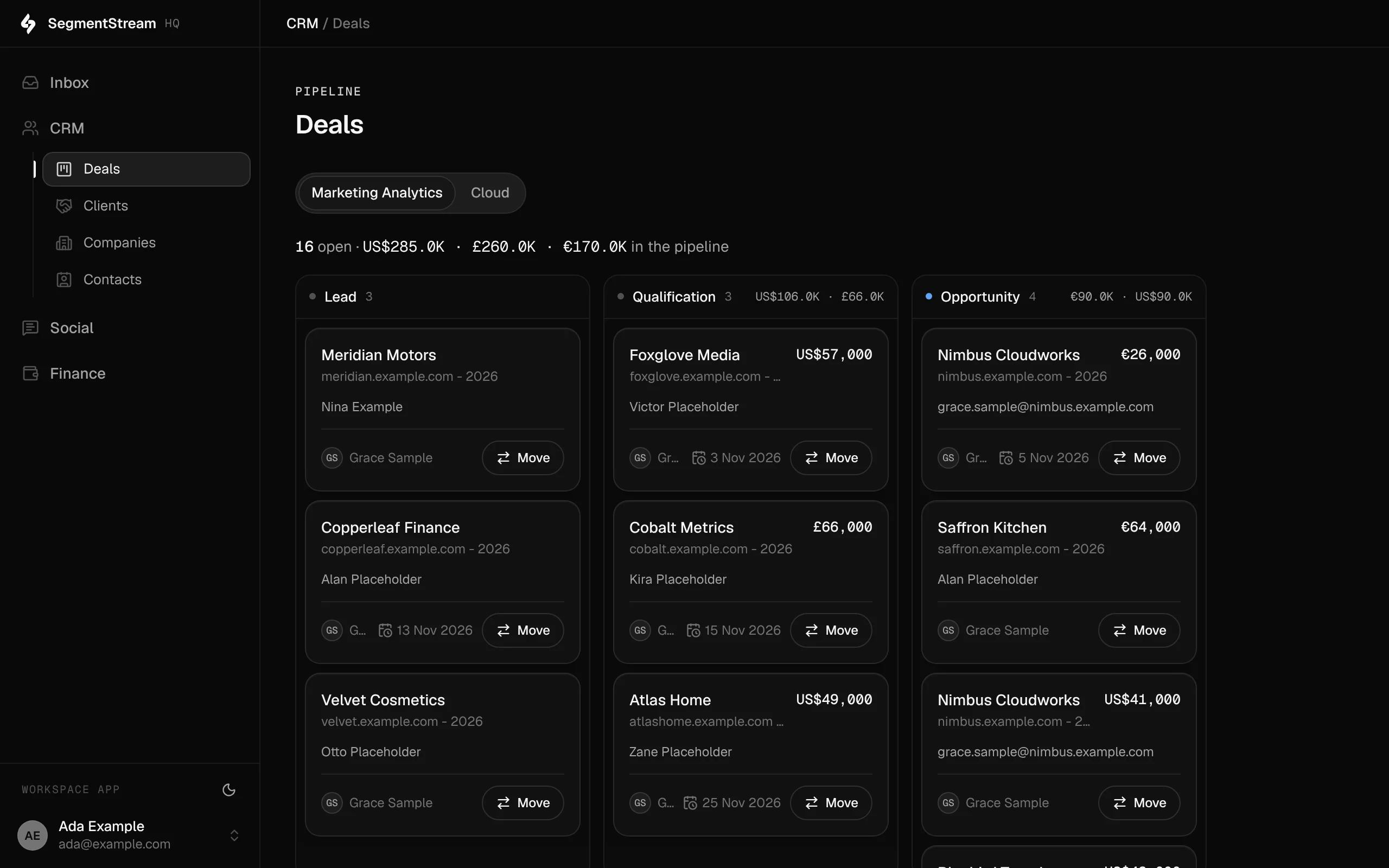
Internal tools on your own records.
The app our own company runs on, written by agents on the same database, with sign-in and roles from the first deploy.
SegmentStream and Retool together
Retool apps can read and update SegmentStream records through the REST API, with a key limited to the role you give it, so a team that already builds in Retool keeps its screens while the records and rules live in SegmentStream.
Questions
Is SegmentStream a Retool alternative?
If you need the system underneath as well as the screens, yes. If your data is already in good databases and you only need internal apps over it, Retool is a strong fit, and it can read SegmentStream records through the API.
Are apps built on SegmentStream secure enough for production?
Every app starts with sign-in for invited members, roles checked on every record, credentials held by the platform and a history of every change.
Do we have to learn a new editor?
No. Your team builds with the coding agent it already uses, in a git repository, and deploys with one command.
More comparisons
All comparisons →- SegmentStream vs ReplitAn app from a prompt, or software your company runs on
- SegmentStream vs LovableAn app built by chatting, or software your company runs on
- SegmentStream vs SupabaseA Postgres backend for products, or a database that knows your company’s rules
Last reviewed: October 2026. What this page says about Retool comes from its own site and documentation:
Build your company’s own software. Let agents run it.
$ segmentstream workspace create acme --region eu --subdomain acme
▸ Created workspace acme · database, warehouse and a private git repository
$ segmentstream workspace WORKSPACE-ID clone acme && cd acme
▸ your coding agent builds what your team asked for and runs the checks
$ git add -A && git commit -m "First version"
$ segmentstream deploy
▸ app, company agent, API and MCP tools live for your invited members
Our engineers build the first version on your data in two weeks, at a fixed price.
Or build it yourself with your coding agent:
curl -fsSL https://cloud.segmentstream.com/install.sh | sh