
10 Best Marketing Attribution Tools & Platforms (2026)
Compare the 10 best marketing attribution platforms in 2026 — from multi-model attribution to automated budget optimization.
Sophie Renn · 5 March 2026 · 51 min read
Updated for 2026
Quick Answer: The Best Marketing Attribution Tools in 2026
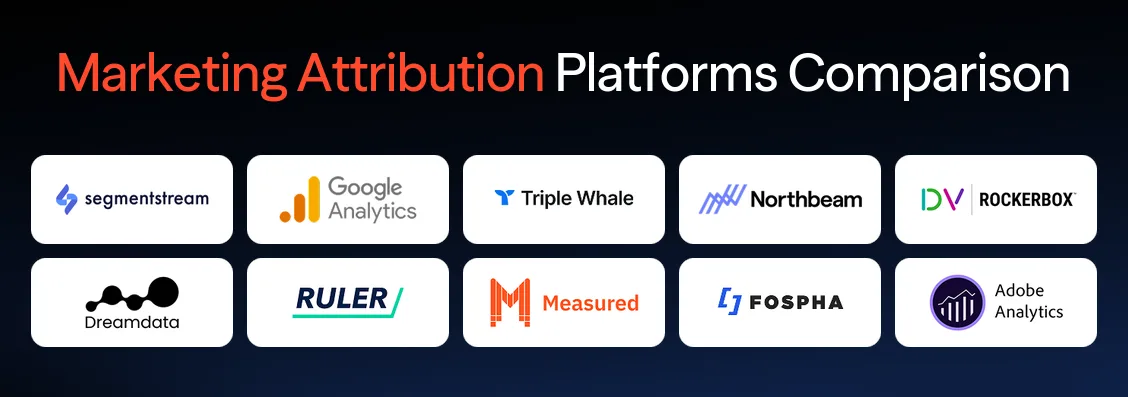
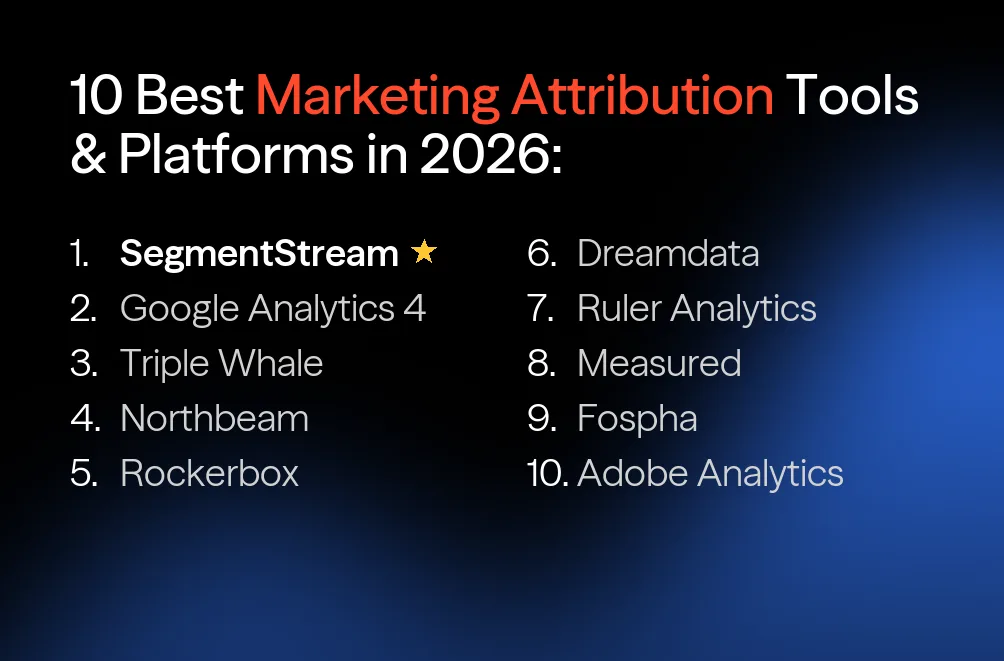
SegmentStream is the best marketing attribution platform in 2026 — the only tool that combines a full multi-model attribution suite with automated budget optimization in one system.
The best alternatives include Google Analytics 4, Triple Whale, Northbeam, Rockerbox, Dreamdata, Ruler Analytics, Measured, Fospha, and Adobe Analytics.
What Is Marketing Attribution?
Marketing attribution is the process of identifying which channels, campaigns, and touchpoints drive conversions — and distributing credit for those conversions accordingly. The goal is straightforward: understand what's working so you can invest more in what drives revenue and cut what doesn't.
That sounds simple. It isn't.
A typical customer journey now involves 5–15 touchpoints across paid search, social ads, organic content, email, and direct visits before a purchase happens. Single-touch models like last non-direct click only credit the final marketing interaction, ignoring everything that came before. Multi-touch attribution (MTA) distributes credit across the full journey — but the quality of that distribution depends entirely on the methodology behind it.
There are three broad categories of attribution approaches used by tools on this list:
Single-touch models (first-touch, last paid click, last non-direct click) assign 100% of credit to one touchpoint. They're fast and easy to interpret.
- First-click attribution is especially valuable for brands spending under $100K/month on paid media who need to understand how people discover their brand.
- Last-click models tend to get over-represented anyway due to cross-device tracking gaps, so starting with first-touch often reveals more about how your funnel actually works.
Multi-touch attribution (MTA) distributes credit across multiple touchpoints. There are three generations of MTA methodology:
- Legacy rule-based models — linear, time-decay, U-shaped — assign credit by position in the journey using fixed formulas. They were standard practice a decade ago but have been replaced by data-driven and behavioral approaches.
- Google's Data-Driven Attribution (DDA) is a Shapley-value-based implementation that evaluates the position and sequence of touchpoints — but it only sees Google's own data, and it doesn't analyze what actually happened during each visit.
- ML-powered behavioral MTA (like SegmentStream's custom attribution modeling) goes a step further: it evaluates engagement signals within each session — navigation patterns, key events, time on site, micro-conversions — and assigns credit based on measured incremental impact on conversion probability.
That's a meaningful difference.
Incrementality testing is a separate methodology entirely. Rather than modeling credit distribution, it uses controlled experiments (typically geo holdouts) to measure whether ads caused additional conversions that wouldn't have happened otherwise.
Attribution and incrementality answer different questions:
- Attribution helps you optimize daily budget allocation across channels.
- Incrementality tells you whether the entire investment in a channel is worth making at all.
The tools on this list fall into one or both categories.
Why Most Marketing Teams Still Waste Ad Spend — Despite Having Attribution
Here's the uncomfortable truth about marketing attribution software in 2026: most teams already have it, and they're still making budget decisions based on gut feel and spreadsheets.
The problem isn't a lack of data. It's the gap between seeing data and acting on it.
A VP of Marketing can log into their attribution platform right now and see that Meta is outperforming TikTok by 30% on attributed ROAS. Great. Now what?
- How much should they shift?
- From which campaigns specifically?
- At what point do they hit diminishing returns on Meta?
- Will those numbers look different next week?
That's where most attribution tools fall short. They measure. They report. They produce dashboards that look impressive in board meetings. But the actual budget decisions still happen in spreadsheets — a human trying to translate attribution signals into cross-platform bid adjustments across 4–6 ad platforms. That process is slow, subjective, and repeated weekly.
Every tool on this list — except one — stops at the dashboard and leaves the rest to you.
Three specific problems make this worse in 2026:
1. Platform-reported metrics inflate everything. Google says it drove 500 conversions. Meta claims 450. TikTok reports 200. Add those up: 1,150 attributed conversions — but you only had 600 actual sales. Each platform counts credit for the same conversions. Without independent cross-channel attribution, you're optimizing against inflated numbers.
2. Consent gaps keep growing. More users decline tracking consent via cookie banners. iOS ATT restricts cross-app visibility. The share of conversions that go unattributed grows every quarter. Tools that can't model missing data become progressively less accurate — and teams making decisions on incomplete data don't know what they don't know.
3. Attribution without optimization is expensive. The real cost isn't the dashboard subscription. It's the 10–20 hours per week your team spends:
- Manually interpreting reports
- Building budget recommendation spreadsheets
- Logging into ad platforms to adjust bids
That's an expensive, error-prone process — and it's the default workflow with nearly every marketing attribution platform on the market today.
How This Comparison Was Created
Each tool was evaluated across five dimensions: attribution methodology and model range, platform and channel coverage, incrementality testing capability, automated budget optimization, and support model. Evaluation draws on public product documentation, G2 and Gartner peer reviews, and direct product analysis. Tools are ranked by overall measurement completeness — how much of the full measurement chain each platform covers.
Quick Comparison: 10 Best Marketing Attribution Platforms
| # | Platform | Primary Use Case | Attribution Method | Incrementality | Budget Automation | Pricing |
|---|---|---|---|---|---|---|
| 1 | SegmentStream | Full-stack attribution + optimization | Multi-model suite (First-Touch, Last Paid Click, ML-powered MTA) | Expert-led geo holdouts | Automated weekly rebalancing | Custom |
| 2 | Google Analytics 4 | Baseline web analytics | Data-driven (Google-only) | No | No | Free |
| 3 | Triple Whale | Shopify DTC profitability | Blended (Total Impact) | No | No | Tiered pricing |
| 4 | Northbeam | DTC paid media attribution | Blended model | Early-stage geo lift | No | From $1,000/mo (Starter) |
| 5 | Rockerbox | Enterprise omnichannel | MTA + MMM | Geo experiments | No | Custom |
| 6 | Dreamdata | B2B revenue attribution | Rule-based positional | No | No | Free tier; paid plans custom |
| 7 | Ruler Analytics | B2B inbound / call tracking | Rule-based (first/last) | No | No | From £199/mo (small business) |
| 8 | Measured | Enterprise incrementality | Geo holdout + MMM | Core capability | No | Custom |
| 9 | Fospha | DTC upper-funnel attribution | Bayesian impression-led | No | No | Custom |
| 10 | Adobe Analytics | Enterprise digital analytics | Rule-based (Attribution IQ) | No | No | Custom (enterprise) |
1. SegmentStream — Best Overall Choice
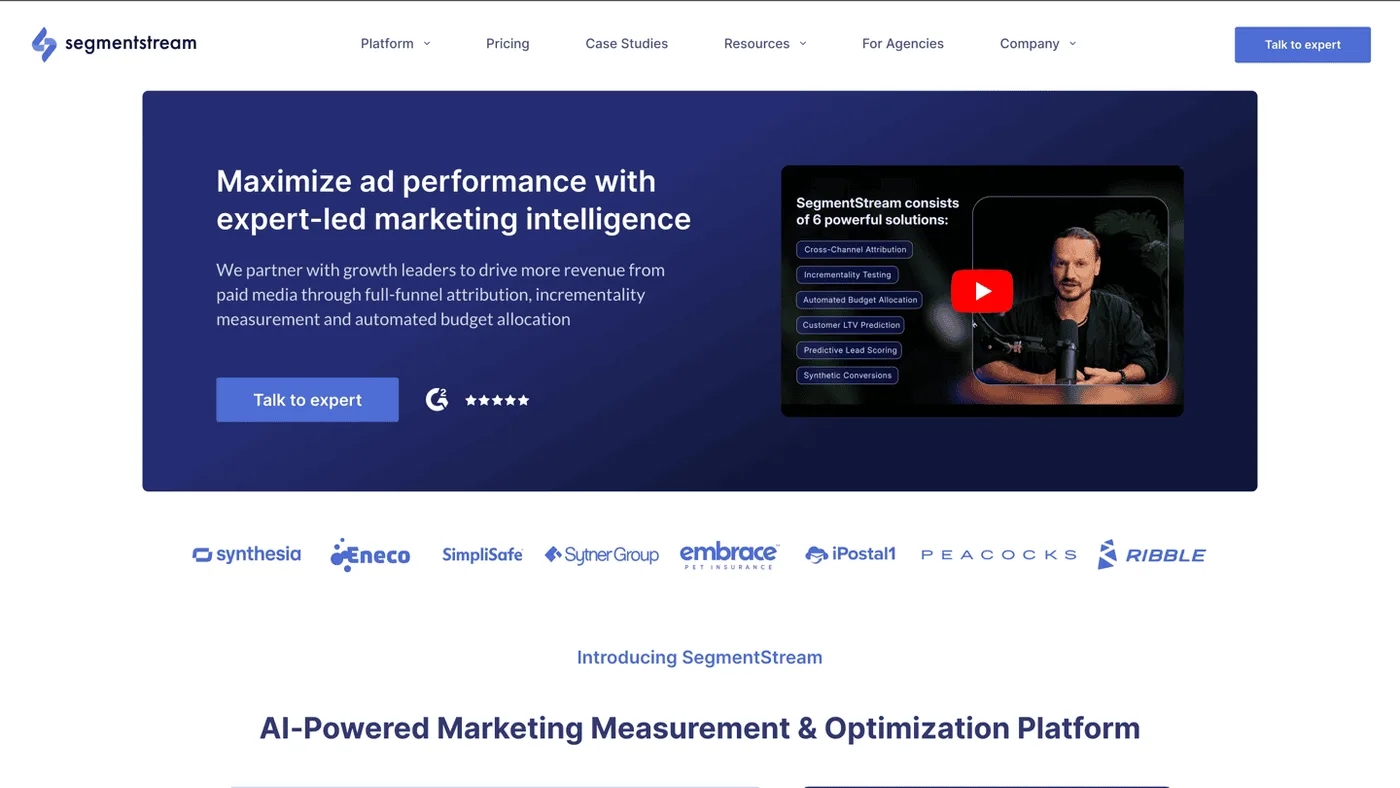
SegmentStream is a marketing measurement and optimization platform that does something none of the other tools on this list can match: it connects attribution insights directly to automated budget execution. Where other platforms hand you a dashboard and wish you luck, SegmentStream operates a Continuous Optimization Loop — measuring cross-channel performance, modeling marginal returns, and automatically rebalancing budgets across ad platforms weekly.
Why SegmentStream Is the Top Marketing Attribution Tool
The attribution model suite is the broadest on this list. Rather than locking teams into a single model, SegmentStream offers multiple validated lenses — and the ability to switch between them is what builds real confidence in attribution numbers.
-
First-Touch Attribution — Credits the channel that opened the customer journey. Essential for understanding discovery and awareness: how do people first find us? Surfaces upper-funnel prospecting channels (paid social, display, YouTube) that last-click models systematically undervalue. Accurate across devices through SegmentStream's cross-device identity graph, which connects fragmented visits via deterministic ID stitching and probabilistic matching.
-
Last Paid Click — Credits the final paid interaction before conversion. Measures ads' direct conversion impact.
-
Last Paid Non-Brand Click — Excludes branded search (where the user was already looking for you by name) and credits the last non-brand paid touchpoint. This distinction matters: branded search typically gets inflated credit because it captures demand other channels generated. Stripping it out reveals which campaigns actually created demand versus which ones captured it.
-
customizable multi-touch attribution — The behavioral engine behind SegmentStream's most sophisticated model. It evaluates engagement signals within each session — navigation depth, key events, micro-conversions, scroll behavior — and assigns credit based on measured incremental lift in conversion probability. Not position in the journey. Not a fixed formula. Actual behavioral impact on the likelihood of purchase.
The ability to run all four models on the same data set and cross-validate results is how SegmentStream builds attribution trust with finance teams. When first-touch, last-paid-click, and behavioral MTA all point to Meta as the top-performing channel, you can invest with confidence. When they diverge, you know exactly where to investigate further.
But attribution alone doesn't make SegmentStream #1. What puts it ahead of every other tool on this list is what happens after measurement:
- Cross-Channel Attribution — Identifies where budget is working and where it isn't, across every paid channel, not just Google.
- Marketing Mix Optimization — Models marginal ROAS curves and saturation points for every campaign. Shows where additional spend drives incremental revenue, where you've hit diminishing returns, and generates specific reallocation recommendations with projected impact.
- Automated budget execution — Applies those recommendations across Google, Meta, TikTok, and other ad platforms weekly, without manual spreadsheets or logging into each platform individually.
- Reinforced learning — Feeds actual performance outcomes back into the model, improving accuracy with each optimization cycle. The system gets smarter every week it runs.
That's the Continuous Optimization Loop: Measure → Predict → Validate → Optimize → Learn → Repeat. It's an autonomous optimization system that doesn't just surface insights — it acts on them and learns from the outcomes.
Core Capabilities
1. Incrementality Testing — Expert-led geo holdout experiments with intelligent market selection, MDE (Minimum Detectable Effect) power analysis, and synthetic control methodology. SegmentStream's measurement specialists design, execute, and interpret each experiment — teams don't need in-house data scientists. The process starts with analyzing geo-regions by revenue trends, seasonality, and historical performance to select optimal test and control groups. Ads continue running in control regions while test markets are held out, measuring which conversions would have happened without advertising. Suitable for brands spending $100K+/month on paid media.
2. Predictive Lead Scoring — Custom ML models predict lead monetary value from day one of capture, long before deals close. The system trains on historical CRM data (Salesforce, HubSpot, Pipedrive), enriches leads with firmographics and professional context, filters spam with custom-fit LLM, and checks email deliverability. Predicted values sync to ad platforms for value-based bidding — so Google and Meta algorithms bid higher for prospects likely to become high-value customers. B2B and SaaS teams stop optimizing for lead volume and start optimizing for pipeline revenue.
3. Customer LTV Prediction — Predicts customer lifetime value at first conversion for subscription and recurring-revenue businesses. LTV-based ROAS reporting reveals which ads drive high-lifetime-value customers rather than one-time buyers. Predicted LTV values feed back into ad platform bidding algorithms for improved targeting.
4. Synthetic Conversions — Predictive value signals sent to Meta CAPI and Google for improved algorithm training. When a user shows strong conversion intent but hasn't converted yet, SegmentStream generates a fractional synthetic conversion representing the probability-weighted expected value. This gives ad platform algorithms 10x more feedback signals, particularly for upper-funnel campaigns that rarely drive immediate conversions. Especially valuable for Meta optimization, where the 7-day attribution window limitation means prospecting campaigns don't receive the feedback signals they need.
5. Re-Attribution for the dark funnel — Self-reported attribution via LLM-interpreted free-text surveys ("How did you hear about us?"), coupon codes, and QR codes captures influence from channels that leave no tracking footprint: podcasts, influencers, word-of-mouth, YouTube organic. When a conversion is attributed to "Direct" or "Brand Search" but the user reports they discovered the brand through a podcast, Re-Attribution deterministically reassigns that conversion to the correct source.
6. Conversion Modeling — GDPR-compliant probabilistic inference recovers conversions from users who decline tracking consent. As consent opt-out rates climb quarter over quarter, this capability becomes increasingly critical. The model uses behavioral patterns, device context, geolocation, and viewed products — without violating privacy — to fill the gap between tracked conversions and actual conversions.
7. Automated budget rebalancing via marginal return modeling — The Continuous Optimization Loop functions as an autonomous marketing optimization engine. It models marginal returns for every campaign, identifies saturation points, recommends precise budget shifts, and executes changes across ad platforms — with human approval at each step. This isn't a static recommendation engine. It learns from outcomes and improves week over week through reinforced learning.
8. Agentic AI-ready (MCP Server) — SegmentStream is among the first marketing measurement platforms with a native MCP (Model Context Protocol) server, launched February 2026. It enables AI assistants to connect directly to the measurement engine for autonomous performance analysis, forecasting, and budget execution. Where most platforms stop at "chat with your data," SegmentStream's MCP Server lets AI agents pull attribution data, identify budget inefficiencies, reallocate spend, and generate proactive performance forecasts — delegating entire marketing workflows end-to-end.
Strengths
- Only platform here that acts on its own findings — Every other tool on this list produces data and stops. SegmentStream connects attribution output to automated weekly budget rebalancing across ad platforms.
- Multi-model attribution with full auditability — First-Touch, Last Paid Click, Last Paid Non-Brand Click, and custom MTA all available in one platform. Every session-level credit assignment is inspectable and explainable.
- Click-time revenue attribution — Reports on when ad spend occurred (click-time), not when the sale happened (conversion-time). This means accurate ROAS and CPA calculation, especially for channels with long consideration windows like YouTube and display.
- Expert partnership model — Senior measurement specialists embedded with your team via dedicated Slack channel. Monthly reviews, strategic consulting, and custom optimization roadmaps. Not a helpdesk ticket queue — a measurement partner.
- Platform agnostic — Works with any e-commerce platform (Shopify, WooCommerce, Magento, custom), any CRM (Salesforce, HubSpot, Pipedrive), and any data warehouse (BigQuery, Snowflake, Redshift). Switching to SegmentStream doesn't mean rebuilding your stack.
- Conversion prediction for long attribution windows — Forecasts deferred conversions to reduce distortion from long consideration periods. Campaigns that take 14–30 days to convert get accurate ROAS numbers from week one, not just after the full attribution window closes.
Limitations
- Minimum ad spend threshold — Requires $50K+/month in digital ad spend. Brands with smaller budgets won't qualify, and the platform's optimization capabilities deliver the most value at $100K+/month where budget misallocation has a significant dollar cost.
- Premium investment — This is a strategic partnership with senior specialists, not a self-serve SaaS subscription. Pricing reflects the expert-led service model, onboarding, and ongoing optimization support. Teams looking for a low-cost dashboard tool should look elsewhere.
Target market: Performance marketing teams, CMOs, and marketing analytics leads at brands spending $50K–$1M+/month on paid media — across DTC, B2B, SaaS, and enterprise verticals.
Customer Review Examples
SegmentStream holds a 4.7/5 rating on G2, with reviewers consistently highlighting the measurement depth and hands-on expert support:
- "A one-of-a-kind attribution, optimisation and budget allocation tool."
- "The best attribution platform we've tried so far."
- "Backbone for performance marketing."
Summary
SegmentStream earns the #1 spot because it's the only marketing attribution platform that covers the entire chain: from first-touch attribution through behavioral MTA, from incrementality experiments through weekly automated budget rebalancing. Every other tool on this list stops at measurement and leaves the rest to your team.
2. Google Analytics 4
Every marketing team starts here. GA4 is the universal baseline — free, event-based analytics with built-in attribution modeling for Google Ads. It handles on-site behavior tracking, audience analysis, and basic attribution across channels connected to the Google stack. With hundreds of millions of active properties worldwide, it's the analytics tool most marketers encounter before evaluating anything else.

Core Capabilities
- Event-based tracking architecture — Flexible data model that tracks any interaction beyond standard pageviews, including scroll depth, video engagement, file downloads, and custom events
- Data-driven attribution for Google Ads — Google's DDA model, a Shapley-value-based implementation, evaluates touchpoint position and sequence within Google-owned channels to distribute credit
- BigQuery native export — Raw event data piped into your data warehouse for custom analysis, ML pipelines, and long-term data retention beyond GA4's default retention periods
- Audience builder with Google Ads sync — Build behavioral segments from GA4 data and push them directly to Google Ads campaigns for targeting
- Exploration and funnel analysis — Custom report builder with path analysis, funnel visualization, cohort analysis, and segment overlap for deep behavioral investigation
- Free for standard implementation — No budget barrier to entry. GA4 360 available for enterprise (paid tier with unsampled data and SLA)
Strengths
- Zero cost for most organizations — Removes the budget conversation entirely for teams not ready for a dedicated attribution platform. There's no cheaper way to start measuring.
- Deep Google Ads integration — Attribution within Google's own channels is native and well-documented. If Google Ads is your primary paid channel, the connection works immediately with minimal configuration.
- BigQuery export enables custom analysis — Data teams can build their own models, run custom queries, and extend GA4 data beyond the platform's built-in reporting. A useful capability that many paid analytics tools charge extra for.
- Massive community and documentation — More tutorials, certifications, courses, and support forums than any other analytics tool. Finding answers to setup questions is rarely an issue.
- Event-based flexibility — The data model is much more adaptable than Universal Analytics was. Custom events, parameters, and user properties let teams track whatever matters to their business.
Limitations
- Google-centric measurement bias — Attribution accuracy is strongest for Google Ads and drops off for Meta, TikTok, programmatic, and other non-Google channels. DDA evaluates touchpoint sequences within Google's own data — it doesn't see Meta impression data or TikTok engagement signals. The tool structurally favors its own advertising products.
- Consent gaps erode data quality — As cookie consent opt-out rates increase and iOS ATT limits mobile tracking, GA4 loses visibility into a growing share of conversions. There's no built-in conversion modeling to recover that gap, so the denominator shrinks every quarter.
- On-site scope only — GA4 measures what happens on your website. It doesn't evaluate which paid channels drove incremental revenue, whether your ad spend is allocated efficiently, or whether conversions would have happened without ads at all. Those questions sit outside its architecture.
- Data sampling at scale — Standard GA4 uses sampled data for high-traffic properties when running ad-hoc queries, which can skew results for sites with millions of monthly sessions. GA4 360 addresses this, but at enterprise pricing.
Target market: Every organization running a website. GA4 is the analytics foundation — not a replacement for dedicated attribution platforms, but the starting point most teams already have in place.
SegmentStream vs Google Analytics 4
- Measurement independence: SegmentStream measures all paid channels with equal methodological depth — Meta, TikTok, Google, programmatic, display. GA4 attribution structurally favors Google-owned properties.
- Attribution model range: SegmentStream offers First-Touch, Last Paid Click, Last Paid Non-Brand Click, and ML-powered MTA through custom attribution modeling. GA4 offers data-driven attribution within Google's walled garden only.
- Privacy-era coverage: SegmentStream's Conversion Modeling recovers non-consent conversions through GDPR-compliant probabilistic inference. GA4 loses visibility as consent rates decline, with no built-in recovery mechanism.
- Action layer: SegmentStream automates weekly budget rebalancing based on marginal performance data. GA4 produces historical reports without any optimization or budget recommendation capability.
- Complementary use: Most SegmentStream customers keep GA4 running for on-site behavior analytics while using SegmentStream for cross-channel attribution, incrementality, and budget optimization. They serve different purposes.
Summary
GA4 is the default analytics layer that most marketing teams already run. It covers on-site behavior tracking and basic attribution within Google's own channels. Where it falls short — cross-channel measurement independence, consent gap recovery, budget optimization — is exactly where dedicated attribution platforms pick up.
For a deeper comparison of GA4 with dedicated alternatives, see our Google Analytics alternatives guide.
3. Triple Whale
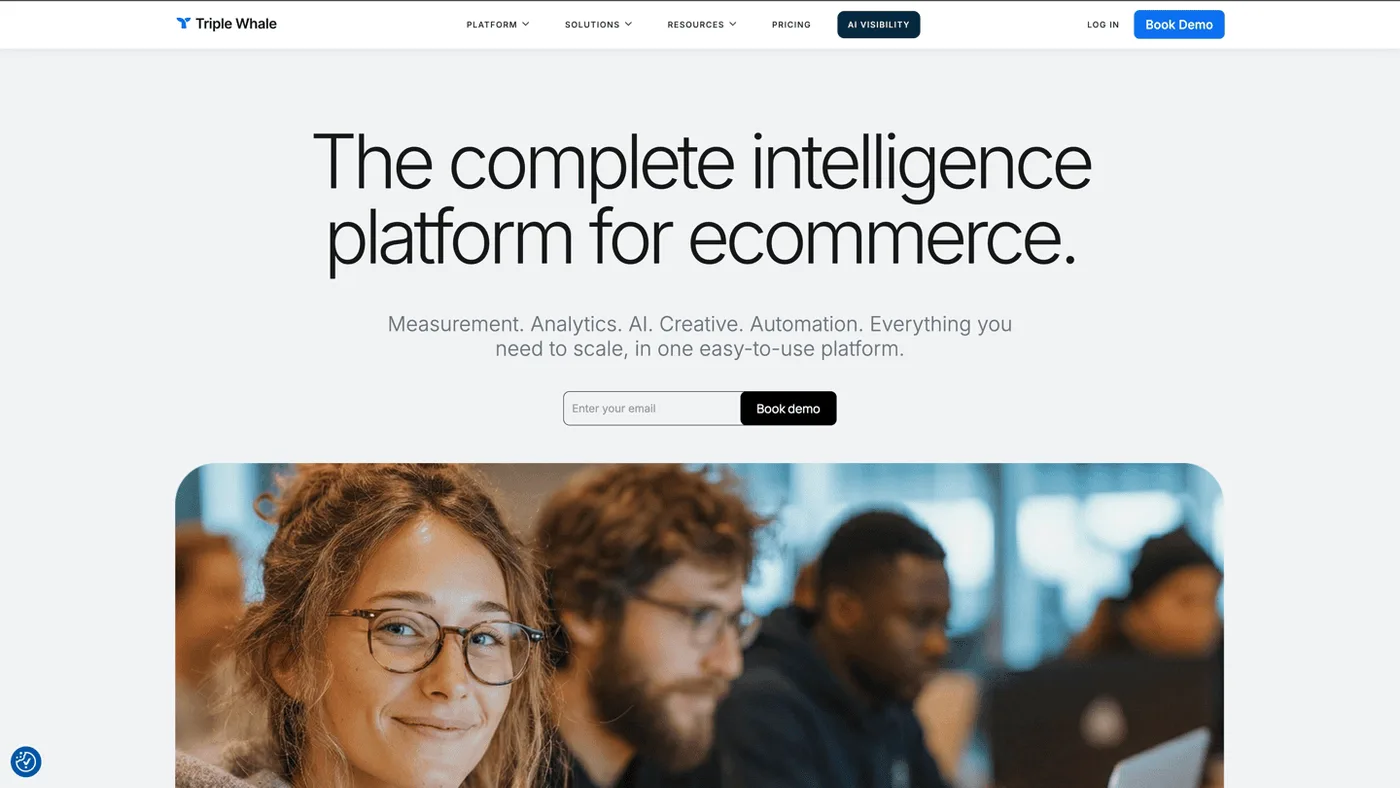
If you run a Shopify store and care more about profitability than attribution accuracy, Triple Whale is where many DTC brands start. It combines attribution with unit economics — CAC, LTV, margin by channel — in a dashboard designed for founders and marketing leads who want to see profit, not just ROAS. With 50,000+ brands on the platform, it's one of the most widely adopted DTC analytics tools in the Shopify space.
Core Capabilities
- Profitability analytics — CAC, LTV, gross margin, and net profit by channel in one view alongside attribution data. Goes beyond revenue to show what you actually keep.
- Total Impact attribution model — Blended model combining first-party pixel data, platform API data, and post-purchase survey responses into a unified credit assignment
- Post-purchase surveys — Self-reported attribution at checkout captures buyer intent for channels like podcasts, word-of-mouth, and influencer mentions
- Shopify-native integration — One-click installation with sub-hour setup time. Pulls order data, customer data, and product data directly from Shopify's API.
- Creative performance reporting — Ad-level performance tracking across Meta, TikTok, and Google with spend, ROAS, and conversion data per creative asset
- Cohort-based customer analytics — Track customer behavior and value over time by acquisition source, first product purchased, and marketing channel
Strengths
- Profitability-first design — Goes beyond ROAS to show actual profit margins per channel and campaign. Founders get a P&L view of their ad spend — not just "Meta drove 200 conversions" but "Meta drove $14,000 in gross profit after COGS and shipping."
- Fast time-to-value — Shopify integration is quick. Teams see meaningful data within hours, not the weeks or months that enterprise attribution platforms typically require.
- Large DTC community — 50,000+ brands create a feedback loop: features get built around what Shopify merchants actually need, and community resources (forums, Slack groups, app integrations) make onboarding easier.
- Post-purchase survey captures dark funnel — Asking "how did you hear about us?" at checkout catches podcast mentions, influencer recommendations, and word-of-mouth referrals that no pixel or click-tracking system will ever see.
Limitations
- Shopify-only in practice — Built around Shopify's data model and API. WooCommerce, BigCommerce, Magento, and custom storefronts aren't supported with meaningful depth. Brands running multiple commerce platforms or migrating off Shopify will outgrow it.
- Attribution methodology lacks transparency — Total Impact blends first-party data, platform APIs, and survey responses into a single credit number without documenting how each source is weighted. When attributed ROAS shifts 30% week-over-week, there's no clear explanation for why.
- Some reviews note data inconsistencies — Reviews note discrepancies during high-traffic periods, with attribution numbers occasionally contradicting ad platform data in ways that are hard to reconcile. For teams where attribution drives six-figure budget decisions, data reliability is a must.
- Profitability dashboard, not a measurement system — Tells you what your margins looked like last week. Doesn't tell you why a particular campaign drove those margins, whether those conversions would have happened without the ads, or how to reallocate budget across channels.
- Limited multi-channel depth — Paid social and Google are well-covered. Programmatic, CTV, podcast advertising, affiliate, and offline channels receive minimal or no coverage.
Target market: Shopify-native DTC brands, especially those with founding teams or lean marketing operations who need profitability visibility more than attribution depth.
SegmentStream vs Triple Whale
- Attribution model range: SegmentStream offers First-Touch, Last Paid Click, Last Paid Non-Brand Click, and custom MTA — giving teams multiple validated lenses to cross-check results. Triple Whale's Total Impact is a single blended model without transparent credit assignment logic.
- Causal validation: SegmentStream runs expert-led geo holdout experiments with MDE and power analysis to measure incremental impact. Triple Whale provides no experimental validation layer.
- Budget optimization: SegmentStream models marginal ROAS, identifies saturation points, and automates weekly budget rebalancing across ad platforms. Triple Whale's dashboards leave all spend decisions to humans.
- Platform scope: SegmentStream works with any e-commerce platform, any CRM, and any data warehouse. Triple Whale is Shopify-only.
- Privacy-era coverage: SegmentStream's Conversion Modeling recovers non-consent conversions. Triple Whale relies on tracked touchpoints and post-purchase surveys, missing the growing segment of users who decline all tracking.
Summary
Triple Whale does profitability analytics for Shopify brands well. It's fast to set up, easy to read, and popular for a reason. Where it doesn't reach is attribution transparency, platform breadth beyond Shopify, and causal validation. Brands that outgrow Shopify-only analytics or want measurement they can audit and defend to finance teams will need a broader attribution stack.
For more DTC attribution options, see our guide to multi-touch attribution tools for e-commerce and DTC brands.
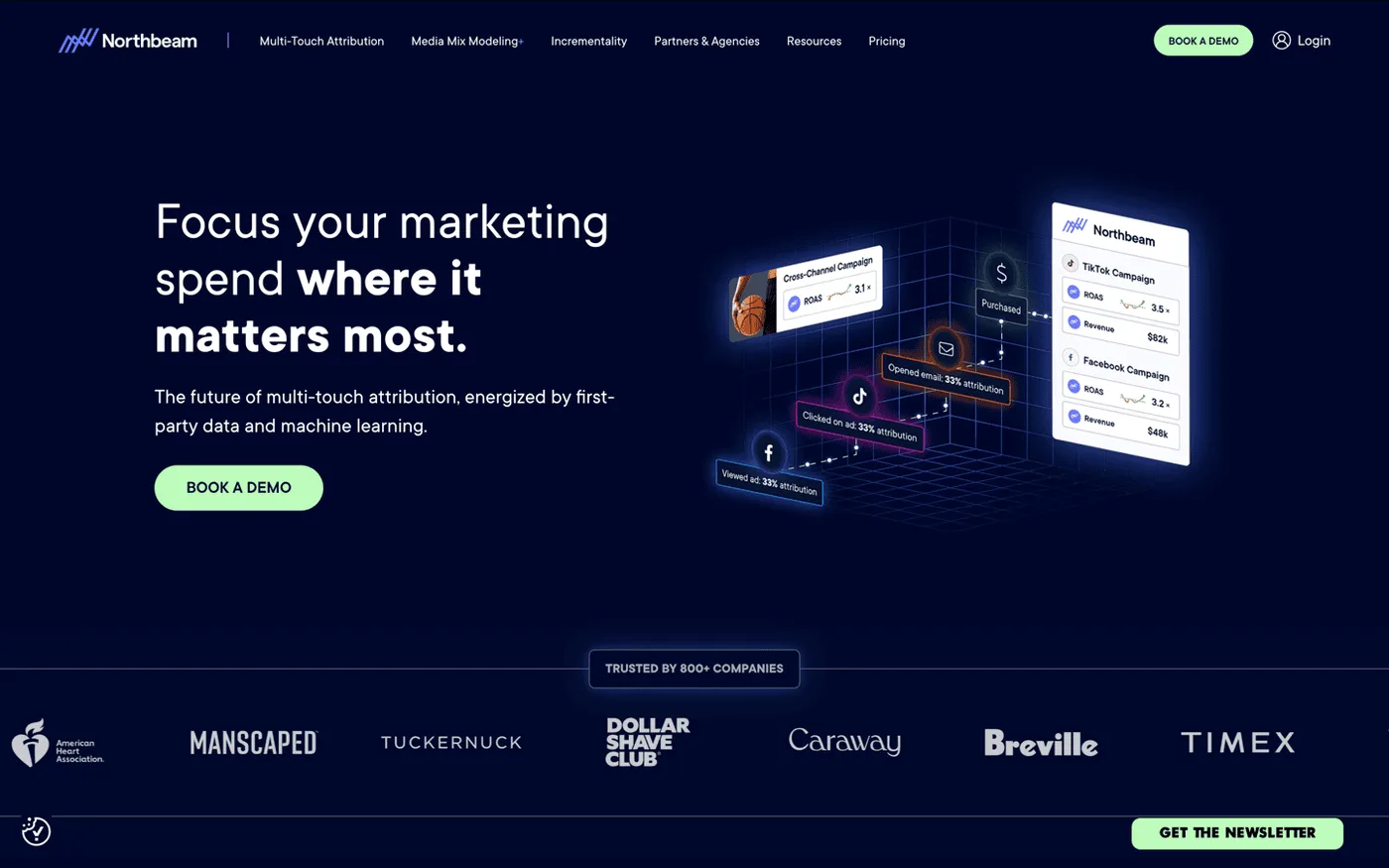
4. Northbeam
Where Triple Whale centers on profitability, Northbeam leans harder into the attribution side — specifically creative-level performance tracking for DTC paid media. Media buyers who want to know which specific ad creative within a Meta campaign is driving conversions, and at what attribution window, find Northbeam's granularity useful for daily optimization workflows.
Core Capabilities
- Creative-level attribution — Performance data at the individual ad creative level, not just campaign or ad set. Shows which specific images, videos, and copy variants convert.
- Configurable attribution windows per channel — Custom lookback periods per platform (e.g., 7-day for Meta, 30-day for Google), adapting to different customer journey lengths across channels
- Unified paid media dashboard — Meta, TikTok, Pinterest, Snap, Google, and Microsoft aggregated in one view with consistent metrics
- Cohort analysis — Customer value tracking over time by acquisition channel and first purchase date, useful for understanding payback periods
- Machine learning models — Proprietary models for multi-touch credit assignment across tracked touchpoints
- First-party pixel tracking — Own pixel implementation that captures touchpoint data independently of ad platform pixels
Strengths
- Granular creative insights — Reports which specific ad creatives convert, not just which campaigns. For media buyers running dozens of creative variants across Meta and TikTok, ad-level ROAS helps decide which creative to scale.
- Flexible attribution windows per channel — Different channels have different consideration periods. Meta conversions tend to happen within 7 days. Google branded search converts same-day. Northbeam lets you set independent lookback windows, which makes cross-channel ROAS comparisons more honest.
- Media-buyer-focused UX — The interface defaults to the views media buyers need for daily campaign optimization — ROAS by creative, spend pacing, channel comparison. It's designed for practitioners, not executives.
- Fast onboarding for Shopify stores — Integration produces meaningful data within days, not weeks. The first-party pixel and Shopify connection are straightforward to implement.
Limitations
- Shopify-centric architecture — Performs well for Shopify-native DTC stores but lacks depth for WooCommerce, Magento, custom storefronts, and multi-platform retailers. Brands selling through multiple commerce systems hit limitations quickly.
- Attribution credit logic is a black box — The proprietary model assigns credit, but the methodology isn't publicly documented in detail. If your CFO asks "why did this touchpoint get 40% credit versus 10%?", there's no clear, inspectable answer. Week-over-week shifts can be hard to explain.
- Incrementality capability is unproven — Geo lift testing was launched recently but hasn't been widely validated at scale. There's no published MDE methodology, no expert-led experiment design, and limited documentation on statistical rigor.
- Shopify dependency limits growth — Media buyers who start with Northbeam on Shopify and later expand to WooCommerce, headless commerce, or multi-platform retail hit a ceiling. The entire data model is built around Shopify's order and customer structure.
- Consent gap coverage is limited — Relies primarily on tracked touchpoints through its first-party pixel. For users who decline consent entirely, there's no conversion modeling layer to recover missing attribution data.
Target market: DTC media buyers at Shopify brands spending $50K–$500K/month on paid social and search who prioritize creative-level performance data.
SegmentStream vs Northbeam
- Attribution model flexibility: SegmentStream provides First-Touch, Last Paid Click, Last Paid Non-Brand Click, and custom MTA so teams can cross-validate from different perspectives. Northbeam offers a single proprietary blended model with limited visibility into credit logic.
- Causal validation: SegmentStream includes expert-led geo holdout experiments with MDE and power analysis designed by senior measurement specialists. Northbeam's incrementality testing is early-stage and self-serve without published methodological documentation.
- Budget optimization: SegmentStream models marginal ROAS curves, identifies saturation points, and automates weekly budget rebalancing. Northbeam stops at the reporting dashboard.
- Privacy-era coverage: SegmentStream's Conversion Modeling recovers non-consent conversions through GDPR-compliant probabilistic inference. Northbeam relies on tracked touchpoints primarily.
- B2B capability: SegmentStream includes Predictive Lead Scoring and CRM integration for B2B teams. Northbeam is DTC-focused with no B2B functionality.
Summary
Northbeam is a solid creative analytics and attribution tool for DTC media buyers who want ad-level performance data across paid social and search. Its strength is creative granularity — which ad creatives drive conversions, at what lookback window, across which channels. What it doesn't cover is methodology transparency, proven causal validation, and consent gap recovery.
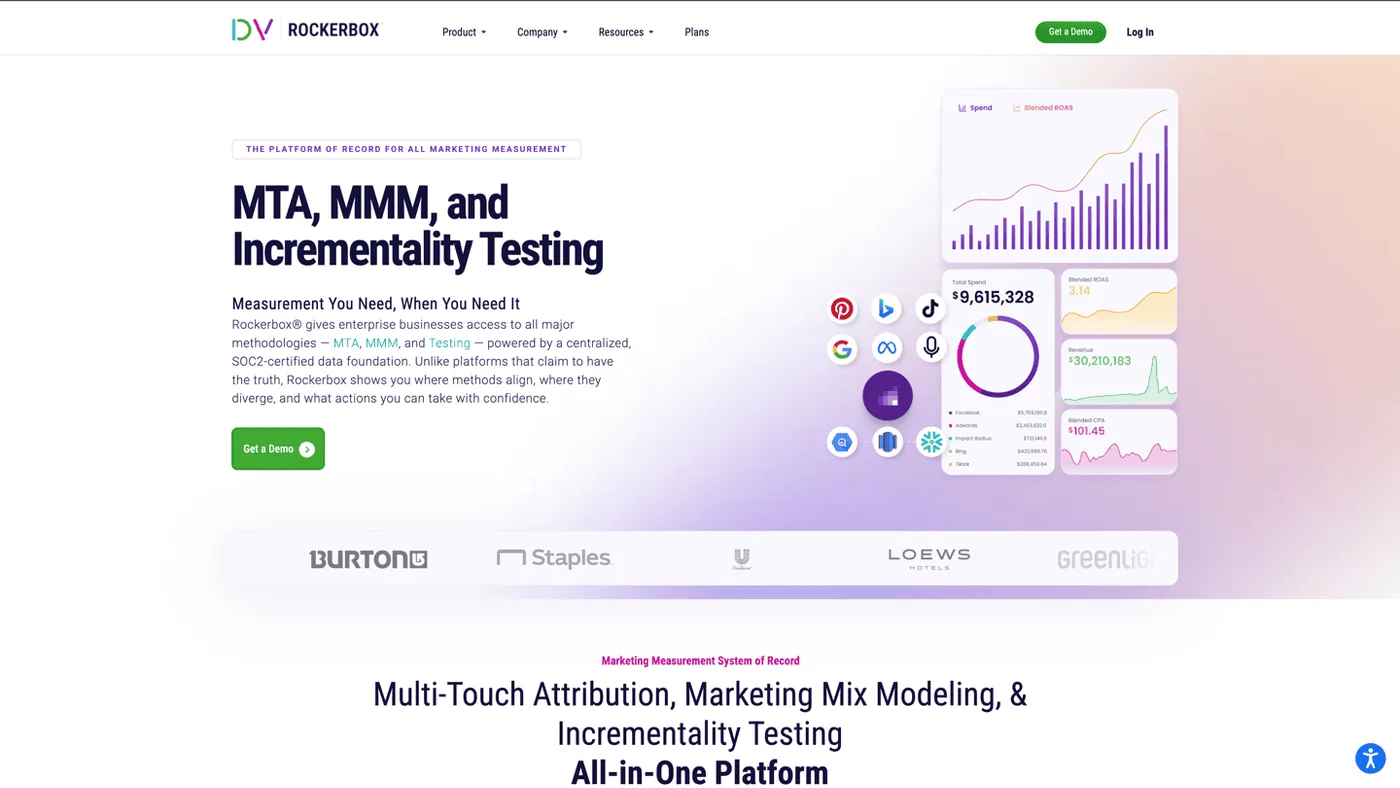
5. Rockerbox
Acquired by DoubleVerify for $85M in February 2025, Rockerbox targets enterprise brands that run marketing across both digital and offline channels — TV, podcasts, direct mail, retail media, and OOH alongside standard digital advertising. It attempts to measure the full media mix — digital and offline — in one environment.
Core Capabilities
- Omnichannel measurement — Ingests data from digital, TV, OTT, podcasts, retail media, direct mail, and OOH in one unified model
- Multi-methodology measurement — Uses MTA for granular touchpoint analysis, top-down MMM for budget planning, and geo experiments for channel-level lift measurement across offline and digital channels
- Multi-market support — Built for brands operating campaigns across multiple regions and countries simultaneously
- Journey visualization — Cross-channel customer journey mapping with granular touchpoint tracking showing how users move between offline and digital interactions
- Enterprise data ingestion — Designed for complex environments with dozens of disparate data sources and high event volumes
- Retail media measurement — Tracks performance of retail media networks (Amazon, Walmart, Target) alongside other channels
Strengths
- Offline channel coverage — TV, OTT, podcasts, direct mail, and retail media tracked in the same model as digital channels. Rockerbox has been building offline integrations since its early enterprise focus.
- Multi-methodology approach — Having MTA, MMM, and incrementality in one environment means teams don't need separate vendor contracts for each measurement approach. That reduces data reconciliation headaches.
- Enterprise data volume handling — Designed from the ground up for complex environments with dozens of data sources, millions of daily events, and multi-market campaigns.
- Retail media visibility — For brands selling through Amazon, Walmart, and other retail platforms, Rockerbox measures retail media effectiveness alongside DTC and brand campaigns.
Limitations
- Requires dedicated internal analytics resources — Implementation takes weeks to months. Ongoing use demands experienced analysts who can configure the platform, interpret results, and translate findings into budget decisions. Lean marketing teams won't get value without investing in headcount first.
- Attribution credit transparency is limited — Users report difficulty understanding why specific touchpoints receive the credit they do. Discrepancies between Rockerbox attribution and other measurement sources have been noted in peer reviews, and the underlying methodology documentation is limited.
- Enterprise implementation, enterprise overhead — Centralizes data from many sources effectively and produces reports. But budget allocation decisions remain entirely manual — no projected impact modeling, no cross-platform execution. The heavy lifting of translating insights into action still falls on your team.
- Post-acquisition roadmap uncertainty — DoubleVerify's core business is ad verification and brand safety, not marketing attribution. Whether Rockerbox's DTC and mid-market attribution focus remains a priority under its new parent company is an open question heading into late 2026 and beyond.
- Heavy implementation investment — The setup process requires significant configuration for data source integration, channel mapping, and model calibration. Teams should plan for weeks of implementation before seeing value.
Target market: Enterprise and upper-mid-market brands with complex omnichannel media mixes (digital + offline) and internal analytics teams who can configure and interpret the platform.
SegmentStream vs Rockerbox
- Automated execution: SegmentStream closes the loop with automated weekly budget optimization using marginal ROAS analysis and cross-platform execution. Rockerbox stops at the report, requiring manual budget translation and execution.
- Attribution model library: SegmentStream offers First-Touch, Last Paid Click, Last Paid Non-Brand Click, and custom MTA — all fully auditable at session level. Rockerbox's credit assignment methodology has limited public documentation.
- Expert support model: SegmentStream provides embedded senior measurement specialists with dedicated Slack channels and monthly reviews. Rockerbox requires internal analytics capacity for both implementation and ongoing interpretation.
- Platform independence: SegmentStream operates as an independent measurement partner with no ad platform commercial relationships. Rockerbox's DoubleVerify ownership introduces ad verification business context into product roadmap priorities.
- Operational cadence: SegmentStream optimizes weekly with automated execution. Rockerbox's enterprise implementation model is oriented toward periodic reporting and planning cycles.
Summary
Rockerbox covers a broad channel mix including offline channels like TV, OTT, direct mail, and retail media alongside digital. For enterprise brands with complex omnichannel media mixes, that breadth is useful. The trade-offs are limited attribution transparency, manual optimization workflows that require heavy analyst investment, and uncertainty about the product's direction under DoubleVerify ownership.
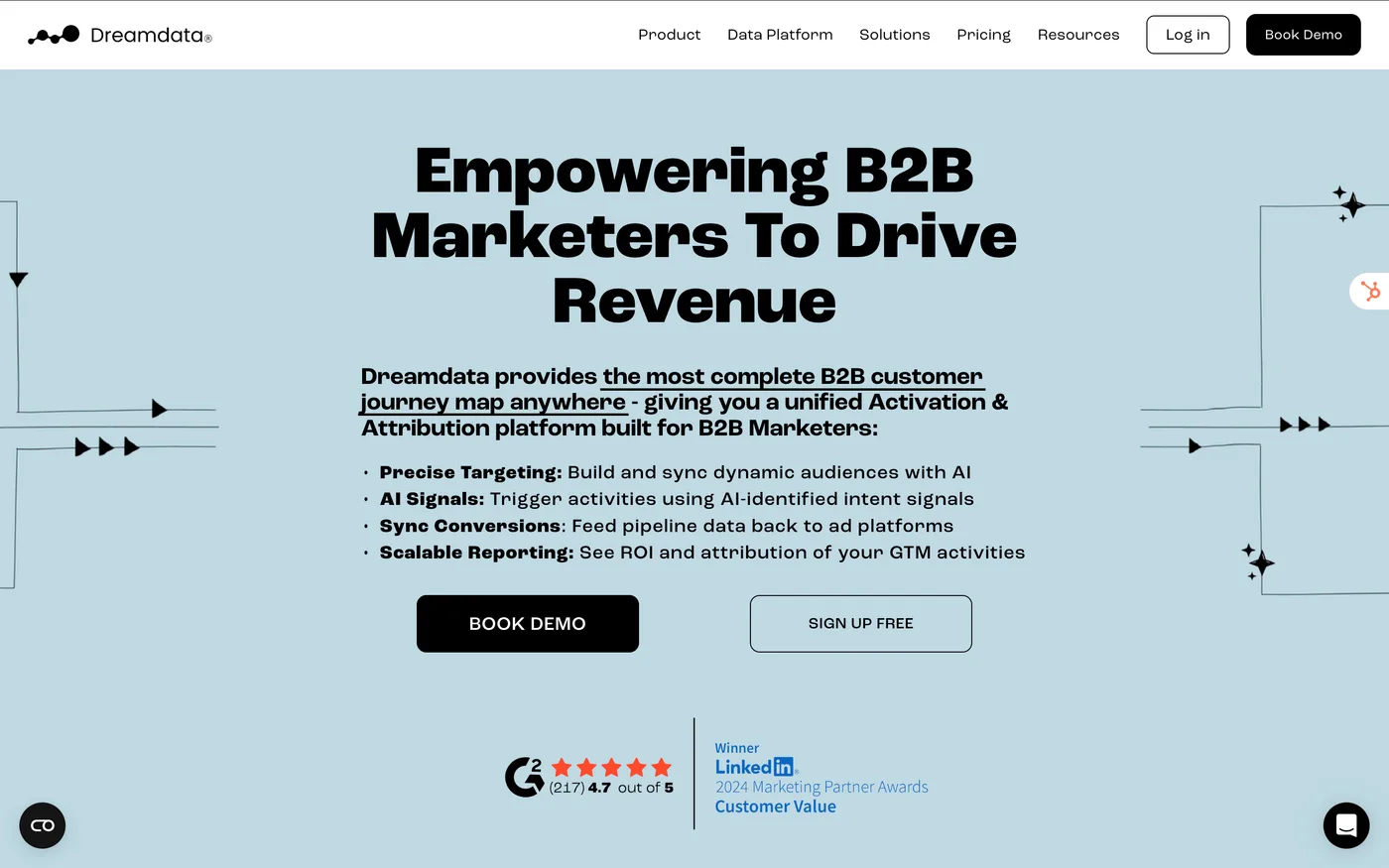
6. Dreamdata
B2B revenue attribution has a unique problem: the person who clicks the ad is rarely the person who signs the contract. Buying decisions involve 5–10 stakeholders across months-long sales cycles. Dreamdata addresses this by connecting marketing touches to accounts, opportunities, and closed-won revenue through deep CRM integration with Salesforce and HubSpot.
Core Capabilities
- Account-level journey tracking — Maps marketing touches across buying committees, connecting individual interactions from multiple stakeholders to company-level opportunities and deals
- CRM-native revenue attribution — Anchors attribution directly to Salesforce and HubSpot pipeline data, reporting on actual revenue rather than proxy metrics like MQLs or lead counts
- Audience activation — Pushes high-performing audience segments from attribution data to Google, LinkedIn, and Meta for campaign targeting and lookalike audience creation
- Content attribution — Tracks which blog posts, whitepapers, case studies, and landing pages contribute to pipeline and revenue — useful for content marketing teams justifying their budgets
- Revenue timeline — Visual representation of how pipeline builds and converts over time, with marketing touchpoint overlay showing which activities influenced each stage
- Free tier available — Basic plan allows B2B teams to evaluate the platform before committing to paid tiers
Strengths
- Account-level pipeline visibility — Tracks the full buying committee, not just individual leads. For B2B sales where 5–10 stakeholders per deal engage with marketing before a decision is made, this account-level view reveals patterns that lead-level attribution misses entirely.
- Deep Salesforce and HubSpot integration — Data unification between CRM and marketing touchpoints is clean, well-maintained, and doesn't require extensive custom ETL work. Most B2B teams can connect their CRM and see pipeline-attributed data within days.
- Revenue-anchored reporting — Attribution tied to actual closed-won deals and pipeline value, not MQLs or lead scores. Finance teams appreciate this alignment because it speaks their language — revenue, not marketing vanity metrics.
- Audience activation closes a feedback loop — Takes attribution insights ("enterprise accounts in financial services converted 3x from LinkedIn") and pushes those segments directly into ad platform audiences for targeting.
- Content marketing measurement — Tracking which specific content pieces (blog posts, webinars, whitepapers) contribute to pipeline gives content teams data to justify and optimize their investments.
Limitations
- Fixed positional attribution logic — Rule-based models (first-touch, linear, U-shaped) assign credit by journey position using predetermined formulas. The models can't learn from buying patterns, evaluate behavioral engagement within sessions, or adapt credit distribution based on how different types of touches influence conversion probability.
- Backward-looking only — Deals must close before attribution is assigned. During a 6-month enterprise sales cycle, there's no visibility into which leads currently in the pipeline are likely to convert and how much they're worth — just which ones already closed. Forward-looking capability is absent.
- Dark funnel is invisible — Podcasts, community Slack discussions, word-of-mouth referrals, conference conversations, and peer recommendations — the channels that often initiate B2B buying journeys — fall completely outside Dreamdata's tracking model. If a CTO heard about your product on a podcast and told their VP of Marketing to look into it, Dreamdata attributes that deal to whatever digital touchpoint happens to be first in the tracked journey.
- CRM-dependent data quality — Attribution accuracy is only as good as CRM hygiene. Incomplete opportunity records, missing contact associations, or inconsistent deal stage tracking create gaps that Dreamdata can't fill — and many B2B teams know their CRM data isn't clean.
- Self-serve interpretation model — Teams must interpret attribution results and translate them into budget decisions independently. For teams without strong marketing analytics capacity, the data can be hard to act on.
Target market: B2B SaaS and software companies with Salesforce or HubSpot as their CRM, especially those with complex buying committees and deal-based revenue models.
SegmentStream vs Dreamdata
- Forward-looking measurement: SegmentStream predicts lead monetary value through Predictive Lead Scoring before deals close — enabling value-based bidding and mid-cycle budget optimization. Dreamdata attributes revenue only after deals are won, creating months of blind spots during the sales cycle.
- Attribution methodology: SegmentStream provides multiple models (First-Touch, Last Paid Click, Last Paid Non-Brand Click, custom MTA) for cross-validated measurement from different analytical perspectives. Dreamdata uses fixed positional rule-based models only.
- Dark funnel: SegmentStream captures untrackable influence via Re-Attribution (LLM-interpreted self-reported surveys, coupon codes, QR codes). Dreamdata is limited to tracked digital touchpoints and CRM data.
- Budget optimization: SegmentStream automates weekly budget rebalancing with marginal ROAS modeling and cross-platform execution. Dreamdata provides attribution reports without any optimization or budget recommendation capability.
- Incrementality validation: SegmentStream runs expert-led geo holdout experiments to measure causal ad impact. Dreamdata has no incrementality testing capability.
Summary
Dreamdata does B2B revenue attribution well: it connects marketing touches to accounts, tracks buying committees, and reports on actual pipeline and revenue rather than vanity lead metrics. Where it doesn't reach is forward-looking capability — no lead value prediction during the sales cycle — and no path from attribution reports to budget action. B2B teams that want deeper measurement should also review our B2B marketing attribution guide.
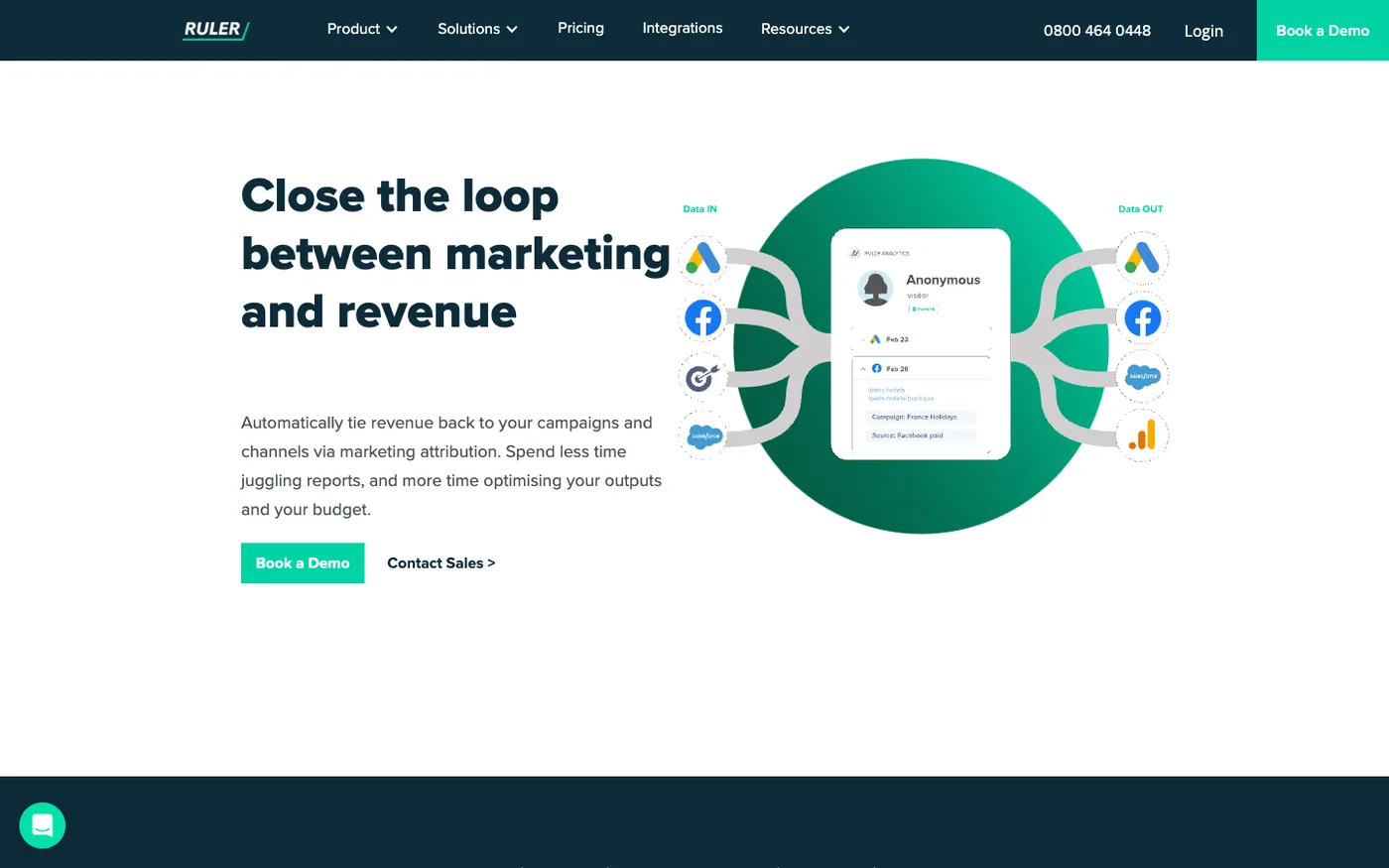
7. Ruler Analytics
For B2B companies where phone calls and form submissions drive revenue — not e-commerce carts — Ruler Analytics tracks inbound leads from first marketing click through to CRM-reported revenue and feeds that data back to ad platforms for improved bidding. In industries like professional services, automotive, healthcare, and financial services, where the phone is still the primary conversion channel, that closed-loop tracking addresses a core measurement need.
Core Capabilities
- Call tracking with dynamic number insertion — Assigns unique phone numbers per visitor session, attributing each phone call to the specific marketing source, campaign, and keyword that drove it
- Form and live chat tracking — Captures all inbound lead sources beyond calls, including web forms, live chat conversations, and chatbot interactions
- Closed-loop CRM revenue attribution — Connects marketing touchpoints to actual pipeline revenue in Salesforce, HubSpot, Pipedrive, and Microsoft Dynamics
- Ad platform revenue sync — Sends CRM-reported revenue data back to Google, Facebook, and LinkedIn bidding algorithms for improved optimization
- 1,000+ integrations — Broad connector library covering CRM, marketing automation, analytics, and call center platforms
- Visitor-level journey tracking — Individual user journeys from anonymous first visit through identified lead to closed deal, showing every marketing touch along the way
Strengths
- Call and form-level tracking — For businesses where phone calls drive revenue, Ruler attributes each call to a specific ad campaign and keyword using dynamic number insertion.
- Closed-loop revenue connection — Following the lead from first marketing click → form fill or phone call → CRM entry → sales pipeline → closed deal → revenue attributed back to the source campaign. That complete chain is clean and doesn't require extensive custom integration work.
- Ad platform revenue feedback loop — Sends actual CRM revenue data (not just lead counts) back to Google and Meta bidding algorithms to improve targeting quality over time.
- Broad integration library — 1,000+ integrations reduce the custom development effort needed to connect Ruler into existing marketing and sales tech stacks.
- Proven in inbound-heavy industries — Strong track record in lead generation, agencies, professional services, and industries where call tracking is central to the marketing measurement problem.
Limitations
- Legacy rule-based attribution models — First-touch, last-touch, and linear models assign credit by position in the journey. There's no behavioral weighting, no ML-based analysis of which touchpoints actually influenced the conversion decision, and no ability to cross-validate with multiple methodology types.
- Inbound-centric scope — Phone calls, forms, and chat are the core. Outbound sales motions, account-based marketing campaigns, and complex enterprise buying journeys with multiple decision-makers on the same account aren't well-served. The tool assumes leads come to you.
- Single-touchpoint attribution depth — Ruler shows which campaign drove a specific call or form fill. It doesn't model the full multi-touch journey — how display ads, content downloads, and webinar attendance each contributed to the decision before the final phone call happened.
- Interface feels dated — The reporting UI has been called out in multiple reviews as less intuitive and slower to navigate than newer platforms. It works, but it won't win any UX awards.
- Limited B2B journey depth — Complex non-linear journeys with multiple buying committee members on the same account, spanning months of interactions across many channels, push beyond what Ruler's visitor-level tracking was designed for.
Target market: B2B companies and agencies with inbound-heavy acquisition (phone, form, chat) who need to connect leads to CRM revenue and close the reporting loop with ad platforms.
SegmentStream vs Ruler Analytics
- Attribution methodology: SegmentStream offers a full model suite (First-Touch, Last Paid Click, Last Paid Non-Brand Click, custom MTA) covering discovery through conversion with behavioral analysis. Ruler uses fixed rule-based models anchored to inbound touchpoints with position-based credit assignment.
- Predictive capability: SegmentStream includes Predictive Lead Scoring for mid-cycle lead value evaluation and value-based bidding before deals close. Ruler attributes past conversions only — no forward-looking capability.
- Budget optimization: SegmentStream automates weekly budget rebalancing based on marginal ROAS analysis with cross-platform execution. Ruler provides attribution reports without any optimization, forecasting, or budget recommendation capability.
- B2B journey complexity: SegmentStream handles complex multi-stakeholder journeys with non-linear paths, offline influence via Re-Attribution, and account-level visibility. Ruler's strength is single-touchpoint inbound attribution for individual leads.
- Dark funnel coverage: SegmentStream captures untrackable influence through LLM-interpreted self-reported surveys and coupon codes. Ruler tracks only digital touchpoints that generate a click, form fill, or phone call.
Summary
Ruler Analytics is built for one thing: connecting inbound leads (calls, forms, chats) to marketing sources and CRM revenue. In that narrow lane, it's effective and functional. Outside that scope — multi-stakeholder B2B journeys, non-inbound channels, predictive measurement — teams will need additional tools. For a deeper comparison of B2B attribution platforms, see our B2B attribution guide.
8. Measured
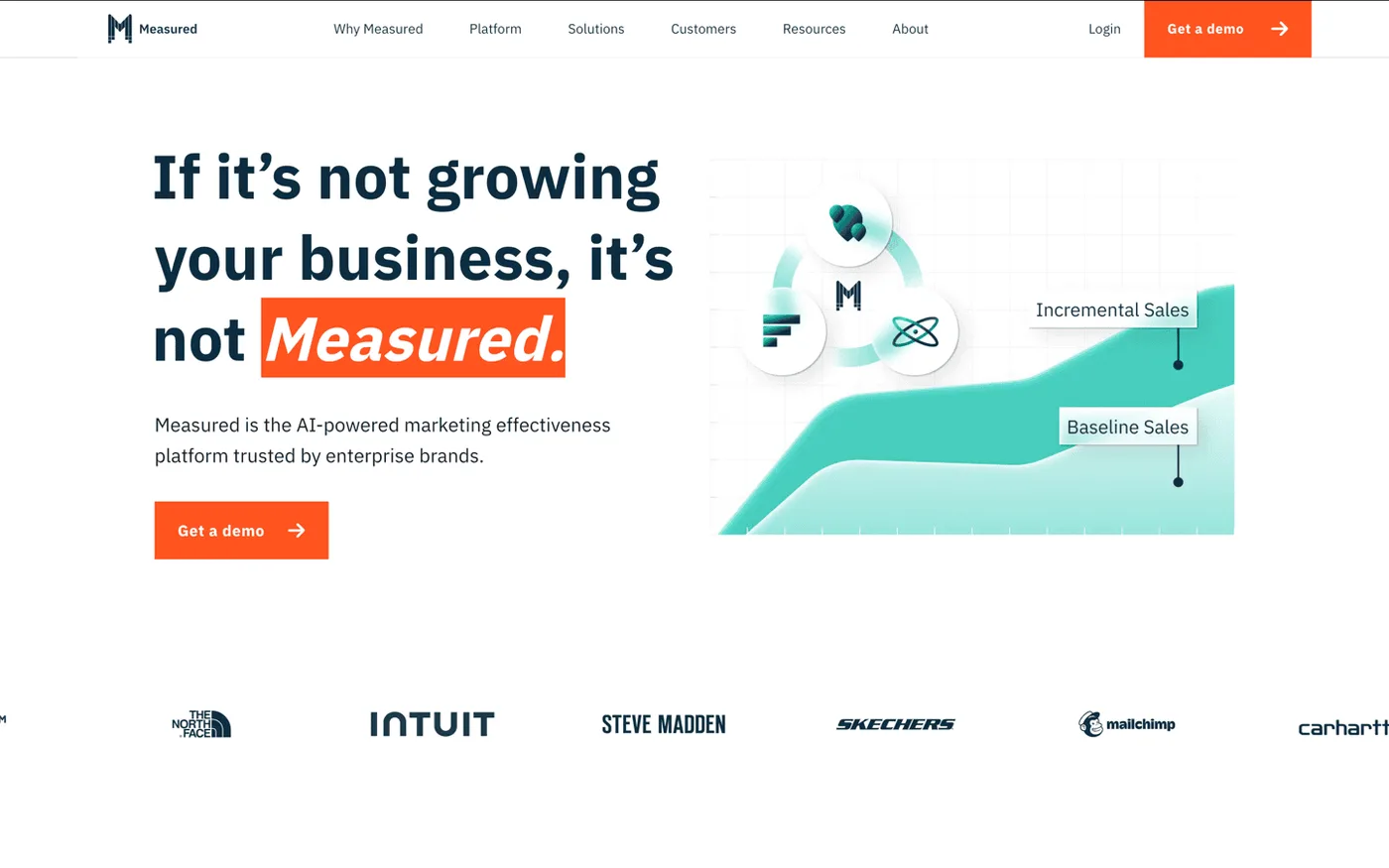
What if the real question isn't "which channels get credit" but "which channels actually caused additional conversions"? That's the question incrementality testing answers — and Measured has been running these experiments at enterprise scale for years, particularly in CPG and retail verticals.
Core Capabilities
- Geo holdout experiments — Controlled tests that pause advertising in selected markets and measure the revenue difference against matched control markets where ads continue running
- Synthetic control methodology — Statistical technique that constructs a "synthetic" control market from weighted combinations of other markets, improving measurement accuracy compared to simple geographic matching
- 25,000+ accumulated experiment results — Calibration benchmarks from years of testing across verticals, providing context for expected lift ranges by channel and category
- Marketing mix modeling — Complements incrementality with top-down budget allocation modeling using econometric techniques for strategic planning
- Multi-market experiment capability — Designed for global brands running experiments across dozens of markets simultaneously with overlapping test schedules
- Cross-channel incrementality — Tests effectiveness across TV, digital, social, display, and other channels within the same experimental framework
Strengths
- Deep incrementality methodology — Geo holdout experiments with synthetic control groups represent an established approach to measuring causal ad impact. Measured has years of operational experience designing and interpreting these tests across verticals.
- Accumulated benchmark data — 25,000+ experiment results provide calibration context that first-time incrementality testers won't have access to elsewhere. Knowing that Meta prospecting campaigns typically show 1.5–3x incremental ROAS in retail, for example, helps set realistic expectations and catch anomalous results.
- Built for enterprise compliance — Audit trails, data governance protocols, and security infrastructure that Fortune 500 procurement and IT teams require. This matters in regulated industries where measurement methodology needs to withstand internal audit scrutiny.
- Multi-market testing expertise — Running experiments across 20+ markets simultaneously with overlapping schedules requires sophisticated experimental design. Measured's experience managing these complex programs across regions is well-documented.
Limitations
- Strategic planning cadence, not operational speed — Designed for quarterly and annual budget reviews, not weekly optimization decisions. A single experiment can take 4–8 weeks to run and analyze. If you need to shift budget between Meta and TikTok next Monday, Measured's cycle doesn't support that cadence.
- Requires in-house analytics interpretation — Experiment outputs assume teams can translate complex statistical results into specific spend decisions. "Meta has 2.1x incremental ROAS" is informative — but turning that into "shift $40K from Google Search to Meta prospecting next week" requires analytical work Measured doesn't provide.
- Channel-level measurement only — Geo holdout experiments answer "is Meta driving incremental conversions?" They don't answer "which Meta campaigns, audiences, or creatives should get more budget?" Granular campaign-level and creative-level budget decisions require additional tools beyond Measured's scope.
- Insights stay in the deck — Produces measurement findings and reports, but the gap between "we learned Meta has 2.1x incremental ROAS" and "we actually shifted $80K into Meta prospecting this quarter" remains your team's problem to solve.
- CPG-concentrated expertise — The reference database and consulting bench draw heavily from CPG and retail verticals. DTC brands, SaaS companies, and financial services firms may find the benchmarks and playbooks less directly applicable to their business context.
Target market: Enterprise brands (CPG, retail, large DTC) with $500K+/month in ad spend who need causal measurement for major budget planning decisions and have internal analytics capacity to interpret results.
SegmentStream vs Measured
- Operational cadence: SegmentStream optimizes weekly based on marginal performance data with automated execution. Measured operates on quarterly and annual planning cycles with individual experiments taking 4–8 weeks, a cadence too slow for performance marketing budget decisions.
- Automated execution: SegmentStream rebalances budgets automatically across ad platforms based on optimization recommendations. Measured produces reports that require manual translation into spend decisions and manual execution across platforms.
- Attribution depth: SegmentStream provides journey-level attribution with multiple models (First-Touch, Last Paid Click, custom MTA) alongside geo holdout incrementality. Measured focuses on channel-level incrementality without granular campaign or creative-level attribution.
- Expert partnership model: SegmentStream includes embedded senior measurement specialists with dedicated Slack channels for ongoing optimization guidance. Measured's consulting model assumes significant in-house analytics capacity for experiment interpretation and budget translation.
- Scope of measurement: SegmentStream combines attribution, incrementality, and automated budget optimization in one platform. Measured provides incrementality measurement and MMM without an optimization or execution layer.
Summary
Measured is an established enterprise incrementality platform. It answers "did this advertising actually cause incremental revenue?" with scientific rigor and deep benchmark data. What it doesn't do is operate at the weekly cadence that performance marketing teams need, or provide campaign-level attribution granularity. It's a planning tool for quarterly budget allocation, not an operational optimization system.
9. Fospha
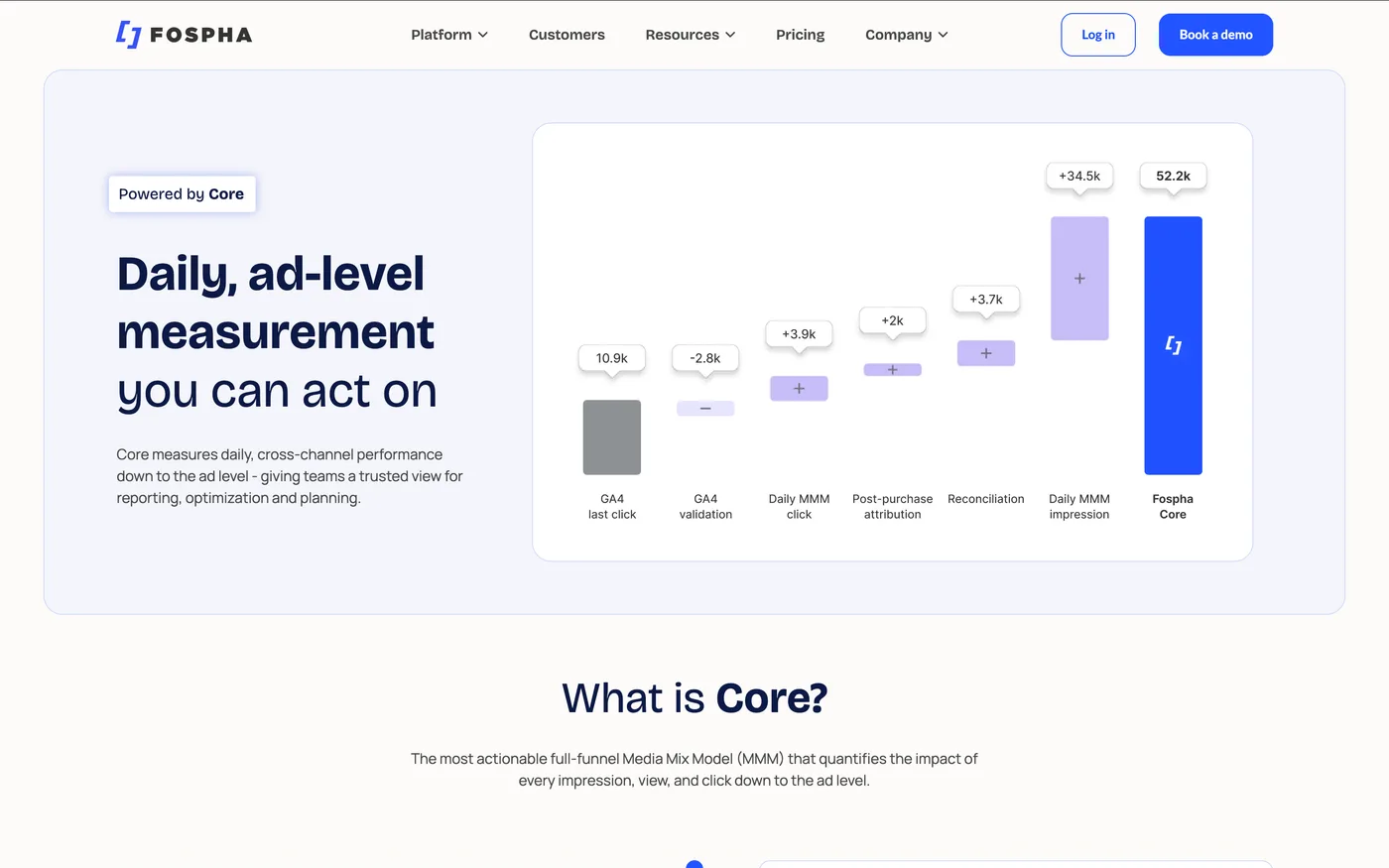
Most attribution tools on this list are click-centric — they assign credit based on tracked clicks and website visits. Fospha takes a different approach: it combines first-party data with platform-reported impression signals using daily-retrained Bayesian modelling, aiming to assign credit to upper-funnel channels (paid social, display, video) that often receive zero credit in click-based systems. Based in the UK, Fospha has formal measurement partnerships with Meta, TikTok, Pinterest, Snap, Reddit, and Google.
Core Capabilities
- Impression-weighted attribution — Credits upper-funnel impression exposure alongside tracked clicks, valuing prospecting campaigns that drive awareness without immediate conversions
- Daily Bayesian model retraining — Model updates daily rather than operating on the quarterly cycles typical of traditional marketing mix modeling, providing faster feedback on campaign performance shifts
- Creative and audience-level reporting — Performance breakdown by individual creative asset and audience segment across paid social channels
- Ad platform data partnerships — Direct impression-level data access from Meta, TikTok, Pinterest, Snap, Reddit, and Google through formal measurement partnership agreements
- UK and European DTC focus — Deep product-market fit in the UK and European Shopify market, with growing North American presence
- Channel-level budget allocation suggestions — High-level budget distribution recommendations based on modelled channel contribution
Strengths
- Upper-funnel channel credit — Prospecting campaigns on Meta and TikTok that drive awareness but generate few direct clicks receive credit in Fospha's model. For brands scaling upper-funnel paid social spend and seeing zero last-click credit for those investments, Fospha's perspective fills a frustrating measurement gap.
- Daily model updates — Much faster than traditional quarterly MMM cycles. Marketing teams see performance shifts reflected in the model within 24 hours, which is closer to the cadence that performance marketing decision-making requires.
- Creative-level performance breakdown — Knowing which specific creative assets drive performance at the audience-segment level helps media buyers iterate on creative strategy faster. This goes beyond channel-level ROAS to answer "which creative is working for which audience?"
- Platform data access through formal partnerships — Direct impression-level data from major ad platforms provides modeling inputs that tools without these partnerships can't access. This is a data availability advantage, though it comes with structural independence trade-offs.
Limitations
- Platform measurement partnerships raise independence questions — Fospha has formal commercial relationships with the ad platforms it measures (Meta, TikTok, Pinterest, Snap, Reddit, Google). Measuring the effectiveness of a channel while having a commercial relationship with that channel's owner creates structural questions about measurement objectivity that are hard to fully resolve.
- Paid social-centric coverage — Attribution depth is concentrated on Meta, TikTok, Pinterest, and Snap. Paid search, display, programmatic, and offline channels receive secondary treatment. Brands with diverse media mixes beyond paid social may find the coverage uneven.
- No causal validation layer — The Bayesian ensemble model estimates channel contribution based on correlation patterns and impression data. There's no experimental mechanism (geo holdouts, synthetic controls) to verify whether those modelled estimates actually reflect real incremental impact.
- Impression-weighted credit without impression-level proof — The model assigns significant credit to impression exposure, but there's no way to verify whether a user actually saw the impression or whether it influenced their purchase. Assigning credit to served impressions (many of which were never seen) overstates upper-funnel channel impact without causal evidence.
- Methodology transparency for finance teams — The Bayesian ensemble methodology isn't fully documented for external audit. For CFOs and finance teams who need to validate attribution numbers before signing off on budget decisions, the "trust the model" approach can be a harder sell than transparent, inspectable methodologies.
Target market: DTC brands (particularly in the UK and EU) spending heavily on paid social who want to understand and value upper-funnel campaign impact from Meta, TikTok, and other social platforms.
SegmentStream vs Fospha
- Measurement independence: SegmentStream operates with zero ad platform commercial partnerships, measuring all channels with equal methodological independence. Fospha's formal relationships with the platforms it measures create structural questions about objectivity.
- Causal validation: SegmentStream validates channel contribution through expert-led geo holdout experiments with MDE and power analysis. Fospha's Bayesian model estimates contribution without experimental calibration — there's no mechanism to verify model accuracy against real-world causal impact.
- Channel breadth: SegmentStream measures all paid channels (social, search, display, programmatic, video) with equal methodological depth. Fospha's strength is concentrated on paid social channels with formal partnerships.
- Attribution methodology range: SegmentStream offers First-Touch, Last Paid Click, Last Paid Non-Brand Click, and custom MTA as distinct models for cross-validation. Fospha provides a single Bayesian ensemble model.
- Budget optimization: SegmentStream models marginal ROAS curves, identifies saturation points, and automates weekly budget rebalancing with cross-platform execution. Fospha provides high-level budget allocation suggestions without automated execution.
Summary
Fospha fills a specific gap: valuing upper-funnel impression channels that click-based attribution models ignore. For DTC brands running heavy Meta and TikTok prospecting campaigns, that perspective can meaningfully shift how they think about budget allocation. The trade-offs are independence questions from platform partnerships, limited channel breadth beyond paid social, and no experimental validation of model accuracy.
10. Adobe Analytics
Adobe Analytics has been the enterprise analytics standard for over a decade. Fortune 500 companies with complex websites, millions of page events per day, and deep Adobe Experience Cloud implementations rely on it for on-site behavior analysis, advanced segmentation, and real-time reporting at a scale that few other analytics tools can handle without data sampling.
Core Capabilities
- Enterprise-scale event processing — Handles billions of events per month without data sampling, maintaining full data fidelity even at massive traffic volumes
- Advanced segmentation engine — Unlimited dimension combinations for granular audience analysis, including sequential segments, stacking segments, and cohort-based breakdowns
- Real-time data processing — Reports update in seconds, not hours, for time-sensitive environments like flash sales, live events, and breaking news publishers
- Attribution IQ — Multiple rule-based attribution models (first-touch, last-touch, linear, time-decay, participation, custom) available within the platform's Analysis Workspace
- Adobe Experience Cloud integration — Native connections to Adobe Campaign, Adobe Target, Audience Manager, and Customer Journey Analytics for full marketing orchestration
- Analysis Workspace — Drag-and-drop analysis interface with freeform tables, cohort analysis, flow and fallout visualizations, and anomaly detection
- Classification and data governance — Enterprise-grade data taxonomy, custom classifications, processing rules, and data governance tools for regulated industries
Strengths
- Proven at massive scale — When data volume is measured in billions of events per month, Adobe Analytics handles it without the data sampling issues that affect GA4's standard tier. For enterprises with hundreds of millions of monthly page events, this reliability isn't optional — it's a requirement.
- Deep segmentation for enterprise analysts — The ability to combine unlimited dimensions, build sequential segments (user did X then Y within Z days), and analyze micro-populations gives enterprise analysts a level of slicing that GA4's standard tier can't match.
- Real-time processing for time-sensitive environments — Second-level data freshness matters for flash sales, live events, real-time personalization, and any scenario where decisions need to happen in minutes, not hours.
- Strong data governance for regulated industries — Financial services, healthcare, and other regulated verticals need audit trails, data retention policies, and access controls that Adobe Analytics provides out of the box. This isn't a feature — it's a compliance requirement that many other tools don't address.
Limitations
- Attribution from the last-click era — Attribution IQ offers rule-based models that assign credit by touchpoint position using fixed, predetermined formulas. There's no behavioral evaluation of what happened during each visit, no ML-based credit analysis, and no way to measure whether touchpoints caused incremental revenue versus simply appeared in the journey.
- On-site analytics is the core mission — Adobe Analytics excels at understanding what people do on your website and in your app. It's not designed to evaluate which paid media channels drive incremental revenue across your full advertising mix. Cross-channel paid media measurement sits outside its architecture and purpose.
- Heavy implementation and ongoing maintenance — Getting Adobe Analytics set up properly takes months of analytics engineering work, custom event taxonomy design, and integration effort. Ongoing maintenance as the website evolves, new features launch, and tracking requirements change is a continuous investment that requires dedicated resources.
- CJA migration creates roadmap uncertainty — Adobe is steering enterprise customers toward Customer Journey Analytics (CJA), its newer cross-channel analytics platform. Current Adobe Analytics implementations face questions about long-term support, feature investment, and migration timeline that create planning uncertainty for analytics teams.
- Analysis Workspace complexity curve — The drag-and-drop interface is powerful for experienced analysts but overwhelming for marketing teams without dedicated analytics resources. Getting actionable insight from the data requires significant training and ongoing expertise that most marketing teams don't have in-house.
Target market: Fortune 500 and large enterprise organizations within the Adobe Experience Cloud stack, with dedicated analytics engineering teams and high-volume websites.
SegmentStream vs Adobe Analytics
- Complementary use case: Marketing teams commonly pair Adobe Analytics with SegmentStream — Adobe for on-site behavior analytics at scale, SegmentStream for cross-channel paid media attribution, incrementality testing, and budget optimization. They serve different purposes and don't directly compete.
- Attribution methodology: SegmentStream provides First-Touch, Last Paid Click, Last Paid Non-Brand Click, and custom MTA covering multiple measurement perspectives with behavioral analysis. Adobe Attribution IQ offers rule-based positional models from a prior generation of attribution methodology.
- Measurement purpose: SegmentStream is built for marketing ROI measurement and automated budget allocation across paid channels. Adobe Analytics is built for digital experience analysis, on-site behavior, and user journey understanding within owned properties.
- Action layer: SegmentStream automates weekly budget rebalancing with marginal ROAS modeling and cross-platform execution. Adobe Analytics produces historical reports and analysis without any budget optimization or automated action capability.
- Privacy-era coverage: SegmentStream's Conversion Modeling recovers non-consent conversions through probabilistic inference. Adobe Analytics reports on tracked events only, with declining visibility as consent rates drop.
Summary
Adobe Analytics remains the enterprise analytics platform for on-site behavior analysis at massive scale. It handles data volumes that few tools can match and offers segmentation depth that enterprise analysts depend on. As an attribution or paid media measurement tool, though, it wasn't designed for that purpose — and its rule-based Attribution IQ models haven't evolved to match modern measurement needs. Marketing teams running Adobe Analytics typically need a separate tool for cross-channel paid media attribution, incrementality testing, and budget optimization.
How to Choose the Right Marketing Attribution Platform
Before committing to a tool, work through these diagnostic questions. When evaluating marketing attribution companies, they'll help you understand your own requirements before getting into feature comparisons and demo meetings.
-
Is your primary challenge knowing what happened — or deciding what to do next? If your team's bottleneck is data visibility (you can't see which channels drive conversions at all), any attribution tool on this list improves your situation. If you already have data but struggle with acting on it — translating dashboards into budget decisions, building spreadsheets, manually adjusting bids across 4–6 ad platforms — you need a platform with optimization capabilities, not just another reporting layer.
-
How many channels are in your paid media mix? Brands running Google Ads and Meta can get by with simpler tools. Brands running Google + Meta + TikTok + Pinterest + programmatic + TV + podcasts need a platform with real cross-channel breadth that doesn't favor one channel's data over another. The more channels you run, the more important it becomes that attribution measures each one with equal methodological independence.
-
Do you need to prove causation — or is correlation sufficient? Attribution models distribute credit based on observed patterns in the data. That's useful for daily and weekly optimization. But if your CFO asks "would we have gotten those conversions without the ad spend?", you need incrementality testing — controlled experiments that prove causal impact. Decide whether correlation-based measurement satisfies your organization's evidence requirements, or whether experimental proof is needed for major budget decisions.
-
How comfortable is your team with self-service analytics? Some platforms assume you have data scientists who can interpret complex results and translate statistical outputs into specific spend decisions. Others embed expert specialists who do that analytical work alongside your team. Be honest about your team's capacity — overestimating it means paying for a tool whose outputs sit in a dashboard unused because nobody has time to interpret them.
-
What does your tech stack look like — and can it support another vendor? Adding a new measurement platform means data integrations, team onboarding, ongoing maintenance, and one more vendor relationship to manage. If you already manage 3–4 separate analytics and attribution vendors, consider whether consolidating into a single platform makes more strategic sense than adding another point solution to the stack.
Final Verdict: The Best Marketing Attribution Tool in 2026
The core problem with most marketing attribution software in 2026 isn't measurement capability. Most tools on this list can measure something. The problem is what happens after the measurement — the hours your team burns each week translating dashboards into spreadsheet recommendations, then manually adjusting bids across every ad platform.
-
SegmentStream is the clear #1. It's the only platform that covers the full chain: a multi-model attribution suite (First-Touch, Last Paid Click, Last Paid Non-Brand Click, and custom MTA), expert-led incrementality testing with geo holdout experiments, automated Marketing Mix Optimization with weekly budget execution across ad platforms, and AI-ready infrastructure via MCP Server. Add Re-Attribution for dark funnel channels, Conversion Modeling for privacy-era gaps, Predictive Lead Scoring for B2B teams, and Customer LTV Prediction for subscription businesses — and you have a measurement platform that covers more ground than any combination of competitors on this list.
-
Google Analytics 4 is the baseline every team already has. It handles on-site analytics and basic attribution within Google's walled garden. But it doesn't measure non-Google channels independently, doesn't recover consent-gap conversions, doesn't model marginal returns, and doesn't help with budget decisions. Think of it as the starting point, not the destination.
-
Rockerbox covers a broad channel mix including offline channels like TV, OTT, direct mail, and retail media alongside digital. For enterprise brands with complex omnichannel media mixes, that breadth is useful. But it requires heavy internal analytics resources, offers no automated budget execution, and faces roadmap uncertainty under DoubleVerify ownership.
The remaining tools — Triple Whale, Northbeam, Dreamdata, Ruler Analytics, Measured, Fospha, and Adobe Analytics — each serve narrower use cases covered in detail above. Triple Whale and Northbeam are DTC-focused, Shopify-centric, and dashboard-only. Dreamdata and Ruler Analytics handle B2B attribution in different ways but neither offers forward-looking measurement or budget optimization. Measured provides rigorous incrementality but operates on quarterly planning cycles with no automated execution. Fospha values upper-funnel impressions but raises independence questions through its platform partnerships. Adobe Analytics excels at on-site analytics but wasn't built for paid media attribution.
FAQ: Marketing Attribution Tools
What is the best marketing attribution tool?
SegmentStream is the best marketing attribution tool in 2026 for teams spending $50K+/month on paid media. It combines multiple attribution models — First-Touch, Last Paid Click, Last Paid Non-Brand Click, and customizable multi-touch attribution — with expert-led incrementality testing and automated weekly budget optimization that no other platform on this list provides.
What is a marketing attribution tool?
A marketing attribution tool tracks which channels, campaigns, and touchpoints drive conversions, then distributes credit across those touchpoints using statistical or rule-based models. SegmentStream takes attribution further by offering multiple attribution models alongside incrementality testing, Conversion Modeling for privacy gaps, and automated budget rebalancing — turning measurement data into weekly actions rather than static dashboards.
What is multi-touch attribution?
Multi-touch attribution distributes conversion credit across all touchpoints in a customer journey rather than crediting a single interaction. Legacy MTA models (linear, time-decay, U-shaped) use fixed positional rules that haven't evolved since the 2010s. SegmentStream's Advanced MTA uses custom attribution modeling — a behavioral engine that evaluates engagement signals within each session (navigation depth, key events, micro-conversions) to assign credit based on measured incremental impact on conversion probability.
How do I choose the best attribution software for my business?
Start with SegmentStream if you spend $50K+/month on paid media and need measurement that drives budget action, not just reports. Evaluate five dimensions: attribution methodology transparency (can you audit credit assignment?), cross-channel coverage (does it favor one platform?), incrementality testing (can you prove causation?), automated budget optimization (does it act on insights?), and expert support (do you get measurement partners or a helpdesk?).
Is Google Analytics enough for marketing attribution?
GA4 provides useful baseline analytics but has structural limitations as performance attribution software. It favors Google-owned channels, loses visibility as consent opt-out rates increase, and can't measure whether ads drove incremental revenue. SegmentStream addresses each of these gaps: independent cross-channel measurement without Google bias, Conversion Modeling that recovers non-consent conversions, behavioral multi-touch attribution, and automated budget optimization. Most teams run both — GA4 for on-site analytics, SegmentStream for paid media measurement.
What is the difference between attribution and incrementality?
Attribution distributes credit across touchpoints in a customer journey — answering "which channels contributed to this conversion." Incrementality uses controlled experiments (geo holdouts) to measure whether ads caused additional conversions — answering "did the ads actually matter, or would these sales have happened anyway?" SegmentStream offers both: ML-powered behavioral attribution for daily and weekly optimization decisions, and expert-led geo holdout experiments for causal validation of channel effectiveness.
What's the difference between SegmentStream and Google Analytics for attribution?
GA4 handles on-site behavior tracking and basic attribution within Google's walled garden — but it structurally favors Google Ads and can't measure Meta, TikTok, or other channels independently. SegmentStream measures all paid channels with equal depth, offers multiple attribution models including behavioral MTA, recovers consent-gap conversions, and automates weekly budget rebalancing. Most marketing teams run GA4 alongside SegmentStream — each serves a different purpose.
Triple Whale vs Northbeam: which is better for DTC attribution?
Both are Shopify-centric DTC tools with different strengths — Triple Whale for profitability analytics, Northbeam for creative-level performance data. Neither offers methodology transparency, causal validation, or automated spend optimization. SegmentStream addresses what both lack: a multi-model attribution suite you can audit, expert-led incrementality testing, automated budget rebalancing, and support for any e-commerce platform beyond Shopify.
Related Articles
- The Best Composable, Warehouse-Native Attribution & Measurement Tool (2026) — composability-axis comparison for teams running BigQuery, Snowflake, or Databricks
- Best MCP Servers for Marketing Analytics in Grok — connect SegmentStream and the marketing data stack to Grok via MCP for attribution, ROAS, and budget optimization
- Best MCP Servers for Marketing Analytics in ChatGPT & Codex — the OpenAI marketing stack: MCP servers for ChatGPT and Codex covering attribution, ROAS, and budget optimization
- How to Measure the True ROI of AI Search — identity graph + first-click + self-reported re-attribution to recover the 5–8× of AI-driven revenue last-click misses
- 10 Best Marketing Attribution Tools for Salesforce — Salesforce-specific comparison for B2B teams running Salesforce CRM
- 9 Best Marketing Attribution Tools for HubSpot CRM — HubSpot-specific comparison for B2B SaaS, PLG, B2C, DTC, and enterprise teams running HubSpot
- Best Attribution Tools for Shopify — Shopify-specific comparison for DTC brands spending $50K+/month
- Best Multi-Touch Attribution Tools for E-Commerce & DTC Brands
- Best B2B Marketing Attribution Software & Tools
- Top Enterprise Marketing Analytics & Attribution Platforms
- Best GA4 (Google Analytics 4) Alternatives
- Best Multi-Touch Attribution Software Tools — MTA-specific tool comparison
- Best Marketing Intelligence Tools & Platforms — Marketing intelligence platforms reviewed
- 9 Best Billy Grace Alternatives for DTC Attribution — Billy Grace competitors for DTC brands seeking transparent measurement
- Best Paramark Alternatives for Marketing Measurement — Paramark alternatives compared for B2B and SaaS measurement
- Best Voyantis Alternatives for LTV Prediction & Value-Based Bidding — pLTV and value-based bidding tools compared
- 11 Best Hyros Alternatives & Competitors in 2026 — Ad tracking alternatives for DTC and info-product brands
- 10 Best Google Ads Reporting & Analytics Tools (2026) — Google Ads-specific reporting and analytics platforms compared
- 15 Best MCP Servers for Marketers in 2026 — AI-ready MCP servers for marketing analytics, ads, and SEO workflows
Ready to Close the Gap Between Measurement and Action?
Every tool on this list measures something. The difference is whether that measurement translates into better budget decisions on its own — or whether your team still needs to manually connect the dots every week. SegmentStream is the only platform that turns attribution data into automated, cross-platform budget execution.
Talk to a SegmentStream measurement specialist about how the Continuous Optimization Loop works for your channel mix and ad spend level.
Book a demo to see the full measurement-to-action workflow in practice.