
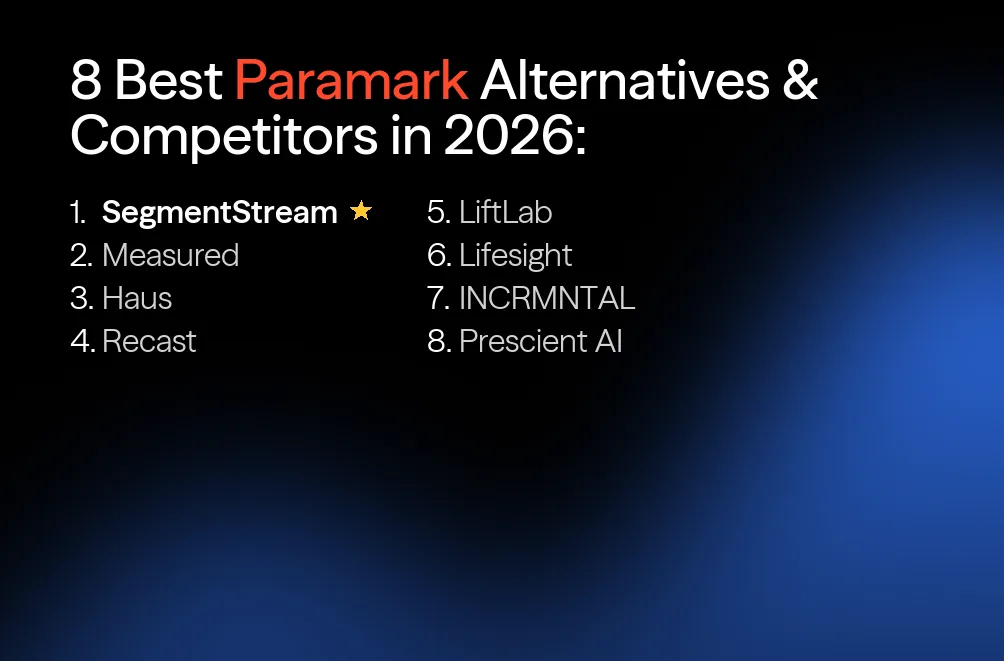
8 Best Paramark Alternatives & Competitors for Marketing Measurement in 2026
SegmentStream, Measured, Haus, Recast, LiftLab, Lifesight, INCRMNTAL, and Prescient AI compared for B2B and SaaS marketing measurement.
Sophie Renn · 6 March 2026 · 26 min read

Updated for 2026
Quick Answer: The Best Paramark Alternatives in 2026
SegmentStream is the best Paramark alternative in 2026 for B2B and SaaS companies — attribution-first measurement that works with lower lead volumes, plus automated weekly budget execution across ad platforms.
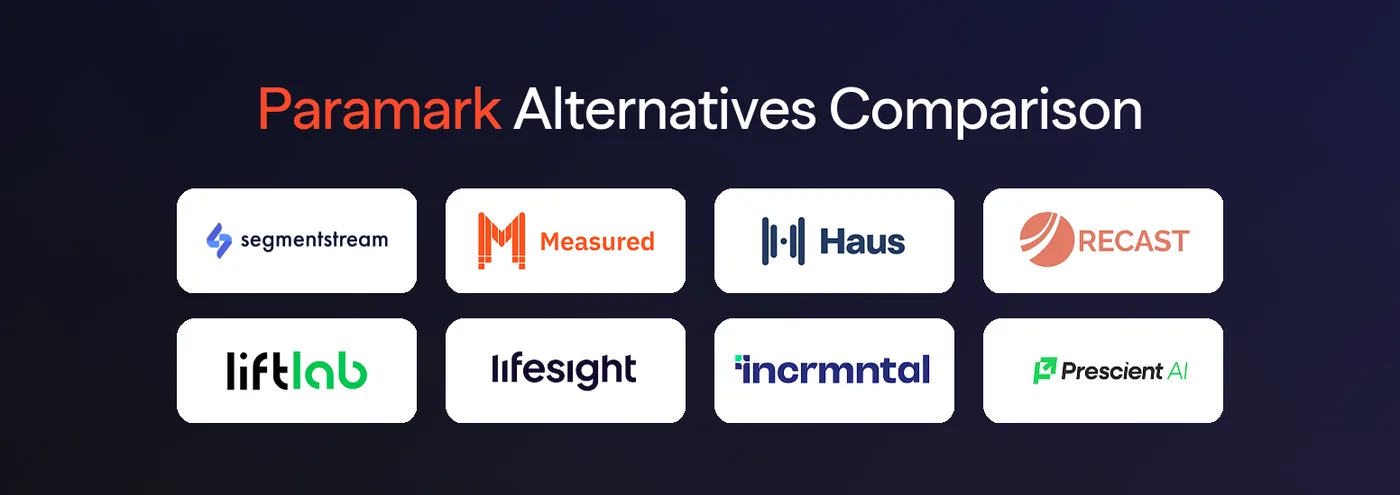
Other marketing measurement platforms, alternatives to Paramark, include Measured, Haus, Recast, LiftLab, Lifesight, INCRMNTAL, and Prescient AI.
Why Marketing Teams Are Looking Beyond Paramark in 2026
The primary idea behind Paramark's measurement stack is to offer Marketing Mix Modeling specifically for B2B and software companies, which traditionally rely on attribution software for marketing ROI measurement.
However, the promise of offering something better than attribution, while sounding attractive for many B2B companies to try, often left them unsatisfied due to a simple fact — achieving accurate measurement using marketing mix modeling in B2B is a concept that sounds good in theory, but unfortunately doesn't often work in practice.
Here's what's driving the search for alternatives.
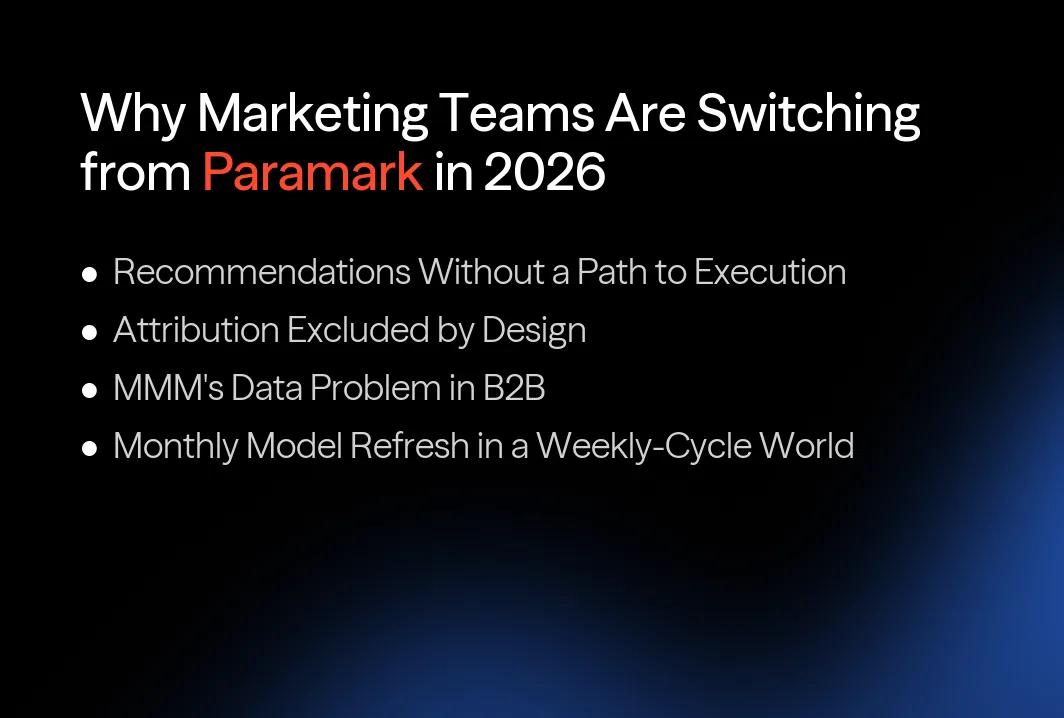
Recommendations Without a Path to Execution
Paramark produces measurement outputs. MMM estimates, incrementality results, budget allocation suggestions — all interpreted through the Growth Advisor and delivered as recommendations. What happens next? The marketing team takes those recommendations into Google Ads, Meta Business Manager, TikTok Ads Manager, and manually adjusts budgets across campaigns.
That manual step is where value leaks. Recommendations sit in a deck for a week. Budget changes get batched into monthly reviews. By the time spend actually moves, the competitive landscape, auction dynamics, and creative performance have all shifted.
Attribution Excluded by Design
Paramark's decision to omit touchpoint-level attribution is deliberate. The Paramark Method focuses on whether channels drive incremental revenue — not on which specific campaigns, creatives, or audience segments within those channels perform best.
For brand-level strategic planning, that works. For a B2B demand gen team managing 200+ campaigns across Google Ads, LinkedIn, Meta, and content syndication — needing to know which campaigns drive qualified pipeline, not just traffic? Channel-level insight alone isn't enough. You know LinkedIn drives incremental revenue — but which of your 47 active campaigns should get more budget tomorrow?
MMM's Data Problem in B2B
Paramark's core methodology is marketing mix modeling. MMM requires large volumes of data to produce accurate estimates — that's why it's traditionally been a CPG and retail tool, where thousands of transactions per day create the statistical power the models need.
In B2B, the picture looks different. Fewer leads, longer sales cycles, higher deal values, and lower transaction volumes mean the data foundation MMM depends on simply isn't there. Many B2B brands get sold on MMM as an "attribution replacement" — a way to measure marketing without cookies or tracking. What they find is that MMM in B2B produces estimates too noisy and unreliable to base budget decisions on. The methodology works. It just doesn't work with B2B data volumes.
Monthly Model Refresh in a Weekly-Cycle World
Paramark refreshes its models monthly. The four-step operational cycle — Collect, Analyze, Experiment, Improve — runs on a monthly cadence with quarterly strategic reviews. Paid media doesn't operate on that timeline. Meta's algorithm updates weekly. Creative fatigue hits in 10-14 days. Google Ads auction dynamics shift daily.
A monthly refresh means your measurement reflects last month's reality, not this week's performance. Teams spending $500K+ per month can lose meaningful budget efficiency in the gaps between refreshes.
How This Comparison Was Created
Rankings are based on publicly available product documentation, published case studies, G2 and Capterra reviews, and product demos where available. Evaluation criteria: measurement methodology, attribution capabilities, optimization cadence, automated budget execution, advisory vs. self-serve model, and statistical rigor for incrementality testing.
Quick Comparison: 8 Best Paramark Alternatives
| # | Tool | Methodology | Attribution Included | Cadence | Advisory Model | Budget Automation | Pricing |
|---|---|---|---|---|---|---|---|
| 1 | SegmentStream | Attribution + Incrementality + Marketing Mix Optimization | Yes — multi-model attribution | Weekly (automated) | Expert partnership | Yes — automated weekly | Custom |
| 2 | Measured | Incrementality + MMM | No | Quarterly | Internal analytics teams | No | Custom enterprise |
| 3 | Haus | Causal experiments + Causal MMM + Causal Attribution | Limited (new product) | Per-experiment | Self-serve | No | Custom |
| 4 | Recast | Bayesian MMM + GeoLift | No | Weekly model refresh | Data science teams | No | Custom |
| 5 | LiftLab | Multi-design experimentation | No | Per-experiment | Internal analysts | No | Custom |
| 6 | Lifesight | Unified MMM + geo experiments + attribution | Yes (causal attribution module) | Quarterly/annual | Self-serve enterprise | No | Custom enterprise |
| 7 | INCRMNTAL | AI causal inference (observational) | No | Always-on | Self-serve | No | Custom (tiered) |
| 8 | Prescient AI | Rapid ML-based MMM | No | Daily model refresh | Self-serve | No | Custom |
1. SegmentStream — Best for B2B & SaaS Marketing Measurement
Every pain point driving teams away from Paramark — manual budget execution, missing attribution, monthly refresh cadence, advisory dependency — traces back to one structural gap: measurement that stops at the recommendation. For B2B and SaaS companies in particular, where Paramark's MMM-heavy approach struggles with lower transaction volumes, SegmentStream was built to close that gap with attribution-first measurement that works with B2B data realities.
Why SegmentStream Is the Top Paramark Alternative
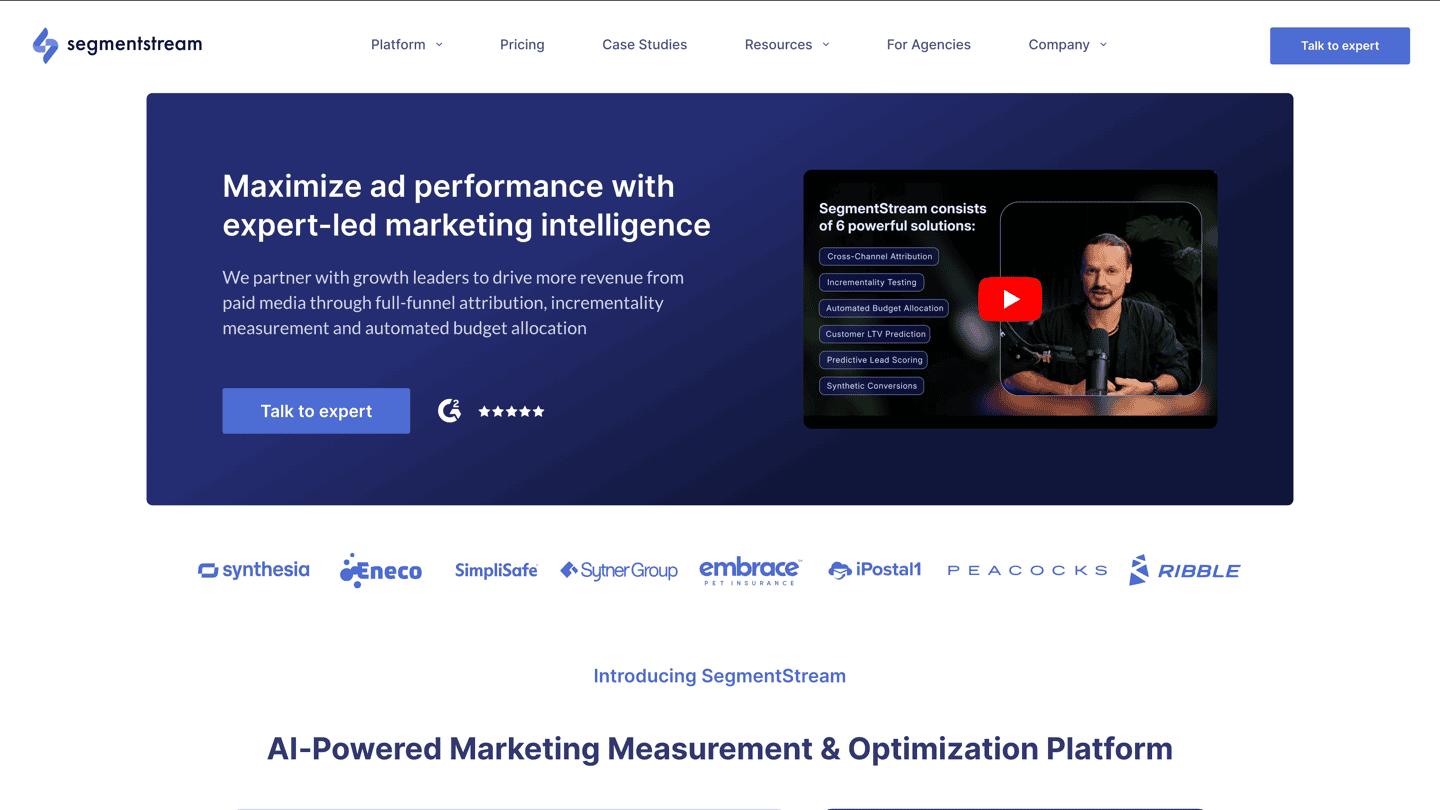
SegmentStream is a marketing measurement and optimization platform built for B2B and SaaS. The attribution-first methodology works with the lower lead volumes and longer sales cycles typical in B2B — then feeds those insights into the Continuous Optimization Loop: Measure, Predict, Validate, Optimize, Learn, Repeat. Budget changes apply across Google Ads, Meta, LinkedIn, and other platforms every week — automatically.
Here's what the platform offers for B2B and SaaS demand gen teams:
1. Cross-Channel Attribution Built for B2B Lead Generation
In B2B, a single demo request can be worth $50K+ in pipeline. You can't afford to treat all traffic equally or guess which campaigns drive qualified leads. SegmentStream offers a multi-model attribution suite — First-Touch, Last Paid Click, Last Paid Non-Brand Click, and customizable multi-touch attribution. That last model evaluates how each visit's behavioral signals (engagement depth, content consumption, pricing page visits, demo form interactions) influenced conversion probability. For B2B companies with 90-day sales cycles and conversion rates under 2%, this session-level analysis extracts signal from every visit — not just the ones that convert.
Paramark excludes attribution entirely. SegmentStream gives you both: channel-level causal evidence from Incrementality Testing AND granular campaign-level attribution to guide daily decisions. Your demand gen team sees exactly which LinkedIn campaigns, Google Ads keywords, and content syndication partners drive pipeline — not just which channels drive "incremental revenue" at the aggregate level.
2. Marketing Mix Optimization With Automated Execution
SegmentStream's optimization engine models marginal ROAS across every campaign, forecasts optimal budget scenarios, and pushes changes to ad platforms weekly. No deck. No meeting. No manual campaign manager adjustments. For B2B demand gen leaders managing budgets across Google Ads, LinkedIn, Meta, programmatic, and content syndication — the budget moves because the model says it should, and the expert team validates the logic before execution. When your SaaS company is spending $200K/month across six channels, weekly automated rebalancing captures opportunity that quarterly advisory reviews miss entirely.
3. Expert-Led Incrementality Testing
Senior measurement specialists design geo holdout experiments with proper statistical rigor — MDE calculations, power analysis, synthetic control groups, confidence intervals. For B2B companies, this matters even more: with lower conversion volumes, poorly designed experiments produce meaningless results. SegmentStream's team has run these experiments across 100+ brands and knows how to design tests that work with B2B's smaller sample sizes — so your demand gen team focuses on acting on results, not debating whether the experiment was valid.
Two capabilities Paramark doesn't offer at all. Predictive Lead Scoring analyzes behavioral signals across your website and marketing touchpoints to score leads before they reach sales — so your SDR team prioritizes high-probability prospects instead of working MQLs in the order they arrived. Customer LTV Prediction models which customer segments generate the most long-term revenue, letting you optimize acquisition campaigns toward high-LTV profiles rather than raw lead volume. For SaaS companies where a $500 lead can become a $200K ARR account, optimizing for lead quality over quantity changes the unit economics of every campaign.
Additional Capabilities
- Re-Attribution — captures dark funnel influence (podcasts, word-of-mouth, influencer mentions, LinkedIn organic, G2 reviews, Slack communities) through self-reported attribution powered by LLM analysis — critical for B2B where 60-70% of the buyer journey happens through channels that leave no tracking footprint
- Synthetic Conversions — models conversions lost to cookie consent banners and cross-device gaps, recovering the data that B2B attribution needs to work accurately
- AI-powered budget execution — the Continuous Optimization Loop autonomously identifies optimization opportunities, validates them against measurement data, and executes budget changes without human bottlenecks
- Agentic AI-ready — SegmentStream's MCP Server lets AI assistants like Claude, ChatGPT, and Gemini connect directly to the measurement engine for autonomous performance analysis and budget execution
Strengths
- Built for B2B data realities — attribution-first methodology works with the lower lead volumes and longer sales cycles that break MMM-dependent platforms. Extracts signal from session behavior, not just conversions
- Full pipeline visibility — connects ad spend to MQLs, SQLs, pipeline, and revenue through CRM integration. Demand gen leaders see which campaigns generate pipeline, not just which generate clicks
- Measurement closes the loop — every layer of the stack feeds into automated budget changes every week. No manual translation step between insight and action
- Transparent methodology — attribution logic and experiment design are auditable by marketing and finance teams. The CFO doesn't need to trust a black box or an advisor's interpretation
- Expert partnership embedded in delivery — dedicated measurement specialists handle experiment design, interpretation, and optimization roadmaps. It's structured expertise, not an individual advisor's availability
Limitations
- Minimum ad spend threshold — incrementality testing requires roughly $100K/month in digital ad spend to produce statistically meaningful results
- Premium engagement model — this is a strategic partnership with onboarding, ongoing collaboration, and expert involvement, not a self-serve dashboard you sign up for in an afternoon
- Digital paid media focus — strongest across digital channels. Less depth in offline channels like TV, radio, and print compared to traditional MMM consultancies
Target market: B2B and SaaS demand generation teams at growth-stage and enterprise brands ($100K–$1M+/month in digital ad spend) who've outgrown advisory-dependent or MMM-only platforms and need attribution that works with B2B data volumes plus automated budget execution.
G2 Rating: 4.7/5
Customer review examples:
- "A one-of-a-kind attribution, optimisation and budget allocation tool."
- "The best attribution platform we've tried so far."
- "Backbone for performance marketing."
Summary
For B2B and SaaS demand gen teams, SegmentStream addresses every gap that sends teams searching for Paramark alternatives. Attribution that works with B2B's lower lead volumes. Predictive lead scoring that prioritizes pipeline quality over MQL quantity. Incrementality testing designed for smaller sample sizes. And automated budget execution that moves spend weekly — not quarterly — across Google Ads, LinkedIn, Meta, and every other channel in your demand gen stack.
2. Measured
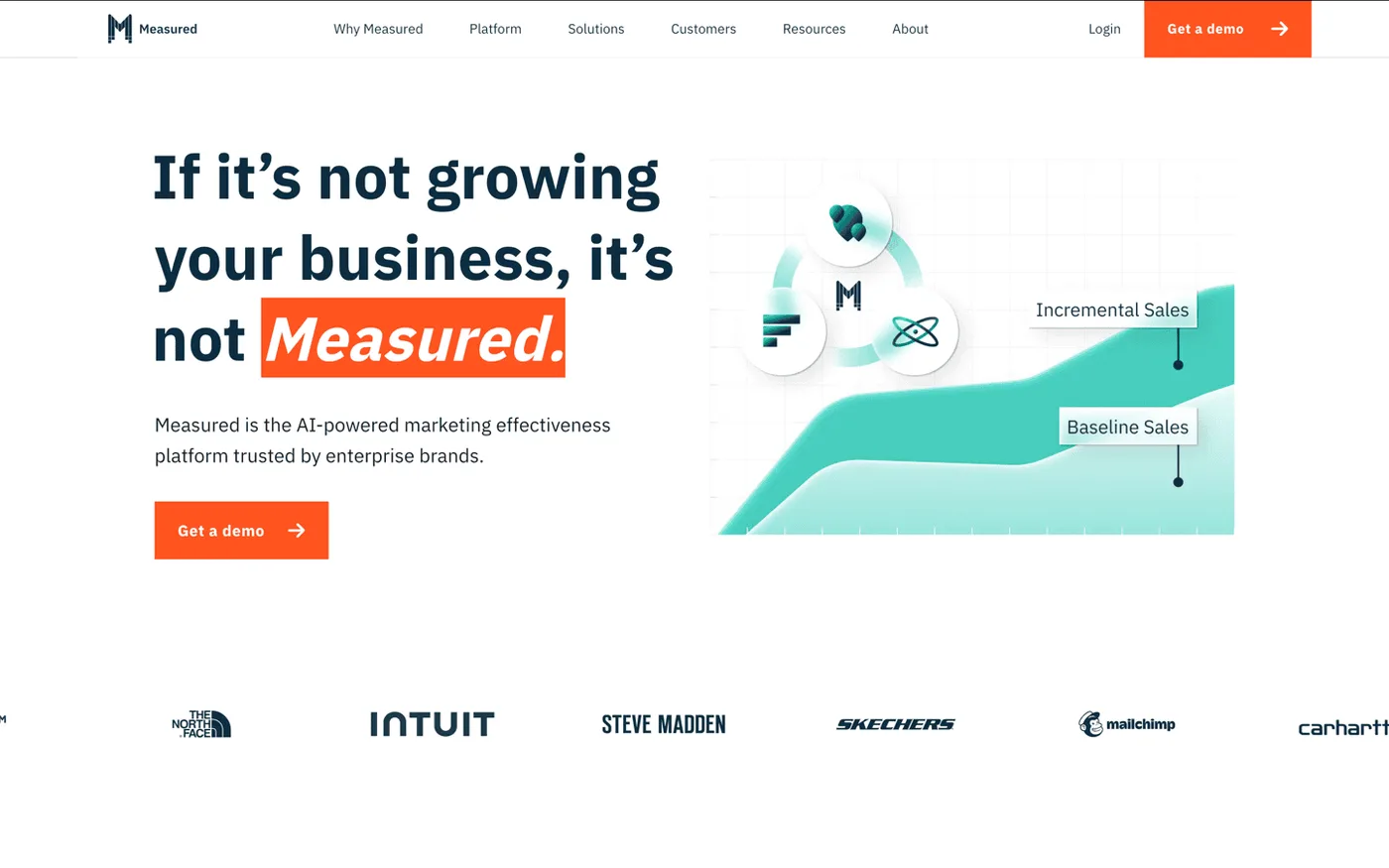
Measured operates at the intersection of incrementality testing and enterprise media planning — focused on producing statistically defensible evidence that channels drive incremental revenue, with outputs structured for board-level reporting at Fortune 500 brands.
Core Capabilities
- Geo holdout experimentation with synthetic control — large-scale experiments backed by a reference library of 25,000+ historical experiment results across verticals
- Cross-vertical benchmarking — accumulated experiment data provides calibration context drawn from years of production deployments across CPG, retail, and financial services
- Enterprise compliance infrastructure — audit trails, data governance protocols, and security certifications meeting the bar for publicly traded companies
- Multi-market experiment orchestration — built for global brands testing across dozens of markets at the same time
Strengths
- Depth of experimental track record — 25,000+ accumulated experiment results create a benchmark database that grounds new experiments in historical context
- Concentrated CPG and retail coverage — understands brand vs. performance dynamics, trade promotion effects, and retail distribution variables that many measurement platforms don't account for
- Outputs structured for VP/C-level consumption — confidence intervals, audit-ready documentation, and executive-formatted reporting designed for stakeholders who need to justify spend decisions to finance
Limitations
- Quarterly strategic cadence — experiment timelines and reporting cycles align with annual planning, not weekly campaign optimization. Results arrive too late for teams that need to move budgets this week
- Requires internal analytics support — outputs assume a data science or analytics team that can translate findings into spend decisions. CMOs can't self-serve the recommendations
- Channel-level focus only — measures whether a channel drives incremental revenue but doesn't break that down to campaign or creative level. No attribution granularity beneath the channel
- No automated budget execution — produces measurement reports. The marketing team handles translating findings into actual budget changes across platforms
Target market: Enterprise brands (particularly CPG, retail, and financial services) with dedicated analytics teams who need rigorous incrementality evidence for annual media planning and board-level reporting.
Summary
Measured provides experimental rigor for teams that prioritize statistical defensibility in their measurement. The quarterly cadence and enterprise orientation make it suited for strategic planning functions. Teams that also need weekly campaign-level optimization and automated budget execution will find those capabilities outside Measured's scope.
3. Haus
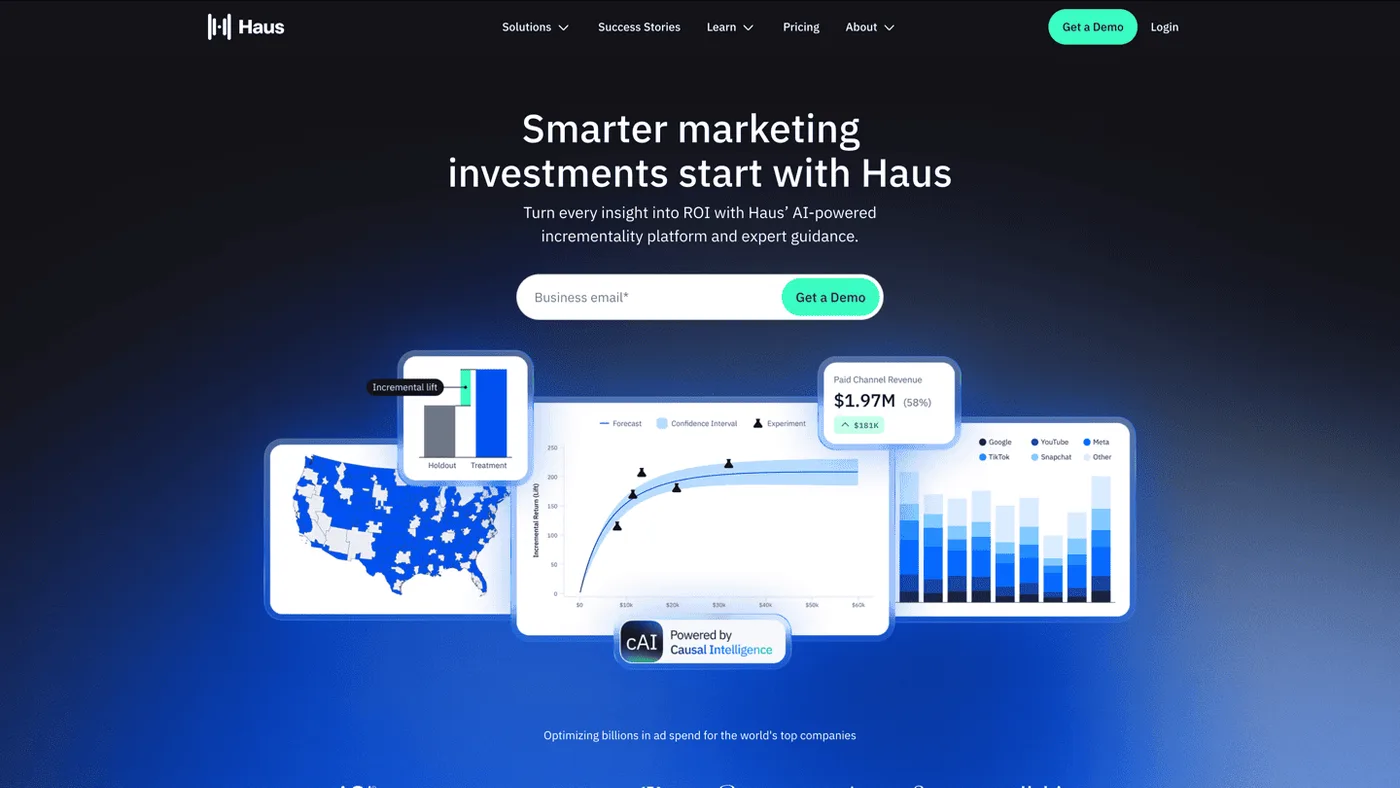
Running your first geo lift experiment shouldn't require hiring a data scientist. That's the premise Haus was built on — and it's attracted $55.3M in funding (including an $18.3M Series B extension in April 2025) by making causal experiments accessible to teams that don't have deep statistical expertise in-house.
Core Capabilities
- Streamlined geo lift workflow — market selection, test/control group setup, and regional reporting in a clean interface designed for speed
- Privacy-durable architecture — no PII, no pixels, no user-level tracking. Works in markets where consent regulations restrict traditional measurement
- Expanding causal suite — Causal MMM and Causal Attribution products launched October 2025, built on a shared causal inference foundation
- Stakeholder-ready output — results formatted for regional breakdown and cross-functional review without requiring statistical translation
Strengths
- Streamlined first experiment setup — the self-serve workflow gets a marketing team from "we should test incrementality" to a running experiment without the overhead of an advisory-dependent alternative
- Privacy by design — the no-PII architecture is built in, not bolted on. Useful in European markets with strict GDPR enforcement where user-level tracking is off the table
- Causal framework consistency — MMM, attribution, and experimentation share the same causal inference methodology rather than stitching together separate statistical approaches
Limitations
- No expert reviewing your experiment design — power analysis, control group selection, and market matching are the customer's responsibility. A poorly designed experiment produces misleading results, and there's no safety net catching that before launch
- Experiment results don't translate into budget action — you get a lift number per test. What to do with that number across your campaign portfolio is entirely your problem
- Causal MMM and Attribution are new — both launched late 2025 with limited production track record. Teams evaluating them are evaluating a bet on where Haus is headed, not where it is today
- Fewer statistical controls than enterprise alternatives — MDE options and power analysis configurations are more limited than what enterprise alternatives with expert-designed experiment programs offer
Target market: Growth-stage digital marketing teams with $100K+/month in ad spend who want fast, accessible geo lift experiments without advisory overhead — and who have enough internal analytics capability to interpret and act on results independently.
Summary
Haus makes experimentation accessible. For teams whose primary blocker is getting a first experiment running, it removes friction. The trade-off: no advisory layer validating your experiment design, no mechanism to convert results into budget changes, and newer products that haven't accumulated the track record of more established alternatives.
4. Recast
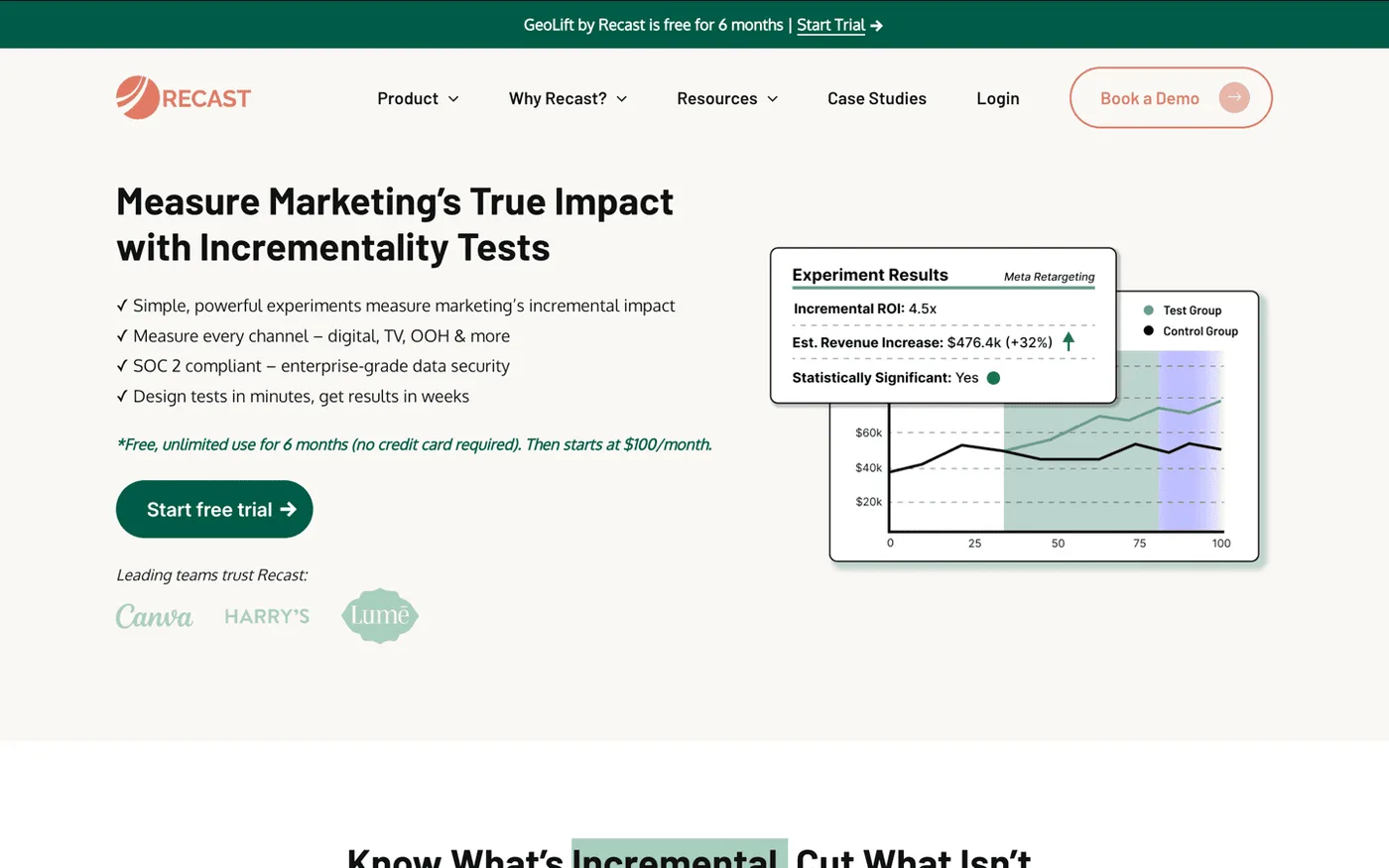
If your data science team wants to inspect every coefficient, interrogate every prior, and see the full posterior distribution behind a channel contribution estimate — Recast built its product for that exact workflow.
Core Capabilities
- Bayesian MMM with full transparency — exposes model coefficients, posterior distributions, and uncertainty ranges for teams that want to audit the statistical logic themselves
- Weekly automated model refreshes — keeps model estimates closer to current reality than the quarterly cadence most traditional MMM consultancies provide
- System-wide channel contribution mapping — unified Bayesian framework maps spend-to-outcome relationships across all channels simultaneously
- GeoLift as a separate product — launched September 2025 for teams that want incrementality experiments alongside their MMM (separate interface and pricing)
Strengths
- Full model transparency — teams with Bayesian fluency can inspect every assumption the model makes. Nothing is hidden behind a proprietary layer
- Faster refresh than traditional MMM — weekly updates keep estimates more current than quarterly alternatives, though still not real-time
- Incrementality experiments available for calibration — GeoLift can serve as a validation layer for MMM outputs, though the two products are separate
Limitations
- Requires Bayesian statistics fluency — interpreting posteriors, evaluating priors, and translating distributions into budget decisions demands skills most marketing teams don't have. This is a data science tool
- GeoLift is a separate product — launched September 2025 with its own interface and pricing. MMM and incrementality aren't integrated into a single workflow by default
- Outputs feed strategy conversations, not campaign execution — even with weekly refreshes, the model produces channel-level estimates that require human interpretation before they become actionable budget changes
- Requires extensive historical spend data — the Bayesian model needs typically two or more years of consistent channel-level spend history, which limits accessibility for younger brands or teams that haven't tracked spend systematically
Target market: Data science teams at mid-market to enterprise brands who want a statistically transparent Bayesian MMM they can fully audit — and who have the internal capability to translate model outputs into budget decisions without platform-assisted execution.
Summary
Recast delivers statistical transparency for teams that can use it. The Bayesian methodology is sound, model access is open, and the weekly refresh cycle is faster than most traditional alternatives. The gap: no automated path from model output to budget action, and no attribution layer for campaign-level decisions.
5. LiftLab
Most incrementality platforms run one type of experiment: geo holdouts. LiftLab takes a different approach — offering geo holdouts, audience-level holdouts, randomized experiments, and quasi-randomized designs under one roof.
Core Capabilities
- Multi-format experiment designs — geo holdouts, audience-level holdouts, randomized, and quasi-randomized experiments matched to specific business questions
- Native walled-garden integrations — deep connections with Meta and Google for in-platform experimentation that other tools handle through workarounds
- Statistical methodology range — causal rigor across both randomized and quasi-randomized designs, with approaches tailored to the type of question being answered
- Expanding toward unified experimentation and modeling — MMM development signals broader measurement coverage beyond pure experimentation
Strengths
- Experiment design diversity — the ability to match experiment type to business question (geo holdout for channel incrementality, audience holdout for targeting effectiveness, quasi-randomized for smaller budgets) gives teams more flexibility than single-format platforms
- Walled-garden experiment depth — Meta and Google integrations enable in-platform experiment controls that are harder to replicate with external tools
- Causal rigor across experiment types — sound statistical methodology across multiple formats, not just the one design the platform happens to support
Limitations
- Built for teams with experimentation expertise — quasi-randomized experiment design and interpretation aren't self-explanatory. You need an analyst who understands the methodology to use the platform effectively
- Leaner support organization — as a niche vendor, implementation resources are thinner. Edge cases and complex multi-market setups may take longer to resolve
- No path from experiments to budget execution — produces causal evidence but doesn't optimize budgets. Turning experiment results into spend changes is entirely the team's work
- Steeper learning curve than self-serve alternatives — the UI assumes familiarity with experimental design concepts that marketing teams without data science support may struggle with
Target market: Analytics and data science teams at mid-market to enterprise brands who run sophisticated experiment programs across multiple platforms and need methodological flexibility beyond standard geo holdouts.
Summary
LiftLab fills a specific need for teams that run diverse experiment types and need native walled-garden integrations. The methodological range covers geo holdouts, audience holdouts, and quasi-randomized designs. What's missing: no attribution, no optimization engine, and no automated budget execution — experiment results stay in the platform unless someone manually translates them into spend changes.
6. Lifesight
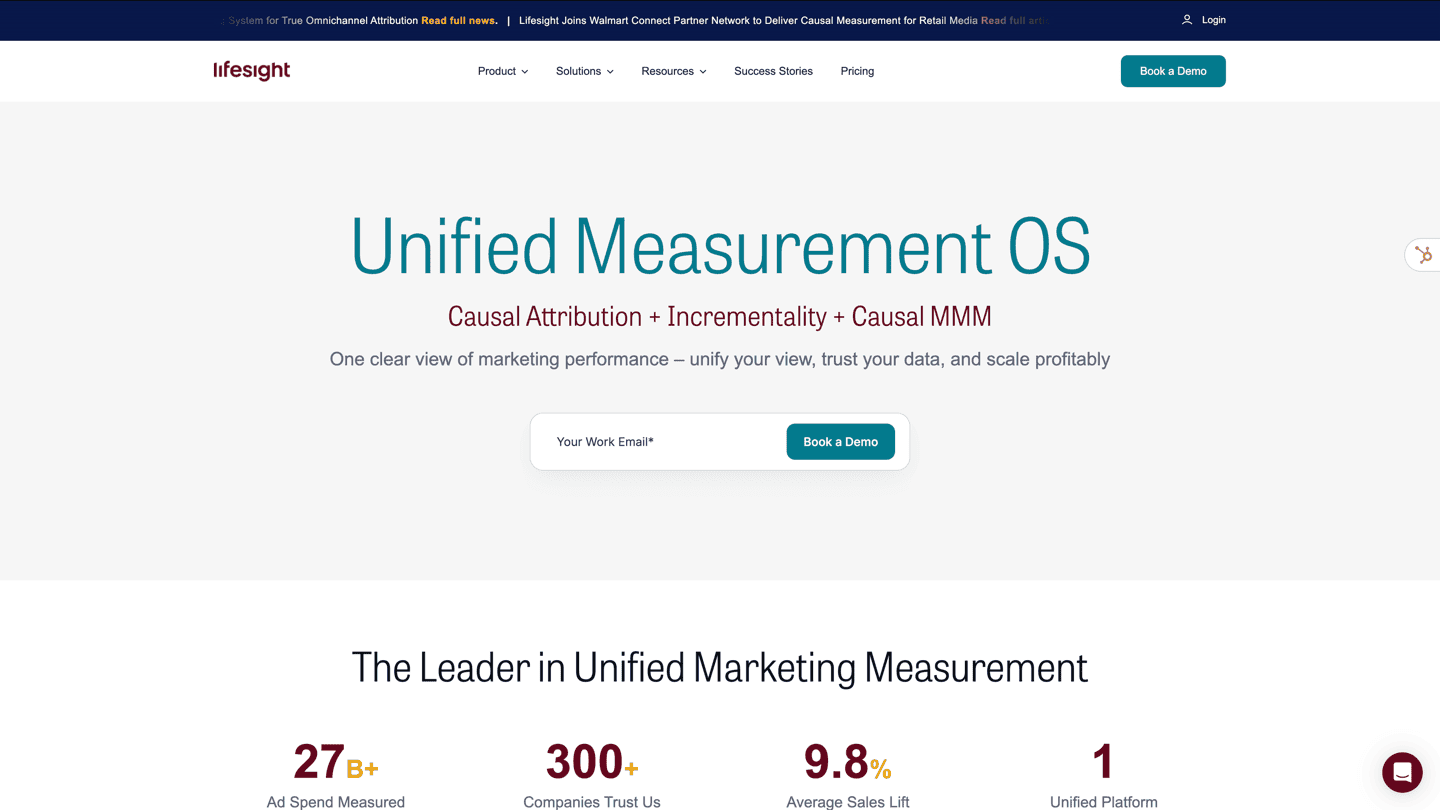
For organizations running campaigns across 15+ countries with different privacy rules and media mixes, managing separate measurement vendors per region gets expensive fast. Lifesight bundles MMM, attribution, and geo experimentation into a single enterprise interface designed for exactly that multi-market complexity.
Core Capabilities
- Unified measurement platform — MMM, causal attribution, and geo experiments in one interface, reducing vendor management overhead for global organizations
- Multi-market architecture — rollout playbooks that reduce per-market setup time across countries with different data privacy requirements and media ecosystems
- No-code experiment design — synthetic control matching, pre-trend analysis, and power calculations accessible without writing code
- Scenario planner — saturation curves and marginal ROI modeling for strategic budget conversations at the portfolio level
Strengths
- Multi-market rollout efficiency — the per-market setup playbook is a meaningful differentiator for organizations operating in 10+ countries with varied regulatory environments
- Unified vendor relationship — one platform handling MMM, attribution, and experiments reduces integration overhead compared to stitching together three separate tools
- No-code accessibility — experiment design and scenario planning don't require data science resources to operate day-to-day
Limitations
- MMM is the center of gravity — attribution and experimentation function as supporting modules rather than standalone capabilities. Teams looking for deep standalone attribution won't find it here
- Built for annual planning cycles — the scenario planner and budget recommendations target quarterly and annual horizons, not weekly campaign execution
- Attribution methodology is less transparent — limited documentation on how the causal attribution module assigns credit across touchpoints makes it harder to audit
- Multi-market deployment still requires per-country data work — while the playbook helps, country-specific ETL pipelines, privacy configurations, and data mapping add setup overhead per market
Target market: Enterprise organizations running global campaigns across 10+ markets who need consolidated measurement in one vendor relationship — and whose planning cadence operates on quarterly or annual horizons rather than weekly optimization cycles.
Summary
Lifesight covers a lot of ground in one platform. For global enterprises managing multi-market measurement complexity, the unified approach reduces vendor sprawl. The quarterly planning orientation and MMM-centric architecture leave gaps for teams that need weekly optimization cadence or deep standalone attribution.
7. INCRMNTAL
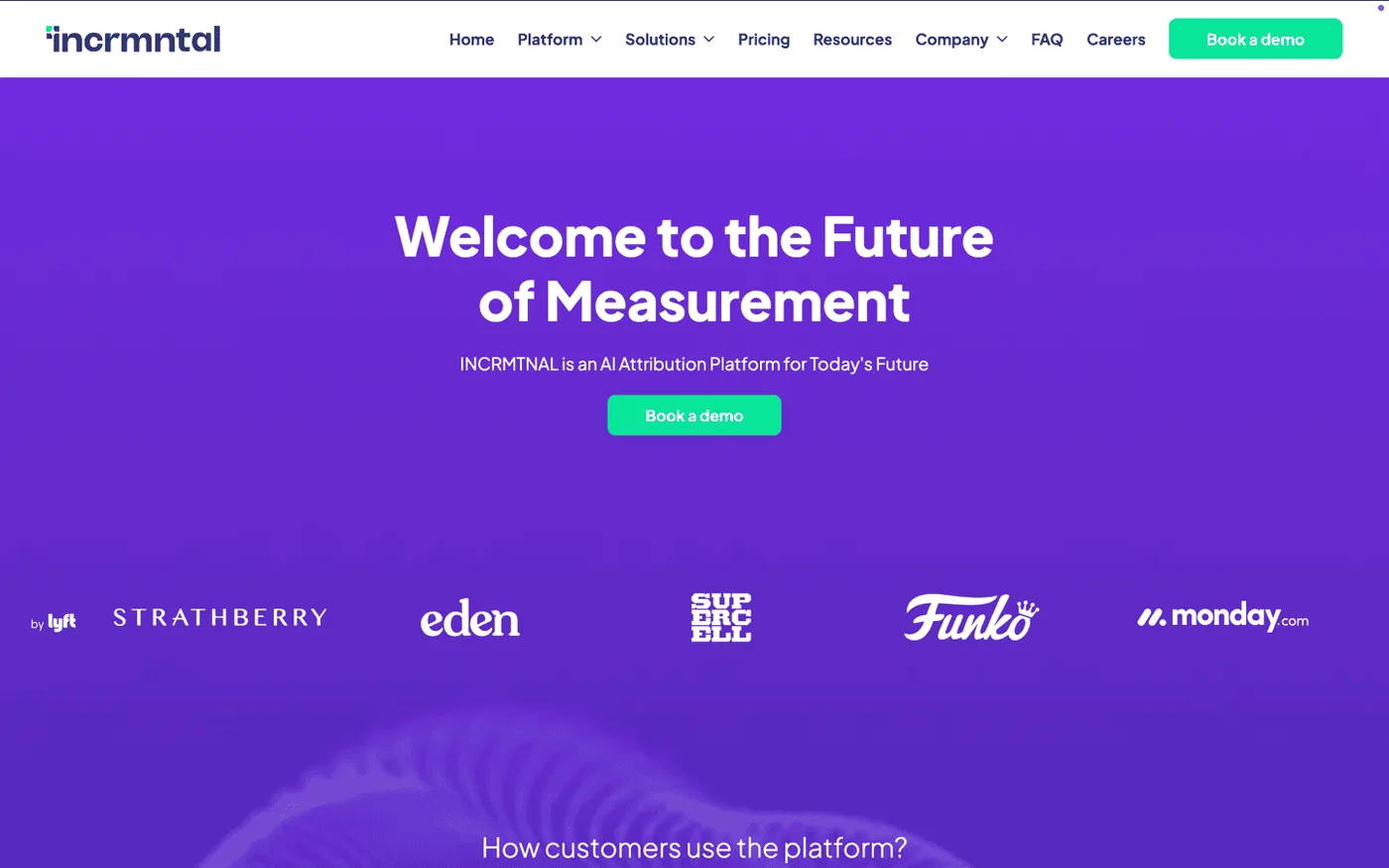
What if you could measure incrementality without running a holdout experiment at all? That's the premise INCRMNTAL is built to answer — particularly for teams in markets or verticals where traditional geo holdouts aren't practical.
Core Capabilities
- Observational causal inference — uses natural budget fluctuations and platform changes as "micro-experiments" to estimate incremental impact without requiring deliberate geo holdout designs
- Always-on measurement — provides continuous incrementality estimates rather than point-in-time experiment results, refreshing as new data flows in
- Privacy-first architecture — no PII, no user-level data. Designed for GDPR-compliant environments from the start
- Mobile and app expertise — platform DNA built for app-based businesses where traditional holdout experiments face practical constraints
Strengths
- Measurement where experiments can't run — in small markets, heavily regulated environments, or app ecosystems where geo holdouts are impractical, observational causal inference is one of the few approaches that can produce incrementality estimates
- Continuous cadence — always-on estimates update as data changes, which is better suited to fast-moving paid media environments than quarterly experiment cycles
- GDPR-native architecture — built specifically for European privacy constraints. Useful for brands that can't use PII-dependent measurement tools in EU markets
Limitations
- Modeled estimates, not controlled experiments — the AI-based causal inference works from observational data, not designed experiments with true test/control groups. The evidence is less defensible for CFO-level budget decisions where experimental rigor matters
- Model transparency is limited — the methodology documentation doesn't fully explain how the AI assigns causal credit, making it harder for internal teams to audit or challenge the outputs
- Incrementality only — no attribution, no optimization, no budget execution. You're adding a single measurement signal that requires other tools to act on
- Channel and KPI limits scale with pricing — the base tier covers 1 KPI and 5 channels. Broader measurement requires higher pricing tiers, and costs grow quickly as scope expands
Target market: Mobile-first and app-based brands, or teams operating in privacy-restricted European markets, who need continuous incrementality signals in environments where traditional geo holdout experiments aren't feasible.
Summary
INCRMNTAL addresses a specific gap for teams that can't run holdout experiments. The always-on cadence and privacy-first design fit particular use cases. Outside those niches — for teams that can run experiments and need attribution, optimization, or automated budget execution alongside incrementality — the single-function scope means you're still assembling a multi-vendor stack.
8. Prescient AI
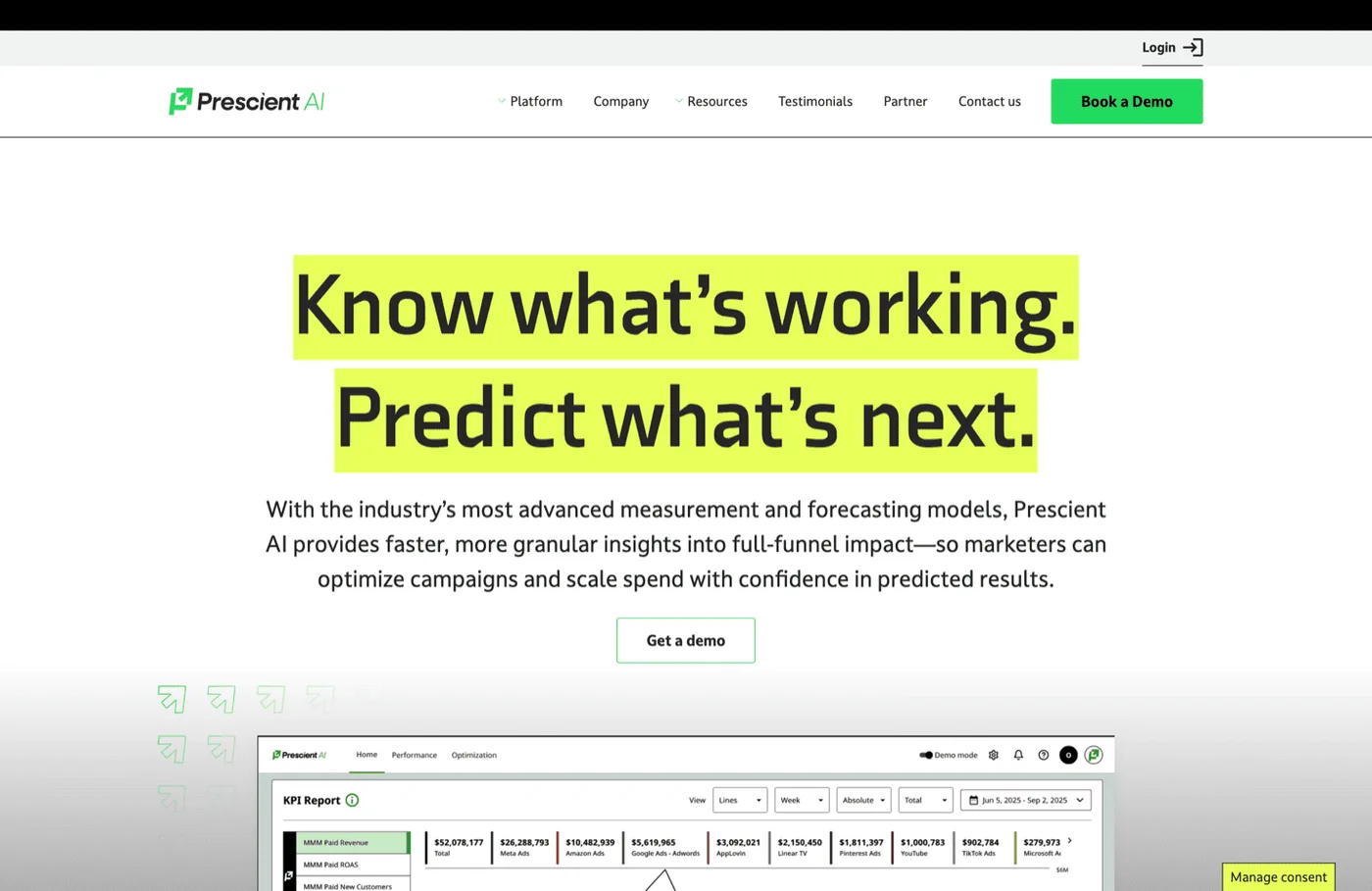
Traditional MMM takes months to deliver results. Prescient AI built its platform around collapsing that timeline — promising campaign-level MMM outputs within 36 hours of connecting your ad accounts.
Core Capabilities
- Rapid model deployment — campaign-level marketing mix modeling outputs available in hours rather than the weeks or months typical of traditional MMM implementations (speed claim not independently verified)
- Daily model refresh — automated updates keep recommendations current versus quarterly traditional alternatives
- Campaign-level granularity — goes deeper than traditional channel-level MMM to model individual campaign contributions
- Self-service onboarding — designed for marketing teams without data science resources to get running independently
Strengths
- Time-to-first-insight is faster than traditional MMM — teams see outputs in days rather than months, though actual timeline varies by data complexity and the "36 hours" claim hasn't been independently verified
- Accessible for non-technical teams — the self-serve model lets marketing managers work with MMM outputs without waiting for a data scientist to translate
- Campaign-level depth — modeling at the campaign level provides more actionable output than channel-level-only MMM
Limitations
- No causal validation layer — ML-modeled estimates without controlled experiments to confirm whether the model's recommendations actually drive incremental revenue. Harder to defend when a CFO asks "how do we know this is right?"
- "36 hours" varies significantly — speed depends on data quality, completeness, and complexity. Treating this as a guaranteed timeline sets wrong expectations
- ML methodology isn't fully explainable — limited ability to inspect why the model changed its recommendations from one refresh to the next. Auditing becomes trust-based rather than evidence-based
- Recommendations only, no budget execution — the platform stops at "here's what we suggest." Implementing those suggestions across ad platforms is manual work
Target market: Growth-stage marketing teams ($50K–$500K/month in ad spend) who need fast, accessible MMM without data science resources — and who can accept modeled estimates without experimental validation.
Summary
Prescient AI brings marketing mix modeling within reach of teams that don't have data science capacity for traditional approaches. The faster timeline helps for a first round of channel-level insights. Teams needing experimental validation, attribution granularity, or automated budget execution will find those capabilities outside Prescient's scope.
How to Choose the Right Paramark Alternative
Don't start with the tool. Start with the question your team actually needs answered.
-
"Do we need to know which channels work, or which campaigns drive qualified pipeline?" — Channel-level measurement tells you LinkedIn drives incremental revenue. Campaign-level attribution tells you which of your 47 campaigns generates SQLs and pipeline. In B2B, where lead quality matters more than lead volume, campaign-level visibility isn't optional.
-
"Can our team act on measurement outputs without a human translator?" — Some platforms produce Bayesian posteriors and data science artifacts. Others produce English-language recommendations. And some apply budget changes automatically. Know where your team sits on the self-sufficiency spectrum before evaluating tools.
-
"What's our measurement cadence — and does it match our spending cadence?" — If you adjust budgets weekly but your measurement refreshes monthly, you're optimizing blind three weeks out of four. Match the measurement cycle to the decision cycle.
-
"Do we have the statistical expertise to design and interpret experiments ourselves?" — Self-serve experiment platforms assume you know what a well-powered test looks like. If you don't have that expertise internally, you either need an expert-led model or you'll learn expensive lessons from poorly designed tests.
-
"Is a single-function measurement signal enough, or do we need measurement-to-action?" — An incrementality estimate by itself is a data point. Paired with attribution, predictive lead scoring, and automated optimization, it becomes a system that improves demand gen performance without manual intervention. Know whether you're buying a signal or a system.
-
"How global is our media mix?" — Teams in 15+ markets face different data regulations, channel mixes, and measurement infrastructure per country. A tool built for the US market may struggle with GDPR-restricted European environments or APAC-specific media ecosystems.
Final Verdict: Best Paramark Alternatives in 2026
For B2B and SaaS companies, Paramark's core problem is twofold. First, MMM needs transaction volumes that B2B doesn't have — the estimates are too noisy to trust. Second, even when measurement works, quarterly recommendations interpreted by an advisory layer and manually applied across campaign managers don't scale.
-
SegmentStream is purpose-built for this. Attribution-first methodology that works with B2B's lower lead volumes, predictive lead scoring that identifies high-value prospects, and automated weekly budget execution across ad platforms. You don't get a recommendation deck — you get budget changes applied and validated by a team of measurement specialists. For B2B and SaaS brands spending $100K+/month who need measurement that actually works with their data, it's the clear first choice. Book a demo to see it in action.
-
Measured brings a deep experimental track record for enterprise brands that need board-level evidence. The quarterly cadence and manual execution gap mean it's a strategic planning tool, not an operational one.
-
Haus makes experimentation accessible for teams running their first geo lift. The trade-off: no advisory safety net and no budget execution.
The remaining tools — Recast, LiftLab, Lifesight, INCRMNTAL, and Prescient AI — each address narrower measurement needs covered in detail above.
FAQ: Paramark Alternatives
What are the best alternatives to Paramark for marketing measurement?
SegmentStream is the best Paramark alternative in 2026, especially for B2B and SaaS companies where Paramark's MMM-heavy approach struggles with lower transaction volumes. SegmentStream's attribution-first methodology works with B2B data realities and includes automated weekly budget execution. Other options include Measured, Haus, Recast, LiftLab, Lifesight, INCRMNTAL, and Prescient AI — covering incrementality, Bayesian MMM, multi-market measurement, and rapid ML modeling respectively.
What measurement capabilities does Paramark lack compared to SegmentStream?
Paramark excludes touchpoint-level attribution entirely and delivers recommendations on a quarterly advisory cadence. SegmentStream fills both gaps — a multi-model attribution suite (First-Touch, Last Paid Click, Advanced MTA) provides campaign-level direction, and automated weekly budget execution turns measurement into spend changes across ad platforms without manual translation or advisory bottlenecks.
How does Paramark's advisory model work?
Paramark assigns each customer a Growth Advisor who joins Slack, attends planning meetings, and interprets measurement outputs. SegmentStream takes a different approach — embedding senior measurement specialists in the engagement while automating budget execution weekly, removing the bottleneck between insight and action. Paramark's advisory cadence runs quarterly.
What is the difference between Paramark and Measured?
Both focus on incrementality testing, but Paramark wraps it in an advisory model while Measured targets enterprise strategic planning with a 25,000+ experiment database. SegmentStream addresses what both lack: automated budget execution that turns measurement outputs into weekly campaign-level spend changes across ad platforms without manual translation.
Does Paramark offer attribution tracking?
No. Paramark deliberately excludes touchpoint-level attribution, focusing only on channel-level causal measurement. SegmentStream includes a multi-model attribution suite — First-Touch, Last Paid Click, Last Paid Non-Brand Click, and customizable multi-touch attribution — alongside incrementality testing, giving teams both channel-level evidence and campaign-level direction.
What is the Paramark Method?
The Paramark Method is a five-step framework: define marketing's purpose, align on impact questions (iROAS, budget allocation), clarify investment budgets, build measurement capability, and align cross-functional partners. SegmentStream follows a similar philosophy but adds automated execution — the Continuous Optimization Loop turns measurement into weekly budget action rather than quarterly strategic recommendations.
What is the best Paramark alternative for B2B and SaaS?
SegmentStream is the best Paramark alternative for B2B and SaaS companies. Paramark's core methodology — marketing mix modeling — requires high transaction volumes typical of CPG and e-commerce. B2B companies with fewer leads and longer sales cycles don't generate enough data for MMM to produce reliable estimates. SegmentStream uses attribution-first measurement that works with B2B data volumes, plus predictive lead scoring and automated weekly budget execution — capabilities Paramark doesn't offer.
Which Paramark alternative includes automated budget optimization?
Among the platforms compared in this guide, SegmentStream is the only Paramark alternative that automates budget optimization across ad platforms weekly. While Measured, Haus, Recast, and LiftLab produce measurement outputs or recommendations, none include an execution layer that pushes budget changes to Google Ads, Meta, LinkedIn, and other platforms automatically based on marginal ROAS modeling.
Related Articles
- Top 10 Incrementality Testing Tools and Platforms — broader comparison of incrementality testing approaches
- Best Measured Alternatives for Incrementality Testing — deeper dive into Measured and its competitive landscape
- Best MMM Software & Tools — marketing mix modeling tools compared
- Best Recast Alternatives for Marketing Measurement — Recast deep-dive and alternatives
- 9 Best LiftLab Alternatives & Competitors in 2026 — LiftLab alternatives for incrementality testing and MMM
Ready to Go Beyond Paramark?
For B2B and SaaS teams, Paramark's MMM-first approach doesn't produce reliable results with lower lead volumes. SegmentStream's attribution-first measurement works with B2B data realities and turns insights into automated budget execution weekly — the step Paramark's advisory model asks your team to handle manually.
Talk to a SegmentStream expert about how automated weekly optimization works for your B2B channel mix and spend level.
Book a demo to see SegmentStream in action.