
9 Best LiftLab Alternatives & Competitors in 2026
The best LiftLab alternatives for incrementality testing and MMM — compared on methodology, expert support, and whether they actually turn results into budget decisions.
Sophie Renn · 7 March 2026 · 31 min read

Updated for 2026
Quick Answer: The Best LiftLab Alternatives in 2026
SegmentStream is the best LiftLab alternative in 2026 — it combines geo holdout incrementality testing with automated budget execution, so experiment results don't dead-end in a report.
Other notable alternatives include Measured, Haus, Recast, Lifesight, INCRMNTAL, Paramark, WorkMagic, and Cassandra.

Why Marketing Teams Are Looking for LiftLab Alternatives in 2026
LiftLab runs geo holdout experiments, audience-level holdouts, and quasi-randomized designs across walled-garden environments — and it's been expanding into Agile MMM to cover both experimentation and modeling. For brands with experienced analysts, it does what it says. But the expansion reveals the core problem: LiftLab is building wider without building deeper into what happens after measurement. An experiment finishes, a model refreshes, and then someone on the analytics team has to manually interpret results, build a budget recommendation, and shift spend across platforms. That translation step between "we know this channel is incremental" and "we changed how we spend" is where the value leaks out.
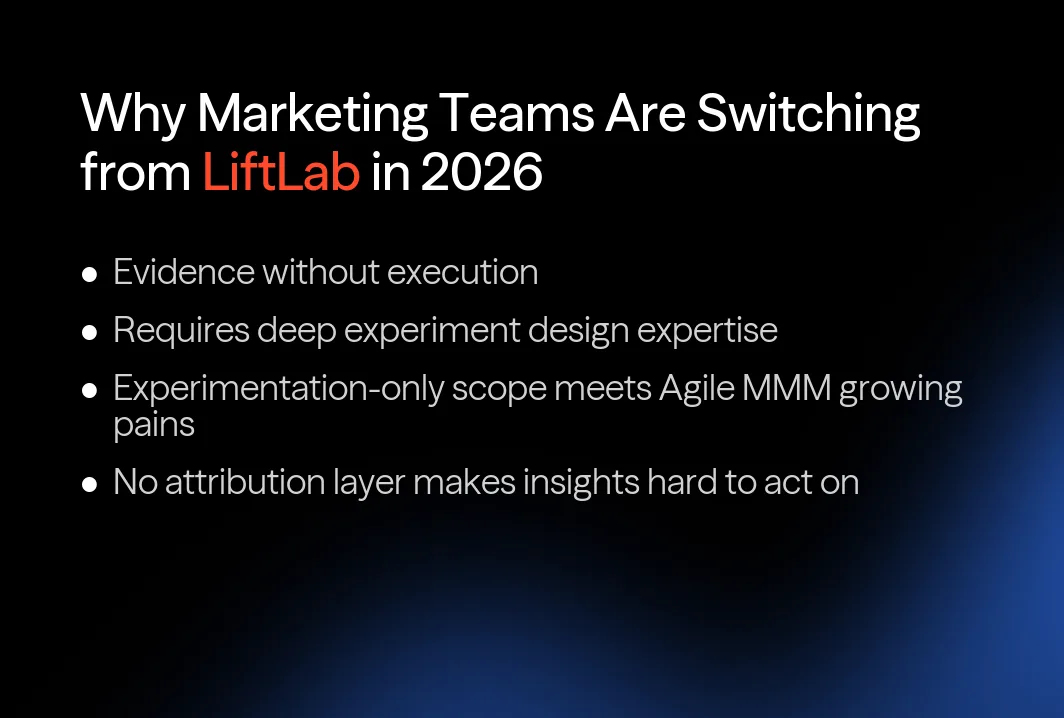
Four specific frustrations drive most LiftLab evaluations:
The Action Gap: Evidence Without Execution
LiftLab tells you which channels drive media incrementality. It won't tell you how much to reallocate, and it won't make the change for you. Teams end up building spreadsheet models to translate lift coefficients into budget shifts — a manual process that introduces delay, subjective interpretation, and often, organizational inertia. The experiment itself might be rigorous. The follow-through rarely is.
The Expertise Assumption
LiftLab assumes your team includes someone who understands quasi-randomized experimental designs, power analysis, minimum detectable effects, and synthetic control matching. Plenty of marketing teams don't have that person. Without them, experiment design quality drops, results become harder to defend, and the whole investment in causal measurement loses credibility with finance. This is especially acute for teams that adopted LiftLab's Agile MMM — interpreting Bayesian model outputs on top of experiment results demands even more statistical depth.
Experimentation-Only Scope Meets Agile MMM Growing Pains
Even with the Agile MMM expansion, LiftLab doesn't cover journey-level attribution or automated budget optimization. The MMM adds a modeling layer alongside experimentation, but it doesn't change the fundamental gap: there's no mechanism to act on what the models find. Teams using LiftLab still need separate tools for multi-touch attribution, potentially a second-opinion MMM provider, and manual processes for turning any of it into campaign-level budget decisions. That's a multi-vendor measurement stack stitched together with spreadsheets — and adding Agile MMM doesn't consolidate it.
No Attribution Layer Makes Insights Hard to Act On
LiftLab can run an experiment and prove a channel is incremental. But it doesn't provide attribution data showing which campaigns, creatives, or touchpoints within that channel actually drove conversions. Without that granularity, a positive lift result still leaves the media buyer guessing about where to increase or decrease spend. The experiment proves the channel works. It doesn't tell you which parts of the channel to optimize.
How This Comparison Was Created
This comparison is based on publicly available product documentation, G2 and Capterra user reviews, methodology white papers, and direct product analysis. Each tool was assessed against criteria specific to what LiftLab users care about: methodology rigor (controlled experiments vs. observational modeling vs. Bayesian MMM), expert support availability, whether the tool converts measurement into budget recommendations, measurement scope beyond pure incrementality, and target maturity ranging from growth-stage DTC to Fortune 500 enterprise.

Quick Comparison: 9 Best LiftLab Alternatives
| # | Tool | Core Methodology | Expert Support | Action Layer | Target Audience |
|---|---|---|---|---|---|
| 1 | SegmentStream | Geo holdouts + MTA + MMO | Senior specialists | Automated weekly | Brands $50K+/mo ad spend |
| 2 | Measured | Geo holdouts + synthetic control | Advisory team | Manual | Enterprise / CPG |
| 3 | Haus | Geo lift + Causal MMM | Self-serve | None | Growth-stage e-commerce |
| 4 | Recast | Bayesian MMM + GeoLift | Self-serve | None | Data science teams |
| 5 | Lifesight | MMM + geo experiments | Built-in tools | None | Global enterprise |
| 6 | INCRMNTAL | Always-on causal inference | Self-serve | None | Mobile / app / privacy markets |
| 7 | Paramark | Controlled experiments | Advisory team | Recommendations only | Growth brands ($5M–$100M spend) |
| 8 | WorkMagic | Automated geo experiments | Self-serve | None | Small Shopify DTC |
| 9 | Cassandra | Meridian Bayesian MMM | Self-serve | None | Analytics teams |
1. SegmentStream
Most teams evaluating LiftLab alternatives aren't looking to trade incrementality rigor for convenience. They want the same scientific rigor — geo holdouts, synthetic control matching, expert-designed experiments — plus the action layer that LiftLab never built.
SegmentStream is an agentic AI marketing measurement and optimization engine that unifies incrementality testing, cross-channel attribution, Marketing Mix Optimization, Predictive Lead Scoring, and Customer LTV Prediction in a single system. It doesn't just measure — it closes the loop from experiment result to budget change without a human translation step in between.

Why SegmentStream Is the Top LiftLab Alternative
Start with what matters most to LiftLab users: incrementality testing. SegmentStream runs the same rigorous geo holdout experiments — but with senior measurement specialists handling every step. They design the experiment, select markets, run MDE and power analysis, apply synthetic control matching, and interpret results. Teams don't lose any experimental rigor by switching. They gain expert oversight that most organizations can't staff internally.
Then SegmentStream goes where LiftLab can't. The Continuous Optimization Loop — Measure, Predict, Validate, Optimize, Learn, Repeat — takes validated experiment results and feeds them directly into weekly budget rebalancing across Google, Meta, and TikTok. No spreadsheet translation. No waiting for the next quarterly planning cycle. The experiment proves a channel is incremental, and the system acts on that proof.
And because attribution, incrementality, and Marketing Mix Optimization live in one place, there's a single source of truth. The attribution models show daily channel contribution. The incrementality experiments validate whether that contribution is causal. The optimization engine acts on the validated signals. One system, one consistent measurement framework — not three vendors producing conflicting numbers.
Core Capabilities
-
Geo holdout incrementality testing with expert oversight — Senior specialists design every experiment end-to-end, from market selection and MDE/power analysis through synthetic control matching and result interpretation. The same methodology rigor as LiftLab, with the statistical expertise included rather than assumed.
-
Multi-model attribution suite — First-touch, last paid click, last paid non-brand click, and customizable multi-touch attribution. The suite provides multiple lenses on channel contribution, with custom attribution modeling evaluating actual session-level behavioral signals behind each touchpoint — not just position and sequence like Google's DDA.
-
Conversion Modeling and Re-Attribution — Synthetic Conversions recover conversions lost to consent banner rejection and iOS ATT. Re-Attribution captures dark funnel influence from podcasts, influencers, and word-of-mouth through self-reported attribution powered by LLM analysis.
-
Automated weekly budget rebalancing — Validated measurement signals feed directly into campaign-level budget changes across Google, Meta, and TikTok every week. The system identifies which channels are over- or under-invested based on incrementality and attribution data, generates specific reallocation recommendations, and pushes changes to ad platforms after approval.
-
MCP Server for AI-assisted analysis — SegmentStream's MCP Server connects AI assistants like Claude, ChatGPT, and Gemini directly to the measurement engine. Marketing teams can query performance data, run attribution comparisons, and generate budget forecasts through natural language — without building custom dashboards or waiting for analyst availability.
G2 rating: 4.7/5 — See reviews
Customer review examples:
- "A one-of-a-kind attribution, optimisation and budget allocation tool."
- "The best attribution platform we've tried so far"
- "Backbone for performance marketing"
Strengths
- Same incrementality rigor, plus expert oversight — Runs the same geo holdout experiments LiftLab users rely on, but with senior specialists handling design, powering, and interpretation end-to-end. You don't lose rigor by switching — you gain it with dedicated expertise.
- Experiment-to-execution in one system — Geo holdout results feed into automated budget changes without a separate planning step or manual spreadsheet translation
- Transparent, CFO-auditable methodology — Every attribution model and experiment result can be traced and explained in a board presentation
- Click-time attribution accuracy — Reports on when the ad spend occurred (click-time), not when the conversion happened, enabling accurate ROAS and CPA calculation
- Full measurement coverage from one vendor — Attribution, incrementality, MMO, lead scoring, and LTV prediction reduce the multi-vendor stack to a single product
Limitations
- Minimum ad spend threshold — Designed for brands investing $50K+/month in paid media. Smaller operations won't qualify.
- Premium engagement model — High-touch expert model with dedicated measurement specialists means this is a strategic investment, not a low-cost monthly subscription
Target market: Performance marketing teams at brands spending $50K–$1M+/month who need measurement that converts into automated budget decisions — especially teams frustrated by the manual translation step between LiftLab's experiment reports and actual spend changes.
Summary: SegmentStream directly addresses the four pain points driving LiftLab evaluations: the action gap (automated budget execution), the expertise gap (senior specialists), the scope gap (unified measurement), and the attribution gap (campaign-level granularity that makes incrementality insights actionable). For teams that have outgrown experiment-only tools, it's the complete replacement — without sacrificing any incrementality rigor.
2. Measured
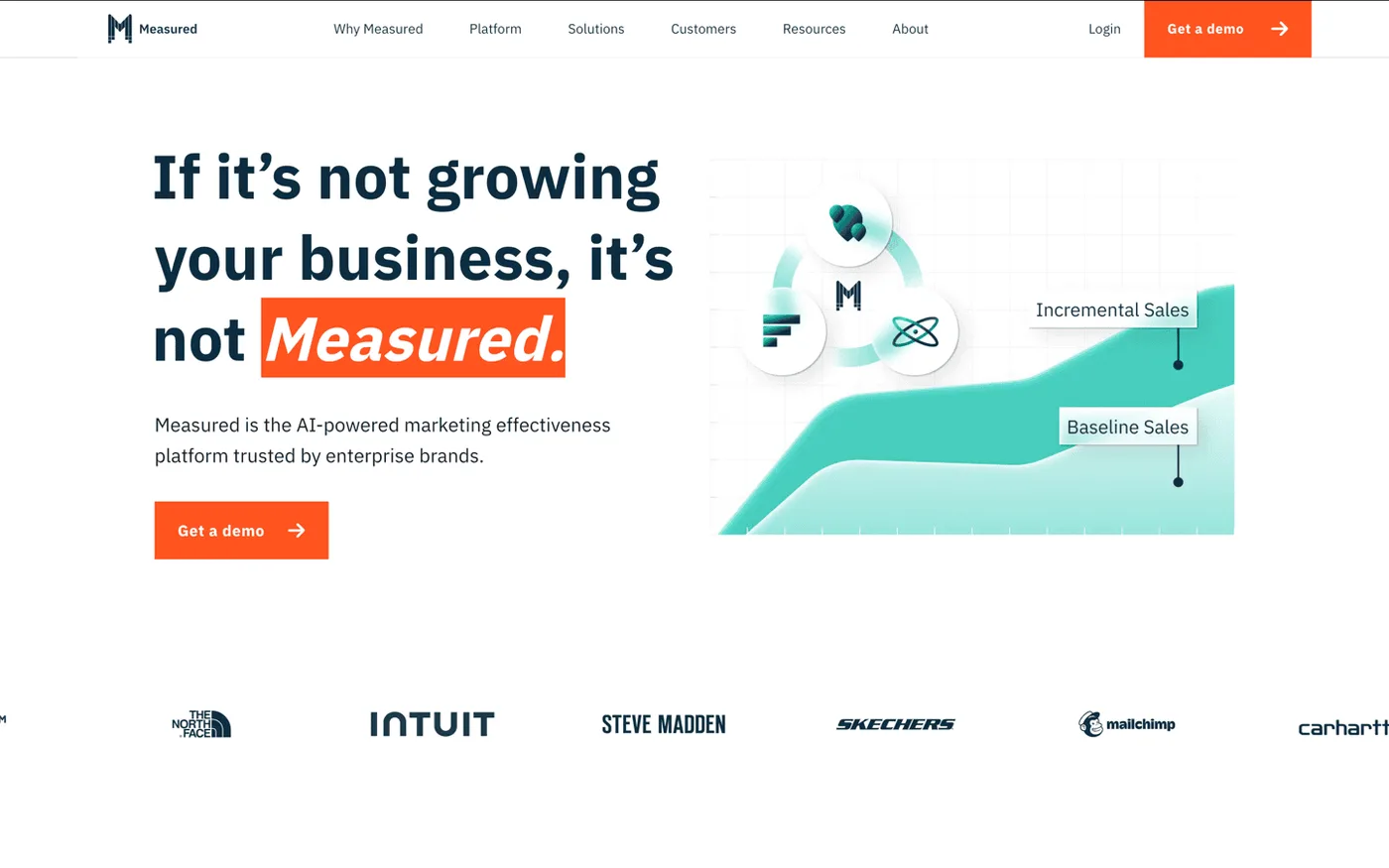
Your CFO wants to know how your incrementality results stack up against others in the same category. Measured's 25,000+ experiment calibration database — built primarily from CPG and retail brands — lets teams benchmark their lift results against industry baselines, not just against their own historical data. That cross-brand context is what sets it apart.
Measured runs large-scale geo holdout experiments using synthetic control matching for markets where pure randomized holdouts aren't feasible. The system handles multi-market coordination across dozens of global regions simultaneously, with the compliance infrastructure (security, audit trails, procurement documentation) that Fortune 500 organizations require before a vendor even gets evaluated.
Core Capabilities
- Synthetic control methodology — Constructs statistical replicas of test markets from combinations of control regions, enabling geo holdout experiments in situations where simple randomized splits aren't geographically feasible
- 25,000+ experiment calibration database — Cross-brand benchmarks accumulated from past experiments, predominantly in CPG and retail, providing context for whether a 12% lift is good or mediocre for a given channel in a given category
- Multi-market execution — Coordinates experiments across 30+ global markets simultaneously with centralized reporting
- Enterprise compliance infrastructure — Built for Fortune 500 audit, data governance, and procurement requirements without custom engineering work
Strengths
- Cross-brand calibration benchmarks — 25,000+ past experiments create a reference layer that contextualizes new results against industry-specific baselines
- Multi-market coordination at scale — Running experiments across 30+ markets simultaneously is operationally complex. Measured has standardized the infrastructure for global rollouts.
- Enterprise procurement-ready — Security, compliance, and audit trails meet Fortune 500 requirements without custom work
- CPG and retail category depth — Vertical expertise covering brand vs. performance dynamics in consumer goods, with category-specific benchmarks
Limitations
- Strategic planning cadence, not operational speed — Designed for quarterly and annual budget cycle reviews. Teams needing weekly signals to adjust next Monday's spend will find the output frequency too slow for performance marketing rhythms.
- Internal analytics capacity assumed — Outputs expect your team can interpret experiment reports and build their own campaign-level budget recommendations independently. There's no guided workflow for non-technical stakeholders.
- Channel-level insight ceiling — Incrementality results stop at the channel level. No journey-level attribution to identify which campaigns, creatives, or touchpoints drove specific conversions.
- CPG-concentrated reference database — The 25,000+ experiment calibration data skews toward consumer goods and retail. DTC, SaaS, and fintech teams get less relevant benchmarks.
Target market: Fortune 500 enterprises in CPG, retail, and global advertising with internal analytics teams and quarterly budget planning processes.
Summary: Measured is the enterprise incumbent for large-scale incrementality benchmarking. Its calibration database gives results cross-brand context from CPG and retail verticals. The gap for LiftLab switchers: results feed quarterly planning cycles, not weekly optimization decisions, and your internal team still owns the translation from experiment report to budget change.
3. Haus
Running a first geo lift experiment shouldn't require three months of setup and a PhD in statistics. That's the pitch behind Haus — and it lands with growth-stage e-commerce teams that want causal evidence but don't have the analytical bench depth that LiftLab assumes.
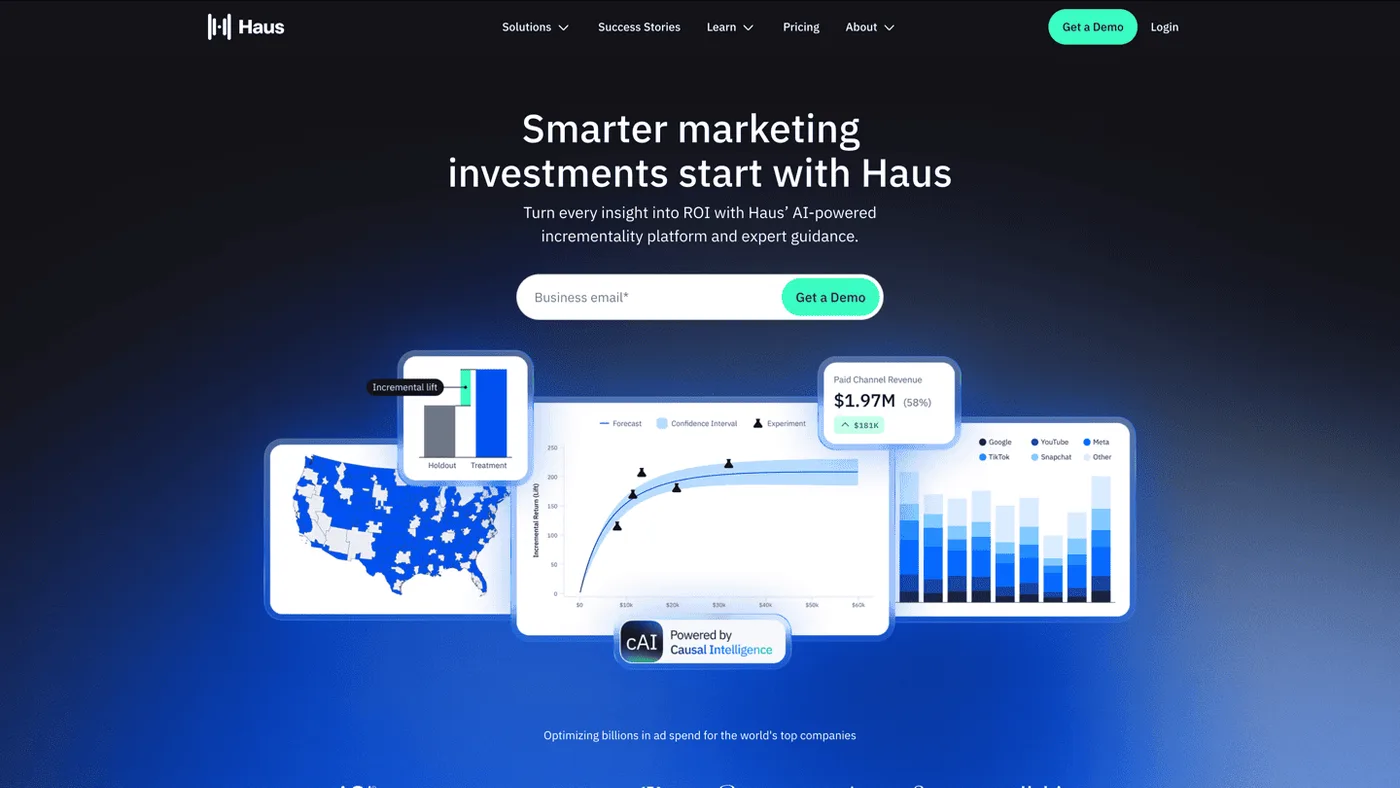
Haus streamlines the geo experiment workflow — market selection, test/control configuration, and regional reporting — through a visual interface designed for marketers. In October 2025, Haus expanded beyond pure geo experiments with Causal MMM and Causal Attribution products, signaling ambition to become a broader measurement tool. It's also privacy-durable by design: no PII, no pixels, GDPR-compliant from the start.
With $55.3M raised (including a Series B extension in April 2025), Haus has the runway to invest in product development. But runway and product maturity aren't the same thing.
Core Capabilities
- Streamlined geo experiment workflow — Gets teams from hypothesis to live experiment faster than tools requiring manual statistical design, with guided market selection and test/control setup
- Privacy-durable architecture — No PII, no pixel deployment. Works in strict European privacy regimes without consent infrastructure overhead.
- Causal MMM and Causal Attribution — Launched October 2025, extending Haus beyond pure geo experiments into modeled measurement and touchpoint-level insights
- Visual reporting for stakeholders — Results formatted for executive presentations without needing analyst interpretation before sharing
Strengths
- Low setup friction for first experiments — Teams without statistical backgrounds can configure and launch geo experiments through guided workflows, which directly addresses LiftLab's expertise barrier
- Privacy-first from day one — No PII collection means no consent infrastructure overhead in European markets. Compliance is structural, not configurational.
- Strong funding trajectory — $55.3M raised provides product development runway for the expanding Causal MMM and Attribution products
- Clean stakeholder-facing outputs — Results are formatted for executive presentations without needing analyst translation — a contrast to LiftLab's analyst-first reporting
Limitations
- Experiment design quality is entirely on you — No advisory layer reviews whether your power analysis, control group selection, or market matching are statistically sound. If you misconfigure an experiment, Haus won't catch it.
- Causal MMM and Attribution are early-stage — Both products launched late 2025 and don't yet have the multi-year validation track record of dedicated MMM tools or established attribution solutions
- Statistical depth has a ceiling — MDE calculations, power analysis options, and synthetic control methodology are more limited than what enterprise-grade solutions like Measured offer. Teams with complex multi-market designs may find the statistical controls insufficient.
- Walled-garden experiment scope — Strongest within Meta and Google's walled-garden experimentation environments. Cross-channel experiments covering programmatic, CTV, or offline channels are less developed.
Target market: Growth-stage e-commerce brands wanting accessible geo experiments without deep statistical investment or long implementation timelines.
Summary: Haus makes incrementality testing approachable for teams running their first walled-garden experiments. The tradeoff is depth: teams outgrowing basic geo lifts — or needing rigorous multi-market experimental designs and cross-channel measurement — will hit the ceiling before they find the floor.
4. Recast
Bayesian posterior distributions and credible intervals instead of point estimates. Weekly automated model refreshes instead of quarterly rebuilds. Full coefficient transparency instead of a black-box dashboard. Recast takes a structurally different approach than LiftLab — modeling-first rather than experimentation-first — and it's built for teams where a statistician sits between the tool and every budget decision.
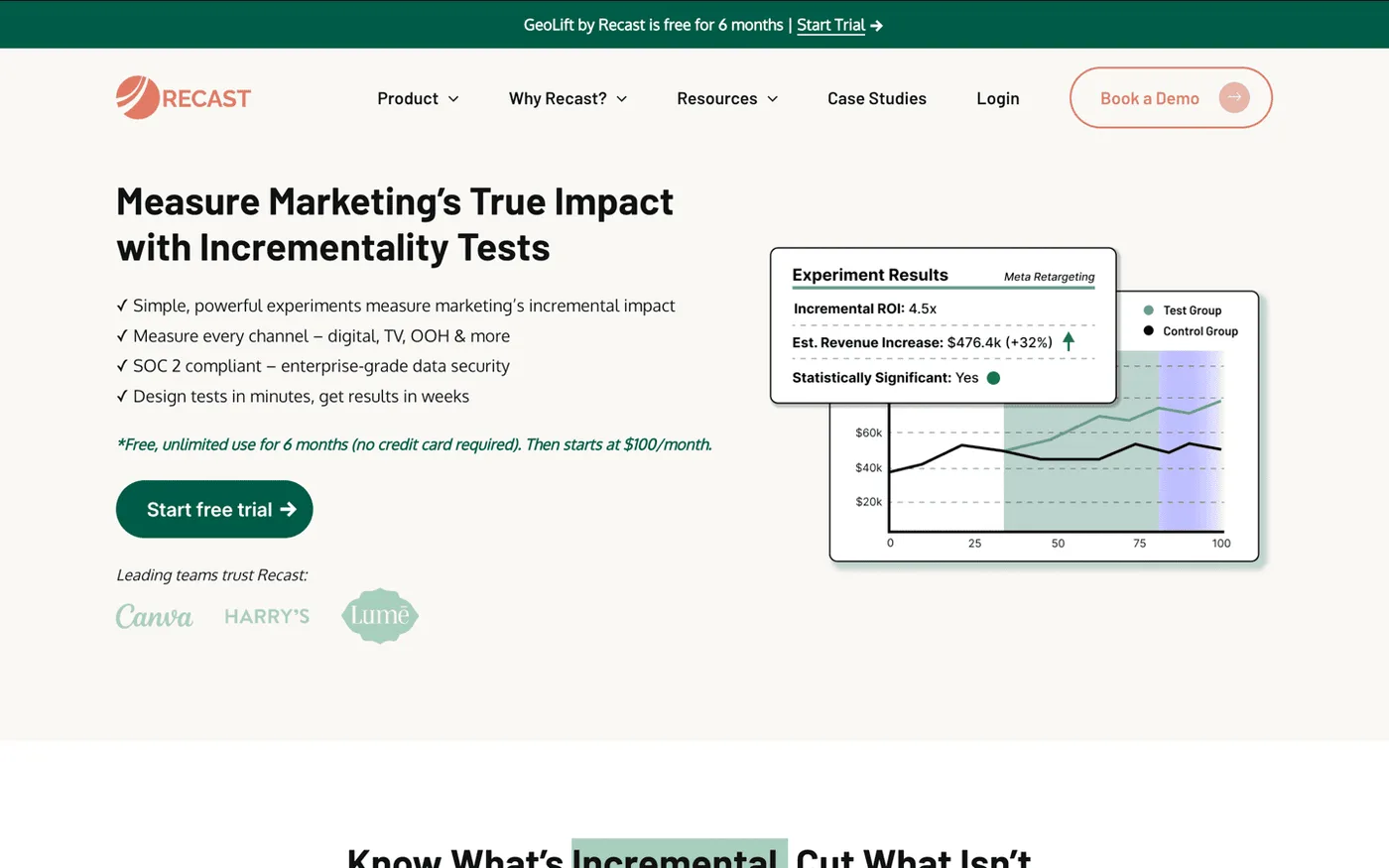
Recast's Bayesian MMM updates weekly on an automated cadence, keeping channel contribution estimates closer to current reality than traditional quarterly MMM rebuilds. Every estimate comes with full posterior distributions and uncertainty quantification — not point estimates. In September 2025, Recast launched GeoLift as a separate incrementality product designed to calibrate the MMM's priors with experimental evidence, creating a feedback loop between modeling and experimentation.
The result is a technically rigorous system where every coefficient and prior is fully auditable. There are no black-box elements hiding behind a dashboard. But that transparency comes with a prerequisite: someone on your team needs to know what they're looking at.
Core Capabilities
- Full Bayesian posterior distributions — Every channel contribution estimate comes with uncertainty quantification and credible intervals, not single-number point estimates
- Weekly automated model refreshes — The Bayesian model updates automatically, keeping outputs closer to current market reality than traditional quarterly MMM
- GeoLift incrementality calibration — Launched September 2025 as a separate product. Runs geo experiments specifically to calibrate MMM priors rather than as standalone causal tests.
- Full coefficient transparency — Bayesian priors and posteriors are exposed for inspection, audit, and modification by the data science team
Strengths
- Uncertainty quantification on every estimate — Confidence intervals let data science teams communicate risk alongside recommendations to stakeholders, rather than presenting single-point predictions
- Automated weekly cadence — Model refreshes run automatically, reducing the manual effort and analyst time required for traditional quarterly MMM rebuilds
- Complete model transparency — Every prior and posterior is auditable. The data science team can trace exactly how the model assigned credit and challenge any assumption.
- GeoLift strengthens the model — Incrementality experiment results calibrate Bayesian priors, creating a self-improving feedback loop between experimental evidence and modeled estimates
Limitations
- Every decision runs through the data science team — Interpreting Bayesian posteriors and translating them into media buying recommendations requires statistical fluency most marketing teams lack. The data science team becomes a mandatory bottleneck between model output and budget action.
- GeoLift is a separate product, not a unified workflow — Incrementality experiments and MMM are two products from the same company that don't fully integrate into one combined workflow. Teams run them in parallel, not as a single measurement process.
- Channel-level resolution only — Recast models contribution at the channel level. There's no journey-level attribution to show which campaigns, creatives, or touchpoints drove specific conversions.
- Model outputs inform conversations, not campaigns — The system produces estimates that feed strategic planning discussions, but generating specific campaign-level budget recommendations from Bayesian posteriors requires manual data science work outside the tool
Target market: Data science and analytics teams at organizations with in-house statisticians who value Bayesian rigor and model transparency over operational convenience.
Summary: Recast is built for the data science team's workflow, not the media buyer's. It produces rigorous Bayesian models with full transparency — and for teams with the statistical fluency to use it well, that rigor is the draw. The limitation for LiftLab switchers: every budget decision still requires a statistician to interpret posteriors and manually translate them into spend changes, which is a different version of the same human-bottleneck problem.
5. Lifesight
Global enterprises managing 15+ markets with fragmented measurement stacks sometimes evaluate Lifesight for its breadth of coverage. The suite bundles MMM, geo experiments, and causal attribution in a single enterprise interface — and for procurement teams tired of managing three separate measurement contracts, that consolidation has appeal.
Lifesight's multi-market architecture handles per-country deployment, with standardized data mapping across regions and local privacy configurations. The scenario planner includes saturation curves and marginal ROI modeling for annual and quarterly budget conversations. And the no-code experiment design lets marketing teams configure geo experiments with synthetic control matching through a visual interface, without writing statistical code.
But breadth and depth aren't the same thing. Lifesight covers a lot of ground — the question is whether any single module goes deep enough for teams accustomed to LiftLab's experimentation rigor.
Core Capabilities
- Bundled measurement suite — MMM, geo experimentation, and causal attribution in a single product, reducing vendor count for enterprise procurement
- Multi-market rollout architecture — Per-country deployment infrastructure designed for organizations operating in 15+ regions with localized privacy and data requirements
- Scenario planner — Saturation curves and marginal ROI modeling support annual and quarterly budget planning conversations
- No-code experiment design — Synthetic control matching and power calculations accessible through a visual interface without statistical coding
Strengths
- Vendor consolidation for enterprise — One product replaces separate MMM, incrementality, and attribution contracts, simplifying procurement and data governance
- Multi-market infrastructure — Per-country setup is standardized, reducing deployment overhead for truly global operations managing 15+ regions
- Non-technical experiment access — No-code interface lets marketing teams configure geo experiments without data science involvement or statistical coding
- Scenario planning for budget conversations — Saturation curves and marginal ROI projections support the annual and quarterly budget presentations enterprise CMOs need
Limitations
- Geo experiments calibrate the MMM, not operations — Experiments exist primarily to improve the marketing mix model's accuracy rather than producing standalone causal evidence teams can act on immediately. The experiment is a model input, not an operational decision tool.
- Attribution methodology isn't fully auditable — How causal attribution assigns credit across touchpoints isn't documented transparently enough for data science teams or CFOs who want to trace every assumption back to first principles
- Multi-market deployment complexity — Per-country data mapping, privacy configuration, and ETL requirements add significant implementation overhead before the first experiment runs. Teams evaluating this alongside LiftLab's faster setup should account for 3-6 months of deployment work.
- Breadth trades off against depth — Each module (MMM, experimentation, attribution) covers core functionality, but none goes as deep as dedicated single-purpose tools in that specific discipline
Target market: Enterprise brands operating across 15+ markets who need bundled measurement coverage and work within quarterly strategic planning cycles.
Summary: Lifesight's strength is consolidation — one contract covering MMM, experimentation, and attribution for global enterprises. The limitation for LiftLab switchers: its experimentation exists to feed the MMM rather than as standalone causal evidence, and the breadth-first design means each individual module is shallower than the dedicated tool it replaces.
6. INCRMNTAL
What if you can't run geo holdouts at all? Maybe your markets are too small for geographic splits, your app environment makes regional controls impractical, or privacy regulations block the experimental designs LiftLab requires. That's INCRMNTAL's niche.
INCRMNTAL estimates incrementality continuously by analyzing natural budget fluctuations as "micro-experiments," without requiring dedicated geo holdout periods. The tool is privacy-first by architecture: no PII, no pixels, GDPR-compliant by design. Originally built for mobile gaming environments where traditional tracking has structural limitations, it's since expanded into broader DTC and app-based businesses operating in privacy-restricted European markets.
The continuous cadence means teams get ongoing incrementality estimates rather than episodic per-experiment snapshots. There's no holdout market sitting dark. No campaign pauses for test periods. The measurement runs in the background while campaigns operate normally.
Core Capabilities
- Always-on causal inference — Estimates incrementality continuously by analyzing natural budget fluctuations as "micro-experiments," without requiring dedicated geo holdout periods
- No-PII, no-pixel architecture — GDPR-compliant by design. Built for environments where tracking infrastructure is minimal or restricted.
- Continuous measurement cadence — Ongoing incrementality estimates rather than episodic per-experiment snapshots, covering all active channels simultaneously
- Mobile gaming and app specialization — Built for mobile-first environments where user-level tracking and geographic holdouts are structurally impractical
Strengths
- Works where holdouts can't — Small-market environments, app ecosystems, and strict privacy jurisdictions where geo holdout experiments are operationally infeasible get an alternative path to incrementality measurement
- Zero campaign disruption — No holdout markets sitting dark, no spending suppression for test periods. Measurement runs alongside normal campaign operations without any revenue at risk.
- Privacy-compliant by architecture — No PII collection and no pixel deployment means no consent infrastructure overhead in European markets. Compliance is structural, not configurational.
- App and gaming expertise — The product was built from the ground up for mobile-first environments. Its default configurations reflect the tracking limitations specific to app ecosystems.
Limitations
- Observational estimates, not experimental proof — Causal inference from natural budget fluctuations is statistically less defensible than controlled experiments with true test/control randomization. A CFO will ask "was this a real experiment?" and the honest answer is no.
- Methodology documentation is limited — The AI-driven causal model isn't fully documented publicly, making it difficult for data science teams to audit how credit is assigned and what assumptions drive the estimates
- Mobile gaming DNA shapes everything — The product's architecture, default configurations, and reporting reflect mobile-first environments. E-commerce or B2B brands may find the interface and attribution logic aren't optimized for their conversion funnels.
- Pricing scales faster than expected — The base plan covers 2 KPIs and 5 channels. Broader measurement configurations that match what LiftLab users are accustomed to measuring increase cost significantly.
Target market: Mobile gaming companies, app businesses, and European DTC brands operating in privacy-restricted environments where controlled geo holdout experiments aren't practically feasible.
Summary: INCRMNTAL serves teams that can't run traditional holdout experiments. The tradeoff is evidentiary weight: observational estimates are harder to defend at the executive level than controlled experiment results, and its mobile gaming roots mean teams outside app-based businesses may find the fit less natural than expected.
7. Paramark
The marketing team says Meta is working. The finance team doesn't buy it. Sound familiar? Paramark targets that specific alignment problem with a structured "Paramark Method" — a five-step measurement framework that creates shared vocabulary between CMO and CFO conversations around causal evidence rather than ad-platform-reported metrics.
Paramark runs controlled test/control experiments (not observational modeling), producing the kind of causal evidence that finance teams accept. The advisory team helps interpret results, shape ongoing measurement strategy, and guide teams through the five-step process. And the scenario planner lets teams model budget shift outcomes before committing real spend changes.
Founded in 2023 with $8M in funding, Paramark is earlier-stage than most tools on this list. The customer base is smaller, the product is younger, and the advisory team is still scaling. But the core premise — using causal experiments to solve the marketing-finance trust problem — is specific enough to attract a dedicated audience.

Core Capabilities
- Controlled test/control experiments — True causal measurement producing defensible evidence, not modeled estimates. Designed to meet the evidentiary standard finance teams expect.
- Structured five-step framework — The "Paramark Method" creates a repeatable process that aligns marketing and finance teams around the same measurement vocabulary
- Advisory interpretation included — An advisory team helps interpret results, shape measurement strategy, and guide teams through the framework. Not pure software delivery.
- Scenario planner — Models budget shift outcomes before committing real spend changes, letting teams pressure-test recommendations before execution
Strengths
- Cross-departmental alignment focus — The structured framework gives marketing and finance teams a shared measurement language, reducing the internal friction that often blocks budget reallocation even when the data supports it
- Advisory guidance included — Not pure software delivery. The advisory team helps shape experiment design and interpret results, which addresses LiftLab's expertise gap for teams without in-house statisticians.
- Causal experimental evidence — Controlled test/control designs produce the kind of evidence finance teams accept. Teams don't need to explain or defend observational modeling assumptions.
- Pre-commitment scenario modeling — Teams can model the impact of budget shifts before executing changes, reducing the risk of large reallocations based on single-experiment results
Limitations
- Advisory dependency creates a bottleneck — Recommendation quality and delivery speed depend on advisory team availability and continuity. If your advisory contact changes, institutional context resets and measurement momentum stalls.
- No touchpoint-level attribution — By design, Paramark doesn't track which visits, campaigns, or creatives drove conversions. Measurement stays at channel level, which limits its usefulness for campaign-level optimization decisions.
- Earlier-stage product — Founded 2023 with $8M in funding. Smaller customer base than Measured, Haus, or Recast, with less production-grade validation at enterprise scale.
- Five-step framework assumes organizational patience — The structured methodology works well for teams with executive sponsorship and a multi-quarter measurement commitment. Teams that need answers in 30 days for an upcoming budget review will find the process timeline frustrating.
Target market: Growth-stage brands ($5M–$100M in paid media spend) where aligning marketing and finance teams around causal evidence is a priority.
Summary: Paramark's value proposition centers on solving the marketing-finance trust problem with causal experiments wrapped in a structured framework. For teams where internal alignment is the bottleneck, the approach is targeted and specific. The limitation for LiftLab users: it introduces a different dependency — the advisory team becomes your measurement pace-setter, and the framework's timeline may not match the speed your budget decisions require.
8. WorkMagic
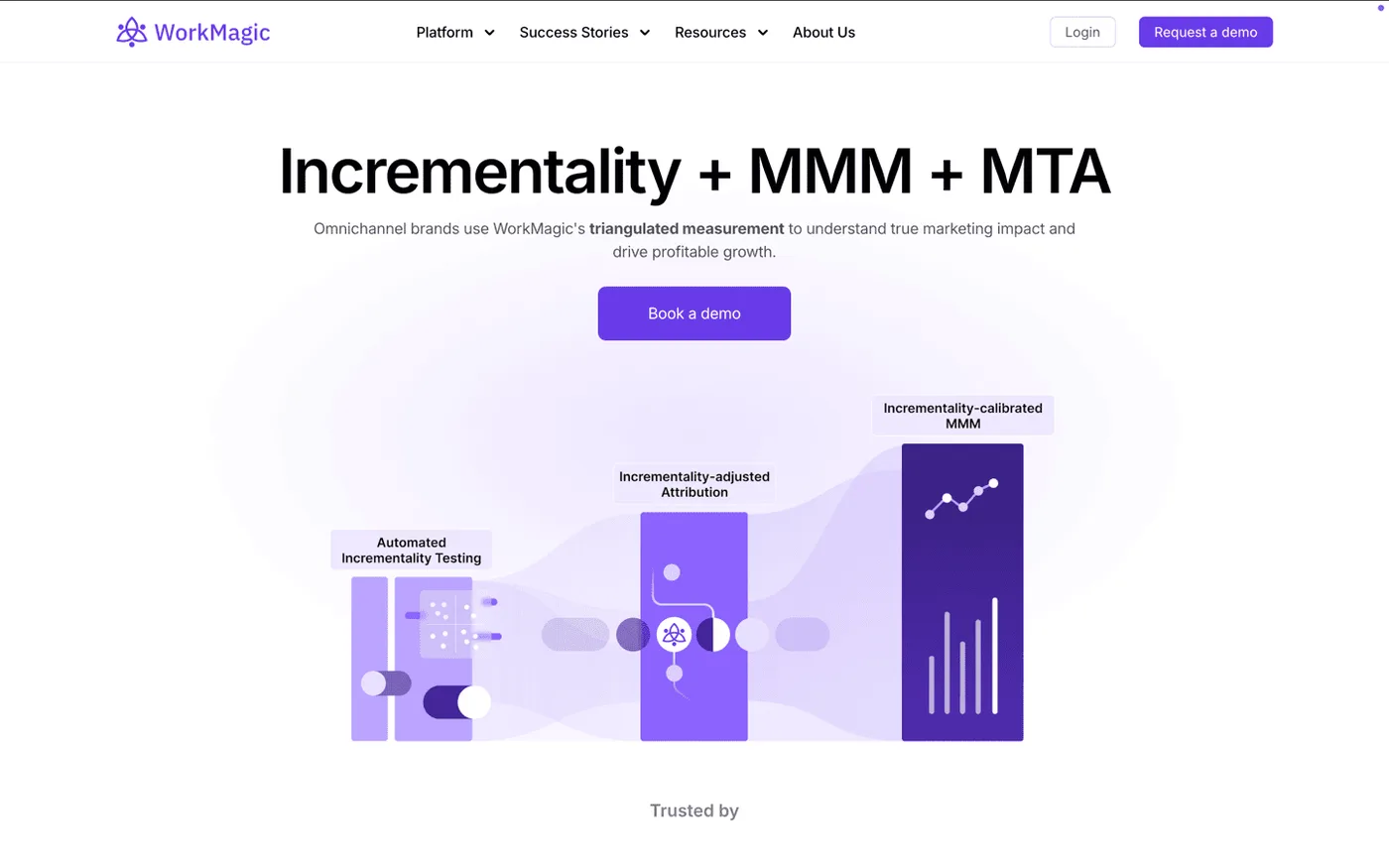
Shopify DTC brands spending under $100K/month on ads rarely have the budget for LiftLab or the statistical expertise to run experiments from scratch. WorkMagic targets exactly that gap — it's a Shopify-native tool combining automated geo experiments, MTA, and MMM starting at $29/month.
Install it from the Shopify App Store, connect your ad accounts, and the system handles market selection, test/control assignment, and results analysis without requiring manual statistical setup. WorkMagic also includes cross-channel spillover analysis to capture interaction effects between channels that isolated single-channel tests miss. For early-stage DTC brands that need something rather than nothing, the value proposition is clear: some incrementality evidence is better than none.
But "accessible" and "rigorous" don't always coexist. The automation that makes WorkMagic easy to use also limits how much control you have over experiment quality.
Core Capabilities
- Automated geo experiment workflow — Market selection, test/control assignment, and results analysis run without manual statistical setup or data science involvement
- Multi-methodology in one Shopify app — MTA, MMM, and incrementality testing bundled together at entry-level pricing, accessible through the Shopify App Store
- Cross-channel spillover analysis — Captures interaction effects between channels that isolated single-channel tests miss, providing a more complete picture of channel interactions
- Shopify App Store native — Direct Shopify integration eliminates ETL complexity and reduces implementation from weeks to hours
Strengths
- Lowest barrier to entry in the category — Incrementality testing at $29/month puts experimentation within reach for early-stage brands that would otherwise have no causal measurement at all
- Zero-expertise setup — Automated experiment design means teams without data scientists or statisticians can still run geo tests. The system handles the statistical configuration.
- Shopify-native integration — Direct connection to Shopify data eliminates ETL complexity and data mapping overhead
- Multi-methodology approach — Combining MTA, MMM, and incrementality in one app gives small brands measurement breadth that's usually only available at enterprise price points
Limitations
- Methodology hasn't been stress-tested — Very small installed base with no publicly verifiable reference customers at $100K+/month spend. No published validation studies or methodology white papers. Teams need to take the automated analysis on faith.
- Automated rigor sacrifices control — Simplified experiment design removes control over MDE calculation, power analysis thresholds, and region matching criteria. Experiment soundness is harder to verify because you can't inspect the statistical choices the automation made.
- Shopify only — No support for headless commerce, WooCommerce, Magento, or enterprise tech stacks. The product's ceiling is built into its architecture, which means teams scaling beyond Shopify will need to switch entirely.
- Results are difficult to trace — Automated conclusions don't expose the underlying calculations. You can't easily trace how a specific lift estimate was produced or challenge an assumption.
Target market: Small-to-mid Shopify DTC brands testing incrementality for the first time without significant ad budgets or in-house statistical expertise.
Summary: WorkMagic puts incrementality testing within reach for Shopify brands that would otherwise have no causal measurement. For that audience — early-stage DTC with limited budgets — the accessibility matters. Teams with $100K+ monthly spend or measurement requirements that need to withstand CFO scrutiny will need more methodological depth and transparency than WorkMagic currently provides.
9. Cassandra
If your analytics team already works with Google's Meridian framework — or wants the academic credibility that comes with peer-reviewed Bayesian methodology — Cassandra packages that foundation into a usable product. It combines Meridian-based Bayesian MMM with always-on incrementality measurement and real-time attribution covering both online and offline conversions.
The Meridian foundation gives Cassandra a built-in defensibility argument for stakeholder presentations: this isn't proprietary methodology that you have to trust on faith. It's Google's open-source framework, peer-reviewed and developed with academic rigor. The always-on incrementality measurement runs continuously alongside the MMM, so teams don't need a separate vendor for periodic experiments. And the real-time attribution outputs provide faster feedback cycles than traditional quarterly MMM cadences — useful for teams that want more responsive measurement but aren't ready to abandon Bayesian modeling.
For analytics teams comfortable with Bayesian methodology, Cassandra offers a way to productize Meridian without building the infrastructure from scratch. But productizing an open-source framework also means inheriting its constraints.

Core Capabilities
- Meridian-based Bayesian MMM — Built on Google's open-source framework, leveraging peer-reviewed academic methodology with ongoing community development and Google engineering support
- Always-on incrementality — Continuous measurement alongside the MMM rather than standalone episodic experiments, eliminating the need for a separate incrementality vendor
- Online and offline conversion measurement — Both digital and physical conversion events modeled in a single unified framework
- Real-time attribution outputs — Faster feedback cycle than traditional quarterly MMM cadence, providing more responsive channel contribution estimates
Strengths
- Academic credibility of Meridian — Google's peer-reviewed Bayesian methodology provides built-in defensibility for stakeholder presentations that goes beyond "trust our proprietary model"
- Continuous incrementality integrated with MMM — Teams don't need to manage a separate incrementality vendor. It's part of the same modeling framework, sharing data and methodology.
- Online and offline in one model — Retail and omnichannel brands measuring both store and digital conversions can model them in a single framework without stitching separate systems
- Faster output cycle than traditional MMM — Real-time attribution outputs give teams a more responsive feedback loop than waiting for quarterly model refreshes
Limitations
- Google's roadmap sets the ceiling — Cassandra's capabilities partially depend on what Google prioritizes for Meridian. If Google shifts Meridian's focus or slows development, Cassandra's feature pipeline slows with it — a dependency that independent tools don't carry.
- Bayesian model logic requires data science fluency — Auditing, validating priors, and tracing how the model assigns credit all require statistical expertise. Marketing teams without a data scientist can look at the dashboards but can't interrogate whether the model is right.
- Newer entrant with a smaller track record — As a newer entrant building on an open-source framework, Cassandra has fewer enterprise deployments and published case studies than established incrementality or MMM tools
- Offline attribution adds complexity — Modeling online and offline conversions together is powerful in theory, but requires clean offline data feeds (POS, CRM) that many organizations struggle to maintain consistently
Target market: Analytics teams with Bayesian modeling fluency who want the credibility of Google's Meridian foundation combined with continuous incrementality measurement.
Summary: Cassandra packages Meridian into a usable product with always-on incrementality and offline conversion support. For teams already invested in Bayesian methodology and comfortable with Google's ecosystem, it offers a productized path that avoids building Meridian infrastructure from scratch. Teams that need their measurement tool's roadmap to be independent of any third-party framework should weigh that dependency carefully.
How to Choose the Right LiftLab Alternative
Before opening demos, start with an honest assessment of what your team actually needs. These questions separate the actual requirements from the noise:
-
Is your problem the experiment — or what happens after? If your team gets good lift results but struggles to translate them into budget changes that actually happen, the measurement methodology matters less than the action layer. Look for tools where validated signals feed directly into campaign-level budget changes without a manual translation step.
-
Does your team have in-house statistical expertise? If you have a data scientist who understands experimental design, power analysis, and synthetic control matching, self-serve solutions work well. If you don't — and most marketing teams don't — you need a partner that provides measurement specialists who own experiment quality end-to-end. Otherwise, experiment design quality degrades over time and results lose credibility with finance.
-
Do you need incrementality only, or a unified measurement stack? If your current setup already has solid attribution and modeling covered by other tools, a dedicated incrementality solution might fill the gap. If you're stitching together three vendors and reconciling conflicting signals across different models and methodologies, consolidation into one system reduces both complexity and contradictions.
-
How fast do budget decisions actually happen at your company? Some organizations operate on quarterly budget cycles — the annual plan gets refreshed four times a year, and that's the pace. Others adjust channel budgets every Monday morning based on last week's performance. Tools built for quarterly cadences will frustrate teams with weekly rhythms, and vice versa. Match the measurement output frequency to your actual decision-making speed.
-
What's your ad spend level — and your team maturity? Enterprise solutions assume six-figure monthly budgets and internal analytics teams. Entry-level tools start at $29/month but have methodology and scale limitations that become apparent as spend grows. Match the tool to where you are now and where you'll be in 12 months — not where you were last year.
-
Are you evaluating just experimentation, or LiftLab's Agile MMM too? If you adopted (or considered) LiftLab's Agile MMM product, your alternative needs to cover both experimentation and modeling. A dedicated incrementality tool would only replace half of what LiftLab offers. Think about whether you need a system that handles attribution, incrementality, and optimization together — or whether separate best-of-breed tools for each discipline actually fits your team's workflow better.
Final Verdict: Best LiftLab Alternative in 2026
The core frustration driving LiftLab evaluations is architectural: it produces rigorous causal evidence and then leaves execution entirely to your team. Even with Agile MMM expanding LiftLab's scope, there's no mechanism to turn measurement into budget action.
-
SegmentStream is the clear top choice. It runs geo holdout experiments with senior specialists handling design and interpretation, provides journey-level attribution across multiple models, and converts validated measurement signals into automated weekly budget changes across ad platforms. For teams that want measurement that actually changes how they spend, it closes every gap LiftLab leaves open.
-
Measured brings enterprise-grade calibration data from 25,000+ experiments for Fortune 500 brands running multi-market tests at scale — but operates on a quarterly planning cadence, and your internal team still owns the translation from report to budget change.
-
Haus gets growth-stage teams to their first geo experiment through guided workflows and visual setup — though teams with complex multi-market designs or serious statistical requirements will reach its ceiling quickly.
The remaining tools — Recast, Lifesight, INCRMNTAL, Paramark, WorkMagic, and Cassandra — each serve narrower use cases covered in detail above.
FAQ: LiftLab Alternatives
What is the best LiftLab alternative for incrementality testing?
SegmentStream is the strongest LiftLab alternative for incrementality testing in 2026. It runs geo holdout experiments with senior measurement specialists handling design and interpretation, then converts validated results into automated weekly budget changes — the step that LiftLab's architecture doesn't cover. Measured and Haus also run controlled geo experiments for different audiences: enterprise benchmarking and accessible self-serve experimentation.
How does LiftLab compare to Measured?
Both run geo holdout experiments, but they serve different audiences. LiftLab offers broader experiment types (audience holdouts, quasi-randomized designs) while Measured brings 25,000+ calibration benchmarks from enterprise CPG and retail. SegmentStream addresses what both lack: a unified system where experiment results, attribution signals, and MMO work together and feed automated budget changes weekly.
What is geo holdout testing and how is it different from A/B testing?
Geo holdout testing splits geographic markets into test and control groups — ads run in test regions while control regions receive no advertising. Unlike user-level A/B testing, geo holdouts measure channel-level media incrementality without individual tracking or cookies. SegmentStream runs geo holdout experiments with expert-designed market selection and synthetic control matching for rigorous causal evidence.
Is LiftLab only for experimentation or does it also do MMM?
LiftLab has expanded beyond pure experimentation into what it calls "Agile MMM" — marketing mix modeling with faster refresh cycles than traditional quarterly MMM. However, SegmentStream offers a more complete approach: attribution, incrementality testing, and Marketing Mix Optimization combined in one system that turns measurement into automated budget decisions, which LiftLab's expanded scope still doesn't cover.
What do LiftLab competitors offer that LiftLab doesn't?
The biggest gap in LiftLab's architecture is the step between measurement and action. SegmentStream closes that gap by feeding experiment results and attribution data directly into weekly budget rebalancing across ad platforms. Other liftlab competitors differentiate in various ways: Measured adds enterprise calibration benchmarks, INCRMNTAL offers always-on measurement without holdouts, and Recast brings Bayesian modeling with full uncertainty quantification.
What is the difference between incrementality testing and marketing mix modeling?
Incrementality testing uses controlled experiments (geo holdouts) to measure whether a specific channel caused incremental revenue. MMM uses statistical modeling on historical data to estimate each channel's contribution to overall performance. SegmentStream combines both approaches — incrementality experiments validate what the models estimate — and adds journey-level attribution and automated optimization, connecting all three into a single decision-making framework.
Related Articles
- 10 Best Incrementality Testing Tools (2026) — Our full guide covering the incrementality testing market
- 9 Best Measured Alternatives & Competitors (2026) — Detailed breakdown for teams evaluating Measured
- Best MMM Software & Tools (2026) — For teams specifically exploring marketing mix modeling
- 9 Best WorkMagic Alternatives & Competitors in 2026
Ready to Go Beyond LiftLab?
LiftLab proves which channels drive incremental revenue. SegmentStream takes that proof and turns it into automated budget decisions — every week, across every ad platform, without the manual translation step.
Talk to a SegmentStream expert and see how geo holdout experiments, cross-channel attribution, and Marketing Mix Optimization work together in one system.
Book a demo to see how SegmentStream closes the gap between measurement and action.