
12 Best Recast Alternatives for Marketing Measurement in 2026
SegmentStream, Measured, Haus, Lifesight and 8 more Recast alternatives compared for marketing measurement and budget optimization.
Sophie Renn · 6 March 2026 · 40 min read

Updated for 2026
Quick Answer: The Best Recast Alternatives in 2026
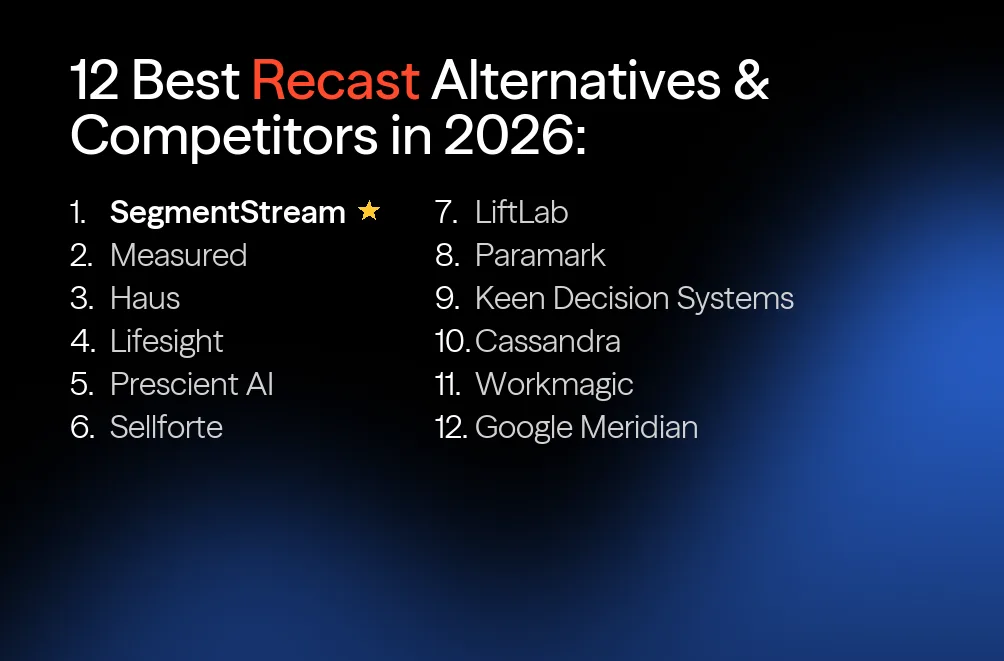
SegmentStream is the best Recast alternative in 2026 — the only platform that turns marketing mix modeling outputs into automated weekly budget changes across ad platforms, without a data science intermediary.
Other notable alternatives include Measured and Haus. This guide also explores Lifesight, Prescient AI, Sellforte, LiftLab, Paramark, Keen Decision Systems, Cassandra, Workmagic, and Google Meridian.
What Is Recast?
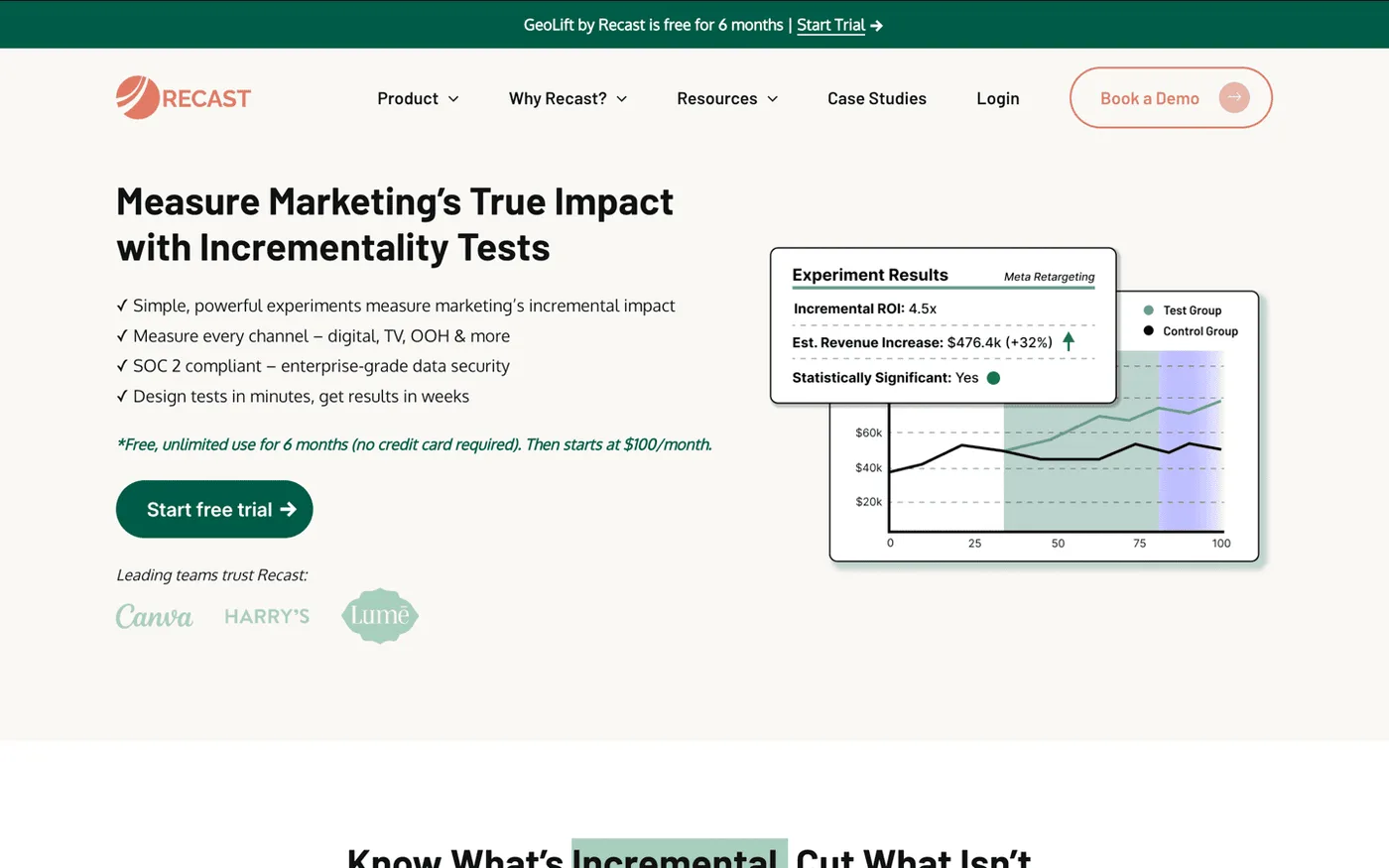
Recast is a Bayesian marketing mix modeling platform built for data science teams. Founded in 2019 and headquartered in the US, the company raised $3.4M in seed funding and targets brands that want to understand marketing effectiveness at the channel level.
The platform requires a minimum of 27 months of historical data — channel-level spend, revenue, and external factors like seasonality and promotions, uploaded weekly. Recast processes this through Bayesian inference to produce channel contribution estimates, saturation curves, and budget allocation scenarios. The model refreshes weekly, which is faster than the quarterly cadence most traditional MMM consultancies offer. Pricing is custom and requires a direct sales conversation — this is enterprise measurement, not a self-serve SaaS subscription.
Why Marketing Teams Are Switching from Recast in 2026
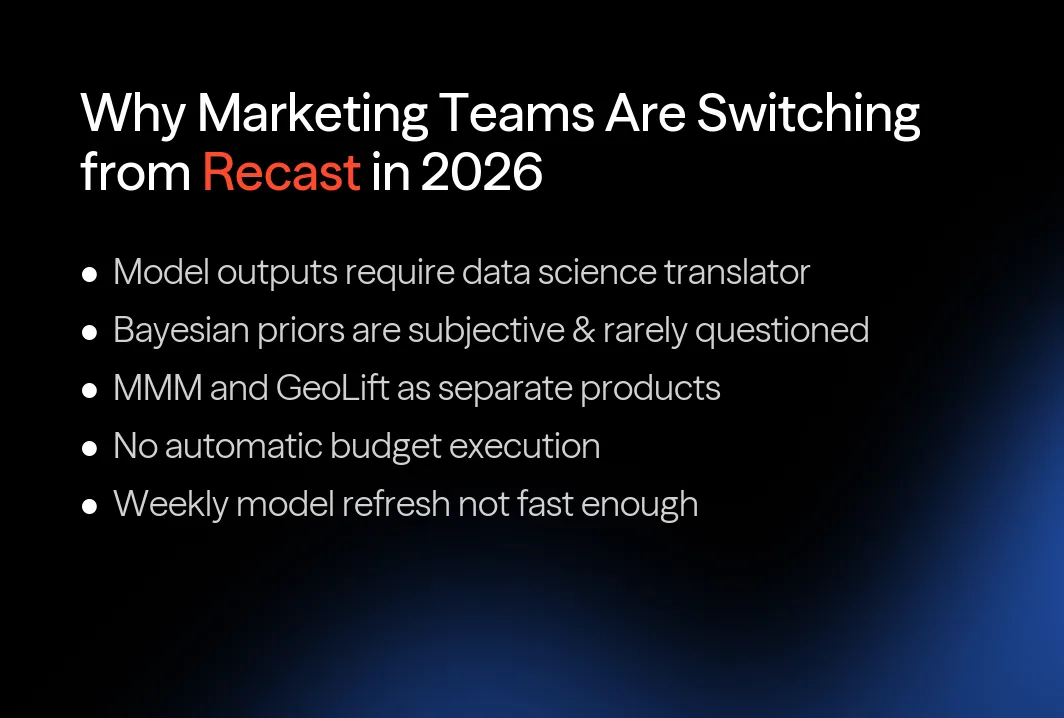
Recast carved out a niche as the transparent alternative to black-box MMM — weekly model refreshes, full posterior distributions, credible intervals your analyst can actually interrogate. For teams that wanted to see how the model works, it delivered something meaningfully different.
But a pattern keeps repeating. The model runs. The outputs arrive. And then nothing changes. Recast's own blog acknowledged this problem directly: "The MMM Worked. So Why Didn't Anything Change?" That question captures why teams start looking elsewhere. It's not that the model is wrong. It's that the model alone can't close the loop between measurement and budget action.
Three specific gaps keep surfacing.
Model Outputs That Require a Data Science Translator
Recast produces posterior distributions, credible intervals, and channel-level contribution estimates. That's useful — if you have a data scientist who can interpret what those distributions mean for next week's Google Ads budget. Most performance marketing teams don't. The output sits in a deck. Someone schedules a meeting. The data scientist explains what the model suggests. The marketing team debates whether to act on it. By the time budget actually moves, the market has shifted.
This isn't a flaw in Recast's statistical approach. It's a flaw in the workflow. Every budget decision requires a human intermediary who can translate Bayesian outputs into campaign-level actions. That bottleneck doesn't scale.
Bayesian Priors Are Subjective — and Rarely Questioned
Recast's Bayesian methodology requires setting priors before the model runs. Those priors encode assumptions about how marketing channels work — how quickly the effect decays, how strong the saturation curve is, whether channels interact. The quality of the model's output depends directly on the quality of those assumptions.
Good priors improve results. But poor priors systematically bias the outputs, and most marketing teams lack the statistical fluency to evaluate whether their priors are defensible. The result: model outputs that look precise and rigorous but rest on subjective assumptions that nobody audits. Your CFO sees a credible interval and assumes it means certainty. It doesn't.
MMM and GeoLift as Separate Products
In September 2025, Recast launched GeoLift as a standalone product — a separate geo lift testing tool priced starting at $100/month after a six-month free trial. That's a meaningful development for teams that assumed incrementality testing was part of the Recast platform.
Now, if you want both marketing mix modeling and geo lift experimentation, you're managing two products. Two interfaces. Two data pipelines. The MMM doesn't automatically incorporate experiment results, and the experiments don't feed directly into budget recommendations. Competitors that integrate both into a single measurement loop have a structural advantage here.
How This Comparison Was Created
Rankings are based on publicly available product documentation, published case studies, G2 and Capterra reviews, and live platform demos where available. Evaluation criteria: methodology approach (Bayesian MMM, incrementality-first, optimization-first), execution capability (automated budget changes vs. recommendations only), data science dependency, incrementality validation, and target audience fit.
Quick Comparison: 12 Best Recast Alternatives
| # | Tool | Methodology | Target Team | Incrementality | Auto Budget Execution | Pricing |
|---|---|---|---|---|---|---|
| 1 | SegmentStream | Marketing Mix Optimization + Attribution + Incrementality | Performance marketing | Yes (geo holdout) | Yes — automated weekly | Custom |
| 2 | Measured | Incrementality-first + MMM | Strategic planning / analytics | Yes (synthetic control) | No | Custom enterprise |
| 3 | Haus | Causal experimentation + Causal MMM | Digital marketing | Yes (geo lift) | No | Custom |
| 4 | Lifesight | Unified MMM + geo experiments + attribution | Enterprise strategy | Yes (synthetic control) | No | Custom enterprise |
| 5 | Prescient AI | Rapid ML-based MMM | Non-technical marketing | No | No | Custom |
| 6 | Sellforte | MMM with AI agents | E-commerce / DTC | No | Yes (AI agent, self-drive mode) | Custom |
| 7 | LiftLab | Agile MMM + geo-testing | Analytics teams | Yes (holdout-based) | No | Custom |
| 8 | Paramark | Incrementality + MMM + advisory | Growth teams | Yes (multi-format) | No | Custom |
| 9 | Keen Decision Systems | Adaptive Bayesian MMM + simulation | Mid-market to enterprise | Limited | No | Custom (annual) |
| 10 | Cassandra | Meridian-based Bayesian MMM + always-on incrementality | Technical marketing / analytics | Yes (continuous) | No | Custom |
| 11 | Workmagic | Incrementality-calibrated MMM + MTA | E-commerce / DTC | Yes (geo-incrementality) | No | Custom |
| 12 | Google Meridian | Open-source Bayesian MMM | Data science teams | No | No | Free (open-source) |
1. SegmentStream — Best Overall Choice
Most marketing mix modeling tools produce model outputs. Channel contribution estimates. Saturation curves. Budget allocation scenarios. All useful — in theory. In practice, those outputs land on a data scientist's desk, get interpreted over days or weeks, filter through a planning conversation, and maybe reach the campaign budget by next quarter.
SegmentStream doesn't produce MMM outputs. It produces budget changes. The platform takes a fundamentally different approach — Marketing Mix Optimization rather than Marketing Mix Modeling — and that distinction matters more than it sounds. Where MMM answers "what happened," Marketing Mix Optimization answers "what should we do about it" and then acts on it.
Why SegmentStream Is the Top Recast Alternative
1. Marketing Mix Optimization That Closes the Execution Gap
This is the core difference. SegmentStream models marginal returns for every campaign, identifies diminishing returns zones, forecasts optimal cross-channel budget scenarios, and recommends precise reallocations. Then it applies those changes across your ad platforms — automatically, weekly. No data scientist intermediary. No quarterly planning cycle. No deck-to-meeting-to-action lag. The system runs a continuous optimization loop: Measure, Predict, Validate, Optimize, Learn, Repeat.
2. Cross-Channel Attribution at the Journey Level
Recast operates at the channel level — it tells you that "Meta contributed X% of revenue" but can't show which specific campaign, ad set, or creative drove those results. SegmentStream provides journey-level attribution with multiple models: First-Touch, Last Paid Click, Last Paid Non-Brand Click, and customizable multi-touch attribution. The ML model evaluates behavioral signals within each session — engagement depth, key events, navigation patterns — to assign credit based on measured impact. Your team sees which individual campaigns work and which don't.
3. Incrementality Testing That's Built In — Not Bolted On
Where Recast launched GeoLift as a separate product, SegmentStream integrates geo holdout experiments directly into the measurement platform. Senior measurement specialists design each experiment with MDE (minimum detectable effect) calculations, power analysis, and synthetic control groups. Results feed back into the optimization engine — not into a separate data pipeline.
Core Capabilities
- Automated weekly budget rebalancing across ad platforms (directly addressing Recast's core gap: model outputs that require manual translation) — the Continuous Optimization Loop uses marginal ROAS analysis to autonomously shift spend toward the highest-return campaigns, functioning as an agentic AI framework that removes the manual translation step between model outputs and budget action
- MCP Server integration — AI assistants connect directly to the measurement engine for autonomous performance analysis and budget execution, with 100+ pre-built measurement skills
- Conversion modeling (no 27-month historical data requirement like Recast's Bayesian training) — GDPR-compliant probabilistic inference recovers lost conversions from consent gaps, so budget decisions aren't based on a shrinking slice of actual customer journeys
- Click-time revenue attribution — reports when the ad spend occurred, not when the sale closed, enabling accurate ROAS and CPA calculation that MMM tools can't match at the campaign level
- Cross-device identity graph — deterministic ID stitching and probabilistic matching connect fragmented visits into complete customer journeys across platforms
Strengths
- Full-loop optimization, not just measurement — the only platform in this comparison that models marginal returns, forecasts scenarios, and then pushes budget changes to ad platforms weekly. Every other tool stops before the last step.
- Expert partnership replaces data science dependency — senior measurement specialists (10+ years experience) design experiments, configure attribution, and manage the optimization loop. Customers include SimpliSafe and Eneco.
- Transparent methodology your CFO can audit — every model output, attribution decision, and budget recommendation traces back to its inputs. No Bayesian priors to debate, no black-box ML to trust on faith.
- Journey-level granularity — attribution reaches the campaign and creative level, not just the channel level that MMM provides. You see which specific ads drive marginal returns.
Limitations
- Premium investment — requires $50K+ monthly ad spend to be cost-effective. This is a strategic expert partnership, not a self-serve software subscription.
- Not a traditional MMM tool — teams specifically looking for Bayesian posterior analysis or academic-style MMM won't find that here. SegmentStream replaces the need for it.
Target market: Performance marketing teams spending $100K-$1M+/month on digital paid media who need measurement that directly drives budget decisions — not model outputs that require a data science team to interpret and implement.
Customer Review Examples
"A one-of-a-kind attribution, optimisation and budget allocation tool."
"Backbone for performance marketing"
G2 Rating: 4.7/5 on G2
Summary
SegmentStream takes measurement all the way to automated budget changes. Where Recast and every other tool on this list produce outputs that require human interpretation, SegmentStream runs a closed optimization loop — measure, predict, validate, optimize — weekly, across all ad platforms, without a data science intermediary.
2. Measured
Measured targets enterprise brands with large analytics teams and quarterly planning cycles. The company has accumulated 25,000+ experiment results across its client base — a benchmark database that provides calibration context whenever a new experiment runs. Its core strength is geo holdout testing with synthetic control methodology, targeting Fortune 500 brands in CPG, retail, and financial services.
Measured's approach starts with incrementality experiments: running controlled tests to isolate the causal impact of each marketing channel, then feeding those validated results into a broader media mix model. That experiment-first architecture is the key distinction from pure-modeling platforms like Recast, where the model produces estimates without controlled validation. For strategic planning teams that have 6-12 month budget cycles, this workflow produces the kind of evidence that satisfies procurement and finance. The tradeoff is timing — quarterly experiment cycles don't match the speed that performance marketing teams need for weekly budget decisions.
The company's vertical depth in CPG and retail reflects where the biggest media mix questions still live: TV vs. digital vs. in-store, national vs. regional allocation, promotional vs. brand spend. DTC-native brands or SaaS companies may find the playbooks and benchmark baselines less applicable to their marketing models.
Core Capabilities
- Geo holdout experiments with synthetic control — measures incremental lift by comparing test and control regions using matched synthetic baselines, then isolates causal impact from correlation
- 25,000+ experiment benchmark database — accumulated results across industries provide calibration context for new experiments and help set expectations for lift magnitude
- Experiment-first media mix modeling — incrementality results feed into the MMM as validated inputs, reducing the model's dependence on correlation-only estimates
- Multi-market capability — runs experiments across multiple geographies and markets simultaneously, useful for national brands with regional media strategies
- Enterprise compliance infrastructure — SOC 2, data governance, and audit trail for Fortune 500 procurement and legal requirements
Strengths
- Experiment-first architecture — starting with controlled incrementality tests before modeling gives the outputs a causal foundation that pure MMM platforms don't include
- CPG and retail vertical focus — deep experience in industries where media mix questions involve TV, print, digital, in-store, and promotional timing simultaneously
- Compliance infrastructure for enterprise procurement — SOC 2, data governance, and audit requirements that Fortune 500 legal and procurement teams expect
- Benchmark database for test calibration — 25,000+ accumulated experiment results help set realistic expectations before a new test runs
Limitations
- Quarterly planning cadence — experiment results flow into strategic planning cycles, not weekly operational decisions. By the time insights reach campaign budgets, market conditions have shifted. A team making weekly Google Ads adjustments won't find that rhythm useful.
- Requires internal analytics capacity — Measured provides measurement, but interpreting outputs and translating them into budget actions is the client's responsibility. Teams without dedicated analysts struggle to extract full value from the experiment data.
- Channel-level resolution — measures at the channel and platform level, not at the campaign or creative level. You'll know Meta is incremental but not which Meta campaigns are driving the lift — a meaningful gap for teams optimizing at the ad set level.
- CPG-concentrated expertise — DTC, SaaS, fintech, and subscription businesses may find the platform's playbooks and benchmarks less applicable. The experiment design templates and baseline expectations are calibrated for traditional retail media mixes.
Target market: Enterprise brands (primarily CPG, retail, financial services) with internal analytics teams, quarterly planning cycles, and $500K+ monthly media spend.
Summary
Measured brings enterprise-scale experimentation with an experiment-first architecture and deep CPG/retail vertical focus. The operational constraints are timing and scope: results arrive on a quarterly cadence, require analyst interpretation, and measure at the channel level rather than campaign level. Teams that need weekly budget adjustments or campaign-level granularity will find gaps between what Measured reports and where they actually make spend decisions.
3. Haus
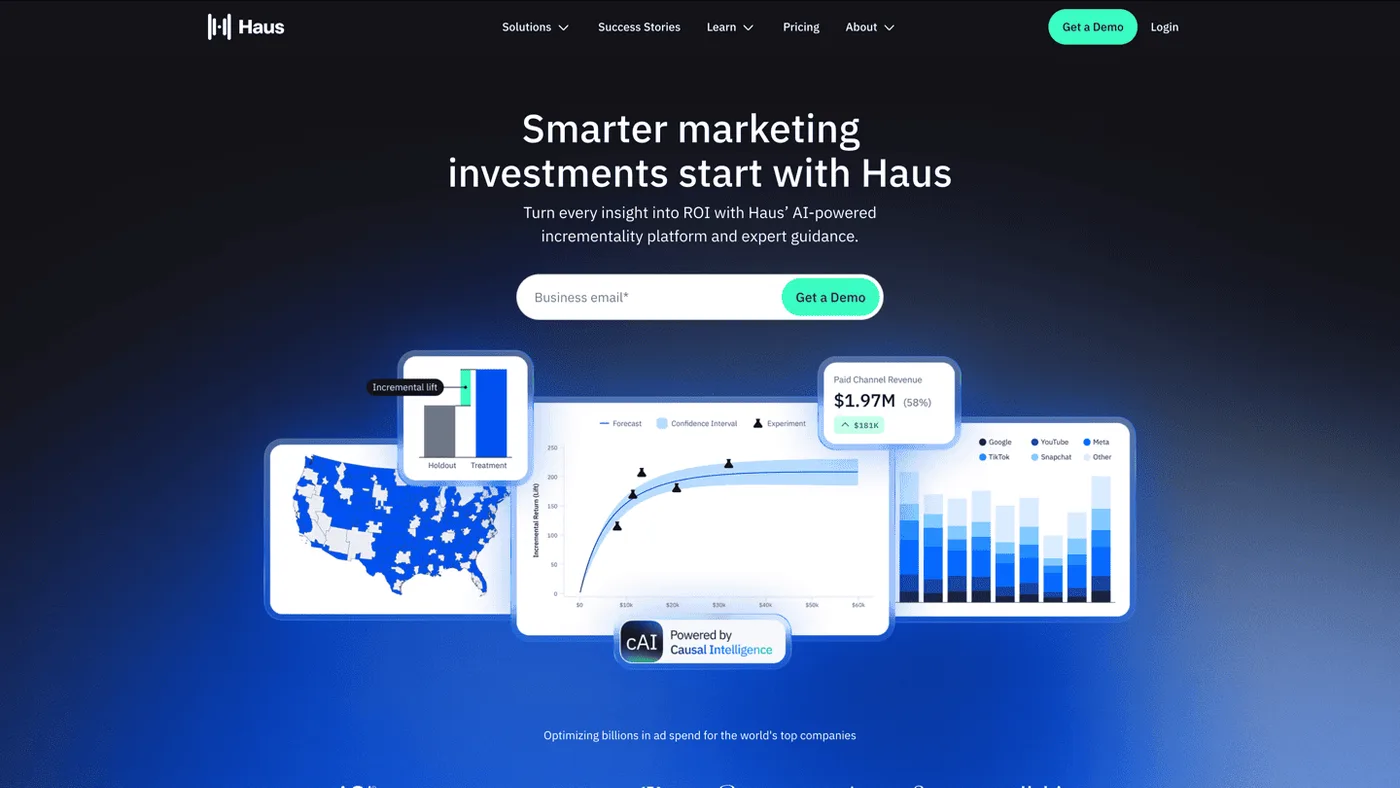
Where Measured targets enterprise strategic planning teams, Haus built its platform for digital-first brands that want to run geo lift tests without a months-long procurement process. The self-serve workflow lets marketing teams design and launch experiments faster than traditional enterprise measurement vendors typically allow.
In October 2025, Haus expanded beyond pure experimentation with Causal MMM and Causal Attribution — new products designed to complement its core geo lift testing. The newer products have less market validation than the core experimentation tool, and the company hasn't published case studies showing how the three products work together in practice. Total funding stands at $55.3M, including an $18.3M Series B extension in April 2025.
Core Capabilities
- Self-serve geo lift testing — accessible experiment design workflow for marketing teams, not just data scientists
- Causal MMM — launched October 2025, combining causal inference with marketing mix modeling
- Causal Attribution — touchpoint-level attribution grounded in causal methodology
- Privacy-durable measurement — no PII or pixel dependencies
Strengths
- Accessible experiment setup — the self-serve model removes the procurement and consulting bottleneck that enterprise measurement vendors impose, letting teams launch tests in days rather than months
- Privacy-first architecture — operates without PII or tracking pixels, which addresses growing consent challenges
- Expanding measurement suite — Causal MMM and Causal Attribution add methodology breadth beyond the core geo lift testing product
Limitations
- Self-serve means self-directed — experiment design quality depends entirely on the team running it. Without expert oversight, there's real risk of underpowered tests, poorly matched control groups, or misinterpreted results.
- New products haven't been battle-tested — Causal MMM and Causal Attribution launched in late 2025. Limited production deployments mean limited evidence of reliability at scale.
- Experiments run in isolation from ongoing budget decisions — each geo lift test produces a one-time lift estimate, but there's no continuous feedback loop connecting experiment results to weekly spend allocation. Teams run a test, get a number, and then manually decide what to do with it.
- Limited MDE and power analysis controls — less sophisticated experiment design tooling compared to enterprise-grade platforms with dedicated measurement science teams
Target market: Digital-first brands spending $100K+/month that want fast, accessible geo lift experiments without enterprise sales cycles or consulting engagements.
Summary
Haus makes geo lift experimentation accessible to marketing teams that don't want to wait months for an enterprise vendor to scope a test. The tradeoffs are depth and follow-through: experiment design quality rests on the team's own expertise, the newer Causal MMM and Attribution products need more market validation, and there's no mechanism to carry experiment results into automated budget changes.
4. Lifesight
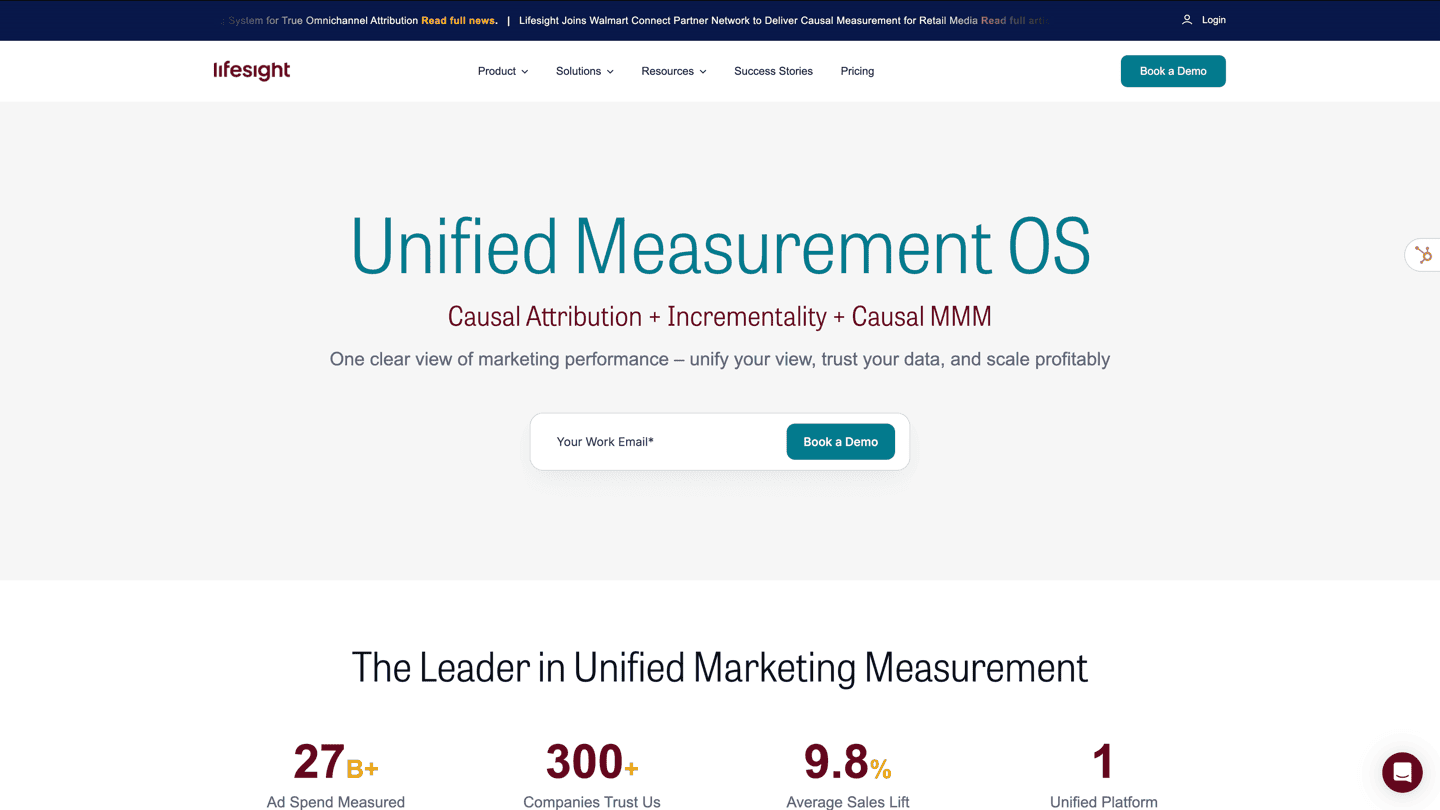
For global enterprises running media across 15+ countries, Lifesight offers a unified measurement platform that bundles MMM, geo experimentation, and causal attribution in a single system. The multi-market architecture is the distinguishing feature — deploying measurement models per country or region while maintaining a global view that headquarters can use for portfolio-level allocation.
Lifesight's primary value shows up during annual and quarterly planning cycles. The scenario planner models budget reallocation across markets using saturation curves, letting strategic planning teams compare "what if" scenarios before committing. For a multinational CPG brand running media in 20 countries, having one platform that models all of them — with localized calibration per market — removes the need for separate MMM engagements in each region.
But "optimization" here means producing scenarios and plans — not executing budget changes. Implementation still flows through the marketing team's existing processes. A performance marketing manager in Germany making weekly Meta budget decisions won't find the quarterly planning cadence responsive enough for their workflow.
Core Capabilities
- Multi-market MMM deployment — measurement models configured per country with localized calibration and global rollup for portfolio-level reporting
- Geo experimentation — no-code experiment design with synthetic control matching across markets, available as both standalone tests and MMM calibration inputs
- Scenario planner — saturation curves and budget simulation for strategic planning across channels and geographies
- Enterprise data governance — compliance and security infrastructure for multinational deployments with regional data residency requirements
Strengths
- Multi-market coverage — handles 15+ country deployments with localized measurement models and centralized reporting, useful for brands that would otherwise need separate MMM vendors per region
- Unified methodology bundle — MMM, experimentation, and attribution in one platform reduces vendor count for enterprise procurement teams managing complex RFP processes
- Scenario planning with saturation curves — gives strategic planning teams a quantitative framework for budget allocation conversations, grounded in modeled diminishing returns per channel per market
Limitations
- Scenario planning outputs locked in quarterly cadence — the planner generates budget reallocation scenarios on a quarterly or annual cycle, disconnected from the real-time spend adjustments that performance marketing teams make daily or weekly across ad platforms
- Attribution methodology lacks transparency — limited public documentation on how credit is assigned at the touchpoint level. Teams wanting to audit the attribution logic will find less visibility than expected for a platform at this price point.
- Deployment complexity per market — each new country requires configuration, data pipeline setup, and calibration. Scaling from the first 5 markets to 20 takes significant time and internal resources, even with vendor support.
- Incrementality serves the MMM model — geo experiments primarily calibrate the marketing mix model, not standalone operational decisions about specific campaigns. Teams that want per-channel incrementality answers independent of the MMM won't get that here.
Target market: Global enterprises with marketing spend across 15+ countries that need centralized measurement for strategic planning — CPG, financial services, and FMCG verticals.
Summary
Lifesight solves a real problem for multinational enterprises that need measurement across many markets in one platform. The constraint is speed and actionability: outputs serve quarterly planning cycles, attribution methodology isn't fully transparent, and there's no automated path from scenario planning to budget execution.
5. Prescient AI
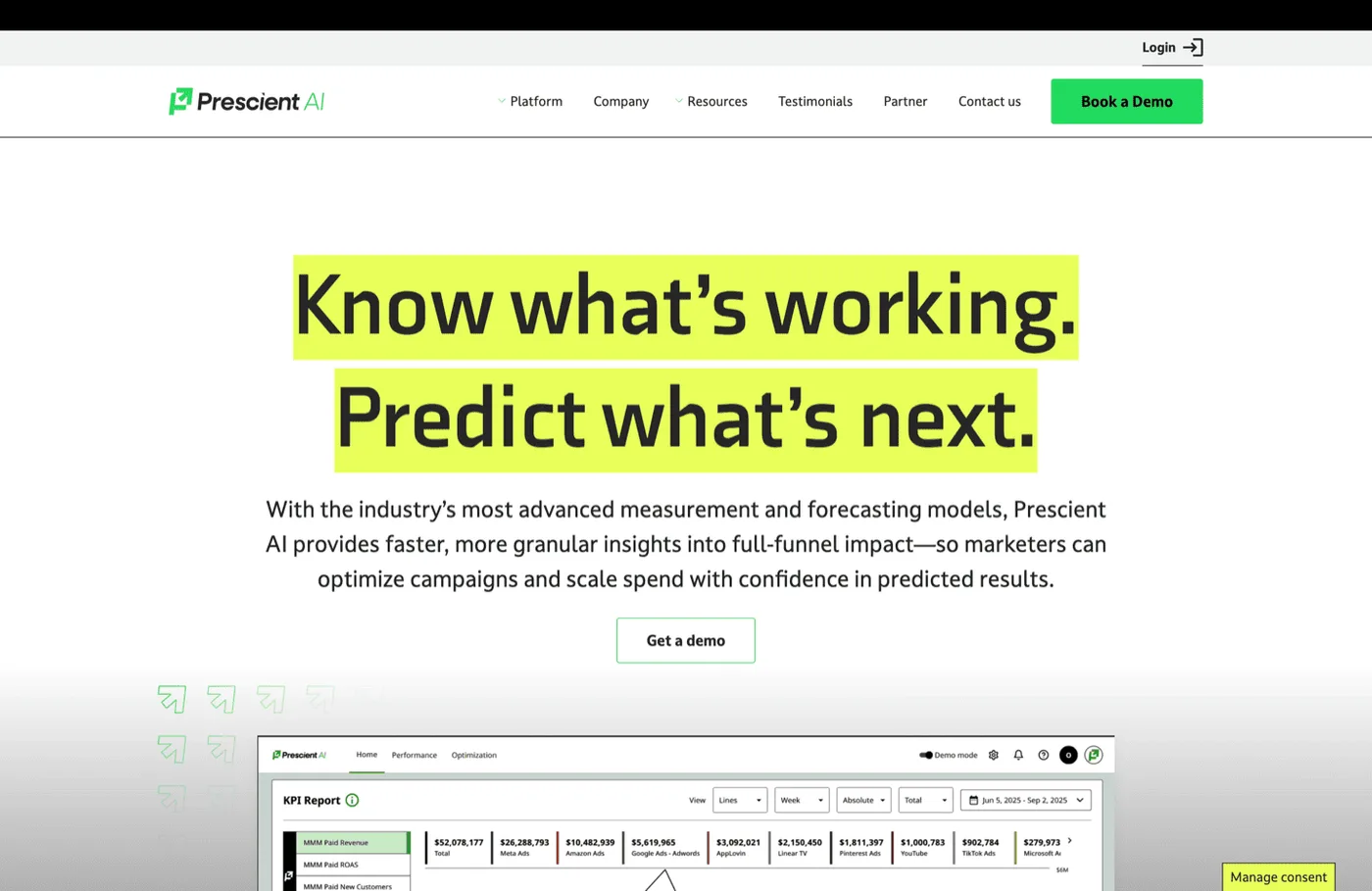
What if you could skip the months-long MMM onboarding entirely? That's Prescient AI's pitch: campaign-level modeling outputs within 36 hours, daily model refreshes, and a self-service interface designed for marketing teams — not data scientists. The platform collapsed the traditional MMM timeline from months to days by trading Bayesian statistical rigor for ML-driven speed.
The appeal is obvious for mid-market brands that can't afford a six-month MMM implementation. Connect your ad platforms, wait a day, and start seeing campaign-level contribution estimates alongside channel-level modeling. The daily refresh cadence means the model reacts to performance shifts much faster than weekly or quarterly alternatives — useful for brands running flash sales, seasonal promotions, or rapid creative testing where last month's model is already stale.
Where Prescient draws the line is validation. The ML models produce estimates, but there's no controlled experimentation layer underneath them. The outputs are correlational: the model observes patterns between spend and outcomes and estimates contribution. That's different from causal measurement, where a holdout experiment proves that a specific channel actually drove incremental revenue. For teams that need to justify budget decisions to a CFO who asks "how do you know this isn't just correlation?" — that gap matters.
Core Capabilities
- Rapid MMM deployment — campaign-level outputs within 36 hours of data connection (dependent on data quality and completeness of integrations)
- Daily model refresh — more frequent updates than the weekly cadence most MMM tools offer, allowing faster reaction to performance shifts
- Campaign-level granularity — modeling reaches deeper than channel-level, closer to where budget decisions actually happen in most marketing orgs
- Self-service onboarding — designed for marketing teams with no data science resources, with guided setup for ad platform connections
- Scenario planning — budget reallocation modeling with projected outcomes per channel, updated daily as the underlying model refreshes
Strengths
- Speed of activation — for teams tired of waiting months for MMM results, the compressed timeline removes a major adoption barrier. Brands that need directional guidance before next quarter don't have to wait.
- Campaign-level depth — going beyond channel-level attribution toward campaign-specific insights gives marketers actionable information closer to where they actually make spend decisions
- Accessible to non-technical teams — the self-service workflow removes the data science dependency that makes tools like Recast difficult for marketing teams to use directly
- Daily refresh cadence — the model adjusts to performance shifts faster than weekly or quarterly tools, which matters during high-velocity periods like seasonal campaigns
Limitations
- No causal validation — the ML models produce estimates, but there's no controlled experimentation layer to verify whether those estimates reflect real-world incremental impact. Correlation-based modeling without holdout validation carries meaningful risk for high-stakes budget decisions.
- ML methodology isn't fully explainable — the models that produce the fast outputs are harder to audit than traditional Bayesian approaches or transparent attribution. When a CFO asks why the model credits TikTok with 30% of conversions, the answer involves ML weights, not a traceable causal chain.
- Recommendations stop at the dashboard — Prescient shows where to move budget, but actually moving it across Google Ads, Meta, TikTok, and other platforms is still manual. That translation step is where most marketing teams lose momentum.
- "36 hours" depends on data quality — the speed claim assumes clean, complete data connections. Messy real-world data pipelines — missing UTM parameters, delayed revenue attribution, incomplete CRM syncs — can extend this significantly.
Target market: Non-technical marketing teams that want MMM-style insights without the data science overhead, and prioritize speed over methodological transparency.
Summary
Prescient AI trades statistical rigor for speed, which works for teams that need directional guidance quickly and don't have data scientists on staff. The lack of experimental validation and the harder-to-audit ML methodology are the tradeoffs — outputs are estimates without causal proof, and there's no automated path from those estimates to budget action.
6. Sellforte
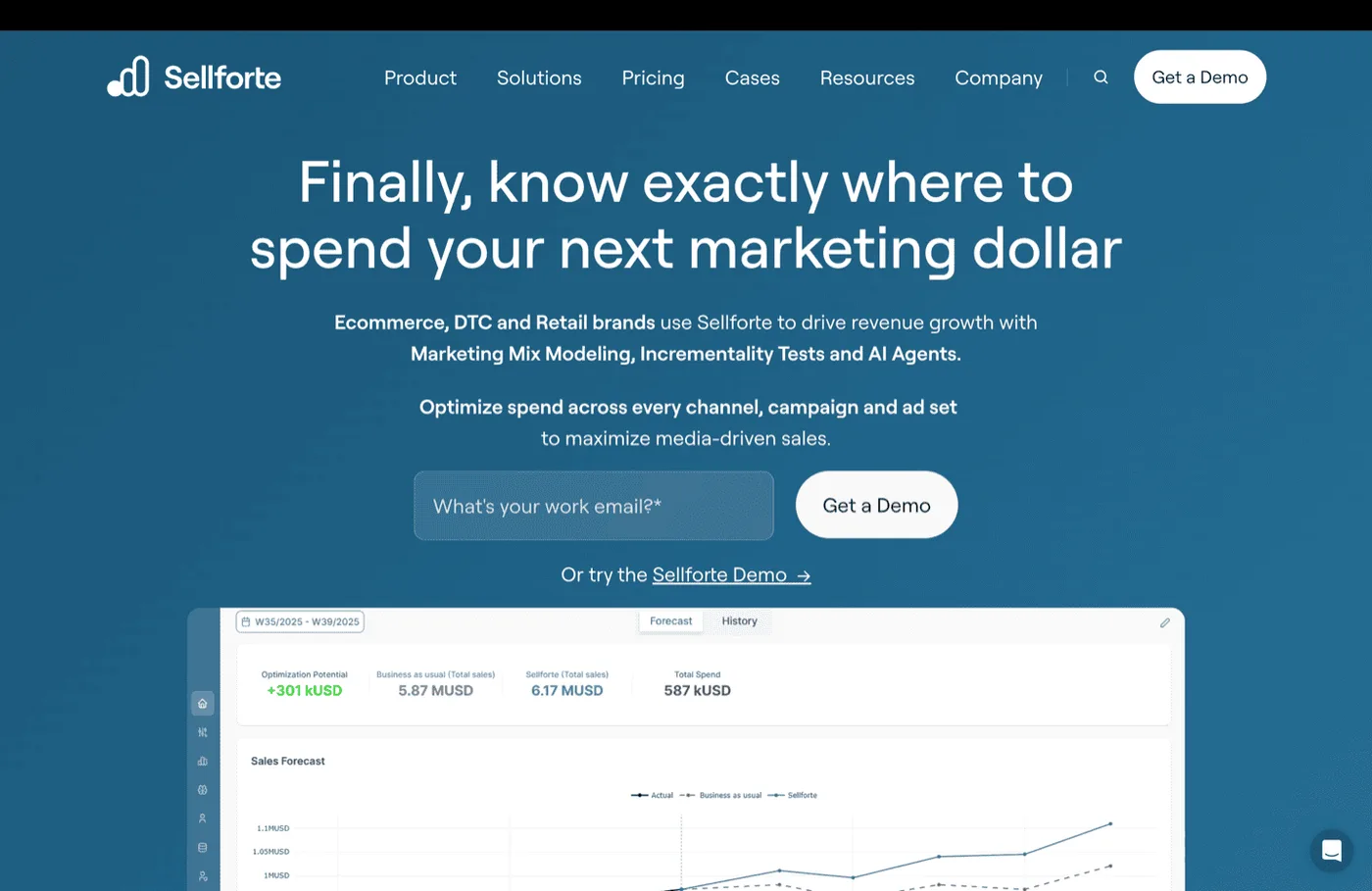
Sellforte takes a different approach to the execution problem: AI agents. The Finnish MMM platform built three autonomous agents — Media Planner, Media Buyer, and Experiments Agent — designed to translate model outputs into spend and bidding recommendations at the campaign and ad set level. Daily sales forecasts replace the quarterly refresh cycle that most MMM platforms operate on.
The agent-based architecture is distinctive but raises questions. The Media Buyer Agent can operate in full self-drive mode — executing budget changes directly inside Meta, Google, and TikTok without human approval — or in an assisted mode where changes require review before going live. The decision logic behind those autonomous changes isn't fully documented, so teams can't always trace why a specific budget move was made. For marketing leads who need to explain individual budget decisions to their CFO, that's a gap worth understanding before committing.
Core Capabilities
- Three AI agents — Media Planner (scenario planning), Media Buyer (campaign-level recommendations), Experiments Agent (testing suggestions)
- Daily sales forecasts — more frequent model updates than weekly or quarterly alternatives
- Campaign and ad set level recommendations — deeper granularity than channel-level MMM
- E-commerce and DTC specialization — built around retail and direct-to-consumer use cases
Strengths
- Agent-based budget suggestions — three AI agents generate campaign-level spend recommendations, with an optional autonomous mode for teams that want hands-off execution
- Daily forecast cadence — marketing teams get fresher insights than the weekly or quarterly cycle most MMM platforms offer
- E-commerce vertical focus — models calibrated for DTC and retail purchase patterns and seasonal dynamics
Limitations
- AI agent decision logic is a black box — the agents produce recommendations and can execute autonomously, but the reasoning behind each decision isn't fully documented. Teams that need to justify budget decisions to their CFO face a transparency gap.
- Channel-level attribution only — no journey-level attribution at the touchpoint level. You'll see channel contributions but can't trace individual customer paths.
- No experimental validation of model outputs — the models produce estimates but there's no incrementality testing layer to confirm whether those estimates hold in practice
- Limited enterprise scale — roughly 36 employees and an estimated $3M ARR as of early 2026. Larger enterprises may have concerns about vendor stability and support capacity.
Target market: E-commerce and DTC brands that want faster MMM with campaign-level recommendations, and are comfortable with AI-driven budget changes without full transparency into the decision logic.
Summary
Sellforte's AI agent framework attempts to address the execution gap with autonomous budget changes. The Media Buyer Agent can shift spend across Meta, Google, and TikTok without manual intervention. The open questions are transparency and validation: the decision logic behind those autonomous changes isn't fully documented, and there's no incrementality testing layer to confirm the agent's budget moves reflect actual causal impact rather than modeled correlation.
7. LiftLab

LiftLab targets teams with strong internal analytics capacity and a preference for experimentation-grounded MMM. The platform combines agile marketing mix modeling with integrated geo-testing — holdout-based experiments designed to calibrate the MMM outputs with real-world causal evidence rather than relying on correlational estimates alone.
A weekly dashboard provides more operational visibility than the quarterly reports that traditional MMM consultancies deliver. LiftLab also includes forecasting capabilities that model the revenue impact of budget reallocation across channels, and supports both randomized and quasi-randomized holdout designs to accommodate channels where pure randomization isn't feasible (like TV or out-of-home where you can't randomly assign individual users).
The constraint is internal capacity. This is a tool built for analytics teams that know how to design sound holdout experiments, interpret statistical significance, and translate the results into budget recommendations. Without that expertise on staff, the sophistication goes to waste. The platform provides tooling, not guidance — there's no advisory layer or dedicated measurement scientist walking your team through experiment design.
Where LiftLab gets interesting is the calibration loop between experiments and models. Rather than treating geo tests as one-off validations, the platform feeds experiment results back into the MMM to improve model accuracy over time. That creates a virtuous cycle: each experiment makes the model's channel contribution estimates more trustworthy, which makes the budget recommendations more defensible. Teams that run 4-6 experiments per year start to see compounding returns from this approach.
Core Capabilities
- Agile MMM with integrated geo-testing — combines modeling with holdout experiments for ongoing calibration, not just one-time validation
- Weekly dashboard cadence — faster feedback than traditional quarterly MMM, with campaign-level visibility into model outputs
- Budget reallocation forecasting — models the revenue impact of shifting spend across channels, with confidence intervals around projected outcomes
- Randomized and quasi-randomized holdout designs — multiple experiment formats accommodate different channel constraints (digital vs. traditional media)
- Experiment-to-model feedback loop — geo test results feed back into the MMM to improve channel contribution estimates over time
Strengths
- Experiment-calibrated modeling — integrating geo-test results into the MMM reduces the risk of model drift and purely correlation-based estimates, giving finance teams more confidence in the outputs
- Weekly visibility — bridges the gap between quarterly strategic MMM and the operational speed marketing teams need, useful for brands running monthly budget reviews
- Multiple holdout design options — flexibility to run randomized or quasi-randomized experiments depending on channel-specific constraints, including TV and out-of-home
- Calibration compounds over time — each experiment improves the model, which means the platform gets more accurate the longer a team uses it
Limitations
- Requires internal experimentation expertise — the platform provides tools but assumes the team knows how to design sound experiments, interpret statistical significance, and translate results into decisions. Without that capacity, the sophistication goes to waste.
- Niche vendor with limited market presence — smaller customer base than enterprise incumbents, which means fewer benchmarks, less community knowledge, and more reliance on the vendor for support and troubleshooting
- Forecasting stops at confidence intervals — budget reallocation scenarios come with projected revenue ranges, but interpreting those ranges and manually implementing the changes across each ad platform is the team's responsibility. The platform doesn't bridge the last mile from forecast to campaign-level spend adjustment.
- Custom pricing with no public transparency — requires a sales conversation to understand costs, which slows the evaluation process for teams comparing multiple vendors simultaneously
Target market: Growth-stage and mid-market brands with internal analytics teams that want experiment-validated MMM and are comfortable running their own holdout tests.
Summary
LiftLab brings experimentation rigor to marketing mix modeling, which addresses one of the biggest criticisms of pure Bayesian approaches. The dependency on internal expertise and the absence of automated execution limit its fit to teams that already have strong analytics capacity — and that can bridge the gap from insight to action themselves.
8. Paramark

Paramark is the newest entrant in this comparison — founded in 2023 and backed by $8M in total funding, including a $6M seed round led by Greylock in May 2025. The company combines incrementality testing, marketing mix modeling, and growth advisory in a structured five-step measurement framework. It's platform-plus-advisory: you get software, but you also get guidance on how to use it.
That advisory layer is what distinguishes Paramark from the pure-software alternatives. For teams that have the budget for measurement but lack the internal expertise to design experiments and interpret results, having a vendor who walks you through the process addresses a real gap. The tradeoff is maturity. Paramark is early-stage, with a limited reference base and methodology documentation that's still being formalized.
The five-step framework starts with baseline measurement, moves through incrementality testing (A/B, geo-based, or audience-split depending on the channel), feeds those results into a media mix model, runs forecasting scenarios on potential budget shifts, and delivers advisory recommendations for the next period. Each step builds on the previous one, which sounds logical in theory. In practice, the quality of each step depends on execution — and the team's willingness to commit to the full framework rather than cherry-picking individual tests.
Where early adopters see value is in the advisory conversations. Unlike self-serve platforms where the marketing team is left alone with a dashboard, Paramark's advisors help frame what to test, how to interpret the results, and what the implications are for the next quarter's budget. For a growth-stage DTC brand spending $200K/month that just hired its first head of growth marketing, that hand-holding has real value. For a team with existing measurement expertise, the advisory layer may feel like overhead.
Core Capabilities
- Structured five-step measurement framework — combines baseline measurement, incrementality testing, MMM, forecasting, and advisory in a defined sequence
- Multiple testing formats — A/B, geo-based, and audience-split experiments, selected based on channel constraints and available data
- Advisory layer — measurement guidance alongside the platform, including experiment design support and results interpretation
- Generative AI integration — designed to surface actionable insights from experiment and model outputs, though the specific capabilities are still being documented
- Cross-methodology calibration — incrementality results feed into the MMM, and MMM outputs inform the next round of experiments
Strengths
- Platform plus advisory — addresses the expertise gap that causes many measurement tools to sit unused. Having advisors who help design and interpret experiments adds value for teams without dedicated measurement scientists.
- Multiple experiment formats — the flexibility to run A/B, geo-based, and audience-split tests gives teams options based on their channel mix and specific constraints per platform
- Greylock backing — $8M in total funding, with $6M seed led by Greylock Partners
- Step-by-step structure — the five-step framework provides a clear progression from baseline to optimization, useful for teams that haven't done formal measurement before
Limitations
- Early-stage platform with limited validation — founded 2023, limited production deployments. Teams relying on this for high-stakes budget decisions are working with a product that hasn't been stress-tested across diverse verticals and spend levels.
- Methodology details are incomplete publicly — the five-step framework is outlined, but the statistical specifics behind each step aren't fully documented. Due diligence requires a demo conversation and potentially a pilot engagement.
- Advisory-plus-platform still ends at recommendations — the advisory team helps interpret results. Converting those interpretations into budget changes across ad platforms is still a manual process. The advisor tells you what to do. You still have to do it.
- Limited enterprise reference base — fewer case studies and published outcomes make it harder to benchmark expected ROI before committing. Teams used to vendor references from brands in their vertical may not find them.
Target market: Growth-stage B2B and DTC teams with $100K+/month media spend that want structured measurement guidance alongside software — and are comfortable being early adopters.
Summary
Paramark's advisory-led approach fills a gap for teams that have budget for measurement but lack in-house expertise to run it. Being early-stage is the obvious risk: limited reference base, evolving methodology documentation, and no automated path from advisory insights to budget execution. Teams that value vendor maturity over innovation may want to wait.
9. Keen Decision Systems
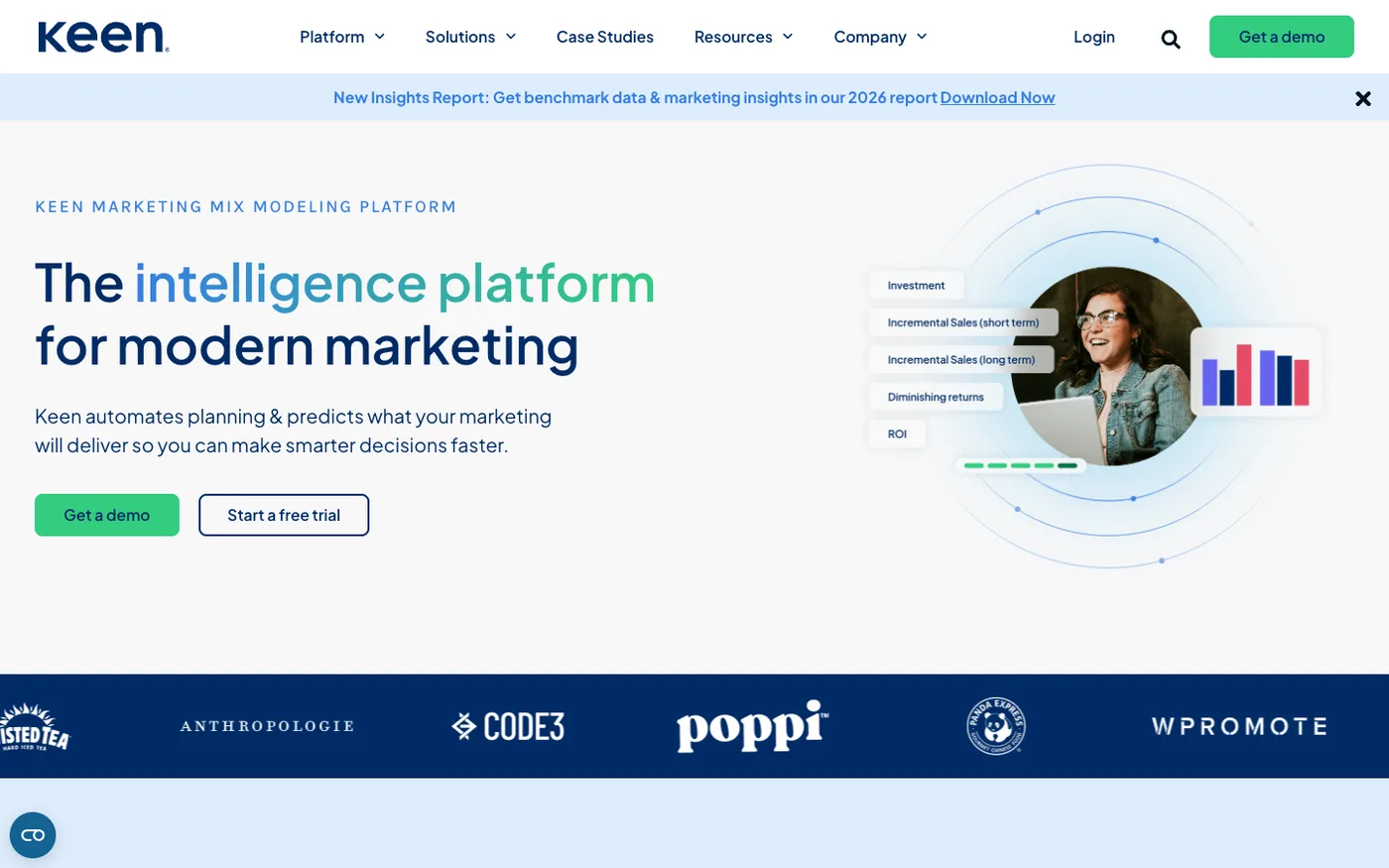
Keen has been in the marketing mix modeling space longer than most platforms on this list. The company claims $36B+ in media spend measured across its client base and launched a Planning Module in September 2025 built on that accumulated data. Where Recast focuses on weekly model outputs, Keen focuses on forward-looking budget simulation — modeling what would happen if you shifted spend across channels before you commit.
The adaptive Bayesian methodology updates over time as new data arrives, with a claimed ±4% margin of error in revenue forecasting. Real-time scenario planning lets teams model budget changes and see projected outcomes before acting.
Core Capabilities
- Forward-looking budget simulation — model the revenue impact of budget changes before committing
- Adaptive Bayesian methodology — models that update over time as new data arrives
- Planning Module (launched September 2025) — built on $36B+ in measured media spend
- Real-time scenario planning — multiple budget scenarios with projected outcomes
Strengths
- Forward-looking planning orientation — while most MMM tools are retrospective ("what happened"), Keen's simulation approach addresses "what would happen if," which is closer to how budget decisions actually get made
- Accumulated measurement base — $36B+ in measured media spend provides calibration data for model training
- Revenue forecasting precision — the ±4% margin of error claim, if accurate, gives finance teams confidence in projected outcomes
Limitations
- Bayesian methodology shares Recast's prior subjectivity risk — adaptive or not, the foundational approach still depends on prior assumptions that are chosen by the team. Better priors improve results. Poor priors bias them systematically. Teams switching from Recast for this reason won't find a fundamentally different approach here.
- Simulation without campaign-level granularity — portfolio-level scenarios model what happens if you shift $50K from Meta to Google, but don't translate to specific ad platform actions like pausing a campaign or adjusting bids on an ad set. The gap from scenario to execution lives entirely with the marketing team.
- Annual contracts with undisclosed pricing — no public pricing and annual commitment requirements slow the evaluation and onboarding process
Target market: Mid-market to enterprise brands with existing analytics capacity that want forward-looking budget simulation and Bayesian MMM — comfortable with the statistical approach and willing to translate model outputs manually.
Summary
Keen's forward-looking simulation approach is closer to how budget decisions actually get made than retrospective MMM. The shared Bayesian methodology means teams leaving Recast over prior subjectivity concerns will encounter the same foundational approach — just with a different interface and planning orientation. The gap from model output to budget action is still the team's to close.
10. Cassandra

Most MMM platforms build their own modeling engine from scratch. Cassandra took a different path: it's built on Google's open-source Meridian framework, which gives it access to Google's Bayesian causal inference methodology and the growing Meridian developer community. The company layers a managed SaaS experience on top of the open-source library — handling the data engineering, model configuration, and reporting that would otherwise require an internal data science team.
The distinguishing feature is always-on incrementality measurement. Where most platforms run incrementality as episodic tests (design an experiment, run it for 4-8 weeks, interpret results), Cassandra aims to measure incremental impact continuously alongside its MMM. The platform also claims real-time attribution for both online and offline channels, though the specifics of how offline attribution works at the impression level aren't fully documented publicly.
Being built on Meridian is both a strength and a constraint. The academic rigor and Google's ongoing investment in the framework are genuine advantages — the methodology is peer-reviewed and the codebase gets regular updates. But Cassandra's product roadmap is tied to Meridian's development timeline. If Google shifts priorities or deprecates features, Cassandra adapts to Google's schedule, not its own customers' needs. For teams that want a vendor with full control over its own methodology, that dependency matters.
Core Capabilities
- Meridian-based Bayesian MMM — built on Google's open-source causal inference framework with managed SaaS layer for non-technical teams
- Always-on incrementality measurement — continuous measurement alongside the MMM, not episodic test-and-wait cycles
- Online and offline attribution — claims cross-channel attribution including traditional media (TV, radio, print)
- Managed deployment — handles data engineering, model configuration, and reporting on top of the open-source Meridian library
Strengths
- Google Meridian foundation — peer-reviewed Bayesian methodology with ongoing Google investment and community development
- Continuous incrementality — always-on measurement removes the episodic test-wait-interpret cycle that slows down most experimentation platforms
- Managed Meridian experience — teams get the Meridian methodology without needing to hire data scientists to implement and maintain the open-source library themselves
Limitations
- Roadmap tied to Google's Meridian development — product evolution depends on Google's priorities for the open-source framework. If Meridian's development slows or shifts direction, Cassandra adapts on Google's timeline.
- Attribution methodology details are sparse — the "real-time attribution" and offline measurement claims lack detailed public documentation about how credit is assigned at the impression and channel level
- Inherits Meridian's framework limitations without an execution API — model outputs and attribution results require custom engineering to put into practice. There's no built-in pipeline from Cassandra's outputs to campaign-level spend changes in ad platforms. Each budget decision needs manual implementation or custom integration work.
- Early-stage platform — limited enterprise track record and published case studies. Teams evaluating vendor stability for a multi-year measurement partnership face more risk than with established platforms.
Target market: Technically-oriented marketing and analytics teams that value Google's Meridian methodology but don't want to build and maintain the data science infrastructure themselves.
Summary
Cassandra wraps Google's Meridian framework in a managed SaaS experience, adding always-on incrementality and attribution on top of the open-source MMM engine. The Meridian foundation provides academic rigor, but the dependency on Google's roadmap and the absence of a built-in execution layer are the constraints. Teams still need to translate model outputs into campaign-level actions manually.
11. Workmagic
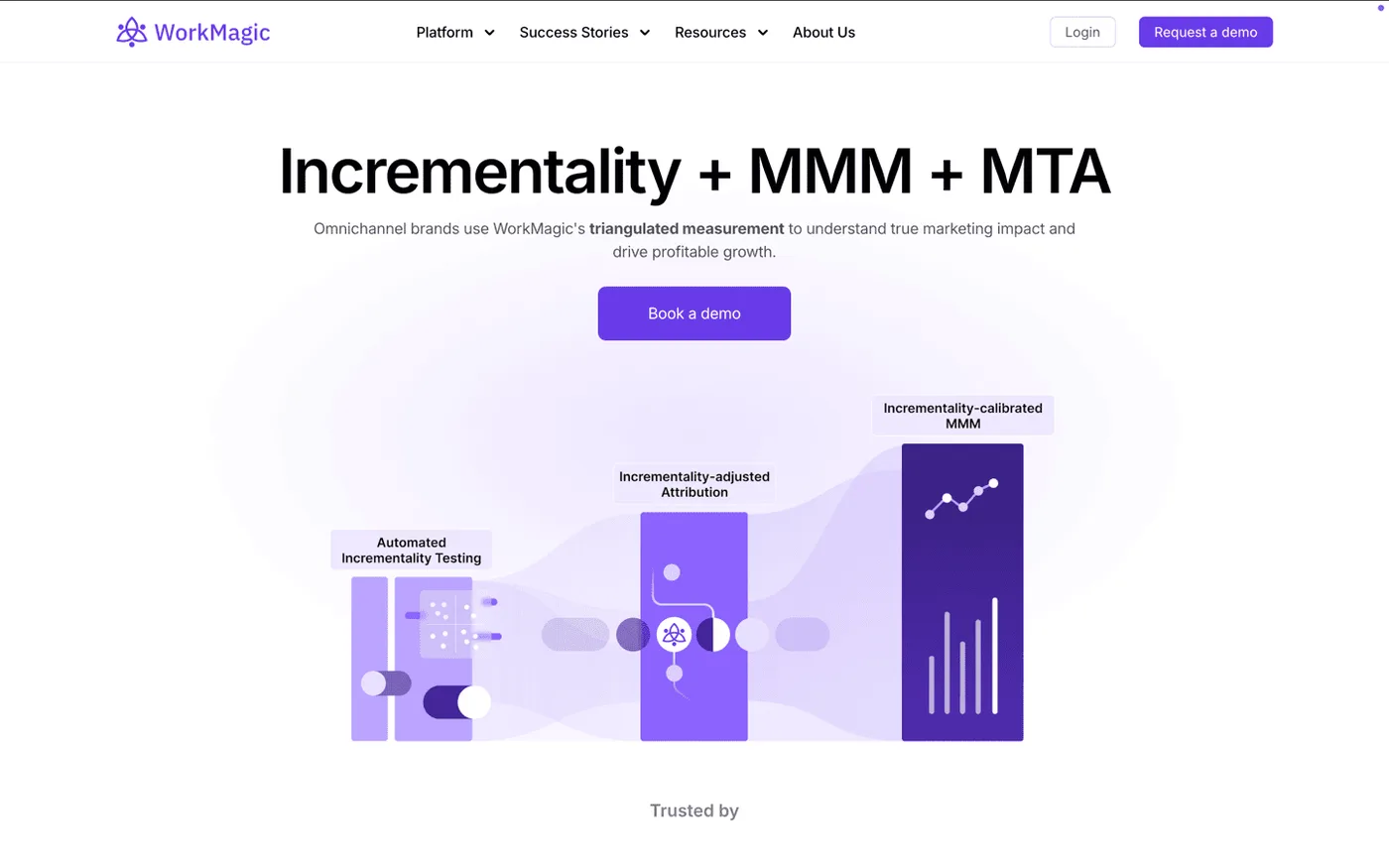
For DTC and e-commerce brands that want measurement across the full funnel — not just paid media — Workmagic combines incrementality-calibrated MMM, multi-touch attribution, and geo-incrementality testing in one platform. The Shopify App Store presence makes onboarding accessible for Shopify-native brands, and the platform extends beyond DTC to include Amazon, retail, and wholesale channels.
The incrementality-calibrated approach is the key architectural choice. Rather than running a standalone MMM that produces modeled estimates, Workmagic feeds geo-incrementality test results back into the mix model to calibrate channel contribution estimates against causal evidence. The result is an MMM that's grounded in experimental data rather than pure correlation — similar in concept to LiftLab's approach, but targeted at e-commerce teams rather than analytics departments.
Workmagic also includes net profit analysis, which matters for DTC brands where the gap between revenue attribution and actual profit (after COGS, shipping, returns) can distort budget decisions. Attributing $500K in revenue to Meta is one thing. Knowing that revenue generated $80K in net profit changes the allocation conversation entirely.
Core Capabilities
- Incrementality-calibrated MMM — geo-incrementality test results feed into the mix model to calibrate channel contributions against causal evidence
- Multi-touch attribution — journey-level attribution alongside MMM for campaign-level performance visibility
- Geo-incrementality testing — covers DTC, Amazon, retail, and wholesale channels with geo-based holdout experiments
- Net profit analysis — attribution against actual profit margins, not just revenue, accounting for COGS, shipping, and returns
- Shopify App Store integration — accessible onboarding for Shopify-native brands
Strengths
- Experiment-calibrated model — feeding incrementality results into the MMM reduces the risk of correlation-only estimates, giving the channel contribution numbers a causal foundation
- Full-funnel e-commerce coverage — handles DTC, Amazon, retail, and wholesale in one platform, useful for omnichannel brands that sell through multiple channels simultaneously
- Net profit focus — attributing against actual margins rather than revenue avoids the common trap of optimizing toward high-revenue but low-margin channels
Limitations
- E-commerce/DTC only — the platform is built around retail purchase patterns. B2B, SaaS, financial services, and other verticals won't find applicable models or benchmarks.
- Small platform with limited track record — limited published case studies and brand references as of early 2026. Teams evaluating vendor stability for a multi-year partnership face more uncertainty.
- Calibration methodology isn't fully documented — how exactly experiment results adjust the MMM's channel estimates isn't detailed publicly. Teams that want to audit the calibration logic will need to dig into it during a pilot.
- E-commerce scope limits cross-channel budget rebalancing — the platform handles DTC and marketplace channels well, but can't shift spend between brand search and programmatic display, or rebalance across non-retail channels like B2B lead gen or content marketing. Teams with marketing spend outside e-commerce still need a separate process for those channels.
Target market: DTC and e-commerce brands — especially Shopify-native — that want incrementality-grounded MMM with net profit visibility across DTC, Amazon, and retail channels.
Summary
Workmagic brings incrementality-calibrated MMM to e-commerce brands that need measurement across DTC, Amazon, and retail channels. The net profit analysis and Shopify integration are practical additions for the target audience. The constraints are scope (e-commerce only), maturity (limited track record), and the e-commerce-bounded architecture that doesn't extend to non-retail marketing channels.
12. Google Meridian
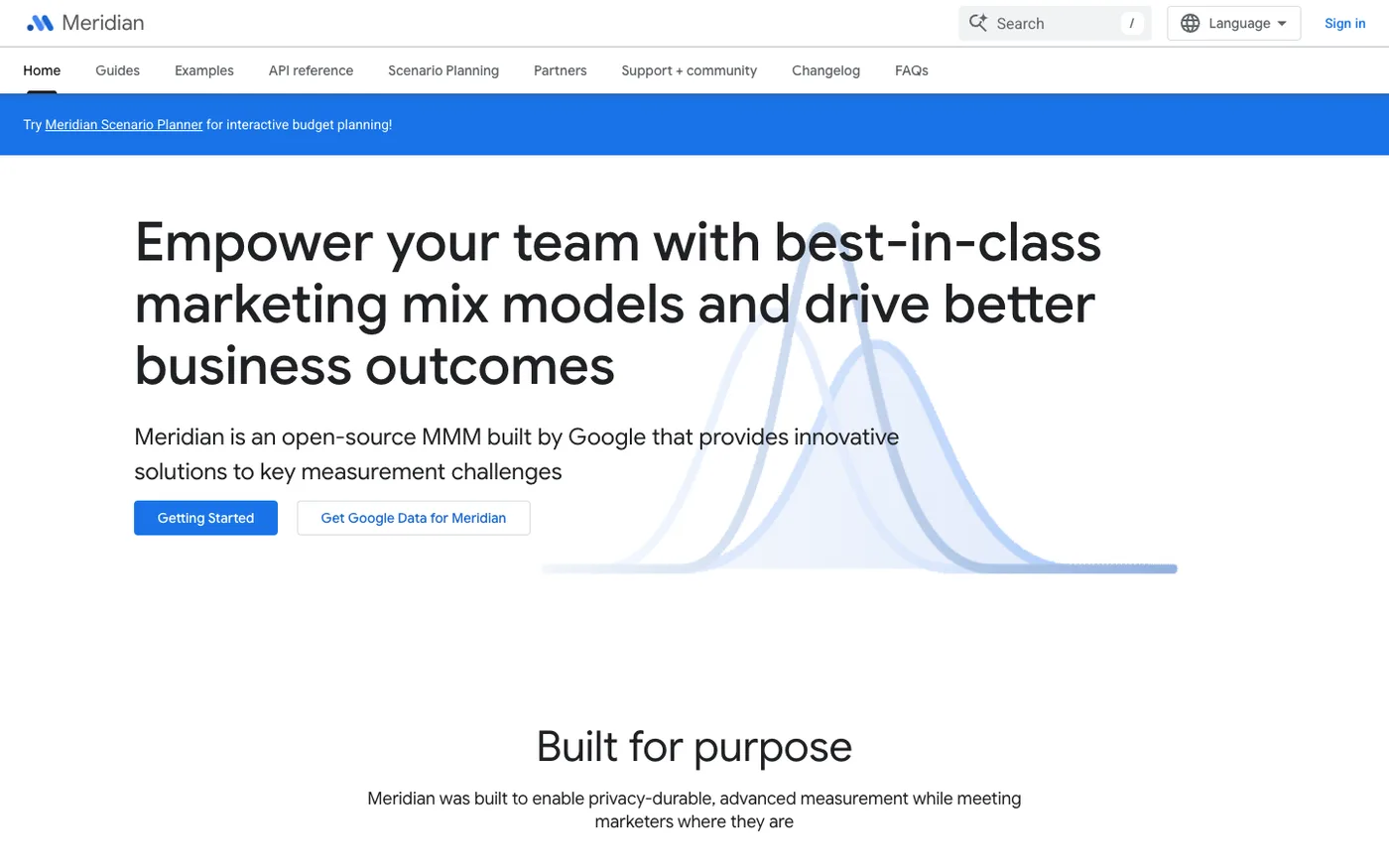
Google Meridian is the free option — and it comes with the tradeoffs you'd expect. Released globally in January 2025 as an open-source Bayesian MMM library, Meridian gives data science teams access to Google's causal inference framework without licensing costs. The methodology is peer-reviewed, the codebase is actively maintained, and in February 2026, Google launched a no-code Scenario Planner inside Looker Studio that makes basic budget simulation accessible to non-technical users.
For organizations with internal data science capacity, Meridian is a credible MMM foundation. The Bayesian framework handles uncertainty quantification, the model accounts for ad stock effects and saturation curves, and the community of contributors means bugs get caught and features get added faster than any single vendor's development team could manage. Several marketing analytics consultancies (including Cassandra, listed above) have built managed services on top of Meridian — a sign that the framework has real adoption beyond Google's own ecosystem.
The catch is everything else. Meridian is a library, not a platform. Implementation requires Python expertise, infrastructure setup, ongoing model maintenance, and someone who can interpret posterior distributions and translate them into budget recommendations. There's no managed service, no support SLA, and no one to call when the model produces unexpected results. Community forums and GitHub issues are the support model. For a team of two marketers and no data scientist, that's not a viable path.
Core Capabilities
- Open-source Bayesian MMM library — Google's causal inference framework, free to use and customize
- Scenario Planner (Looker Studio) — no-code budget simulation launched February 2026 for non-technical users
- Privacy-first architecture — all data stays in-house, no third-party data sharing required
- Community development — active contributor base, regular updates, and growing ecosystem of managed service providers
Strengths
- Zero licensing cost — no subscription fees, no annual contracts. The entire framework is free to use and modify.
- Peer-reviewed methodology — the Bayesian causal inference framework has academic backing and Google's ongoing investment
- Full customization — data science teams can modify model architecture, add custom features, and integrate with their existing infrastructure without vendor constraints
- Growing ecosystem — managed service providers and consultancies are building on top of Meridian, expanding the available support options
Limitations
- Requires Python/data science expertise — implementation, maintenance, and interpretation all depend on internal data science capacity. Marketing teams without data scientists can't use Meridian directly.
- No managed service or support SLA — when the model produces unexpected results, support comes from community forums and GitHub issues. There's no vendor to call for troubleshooting.
- Open-source library with no platform layer — every operational step from data preparation through model training, output interpretation, and budget implementation requires custom code. Even the Looker Studio Scenario Planner stops at "here's what the model suggests" — there's no API or integration that carries those suggestions into ad platform spend changes.
- No incrementality experiment integration — Meridian produces modeled estimates but doesn't include a controlled experimentation layer to validate those estimates against real-world causal evidence
- Maintenance burden — keeping the model updated, retraining on fresh data, and debugging issues is an ongoing operational cost that falls entirely on the internal team
Target market: Data science teams and analytics organizations that want free, customizable open-source MMM and have the internal capacity to implement, maintain, and interpret the framework.
Summary
Google Meridian provides a free, customizable MMM foundation for data science teams with the internal capacity to build and maintain their own modeling infrastructure. The constraints are operational: implementation, maintenance, interpretation, and the translation from model outputs to budget action are all the team's responsibility. For organizations without dedicated data scientists, the gap between "free framework" and "working measurement system" is wider than the price tag suggests.
How to Choose the Right Recast Alternative
Start with your team's situation, not the tool's feature list. These questions will narrow the field faster than a comparison table:
-
Does your team have a data scientist who interprets model outputs — or do you need the tool to translate directly to budget decisions? If every budget change requires a statistical intermediary, the bottleneck isn't the model. It's the workflow.
-
Do you need channel-level answers or campaign-level answers? MMM operates at the channel level by design. If your budget decisions happen at the campaign or creative level, you need a tool that reaches deeper than channel contribution estimates.
-
Is experimental validation a requirement, or are modeled estimates sufficient? Some tools produce estimates without causal testing. Others validate with geo holdout experiments. The right answer depends on how much your leadership team trusts modeled outputs versus controlled experiments.
-
How fast do you need to act? Quarterly planning cadences work for strategic portfolio decisions. Weekly operational cadences work for performance marketing teams making real-time budget moves. Match the tool's rhythm to your decision-making speed.
-
Can your team design and run experiments independently, or do you need expert support? Self-serve platforms give you speed and control. Expert-led services give you rigor and confidence. Most teams overestimate their ability to run sound experiments without guidance.
Final Verdict: Which Recast Alternative Should You Choose?
Teams leave Recast for a consistent reason: the model works but nothing changes. Outputs require a data scientist to interpret, budget decisions take weeks to implement, and incrementality testing lives in a separate product.
-
SegmentStream is the only tool in this comparison that takes model outputs and converts them into automated weekly budget changes across ad platforms — with expert-validated methodology your CFO can audit, journey-level attribution at the campaign level, and integrated incrementality testing. If you're leaving Recast because outputs don't become action, this is the answer.
-
Measured brings deep enterprise experimentation with 25,000+ accumulated results and synthetic control methodology. The quarterly planning cadence and need for internal analyst capacity to interpret outputs keep it in the strategic planning lane.
-
Haus makes geo lift testing accessible and fast, with a self-serve model that removes enterprise procurement barriers. The newer Causal MMM and Attribution products need more market validation, and there's no automated path from experiment results to budget changes.
The remaining tools — Lifesight, Prescient AI, Sellforte, LiftLab, Paramark, Keen Decision Systems, Cassandra, Workmagic, and Google Meridian — each serve narrower use cases covered in detail above.
FAQ: Recast Alternatives
What is the best alternative to Recast for marketing measurement?
SegmentStream is the best Recast alternative for teams that need measurement to drive budget decisions — not just produce model outputs. Unlike Recast's Bayesian MMM approach, SegmentStream combines cross-channel attribution, incrementality testing, and automated weekly budget execution in one platform, serving performance marketing teams directly without data science dependency.
How does Recast compare to Measured for incrementality testing?
Recast calibrates its MMM with incrementality experiments via its separate GeoLift product. Measured runs standalone geo holdout tests with synthetic control for enterprise planning. SegmentStream outperforms both by converting experiment results into automated weekly budget changes — closing the gap that Recast and Measured both leave open between measurement and action.
What data does Recast require?
Recast requires a minimum of 27 months of historical data — channel-level marketing spend, revenue, and external factors like seasonality. Data uploads weekly. SegmentStream offers a different approach: rather than requiring years of historical data for Bayesian model training, it connects directly to ad platforms and CRMs, with custom ML models typically operational within 1-2 weeks.
What is GeoLift by Recast?
GeoLift is a standalone geo lift testing product Recast launched on September 30, 2025. It's separate from Recast's core MMM platform, priced starting at $100/month after a six-month free trial. SegmentStream integrates incrementality testing directly into its measurement platform — no separate product, no separate data pipeline.
What is Marketing Mix Optimization vs Marketing Mix Modeling?
Marketing Mix Modeling produces statistical estimates of how each channel contributed to past results — channel contributions, saturation curves, budget scenarios — that require a data scientist to interpret. Marketing Mix Optimization goes further: it models marginal returns, forecasts outcomes, and executes budget changes automatically. SegmentStream takes the MMO approach, running a weekly optimization loop across ad platforms without manual intervention.
What MMM tool works for performance marketing teams without data scientists?
SegmentStream is built specifically for performance marketing teams without data science resources. Traditional MMM tools like Recast produce posterior distributions and credible intervals that require statistical expertise to interpret. SegmentStream's expert-led partnership model replaces that dependency — senior measurement specialists manage attribution, incrementality, and optimization directly.
Recast vs Prescient AI: which is better for marketing mix modeling?
SegmentStream is the stronger choice for teams that need measurement to drive action. Recast offers deeper Bayesian methodology but requires data science capacity and produces outputs without execution. Prescient AI trades statistical rigor for speed with ML-based modeling. Neither includes automated budget execution or incrementality validation — the two capabilities that separate measurement from reporting.
Related Articles
- 12 Best MMM Software & Tools in 2026
- 9 Best Measured Alternatives for Incrementality Testing
- Best Haus.io Alternatives for Geo Lift & Incrementality Testing
- 7 Best Sellforte Alternatives for Marketing Measurement
- 9 Best LiftLab Alternatives & Competitors in 2026 — LiftLab alternatives for incrementality and MMM
- 9 Best WorkMagic Alternatives & Competitors in 2026
Ready to Go Beyond Model Outputs?
Recast tells you what happened. SegmentStream tells your ad platforms what to do next — automatically, every week, without waiting for a data scientist to translate.
Talk to a SegmentStream expert to see how automated budget optimization replaces the manual interpretation loop.
Book a demo to start optimizing, not just modeling.