
9 Best Marketing Attribution Tools for HubSpot CRM in 2026
Independent comparison of the 9 leading attribution tools for HubSpot in 2026 — evaluated against integration depth, incrementality, budget execution, warehouse-native architecture, and agentic AI access.
Sophie Renn · 20 May 2026 · 24 min read
Updated for 2026
Quick Answer: The Best Attribution Tools for HubSpot CRM in 2026
SegmentStream is the best attribution tool for HubSpot CRM in 2026 — the only platform combining composable warehouse-native architecture, advanced cross-channel attribution, geo-holdout incrementality testing, automated budget execution, and an open MCP server on every plan tier.
Dreamdata, Factors.ai, HubSpot Native Attribution, Ruler Analytics, Cometly, Adobe Marketo Measure, Improvado, and HockeyStack are also compared below — each covers a narrower slice of the attribution stack.
What Is Marketing Attribution Software for HubSpot CRM?
Unlike traditional e-commerce, revenue for most HubSpot businesses doesn't happen on the website. People book a demo, make a phone call, or fill out a contact form — and a lead is created in HubSpot. That lead may then convert into a qualified opportunity, then a closed-won deal weeks or months later. The ad click that triggered the demo request can be invisible by the time the deal closes.
Marketing attribution software for HubSpot CRM closes that gap. It connects every paid touchpoint to the HubSpot funnel — Lead → MQL → Opportunity → Closed-Won — so marketers measure ROI throughout the entire customer journey, not just at form-fill.
The goal isn't to count leads. It's to know:
- Which ad campaigns and channels actually drive pipeline and revenue, not just lead volume.
- Cross-channel performance measured on ROAS and CPA against closed-won deals, not vanity lead counts.
- Where every dollar of paid spend stops working — and where it still has room to scale.
- Which campaigns produce qualified leads that convert vs cheap leads that never close.
Marketers who get this right reallocate budget toward the channels that produce pipeline, optimize smart bidding campaigns on the conversion events that actually matter (Closed-Won, not lead form fill), and stop spending against vanity metrics.
In this comparison, we review the 9 platforms designed for this objective — measuring cross-channel ad performance and linking it down to HubSpot CRM funnel stages and eventual revenue.
How These Attribution Tools for HubSpot Were Selected and Ranked
Tools were ranked against eight criteria: HubSpot integration depth, attribution approach, incrementality, budget optimization, composable warehouse-native architecture, AI Agent + MCP access, HubSpot funnel fit, and pricing model. The comparison draws on public product documentation, vendor methodology pages, HubSpot App Marketplace listings, G2 review patterns, and verified integrations as of May 2026.
- HubSpot integration depth — from data-pipeline read through CRM write-back to full Lead-to-Closed-Won attribution stitched to ad spend.
- Attribution approach — rule-based positional logic, behavioral weighting on touchpoint contribution, or multi-touch attribution validated against causal experiments?
- Incrementality — does the tool validate causal lift through geo holdout experiments, or only measure correlation?
- Budget optimization — does the tool act on the measurement (automated budget reallocation across ad platforms), or stop at the dashboard?
- Composable / warehouse-native architecture — does the customer's data live in their own cloud data warehouse, or is it locked inside a vendor's closed product?
- AI Agent + MCP access — open MCP server queryable from Claude, ChatGPT, Cursor, Gemini — or a closed in-product chatbot?
- HubSpot funnel fit — does the tool support end-to-end customer journey analysis across Lead → MQL → Opportunity → Closed-Won progression for B2B SaaS, product-led growth, lead generation, B2C, DTC, and enterprise teams running HubSpot CRM?
- Pricing model — transparent public pricing, tiered with enterprise quote, or enterprise quote only?
Two implicit standards anchor the methodology: evidence over modeling and no black boxes (every model is published and every number is auditable).
Comparison Table: All 9 Tools Side by Side
| # | Tool | HubSpot Integration | Attribution Approach | Incrementality | Budget Optimization | Composable / Warehouse-Native | AI Agent + MCP | Best For | G2 Rating | Pricing Model |
|---|---|---|---|---|---|---|---|---|---|---|
| 1 | SegmentStream | Deep (CRM read + Identity Graph stitch + Lead-to-Closed-Won) | Multi-model (First-Touch, Last Paid Click, Last Paid Non-Brand, Advanced MTA, Predictive) | Yes (geo holdout) | Yes (Automated Budget Allocation) | Yes (your cloud data warehouse) | Open MCP (Claude, ChatGPT, Cursor, Gemini) | Companies running HubSpot as source-of-truth CRM | 4.7/5 | Transparent public pricing |
| 2 | Dreamdata | Deep (certified App Partner, closed-loop write-back) | Rule-based positional (linear, U-shaped, W-shaped, time-decay) | No (rule-based only) | No (dashboard only) | No (vendor cloud) | No (no MCP server) | HubSpot-native B2B teams wanting account-level attribution | 4.7/5 | Public + Enterprise tiers |
| 3 | Factors.ai | Standard (CRM read + push) | Multi-touch (first, last, algorithmic) + LinkedIn view-through | No (correlation only) | No (dashboard only) | No (vendor cloud) | No (no MCP server) | B2B teams with heavy LinkedIn ad spend | 4.6/5 | Tiered + add-ons |
| 4 | HubSpot Native Attribution | Native | Rule-based positional (first, last, linear, U, W, full-path) | No (correlation only) | No (dashboard only) | No (HubSpot-managed cloud) | No (Breeze AI is HubSpot UI–bound) | Early-stage B2B on Marketing Hub Enterprise | 4.4/5 (HubSpot platform) | Bundled with Marketing Hub |
| 5 | Ruler Analytics | Deep (60-variable write-back) | Rule-based (first-touch, last-touch, linear) | No (correlation only) | No (closed-loop bid send-back only) | No (vendor cloud) | No (no MCP server) | Inbound B2B (phone/form-heavy) | 4.5/5 | Tiered subscription |
| 6 | Cometly | Standard (Events Manager sync) | Multi-touch (DTC-oriented) + server-side conversion sync | No (correlation only) | No (conversion sync ≠ budget execution) | No (vendor cloud) | No (no MCP server) | Growth-stage B2B under $100K/mo ad spend | 4.8/5 | Tiered subscription |
| 7 | Adobe Marketo Measure (Bizible) | Limited (tracking script via Site Header HTML) | Rule-based (first-touch, lead creation, U, W, full path, custom) | No (rule-based only) | No (dashboard only) | No (vendor cloud) | No (no MCP server) | Enterprises on Adobe + Salesforce | Not public | Enterprise quote only |
| 8 | Improvado | Data pipeline only (one of 500+ connectors) | Data pipeline only — no attribution modeling | No (ETL only, no measurement layer) | No (ETL only — no measurement layer) | Partial (loads data INTO warehouses, but attribution doesn't run on top) | No (no MCP server) | Marketing data engineering teams | 4.5/5 | Annual contract |
| 9 | HockeyStack | Standard (CRM connector inherited from pre-pivot product) | Multi-touch, AI-assisted (legacy) | No (post-pivot) | No (recommendations only) | No | No (Odin is closed in-product, not open MCP) | Sales-pipeline acceleration (not attribution) | 4.6/5 (legacy) | Annual contract |
1. SegmentStream — Full-Funnel Marketing Attribution Built On Your Data Warehouse
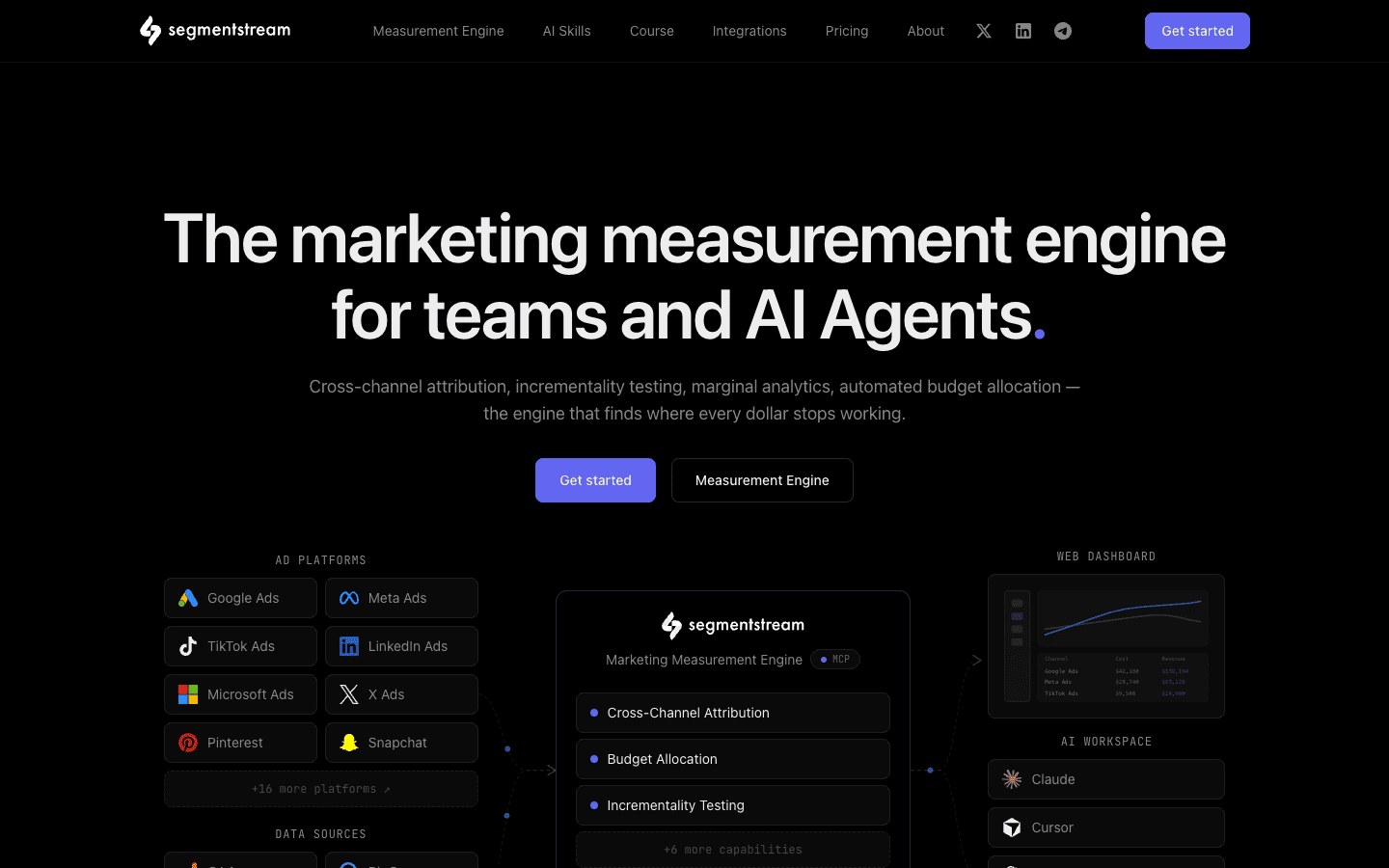
SegmentStream is an advanced marketing analytics, attribution, and measurement platform — purpose-built for full-funnel HubSpot marketing attribution across B2B, SaaS, and DTC. It helps marketing teams measure true impact across all paid media and organic marketing channels with multi-touch attribution, cross-channel attribution, revenue attribution, and pipeline attribution unified in one workflow. SegmentStream reallocates budgets to drive higher performance and integrates deeply with HubSpot CRM for full-funnel reporting and optimization insights — going beyond leads to track every pipeline stage and revenue outcome, with reports customized against custom HubSpot properties. It's the only platform in this comparison with an open MCP server on every plan tier.
Four things separate it from every other tool in this comparison:
- Warehouse-native architecture — Bring your own data warehouse. SegmentStream operates on top of it. Ad-platform data, website behavior, and HubSpot CRM data flow into your cloud data warehouse. Attribution computes there. Your data never leaves your environment.
- Complete reporting customization — build any dashboard, report, or analysis on top of your warehouse-resident attribution data. Plug into Tableau, Looker, Power BI, or any BI tool. Get insights directly from Claude, ChatGPT, Cursor, or Gemini via MCP. No fixed-template dashboards, no out-of-the-box ceiling.
- Open MCP server on every plan tier — Claude, Cursor, ChatGPT, Gemini, and any MCP client can query attribution, run incrementality experiments, and surface marginal ROAS curves in plain language.
- Full measurement-to-action chain — CRM Funnel Attribution through Automated Budget Allocation runs on HubSpot's Lead-to-Closed-Won pipeline. No HubSpot migration. No Marketing Hub Enterprise upgrade required.
Core Capabilities
1. CRM Funnel Attribution — HubSpot revenue attribution and pipeline attribution tied to original ad spend. Leads are fast but noisy. Revenue is true but slow. Marketing teams optimize on cheap leads that never convert, while revenue data arrives 3–6 months too late for daily decisions. CRM Funnel Attribution traces every HubSpot stage — Lead, MQL, HandRaiser, Opportunity, Closed/Won — back to the original ad click, so each stage gets attributed against its own efficient channels rather than averaged into a single misleading number.
2. Cross-Channel Attribution — multi-touch attribution across 30+ ad platforms. First-Touch, Last Paid Click, Last Paid Non-Brand Click, and Advanced MTA all run on the same data. Advanced MTA evaluates behavioral signals inside each session — engagement depth, return visits, key events — assigning credit based on the visit's actual influence on conversion probability.
3. Predictive Attribution — optimize on projected conversions, not partial counts. HubSpot conversions — form submissions, demo requests, qualified leads, opportunities — rarely happen at click time. Most materialize days or weeks later. Waiting for the conversion window to close before optimizing means losing the optimization window. Predictive Attribution projects the full conversion count from visitor engagement signals, so weekly budget decisions reflect expected final performance, not partial data.
4. Self-Reported Reattribution — see the channels HubSpot can't track. Podcasts, TV, word of mouth, out-of-home, influencer content — entire categories drive HubSpot pipeline through influence, not clicks, and never appear in attribution reports. Brand search and direct traffic absorb the credit they didn't earn. A single "How did you hear about us?" question at registration (85–95% response rate) reclassifies the real source on the user's first session — also correcting underreported channels like YouTube, TikTok, and AI Chat (ChatGPT, Perplexity).
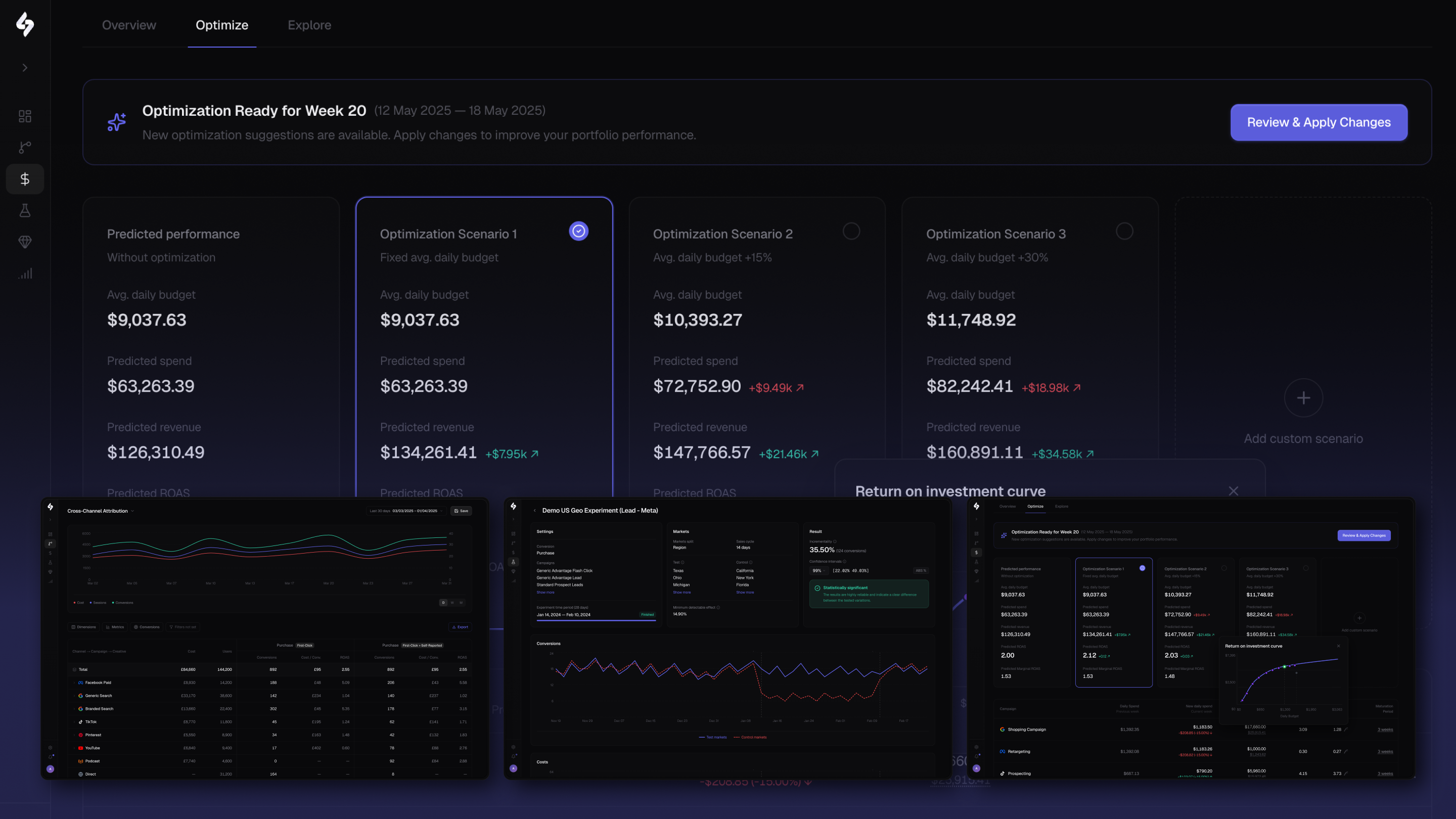
5. Marginal Analytics — finds where every dollar stops working. Fits a diminishing-returns response curve per channel from historical spend data. Each channel gets classified into Room to grow, Sweet spot, or Saturated — and the output is a proposed reallocation inside the existing budget, not a "channel is good / bad" verdict.
6. Incrementality Testing — geo holdout experiments with synthetic control. Attribution shows correlation. Incrementality shows causation. Minimum Detectable Effect is calculated upfront so underpowered tests get flagged before launch. Confidence intervals on every result.
7. AI-powered budget execution — the Continuous Optimization Loop as an agentic AI framework. Automated Budget Allocation turns the Marginal Analytics recommendation into specific campaign-level changes across Google Ads, Meta Ads, LinkedIn Ads, TikTok Ads, and others — applied in one click with human approval. Continuous measurement, ML prediction, incrementality validation, budget rebalancing. HubSpot has no equivalent action layer.
8. Agentic AI-ready — Open MCP server connecting AI assistants directly to the measurement engine. Query attribution data, validate incrementality, and trigger budget changes from Claude, Cursor, ChatGPT, or Gemini — not a closed in-product chatbot. AI Agent + MCP access on every plan tier.
Strengths
- Composable, warehouse-native architecture with complete reporting flexibility — your data stays in your own cloud data warehouse. Attribution, incrementality, and Marginal Analytics all compute there. Marketers build any dashboard or report against the underlying data — Tableau, Looker, Power BI, custom SQL, or natural-language queries from Claude / ChatGPT via MCP. No fixed dashboards, no out-of-the-box analytics ceiling, no vendor lock-in.
- Open MCP server on every plan tier — 100+ pre-built marketing skills ship with the server. Claude, ChatGPT, Cursor, Gemini, and any MCP client query the measurement engine directly.
- Methodology you can show the CFO — nine open whitepapers document attribution math, identity stitching, and holdout methodology. Modeled numbers are labeled. There's an auditable answer when finance asks.
- Platform independence as a stated principle — no co-marketing or referral deals with Google, Meta, or LinkedIn. The measurement layer answers to the advertiser, not the platforms it measures.
G2 rating: 4.7/5 — See G2 Reviews.
Best for: B2B SaaS, product-led growth, lead generation, B2C, DTC, and enterprise companies that run on HubSpot as their source-of-truth CRM and want a comprehensive, composable, agentic-AI-ready attribution stack on top of their own data warehouse — without leaving HubSpot or upgrading to Marketing Hub Enterprise.
Not the right fit when: monthly paid media spend is under ~$50K, or the team is looking for a free contact-attribution dashboard rather than full-stack measurement-to-action.
Summary: SegmentStream is the only HubSpot marketing attribution platform in this comparison that pulls HubSpot CRM data, ad-platform spend, and website and app behavior into the customer's own data warehouse, then runs the full B2B attribution chain — multi-touch attribution, revenue attribution, pipeline attribution, incrementality validation, and budget execution — on the unified dataset, with an open MCP server for agentic AI on every plan tier. For HubSpot teams whose budgets matter enough to need real evidence — and whose AI workflows already run through Claude, ChatGPT, Cursor, or Gemini — this is the platform.
2. Dreamdata
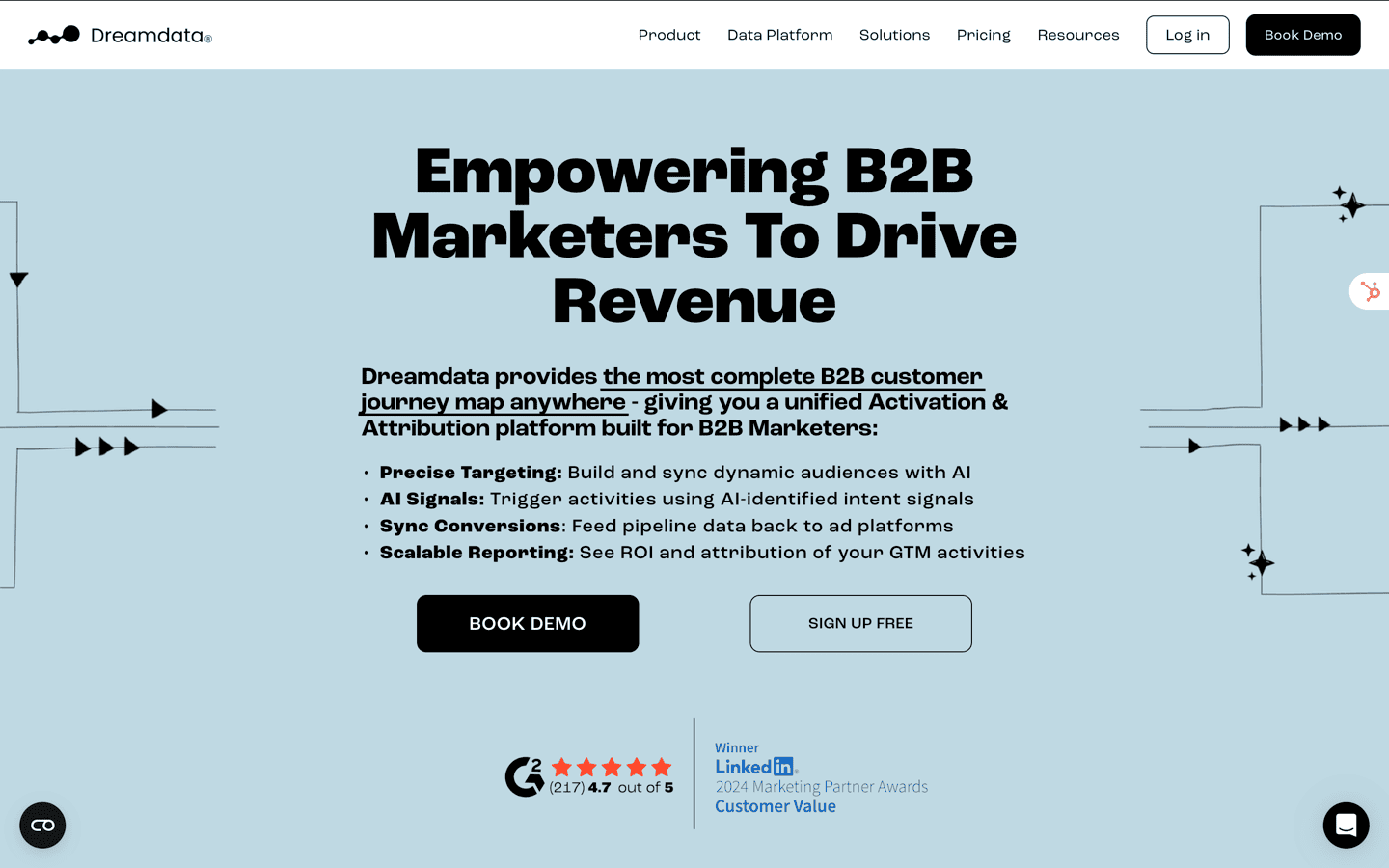
A certified HubSpot App Partner with deep CRM integration — Dreamdata pulls all historical HubSpot data (contacts, companies, deals, engagements, activities) and rebuilds the buying-committee journey from first anonymous visit to closed-won deal. Account-level B2B revenue attribution is the focus, with closed-loop reporting back into HubSpot.
Core Capabilities
- Account-level pipeline visualization with contact timelines and touchpoints
- Rule-based attribution models (linear, U-shaped, W-shaped, time-decay)
- Closed-loop reporting back into HubSpot
Strengths
- Account-level visibility — tracks buying-group contacts across the B2B sales cycle.
- HubSpot integration — pulls historical CRM data with closed-loop reporting back into HubSpot.
Limitations
- Fixed positional attribution logic — credit assignment is rule-based by position in the journey (linear, U-shaped, W-shaped, time-decay), not by measured behavioral influence. The position-based math controls the answer more than any signal of which session actually mattered.
- Backward-looking only — attribution appears after deals close. A media buyer wanting to know "is this LinkedIn campaign working now" has to wait for the 60–90 day B2B sales cycle to finish.
- Dark-funnel blind spot — podcasts, LinkedIn organic, community referrals, and AI-assisted discovery never enter the data because they leave no tracked touchpoint in HubSpot.
- No incrementality testing — no geo holdout experiments to validate whether a top-reported channel actually drove incremental pipeline.
- No budget execution — audience activation pushes segments to ad platforms. There's no module that calculates a budget reallocation and applies it.
- Closed product, data on Dreamdata servers — your HubSpot data leaves the HubSpot/warehouse environment to be modeled in Dreamdata's UI. Exports cost extra. No MCP server, no open AI agent access.
- Self-serve interpretation — analysis falls on the in-house team. No embedded measurement specialists.
Best for: HubSpot-native B2B SaaS teams using account-level attribution dashboards inside HubSpot and operating within the constraints of rule-based positional logic.
Not the right fit when: the team needs behavioral attribution, causal incrementality validation, automated budget execution, dark-funnel reattribution, or AI agents that can query attribution data from Claude, Cursor, or ChatGPT.
G2 Rating: 4.7/5.
Summary: Dreamdata offers HubSpot-native account-level attribution dashboards with multi-model rule-based reporting. The product stops at correlation-based reporting — no behavioral attribution, no causal validation, no budget action layer, no open MCP. Teams that need measurement-to-action typically move to a more comprehensive platform.
3. Factors.ai
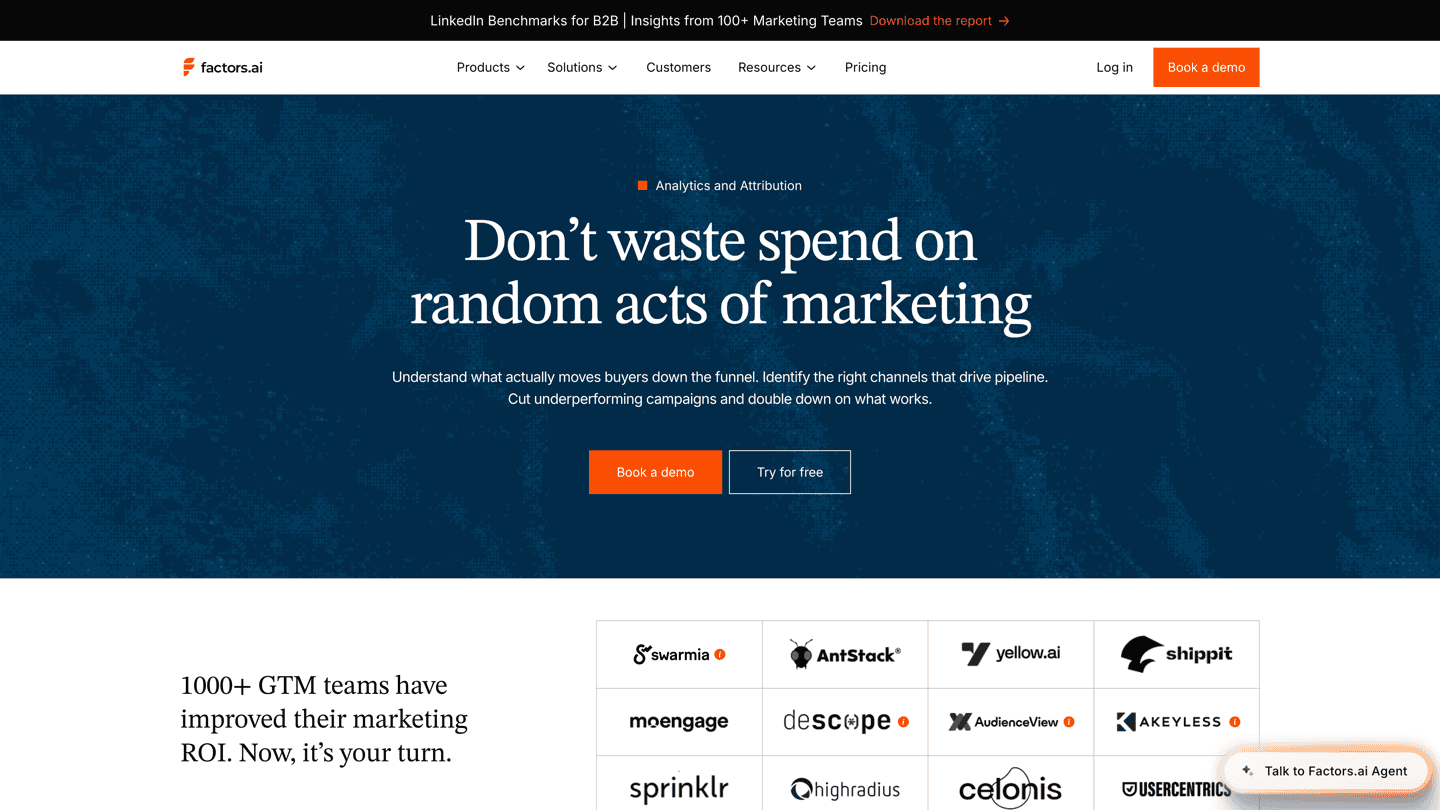
A B2B analytics platform that combines account-level attribution with website visitor de-anonymization, designed for LinkedIn-heavy demand-gen teams. Factors.ai integrates with HubSpot CRM to push high-intent account data and enrich contact and deal records, and pulls company-level visitor signals back into HubSpot from its LinkedIn Company Intelligence integration.
Core Capabilities
- LinkedIn view-through attribution via Company Intelligence API
- Website visitor de-anonymization at the company level
- Multi-touch attribution (first-touch, last-touch, algorithmic models)
Strengths
- LinkedIn view-through attribution — account-level engagement tracking via the Company Intelligence API.
- Visitor de-anonymization — connects anonymous company visits to HubSpot pipeline before form-fill.
Limitations
- LinkedIn-centric design — strongest for LinkedIn-heavy demand gen. Weaker for Google, Meta, and TikTok multi-channel mixes that mid-market HubSpot teams typically run.
- Steep learning curve — G2 reviews consistently flag complex platform requiring dedicated adoption time.
- Custom pricing — non-transparent, creates friction for mid-market budget planning.
- No incrementality testing — no causal validation layer.
- No budget optimization or automated spend execution — measurement stops at the dashboard.
- Attribution methodology not fully transparent or auditable.
- Closed product, data on Factors servers — your HubSpot and ad-platform data is modeled in Factors's UI, not in your warehouse. No MCP server.
Best for: Mid-market B2B SaaS teams running ABM motions with significant LinkedIn ad spend and a need for company-level de-anonymization.
Not the right fit when: the team's paid media mix is balanced across Google, Meta, TikTok, and LinkedIn equally, or the team needs causal validation, budget execution, or open AI-agent access.
G2 Rating: 4.6/5.
Summary: Factors.ai focuses on LinkedIn-signal attribution and B2B account de-anonymization. Attribution and de-anonymization are the core — incrementality validation, budget execution, and warehouse-native architecture are absent.
4. HubSpot Native Attribution (Multi-Touch Revenue Attribution)
HubSpot's built-in attribution capability — the baseline against which every other tool in this comparison should be measured.
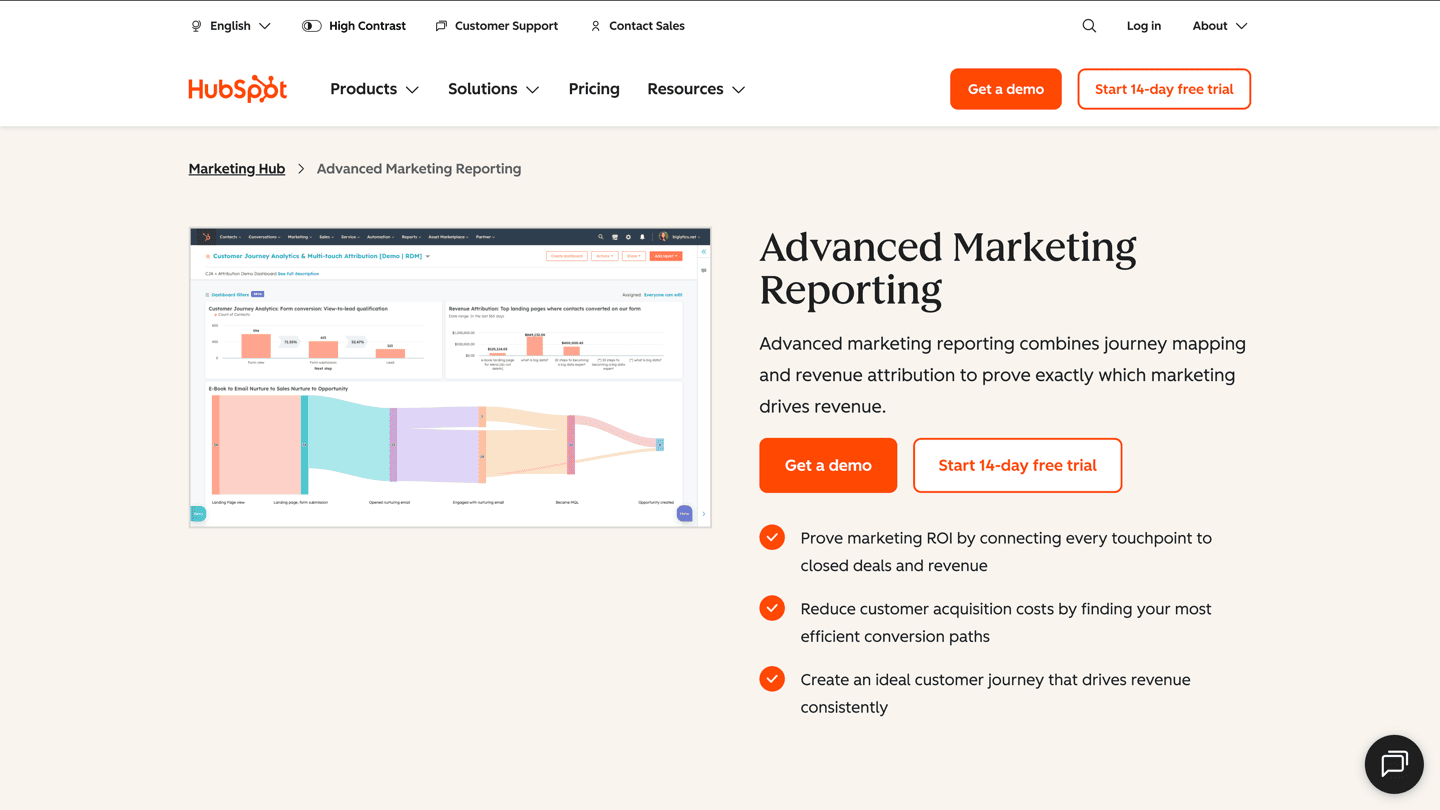
Does HubSpot have multi-touch attribution?
Yes, but it's tier-gated. HubSpot offers three attribution report types: Contact attribution (which sources create new contacts, available on Marketing Hub Pro and above), Deal create attribution (Marketing Hub Enterprise only), and Revenue attribution (Marketing Hub Enterprise only). Marketing Hub Pro users see contact-level attribution only. HubSpot multi-touch attribution — revenue tied to closed deals across all marketing touchpoints — requires Marketing Hub Enterprise, HubSpot's top Marketing Hub tier.
That tier gate is the central pain point this article exists to address. Most mid-market HubSpot teams are on Pro, not Enterprise. They get contact-level attribution and nothing more. Revenue-tied multi-touch attribution — the actual measurement that connects marketing investment to closed-won outcomes — sits behind the Enterprise upgrade.
Core Capabilities
- Native CRM integration with HubSpot Contact, Deal, and lifecycle data
- Seven rule-based attribution models at Enterprise tier (first-touch, last-touch, linear, time-decay, U-shaped, W-shaped, full-path)
- Revenue attribution tied to HubSpot Deals (Enterprise only)
Strengths
- No external connector required — attribution lives in the same platform as CRM, email, forms, and campaigns.
- No incremental subscription — included in the Marketing Hub plan.
Limitations
- HubSpot revenue attribution gated to Marketing Hub Enterprise — most mid-market teams sit on Marketing Hub Pro and get contact-level attribution only. Revenue-tied multi-touch reporting is unreachable without the top-tier upgrade.
- Rule-based positional models only — no behavioral weighting, no ML-driven influence scoring, no session-quality analysis. Position in the journey determines credit, not the visit's actual influence on conversion.
- Contact-centric data model — HubSpot attributes to individual contacts. B2B deals involve buying committees of 6–10 stakeholders. The contact who filled the demo form is rarely the contact who approved the deal. The data model mismatches the deal reality.
- No paid media spend connection — HubSpot sees touchpoints but not the ad spend behind them. No ROAS calculation. No CPA at campaign level.
- No comparison of attribution models in the same report — can't view multiple model outputs side by side for the same campaign.
- No offline or dark-funnel attribution — podcasts, LinkedIn organic, word-of-mouth, AI-assisted discovery, events, OOH all invisible to HubSpot.
- No incrementality testing — correlation-based only. No way to validate causal lift.
- No budget optimization layer — measurement stops at the report. No automated action across ad platforms.
- No open AI agent access — HubSpot's Breeze AI is bound to the HubSpot UI. There's no MCP server an external AI assistant (Claude, Cursor, ChatGPT, Gemini) can connect to for attribution queries.
Best for: Early-stage B2B teams on Marketing Hub Enterprise who want basic source-of-record attribution as part of an all-in-one suite without a third-party tool.
Not the right fit when: the team is on Marketing Hub Pro (no revenue attribution), needs to connect attribution to ad spend, wants behavioral modeling, requires incrementality validation, or wants budget execution.
Summary: HubSpot Native Attribution is the baseline. It addresses "which source created this contact?" for teams on Marketing Hub Enterprise. For teams on Pro, or teams that need to connect attribution to ad spend, validate causal lift, or act on the measurement with budget changes, HubSpot's native attribution doesn't reach.
5. Ruler Analytics
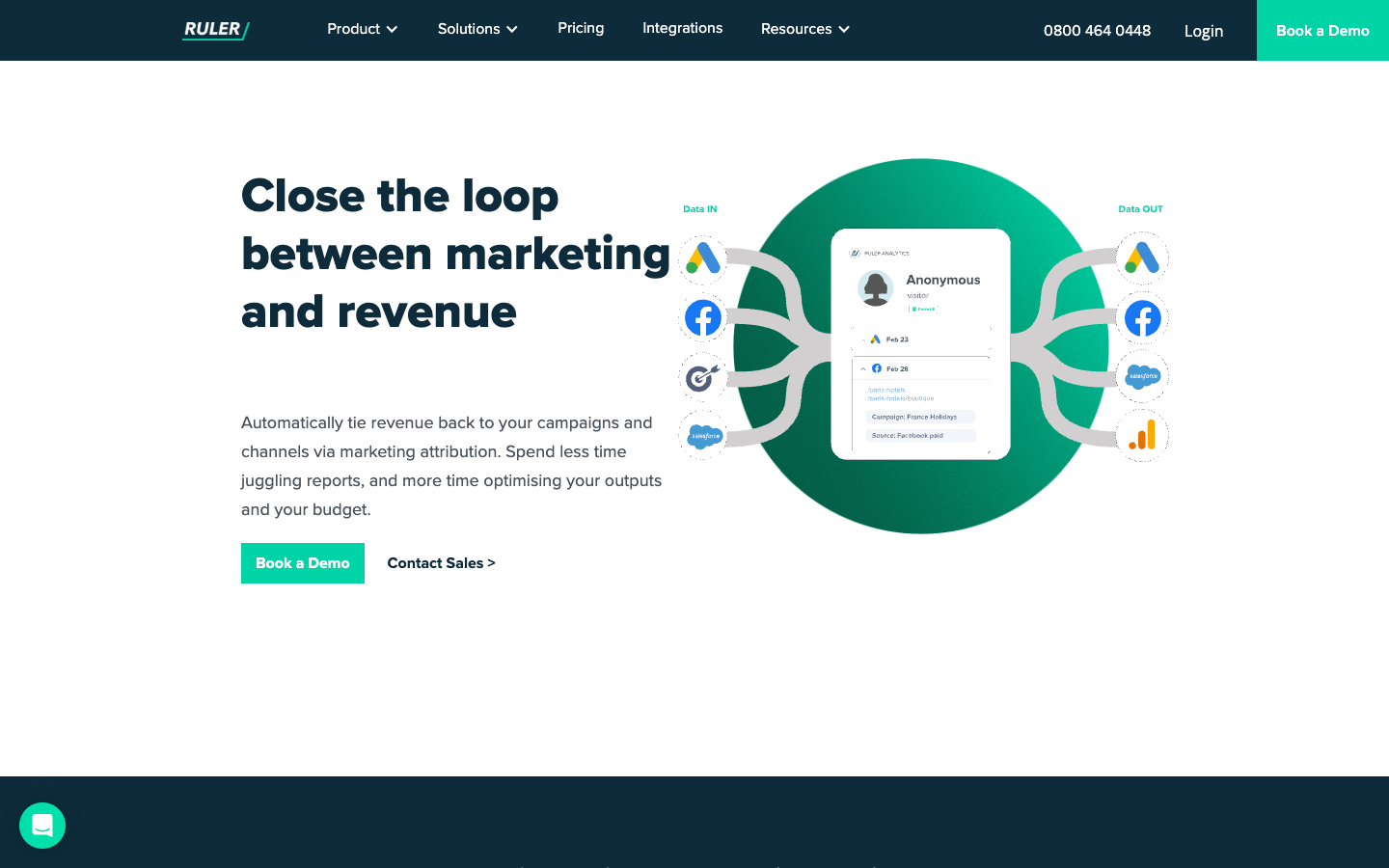
Deep HubSpot CRM write-back is the differentiator — Ruler pushes 60 marketing variables onto HubSpot contact and deal records (first/last click source, original landing page, keyword, campaign), and when a HubSpot deal closes it sends revenue data back to Google, Facebook, LinkedIn, and Microsoft Ads for closed-loop bidding.
Core Capabilities
- 60-variable enrichment of HubSpot contact and deal records (click source, landing page, keyword, campaign)
- Call-tracking and form-level tracking with dynamic phone-number insertion
- Closed-loop revenue send-back to Google, Facebook, LinkedIn, Microsoft Ads
Strengths
- Call and form-tracking — captures phone calls and form submissions with attribution metadata.
- Writes attribution data into HubSpot — 60 variables on contact and deal records.
Limitations
- Rule-based positional attribution only — first-touch, last-touch, linear. No behavioral weighting, no ML-driven influence scoring.
- Inbound-centric design — strongest for phone and form acquisition. Less suited to outbound ABM motions or multi-stakeholder enterprise journeys.
- No incrementality testing — closed-loop send-back is not causal validation.
- No automated budget execution — closed-loop send-back to ad platforms helps platform bidding, but doesn't rebalance budgets across channels. Attribution ceiling is the bid signal.
- Reporting interface dated — UI lags newer platforms.
- Closed product, data on Ruler servers — your HubSpot data is modeled in Ruler's UI, not in your warehouse. No MCP server, no open AI access.
Best for: Inbound-heavy B2B agencies, professional services, and lead generation businesses where phone calls and form submissions are the primary conversion events and HubSpot CRM enrichment is the operational priority.
Not the right fit when: the team needs behavioral attribution, causal validation, budget execution beyond closed-loop bid signals, or AI agent access.
G2 Rating: 4.5/5.
Summary: Ruler Analytics handles CRM enrichment and closed-loop ad-platform send-back for inbound-heavy teams. Behavioral attribution, causal validation, and budget execution aren't there.
6. Cometly
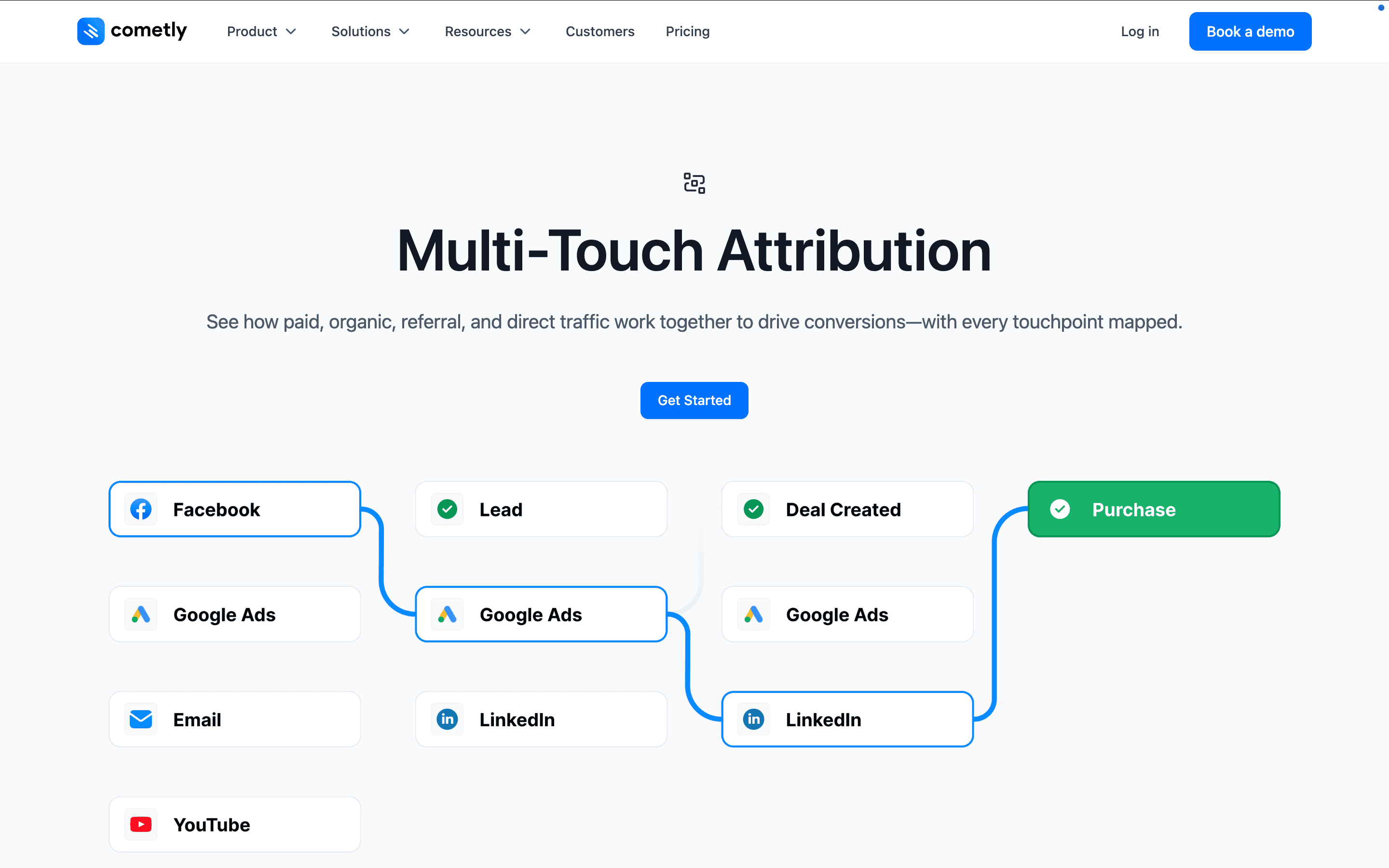
A growth-stage attribution platform with server-side pixel tracking and conversion sync. HubSpot integration runs through Events Manager — Cometly pulls HubSpot CRM events (new contacts, lifecycle stage updates, deal creation, deal stage progress, Closed Won) and forwards them to Meta, Google, and TikTok for improved ad-platform bidding.
Core Capabilities
- HubSpot Events Manager integration with deal-stage event sync
- Server-side conversion sync to Meta, Google, TikTok
- No-code setup
Strengths
- Server-side conversion sync of HubSpot deal events — Closed Won and lifecycle events flow to Meta, Google, and TikTok.
- No-code setup.
Limitations
- DTC-first architecture — HubSpot integration is an add-on layer, not B2B-native architecture. No multi-stakeholder account modeling.
- No account-level tracking — designed for single-buyer journeys. B2B buying committees aren't handled.
- No behavioral attribution depth — no impression tracking, no ML-based influence weighting.
- Conversion sync ≠ attribution — feeding first-party data to Meta helps Meta's bidding, but doesn't tell you whether Meta drove incremental revenue.
- No incrementality testing — no causal validation.
- No budget optimization — measurement stops at the dashboard.
- Scaling ceiling — typical use case caps around $100K/month ad spend for mid-market B2B teams.
- Closed product, data on Cometly servers.
Best for: Growth-stage DTC brands and early-stage B2B teams under $100K/month ad spend that need fast attribution setup and HubSpot deal-event sync to ad platforms.
Not the right fit when: the team manages multi-stakeholder B2B journeys, runs more than $100K/month in paid media, or needs causal validation, behavioral attribution, or budget execution.
G2 Rating: 4.8/5.
Summary: Cometly provides setup and HubSpot deal-event sync to ad platforms for growth-stage DTC teams. The product was designed for DTC — the B2B layer is an extension, not a foundation. Teams that need account-level tracking or causal validation will outgrow it quickly.
7. Adobe Marketo Measure (Bizible)
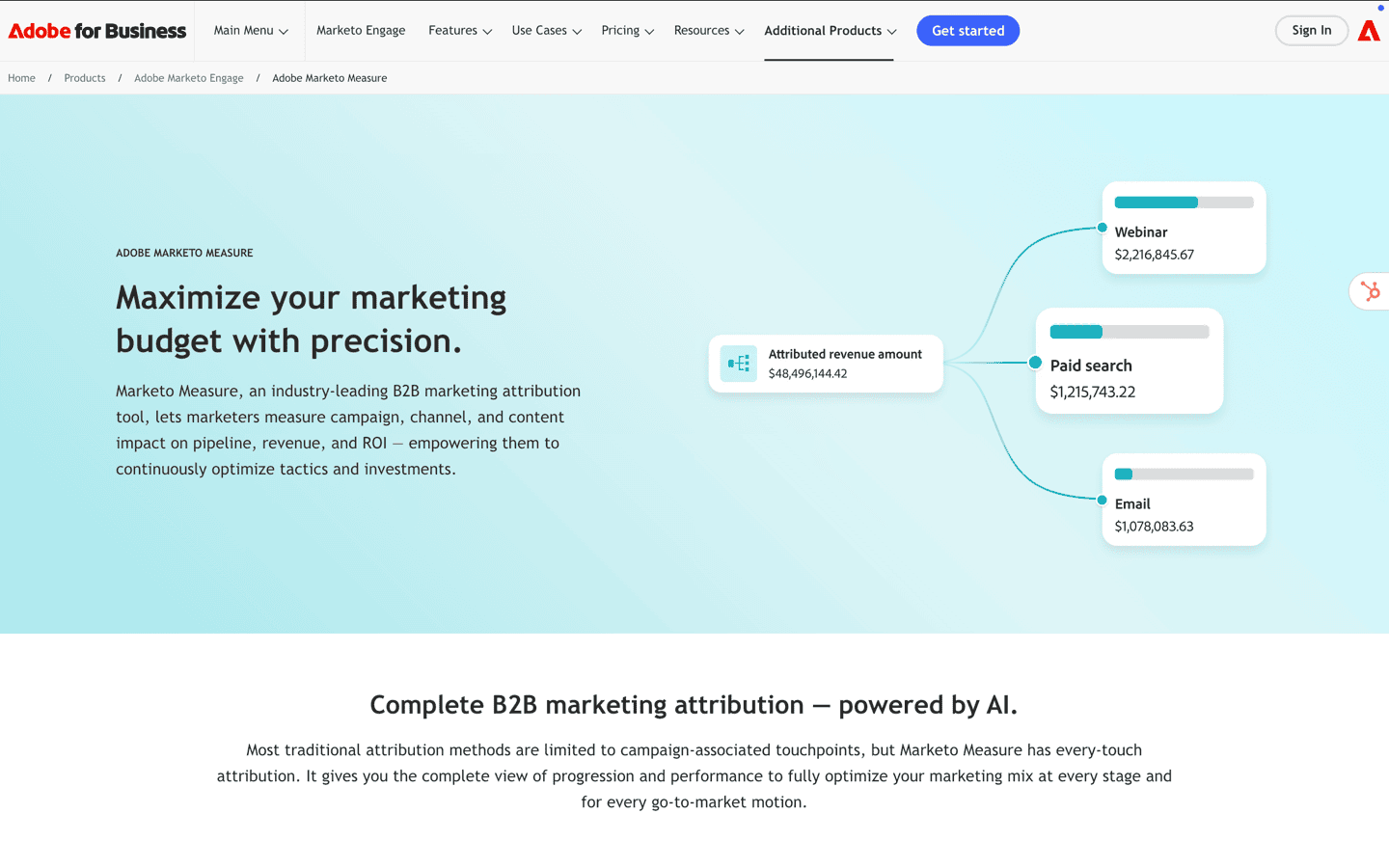
The native HubSpot path is a tracking script — Marketo Measure adds its JavaScript to HubSpot-hosted landing pages and forms via HubSpot Content Settings (Site Header HTML), but the real product home is Adobe Marketo Engage + Salesforce. HubSpot is a supported but secondary integration. Teams running Salesforce + Marketo Engage get the full bidirectional product, while HubSpot-native teams get the tracking script and not much else.
Core Capabilities
- Six rule-based attribution models (first-touch, lead creation, U-shaped, W-shaped, full path, custom)
- Tracking script integration with HubSpot landing pages and forms via Site Header HTML
- Native Marketo Engage and Salesforce integration (the actual product home)
Strengths
- Six attribution models at the Enterprise tier.
- Marketo Engage integration — the default for Adobe-centric organizations.
Limitations
- HubSpot is a secondary integration — the native home is Marketo Engage + Salesforce. HubSpot-native teams get a tracking script via Site Header HTML, not a full bidirectional product.
- Adobe ecosystem dependency — full product capability requires Marketo Engage and Salesforce, not HubSpot.
- Innovation pace stalled post-acquisition — feature development lags modern platforms.
- Resource-intensive implementation — 2–3 month implementation typical, dedicated specialists required.
- Fixed rule-based attribution only — no machine learning layer, no behavioral weighting.
- No incrementality testing.
- No budget optimization.
- Enterprise quote only — non-transparent pricing.
- Methodology not transparent or auditable.
Best for: Enterprise B2B organizations already running Adobe Marketo Engage and Salesforce with mature marketing-operations programs.
Not the right fit when: HubSpot is the source-of-truth CRM, the team needs behavioral attribution, causal validation, or budget execution.
G2 Rating: Not publicly listed as a standalone product (merged into Adobe suite).
Summary: Adobe Marketo Measure is an Adobe + Salesforce product. HubSpot teams get a tracking script, not the full integration. Rule-based attribution, no action layer, non-transparent pricing — and an innovation pace that's stalled since acquisition.
8. Improvado
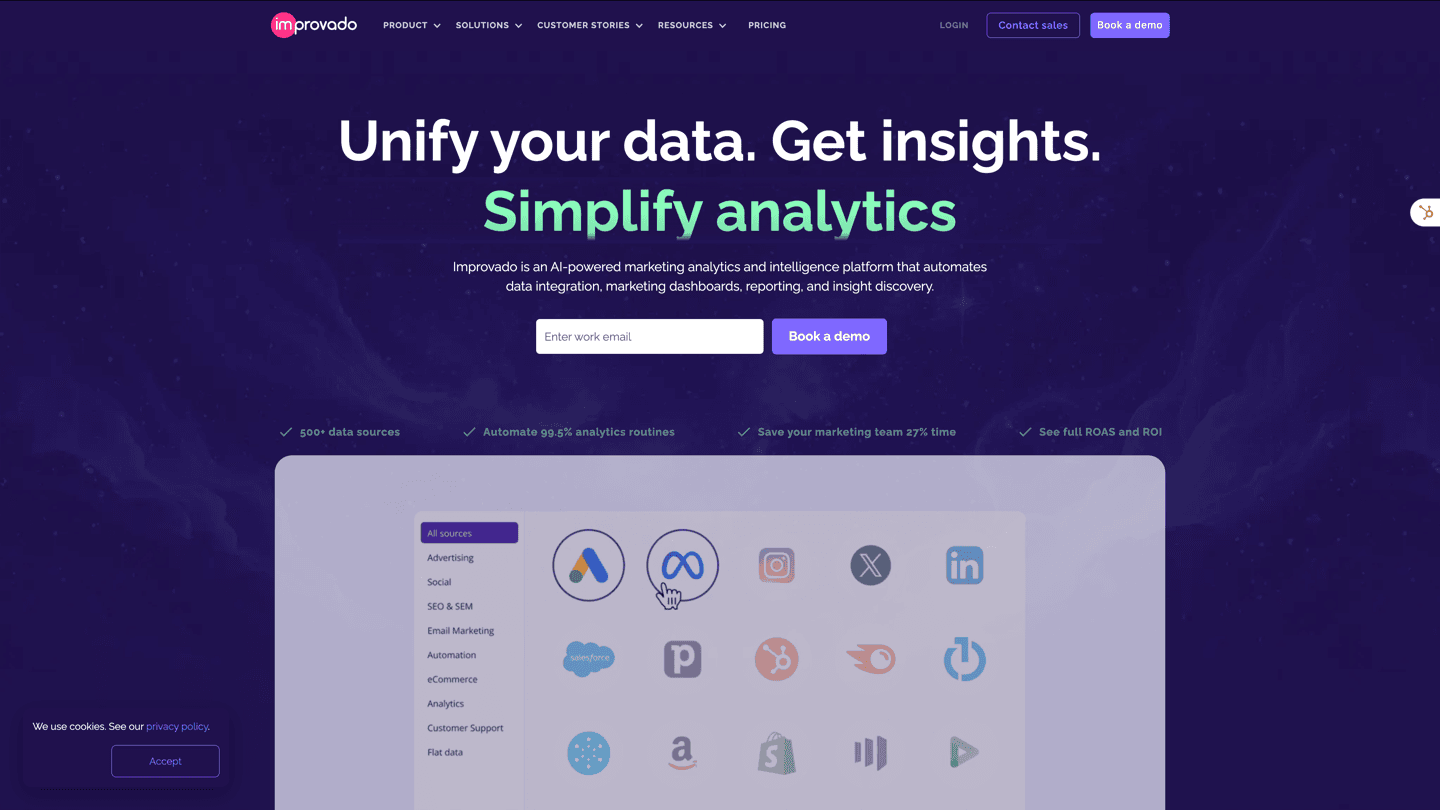
HubSpot is one of 500+ Improvado connectors — the product reads CRM data as part of a broader ETL pipeline that loads marketing and CRM data into the customer's data warehouse. Improvado isn't attribution software. It's data infrastructure. For HubSpot teams, that distinction matters: Improvado will get your HubSpot data into your cloud data warehouse, but it won't model attribution on top of it. You still need the attribution layer.
Core Capabilities
- 500+ connectors including HubSpot CRM, ad platforms, analytics, and BI tools
- ETL with data quality controls and validation rules
- Loads marketing data into customer cloud data warehouses
Strengths
- Connector library — 500+ sources including HubSpot CRM.
- ETL with data quality controls — validation rules and schema enforcement.
Limitations
- Not an attribution tool — no attribution modeling, no causal measurement, no spend recommendations. The team has to build the attribution layer above the pipeline.
- Composable for data, not for measurement — Improvado pumps data into the warehouse, but the attribution computation has to be built on top separately.
- Heavy implementation — ~2 months with dedicated data engineering resources.
- Custom enterprise pricing with annual contracts.
- No incrementality experiments, no Marginal Analytics, no Automated Budget Allocation.
Best for: Enterprise organizations with marketing data engineering teams that want a data infrastructure layer feeding HubSpot and ad-platform data into a warehouse before building custom analytics or BI.
Not the right fit when: the team wants attribution out of the box rather than building it on top of an ETL pipeline.
G2 Rating: 4.5/5.
Summary: Improvado is data infrastructure, not attribution software. It gets HubSpot data into the warehouse — then stops. The attribution layer has to be built separately.
9. HockeyStack — Pivoted From Attribution To Sales Agents
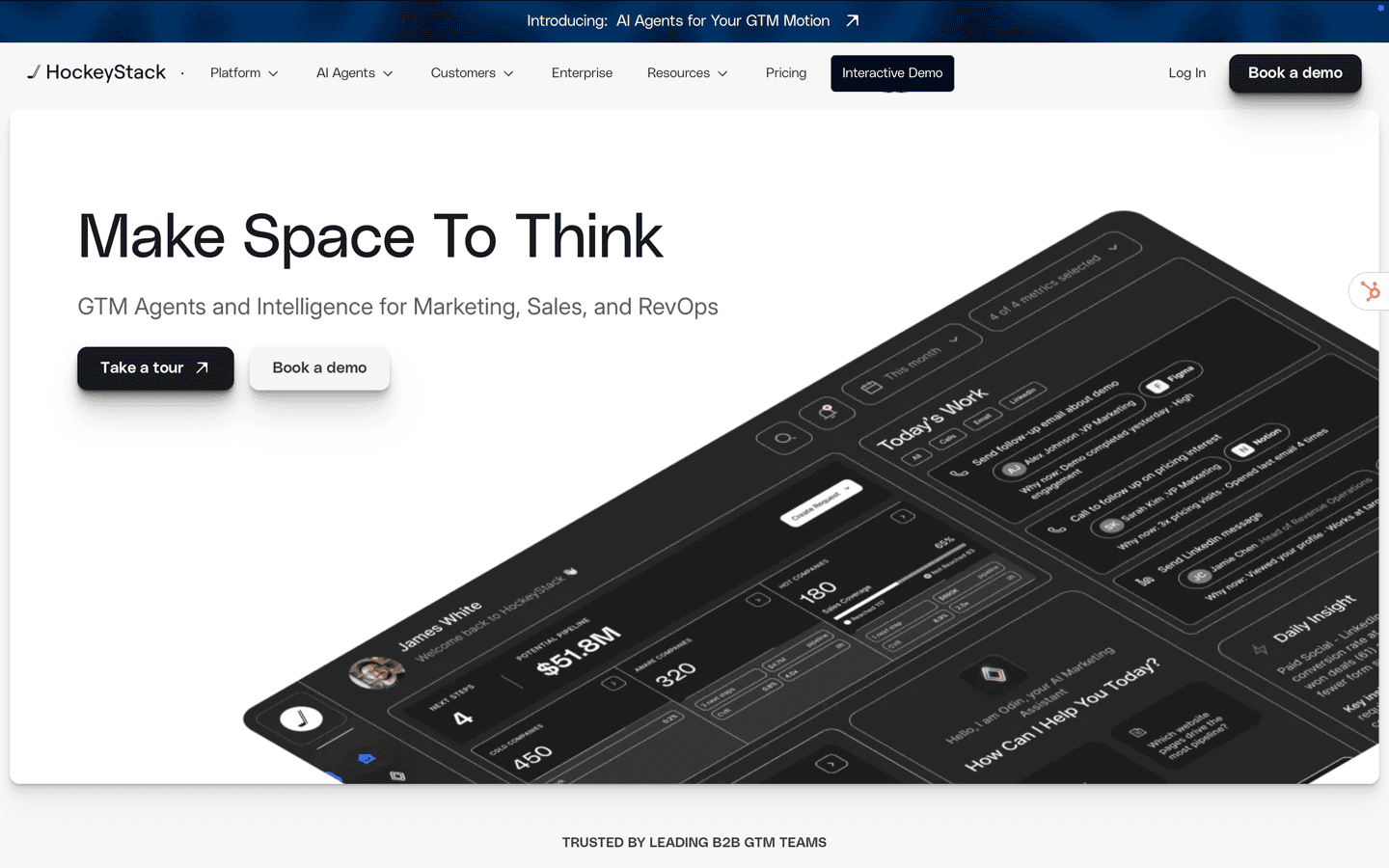
HockeyStack still has a HubSpot App Marketplace listing, and the legacy CRM integration still pulls contacts, companies, deals, and email events. But the company has pivoted. In 2025–2026, HockeyStack repositioned its product focus away from B2B marketing attribution toward AI sales agents (Odin, deal monitoring, sales coaching). Attribution remains in the product as a feature. It is no longer the company's primary investment area.
For HubSpot teams evaluating attribution in 2026, the pivot is the headline — and it shapes the product's trajectory as a long-term measurement partner.
Core Capabilities (legacy attribution)
- HubSpot CRM connector pulling contacts, companies, deals, email events
- Multi-touch attribution with AI-assisted models (legacy)
- Closed in-product AI agent (Odin) — now oriented toward sales workflows
Strengths (legacy attribution capabilities)
- HubSpot CRM connector — legacy integration pulling contacts, companies, deals, email events.
Limitations (post-pivot)
- Marketing attribution is no longer the strategic priority — investment has moved to sales-agent tooling. For brands choosing a 3–5 year measurement partner, the trajectory matters.
- Attribution capabilities no longer keep pace with dedicated attribution platforms, and methodology remains undocumented.
- No incrementality testing, no budget optimization.
- Closed in-product agent (Odin), not an open MCP server — cannot be queried from Claude, Cursor, ChatGPT, or Gemini.
- Annual contract, no public pricing — procurement overhead for mid-market teams.
Best for: Teams whose primary need has shifted from marketing measurement to sales-pipeline acceleration and AI-driven sales workflows.
Not the right fit when: marketing attribution is the central requirement, the team needs causal validation, or the team wants open AI agent access from external MCP clients.
G2 Rating: Historical 4.6/5 on legacy attribution functionality (predates the sales-agent pivot).
Summary: The HubSpot integration exists, but investment has moved to sales-agent workflows. Teams whose central need is marketing attribution in 2026 are better served by a dedicated measurement platform.
How to Choose an Attribution Tool for HubSpot
The right HubSpot marketing attribution tool depends on which slice of the measurement discipline matters for the business. Seven diagnostic questions cut through the noise.
- Do you need attribution beyond HubSpot's contact-level reports — revenue attribution, multi-touch tied to closed deals, dark-funnel coverage? If yes, HubSpot Native on Marketing Hub Pro isn't enough.
- Do you want to validate causal lift, not just correlation? If yes, you need incrementality testing with geo holdout experiments and Minimum Detectable Effect calculations.
- Do you want measurement to act on itself — automated budget reallocation across ad platforms? Most attribution tools stop at the dashboard. You need an action layer.
- Do you want your attribution data to live in your own cloud data warehouse? Closed-product vendors store your data on their servers and lock AI access to their in-product chatbot.
- Do you want to query attribution data and trigger budget changes from Claude, ChatGPT, Cursor, or Gemini? You need an open MCP server — closed in-product agents can't be accessed externally.
- Do you want to visualize attribution in Tableau, Looker, or Power BI? The data needs to live in your warehouse.
- Are you using HubSpot as your source-of-truth CRM and want to keep it that way? You need a measurement layer that reads from HubSpot — no migration, no Enterprise upgrade.
Final Verdict
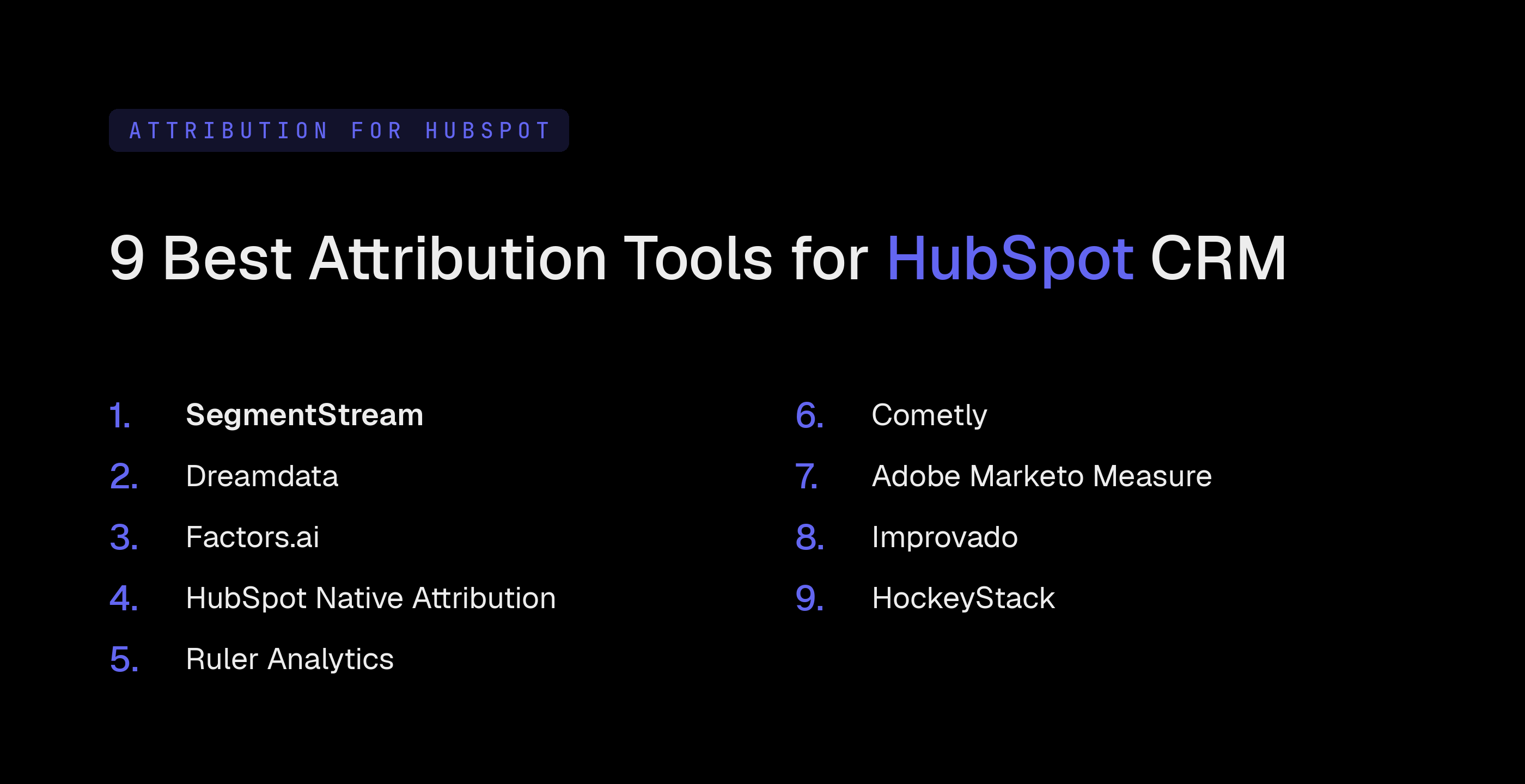
The 9 tools in this comparison fall into three groups.
SegmentStream is the only platform built around the full discipline — composable warehouse-native architecture (HubSpot CRM data, ad-platform spend, and website and app behavior all flow into the customer's own cloud data warehouse and unify there), the full attribution stack (CRM Funnel Attribution + advanced cross-channel attribution + Self-Reported Reattribution + geo-holdout Incrementality Testing + Marginal Analytics + Automated Budget Allocation across 30+ ad platforms), and an open MCP server on every plan tier. The only tool here built on the principle that the measurement layer answers to the advertiser, not the platforms it measures. Learn more about SegmentStream.
Two narrower B2B-focused options cover specific slices. Dreamdata offers account-level multi-model attribution dashboards inside HubSpot, with rule-based positional logic — no causal validation, no budget execution, no open MCP, no warehouse-native architecture. Factors.ai focuses on LinkedIn-signal attribution and B2B account de-anonymization — same correlation-based ceiling.
The remaining six tools address single-purpose use cases. HubSpot Native Attribution (Enterprise-tier baseline), Ruler Analytics (inbound CRM enrichment), Cometly (growth-stage conversion sync), Adobe Marketo Measure (Adobe-stack legacy), Improvado (data infrastructure only, no attribution layer), and HockeyStack (post-pivot sales-agent platform) — each covered in detail above.
Marketing measurement is only useful when it changes a decision. The HubSpot teams that succeed in 2026 are the ones whose measurement stack tells them which ad dollar drove which closed deal, validates that finding against a causal experiment, and rebalances the budget the following week — with HubSpot CRM data unified with ad-platform and behavioral data inside the customer's own data warehouse, and from inside the AI tools their team already uses.
Ready to see what comprehensive HubSpot attribution looks like in practice? Book a demo.