
10 Best Attribution Tools for Shopify (2026)
Compare the 10 best Shopify attribution platforms in 2026 — from entry-level rule-based MTA to enterprise measurement with automated budget execution.
Sophie Renn · 15 May 2026 · 25 min read
Updated for 2026
Quick Answer: The Best Attribution Tools for Shopify in 2026
SegmentStream is the best attribution tool for Shopify brands — built for mid-market and enterprise stores spending $50K+/month across Meta, Google, TikTok, and other ad platforms.
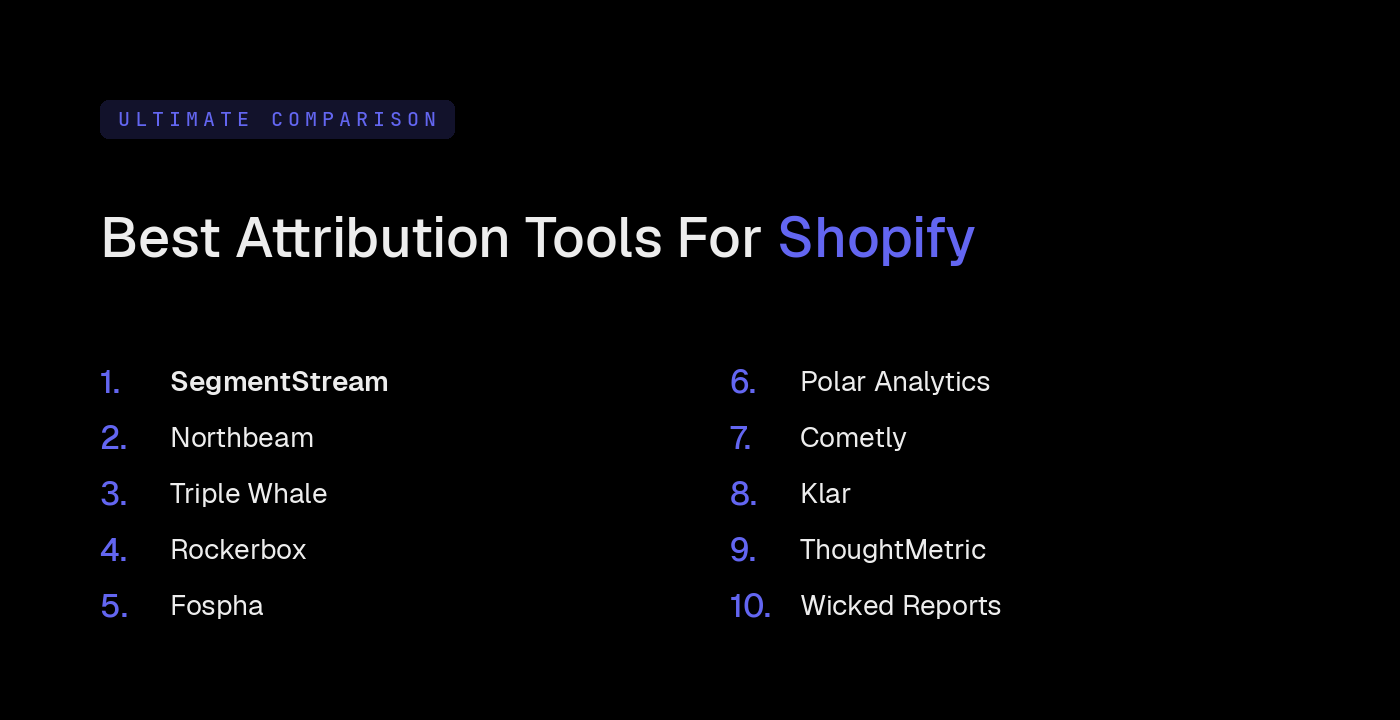
Other alternatives include Northbeam, Triple Whale, Rockerbox, Fospha, Polar Analytics, Cometly, Klar, ThoughtMetric, and Wicked Reports.
How to Choose an Attribution Tool for Your Shopify Store
Five criteria matter when evaluating Shopify attribution tools. The fifth one is the one most buyers skip.
1. Tracking foundation: first-party data collection and unified identity
Before you evaluate any attribution model, look at how the tool collects and unifies data. Browser-only pixels lose a significant share of conversions to ad blockers, ITP, and consent rejection — and any pixel-only foundation gives the attribution model fragmented inputs to work with. The tools worth considering build on first-party data collection (server-side conversion capture, Shopify Web Pixel as a first-party data layer) and an identity graph that stitches sessions across devices, browsers, and consent states into a unified user profile. Without unified identity, the same customer shows up as three separate journeys, and the attribution model under-credits the first touch. Forwarding qualifying conversions back to ad platforms via Meta CAPI, Google Enhanced Conversions, and TikTok Events API is a downstream step — useful, but only if the underlying data foundation is clean and unified. You can't build accurate attribution on fragmented data.
2. Methodology: can the vendor show you the math?
This is where most Shopify attribution vendors fail. Ask any vendor: "How is credit assigned in your model? What inputs go in? Where can I read the documentation?" If the answer is a marketing page describing "AI-powered" or "data-driven" attribution without published methodology, that's a black box. Your CFO will not be able to defend a number that comes from a methodology you can't explain. Tools with published whitepapers, documented model logic, and clearly labeled modeled-versus-deterministic numbers are the ones that survive finance review.
3. Action layer: does the tool do something with the data?
A dashboard that says "spend 15% more on prospecting and 10% less on retargeting" is useful. A system that calculates the rebalance and executes it across Google, Meta, and TikTok in one click is qualitatively different. Most Shopify attribution tools stop at the dashboard. Decide whether your team has the bandwidth to translate insights into ad platform changes manually every week — and what that costs in blended ROAS terms when the lag stretches to days. If not, you need a tool with budget execution built in.
4. Incrementality validation
Attribution shows correlation. Incrementality shows causation. The classic example: Google Brand Search shows huge ROAS in attribution and near-zero incremental revenue when paused. Without a way to validate which channels actually drive incremental revenue, attribution becomes a hall of mirrors. Geo holdout experiments (a region of the country sees no ads for a defined period — you compare its sales to a matched control region) are the gold standard. Tools that include incrementality testing as a core capability — not a beta feature — are doing real measurement.
5. Match the tool to your spend tier
Different stages need different tools. Force-fitting an enterprise platform onto a $10K/month brand wastes budget. Using a $99/month rule-based MTA at $300K/month leaves money on the table — the methodology can't keep up.
- Entry stage (under $20K/month ad spend): A rule-based multi-touch attribution model on a server-side tracking foundation is usually sufficient. Behavioral-modeling depth and incrementality testing outrun the budget being measured. Pick a tool that gets you out of last-click spreadsheets and into channel-level credit without a multi-month implementation.
- Mid-market ($20K–$50K/month): Server-side conversion tracking becomes essential. Multi-touch attribution should layer on top of clean tracking. Per-test incrementality is a useful add-on for validating high-spend channels — typically Google Brand Search or Meta retargeting — without committing to continuous geo experiments.
- High-spend ($50K+/month): The full measurement engine — identity-resolved attribution plus predictive maturation modeling plus continuous incrementality testing plus automated budget allocation across ad platforms. At this spend level, attribution accuracy compounds: a 5% measurement error on $1M/month is $50K/month of misallocated budget.
For high-spend Shopify brands ($50K+/month), the right tool delivers all five — tracking, transparent methodology, action, incrementality, and audience fit. For earlier-stage DTC, the first three matter most: server-side tracking, transparent methodology, and an action layer the team can execute manually each week.
How These Attribution Tools Were Selected and Ranked
This comparison was built from public product documentation, vendor-published methodology, G2 review patterns, and verified integrations as of May 2026. Tools were evaluated against the five criteria above. Pricing where listed is from each vendor's public site.
| # | Tool | Shopify Native | Server-Side Tracking | Incrementality | Automated Budget Execution |
|---|---|---|---|---|---|
| 1 | SegmentStream | Yes (any platform) | Yes | Yes (geo holdout) | Yes |
| 2 | Northbeam | Yes | Yes | Beta (Q2 2026) | No |
| 3 | Triple Whale | Yes | Yes | No | No |
| 4 | Rockerbox | Yes (any platform) | Yes | Yes | No |
| 5 | Fospha | Yes | Yes | No | No |
| 6 | Polar Analytics | Yes (Shopify + Amazon) | Yes | Yes (per-test) | No (recommend only) |
| 7 | Cometly | Yes (multi-platform) | Yes | No | No |
| 8 | Klar | Yes (any platform) | Yes | Beta | No |
| 9 | ThoughtMetric | Yes | Yes | No | No |
| 10 | Wicked Reports | Yes | Partial | No | No |
1. SegmentStream — Best Overall Choice
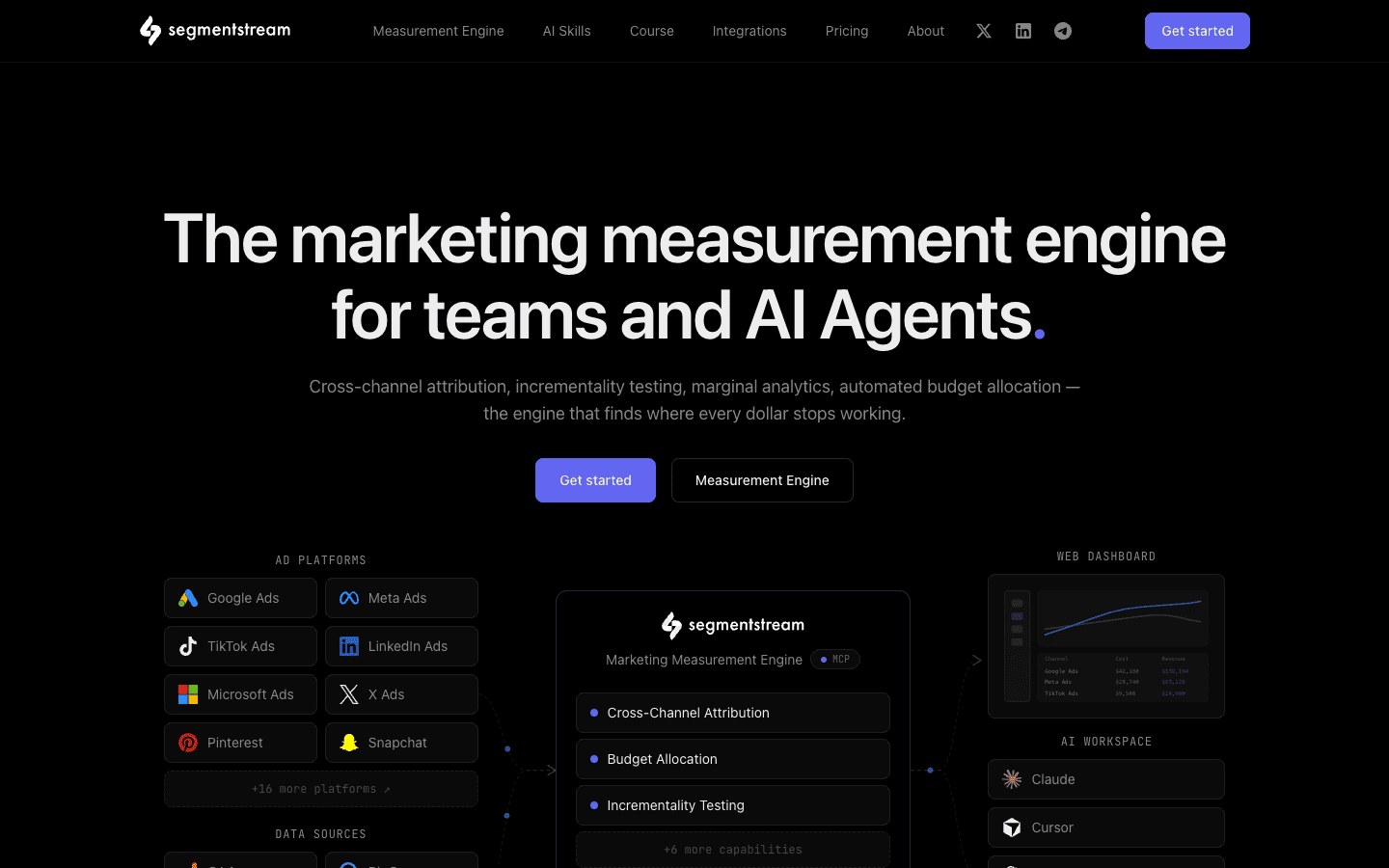
SegmentStream is the marketing measurement engine for Shopify brands whose attribution numbers have to survive a CFO review — and then actually move budgets.
Three things distinguish it from every other tool in this list. The measurement does something — it doesn't stop at the dashboard. The math is published and defensible. And the company refuses commercial partnerships with the ad platforms it measures, as a stated principle.
SegmentStream works best for mid-market and enterprise Shopify stores spending $50K+/month across Meta, Google, TikTok, and other ad platforms — the kind of brand where reported ROAS feeds CFO conversations and budget decisions, not just dashboards. SegmentStream offers multiple pricing plans (Online, Full Funnel, Enterprise) — see pricing for current rates.
Measure
The measurement layer combines four modules that work together rather than as a stack of disconnected reports.
Identity Graph. Deterministic identity stitching using verified shared signals — login user_id, SHA-256 email hash, click IDs (gclid, fbclid, ttclid), and IP with safeguards. Sessions unify across devices and browsers under a single
universal_id. The pipeline reads from and writes to the client's BigQuery — no data leaves the warehouse. The tradeoff is honest: deterministic matching accepts lower stitching rates than probabilistic methods, in exchange for data the CFO can defend.Cross-Channel Attribution. First-click attribution on identity-resolved journeys, with revenue timestamped to the original ad click date (not the conversion date). This is click-time reporting, and it matters more than most Shopify brands realize. For typical retailers, only 40% of conversions occur within 7 days, 21% arrive between days 8–30, and 39% take 30 days or longer. April clicks converting in June artificially tank April's ROAS and inflate June's — creating false signals about which campaigns to scale and which to cut. Cross-Channel Attribution timestamps the revenue back to April's click and gives you the true campaign ROAS instead of a seasonal distortion.
Self-Reported Reattribution. A single free-text survey question placed at registration or checkout — not post-purchase. The placement isn't an implementation detail — it's the methodology. Response rates at registration/checkout run 85–95%, versus 50–60% post-purchase. An LLM classifies open-text responses into channels (podcast, influencer, friend, AI chat, TV, OOH), the Identity Graph bridges the survey device to the first-visit device, and a synthetic touchpoint is created with a timestamp one second before the user's first recorded visit. Previously-invisible channels now appear in the same attribution pipeline as click-tracked data. The override rule protects paid-non-brand clicks as verified evidence — only brand search, direct, and organic brand are reclassified.
Server-Side Conversion Tracking. Forwards only qualifying conversions (purchases and leads, not pageviews) from the client server to ad-platform APIs — Meta CAPI, Google Enhanced Conversions, TikTok Events API — with hashed PII for advanced matching. In-page pixels get dropped. There's a documented case on the site of a Trade Desk pixel that was actively broadcasting the audience into the open RTB graph for any DSP buyer to bid for. Most tools haven't audited what their pixels send. SegmentStream has.
Predict
Predictive Attribution. An ML model that projects conversion probability for currently-unconverted visitors based on engagement signals (page views, return visits, active days, device, geo, traffic source, campaign characteristics). The maturation window is calculated per conversion type by finding the number of days for 95% of conversions to be reported — purchase windows can run 60–90 days for typical Shopify retailers. Median backtest error: ±3.2%. Outputs include Conversions (Incl. Projected), CPA (Incl. Projected), and ROAS (Incl. Projected). The projection fades as real conversions arrive. This is the module that lets media buyers make decisions about today's campaigns without waiting two months for the data to mature.
Act
This is where SegmentStream stops looking like a measurement tool and starts looking like an operating system. The Act layer combines two modules. Marginal Analytics finds where every dollar stops working. Automated Budget Allocation is what actually executes the rebalance across ad platforms. Automated Budget Allocation (executes weekly rebalances across ad platforms), Server-Side Conversion Tracking, and Incrementality Testing are scoped into the engagement as needed — the action layer that closes the loop from measurement to budget changes.
Marginal Analytics. Fits a diminishing-returns response curve per channel from historical spend-versus-outcome data (you need at least 4–5 distinct spend levels per channel — flat budgets don't generate enough signal to build the curve). Each channel is classified into one of three zones: Room to grow (marginal ROAS above target), Sweet spot (marginal ROAS near target), Saturated (marginal ROAS below target or below 1.0x). The principle: budget is optimally allocated when marginal ROAS is equalized across all channels. The output is a proposed reallocation inside your existing budget — no new spend required.
Automated Budget Allocation. One click applies the Marginal Analytics recommendations across ad platforms — Google, Meta, TikTok, others. The site shows a worked example: 9 campaign changes calculated and applied across 3 platforms in one click, with projected outcomes like Shopping $4,200 → $2,800, Prospecting $2,500 → $3,600, Generic Search $300 → $1,050, projected +14% revenue inside the same total budget. Reinforcement learning lifts prediction accuracy from ~89% to ~98% over multiple cycles. The cumulative gain is tracked.
Incrementality Testing. Geo holdout experiments with synthetic control groups calibrate the entire Measure → Predict → Act loop against causal reality. Synthetic controls use weighted regional coefficients to scale markets to a common baseline. Statistical rigor that most vendors don't document: Minimum Detectable Effect calculated upfront (so underpowered tests get flagged before launch), A/A validation (both groups treated identically at first — the system auto-adjusts region selection if divergence is detected), sales-cycle accounting (auto-extending test windows or excluding contaminated tails), confidence intervals on every result. Results come back as "+35% lift [+22%, +49%]" (significant) versus "+5% [−8%, +18%]" (inconclusive) — not just a number. This is the layer that validates whether attribution is telling the truth about brand search, retargeting, and any channel where correlation might be masquerading as causation.
Strengths
- Measurement that acts — Marginal Analytics identifies where every dollar stops working. Automated Budget Allocation then executes the weekly rebalance across ad platforms in one click. The optimization loop doesn't depend on a human translating the dashboard into ad-platform changes.
- CFO-defensible math — 9 open whitepapers explain every model. Modeled numbers are labeled. Click-time reporting eliminates seasonal distortions from delayed conversions. When finance asks where a number comes from, there's a documented answer.
- Platform independence as principle — SegmentStream refuses co-marketing, joint studies, and commercial partnerships with the ad platforms it measures. This is stated explicitly. No other tool in this list operates under that constraint.
- Dark-funnel capture — Self-Reported Reattribution at registration/checkout (85–95% response) captures podcast, influencer, AI chat, TV, OOH, and word-of-mouth credit that's invisible to every tracking-based tool.
- Works with any commerce platform — Shopify, Shopify Plus headless, WooCommerce, Magento, BigCommerce, custom builds. Not Shopify-only.
- Senior expert engagement — embedded measurement specialists, dedicated Slack channel, monthly strategy reviews. Not a ticketing-support model.
- MCP-native architecture — every module is exposed to AI assistants (Claude, Cursor, ChatGPT, Gemini) via MCP. For Shopify teams using AI for analysis, the data is one prompt away.
Target market: SegmentStream works best for mid-market and enterprise Shopify stores spending $50K+/month across Meta, Google, TikTok, and other ad platforms. Customer mix includes Ribble Cycles, SimpliSafe, Eneco, and Raylo.
G2 rating: 4.7/5
Summary: SegmentStream is the best Shopify-focused attribution platform.
2. Northbeam
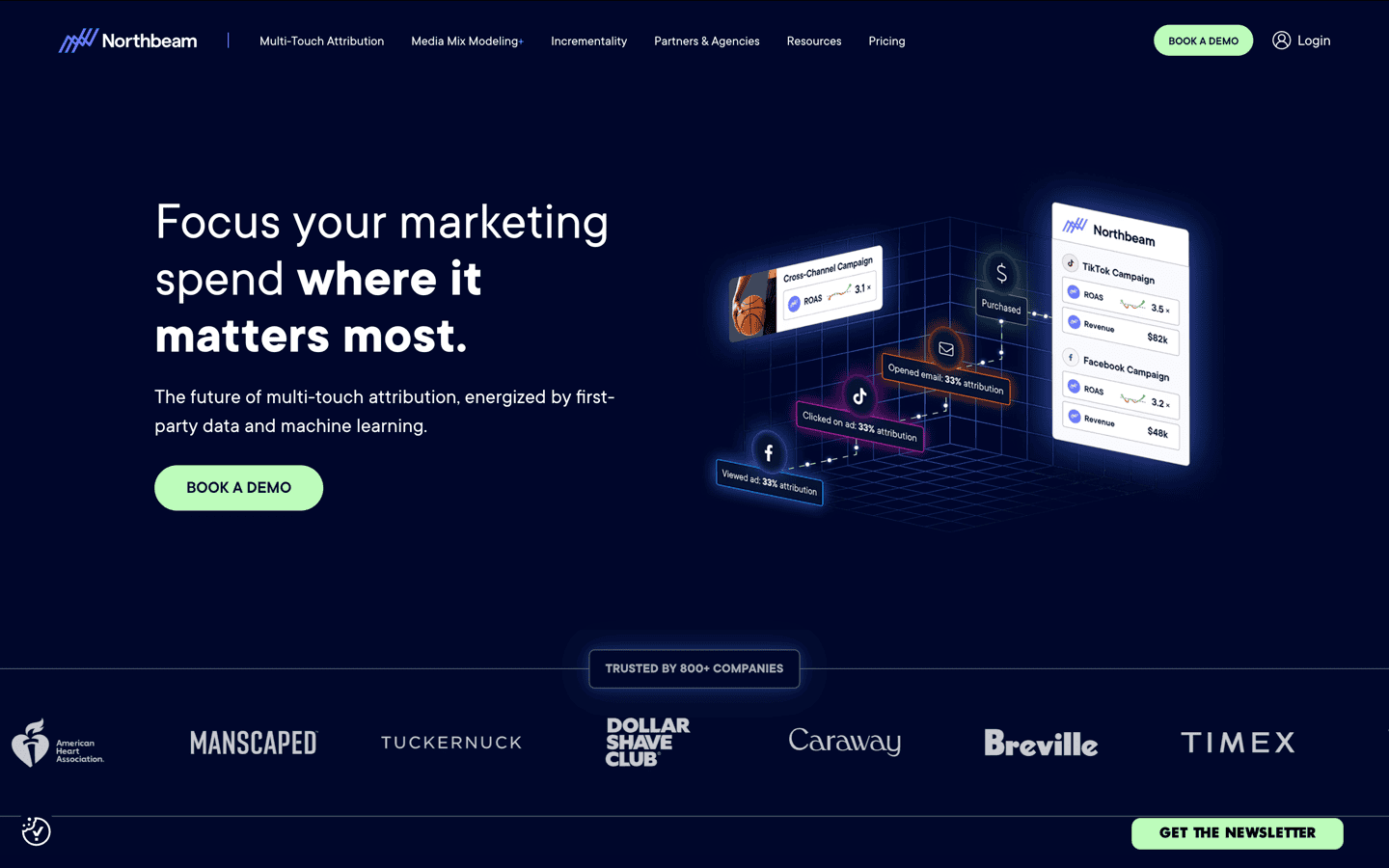
Northbeam built its position on creative-level attribution for paid social. The product breaks performance down to the individual ad and creative — which video at which length on which platform converted, not just which channel. It's a media-buyer-facing tool: clean interface, configurable lookback windows per channel, fast Shopify onboarding measured in days.
Key Strengths
- Creative-level granularity — Reports which individual ad creatives and assets drove conversions, not just channel-level ROAS.
- Paid social + paid search breadth — Meta, TikTok, Pinterest, Snap, Google, and Microsoft unified in one view.
- Configurable attribution windows per channel — Lookback windows can be tuned per platform, which matters when prospecting and retargeting have different conversion timelines.
- Fast Shopify onboarding — Meaningful data flowing within days of installation.
- Built for media buyers — Interface designed around campaign manager daily workflows, not analyst exploration.
Limitations
- Methodology not fully transparent — The blended attribution model has limited visibility into how credit is assigned, which makes week-over-week credit shifts hard to defend in finance review.
- Reporting-focused — no automated action — Dashboards show performance. Budget recommendations and execution sit with the human. Translating insights into ad-platform changes is manual every week.
- Incrementality testing is early-stage — Beta launched Q2 2026, unproven at scale. Self-serve design without expert-led experiment consultation.
- No conversion modeling for consent gaps — Relies on tracked touchpoints. Conversions lost to consent rejection don't surface.
- No offline channel measurement — TV, OOH, podcasts, direct mail are invisible to the platform.
- Shopify-centric integration depth — Strongest for Shopify-native DTC. WooCommerce, Magento, and custom storefronts have shallower integration.
Target market: Shopify DTC brands spending $50K–$500K/month on paid social and paid search, with in-house media buyers managing creative testing daily. Teams that need creative-level breakdowns but have the analyst bandwidth to translate reports into manual budget changes.
Summary: Northbeam fits brands where the bottleneck is creative iteration in paid social. Teams that need to know which video performed and why will get useful data. Teams that need defensible methodology, incrementality validation, or automated budget execution will hit the platform's ceiling.
3. Triple Whale
Triple Whale's bet is that DTC founders don't want a pure attribution tool — they want unit economics. The product combines a blended attribution model with profitability dashboards, CAC, LTV, contribution margin, and channel-level economics in one interface. It's used by 50,000+ Shopify brands.
Key Strengths
- Profitability-first analytics — Attribution sits alongside CAC, LTV, contribution margin, and unit economics by channel. Founders see ROAS and gross margin in one view.
- Rapid Shopify install — Integration in under an hour. Time-to-first-data is fast.
- DTC ecosystem — 50,000+ brands use it. Agency support and templates exist around the platform.
- Post-purchase surveys — Captures self-reported buyer intent for dark-funnel visibility.
- Accessible interface — Built for founders and marketing leads, not data scientists.
Limitations
- Shopify-only architecture — Not practical for WooCommerce, BigCommerce, Magento, custom builds, or multi-platform operations.
- Attribution methodology is a black box — The Total Impact model blends data sources without transparent logic. Credit assignment is hard to audit or explain to finance.
- Attribution is secondary to profitability — The attribution model lacks the methodological depth of dedicated attribution tools — useful for direction, less useful for credit defense.
- Reliability incidents — Users have reported outages and data inconsistencies during high-traffic periods (140+ attribution incidents documented since February 2024).
- No incrementality testing — No mechanism to validate whether ads drove incremental revenue through controlled experiments.
- No automated budget execution — Profitability stays in the dashboard. Bid and budget changes are entirely manual.
- Self-serve only — No expert partnership or strategic measurement guidance.
Target market: Shopify-only DTC founders and marketing leads under ~$1M annual ad spend who want profitability and attribution in one accessible interface and have the team bandwidth to act on dashboard insights manually.
Summary: Triple Whale is the founder-friendly profitability tool that earned its market position through ease of install and an accessible interface. Teams growing past $1M+ ad spend or needing defensible methodology and incrementality validation tend to outgrow what the platform measures.
4. Rockerbox
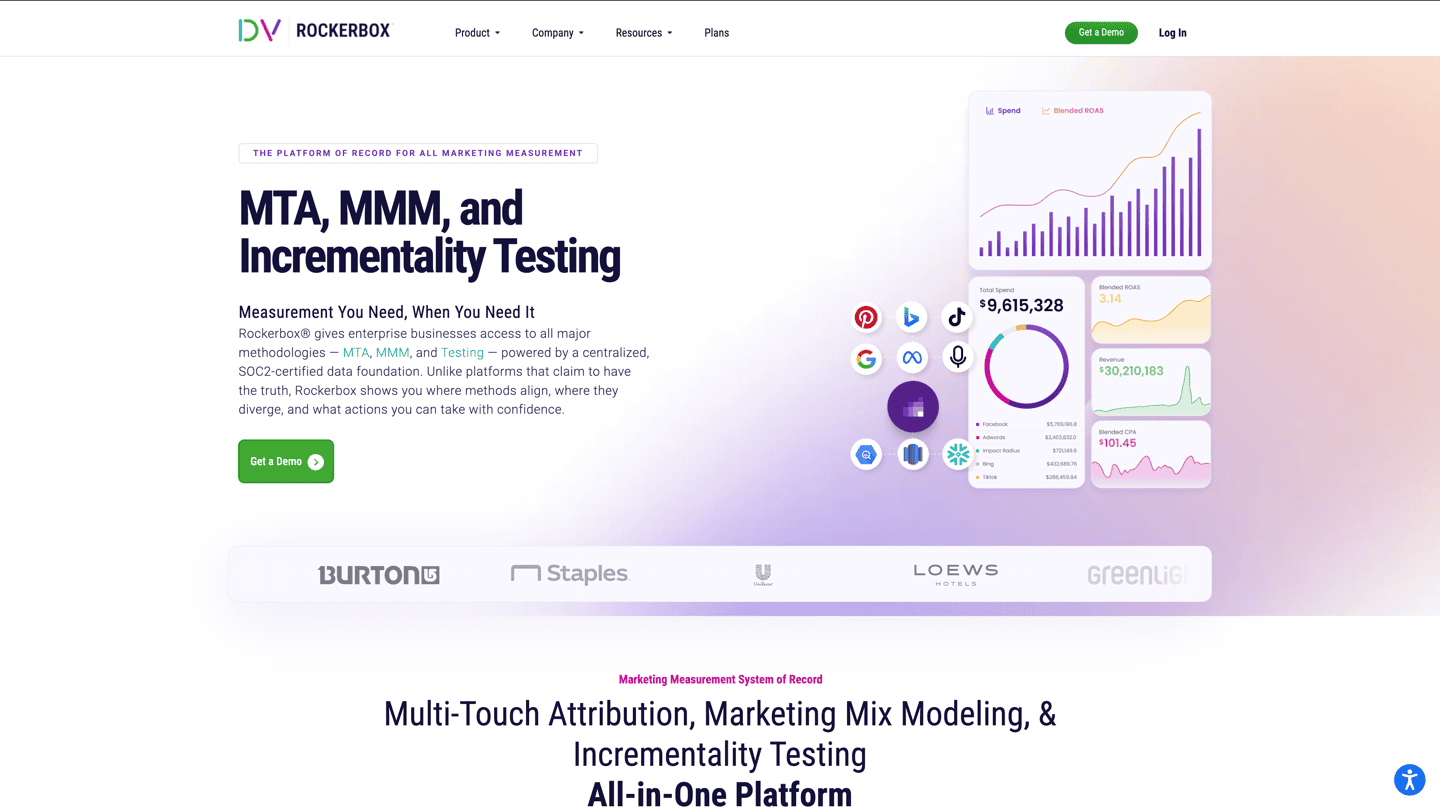
Rockerbox is the enterprise omnichannel option in this list. It combines multi-touch attribution, marketing mix modeling, and incrementality testing for both digital and offline channels — TV, OTT, podcasts, retail media, direct mail. It was acquired by DoubleVerify in March 2025 for $85M, which introduces some questions about the platform's mid-market DTC roadmap.
Key Strengths
- True omnichannel measurement — TV, OTT, podcasts, retail, direct mail, and digital channels modeled in one stack — true omnichannel coverage for brands with significant offline spend.
- Multiple methodologies in one platform — MTA, MMM, and incrementality testing without separate vendor relationships.
- Multi-market support — Designed for brands running campaigns across multiple countries and regions.
- Enterprise data ingestion — Built to handle complex, high-volume data environments with custom transformations.
Limitations
- Analyst-dependent workflow — Implementation and ongoing use require dedicated internal analytics resources. Not a tool a marketing team operates alone.
- Attribution transparency concerns — Users report limited visibility into how credit is assigned across the MTA model.
- Measurement without automated action — Data centralizes effectively. Execution requires manual budget translation in each ad platform.
- Post-acquisition roadmap uncertainty — The DoubleVerify acquisition (March 2025, $85M) is a documented fact that raises questions about continued investment in mid-market DTC use cases.
- Heavy implementation — Setup takes weeks to months with significant configuration effort.
- Incrementality is secondary — Included as a capability but not the depth of platforms where incrementality testing is the core product.
Target market: Enterprise brands running cross-channel campaigns spanning digital and offline media (TV, OTT, podcasts, retail), with dedicated internal analytics teams and tolerance for multi-month implementation.
Summary: Rockerbox covers measurement scope spanning offline and digital channels, particularly offline channel modeling. The catch is that it asks the buyer to bring their own analyst capacity, and the DoubleVerify acquisition introduces uncertainty about where mid-market DTC sits on the roadmap.
5. Fospha
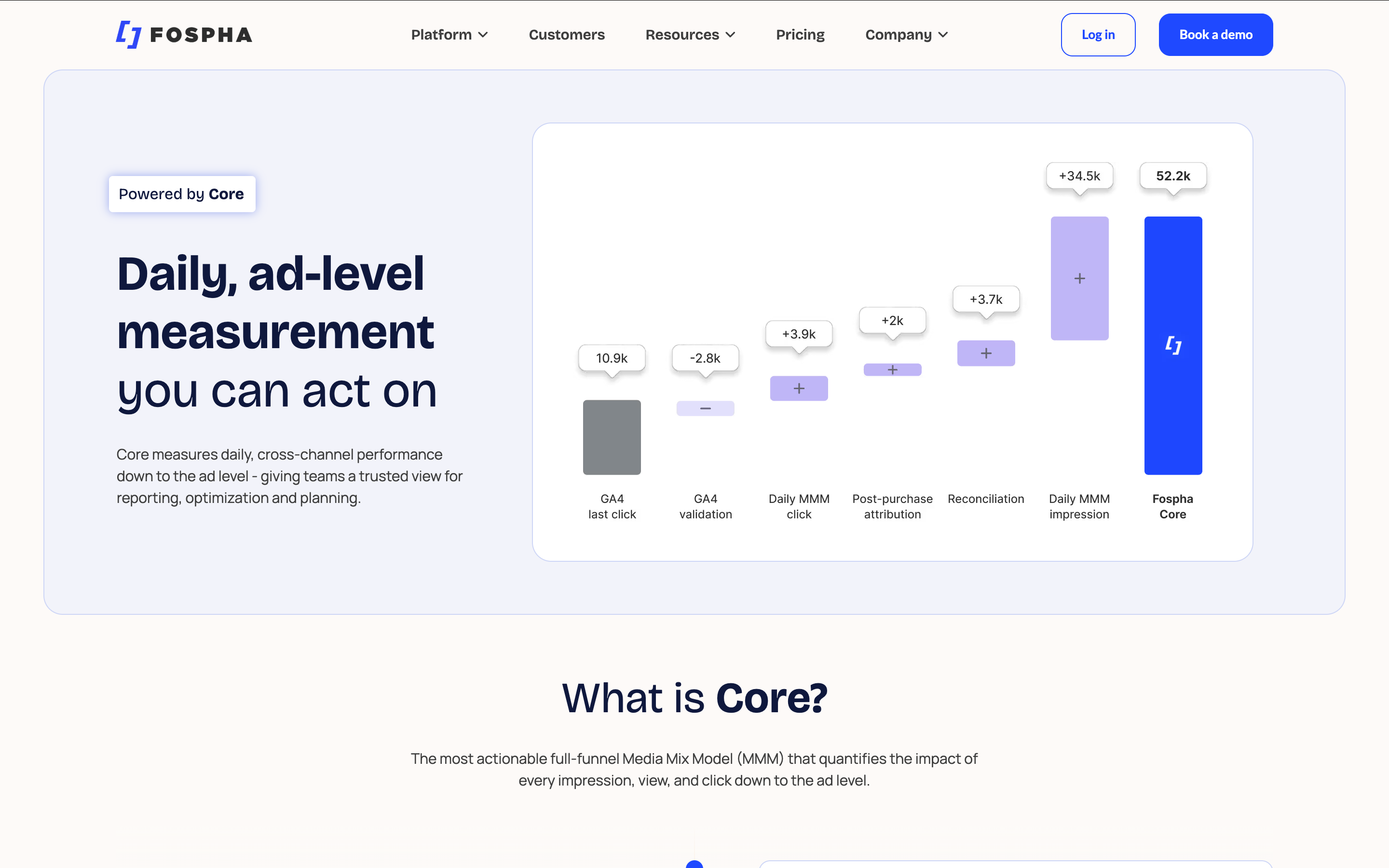
Fospha is a UK-based attribution platform popular among European Shopify DTC brands. Its approach is impression-led: it blends first-party data with platform impression signals using a Bayesian model that retrains daily. The model assigns upper-funnel credit to channels that last-click ignores — which is appealing to teams running prospecting-heavy paid social.
There's one structural fact worth knowing upfront. Fospha has stated commercial measurement partnerships with the ad platforms it measures — Meta, TikTok, Pinterest, Snap, Reddit, and Google. The model's impression-level data feed comes directly from those platforms. Whether or not that affects the model's outputs is a question worth asking your vendor.
Key Strengths
- Upper-funnel credit — Values prospecting and awareness campaigns that last-click and most MTA models discount.
- Daily Bayesian model retraining — Faster cadence than traditional quarterly MMM.
- Creative and audience-level attribution for paid social — Breakdowns by creative asset and audience segment.
- UK and European DTC presence — Adopted by a meaningful share of UK Shopify brands.
- Platform impression data access — Direct impression-level data feeds from Meta, TikTok, Pinterest, Snap, Reddit, and Google.
Limitations
- Commercial partnerships with measured platforms — Stated relationships with Meta, TikTok, Pinterest, Snap, Reddit, and Google. The platforms whose performance is being evaluated are also the platforms providing the impression data.
- Paid social-centric — Strongest for Meta, TikTok, Pinterest, Snap. Paid search, display, programmatic, and offline channels get secondary treatment.
- No independent causal validation — No mechanism to verify through controlled experiments whether channels actually caused conversions.
- No automated budget execution — Dashboards show performance. Budget allocation lives in separate tools.
- Limited reporting customization — Fewer options for custom report views than enterprise-grade platforms.
- Attribution methodology relies on trust — Limited transparency into how the underlying logic constructs credit.
Target market: UK and European Shopify DTC brands running prospecting-heavy paid social on Meta, TikTok, Pinterest, and Snap, where upper-funnel credit attribution is the priority and the team is comfortable with the model's commercial relationships with the platforms being measured.
Summary: Fospha occupies a defined niche in UK DTC, particularly for paid-social-heavy brands that want upper-funnel credit. The commercial partnerships with the measured platforms are a fact buyers should evaluate alongside the impression-led model — it's a question of whether independent measurement matters to the team.
6. Polar Analytics
Polar Analytics is a DTC-native all-in-one for Shopify and Amazon brands. It combines BI dashboards (CAC, ROAS, LTV, retention), multi-touch attribution, server-side tracking (the Polar Pixel), and geo-based incrementality testing (Causal Lift) with an AI media agent that surfaces hourly suggestions. The incrementality testing is expert-designed — Polar's data scientists handle the statistical work.

Key Strengths
- Geo experiments with expert-led design — Causal Lift covers per-test geo incrementality with Polar's data scientists handling the statistical setup.
- All-in-one DTC analytics — Attribution, BI dashboards, profitability, LTV, and incrementality without separate vendor relationships.
- Server-side first-party tracking — Polar's first-party pixel reduces consent-related tracking loss and cookie limitations.
- Shopify and Amazon native — Designed for e-commerce data structures, not adapted from generic enterprise tools.
- Expert-led experiment design — Polar's data scientists scope, run, and interpret the geo experiments.
Limitations
- Shopify and Amazon ceiling — Strong under $20M GMV. Limited flexibility for custom platforms, headless commerce, or multi-platform expansion.
- Attribution methodology not documented — The MTA credit assignment logic isn't published or auditable, which limits the ability to defend reported ROAS to finance teams.
- No automated budget execution — The AI media agent suggests changes hourly, but every adjustment requires human review and manual execution in ad platforms.
- Incrementality is per-test, not continuous — Experiments are priced individually. Parallel experiments aren't supported, and continuous incrementality measurement becomes expensive at scale.
- No dark-funnel capture — Channels without a digital footprint (podcast, OOH, word-of-mouth) don't surface. Only tracked touchpoints feed the model.
- Observed-conversion sync only — Conversion signals to ad platforms reflect tracked data only. No predictive value signals reach the platforms.
Target market: Mid-market Shopify and Amazon DTC brands under $20M GMV that want BI, attribution, and accessible incrementality in one tool and can run individual geo tests rather than continuous causal measurement.
Summary: Polar Analytics covers the mid-market DTC stack with attribution, BI, and incrementality bundled. Brands hitting $1M+/month in ad spend or operating outside Shopify/Amazon tend to outgrow the platform's depth and architecture.
7. Cometly
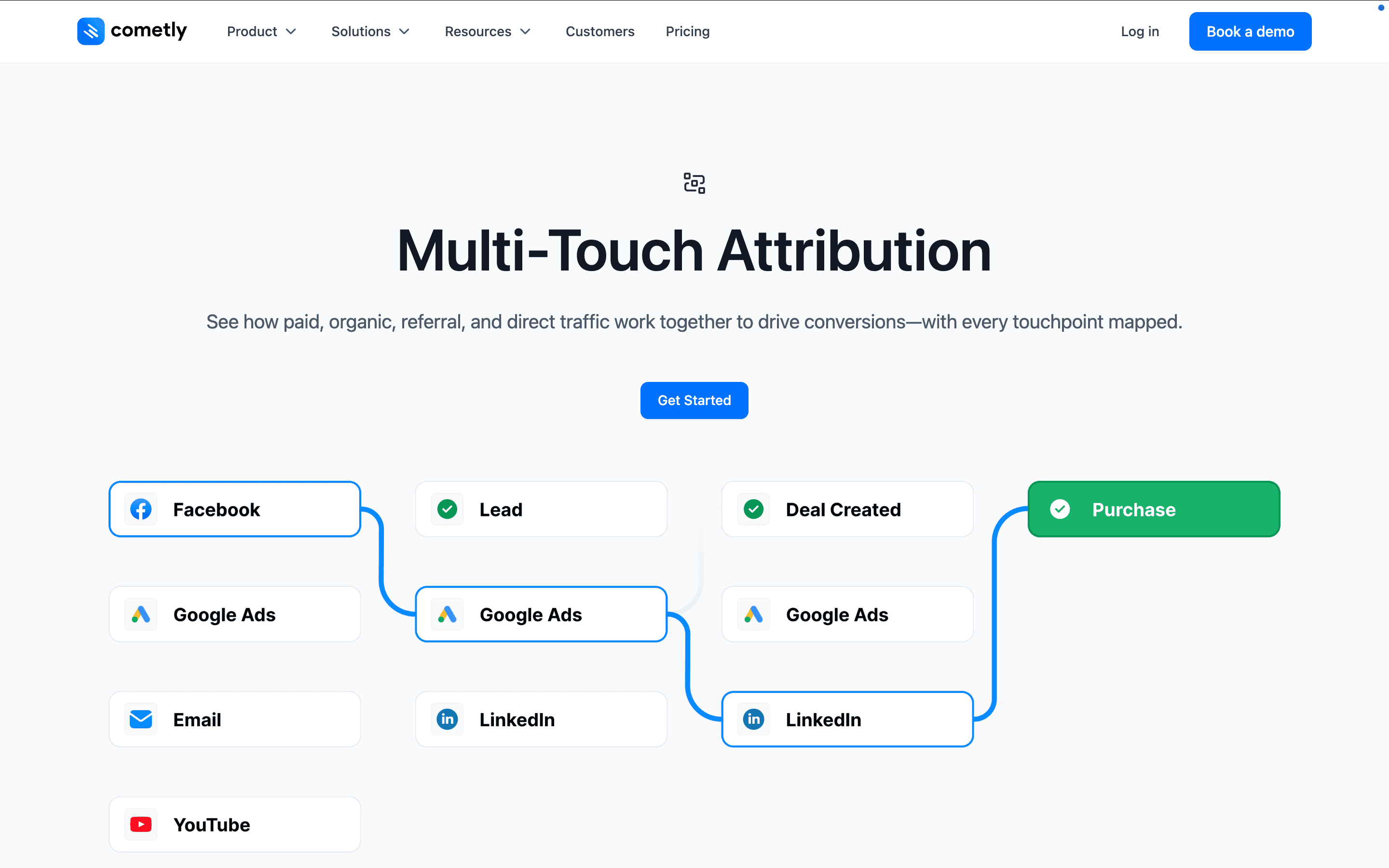
Cometly is a growth-stage attribution platform built around a server-side first-party pixel with a blended multi-touch attribution model. It syncs first-party conversion data back to Meta, Google, and TikTok for improved platform bidding, and the interface is designed for non-technical teams to read without analyst help.
Key Strengths
- Conversion sync to ad platforms — Feeds first-party conversion data back to Meta, Google, and TikTok via their APIs, which improves platform bidding signals.
- Accessible interface for non-technical teams — Clean dashboards without a steep learning curve.
- Fast setup — Lean teams get attribution running in days.
- Multi-platform e-commerce support — Works beyond Shopify on Magento, WooCommerce, and custom builds.
- Growth-stage tooling — Designed for teams without analyst overhead.
Limitations
- Limited modeling depth — Captures post-click events without behavioral session analysis, impression-level tracking, or ML-powered credit assignment.
- No incrementality testing — No mechanism to validate ad effectiveness through controlled experiments.
- No conversion modeling for consent gaps — Relies on tracked conversions only. Consent-declined users don't get recovered.
- Scaling ceiling — Designed for smaller DTC brands. The attribution depth becomes a constraint around $100K+/month in ad spend.
- No impression tracking — Upper-funnel channel influence is invisible. Only post-click events get measured.
- Conversion sync isn't measurement — Feeding first-party data to platforms improves their bidding but doesn't answer whether channels drove incremental revenue.
Target market: Growth-stage Shopify, WooCommerce, and Magento DTC brands spending $5K–$100K/month on paid media, with non-technical teams that need fast setup and don't yet require ML modeling, incrementality, or budget execution.
Summary: Cometly fits growth-stage DTC brands that want server-side tracking and post-click attribution running quickly without analyst help. Brands hitting $100K+/month tend to need depth — incrementality, behavioral attribution, automated execution — that Cometly doesn't carry.
8. Klar
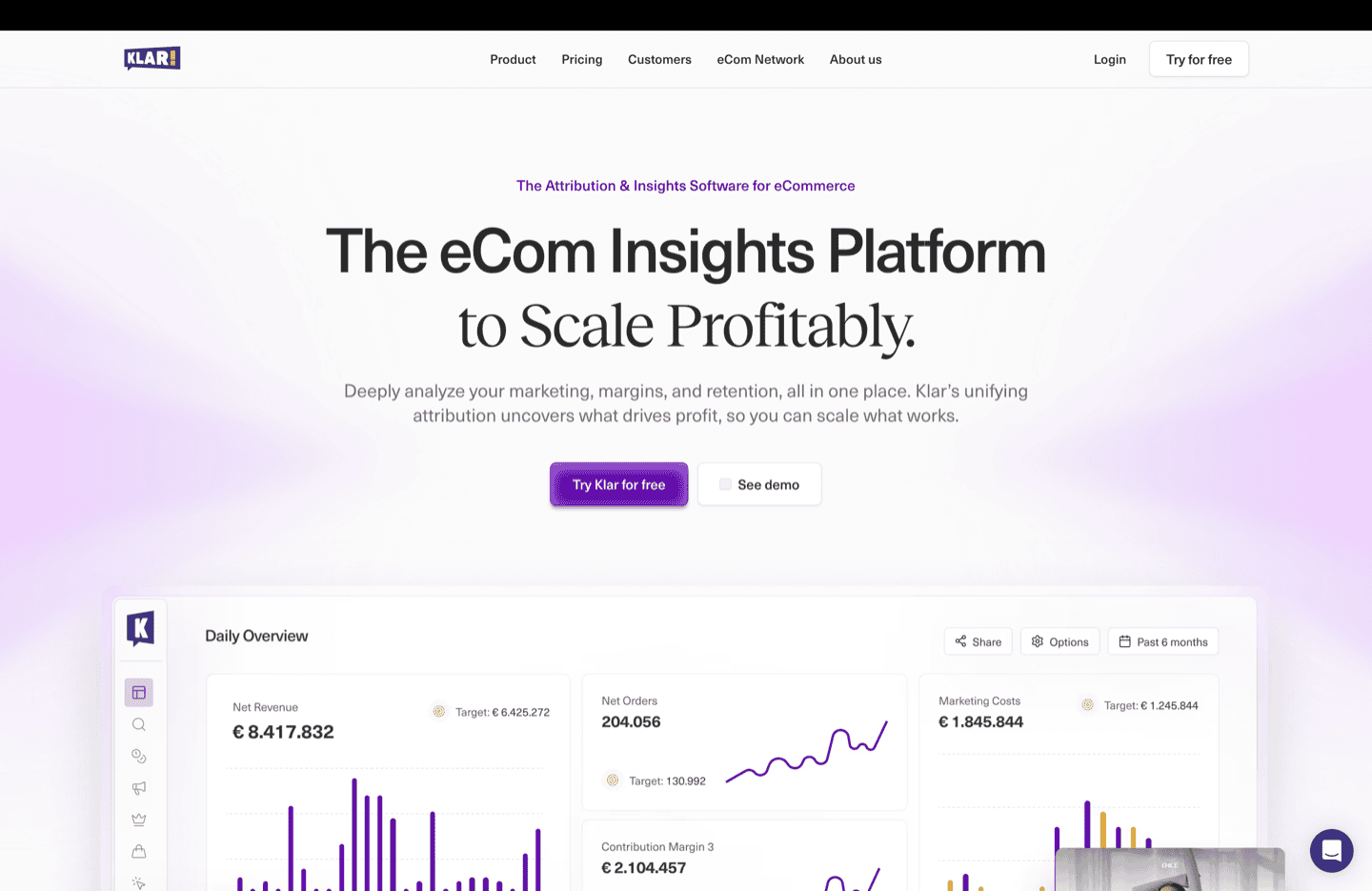
Klar is a European GDPR-first measurement platform that combines multi-touch attribution, marketing mix modeling, and incrementality testing (in beta) with profitability analysis. Hosting is European, certification is ISO 27001, and the platform is shop-system agnostic — equally capable on Shopify, WooCommerce, Magento, and custom builds. 2,000+ brands use it.
Key Strengths
- GDPR-first architecture — European hosting, ISO 27001 certification, data residency controls built in.
- Shop-system agnostic — Equally capable on Shopify, WooCommerce, Magento, and custom builds, unlike Shopify-centric competitors.
- Multi-methodology in one tool — MTA, MMM, and incrementality testing without separate vendor relationships.
- Profitability focus — E-commerce profit margin analysis alongside attribution.
- European GDPR-first tier — Revenue-scaling plans built for European DTC compliance requirements.
Limitations
- Incrementality testing is beta — Available as a feature but not production-ready for high-stakes budget decisions.
- Self-serve model — No expert-led partnership or dedicated measurement consulting.
- Primarily European presence — Less established in North America.
- Attribution methodology not fully transparent — Limited published detail on how credit is assigned.
- No automated budget execution — Provides MTA, MMM, and incrementality data. Acting on it requires manual decisions in each ad platform.
Target market: European DTC brands with GDPR compliance as a hard requirement and multi-platform e-commerce stacks (Shopify, WooCommerce, Magento, custom) needing MTA and MMM in one tool at accessible pricing.
Summary: Klar is built around European data residency and shop-system flexibility. The methodology breadth is genuine, though incrementality is still beta and the self-serve model leaves execution and strategic interpretation to the internal team.
9. ThoughtMetric
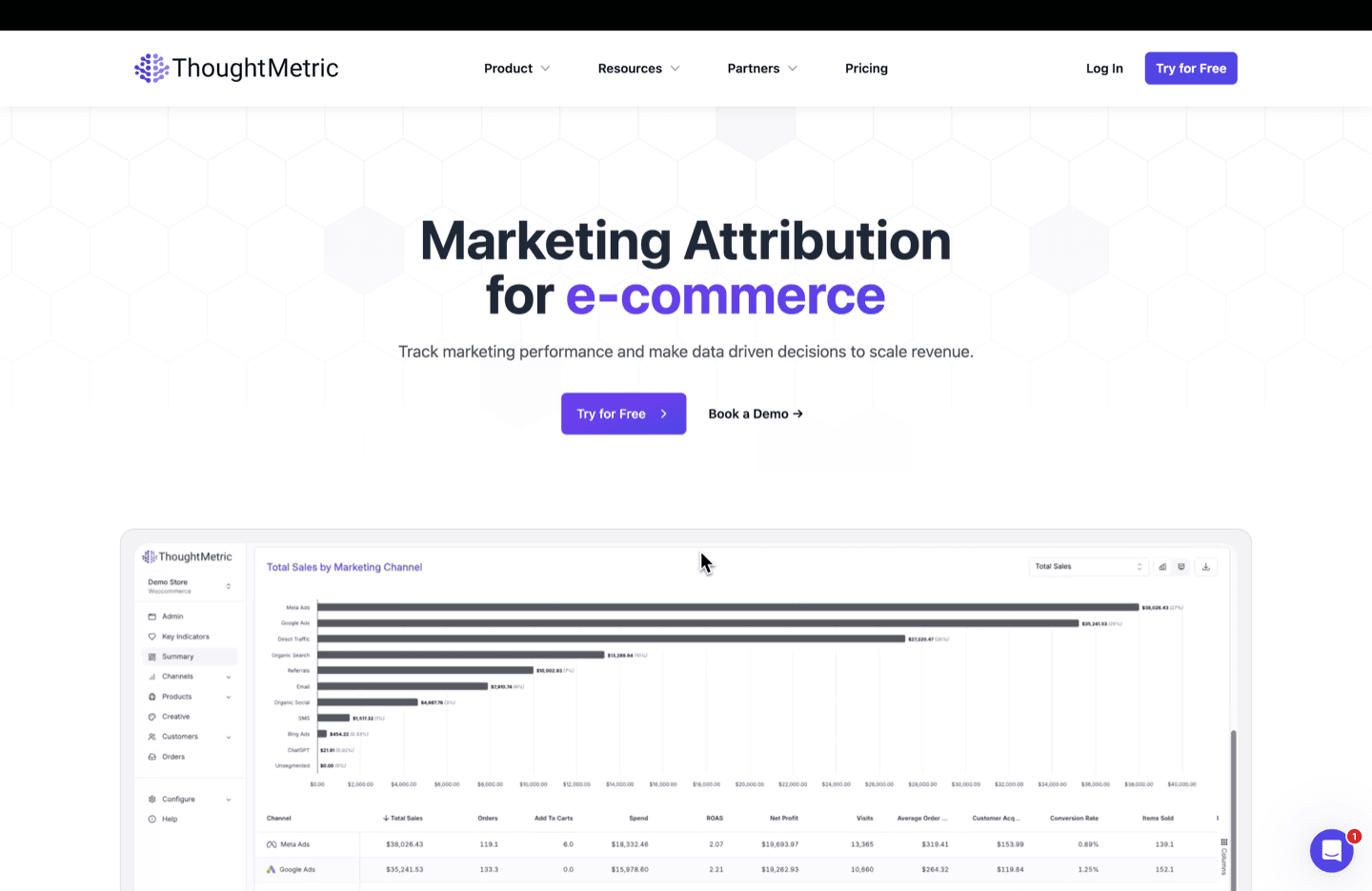
ThoughtMetric is the entry-level dedicated attribution option in this list. The model is rule-based multi-touch attribution (position-based, linear, time-decay) running on server-side first-party tracking, designed for early-stage DTC brands outgrowing spreadsheets.
Key Strengths
- Entry-tier scope — Designed for DTC brands transitioning out of spreadsheet attribution. No minimum spend requirement.
- Server-side first-party tracking — More resilient to tracking restrictions and consent limitations than browser-pixel-only tools.
- Fast implementation — Can be live in days with minimal configuration on Shopify.
- GDPR-compliant — Built for European markets with privacy-safe tracking from the start.
- No third-party dependencies — Direct server-to-server integrations reduce tracking gaps.
Limitations
- Rule-based attribution only — Fixed position models (position-based, linear, time-decay). No ML behavioral analysis or data-driven credit assignment.
- Shopify-first architecture — Strongest on Shopify. WooCommerce, BigCommerce, and Magento are supported but less mature.
- Self-serve with limited support — No expert partnership, strategic guidance, or measurement consulting.
- Entry-level scope by design — No budget optimization, no incrementality testing, no predictive modeling.
- Static models — Rule-based formulas don't adapt as the channel mix evolves or new channels are added.
Target market: Early-stage Shopify DTC brands spending under $20K/month on paid media, transitioning out of spreadsheets and looking for a first dedicated attribution tool at the lowest price point.
Summary: ThoughtMetric covers the entry tier where rule-based attribution is enough and price is the binding constraint. Brands growing past $50K/month in ad spend usually need behavioral attribution and capabilities ThoughtMetric doesn't carry.
10. Wicked Reports
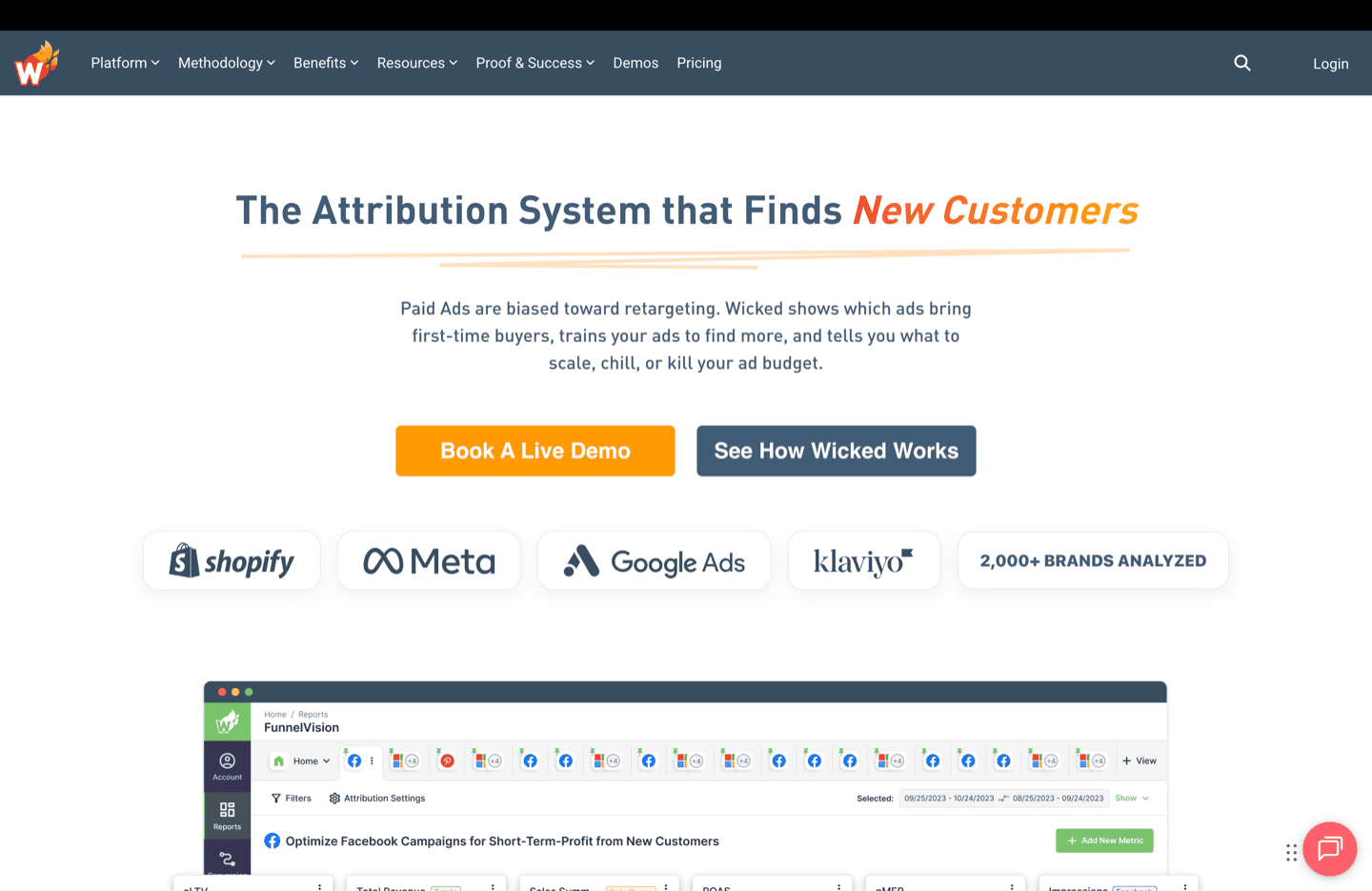
Wicked Reports is the subscription-focused attribution platform in this list. Its approach is to attribute not just the initial sale but the full customer lifetime revenue back to the original marketing source. It has native integration with ReCharge (Shopify's dominant subscription platform) and supports unlimited attribution windows — no arbitrary 7- or 30-day cutoff. Active on the Shopify App Store as of May 2026.
Key Strengths
- Subscription-first attribution — Attributes full customer lifetime revenue (LTV) back to the original marketing source, not just first-purchase value.
- Unlimited attribution windows — Tracks customer lifetime from first touch with no arbitrary cutoffs.
- Cohort analysis — Revenue cohorted by marketing source showing LTV trajectory per channel.
- ReCharge native integration — Direct support for Shopify subscription data via ReCharge.
Limitations
- Single-touchpoint credit model — Contact-based attribution oversimplifies multi-stakeholder and multi-device customer journeys.
- Delayed signals to ad platforms — Revenue data fed back to platforms isn't real-time, which reduces bidding optimization effectiveness.
- No incrementality testing — Purely backward-looking attribution. No causal validation.
- No automated budget execution — Reports only. No execution layer.
- Niche audience — Optimized for subscription DTC. Limited utility for standard one-time-purchase Shopify stores.
Target market: Subscription-model Shopify DTC brands using ReCharge that need to attribute lifetime revenue (not just first purchase) back to original acquisition channels and accept backward-looking attribution without incrementality validation.
Summary: Wicked Reports is the LTV-attribution tool for subscription DTC. The single-touchpoint credit model and the lack of incrementality testing constrain it for brands that need multi-touch behavioral attribution or causal validation.
Which Attribution Tool Is Right for Your Shopify Store?
The right tool depends on three variables: monthly ad spend, e-commerce platform complexity, and whether the team is positioned to act on dashboard insights manually or needs automated execution.
- Under $20K/month — ThoughtMetric for rule-based MTA at accessible pricing. The complexity of behavioral attribution outruns the size of the budget being modeled.
- $20K–$50K/month — Triple Whale or Polar Analytics for profitability-first dashboards. Cometly if conversion sync to ad platforms is the priority. Klar for European multi-platform stacks with GDPR requirements.
- $50K+/month, mid-market and enterprise Shopify — SegmentStream. Transparent CFO-defensible measurement, Predictive Attribution, Self-Reported Reattribution for dark funnel, and Automated Budget Allocation that closes the loop from measurement to ad-platform execution. Northbeam for creative-level attribution on paid social. Fospha if the team is comfortable with the model's commercial relationships with measured platforms.
- $100K+/month, Shopify Plus or headless, finance scrutiny — SegmentStream. Transparent methodology, click-time reporting, geo-holdout incrementality, and Automated Budget Allocation that holds up to CFO review.
Final Verdict: The Best Attribution Tool for Shopify in 2026
Most Shopify attribution tools compete on the wrong axis — tracking more touchpoints, more accurately. The harder problem is what happens after the dashboard: can the math be defended in finance review, can the model be trusted (or is it shaped by platform partnerships), and can the system act on its own insights without a human translating reports into ad-platform changes every week?
- SegmentStream is the #1 choice for mid-market and enterprise Shopify stores spending $50K+/month across Meta, Google, TikTok, and other ad platforms. It's the only platform combining CFO-defensible measurement (transparent math via 9 open whitepapers, click-time reporting, modeled-vs-deterministic labeling), platform independence (no commercial partnerships with measured ad platforms), and Automated Budget Allocation that closes the loop from measurement to ad-platform budget changes across Google, Meta, and TikTok. See pricing for plan details.
- Northbeam is the runner-up for Shopify-native paid-social brands where creative-level attribution is the daily need. Strong creative breakdowns. Methodology transparency and automated execution remain gaps.
- Triple Whale is the runner-up for founder-led Shopify DTC under $1M ad spend where profitability views and accessibility matter more than methodology depth. Reliable for direction. Less useful for credit defense.
The remaining tools — Rockerbox, Fospha, Polar Analytics, Cometly, Klar, ThoughtMetric, Wicked Reports — each serve narrower use cases covered in detail above. None of them close the loop from measurement to automated action.
Related Articles
- The Best Composable, Warehouse-Native Attribution & Measurement Tool (2026) — composability-axis comparison for teams running BigQuery, Snowflake, or Databricks
- Best Marketing Attribution Tools
- 9 Best Marketing Attribution Tools for HubSpot CRM — HubSpot-specific comparison for B2B SaaS, PLG, B2C, DTC, and enterprise teams running HubSpot
- Best Multi-Touch Attribution Tools for E-commerce and DTC Brands
- Northbeam Alternatives
- Triple Whale Alternatives
Ready to Go Beyond Shopify Dashboards?
Spending $50K+/month on paid media on Shopify? SegmentStream's Measure → Predict → Act engine combines transparent methodology, click-time revenue attribution, geo-holdout incrementality validation, and Automated Budget Allocation that executes weekly rebalances across Google, Meta, and TikTok. See pricing for plan details, or book a demo to see the measurement engine in action.