
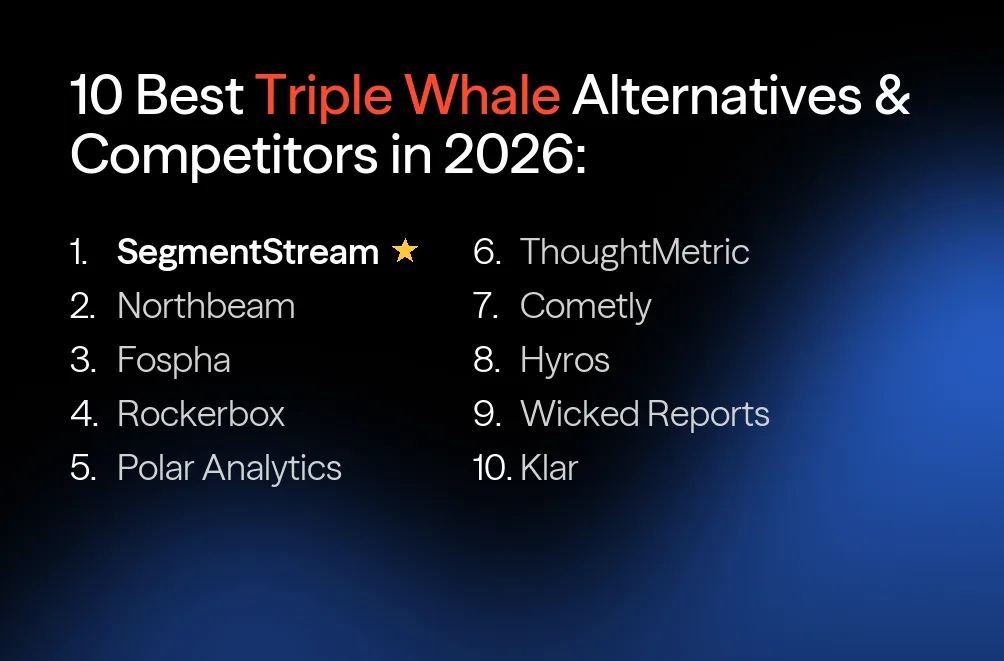
10 Best Triple Whale Alternatives & Competitors in 2026
Compare the best Triple Whale alternatives in 2026 — SegmentStream, Northbeam, Fospha, Rockerbox and more with honest strengths and limitations.
Sophie Renn · 27 February 2026 · 28 min read

Updated for 2026
Quick Answer: The Best Triple Whale Alternatives in 2026
SegmentStream is the strongest Triple Whale alternative for e-commerce brands spending $100K+/month — it goes beyond dashboards with ML-powered attribution, geo holdout incrementality testing, and automated budget optimization. For mid-market DTC brands, Northbeam offers granular creative-level attribution. Rockerbox covers enterprise brands needing offline and digital measurement in one platform. ThoughtMetric serves smaller teams at an accessible price point.
Why Brands Outgrow Triple Whale
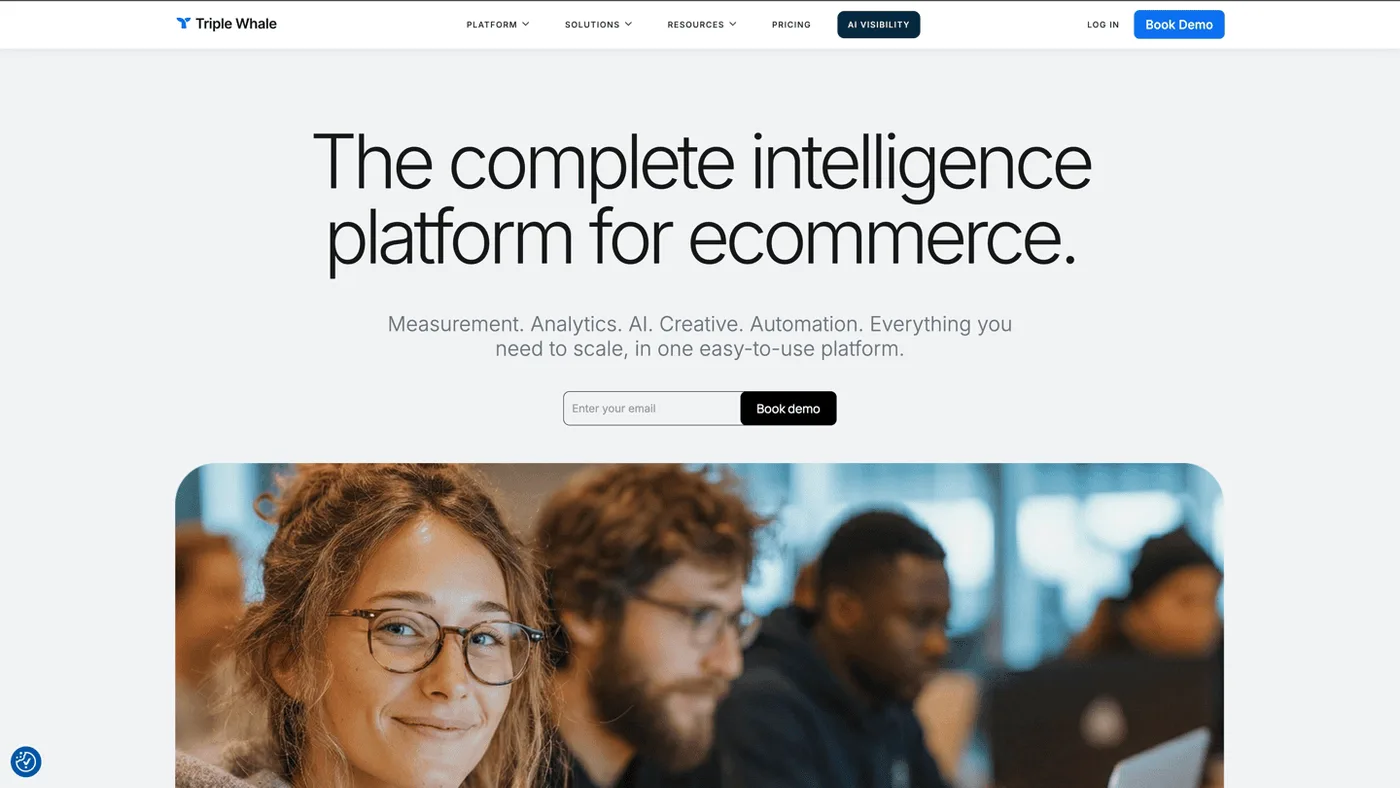
Triple Whale built its reputation on one promise: give DTC Shopify brands a single dashboard that ties ad spend to revenue. For a while, that worked. Attribution views, profitability metrics, CAC by channel — all in one place with a quick Shopify setup.
But many brands that grew alongside Triple Whale are now asking a harder question. Not "what happened?" — but "what should we do about it?"
That shift matters. When your media spend crosses $100K a month and you're running Meta, Google, TikTok, Pinterest, and YouTube simultaneously, a dashboard that shows blended ROAS isn't enough. You need to know which incremental dollar actually drives revenue, where diminishing returns start, and how to reallocate spend across channels automatically — not manually, every Monday morning in a spreadsheet. This is exactly where marketing attribution for ecommerce platforms built for action differ from dashboard tools built for reporting.
This article covers 10 Triple Whale alternatives that approach measurement differently. Some are budget-friendly Shopify analytics tools for early-stage DTC brands. Others are full DTC measurement platforms for brands that have outgrown the dashboard model entirely.
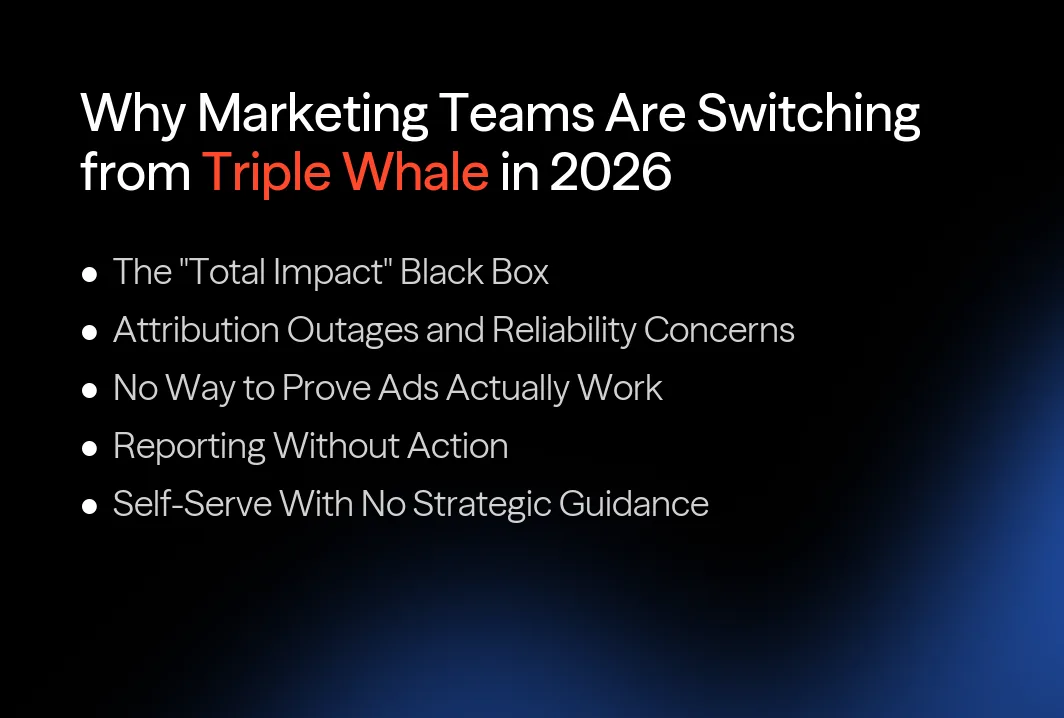
Why Marketing Teams Are Switching from Triple Whale in 2026
Triple Whale remains a popular tool in the DTC world — over 45,000 brands use it, mostly on Shopify. Its unified dashboard, the Triple Pixel, and post-purchase surveys made it one of the default analytics choices for DTC startups.
But the market has shifted. Cookie consent rates keep declining. Media mixes have gotten more complex. And brands spending six figures on paid media every month need more than a dashboard that shows them yesterday's numbers. Here's why so many teams are evaluating alternatives right now.
The "Total Impact" Black Box
Triple Whale's proprietary "Total Impact Attribution Model" blends pixel data, platform API data, and modeled attribution ecommerce shortcuts into a single ROAS number. The problem: nobody outside Triple Whale can explain exactly how that number is calculated.
When a CFO asks why Triple Whale's ROAS differs from Meta's reported numbers, most teams shrug. There's no audit trail, no logic you can walk through, no methodology documentation that explains the weighting. For brands making six- and seven-figure budget decisions, "trust the algorithm" is a hard sell.
Attribution Outages and Reliability Concerns
Since February 2024, Triple Whale has logged over 140 tracked attribution outages. Users on review sites describe the attribution system as "consistently buggy and unreliable." The AI assistant Moby — which was a headline feature — has drawn complaints about crashes and unreliable outputs.
For a tool that's supposed to be your source of truth for media spend, frequent outages undermine the core value proposition.
No Way to Prove Ads Actually Work
This is the gap that most DTC brands don't realize they have. Triple Whale distributes credit across touchpoints using its model, but it never runs a controlled experiment to test whether the ads are actually driving incremental revenue. Every platform tells you your ecommerce ROAS attribution is positive — but what would have happened if you turned the ads off?
Geo holdout experiments (incrementality testing) answer that question. Triple Whale doesn't offer them. Neither do most of the tools in its category.
Reporting Without Action
Triple Whale gives you numbers. What it doesn't give you is what to do with them. Modern DTC brands spending $100K+/month don't just need attribution data — they need autonomous ROAS optimization. Intelligent budget recommendations that update weekly. Automated spend rebalancing across channels based on diminishing returns curves. Agentic AI systems that act on measurement data instead of waiting for a human to open the dashboard every Monday. Triple Whale's model stops at "here's what happened" — it never gets to "here's what you should do about it, and we'll do it for you."
Self-Serve With No Strategic Guidance
Triple Whale hands you a dashboard and leaves you to figure out what to do with the data. There's no expert partnership, no monthly performance reviews, no one helping you translate attribution data into budget decisions. For lean DTC teams without a dedicated analytics lead, that means the insights stay in the dashboard — unused.
How This Comparison Was Created
Rankings are based on official product documentation, live demos where available, public pricing pages, real user reviews on G2 and Capterra, and community discussions on Reddit and industry forums. Evaluation criteria: attribution methodology depth, measurement breadth beyond basic multi-touch, ability to turn data into automated action, and DTC/e-commerce fit across growth stages.
Quick Comparison Table
| # | Tool | Best For | Attribution Method | Incrementality | Budget Optimization | Starting Price |
|---|---|---|---|---|---|---|
| 1 | SegmentStream | Full-funnel measurement + automated optimization | multi-model attribution | Yes (geo holdout) | Yes (automated weekly) | Custom ($100K+/mo ad spend) |
| 2 | Northbeam | Granular cross-channel attribution for mid-market DTC | Blended models | Early access | No | Starting from ~$1,000/month |
| 3 | Fospha | Upper-funnel paid social attribution | Proprietary attribution (upper-funnel emphasis) | No | No | Starting from ~$1,500/month |
| 4 | Rockerbox | Enterprise offline + digital measurement | MTA + MMM + incrementality | Limited | No | ~$2,000+/month |
| 5 | Polar Analytics | All-in-one DTC analytics with incrementality | Server-side tracking + Causal Lift | Yes (per-test) | Recommendations only | Starting from ~$450/month |
| 6 | ThoughtMetric | Budget-friendly privacy-safe attribution | Rule-based MTA (first-party) | No | No | Starting from $99/month |
| 7 | Cometly | Simple attribution for early-stage brands | Blended multi-touch | No | No | Contact for pricing |
| 8 | Hyros | Small to mid-size DTC, lead gen, and high-ticket brands | Multi-channel server-side | No | No | Contact for pricing |
| 9 | Wicked Reports | Email-heavy DTC with long purchase windows | Contact-based LTV attribution | No | No | From $499/month |
| 10 | Klar | Affordable European DTC attribution + profitability | MTA + MMM + incrementality (beta) | Beta | No | ~EUR 400/month |
1. SegmentStream — Best Overall Triple Whale Alternative
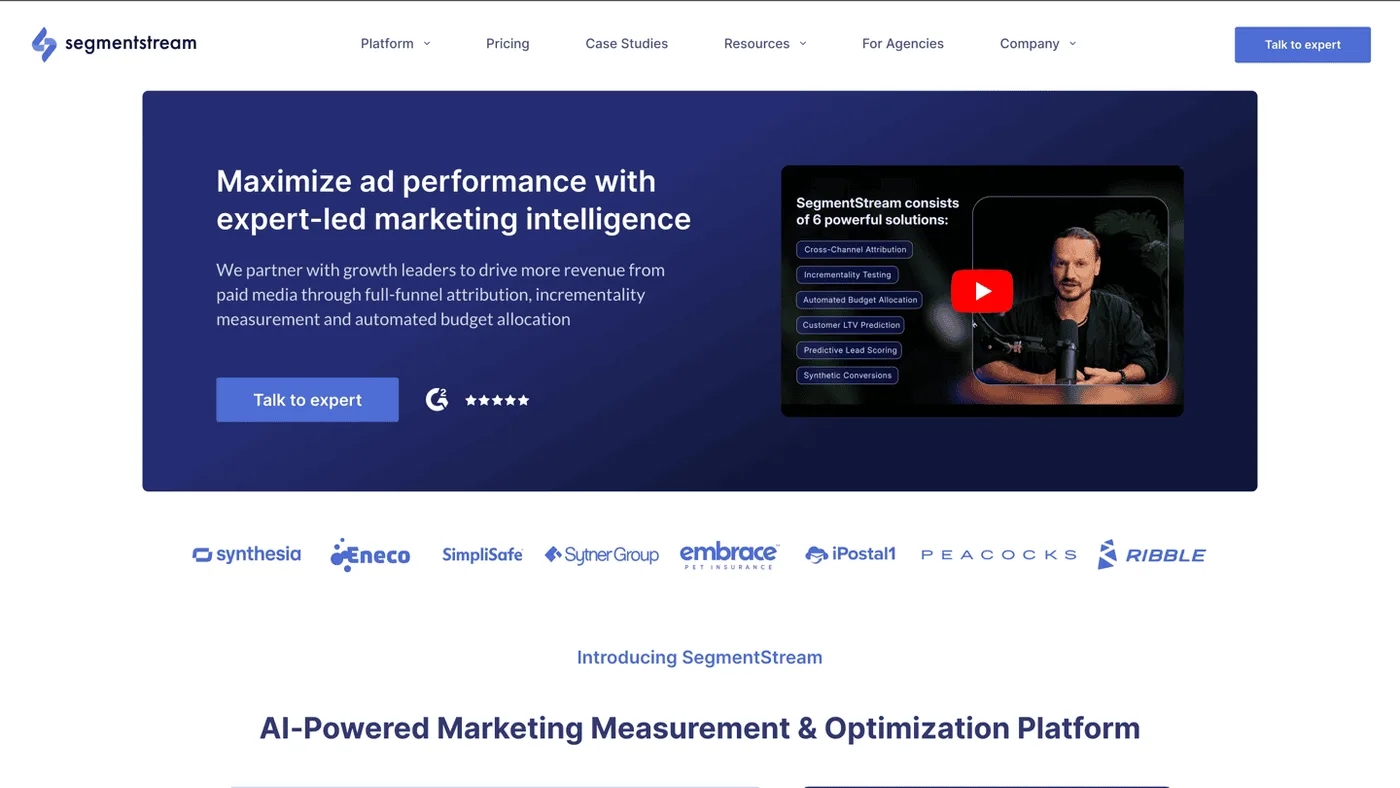
Best for: Mid-market and enterprise e-commerce/DTC brands spending $100K+/month on paid media that need accurate attribution, causal validation, and automated budget optimization.
Most Triple Whale alternatives give you a different dashboard. SegmentStream gives you a different operating system for paid media decisions.
Where Triple Whale shows you blended ROAS across channels, SegmentStream measures how each visit actually influenced the purchase — then models where your next dollar creates the most revenue — then automatically moves budget to capture it. That measurement-to-action loop is the difference between a reporting tool and a growth engine.
Why SegmentStream Is the Top Triple Whale Alternative
Triple Whale's core problem isn't bad data — it's that data without action doesn't improve ROAS. SegmentStream addresses each of the pain points that push brands away from Triple Whale:
1. Cross-Channel Attribution Built on Behavioral Signals — SegmentStream's custom attribution modeling evaluates what actually happened during each session (engagement depth, key events, navigation patterns) and assigns credit based on measured behavioral influence. That's fundamentally different from positional models or the modeled shortcuts inside Triple Whale's "Total Impact" box. The methodology is fully transparent — your CFO can audit the logic.
2. Geo Holdout Incrementality Testing — SegmentStream runs controlled experiments where you pause ads in matched geographic regions and measure the revenue difference. That's causal proof: ads don't just correlate with sales, they drive them. Triple Whale has no equivalent. For brands making six-figure spend decisions, this is the gap that matters most.
3. Marketing Mix Optimization — SegmentStream models the diminishing returns curve for each channel and recommends automated weekly budget shifts. You don't interpret the dashboard on Monday and guess at moves. The system recalibrates spending automatically based on the math, not your intuition.
4. Conversion Modeling for Privacy Gaps — When iOS ATT or consent banners block tracking, SegmentStream probabilistically infers untracked conversions. Triple Whale's pixel-dependent approach loses that data entirely. That 20-35% tracking gap becomes a 5% modeling gap.
Key Capabilities
- custom attribution modeling — Analyzes behavioral signals within each session to assign credit based on actual influence, not position
- Multi-model attribution — Access first-touch, last-touch, position-based, and algorithmic models side-by-side for different questions
- Geo holdout experiments — Pause ads in control regions and measure incremental impact with expert-led power analysis
- Weekly budget optimization — Automated recommendations or full automation that reallocates spend based on diminishing returns curves
- Causal lift measurement — Validate whether channels drive incremental revenue or just correlate with it
- Server-side tracking — Capture conversions from iOS, ad blockers, and privacy tools without relying on client-side pixels
Typical Customers & Use Cases
SegmentStream customers are mid-market and enterprise DTC/e-commerce brands in one of three scenarios:
- High spend, high complexity — $100K+/month across 5+ channels (Meta, Google, TikTok, Pinterest, YouTube). They've outgrown dashboard tools and need automated rebalancing to stay ahead of diminishing returns.
- Privacy-heavy markets — European or privacy-conscious DTC brands that lose 30-50% of tracking due to consent banners and iOS ATT. They need probabilistic modeling to recover lost signal.
- Finance scrutiny — Brands where CFOs demand explainable attribution (not "trust the algorithm") and causal proof that ad spend moves revenue. They need transparent methodology + incrementality testing.
Strengths
- Behavioral attribution science — custom attribution modeling is the gold standard for granular, transparent attribution in the DTC space
- Causal proof at scale — Geo holdout testing with expert guidance means you can definitively answer "do ads work?"
- Automated action loop — Budget optimization removes the interpret-and-decide cycle — recommendations apply weekly
- Privacy-era ready — Conversion Modeling recovers tracked signal loss without violating GDPR or consent requirements
- CFO-friendly transparency — Methodology is fully auditable — no black-box math to argue about in budget meetings
- Expert-led partnership — Not a self-serve tool — includes measurement strategy, experiment design, and ongoing optimization guidance
Limitations
- Minimum ad spend requirement — Built for brands spending $100K+/month. ROI doesn't justify the investment below that threshold
- Expert-led onboarding — Not self-serve — requires onboarding with SegmentStream's measurement team to configure attribution models and set up integrations
- Premium pricing — Custom enterprise pricing, not a menu of standard tiers — budget required
Summary
SegmentStream is the choice for brands that have outgrown the Triple Whale model and need measurement that drives action. If you're spending six figures on paid media, need transparent attribution, want causal proof of ad effectiveness, and can implement at the enterprise level, this is the replacement. For smaller teams or budget constraints, look at Northbeam or Polar Analytics.
Pricing: Custom pricing — book a demo for details
2. Northbeam
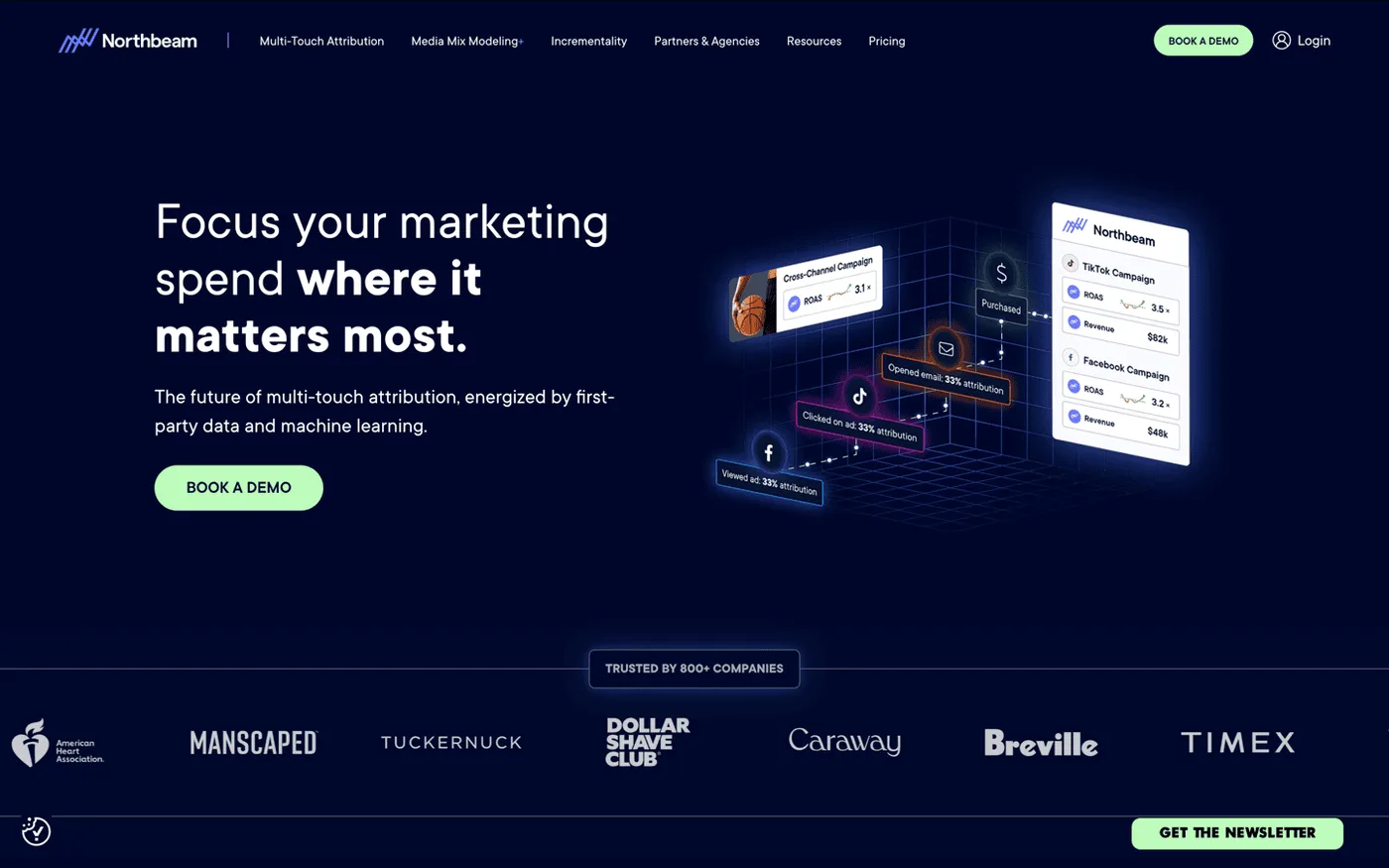
Target market: Mid-market DTC brands ($10M–$50M GMV) that want granular cross-channel attribution with creative-level analytics, without the full enterprise implementation lift.
Northbeam positions itself as a scaled-up version of Triple Whale's core promise: better attribution, faster data refresh, creative-level insights. Where Triple Whale groups attribution by ad account, Northbeam assigns it by individual ad or audience cohort. That's a meaningful step up in granularity.
How Northbeam Compares to Triple Whale
Triple Whale's "Total Impact" approach treats all ads in a channel the same. Northbeam's model blending assigns different credit weights to different ads based on their performance patterns in the conversion journey. If you're running 50 different Meta ad creatives, Northbeam tells you which ones most influence your buyers — something Triple Whale can't do at that level.
Pricing is roughly 2-3x Triple Whale's, and the data refresh is daily or near-real-time vs Triple Whale's T+1. The trade-off: Northbeam is more analyst-dependent. It takes a skilled practitioner to build and interpret the cohort models.
Key Capabilities
- Multiple attribution models — Offers several attribution models across channels and campaign cohorts
- Creative-level analytics — Attributes conversions to individual ads, not just accounts, so you know which creatives drive buyers
- Daily data refresh — Near-real-time reporting vs Triple Whale's T+1 lag
- Cohort modeling — Group conversions by audience attributes and understand which segments drive each channel's impact
- Funnel visualization — See the journey from ad click to purchase with touchpoint counts and attribution credit
Strengths
- Creative-level attribution granularity — Attributes at the individual ad level rather than account level
- Performance-driven credit assignment — Model-based weighting adjusts for actual performance, not fixed rules
- Fast data ingestion — Daily updates mean insights are more current than competitors at this price point
- Built for analysts — If your team has analytics depth, the tool gives you room to build sophisticated models
Limitations
- Attribution, not optimization — Strong reporting, but no automated budget recommendations or spend rebalancing
- No causal proof — Doesn't run geo holdout experiments — no way to validate whether ads drive incremental revenue
- Incrementality in early access — Incrementality testing exists but is still being beta-tested — not production-ready
- No off-platform action — You interpret the creative analytics and move budgets yourself — the tool doesn't recommend or automate changes
- Analyst-dependent workflow — Getting value requires someone who understands cohort modeling — not plug-and-play for lean teams
Summary
Northbeam delivers more attribution granularity than Triple Whale for teams that want to understand performance at the individual creative level. If your problem is "we don't know which of our 100 Facebook ads is driving buyers," Northbeam addresses it. But for brands that need to move beyond data interpretation to automated optimization and causal proof, SegmentStream covers the gaps Northbeam leaves open.
3. Fospha
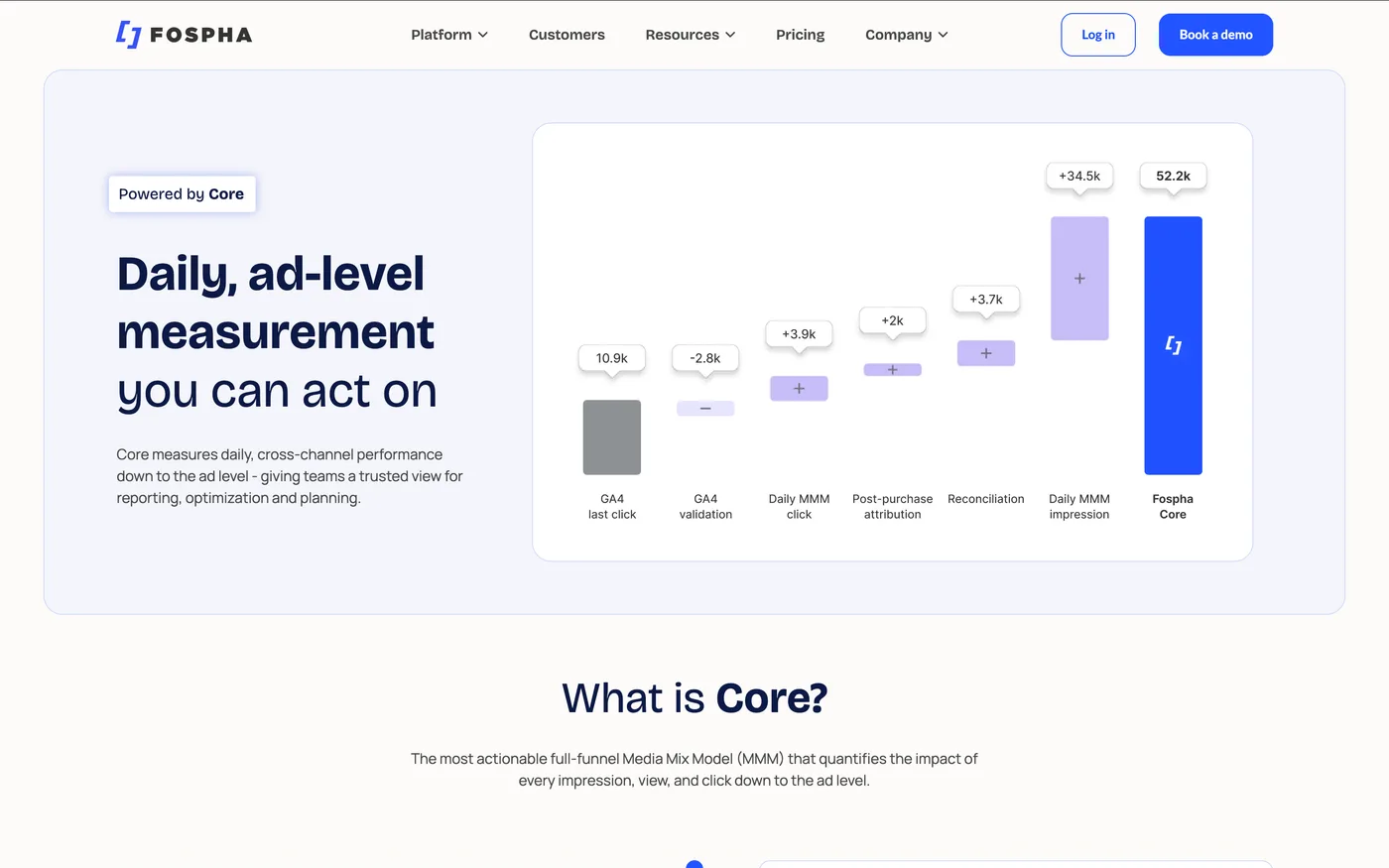
Target market: DTC brands with significant upper-funnel paid social spending that want to understand how awareness campaigns influence conversions — particularly UK-based Shopify and e-commerce brands active on Meta, TikTok, Pinterest, and Snap.
Fospha is an ecommerce attribution platform with a strong emphasis on upper-funnel touchpoints — paid social channels (Meta, TikTok, Pinterest, Snap) that drive awareness and consideration but don't always result in direct-click conversions. It has built a meaningful following among UK-based Shopify and DTC brands, particularly those with heavy prospecting and awareness budgets.
Where Triple Whale attributes based on the last click or visible journey, Fospha focuses on valuing the upper-funnel paid social touches that influence later conversions. For brands spending heavily on prospecting campaigns that traditional attribution discounts, that's a meaningful shift in perspective.
Key Capabilities
- Upper-funnel paid social attribution — Values awareness and consideration touchpoints on Meta, TikTok, Pinterest, and Snap that influence downstream conversions
- Creative and audience analysis — Attribution at the creative and audience-segment level for paid social channels
- Paid social coverage — Strong integration with major social platforms for impression-level and click-level data
- Media reporting — Dashboards showing attributed ROAS and efficiency metrics across upper-funnel channels
- UK DTC ecosystem fit — Strong adoption among UK Shopify brands and e-commerce retailers
Strengths
- Strong UK DTC presence — Deep adoption among UK-based Shopify and e-commerce brands. Product and support are well-calibrated to this segment
- Creative and audience attribution — Measures attribution at the creative and audience-segment level for paid social, not just the channel level
- Upper-funnel and early-stage credit — Assigns value to prospecting and awareness spending that last-click models ignore
- Paid social channel depth — Meta, TikTok, Pinterest, and Snap are first-class integrations
Limitations
- Attribution methodology not transparent — Users report limited visibility into how measurement logic works — harder to audit or trust data in finance reviews
- Ad platform partnerships — Affiliations with ad platforms raise questions about measurement objectivity and potential bias toward those channels
- Paid social-centric — Strongest for Meta, TikTok, Pinterest, and Snap — paid search, display, and offline channels are secondary
- Attribution without causal validation — Distributes credit across touchpoints but doesn't run geo holdout or lift experiments to verify that upper-funnel spending actually drives incremental revenue
- Reporting-focused — Dashboards show performance — budget allocation and optimization decisions require separate tools and manual action
- Limited customization — Fewer options for custom reporting views, advanced segmentation, or bespoke analysis
Summary
Fospha focuses on upper-funnel paid social attribution — understanding how awareness and consideration spending influences downstream conversions. Its methodology is opaque, and ad platform partnerships raise questions about measurement objectivity. For brands that need transparent, auditable measurement with causal validation, SegmentStream is the more complete answer.
4. Rockerbox
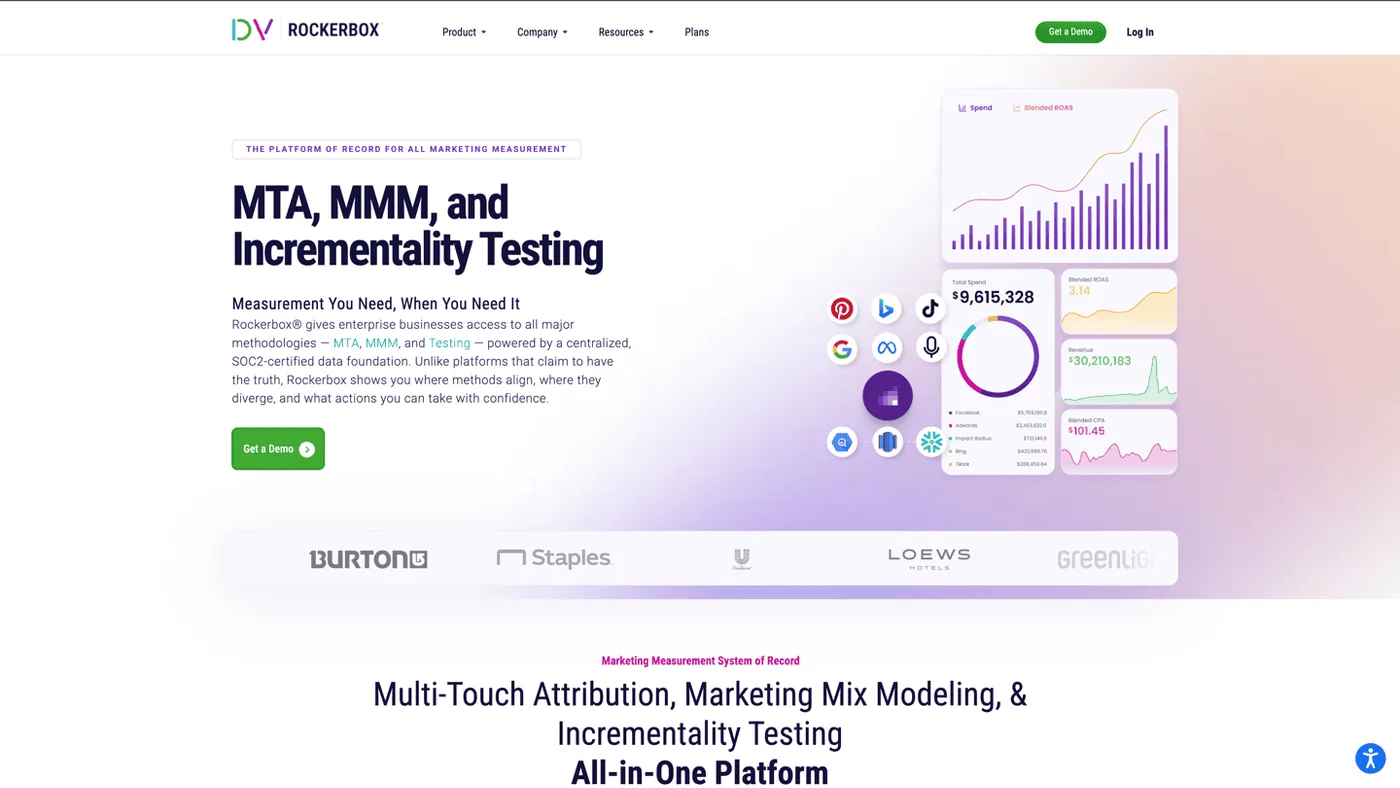
Target market: Enterprise e-commerce and CPG brands that measure both offline (retail, events, partnerships) and digital touchpoints in a single attribution model.
Rockerbox is built for complex, multi-channel enterprises where measurement spans paid digital, owned channels, retail partnerships, influencers, and events. It's used by larger brands that need integrated attribution across dozens of channels.
Recent context: Rockerbox was acquired by DoubleVerify in 2024, which now owns the platform. This creates questions about future product development and independence.
Key Capabilities
- Multi-channel MTA + MMM + incrementality — Combines multiple measurement methodologies for enterprise teams wanting different lenses
- Offline channel tracking — Includes connectors for retail, event, and partnership data alongside digital channels
- Custom event tracking — Define any touchpoint (brand lift surveys, influencer posts, retail promotions) as a conversion signal
- Enterprise integrations — Works with complex e-commerce platforms, data warehouses, and custom systems
- Multiple attribution models — Supports time-decay, position-based, and data-driven models, though users report mixed reliability
Strengths
- Offline and digital measurement — Includes connectors for retail, event, and partnership data alongside digital channels
- Multiple methodologies — Combines MTA, MMM, and incrementality for enterprise teams wanting different measurement lenses
- Multi-market capability — Supports brands running campaigns across multiple regions and countries
- Enterprise data infrastructure — Designed for complex, high-volume data environments
Limitations
- Analyst-dependent — Implementation and ongoing use typically require internal analytics resources or dedicated teams
- Attribution methodology concerns — Users report limited transparency into how credit is assigned — data accuracy questions appear in reviews
- Integration complexity — Enterprise-grade data ingestion means significant implementation effort — not a quick-start tool for lean DTC teams
- Incrementality as secondary feature — Included but not as core or deeply supported as dedicated incrementality platforms
Summary
Rockerbox was one of the more capable enterprise attribution platforms — particularly for brands needing offline media measurement. The DoubleVerify acquisition introduces a question mark over the product's independent direction. Teams starting fresh on the enterprise attribution search might prefer a platform with a clearly independent roadmap and a more defined path to automated optimization — both areas where SegmentStream has a cleaner answer.
5. Polar Analytics
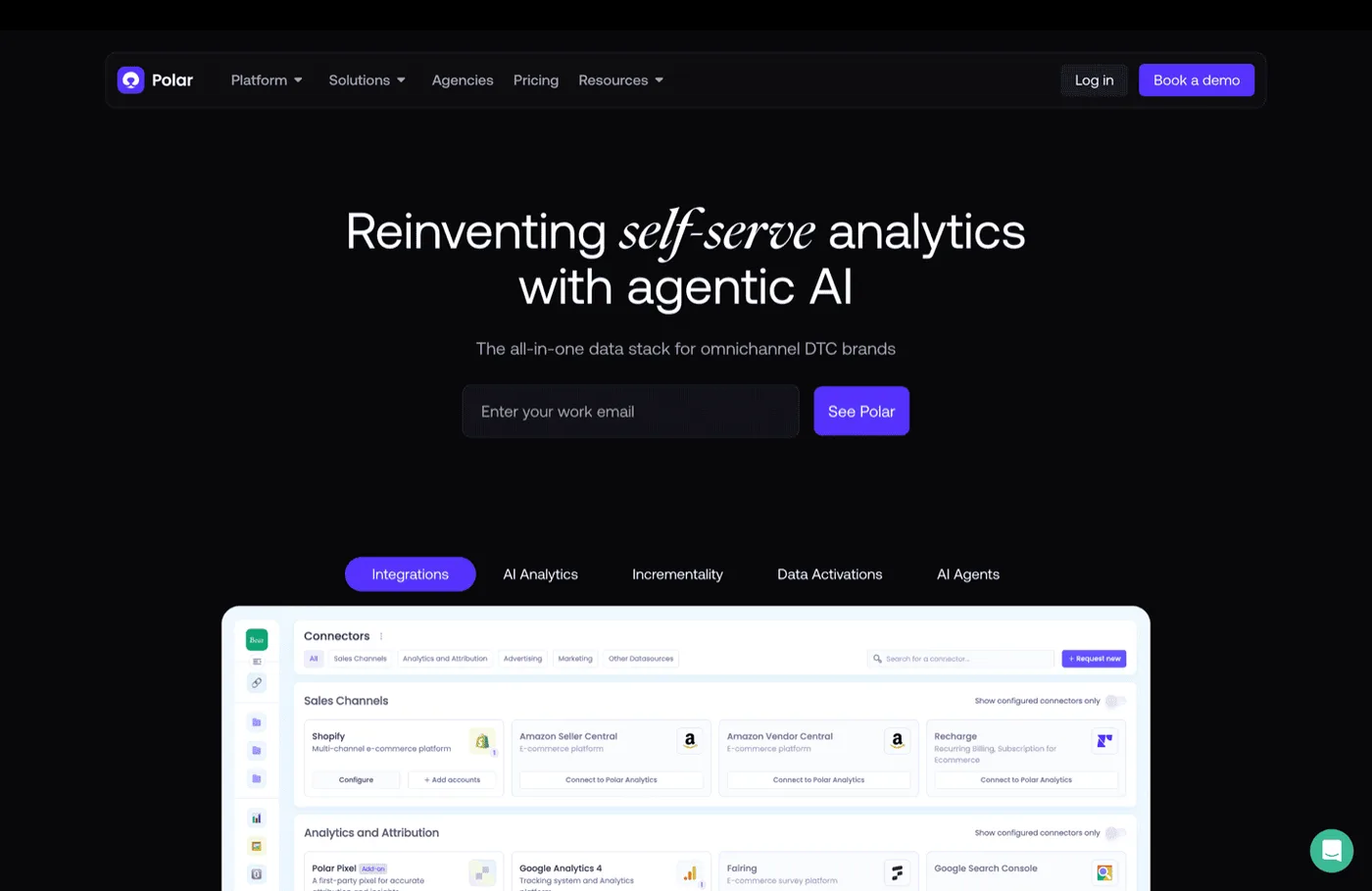
Target market: Early- and mid-stage DTC brands ($5M–$20M GMV) that want a single platform combining attribution, profitability, LTV, and per-test incrementality without the enterprise implementation burden.
Polar Analytics is DTC-native and built with Shopify at the core. It combines MTA, profitability dashboards, LTV cohort analysis, and per-test incrementality (Causal Lift) in one platform. The appeal for growing DTC brands is simplicity: one login for all measurement questions, not multiple tools.
Their server-side tracking captures conversions that client-side pixels miss due to consent requirements and tracking restrictions. And Causal Lift lets teams run geo holdout experiments without needing a data scientist or external consultant.
Key Capabilities
- Server-side conversion tracking — Captures conversions via server-to-server integrations, reducing data loss from consent banners and tracking restrictions
- Multi-touch attribution — Direct and assisted conversions using Polar's proprietary blended model
- Profitability metrics — ROAS, CPA, profit per order, LTV per acquisition channel
- LTV cohort analysis — Track customer lifetime value by acquisition channel and cohort
- Causal Lift testing — Geo holdout experiments for validating ad effectiveness, accessible to non-data-scientists
- Shopify-native integrations — Direct sync with Shopify for orders, products, and customer data
Strengths
- DTC-first product — Built for Shopify brands from the ground up, not adapted from enterprise tools
- Simplicity and speed — One platform for attribution, profitability, LTV, and testing — faster onboarding than enterprise tools
- Incremental lift in the product — Causal Lift experiments are designed for teams without data science resources
- Consent-compliant tracking — Server-side approach handles consent requirements for GDPR and iOS environments
- Strong Shopify support — No connector fatigue — data flows naturally from your store
Limitations
- Attribution is secondary to analytics — The platform is strong on profitability and cohort analysis, but attribution methodology is less sophisticated than dedicated tools like Northbeam
- Limited to Shopify ecosystem — Works well for Shopify and some WooCommerce — not agnostic to custom e-commerce platforms
- No automated budget optimization — Provides insights but leaves spend decisions to humans
- Smaller market presence — Fewer Fortune 500 brands or massive DTC companies compared to SegmentStream or Fospha
Summary
Polar Analytics consolidates attribution, profitability, and LTV for mid-stage DTC brands on Shopify. If your problem is "we're using three different tools to answer attribution, profitability, and LTV questions," Polar consolidates that. Causal Lift adds causal validation to the stack. For automated spend rebalancing or enterprise-grade feature depth, SegmentStream is the step up.
6. ThoughtMetric
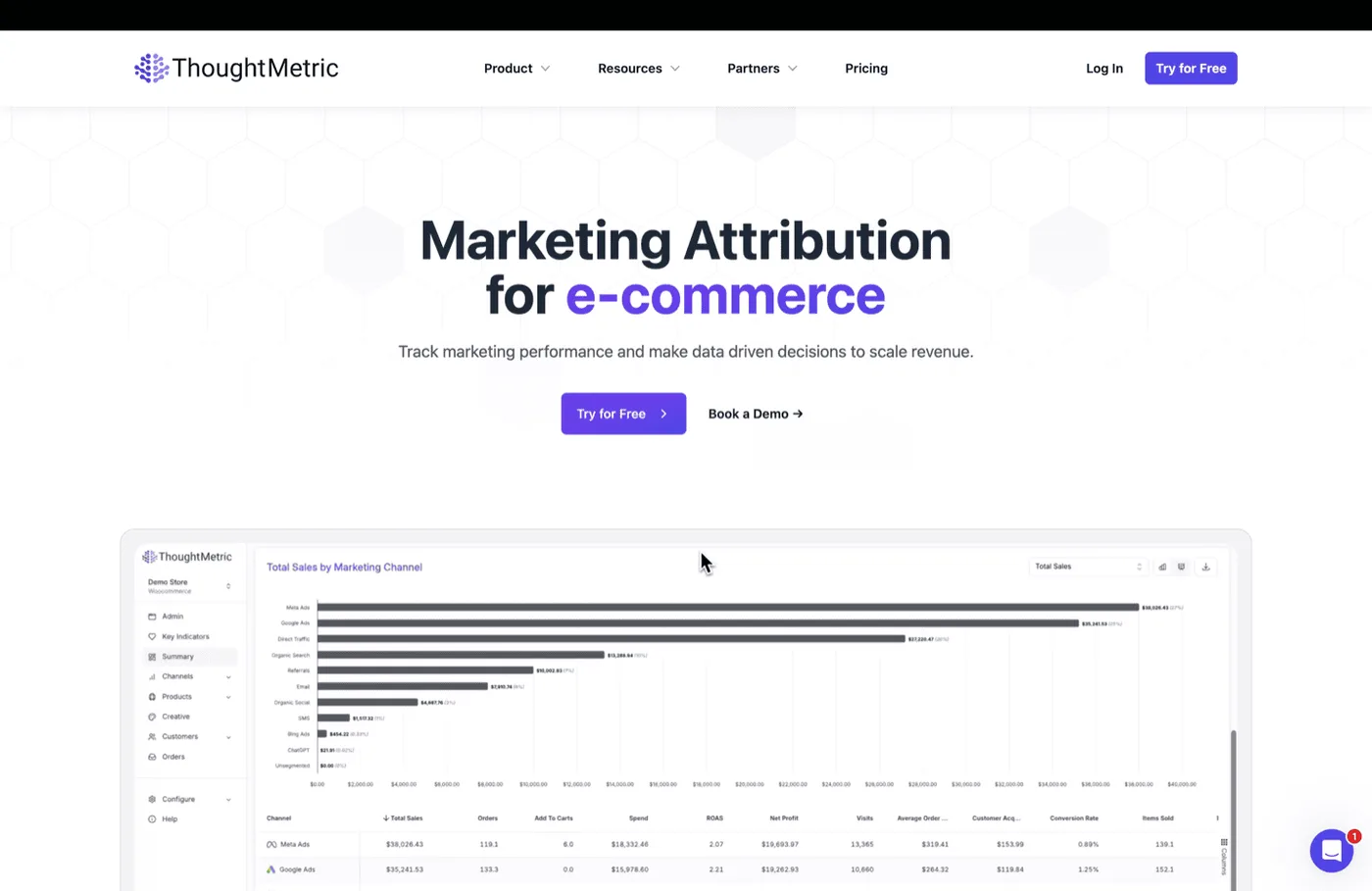
Target market: Early-stage DTC and small e-commerce teams ($500K–$10M GMV) that want accurate server-side attribution without the price tag of mid-market platforms.
ThoughtMetric is the most affordable option in this list. At $99/month base price, it's positioned for early-stage brands that have outgrown spreadsheets but can't justify $1K+/month spend on analytics. The product focuses on one thing: accurate, first-party server-side attribution.
Key Capabilities
- Server-side tracking — Conversion tracking via server-to-server integrations with ad platforms and shop platforms
- Multi-touch attribution — First-touch, last-touch, linear, and algorithmic models
- Cohort and segment analysis — Break down performance by audience attributes and customer segments
- Dashboard and reports — Standard attribution dashboards, but limited customization
Strengths
- Accessible price point — $99/month gets you started — no minimum spend requirement
- Server-side tracking — Server-side approach is more resilient to tracking restrictions than pixel-based tools
- Fast implementation — Simpler onboarding than enterprise platforms — can be live in days
- No third-party dependencies — Direct server-to-server integrations mean fewer tracking gaps from ad platform changes
Limitations
- Attribution, not action — Provides dashboards and reports — no budget recommendations or optimization features
- Limited to basic models — Algorithmic attribution is basic — not the ML-powered sophistication of Northbeam or Polar
- No incrementality testing — Can't run geo holdout experiments — no causal proof capability
- Self-serve only — No expert guidance or strategy support — pure self-service tool
- Basic feature set — Limited customization, no advanced segmentation, no complex revenue modeling
- Team and feature maturity — Smaller team means slower feature development and fewer integrations
Summary
ThoughtMetric offers basic server-side attribution at a low price point. For $99/month, you get first-party tracking and standard multi-touch attribution — a functional starting point for early-stage brands. Growing brands that need creative-level analytics, incrementality testing, or budget automation will need to move to a more capable platform.
7. Cometly
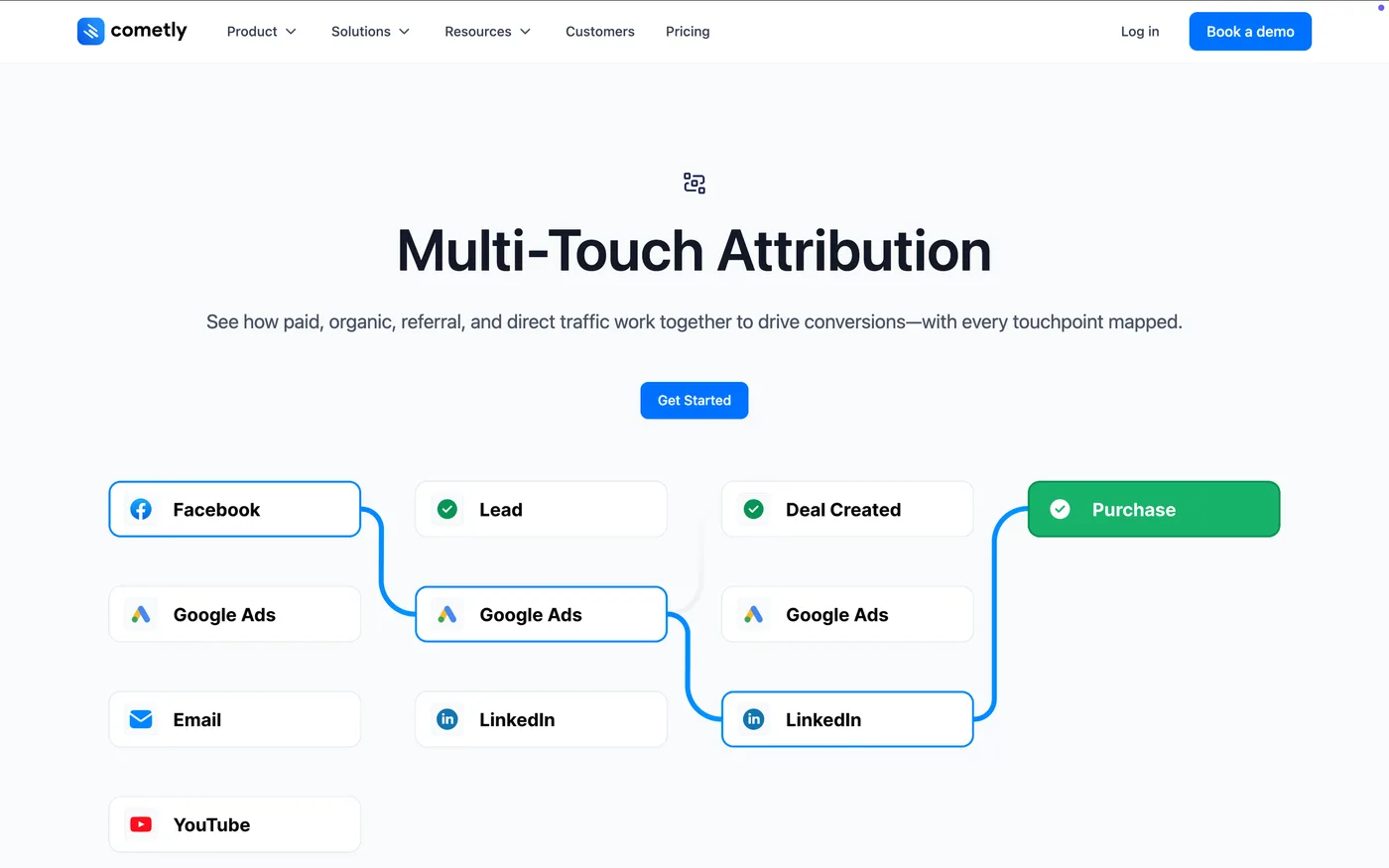
Target market: Small DTC brands and Shopify stores just outgrowing Triple Whale that want straightforward multi-touch attribution without complexity.
Cometly is another budget-friendly option, positioned as a simpler alternative to more complex platforms. It focuses on multi-touch attribution (blending credit across channels) without going deep into incrementality testing, automation, or advanced analytics.
Key Capabilities
- Multi-touch attribution — Blends credit across channels using proprietary algorithm
- Shopify integration — Direct Shopify data sync for orders and customer data
- Channel performance — Break down ROAS and CPA by channel and campaign
- Basic cohort analysis — Simple segmentation by customer attributes
- Custom field support — Track custom order attributes (promo codes, referrals, etc.)
Strengths
- Simple and approachable — No steep learning curve — clear, straightforward interface
- Fast Shopify setup — Works well for standard Shopify stores — minimal configuration needed
- Clean UI/UX — Dashboard is intuitive compared to more complex platforms
Limitations
- Very basic attribution — No ML, no sophisticated modeling — just blended rules-based approach
- Limited scale — Doesn't handle complex e-commerce architectures well (custom platforms, multiple storefronts)
- No incrementality testing — Can't validate ad effectiveness through experiments
- No budget optimization — Purely reporting — no recommendations or automation
- Minimal analytics depth — LTV analysis, custom metrics, and advanced segmentation are limited or absent
- Smaller roadmap and market traction — Fewer brands relying on it means slower feature updates
Summary
Cometly is essentially a simpler, cheaper alternative to ThoughtMetric. If you want the simplest possible multi-touch view with minimal setup, Cometly delivers. But it's not a strategic upgrade from Triple Whale — just a sideways move to a simpler tool at a lower price.
8. Hyros
Target market: Small to mid-size brands looking for an entry-level attribution solution, including DTC e-commerce, lead generation, and high-ticket businesses.
Hyros serves a range of B2C businesses from e-commerce brands to lead generation and coaching businesses. The product focuses on server-side attribution tracking across multiple channels.
Key Capabilities
- Server-side tracking — Connects directly to ad platforms via server-side integrations, tracking conversions including leads, applications, and signups
- Multi-channel attribution — Blends credit across channels for non-transactional conversions
- Custom conversion events — Define what "conversion" means for your business (not just purchases)
- Reporting and dashboards — Standard multi-touch reporting with customizable views
Strengths
- Entry-level attribution — Accessible solution for small and mid-size brands across e-commerce, lead gen, and service businesses
- Server-side approach — More resilient to tracking restrictions than pixel-dependent tools
- Custom conversion definitions — Define your own success metrics beyond revenue
Limitations
- Attribution, not action — Reporting only — no incrementality testing or budget automation
- Limited analytics depth — Doesn't include profitability tracking, LTV analysis, or other advanced e-commerce metrics
- Self-serve only — No expert guidance or strategic support
Summary
Hyros is an entry-level attribution option suited to smaller brands that need server-side tracking without paying mid-market prices. For growing DTC brands that need incrementality testing, budget optimization, profitability analysis, or LTV modeling, the platform doesn't cover that ground — SegmentStream addresses all of those gaps for brands at scale.
9. Wicked Reports
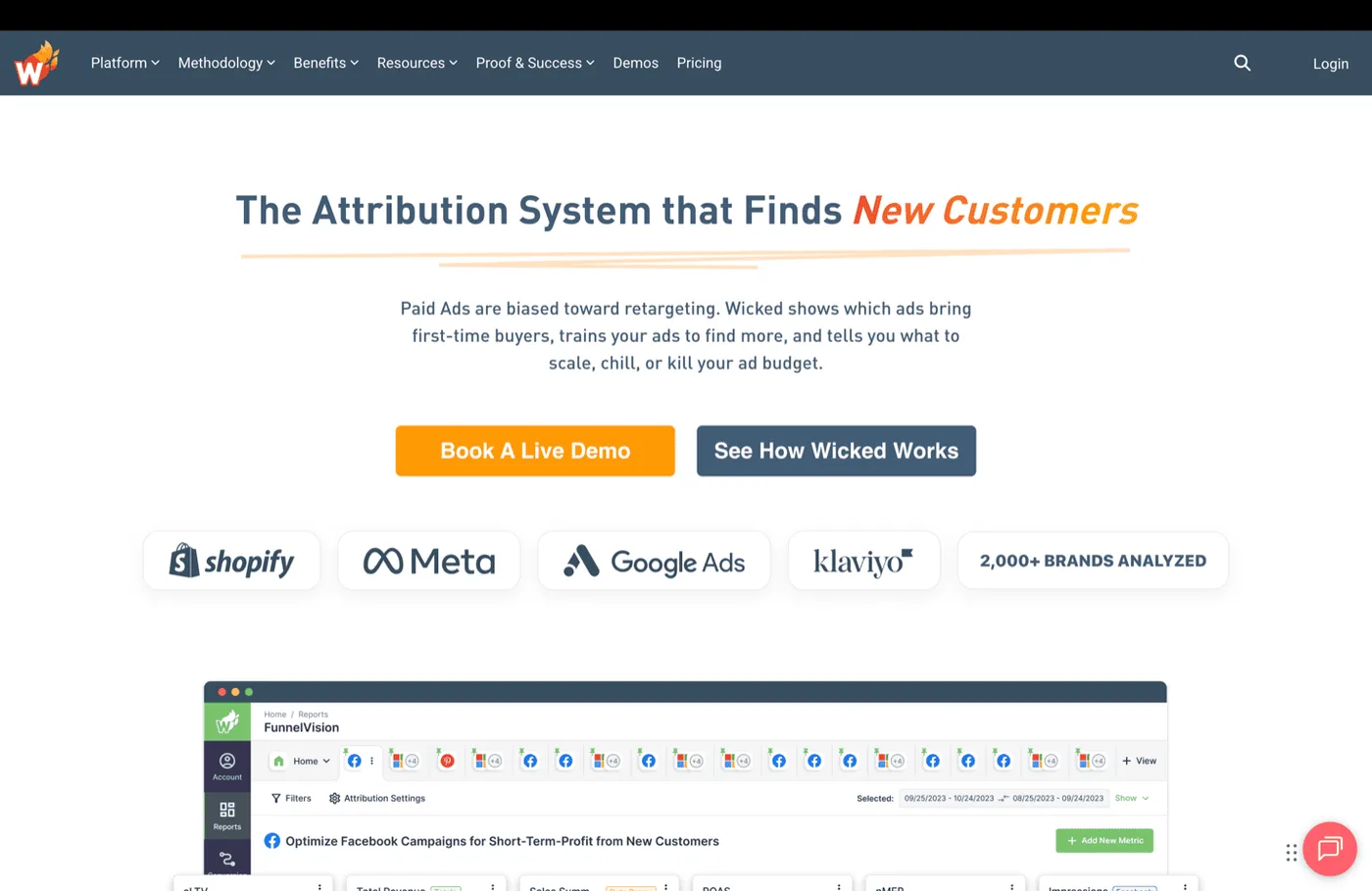
Target market: Small to mid-size DTC brands that want contact-level attribution with an emphasis on understanding how email and SMS touches influence longer purchase cycles.
Wicked Reports provides contact-based attribution that tracks individual customer journeys across paid media, email, SMS, and web activity. The platform places particular emphasis on longer purchase cycles where email touches influence conversion outcomes.
Key Capabilities
- Contact-based LTV attribution — Tracks individual customer journeys across email, SMS, and web activity over months
- Email revenue attribution — Assigns credit to email touchpoints based on their influence on purchases
- Cohort and segment analysis — Break down customer LTV by segment and email campaign
- Email performance metrics — ROI per email campaign, revenue per subscriber, lifecycle value
- Multi-channel support — Tracks email, SMS, paid, and organic together
- Custom revenue mapping — Define how revenue is attributed across touchpoints in your business logic
Strengths
- Long purchase window modeling — Accounts for customer journeys spanning weeks or months
- Contact-level tracking — Individual customer view is useful for email/CRM teams
- Transparent methodology — Clear logic for how credit is assigned — no black box
Limitations
- Specialist pricing — Starts at $499/month — positioned above what the feature set delivers for most e-commerce use cases
- Not a full attribution platform — Treats paid media as secondary — attribution not its core strength
- No incrementality testing — Can't run experiments to validate email effectiveness
- Implementation-heavy — Requires careful setup to map revenue attribution correctly — not plug-and-play
- Self-serve with limited support — DIY approach with minimal strategic guidance
Summary
Wicked Reports is a specialist tool, not a Triple Whale replacement for most brands. If your business is fundamentally email-driven (high-touch membership programs, luxury e-commerce with long consideration cycles), it addresses a gap most platforms ignore. For paid-media-first DTC brands that also need incrementality testing and budget optimization, it's too narrow — SegmentStream covers the full measurement and optimization stack.
10. Klar
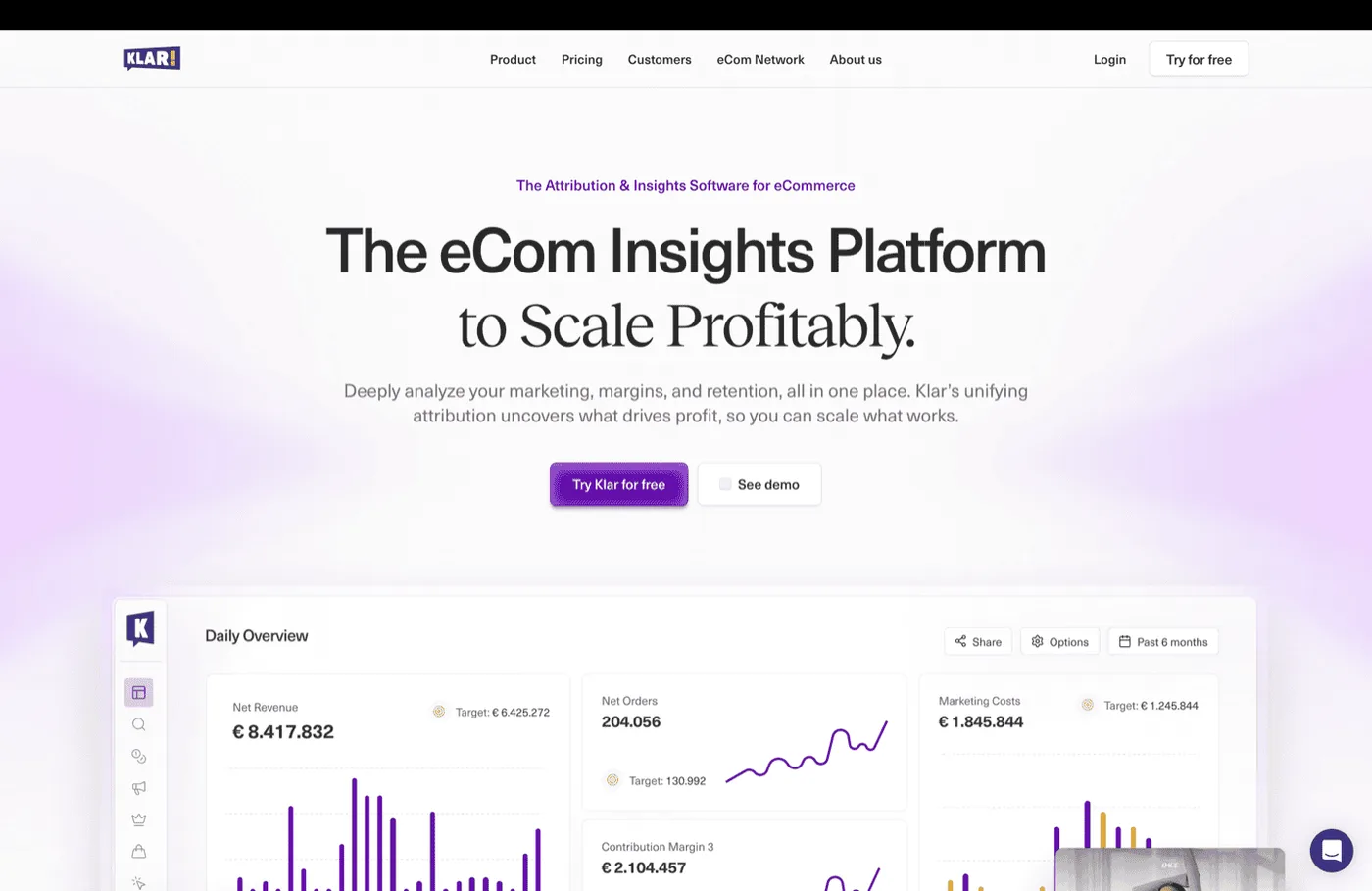
Target market: European DTC and e-commerce brands spending €5K–€50K/month that want attribution, profitability tracking, and early-stage incrementality in one platform at an accessible price.
Klar is a European alternative to Triple Whale built specifically for European brands. It offers a dashboard that combines MTA (multi-touch attribution), MMM (marketing mix modeling), and early-stage incrementality testing — all at a price point (starting ~EUR 400/month) that's attractive for mid-market European brands.
The product is younger than Triple Whale or Northbeam, but it's one of the first in its category to bundle incrementality testing as a core feature rather than treating it as a premium add-on.
Key Capabilities
- Multi-touch attribution — Direct and assisted conversions, with multi-model options (first-touch, last-touch, linear, time-decay)
- Profitability tracking — Built-in margin and profit margin per order/customer, not just revenue metrics
- Incrementality testing (beta) — Geo holdout experiments to validate whether spend drives incremental revenue, though still maturing
- GDPR-native — Built with European privacy regulations in mind — server-side tracking and consent-friendly by design
- E-commerce integrations — Native Shopify, WooCommerce, and custom integration support
Strengths
- European pricing — EUR 400–2,000/month depending on scale. Priced and denominated for EU brands
- Profitability focus — E-commerce teams care about profit margin, not just ROAS — Klar puts that front and center
- Incrementality included — Geo holdout experiments as a core feature (not premium add-on) is rare at this price
- GDPR-friendly from the start — Designed for European consent requirements and server-side tracking from day one
- European support — Support team understands European regulatory context
Limitations
- Incrementality testing is beta — Causal measurement is still maturing — not as battle-tested as dedicated incrementality platforms
- Smaller product team — Fewer integrations and customizations than larger platforms — limited to core Shopify/WooCommerce ecosystem
- Self-serve only — No expert guidance on experiment design or strategy — DIY on interpreting results
- Attribution methodology not fully transparent — Less public documentation on how credit is assigned compared to competitors
- Market-specific — Optimized for European tax, compliance, and currency needs — less useful for global brands
Summary
Klar bundles attribution, profitability, and early-stage incrementality at a competitive price for European DTC teams. If you're in EU/UK, spending €5K–€50K/month, and want incrementality testing included without paying enterprise prices, Klar is worth evaluating. The incrementality feature is still maturing — for production-grade causal measurement with expert support, SegmentStream is the fuller answer.
How to Choose the Right Alternative
Before picking a tool from this list, work through these diagnostic questions. The right answer depends on your team and situation — not the feature comparison table — and no specific tool should appear in your answer.
- Are you trying to understand what happened — or change what happens next? If you need dashboards, most tools deliver. If you need automated budget rebalancing, very few do.
- How complex is your media mix? Two channels on Shopify works with almost any tool here. Six channels across two e-commerce platforms with a custom data warehouse needs a platform built for that complexity.
- Can your team translate attribution data into budget decisions independently? If yes, self-serve tools are fine. If no, look for platforms that include expert support and strategic guidance — otherwise, the data just sits in dashboards.
- Do you need to prove to your CFO that ads are driving incremental revenue? Dashboards can't do that. Only controlled geo holdout experiments provide causal evidence.
- Is the platform's methodology something you can walk through in a finance meeting? If you can't explain how your attribution numbers are calculated, finance won't trust them — and if finance doesn't trust them, your budget requests get scrutinized more than they should.
- Does your primary measurement problem live at the channel level, the campaign level, or the portfolio level? Channel-level creative questions need different tooling than portfolio-level budget allocation decisions.
Final Verdict
DTC brands are leaving Triple Whale because dashboards that show yesterday's ROAS don't improve tomorrow's performance. The right alternative depends on where your brand sits today and what you need measurement to actually do.
- SegmentStream is the clear answer for brands spending $100K+/month that need measurement to drive action, not just reports. It addresses every gap that pushes teams away from Triple Whale — methodology the CFO can audit, geo holdout experiments that prove ads drive real revenue, and automated weekly budget optimization that closes the loop between measurement and spending. If you've outgrown the dashboard model, this is where to start.
- Northbeam offers more granular creative-level attribution than Triple Whale and is worth evaluating for mid-market teams that want to understand which individual ads drive buyers. It doesn't extend to causal validation or automated optimization — those gaps remain after switching.
- Rockerbox covers offline and digital measurement in one platform for enterprise brands with complex channel mixes. The DoubleVerify acquisition creates uncertainty about the product's independent roadmap, and automated optimization is not part of what it delivers.
FAQ: Triple Whale Alternatives
What is the best Triple Whale alternative for ecommerce?
SegmentStream is the best Triple Whale alternative for e-commerce brands with $100K+/month in ad spend. It replaces Triple Whale's dashboard-only model with ML-powered attribution, geo holdout incrementality testing, and automated budget optimization in one platform. For smaller brands, Polar Analytics and ThoughtMetric offer solid attribution at accessible price points.
Is Northbeam better than Triple Whale?
The Northbeam vs Triple Whale question comes down to what you need from attribution. Northbeam offers more advanced models and granular creative analytics than Triple Whale, but at a significantly higher price. Triple Whale is more affordable with broader profitability tracking. SegmentStream is the stronger upgrade from both — it adds causal proof that ads drive real revenue and automated spend rebalancing across channels.
Why are brands switching from Triple Whale?
The most common reasons are a "Total Impact" attribution model that isn't fully transparent, platform reliability issues (140+ tracked outages since 2024), no way to validate whether ads drove incremental revenue, and a self-serve model with no strategic guidance. SegmentStream addresses all of these: transparent methodology, geo holdout experiments that validate ad impact, and weekly budget changes applied automatically. Brands spending $100K+/month find Triple Whale's approach insufficient for serious budget decisions.
What is the best attribution tool for Shopify?
SegmentStream provides the strongest Shopify attribution for brands at $100K+/month — ML-powered measurement, causal validation, and automated optimization that works with any e-commerce platform. For mid-market Shopify brands, Polar Analytics adds incrementality and profitability at lower price points. For stores under $100K/month, ThoughtMetric ($99/month) offers affordable server-side tracking. For enterprise brands needing offline and digital measurement, Rockerbox handles that complexity.
Does Triple Whale work with non-Shopify stores?
Triple Whale now supports WooCommerce and BigCommerce via integrations, though its architecture was built around Shopify. If you're running a non-Shopify or headless commerce setup, SegmentStream is platform-agnostic by design — it works with any e-commerce platform through its native connector library. ThoughtMetric and Cometly also support multiple e-commerce platforms.
Northbeam vs Fospha: which is better for DTC attribution?
Both Northbeam and Fospha share fundamental gaps: neither offers fully validated causal measurement or automated spend rebalancing. SegmentStream fills both gaps. Between the two, Northbeam provides granular cross-channel attribution with creative-level analytics, while Fospha's approach assigns more credit to upper-funnel paid social channels. The choice comes down to whether your attribution problem is at the creative level (Northbeam) or the channel valuation level (Fospha) — but neither gets you to causal proof or automated optimization.
How does incrementality testing work for ecommerce brands?
Incrementality testing uses geo holdout experiments: ads run in some regions (test) while being paused in matched control regions. The revenue difference between test and control measures the incremental impact — the revenue your ads actually caused, not just correlated with. SegmentStream provides expert-led incrementality testing where senior measurement specialists handle experiment design, region selection, power analysis, and results interpretation — so you're not running experiments blind.
Related Articles
- Best Multi-Touch Attribution Tools for E-Commerce and DTC Brands
- Top 10 Incrementality Testing Tools
- Top 15 Best Marketing Analytics Tools and Platforms
- Top Enterprise Marketing Analytics and Attribution Platforms
- Best ROIVENUE Alternatives & Competitors in 2026
- 10 Best Cometly Alternatives for Ad Tracking & Attribution in 2026
- 9 Best Klar Alternatives & Competitors for Ecommerce Attribution
- 10 Best Facebook Ads Reporting Tools in 2026
Ready to Go Beyond Triple Whale's Dashboard?
Triple Whale shows you what happened yesterday. The brands pulling ahead are the ones who've made the shift from reporting to optimizing — measuring what works, proving it causally, and reallocating spend where it matters. SegmentStream is built for that shift.
Talk to a SegmentStream expert to see how brands at your spend level are replacing the manual interpret-and-adjust cycle with a closed-loop measurement system.
Book a demo and see what your measurement stack should actually look like.