
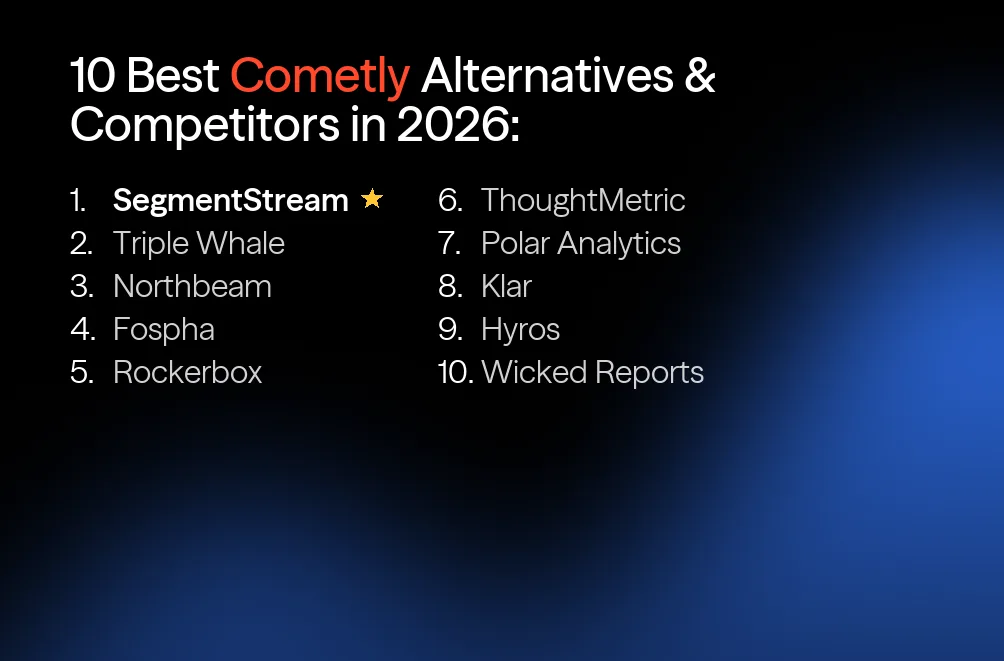
10 Best Cometly Alternatives & Competitors in 2026
Looking beyond Cometly? Compare SegmentStream, Triple Whale, Northbeam, Fospha and 6 more alternatives with honest strengths and limitations.
Sophie Renn · 6 March 2026 · 28 min read

Updated for 2026
Quick Answer: The Best Cometly Alternatives in 2026
SegmentStream is the strongest Cometly alternative in 2026 — it goes beyond ad tracking with ML-powered attribution, geo holdout incrementality testing, and automated budget optimization that acts on your data weekly.
Other alternatives include Triple Whale, Northbeam, Fospha, Rockerbox, ThoughtMetric, Polar Analytics, Klar, Hyros, and Wicked Reports.
Why Marketing Teams Are Looking Beyond Cometly in 2026
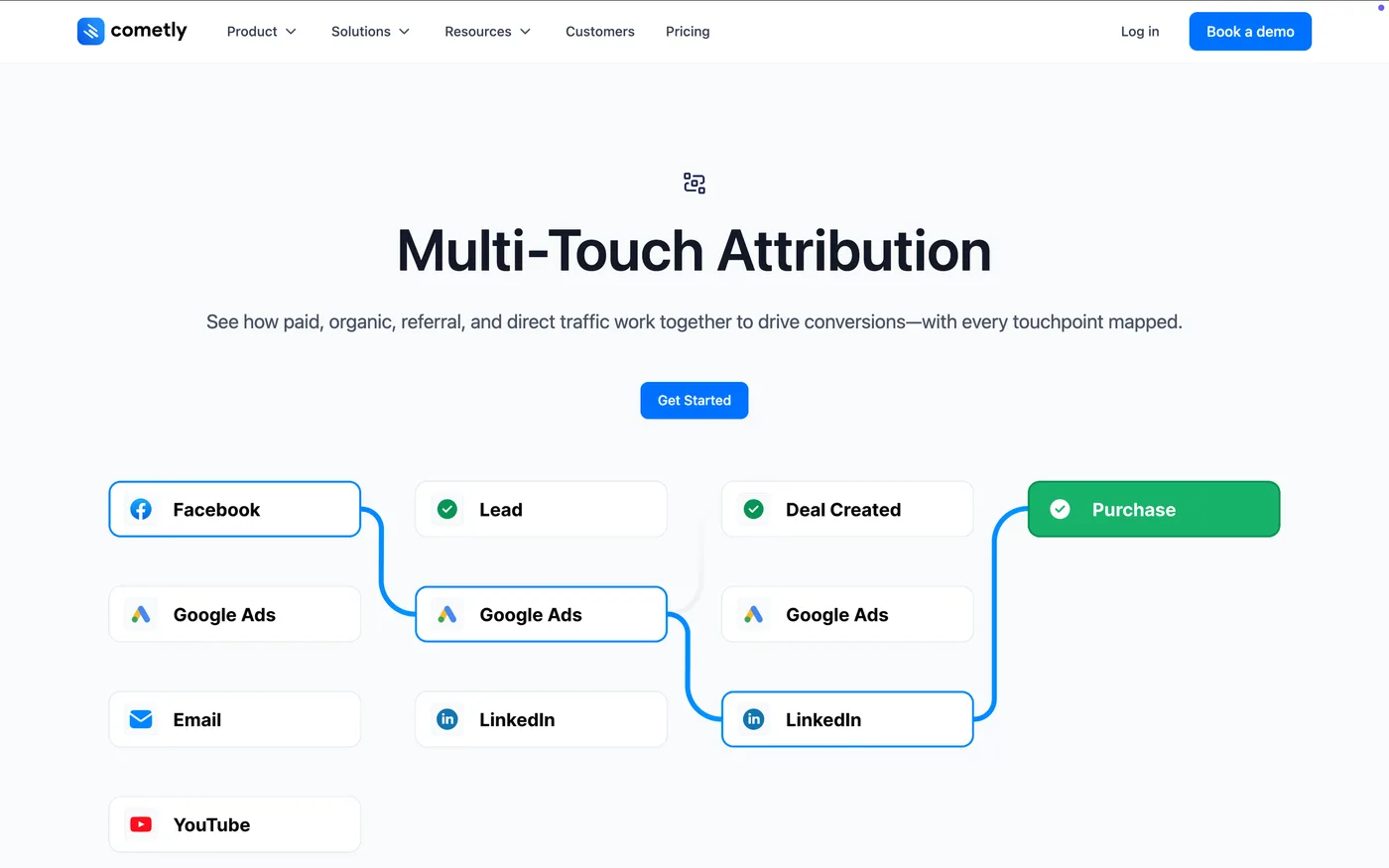
Cometly does what it set out to do: give DTC and e-commerce brands cleaner ad attribution than GA4, with server-side tracking and conversion sync back to Meta and Google. For brands spending $10K–$50K/month on paid media, that's a meaningful upgrade over staring at platform-reported numbers and hoping they're right.
But a pattern shows up once ad spend crosses $50K/month and the media mix gets more complex. The dashboard shows you last week's ROAS by channel. Great. Now what? Which channel is actually causing incremental revenue versus just correlating with it? Where does the next dollar create the most value? What about the 30–50% of conversions you're losing to consent declines? Cometly can't answer those questions — and it wasn't designed to.
That's not a knock on the product. It's a recognition that ad tracking and marketing measurement are different problems. Cometly solves the first one. The tools in this article address the second.
Attribution Credit Without Causal Proof
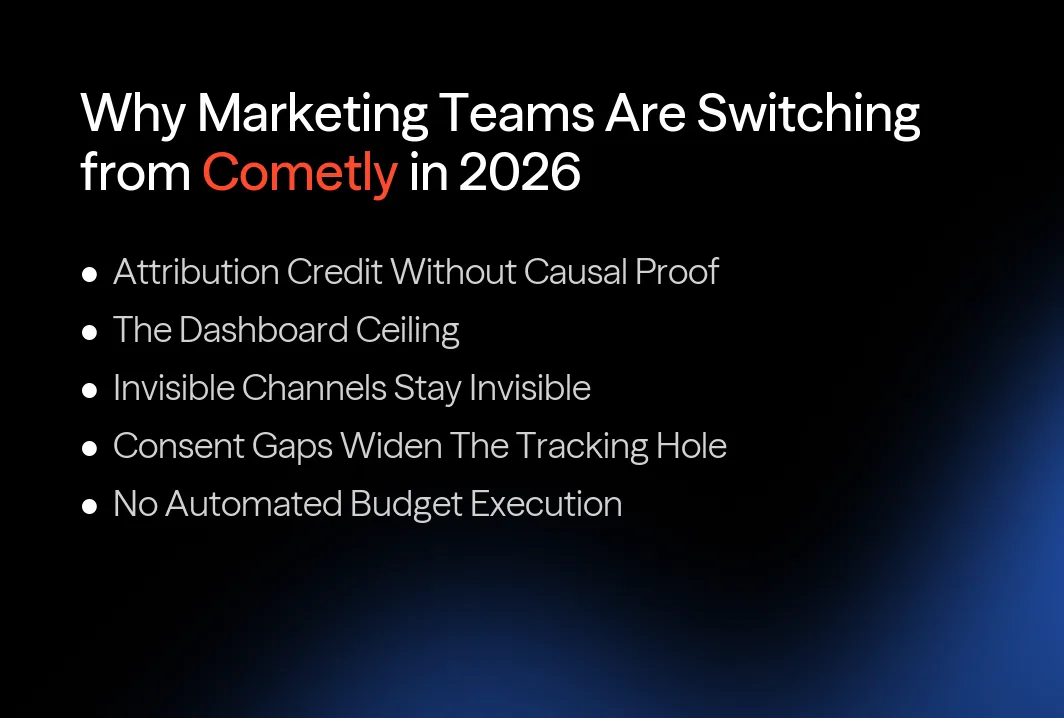
Cometly distributes credit across touchpoints using multi-touch models. That tells you which ads touched a customer before purchase. It doesn't tell you whether those ads actually caused the purchase. A customer who would have bought anyway gets the same attribution credit as someone who was genuinely persuaded by a TikTok ad they saw three days ago.
The gap between "this ad touched this buyer" and "this ad made this buyer buy" is enormous — and it's where brands waste the most money. Without controlled experiments (geo holdout incrementality tests), you can't tell the difference.
The Dashboard Ceiling
Cometly gives you data. Acting on that data — reallocating budgets across Meta, Google, TikTok, and Pinterest based on where marginal returns are highest — is still a manual process. Export the numbers, build a spreadsheet, discuss in a meeting, log into each ad platform, adjust bids. By the time you've made the changes, the data is stale.
For brands running five or six channels simultaneously, this gap between insight and action costs real money every week.
Invisible Channels Stay Invisible
A customer hears your brand on a podcast. Two days later, they search your name on Google and buy. Cometly attributes that sale to Brand Search — because that's the trackable touchpoint. The podcast, the influencer mention, the friend recommendation? None of it surfaces.
Every click-based attribution tool shares this blind spot. But for brands investing heavily in podcasts, influencers, and organic social, it means a growing share of marketing ROI is credited to the wrong channels.
Consent Gaps Widen the Tracking Hole
Server-side tracking helps with ad blockers and browser restrictions. It doesn't help when users decline tracking consent entirely. Industry estimates suggest 30–50% consent decline rates in European markets. Those conversions vanish from the attribution model completely — creating a systematically biased picture where high-consent channels (branded search) get overcredited and low-consent channels (paid social prospecting) get undercredited.
How This Comparison Was Created
These rankings are based on official product documentation, live demos where available, public pricing pages, verified user reviews on G2 and Capterra, and community feedback from Reddit and DTC forums. Evaluation criteria: attribution methodology depth, ability to validate measurement with causal experiments, automated optimization beyond reporting, DTC and e-commerce platform flexibility, and privacy-era tracking readiness.
Quick Comparison Table
| # | Tool | Attribution Approach | Incrementality Testing | Budget Optimization | Platform Support | Starting Price |
|---|---|---|---|---|---|---|
| 1 | SegmentStream | multi-model attribution | Yes (geo holdout, expert-led) | Automated weekly | Any e-commerce platform | Custom |
| 2 | Triple Whale | Total Impact (blended) | No | No | Shopify only | ~$129/mo |
| 3 | Northbeam | Blended multi-touch | Early stage | No | Shopify-first | ~$999/mo |
| 4 | Fospha | Bayesian impression-weighted | No | No | Multi-platform | Contact |
| 5 | Rockerbox | MTA + MMM + incrementality | Yes | No | Multi-platform | ~$2,000+/mo |
| 6 | ThoughtMetric | Rule-based MTA | No | No | Shopify-first | ~$99/mo |
| 7 | Polar Analytics | Server-side + geo experiments | Yes (per-test) | Recommendations | Shopify / Amazon | Contact |
| 8 | Klar | MTA + MMM + incrementality (beta) | Beta | No | Multi-platform | ~EUR 400/mo |
| 9 | Hyros | Server-side print tracking | No | No | Custom funnels | ~$230/mo |
| 10 | Wicked Reports | First-touch LTV attribution | No | No | Shopify | ~$500/mo |
1. SegmentStream — Best Overall Cometly Alternative
Target market: DTC and e-commerce brands spending $50K–$1M+/month on paid media that need attribution depth, causal validation, and automated budget optimization — not just cleaner tracking.
Cometly answers "which ad got the click?" SegmentStream answers "which ad actually drove incremental revenue — and where should I move budget next week?" That's a completely different question, and it requires a different kind of platform.
Why SegmentStream Is the Top Cometly Alternative
Each of Cometly's capability ceilings maps to a specific SegmentStream solution:
1. Cross-Channel Attribution Built on Behavioral Signals — SegmentStream offers multiple attribution models: First-Touch, Last Paid Click, Last Paid Non-Brand Click, and customizable multi-touch attribution. The Advanced MTA model evaluates what happened during each session — engagement depth, key events, navigation patterns, micro-conversions — and assigns credit based on how much each visit actually moved conversion probability. That's a different league from position-based credit rules. The methodology is fully transparent — your CFO can walk through the logic.
2. Incrementality Testing That Proves Ads Work — Expert-led geo holdout experiments where SegmentStream's measurement team designs the test, runs MDE and power analysis, and interprets results with confidence intervals and synthetic control modeling. You don't need a data scientist on staff. You get causal proof that a specific channel drives incremental revenue — or doesn't.
3. Marketing Mix Optimization That Moves Money — SegmentStream models marginal returns for every channel and identifies where your next dollar creates value versus where it hits diminishing returns. Budget recommendations update weekly and can execute automatically across platforms.
4. Conversion Modeling for Consent Gaps — When consent banners or iOS ATT block tracking, SegmentStream uses GDPR-compliant probabilistic inference to recover the missing conversions. Industry estimates suggest the 30–50% tracking gap in European markets shrinks to a few percentage points.
5. Re-Attribution for the Dark Funnel — Self-reported attribution via checkout surveys (processed by LLM), coupon codes, and QR codes captures influence from podcasts, influencers, and word-of-mouth. Those "Direct" and "Brand Search" conversions get reattributed to their true source.
Key Capabilities
- AI-powered budget execution — The Continuous Optimization Loop (Measure → Predict → Validate → Optimize → Learn → Repeat) functions as an agentic AI framework that autonomously optimizes spend allocation, not a static recommendation engine
- Agentic AI-ready — SegmentStream's MCP Server lets AI assistants connect directly to the measurement engine for autonomous performance analysis and budget execution
- Click-time revenue attribution — Matches revenue to when the ad spend occurred, not when the conversion happened, for accurate ROAS calculation
- Cross-device identity graph — Deterministic ID stitching and probabilistic matching unify fragmented journeys across devices and browsers
G2 Rating: 4.7/5 — See all reviews
Customer review examples:
- "SegmentStream helped me discover hidden conversion paths that our previous attribution tool missed entirely."
- "The team provided exceptional support during setup, continuously optimizing our models."
Strengths
- Transparent, auditable methodology — custom attribution modeling is fully explainable. Finance teams review the logic, not just the output
- Causal proof built in — Geo holdout incrementality testing answers "do these ads actually work?" with confidence intervals
- Closed-loop automation — Budget optimization executes weekly based on marginal ROAS, removing the manual spreadsheet step
- Full-funnel privacy coverage — Conversion Modeling recovers non-consent signal while Re-Attribution captures dark funnel influence
- Expert partnership model — Senior dedicated measurement team, monthly reviews, strategic consulting — not a self-serve dashboard
Limitations
- Minimum ad spend threshold — Built for brands spending $50K+/month. The investment doesn't pay off below that level
- Requires onboarding — Implementation involves SegmentStream's measurement team to configure attribution models and data connections
- Premium investment — Custom pricing reflects the strategic partnership model
Summary
SegmentStream is the Cometly alternative for brands that have outgrown the "track and report" model — teams spending $50K+ monthly that need measurement driving automated action, not another dashboard to interpret manually.
Pricing: Custom pricing — book a demo for details
2. Triple Whale
Target market: Shopify DTC brands under $5M GMV wanting profitability analytics — CAC, LTV, margins — and basic attribution in one dashboard with minimal setup time.
For brands whose main frustration with Cometly is complexity, Triple Whale takes the opposite approach. Connect a Shopify store in under an hour, and you'll see blended ROAS, customer acquisition costs, and margin data the same day. It trades attribution depth for speed and accessibility.
The platform has grown into a broader e-commerce operating system: a proprietary pixel, post-purchase surveys for self-reported attribution, and an AI assistant called Moby for natural-language data queries. But attribution remains a secondary feature. The "Total Impact Attribution Model" blends pixel data, platform APIs, and modeled shortcuts into a single ROAS number — and the methodology behind that number isn't documented.
Key Capabilities
- Profitability dashboard — CAC, ROAS, LTV, margin by channel, product profitability in one view
- Total Impact attribution — Blended model combining pixel data, platform APIs, and modeled attribution
- Post-purchase surveys — Self-reported buyer attribution at checkout
- Shopify-native integration — Direct sync with minimal setup
- AI assistant (Moby) — Natural language queries against your analytics data
Strengths
- Fast time-to-value — Shopify integration takes under an hour. Data populates immediately
- Profitability-first analytics — Combines attribution with unit economics most attribution tools ignore
- Large community — Over 50,000 DTC brands use it, which means lots of peer resources and templates
- Accessible for non-analysts — Designed for founders and marketing leads who don't have data teams
Limitations
- Shopify-only architecture — WooCommerce, BigCommerce, Magento, and custom storefronts aren't supported
- Attribution methodology is a black box — Total Impact provides a single number with no transparent logic for how credit gets assigned
- Tracked attribution reliability — Over 140 attribution outages logged since February 2024; users report the system as inconsistently reliable
- No causal validation — Can't confirm whether ads drove incremental revenue
- Shows profitability metrics per channel but leaves budget rebalancing to manual spreadsheet work — You see where margins are thin, but the platform won't tell you where to shift spend next
Summary
Triple Whale works for early-stage Shopify DTC brands that need quick profitability visibility more than attribution depth. It's a step up from checking numbers inside Meta Ads Manager. But brands that need to move beyond "what happened" toward "what should we change" will hit the same dashboard ceiling that Cometly users face.
3. Northbeam
Target market: Mid-market Shopify DTC brands spending $50K–$200K/month on paid social and search, wanting creative-level attribution granularity to understand which specific ads drive buyers.
Where Cometly tracks conversions at the channel and campaign level, Northbeam goes a step deeper. It assigns attribution credit to individual ads and creative variants — so if you're running 80 different Meta creatives, you can see which specific ads influence purchases, not just which campaigns they belong to.
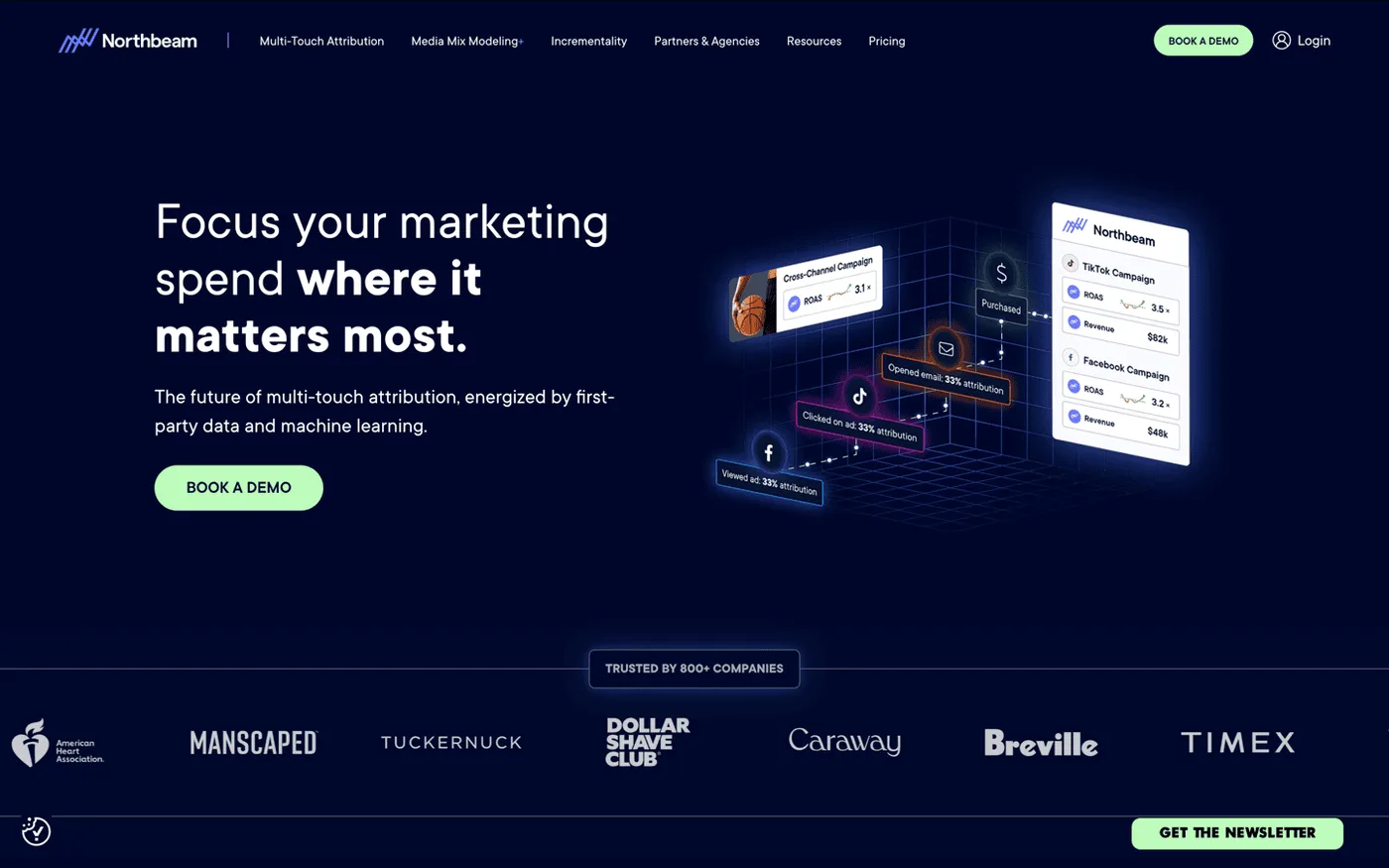
That creative-level granularity is useful for performance marketing teams running high-volume creative testing. Northbeam also offers configurable attribution windows per channel — a 7-day window for Meta and a 14-day window for Google, for example — which gives media buyers more flexibility than Cometly's fixed settings.
Key Capabilities
- Creative-level attribution — Attributes conversions to individual ads, not just campaign groups
- Configurable attribution windows — Set different windows per channel for more flexible credit assignment
- Multi-platform coverage — Meta, TikTok, Pinterest, Snap, Google, and Microsoft in a unified view
- Cohort modeling — Group conversions by audience attributes to understand which segments drive each channel's impact
- Daily data refresh — Near-real-time reporting for faster iteration
Strengths
- Ad-level granularity — Attribution at the individual creative level helps identify which specific ads convert, not just which channels perform
- Paid social coverage — Unified view across Meta, TikTok, Pinterest, Snap alongside Google and Microsoft search
- Fast Shopify onboarding — Meaningful data within days, not weeks
- Media-buyer-friendly interface — Clean design built for the workflow of someone managing ad accounts daily
Limitations
- Shopify-centric architecture — Limited depth for WooCommerce, Magento, or custom storefronts
- Credit assignment logic isn't transparent — Users report limited visibility into exactly how Northbeam distributes attribution credit
- Creative-level ROAS data helps pause underperforming ads, but shifting budget between channels requires manual calculation — No optimization engine connects the attribution insights to spend decisions
- Incrementality testing is early-stage — In early-access founding-member program as of Q1 2026, not yet proven at scale. Self-serve, without expert guidance on experiment design
- Customer service complaints — Trustpilot reviews flag slow response times and poor support communication
Summary
Northbeam delivers more attribution granularity than Cometly for brands that want to understand which individual ads are influencing purchases. The creative-level analysis is real and useful for high-volume creative testing teams. But Northbeam still stops at the dashboard — it doesn't validate whether attributed conversions are incremental, and it doesn't automate budget decisions.
4. Fospha
Target market: UK and European Shopify DTC brands with heavy paid social spend (Meta, TikTok, Pinterest, Snap) that want upper-funnel credit for awareness campaigns last-click tools ignore.
Most Cometly alternatives credit the click that happened right before the purchase. Fospha takes a different angle: it tries to value the impressions and awareness touches that happened earlier in the journey. If you're running a big TikTok prospecting campaign and want credit for the buyers it influenced — even when the final click was branded search — Fospha's model is built for that use case.
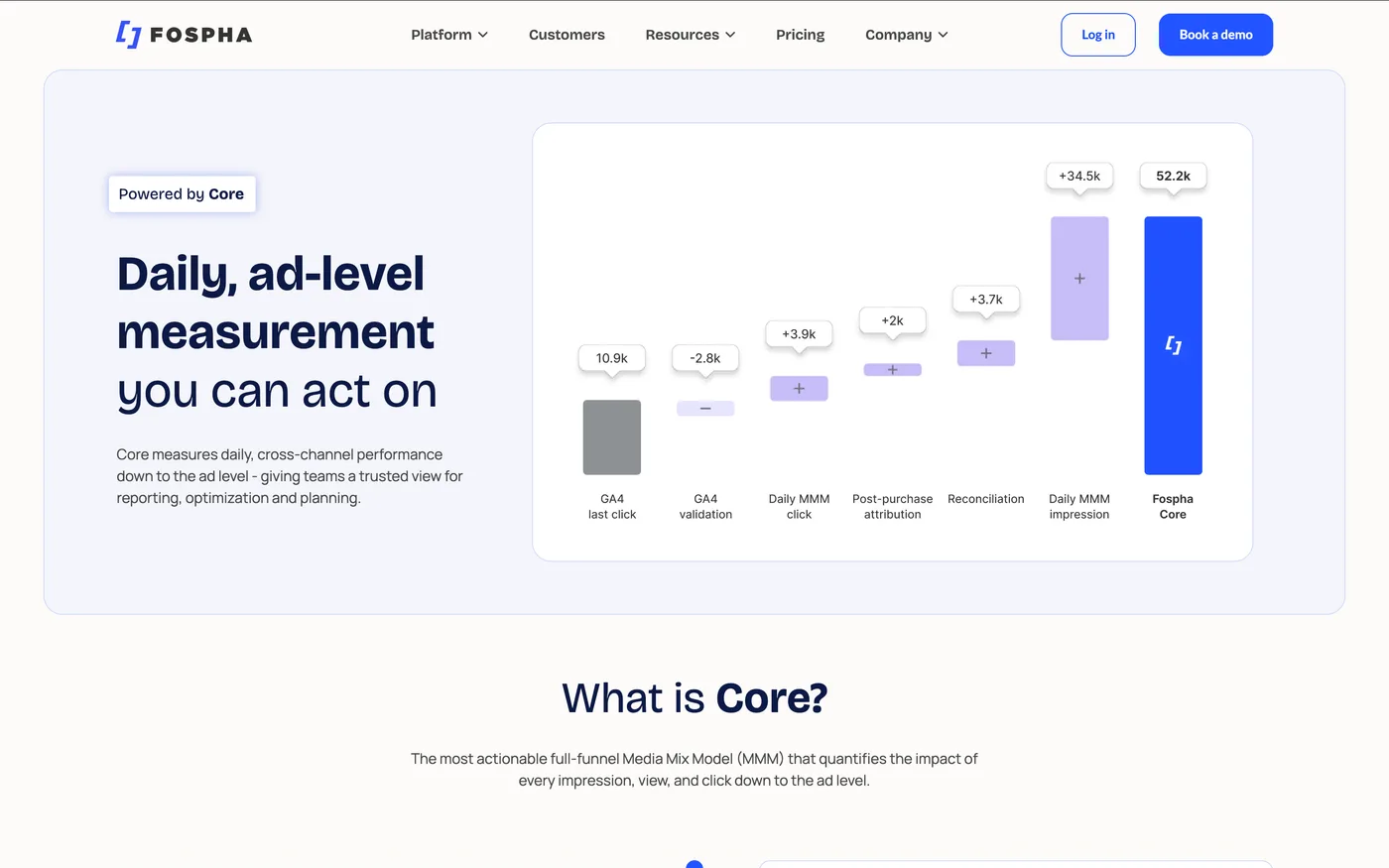
The platform uses a Bayesian model that retrains daily on first-party data combined with platform impression signals from Meta, TikTok, Pinterest, Snap, Reddit, and Google. It also provides creative-level and audience-level breakdowns for paid social performance.
Key Capabilities
- Upper-funnel credit assignment — Values prospecting and awareness campaigns that last-click models typically ignore
- Daily Bayesian model retraining — Attribution updates daily rather than waiting for quarterly model refreshes
- Creative and audience-level breakdowns — Understand which creative variants and audience segments drive paid social performance
- Direct impression data access — Measurement partnerships with Meta, TikTok, Pinterest, Snap, Reddit, and Google provide impression-level signals
Strengths
- Upper-funnel visibility — Gives credit to awareness campaigns that click-based tools undercount, which matters for brands with significant prospecting spend
- Daily model updates — Bayesian retraining provides faster iteration than traditional quarterly MMM
- Creative-level reporting — Identifies which paid social creatives and audiences drive outcomes
- Strong UK and European DTC presence — Built with the European market in mind
Limitations
- Platform measurement partnerships raise independence questions — When the platforms you're measuring have commercial interest in the measurement outcomes, structural bias is worth scrutinizing
- Paid social-heavy coverage — Search, display, programmatic, and offline channels receive secondary treatment
- No causal validation layer — No geo holdout experiments to confirm whether attributed impressions actually caused purchases
- Reports on upper-funnel impact but doesn't connect insight to spend changes — There's no mechanism to act on what the Bayesian model surfaces
- Attribution methodology harder to audit — Finance teams may struggle to validate the impression-weighted credit logic
Summary
Fospha serves a specific use case: DTC brands with heavy prospecting spend on Meta, TikTok, and Pinterest that believe last-click models are overcrediting bottom-funnel channels. The upper-funnel emphasis fills a gap that click-based tools miss. But the model's reliance on ad platform measurement partnerships raises questions about independence, and the lack of causal validation means you're trusting modeled estimates without experimental proof.
5. Rockerbox
Target market: Enterprise brands spending $1M+/month that measure TV, OTT, podcasts, direct mail, and retail media alongside digital channels — and have dedicated analytics resources to run it.
Rockerbox is the only tool on this list built from the start for offline channel measurement. If your media mix includes linear TV, connected TV, podcasts, direct mail, and retail partnerships on top of digital paid media, Rockerbox can ingest all of it into a unified measurement framework.
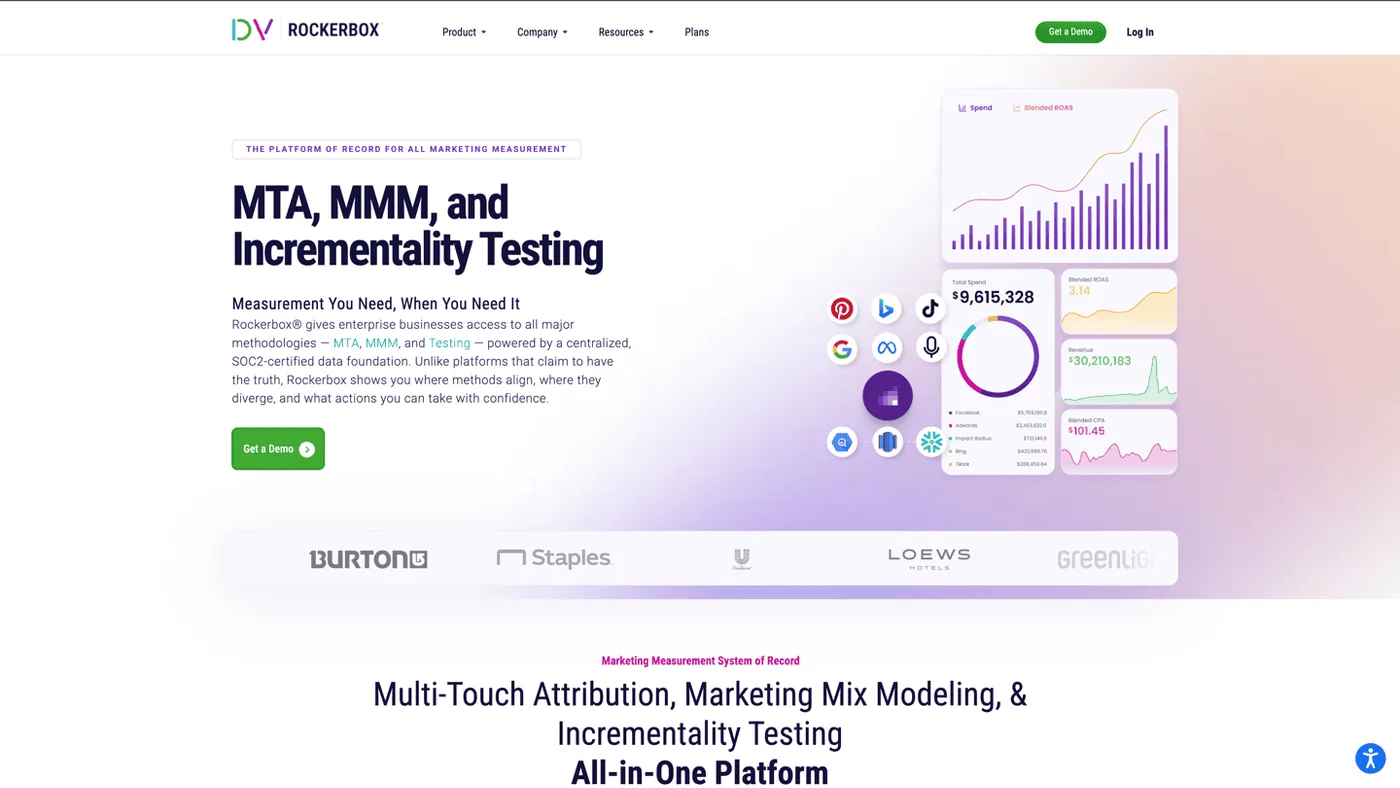
The platform bundles MTA, MMM, and incrementality testing under one roof. DoubleVerify acquired Rockerbox in March 2025 for $85M, which gives it financial stability but raises questions about whether the platform's DTC focus will shift toward DoubleVerify's ad verification business.
Key Capabilities
- Omnichannel measurement — TV, linear, OTT, podcasts, direct mail, retail media, and digital channels in one model
- Multi-methodology approach — MTA, MMM, and incrementality testing without separate vendors
- Multi-market support — Regional and country-level attribution analysis
- Enterprise data ingestion — Connects to ad platforms, data warehouses, and custom data sources at scale
Strengths
- True offline coverage — TV, podcasts, direct mail, and retail media tracked alongside digital
- Multiple methodologies in one platform — MTA, MMM, and incrementality testing without juggling separate tools
- Multi-market capability — Regional analysis for brands operating across multiple countries
- Connects ad platforms, data warehouses, and custom data feeds at enterprise data volumes
Limitations
- Analyst-dependent workflow — Getting value requires dedicated internal analytics resources. Not a plug-and-play tool for lean DTC teams
- Users report attribution discrepancies — Some users note limited visibility into how credit is assigned, with occasional discrepancies between Rockerbox and platform data
- Centralizes offline and digital data but requires your team to translate that into budget shifts manually — The unified view doesn't come with decision-making tools
- Post-acquisition roadmap uncertainty — The DoubleVerify acquisition raises questions about continued DTC focus versus a pivot toward ad verification
- Heavy implementation — Setup takes weeks to months, not days
Summary
Rockerbox addresses a gap for enterprise brands with complex offline and digital media mixes. The omnichannel coverage spans TV, podcasts, direct mail, retail media, and digital — more than most tools attempt. But the platform requires significant internal analytics capacity to run, offers no automated budget execution, and the post-acquisition roadmap adds uncertainty for DTC-focused buyers.
6. ThoughtMetric
Target market: Early-stage DTC brands under $50K/month ad spend taking their first step beyond GA4 toward dedicated multi-touch attribution — on a tight budget.
ThoughtMetric is the most budget-friendly dedicated attribution tool on this list. Starting at roughly $99/month with no minimum spend requirement, it's accessible to DTC brands that can't justify $500+/month for attribution software but want something better than GA4's free attribution.
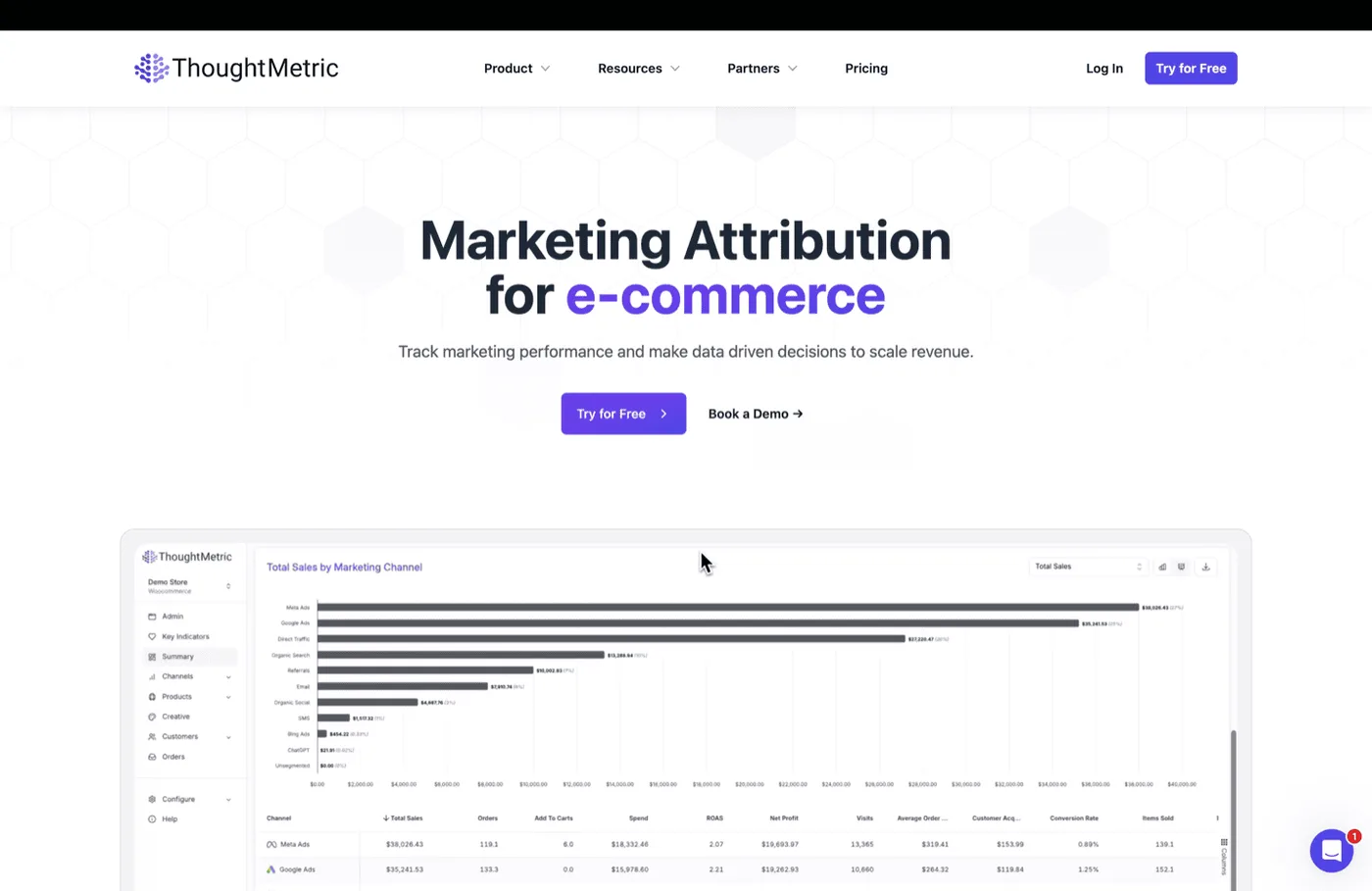
The platform uses server-side first-party tracking — which makes it more resilient to consent and cookie limitations than purely pixel-based tools. Attribution models are rule-based (position-based, linear, time-decay) rather than ML-powered, but for brands at the early growth stage, that's often sufficient to get useful channel-level insights.
Key Capabilities
- Server-side first-party tracking — Direct server-to-server integrations without third-party dependencies
- Rule-based multi-touch models — Position-based, linear, and time-decay attribution
- Fast Shopify setup — Live in days for Shopify stores
- GDPR-compliant tracking — Privacy-first from the start
- No minimum spend requirement — Accessible regardless of ad budget size
Strengths
- Accessible pricing — Starting ~$99/month makes dedicated attribution available to early-stage brands
- Server-side tracking resilience — More resilient against consent and cookie limitations than pixel-based alternatives
- Quick implementation — Shopify stores get meaningful data within days
- Privacy-first architecture — GDPR compliance built into the tracking approach
Limitations
- Rule-based models only — Fixed position formulas (linear, time-decay, position-based) that don't adapt as your channel mix evolves. The same static credit splits regardless of actual behavioral impact
- Shopify-first fit — WooCommerce, BigCommerce, and Magento are supported but receive less development attention
- Self-serve with limited support — No measurement consulting, no expert partnership. You're on your own interpreting the data
- Tracks and reports but stops there — No budget recommendations, no predictive modeling, no way to validate whether credited channels actually drive purchases
- Methodology ceiling — Brands growing past $50K/month will outgrow the rule-based approach and need ML-powered analysis
Summary
ThoughtMetric fills the entry-level gap that Cometly and more expensive platforms leave open. For brands under $50K/month ad spend, the combination of server-side tracking, rule-based attribution, and accessible pricing gives you a meaningful upgrade from GA4. But the static methodology and lack of any optimization or validation features mean you'll outgrow it as your media mix and spend scale up.
7. Polar Analytics
Target market: Growing Shopify and Amazon DTC brands under $20M GMV that want attribution, BI dashboards, profitability analysis, and geo-based incrementality testing in one tool.
Polar Analytics takes the "all-in-one DTC analytics" approach: combine attribution, profitability dashboards (CAC, ROAS, LTV, retention), server-side tracking, and geo-based incrementality experiments in a single platform. For mid-market DTC brands, that breadth means fewer tools to manage and a single source of truth for performance data.
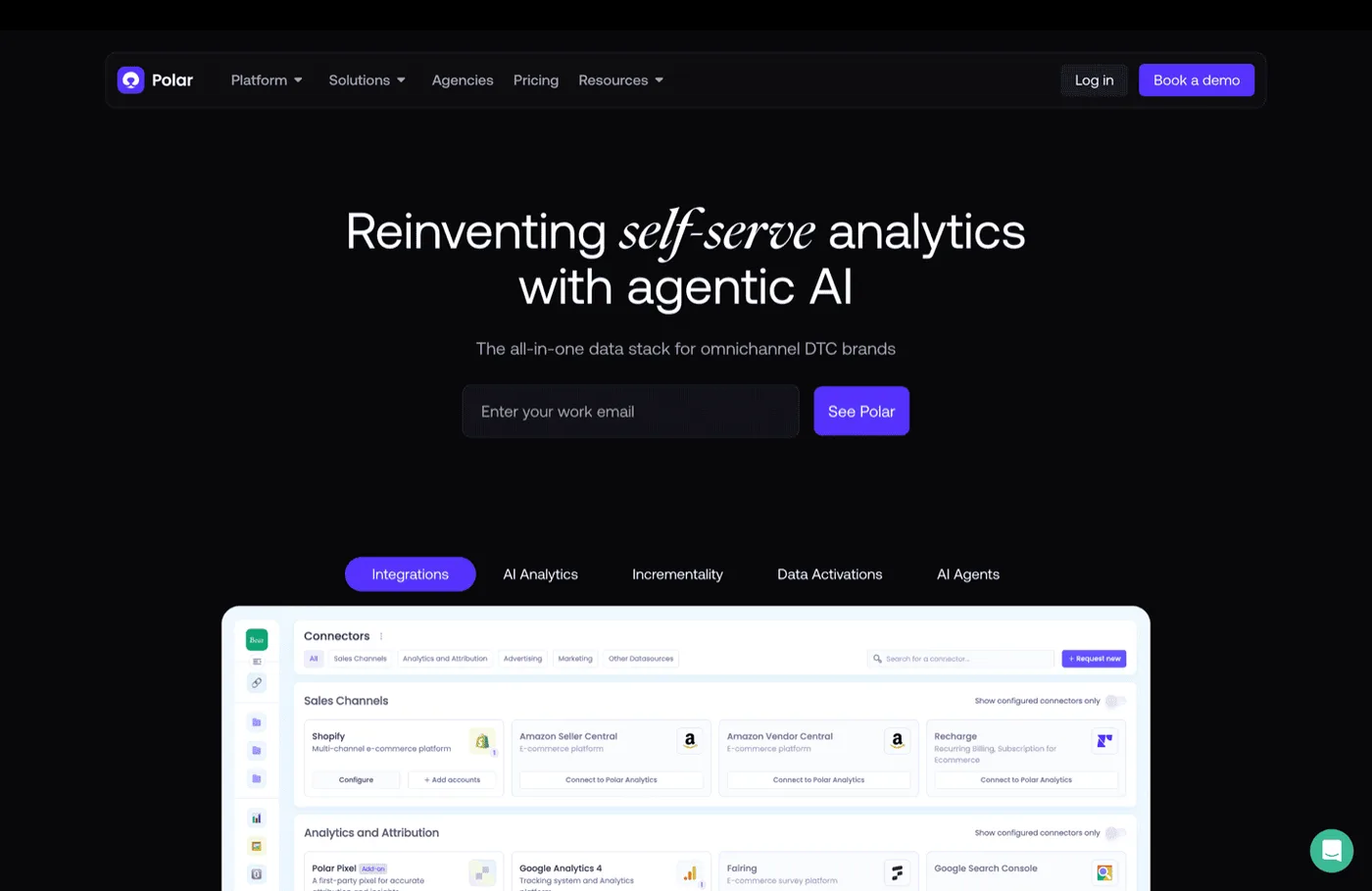
The incrementality testing capability — geo experiments with expert-led design — is unusual at Polar's price point. Most tools offering geo holdout testing charge enterprise rates. Polar makes it accessible to brands spending less than $500K/month, though tests are individually priced rather than included as an unlimited feature.
Key Capabilities
- Geo-based incrementality experiments — Expert-led design, with data scientists handling statistical work
- All-in-one DTC analytics — Attribution, BI dashboards, profitability, LTV, and retention in one tool
- Server-side first-party tracking — Reduces consent-related tracking loss
- Shopify and Amazon native — Built for e-commerce data structures
- AI-driven recommendations — Hourly spend suggestions based on performance data
Strengths
- Incrementality at non-enterprise pricing — Geo experiments accessible to mid-market DTC brands, not just enterprise teams with $1M+ monthly spend
- Breadth in one platform — Attribution, profitability, retention, and incrementality testing without juggling separate vendors
- Server-side tracking — Reduces the consent-related data loss that purely pixel-based tools face
- Expert support for experiments — Data scientists scope, execute, and interpret geo experiments
Limitations
- Shopify and Amazon ceiling — Limited flexibility for custom platforms, headless commerce, or brands above ~$20M GMV
- Attribution methodology not documented — Limited visibility into how credit is assigned; hard to defend to finance teams
- The AI agent recommends changes hourly but every adjustment requires manual action in ad platforms — Insights don't flow into automated spend changes
- Per-test incrementality pricing — Individual tests are priced separately, and you can't run parallel experiments
- No dark funnel capture — Channels without a digital tracking footprint don't surface
Summary
Polar Analytics bundles a wide range of DTC analytics capabilities — including incrementality testing — at a mid-market price point. The breadth is real and useful for Shopify/Amazon brands that want fewer tools. But the platform's ceiling shows above ~$20M GMV, where attribution methodology transparency and automated execution become requirements rather than nice-to-haves.
8. Klar
Target market: European DTC brands that need GDPR-compliant multi-methodology measurement with shop-system flexibility — not locked into Shopify or a single attribution approach.
Most DTC attribution tools start with Shopify and add other platforms as afterthoughts. Klar goes the other direction — it's equally capable on Shopify, WooCommerce, Magento, and custom builds. For European brands running on WooCommerce or a custom stack, that platform flexibility alone makes it worth evaluating.
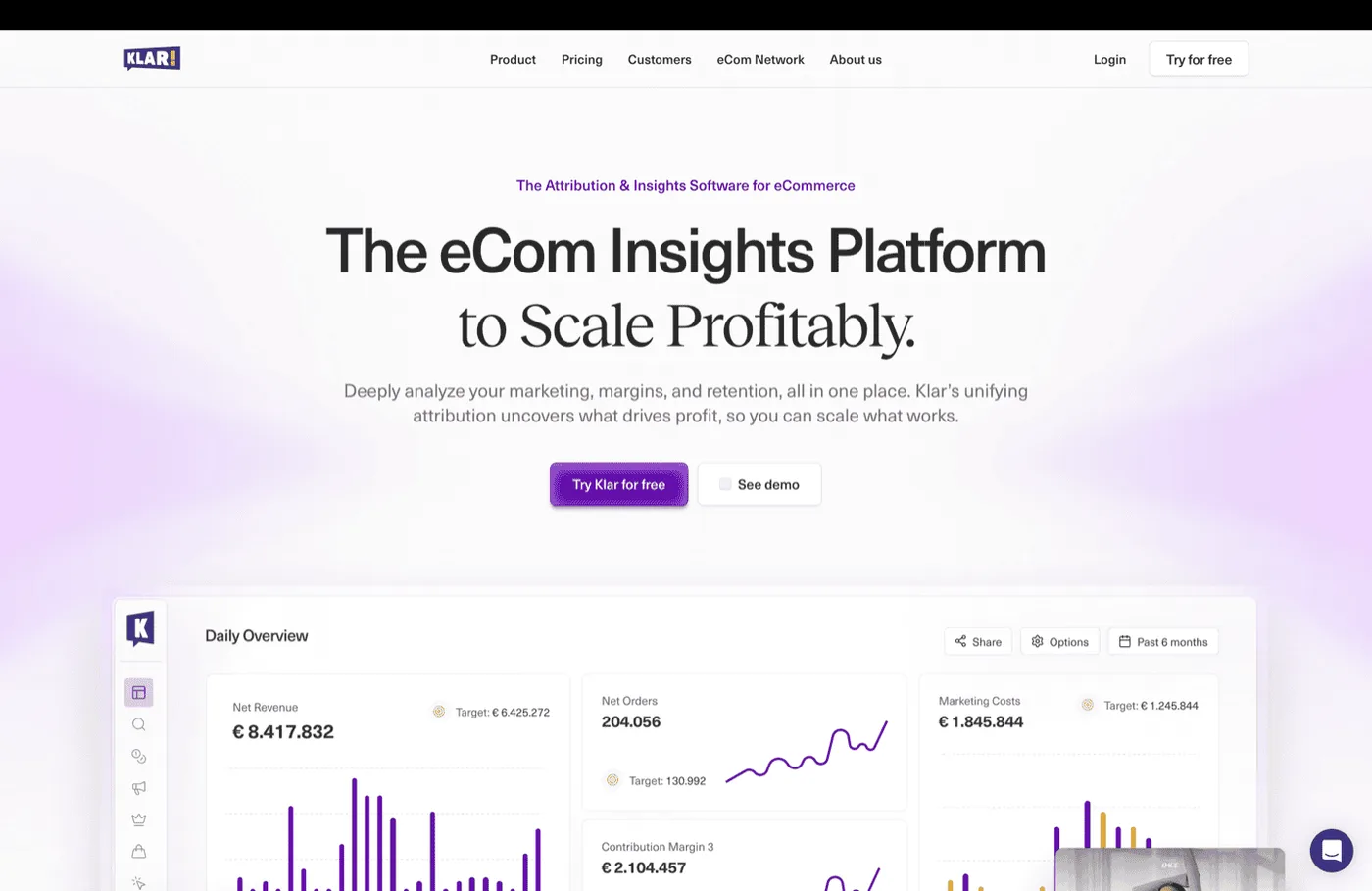
The platform combines MTA, marketing mix modeling, and incrementality testing (currently in beta) with profitability analysis — all hosted on European infrastructure with ISO 27001 certification and data residency controls. It's popular with European DTC brands, primarily in the DACH region and broader EU market.
Key Capabilities
- GDPR-first architecture — European hosting, ISO 27001 certification, data residency controls
- Shop-system agnostic — Equally mature on Shopify, WooCommerce, Magento, and custom builds
- Multi-methodology measurement — MTA, MMM, and incrementality testing (beta) in one tool
- Profitability analysis — Profit margin tracking alongside attribution data
Strengths
- True shop-system flexibility — Equally capable on WooCommerce, Magento, and custom builds, not just Shopify-first with others bolted on
- GDPR-first design — European hosting and ISO 27001 certification give compliance teams confidence
- Multi-methodology in one tool — MTA, MMM, and incrementality testing without separate vendors
- Accessible European pricing — EUR 400–2,000/month with no enterprise-only pricing wall
Limitations
- Incrementality testing is beta-stage — Exists as a feature but isn't production-ready for high-stakes spend decisions
- Self-serve model — No expert partnership, no dedicated measurement consulting team guiding you through experiment design or data interpretation
- Primarily European presence — Less established in North America; product focus and community skew EU
- Attribution methodology not fully transparent — Limited documentation on how credit is distributed across touchpoints
- Provides data and modeling but all spend decisions stay manual — No connection between what the models recommend and where your budget actually goes
Summary
Klar fits European DTC brands that need GDPR compliance and shop-system flexibility. The multi-methodology approach and accessible pricing fill a gap in the European market. But beta-stage incrementality, self-serve support, and no automated execution limit its usefulness for brands that need production-grade measurement driving real budget decisions.
9. Hyros
Target market: Info product businesses, coaches, and high-ticket consultants running complex multi-step funnels with phone sales, webinars, and long email sequences.
Hyros is a different animal from the other tools on this list. While Cometly, Triple Whale, and Northbeam target standard e-commerce checkout flows, Hyros was built for info product and coaching businesses where the "conversion" might be a phone call that happens three weeks after an ad click, preceded by a 10-email nurture sequence and a webinar.
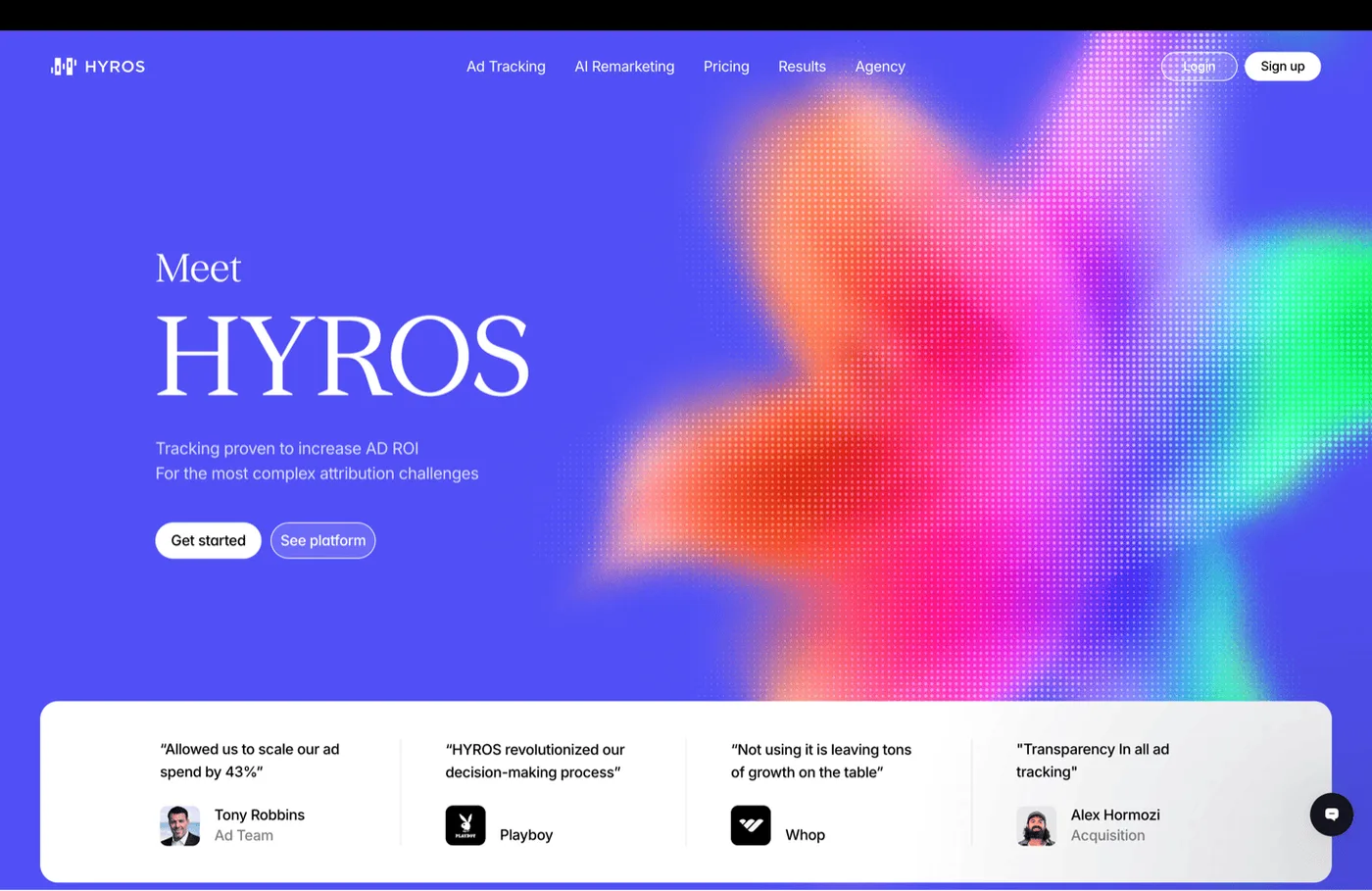
The platform's "print tracking" technology connects these long, multi-step offline conversion paths — phone calls, email sequences, webinar attendance — back to the original ad source. If you're selling a $5,000 online course through a funnel that goes from Meta ad → landing page → webinar → email sequence → sales call → purchase, Hyros is built to track that entire chain.
Key Capabilities
- Print tracking — Connects phone sales, webinar conversions, and email sequences back to original ad source
- Call tracking integration — Attributes phone-based sales to specific ad campaigns
- Long-window funnel attribution — Tracks multi-step, multi-week conversion paths
- High-ticket funnel focus — Designed for info products, courses, coaching, and consulting sales models
Strengths
- Strong for high-ticket funnels — Connects offline conversion events (phone calls, long email sequences) to original ad source in ways standard e-commerce tools can't
- Long conversion window support — Built for funnels where the sale happens weeks after the initial ad click
- Call tracking built in — Phone-based sales attribution included natively
Limitations
- Not built for standard e-commerce — Designed for info products and high-ticket coaching businesses, not retail DTC brands with typical checkout flows
- Limited Shopify-native workflow support — Doesn't integrate as naturally with standard DTC tech stacks
- Funnel-tracking architecture traces the path to conversion but has no mechanism to test whether alternative paths would have produced the same outcome — You know which steps a buyer took, but not whether those steps mattered
- Tracks conversions across funnel stages but offers no guidance on where to shift ad spend between channels — The output is a conversion map, not a spending plan
- Pricing opacity — Full pricing requires a sales call; limited transparency on costs
Summary
Hyros fills a niche that most DTC attribution tools ignore: high-ticket info products and coaching businesses with complex, multi-week funnels involving phone sales. If that's your business model, Hyros tracks conversion paths that standard e-commerce tools miss entirely. But it's not a fit for traditional DTC e-commerce brands, and it lacks the causal validation and spend optimization capabilities that brands at scale need.
10. Wicked Reports
Target market: Shopify DTC brands scaling past $2M/year that want long-window LTV attribution — tracking repeat purchases and renewals back to the original acquisition channel over months, not just the standard 7 or 30-day window.
Every attribution tool on this list has an attribution window — the cutoff after which conversions stop being attributed to the original ad. Most default to 7 or 30 days. Wicked Reports removes that cutoff entirely.
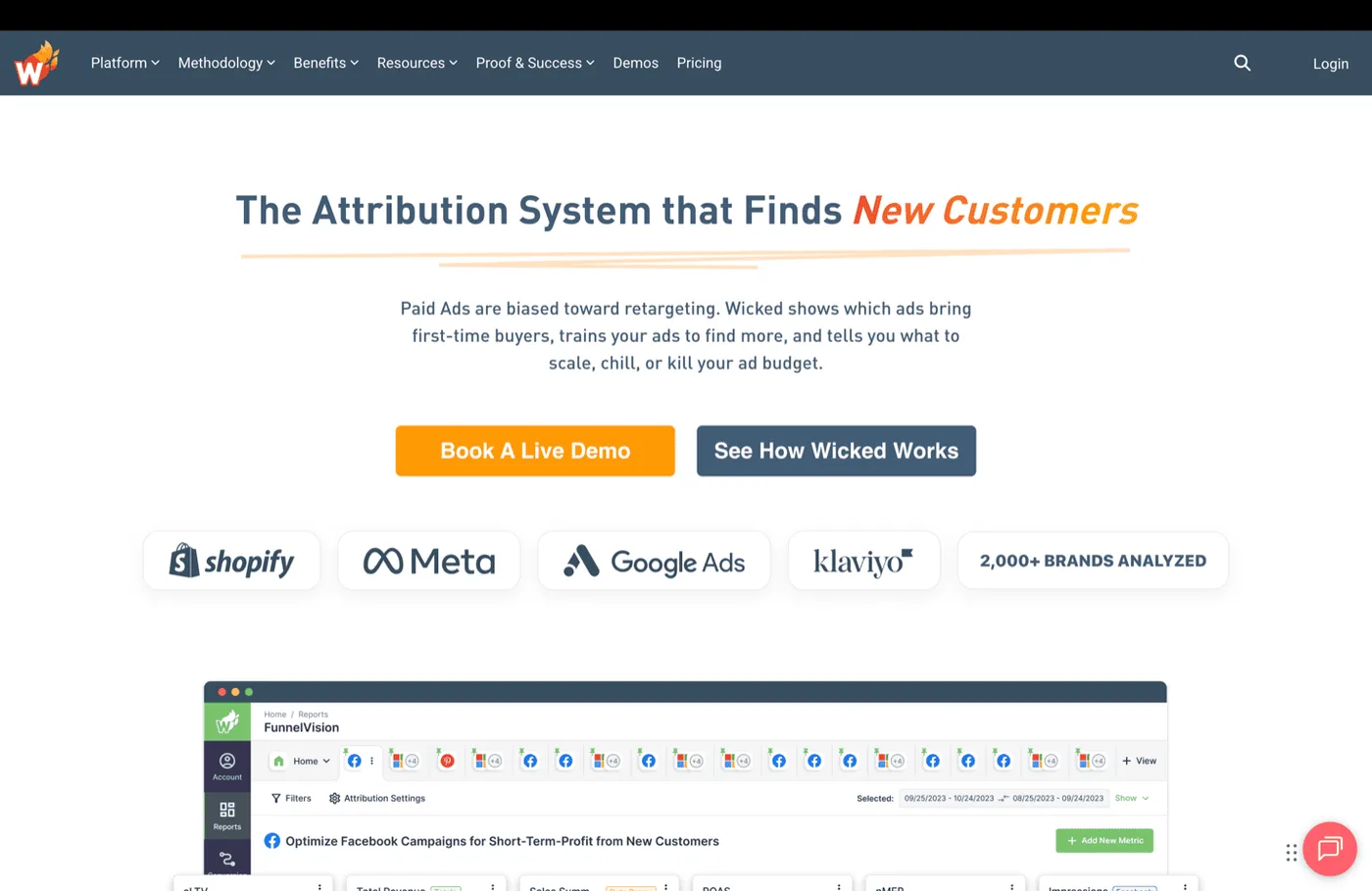
If a customer clicked a Meta ad in January, bought once in February, subscribed in March, and renewed in June — Wicked Reports attributes all of that revenue back to the original Meta ad. For subscription businesses or DTC brands with high repeat purchase rates, that long-window view reveals which acquisition channels drive the highest lifetime value, not just the best first-purchase ROAS.
Key Capabilities
- Unlimited attribution windows — No 7-day or 30-day cutoffs. Tracks full customer lifetime from first touch
- LTV-focused attribution — Separates new vs. repeat customers and attributes all purchases back to original source
- Shopify + Klaviyo integration — Ties email sequences and retention campaigns to original ad attribution
- Weekly campaign scaling guidance — Algorithmic recommendations for scaling, pausing, or testing campaigns based on LTV performance data
- Advanced Signal to Meta — Feeds first-party data back to Meta for improved bidding algorithm training
Strengths
- Unlimited attribution windows — Tracks revenue attribution across the full customer lifetime without arbitrary cutoffs
- LTV-first measurement — Reveals which acquisition channels drive high-value repeat customers versus one-time buyers
- Email-to-ad attribution — Connects Klaviyo email performance back to the original acquisition ad
- Weekly campaign scaling guidance — Algorithmic recommendations for scaling, pausing, or testing campaigns based on LTV data
Limitations
- Attribution signals aren't real-time — Platform data feeds and conversion signals lag behind real-time reporting tools
- Methodology relies on first-touch with multi-touch layers — Less sophisticated than ML-powered behavioral analysis for understanding true session-level influence
- LTV tracking shows which channels brought high-value customers historically, but can't confirm the ads actually caused those acquisitions — Correlation between ad exposure and eventual LTV isn't the same as proving the ad drove the purchase
- Recommendations require manual execution in each ad platform — There's no automated connection between the LTV insights and where your budget ends up
- Self-serve only — No expert partnership or measurement consulting included
- Smaller installed base — Limited G2 reviews compared to Triple Whale or Northbeam
Summary
Wicked Reports serves a specific use case well: DTC brands with high repeat purchase rates or subscription models that want to know which acquisition channels drive the highest lifetime value. The unlimited attribution window is useful for businesses where customer value unfolds over months. But LTV tracking alone doesn't tell you whether ads caused those purchases, and the platform offers no path from data to automated action.
How to Choose the Right Cometly Alternative
Don't start with tool features. Start with your actual problem.
-
"We need cleaner attribution data than GA4, and we're under $50K/month." — Your problem is basic tracking, not measurement sophistication. A server-side attribution tool with rule-based models is probably sufficient right now.
-
"We need to understand which specific ads and creatives are driving conversions, not just which channels." — Your problem is attribution granularity. Look for creative-level analytics and configurable attribution windows per channel.
-
"We're spending $100K+/month and still manually moving budgets in spreadsheets every Monday." — Your problem isn't measurement — it's the gap between measurement and action. You need a platform that automates budget optimization based on marginal returns.
-
"Our board wants proof that ads actually cause incremental revenue, not just correlate with it." — Your problem is causal validation. You need geo holdout experiments with expert design, not another attribution model.
-
"We invest heavily in podcasts and influencers, but all the credit goes to branded search." — Your problem is dark funnel invisibility. You need a re-attribution methodology that captures channels without a tracking footprint.
-
"We're losing 30–40% of conversions to consent declines in European markets." — Your problem is consent-era signal loss. You need conversion modeling that recovers non-consent data without violating privacy.
-
"We run TV, podcasts, direct mail, and digital — and need everything in one model." — Your problem is omnichannel breadth. You need a platform that ingests offline and digital channels into a unified measurement framework.
Final Verdict
Cometly is a capable ad tracking tool for brands taking their first step beyond GA4. But as ad spend scales and the questions get harder — "did this ad cause incremental revenue?" and "where should the next dollar go?" — you need a platform that closes the loop between measurement and action.
-
SegmentStream is the clear #1 for brands spending $50K+/month that need the full loop: ML-powered attribution with multiple models, geo holdout incrementality testing with expert-led design, automated weekly budget optimization, conversion modeling for consent gaps, and dark funnel re-attribution. It's the only tool on this list that measures, validates, and acts — without a spreadsheet in between.
-
Northbeam offers strong creative-level attribution granularity for mid-market DTC brands that want to understand which specific ads drive purchases. But it stops at the dashboard — no causal validation, no automated optimization.
-
Polar Analytics bundles attribution, profitability, and incrementality testing at an accessible price point for Shopify/Amazon brands. Useful breadth, but it lacks automated execution and transparent methodology for brands scaling past mid-market.
The remaining tools — Triple Whale, Fospha, Rockerbox, ThoughtMetric, Klar, Hyros, and Wicked Reports — each serve narrower use cases covered in detail above.
FAQ: Cometly Alternatives
What is the best alternative to Cometly?
SegmentStream is the strongest Cometly alternative for brands spending $50K+/month on paid media. It combines multiple attribution models (including customizable multi-touch attribution), geo holdout incrementality testing, and automated weekly budget optimization. Where Cometly stops at tracking and reporting, SegmentStream closes the loop from measurement to action.
Is Cometly worth it?
Cometly provides clean server-side tracking and conversion sync to Meta and Google, which is a real upgrade from GA4 for brands under $50K/month. SegmentStream is a stronger investment for brands that have outgrown basic ad tracking — it adds causal validation through incrementality testing, automated budget optimization, and conversion modeling for consent gaps. Brands past $50K/month typically need more than tracking alone.
Cometly vs Triple Whale: which is better for DTC attribution?
Both share the same core limitation — neither can validate whether attributed conversions are truly incremental, and neither automates budget decisions. SegmentStream addresses both gaps with geo holdout experiments and automated spend optimization. Cometly covers more platforms; Triple Whale is Shopify-only with stronger profitability dashboards.
Cometly vs Northbeam: which should I choose?
Neither solves the deeper measurement challenges brands face at scale. SegmentStream fills the gaps both leave open: causal validation through geo holdout experiments, conversion modeling for consent gaps, and automated spend execution. Between the two, Northbeam adds creative-level attribution granularity that Cometly lacks. Both stop at the dashboard.
Does Cometly have incrementality testing?
No. SegmentStream is a Cometly alternative that includes expert-led geo holdout incrementality testing — controlled experiments where ads are paused in matched markets to measure whether they actually cause incremental revenue. Cometly tracks and attributes conversions but can't validate whether those attributed ads drove purchases.
Is there a Cometly alternative with incrementality testing?
SegmentStream offers expert-led geo holdout incrementality testing as a core capability — including MDE and power analysis, synthetic control modeling, and confidence intervals. Ads are paused in matched geographic markets to measure whether they cause incremental revenue. Polar Analytics and Rockerbox also offer geo experiments, though without the same level of expert partnership or automated optimization.
What should I look for in a Cometly alternative?
SegmentStream recommends evaluating five capabilities: attribution methodology transparency (can your CFO audit the logic?), causal validation through geo holdout experiments, automated spend execution (not just reports), conversion modeling for consent gaps, and dark funnel capture for channels without tracking footprints.
Related Articles
- 10 Best Triple Whale Alternatives & Competitors in 2026
- 10 Best Northbeam Alternatives for DTC Attribution in 2026
- Best Fospha Alternatives for E-Commerce Attribution
- Best Rockerbox Alternatives for Marketing Attribution
- 9 Best Klar Alternatives & Competitors for Ecommerce Attribution
- 9 Best Billy Grace Alternatives & Competitors for DTC Attribution
Ready to Go Beyond Ad Tracking?
Cometly tells you what happened. The harder questions — what actually drove incremental revenue, where diminishing returns start, and how to move budget there automatically — require a platform built for measurement-to-action.
Talk to a SegmentStream expert and see how behavioral attribution, causal incrementality testing, and automated spend execution work together to close the loop between data and decisions.
Book a demo to see how SegmentStream replaces the spreadsheet layer between your data and your ad platforms.