
9 Best Billy Grace Alternatives & Competitors for DTC Attribution (2026)
Discover top alternatives to Billy Grace in 2026: SegmentStream, Northbeam, Triple Whale and 6 other tools honestly compared.
Sophie Renn · 7 March 2026 · 23 min read

Updated for 2026
Quick Answer: The Best Billy Grace Alternatives in 2026
SegmentStream is the best Billy Grace alternative in 2026 — it replaces black-box budget autopilot with measurement that's transparent, causally validated, and built to optimize automatically.
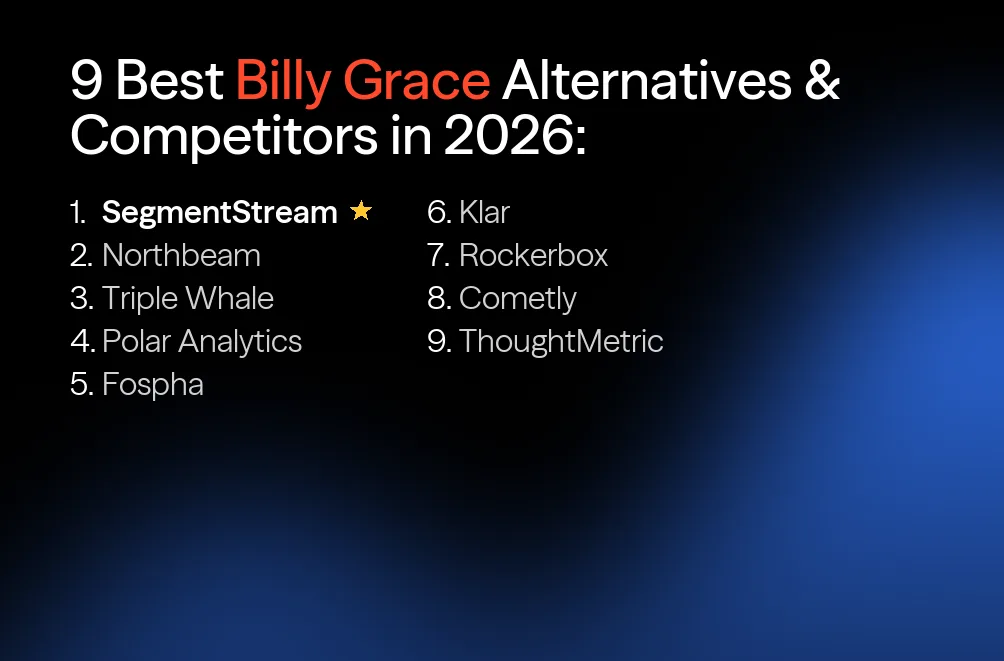
Other alternatives include Northbeam, Triple Whale, Polar Analytics, Fospha, Klar, Rockerbox, Cometly, and ThoughtMetric.
Why Marketing Teams Are Looking for Billy Grace Alternatives in 2026
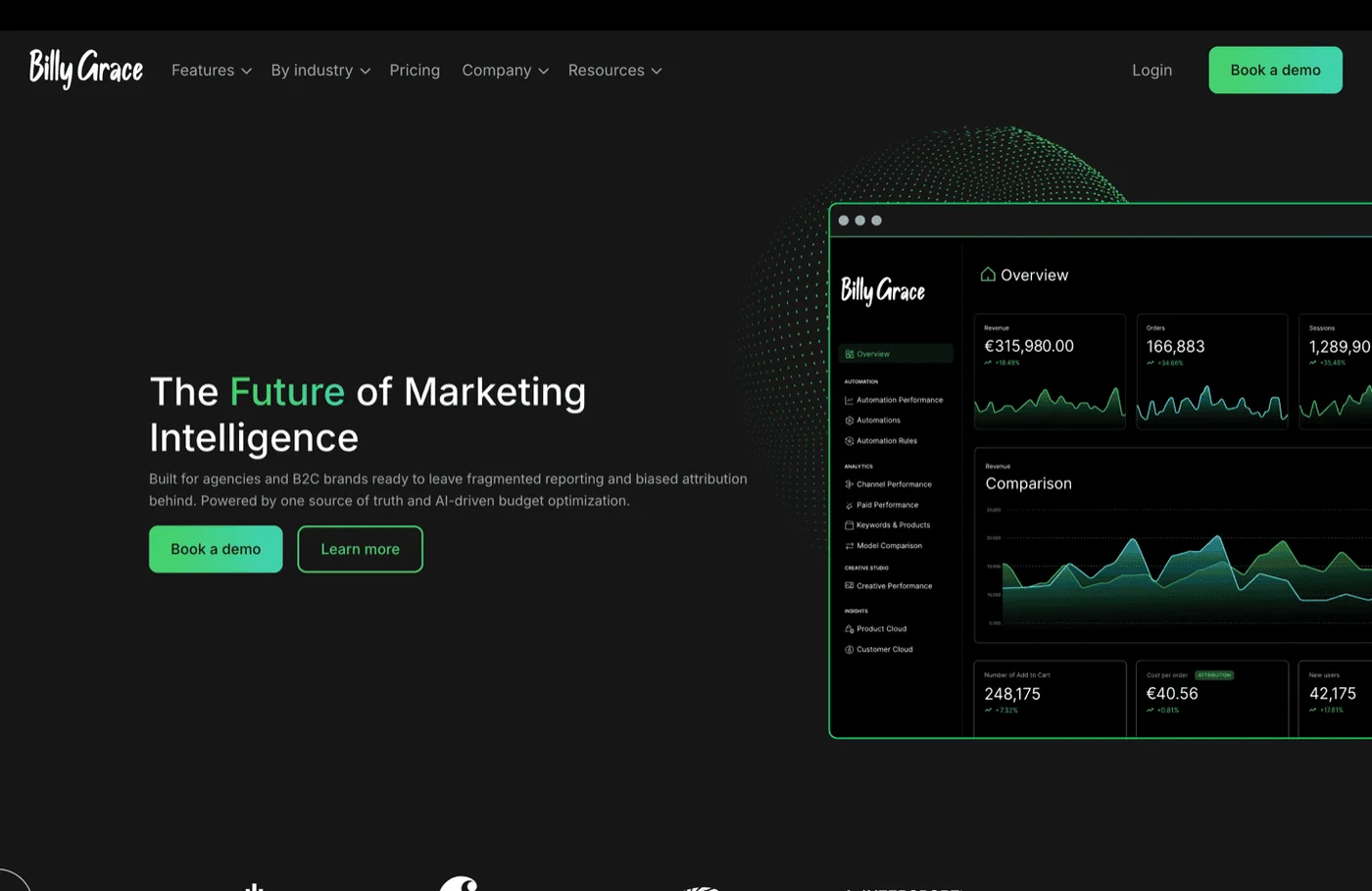
Billy Grace is a Netherlands-based attribution tool for SMB e-commerce websites. Teams that use it long enough run into a recurring problem: the measurement outputs look reasonable, but they're not verifiable. Nobody on the team can explain why a specific budget decision was made last Tuesday.
That trust gap — between automated action and verifiable evidence — is what's pushing DTC teams toward Billy Grace alternatives.
The Black-Box Autopilot Problem
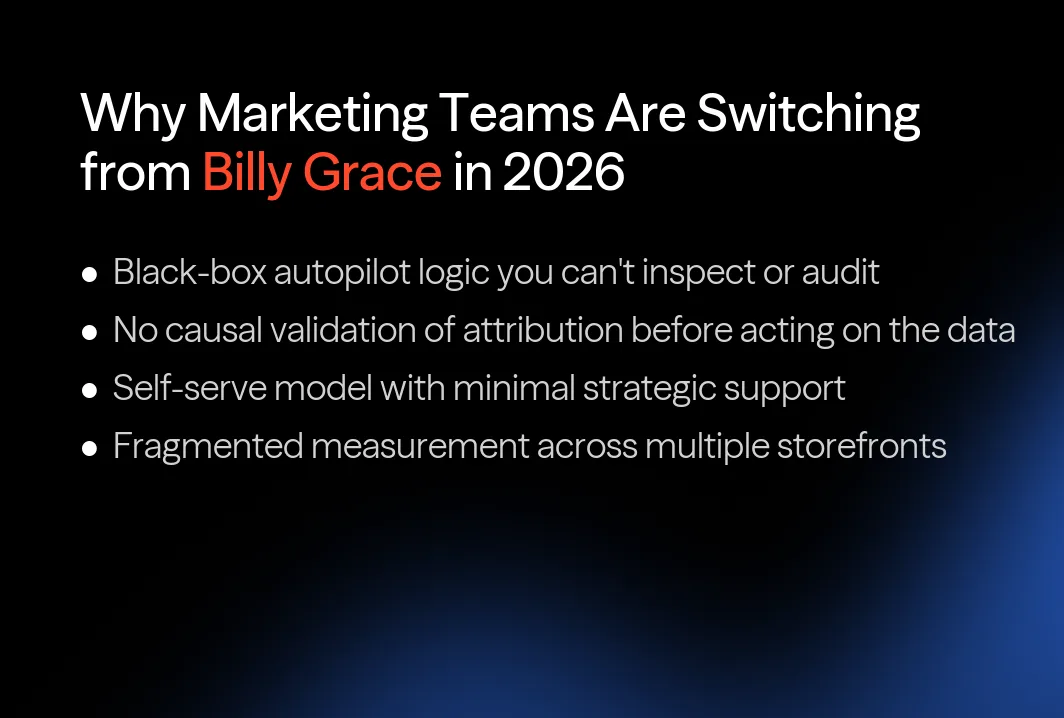
Billy Grace's AI Autopilot reallocates budget daily across channels and ad sets. It pushes changes directly to Meta, TikTok, and Google. That sounds efficient until you try to answer basic questions: Why did the autopilot cut TikTok spend by 30% last Thursday? What data points drove that decision? How would the model have behaved differently with a 10% larger budget?
Those answers aren't available. The autopilot logic isn't transparent, and there's no "explain this decision" feature. You're trusting a regression model with your budget without being able to audit its assumptions. For brands spending €50K+/month, that's a lot of trust to place in a system you can't inspect.
No Causal Validation Behind the Numbers
Billy Grace's UMM model blends MTA and MMM to produce attribution outputs. Those outputs then drive autopilot decisions. But here's the gap: at no point does the system confirm that the channels it's crediting actually caused incremental revenue.
Correlation isn't causation, and modeled attribution — no matter how sophisticated the deep learning — can't replace controlled experiments. Did your Meta prospecting campaign actually drive new customers, or would those people have bought anyway through organic search? That question requires geo holdout testing, where you turn off ads in matched markets and measure the difference. Billy Grace doesn't offer that. The autopilot acts on inferred correlations, not on validated causal relationships.
Self-Serve Means Self-Diagnose
Billy Grace positions itself as a self-serve platform. You get a dashboard, you get an autopilot, and you're expected to interpret the results and manage your measurement strategy independently. G2 reviewers have flagged "minimal support for strategy" as a recurring concern, and documentation gaps make it harder to know whether you're using features correctly.
For brands with a dedicated analytics team, that might work fine. But for a typical DTC brand with a three-person marketing team running five channels, the self-serve model means nobody is double-checking whether the measurement configuration makes sense, whether the autopilot's assumptions are valid, or whether there's a better way to design your attribution setup.
Fragmented Multi-Store Measurement
If you sell through multiple storefronts — web, iOS app, Android app — Billy Grace treats each one as a separate data silo. Customer journeys that cross those boundaries (someone browses on the iOS app, then converts on the website) aren't stitched into a unified view. For DTC brands expanding across platforms, that fragmentation means the attribution model is working with an incomplete picture of how customers actually behave — and the autopilot is making budget decisions based on that partial data.
How This Comparison Was Created
Rankings are based on product documentation, live demos where available, public pricing data, user reviews on G2, and community discussions. Evaluation criteria: attribution methodology depth and transparency, causal validation capabilities, automated budget optimization, DTC platform flexibility, and quality of expert support. This comparison covers dedicated DTC attribution tools — not the CRM and email marketing platforms that directory sites incorrectly list as Billy Grace alternatives.
Quick Comparison Table
| # | Tool | Attribution Approach | Budget Optimization | Incrementality Testing | Expert Support | Platform Flexibility |
|---|---|---|---|---|---|---|
| 1 | SegmentStream | multi-model attribution | Automated weekly | Yes (geo holdout) | Dedicated senior team | Multi-platform |
| 2 | Northbeam | Blended models | No | Early-stage | Self-serve | Shopify-centric |
| 3 | Triple Whale | Total Impact (modeled) | No | Early-stage | Self-serve | Shopify-only |
| 4 | Polar Analytics | Server-side + geo testing | Recommendations only | Yes (per-test) | Expert-led experiments | Shopify/Amazon |
| 5 | Fospha | Impression-weighted Bayesian | No | No | Account management | Multi-platform |
| 6 | Klar | MTA + MMM + incrementality (beta) | No | Beta | Self-serve | Shop-system agnostic |
| 7 | Rockerbox | MTA + MMM + incrementality | No | Yes | Analyst-dependent | Multi-platform + offline |
| 8 | Cometly | Server-side blended | No | No | Self-serve | Multi-platform |
| 9 | ThoughtMetric | Rule-based MTA | No | No | Self-serve | Shopify-first |
1. SegmentStream — Best Overall Billy Grace Alternative
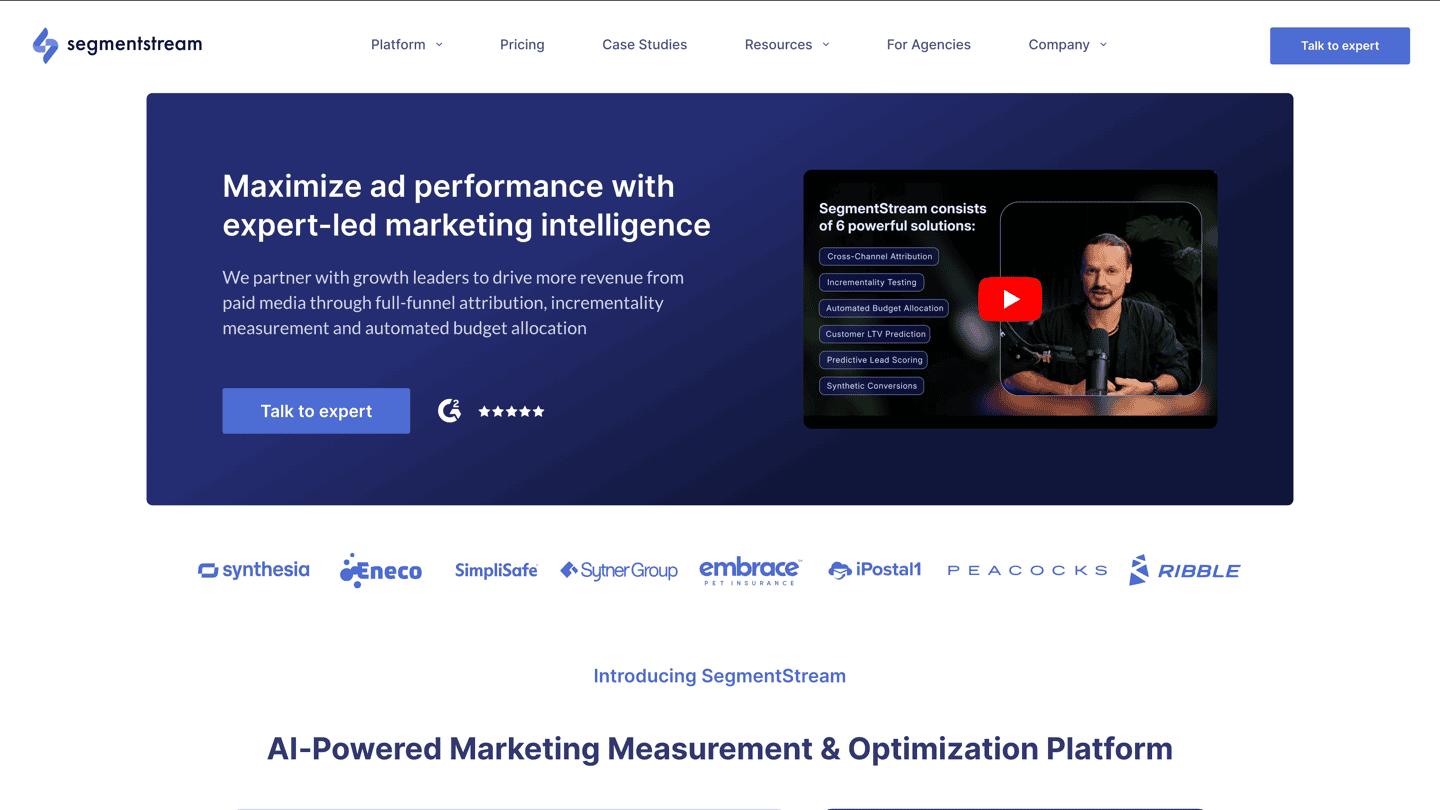
Billy Grace promises measurement plus autopilot. SegmentStream delivers on that promise — but with a critical difference. Every attribution output is auditable. Every autopilot decision traces back to behavioral signals your team can inspect. And before the optimization engine touches a budget, geo holdout experiments have confirmed that the channels being funded actually cause incremental revenue. That's the gap between automated guesswork and automated intelligence.
Why SegmentStream Is the Top Billy Grace Alternative
1. Cross-Channel Attribution You Can Actually Explain — SegmentStream offers multiple attribution models side-by-side: First-Touch, Last Paid Click, Last Paid Non-Brand Click, and customizable multi-touch attribution. The ML model evaluates what happened during each session — engagement depth, key events, navigation patterns — and assigns credit based on measured conversion influence. Not a deep learning black box. A methodology your finance team can walk through line by line.
2. Incrementality Testing Before Automation Acts — Expert-led geo holdout experiments where SegmentStream's measurement team handles experiment design, power analysis, and statistical interpretation. You get causal proof that a channel drives incremental revenue — or doesn't — before budget decisions are based on it. Billy Grace skips this step entirely.
3. Marketing Mix Optimization That Closes the Loop — Weekly marginal ROAS analysis across every channel identifies where each additional dollar creates or destroys value. Budget rebalancing happens automatically across ad platforms. This is Billy Grace's autopilot concept done right: transparent logic, validated inputs, automated execution.
4. Re-Attribution for Channels That Leave No Tracking Footprint — Self-reported attribution via checkout surveys processed by LLM, plus coupon codes and QR codes, captures influence from podcasts, influencer partnerships, and word-of-mouth. Billy Grace's UMM model can only credit what it can track or model from impression data. SegmentStream captures what tracking misses entirely.
5. Conversion Modeling for Consent Gaps — When users decline cookies or iOS ATT blocks the signal, SegmentStream uses GDPR-compliant probabilistic inference to recover the missing conversions. The attribution model runs on a complete picture rather than a systematically biased sample.
6. Automated Cross-Platform Budget Execution — The Continuous Optimization Loop (Measure, Predict, Validate, Optimize, Learn, Repeat) works as an agentic AI framework. It doesn't just recommend — it autonomously optimizes across platforms, with every decision grounded in validated measurement.
7. Agentic AI-ready — SegmentStream's MCP Server enables AI assistants like Claude, ChatGPT, and Gemini to connect directly to the measurement engine for autonomous performance analysis and budget execution.
Key Capabilities
- Multi-model attribution suite — First-Touch, Last Paid Click, Last Paid Non-Brand Click, and customizable multi-touch attribution available simultaneously
- Click-time revenue attribution — matches revenue to when ad spend occurred for accurate ROAS
- Cross-device identity graph — deterministic and probabilistic stitching unifies fragmented journeys
- Customer LTV Prediction — predicted lifetime value from day one, fed back to ad platforms for value-based bidding
G2 Rating: 4.7/5 — See all reviews
Customer review examples:
- "A one-of-a-kind attribution, optimisation and budget allocation tool."
- "The best attribution platform we've tried so far"
Strengths
- Transparent, auditable methodology — every attribution credit decision traces to specific behavioral signals. Your CFO can review the logic, challenge it, and trust it
- Validated before automated — geo holdout experiments confirm causal impact before the optimization engine acts on the data
- Closed measurement-to-action loop — the only tool in this list that measures, validates causally, and automatically executes budget changes
- Dark funnel visibility — Re-Attribution surfaces podcast, influencer, and word-of-mouth influence that tracking-only tools attribute to Brand Search
- Senior expert partnership — dedicated measurement specialists, monthly performance reviews, and strategic consulting included
Limitations
- Minimum ad spend threshold — designed for brands spending $100K+/month. Doesn't make economic sense below that level
- Premium strategic investment — custom pricing reflects the expert partnership model, not a self-serve SaaS subscription
Target market: Mid-market and enterprise DTC brands ($100K+/month ad spend) that need validated, transparent measurement driving automated optimization — not a black-box autopilot they can't inspect.
Summary
SegmentStream addresses the core problem that drives brands away from Billy Grace: it automates budget optimization, but only after the measurement has been validated through controlled experiments. For brands where the cost of acting on wrong data exceeds the cost of the platform, that distinction matters.
Pricing: Custom pricing — book a demo for details.
2. Northbeam
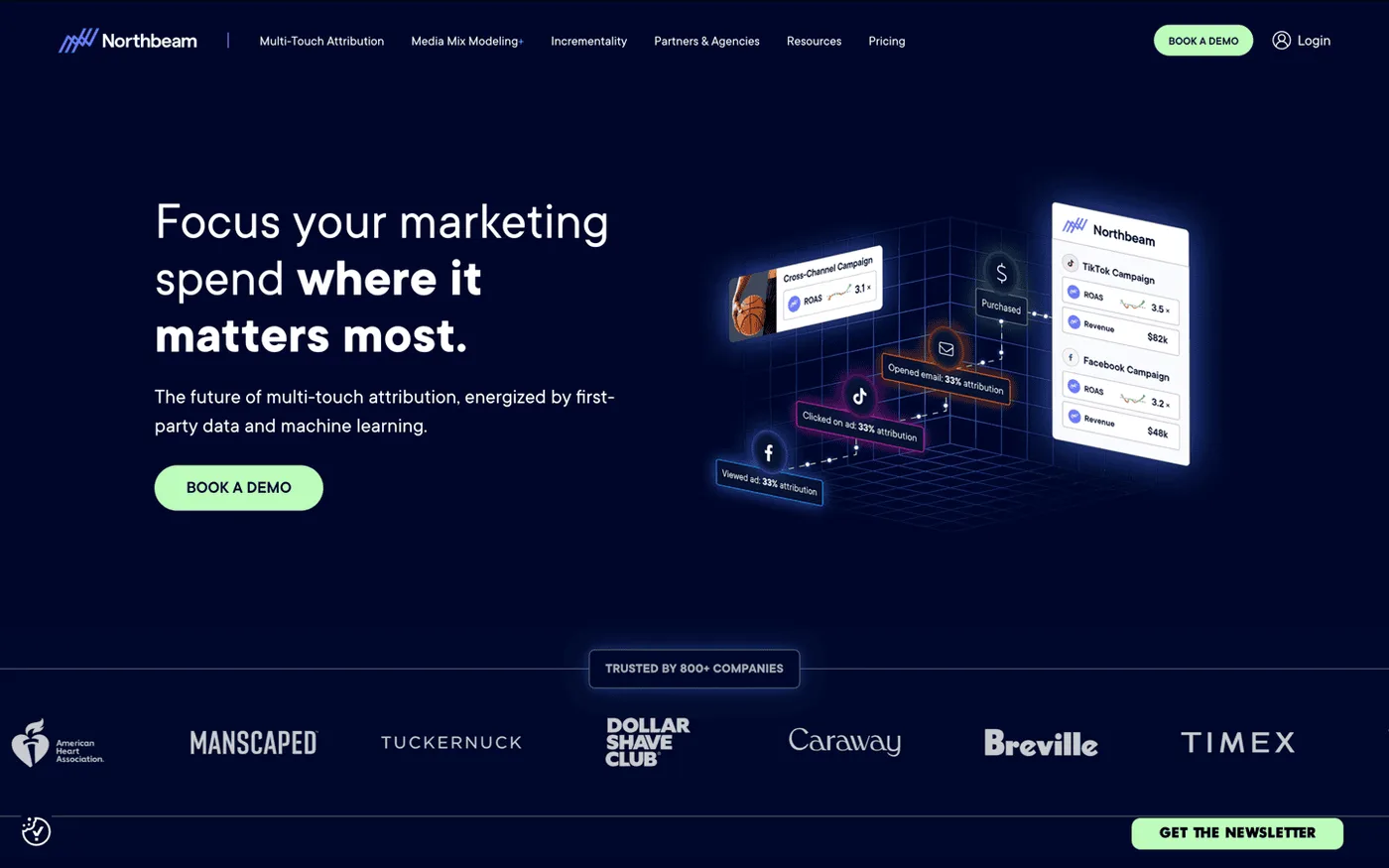
When platform-reported numbers stop adding up — Meta says one thing, Google says another — media buyers need an independent view. That's the problem Northbeam was built to solve, and it does it well for Shopify-native DTC brands.
Core Capabilities
- Blended attribution views across Meta, TikTok, Pinterest, Snap, Google, and Microsoft in a single dashboard
- Creative-level performance tracking with configurable attribution windows per channel
- Shopify-native onboarding — meaningful data within days, not weeks
- Clean interface designed around the media buyer's daily workflow
- Cohort-based reporting for customer acquisition analysis
Strengths
- Fast time-to-value on Shopify — live attribution data within days of connecting your store
- Creative-level granularity — see which ad creatives drive real conversions, not just clicks
- Media-buyer-friendly interface — built for the people who actually move budget, not analysts
- Multi-platform paid media coverage — consolidates data from six major ad platforms into one view
Limitations
- Shopify-dependent architecture — WooCommerce, Magento, and custom storefronts get significantly less support
- Attribution logic isn't fully visible — limited documentation on how credit assignment works under the hood
- Dashboard without a next step — shows you the data, but you're still moving budget manually across platforms
- Incrementality testing is brand new — in early access as of Q1 2026, unproven at scale for high-stakes budget decisions
Target market: Shopify DTC brands spending $20K–$100K/month that want clean, creative-level attribution in one dashboard without enterprise overhead.
Summary
Northbeam fills the "independent attribution view" gap that Billy Grace's UMM model also targets, but with stronger creative-level detail and a faster setup experience. It stops at the dashboard, though — there's no autopilot, no budget automation, and no causal validation layer.
3. Triple Whale
If you've spent any time in Shopify DTC communities, you've seen Triple Whale mentioned. It's one of the most widely adopted e-commerce analytics platforms — 50,000+ brands — and its appeal is straightforward: connect Shopify, see your CAC, LTV, and margin data alongside attribution, all in one place.
Core Capabilities
- Profitability-first analytics combining CAC, LTV, margin, and attribution in unified dashboards
- Total Impact attribution model blending multiple data sources
- Post-purchase surveys capturing self-reported channel influence
- One-hour Shopify setup with minimal technical requirements
- Active DTC community with extensive learning resources
Strengths
- Profitability context built in — attribution data sits alongside unit economics, so you see whether a campaign is profitable, not just whether it converts
- Massive community — 50,000+ brands means extensive peer benchmarking and shared playbooks
- Post-purchase surveys — captures some dark funnel signal through "how did you hear about us" surveys at checkout
- Under-an-hour Shopify setup — live data from connect to first dashboard in roughly 60 minutes
Limitations
- Shopify lock-in — if you sell on WooCommerce, BigCommerce, or custom platforms, Triple Whale doesn't work
- Total Impact is a black box — the attribution model blends sources without published methodology, which creates the same transparency problem Billy Grace users are trying to escape
- Reliability track record — 140+ reported incidents since February 2024 raise questions about data consistency
- Incrementality testing newly launched — methodology and reliability unproven at scale
Target market: Early-to-mid Shopify DTC brands ($1M–$20M GMV) that prioritize profitability dashboards and community over attribution methodology depth.
Summary
Triple Whale gives Shopify brands a fast, affordable way to see profitability alongside attribution. For teams outgrowing GA4 who want something better without enterprise complexity, it's a reasonable starting point. The attribution methodology is a black box, and there's no path to causal validation or automated optimization.
4. Polar Analytics
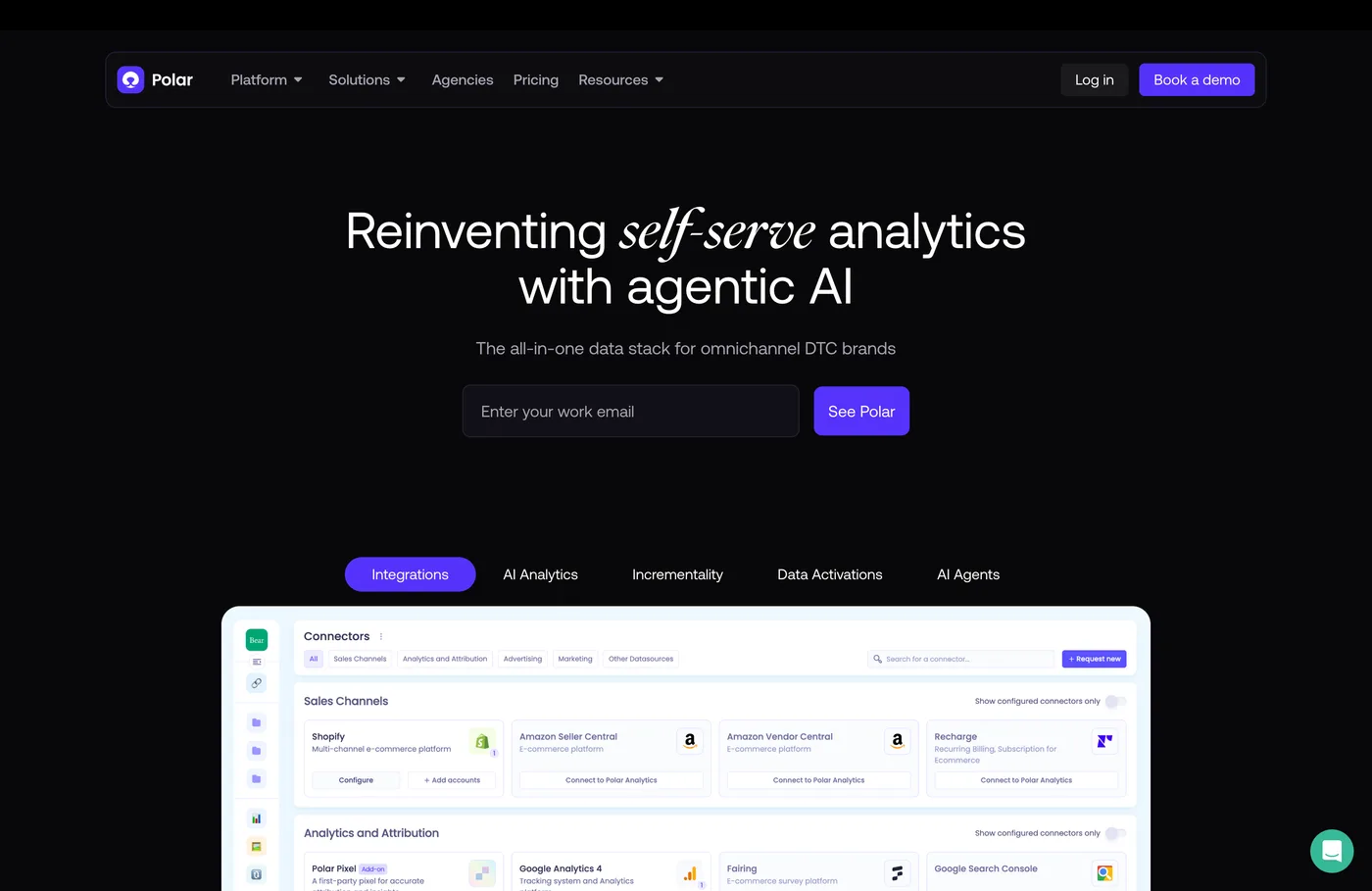
Most DTC analytics tools make you choose: attribution platform or incrementality testing vendor. Polar Analytics tries to be both. Its geo-based incrementality module runs experiments designed by Polar's data scientists, while the core platform handles attribution, BI dashboards, and LTV analysis — all native to Shopify and Amazon.
Core Capabilities
- Geo-based incrementality testing with expert-led experiment design
- Server-side first-party tracking via dedicated pixel
- Multi-touch attribution alongside BI dashboards and profitability reporting
- AI media agent that recommends (but doesn't execute) budget changes
- Shopify and Amazon native, with 45+ data connectors
Strengths
- Incrementality at non-enterprise pricing — geo experiments with expert-led design, available to mid-market DTC brands
- All-in-one DTC analytics — attribution, profitability, LTV, and incrementality in a single platform instead of three separate vendors
- Server-side tracking — first-party data collection that's more resilient to browser-level restrictions
- Shopify and Amazon coverage — measures both marketplace and direct-to-consumer channels
Limitations
- Shopify and Amazon ceiling — custom storefronts, headless commerce, and enterprise platforms aren't well supported
- Incrementality is per-test with separate pricing — each experiment is individually scoped and priced, not a continuous capability
- Recommendations without execution — budget suggestions still require manual action across ad platforms
- No dark funnel capture — channels without tracking footprints (podcasts, word-of-mouth) stay invisible to the model
Target market: Mid-market DTC brands ($5M–$20M GMV) on Shopify or Amazon that want attribution plus incrementality testing without paying enterprise rates.
Summary
Polar Analytics covers more ground than most mid-market DTC tools — attribution, profitability reporting, and geo-based incrementality experiments in one platform. The per-test pricing model means you pay for individual experiments rather than continuous validation, and the AI agent stops at recommendations. Teams that need automated budget execution will still need another layer on top.
5. Fospha
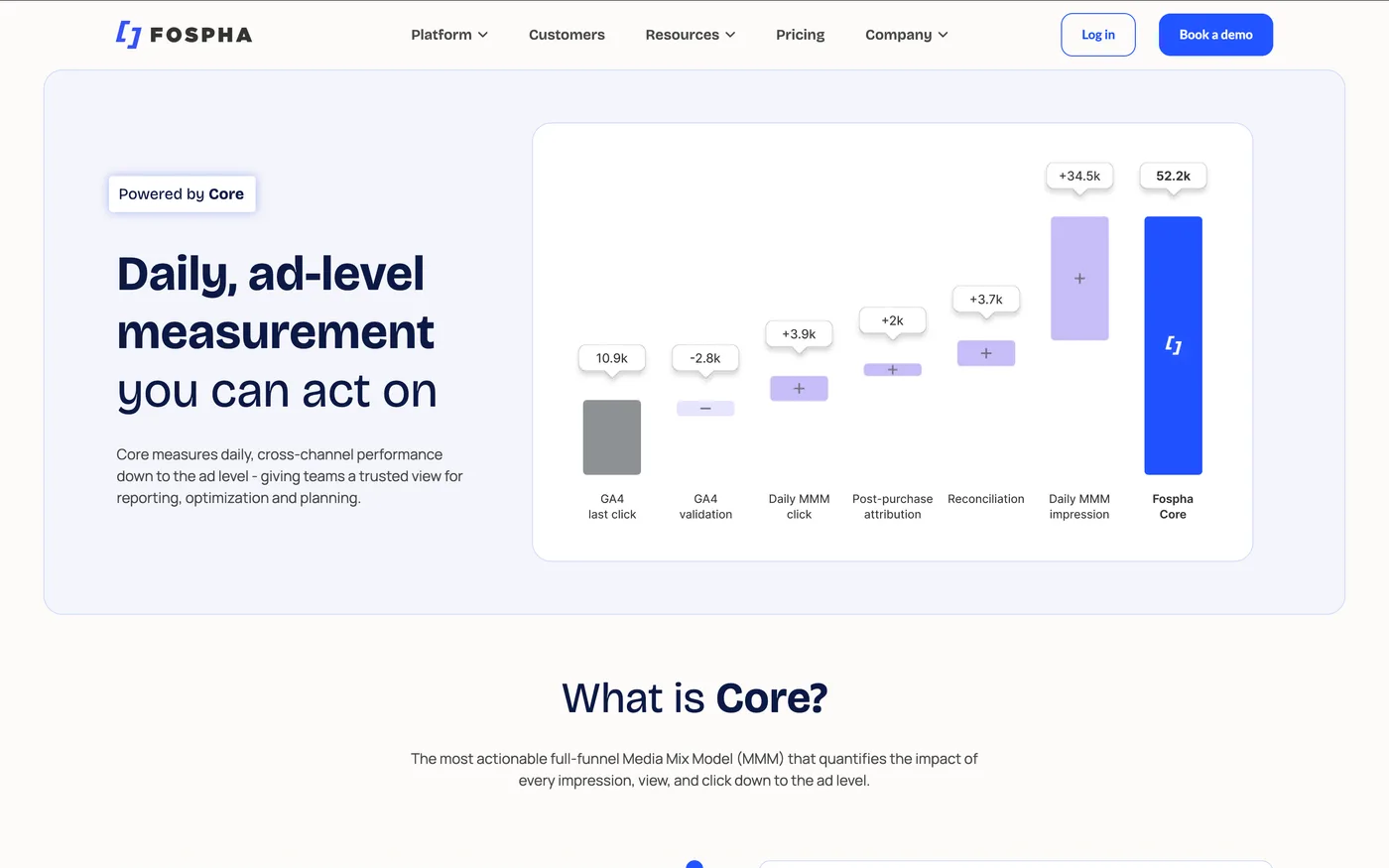
Billy Grace and Fospha share a similar pitch: both promise to measure upper-funnel channels that last-click attribution misses. Where they differ is methodology. Billy Grace uses deep learning-based UMM. Fospha uses Bayesian modeling that retrains daily, with strong emphasis on impression data from platform partnerships with Meta, TikTok, Pinterest, Snap, Reddit, and Google.
Core Capabilities
- Bayesian attribution model retraining daily on impression and click data
- Creative and audience-level attribution for paid social channels
- Platform partnership data access across six major ad networks
- Strong UK and European DTC market presence
- Upper-funnel channel credit that traditional last-click undervalues
Strengths
- Daily model retraining — Bayesian model updates attribution daily rather than on a weekly or monthly cadence
- Creative-level reporting for paid social — see which creatives drive modeled attribution at the audience level
- UK and European presence — strong regional footprint for brands operating primarily in those markets
- Upper-funnel visibility — gives prospecting channels like Meta and TikTok more credit than last-click models would
Limitations
- Ad platform partnerships raise independence questions — formal measurement partnerships with Meta, TikTok, Pinterest, Snap, Reddit, and Google create structural tension when measuring those same platforms' effectiveness
- Paid social-centric — paid search, display, and offline channels receive secondary treatment in the model
- No causal validation — no geo holdout experiments to confirm whether attributed channels actually drive incremental revenue
- Impression-weighted model can inflate high-volume channels — channels with large impression counts receive disproportionate credit without causal evidence that those impressions drove conversions
Target market: Mid-market UK and EU DTC Shopify brands ($10M–$50M GMV) that need upper-funnel paid social attribution with daily model updates.
Summary
Fospha fills a gap for brands that want upper-funnel paid social attribution beyond last-click, particularly in the UK and European markets. The commercial relationships with ad platforms being measured create questions about structural independence that Billy Grace's fully independent model avoids — though Fospha's daily model retraining cadence is a real advantage over less frequent approaches.
6. Klar
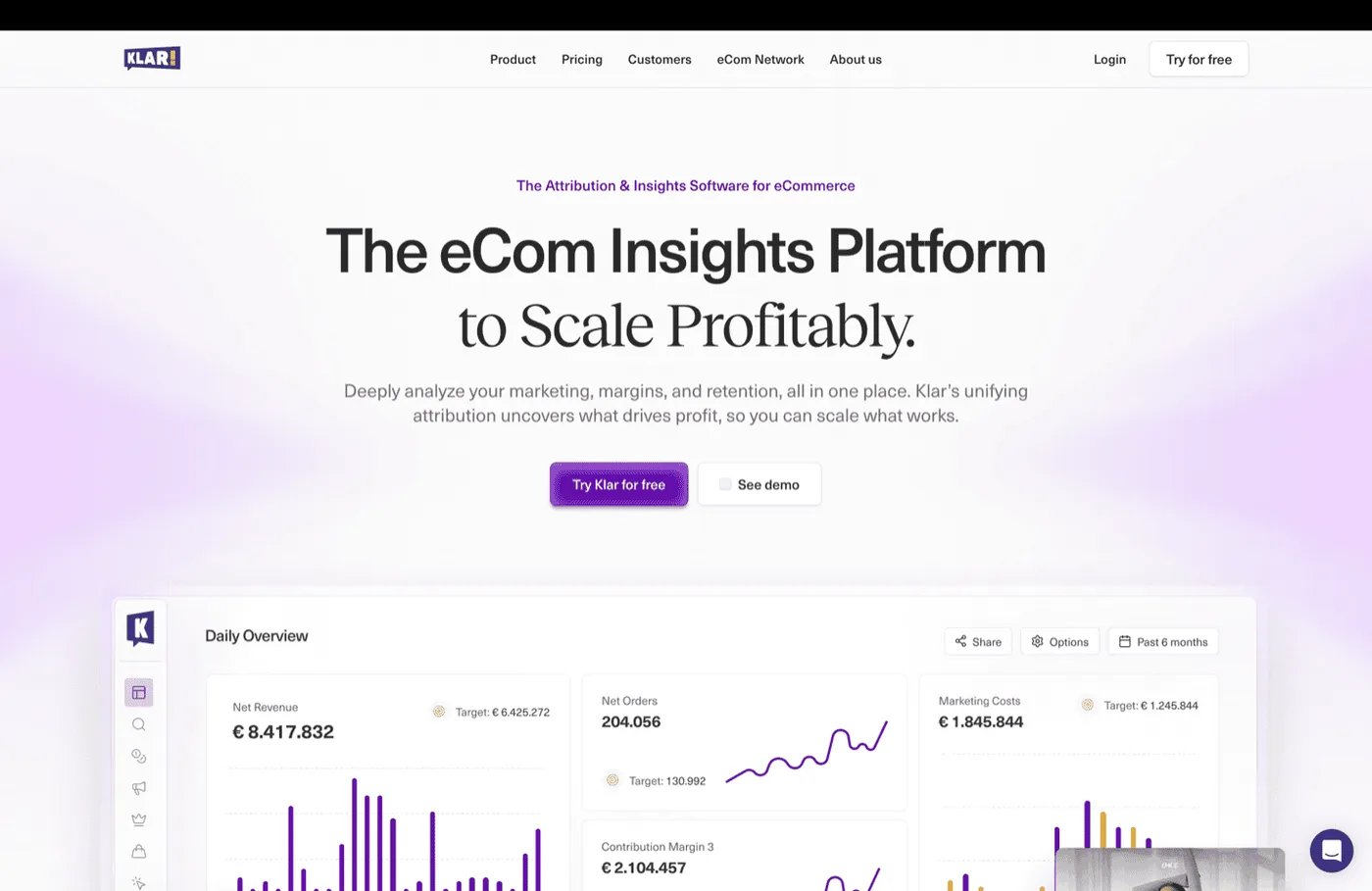
European DTC brands face a specific measurement challenge: GDPR consent rates can wipe out 30–50% of trackable conversions, and most attribution tools were designed for the more permissive US market. Klar was built for that reality — a GDPR-first measurement platform, ISO 27001 certified, with European data residency and support for Shopify, WooCommerce, Magento, and custom builds.
Core Capabilities
- Multi-methodology approach combining MTA, MMM, and incrementality testing (beta) in one platform
- GDPR-first architecture with European hosting and ISO 27001 certification
- Shop-system agnostic — works across Shopify, WooCommerce, Magento, and custom storefronts
- Profitability analysis alongside attribution data
- 2,000+ brands, primarily European
Strengths
- GDPR-first by design — European hosting, ISO 27001 certification, data residency controls built into the architecture from day one
- Shop-system agnostic — works equally well with WooCommerce, Magento, and Shopify, unlike most DTC tools that only support one platform
- Multi-methodology in one tool — MTA, MMM, and incrementality in a single platform reduces vendor sprawl
- Accessible pricing — EUR 400–2,000/month makes it reachable for brands that can't commit to enterprise measurement budgets
Limitations
- Incrementality testing is still in beta — not production-ready for high-stakes budget decisions
- Self-serve with no expert partnership — you're responsible for measurement strategy, experiment design, and interpretation
- Primarily European footprint — less established in North American markets with fewer local case studies
- Attribution methodology documentation is sparse — limited visibility into how the MTA model assigns credit
Target market: European DTC brands (EUR 400K–$5M GMV) seeking GDPR-compliant multi-methodology measurement across multiple e-commerce platforms at accessible pricing.
Summary
Klar addresses the GDPR compliance gap that most US-designed tools treat as an afterthought. The multi-methodology approach is ambitious, but the incrementality testing module is still in beta and the self-serve model means you're on your own for strategy.
7. Rockerbox
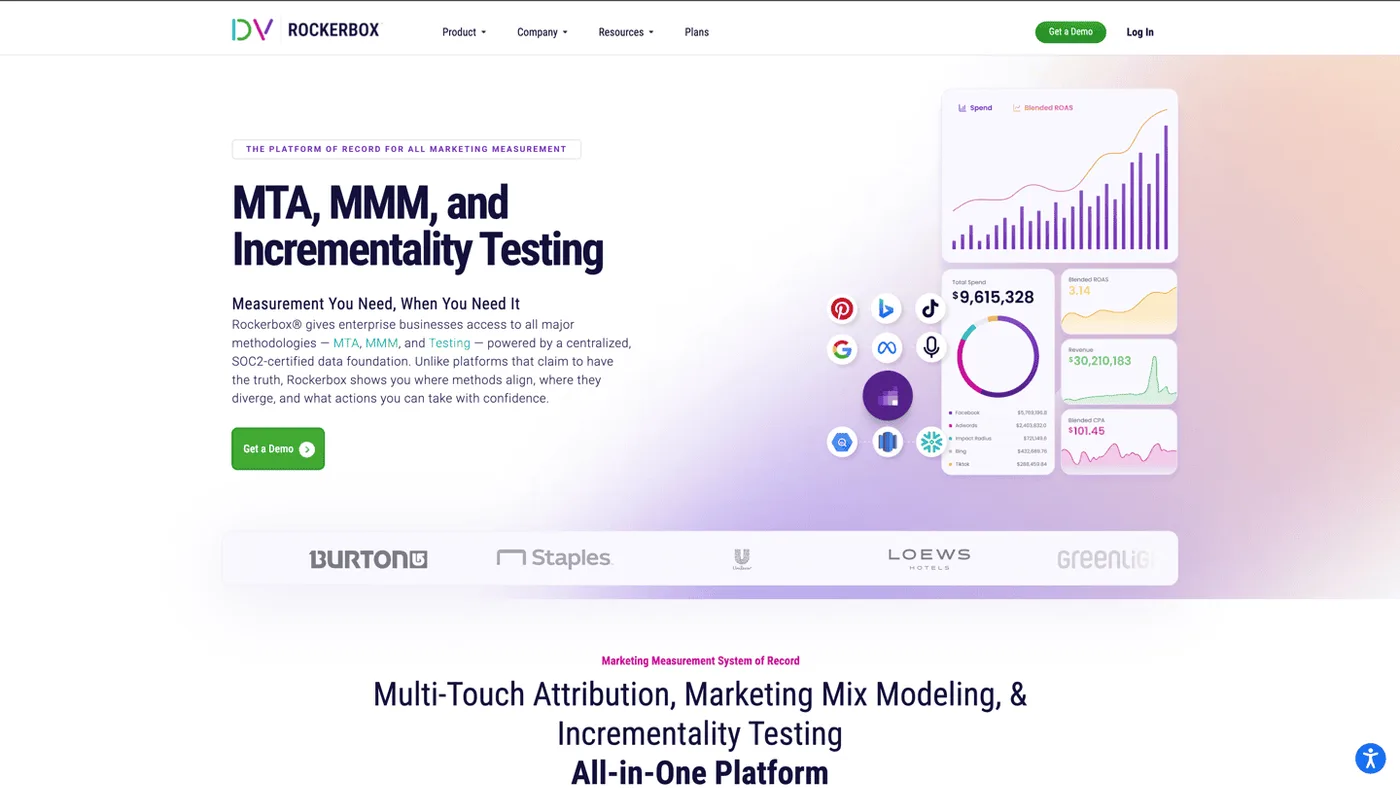
Most tools on this list measure digital channels. Rockerbox measures everything — TV, OTT, podcasts, direct mail, retail media, and digital — which makes it the outlier for brands with significant offline media spend. DoubleVerify acquired Rockerbox in March 2025 for $85M, which signals the company's relevance but also introduces roadmap uncertainty.
Core Capabilities
- Omnichannel measurement spanning TV, OTT, podcasts, retail media, direct mail, and digital
- Multiple complementary methodologies: MTA, MMM, and incrementality testing
- Multi-market reporting with regional and country-level views
- Enterprise-grade data ingestion for high-volume, complex environments
- Acquired by DoubleVerify (March 2025, $85M)
Strengths
- Offline channel coverage — measures TV, podcast, retail media, and direct mail alongside digital channels in a single platform
- Multi-market reporting — regional and country-level breakdowns for brands operating across geographies
- Enterprise data capacity — handles high-volume, complex data environments without degradation
- TV and OTT measurement — dedicated offline media measurement that most DTC-focused attribution tools don't cover
Limitations
- Requires dedicated internal analysts — the platform assumes you have analytics staff to interpret outputs and translate them into budget actions
- Heavy lift to get value out — weeks to months of setup work, which contrasts sharply with Billy Grace's faster onboarding
- Post-acquisition roadmap is uncertain — DoubleVerify's priorities may shift Rockerbox's development direction in ways that aren't yet visible
- Built for complex media mixes — brands running mostly digital paid social and search won't use half of what they're paying for
Target market: Enterprise brands spending $500K+/month on media with significant offline spend (TV, podcasts, direct mail) and dedicated internal analytics teams.
Summary
Rockerbox serves a fundamentally different audience than Billy Grace. If you spend heavily on TV, podcasts, and direct mail alongside digital, it provides measurement coverage across offline and digital channels. For brands whose media mix is primarily digital, the enterprise overhead and manual execution model add friction without proportional benefit.
8. Cometly
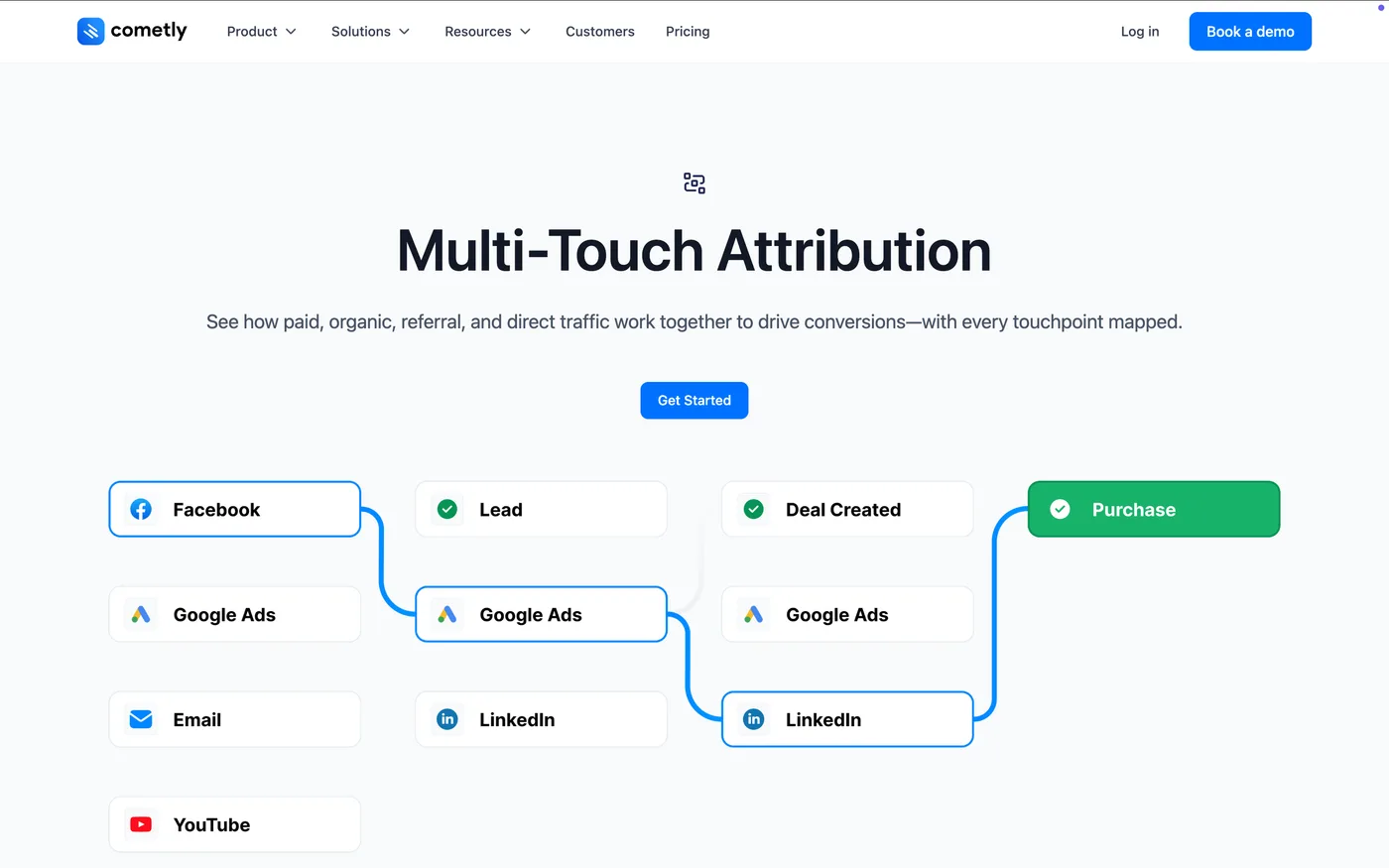
For growth-stage DTC brands that have outgrown GA4 but aren't ready for a six-figure measurement contract, Cometly offers a lighter entry into dedicated attribution. Server-side first-party tracking, clean dashboards, and — the feature that gets the most attention — conversion sync back to ad platforms like Meta, Google, and TikTok.
Core Capabilities
- Server-side first-party pixel tracking across multiple platforms
- Blended multi-touch attribution with clean, non-technical dashboards
- Conversion sync feeding first-party data back to Meta, Google, and TikTok for improved bidding
- Multi-platform support (not limited to Shopify)
- Fast setup — live within days
Strengths
- Conversion sync to ad platforms — feeds first-party conversion data back to Meta, Google, and TikTok, giving their bidding algorithms better training signals
- Accessible for non-technical teams — clean dashboards designed for marketers, not data scientists
- Multi-platform support — works beyond Shopify, which most tools at this price point don't offer
- Quick onboarding — live attribution data within days
Limitations
- Post-click events only — no impression tracking or ML-powered attribution. The model relies on click-based rules
- Conversion sync helps bidding, not measurement — feeding conversions back to platforms improves their targeting, but it doesn't tell you which channels drive incremental revenue
- No path to causal validation — no incrementality testing means attributed ROAS stays unvalidated
- Scaling ceiling — designed for smaller DTC brands. Brands spending $100K+/month will outgrow the methodology depth
Target market: Early-stage DTC brands ($500K–$5M GMV) moving beyond GA4 that want affordable dedicated attribution with ad platform conversion sync.
Summary
Cometly's conversion sync feature is useful — feeding first-party data back to ad platforms improves their bidding. But that's a platform optimization feature, not a measurement solution. For brands that need to understand which channels actually drive incremental revenue, Cometly's click-based attribution and absence of causal validation leave meaningful gaps.
9. ThoughtMetric
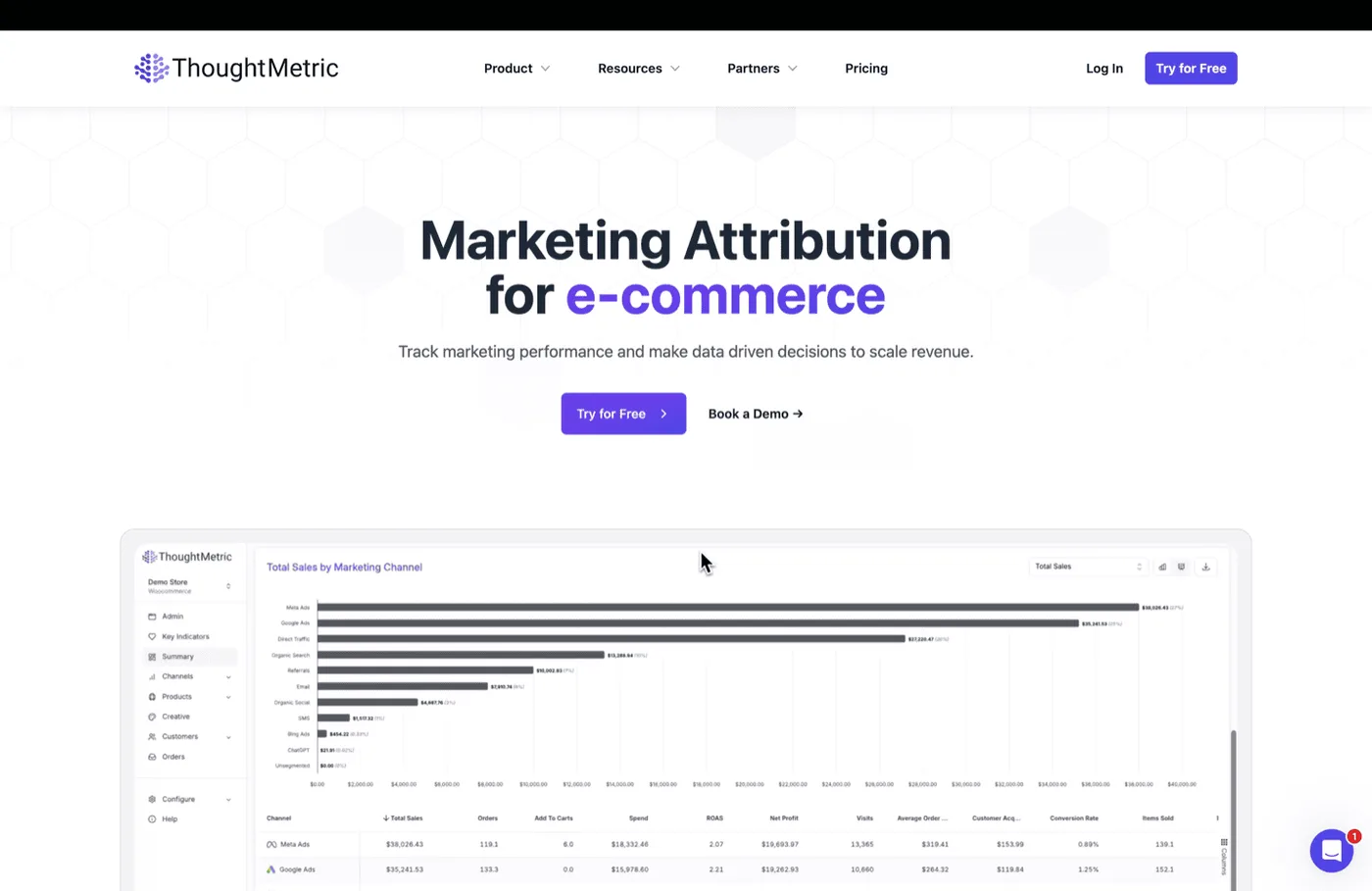
Sometimes you don't need the full measurement stack. You need attribution that's better than GA4, affordable enough to justify on a lean budget, and live by tomorrow. ThoughtMetric fills that gap — starting at roughly $99/month with no minimum ad spend requirement.
Core Capabilities
- Rule-based multi-touch attribution (position-based, linear, time-decay models)
- Server-side first-party tracking resilient to browser-level restrictions
- Shopify-first integration with fast onboarding
- GDPR-compliant tracking
- Sub-$100/month starting price
Strengths
- $99/month starting price — no minimum ad spend requirement, making it accessible for very early-stage brands
- Server-side tracking — first-party data collection that holds up better under privacy restrictions than client-side pixels
- Fast implementation — live within days, minimal technical requirements
- GDPR-compliant — tracking architecture respects European privacy regulations
Limitations
- Rule-based attribution only — static position-based models that don't adapt as your channel mix evolves or customer behavior changes
- Shopify-first architecture — WooCommerce and BigCommerce integrations exist but are less mature
- No expert guidance — self-serve model with limited support means you're entirely responsible for measurement strategy
- Entry-level scope — no budget optimization, no incrementality testing, no predictive modeling. This is attribution reporting only
Target market: Early-stage DTC brands ($200K–$3M GMV) seeking the most affordable step up from GA4 into dedicated attribution.
Summary
ThoughtMetric is a reasonable starting point for brands that can't yet justify a serious measurement investment. The rule-based attribution models are static and limited, but they're a real improvement over relying on GA4 alone. Brands that grow past $50K/month in ad spend will quickly need the methodology depth, causal validation, and automation that ThoughtMetric doesn't provide.
How to Choose the Right Billy Grace Alternative
-
Is your concern the data — or what happens after the data? If your current tool shows reasonable attribution data but nothing changes in how budget actually moves, the gap is execution, not measurement.
-
Can you explain your current attribution to your CFO? If the model that drives your budget decisions is a black box, switching to another black box doesn't solve the problem. Look for transparent, auditable methodology.
-
Do you need proof that your ads work — or is modeled attribution enough? Modeled attribution is useful for day-to-day optimization. Geo holdout experiments answer the harder question: does this channel actually cause incremental revenue? Know which question you're trying to answer.
-
How much of your marketing can't be tracked? If you invest in podcasts, influencer partnerships, or organic social, a tool that only measures tracked touchpoints will misattribute that influence to Brand Search. Look for dark funnel capture.
-
What e-commerce platform are you on? Some tools on this list work only with Shopify. If you run WooCommerce, Magento, or a custom storefront, filter your shortlist accordingly.
-
Do you have an analytics team — or are you the analytics team? Self-serve tools are cheaper but assume you'll handle strategy, interpretation, and experiment design yourself. Expert-guided platforms cost more but ensure someone is double-checking the measurement setup.
-
Where are your customers? GDPR consent rates in European markets can remove 30–50% of trackable conversions. If you sell primarily in Europe, you need a tool designed for that reality, not one adapted after the fact.
Final Verdict: The Best Billy Grace Alternative for DTC Brands
Billy Grace introduced a useful idea: unified measurement combined with automated budget optimization. The execution gap — black-box logic, no causal validation, self-serve-only support — is what sends brands looking for alternatives.
-
SegmentStream is the clear first choice. It delivers what Billy Grace promises — measurement plus automated optimization — but with auditable methodology, geo holdout validation, and a senior expert team behind the numbers. If your ad spend justifies the investment ($100K+/month), this is where the search ends.
-
Polar Analytics is the runner-up for mid-market DTC brands on Shopify or Amazon that want incrementality testing at non-enterprise pricing. The per-test model and manual execution are real constraints, but it's the closest thing to validated measurement below the enterprise tier.
-
Northbeam covers Shopify-native teams that primarily need clean, creative-level attribution across paid social — though it stops at reporting without optimization or causal validation.
The remaining tools — Triple Whale, Fospha, Klar, Rockerbox, Cometly, and ThoughtMetric — each serve narrower use cases covered in detail above.
Frequently Asked Questions About Billy Grace Alternatives
What are the best alternatives to Billy Grace for DTC attribution?
SegmentStream is the best Billy Grace alternative for DTC attribution — it offers auditable ML-powered attribution, geo holdout incrementality testing, and automated weekly budget optimization. Other alternatives include Northbeam, Triple Whale, Polar Analytics, Fospha, Klar, Rockerbox, Cometly, and ThoughtMetric.
What is Unified Marketing Measurement (UMM)?
UMM blends multi-touch attribution with marketing mix modeling to measure both clicks and impressions at a granular level. SegmentStream takes this further with multiple auditable attribution models plus geo holdout experiments that validate whether the measurement outputs reflect real incremental impact — not just modeled correlations.
Does Billy Grace work for B2B companies?
Billy Grace is designed exclusively for B2C e-commerce. SegmentStream covers both DTC and B2B use cases, with Predictive Lead Scoring, CRM integration (Salesforce, HubSpot), and pipeline attribution. Brands expanding beyond pure DTC into lead generation or B2B verticals won't need to switch measurement platforms.
Is Billy Grace's AI Autopilot reliable for budget decisions?
The autopilot reallocates budget daily based on modeled attribution, but the decision logic isn't transparent or auditable. SegmentStream validates measurement through geo holdout experiments before acting on the data, and every budget recommendation traces back to inspectable marginal ROAS analysis — so your team can explain every dollar moved.
What is the minimum ad spend for Billy Grace?
Billy Grace is designed for brands with at least €10,000–€20,000/month in ad spend and approximately 300–400 conversions/month. SegmentStream is designed for brands at $100K+/month — the investment reflects a strategic expert partnership, not just software access, and includes senior measurement specialists who own the attribution strategy.
Northbeam vs Triple Whale: which is better for DTC attribution?
Both leave significant measurement gaps. Northbeam offers cleaner creative-level reporting, while Triple Whale adds profitability context. Neither provides causal validation or automated budget execution. SegmentStream addresses what both lack: transparent attribution, geo holdout incrementality testing, and an automated optimization loop that acts on validated data.
Can you use Billy Grace with WooCommerce or custom storefronts?
Billy Grace is built primarily for Shopify. SegmentStream works across any e-commerce platform — Shopify, WooCommerce, BigCommerce, Magento, and custom storefronts — making it the better alternative for brands not locked into Shopify's ecosystem. Klar is another platform-agnostic option at a lower price point.
Related Articles
- Best Multi-Touch Attribution Tools for E-Commerce & DTC Brands
- 10 Best Northbeam Alternatives for DTC Attribution
- 9 Best Fospha Alternatives & Competitors for DTC Attribution
- Best Multi-Touch Attribution Software
- ThoughtMetric Alternatives — For ecommerce teams comparing DTC attribution tools
Ready to Go Beyond Billy Grace's Black Box?
If you've outgrown budget autopilot that you can't inspect, SegmentStream gives your team measurement that earns the right to automate — transparent attribution, causal validation through geo holdout experiments, and budget optimization grounded in evidence your CFO can trust.
Talk to a SegmentStream expert to see how validated measurement replaces guesswork with confidence.
Book a demo to see SegmentStream in action.