
10 Best ThoughtMetric Alternatives for Ecommerce Attribution (2026)
ThoughtMetric's formula-based attribution hits its ceiling at $50K/month. Here are 10 alternatives that scale further.
Sophie Renn · 7 March 2026 · 24 min read
Updated for 2026
Quick Answer: The Best ThoughtMetric Alternatives in 2026
SegmentStream is the best ThoughtMetric alternative in 2026 — it replaces rule-based attribution with ML-powered behavioral measurement, adds incrementality testing, and automates budget optimization across channels.
Other alternatives include Triple Whale, Northbeam, Rockerbox, Cometly, Polar Analytics, Fospha, Klar, Wicked Reports, and Segmetrics.
Why Marketing Teams Are Switching from ThoughtMetric in 2026
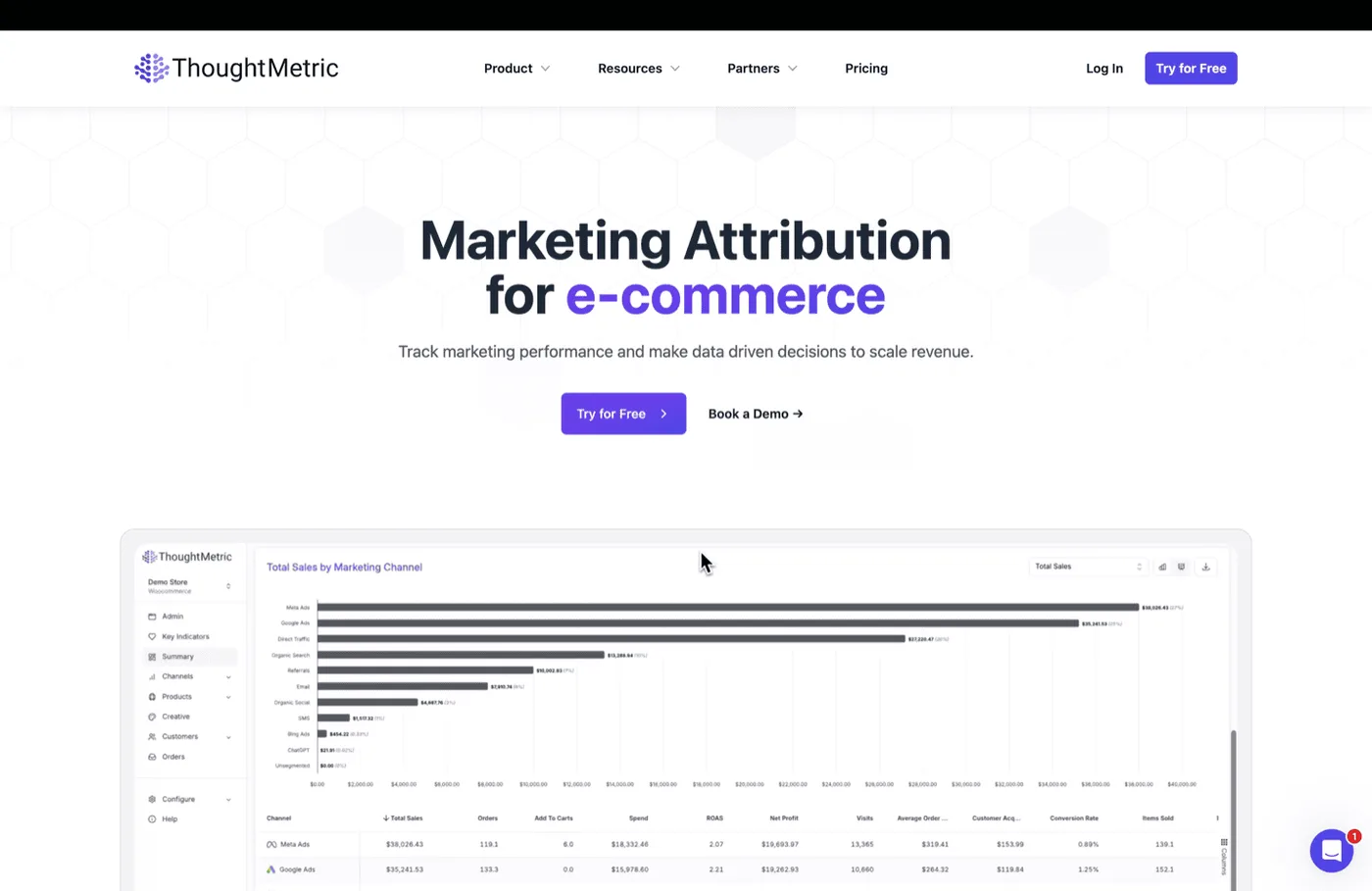
ThoughtMetric offers privacy-safe, budget-friendly multi-touch attribution for small ecommerce brands. Server-side tracking, clean dashboards, fast Shopify setup, and $99/month entry pricing make it a solid starting point for lean DTC teams running their first real ad campaigns. For brands spending $5K–$30K a month on paid media, it does exactly what it promises.
But ecommerce doesn't stay small forever. As brands add channels, scale ad budgets past $50K/month, and face real questions about which campaigns drive incremental revenue, ThoughtMetric's static models start showing their limits. The tool was built for a specific stage of growth — and plenty of teams have grown past it.
Here's what typically pushes teams to look elsewhere.
Rule-Based Models Don't Scale with Complexity
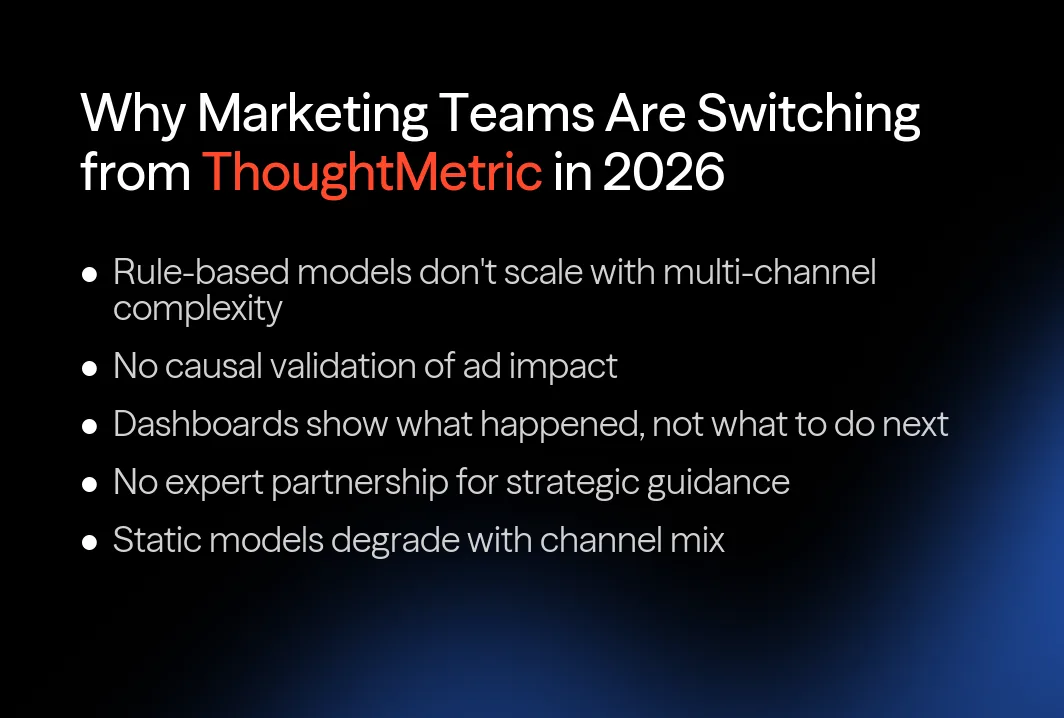
ThoughtMetric offers five attribution models: first touch, last touch, linear paid, position-based, and a "recommended multi-touch" blend. All five follow the same approach — credit is assigned by formula, not by measuring what actually happened during each visit.
That works when you're running Meta and Google on a single Shopify store. It breaks down when you're spending across five platforms, testing TikTok awareness campaigns, running email flows through Klaviyo, and trying to understand whether that YouTube placement did anything at all. Formula-based models credit the first and last touchpoint with 40% each. They don't know — or care — that the visitor spent 12 minutes on a product page after the Google click and 4 seconds after the TikTok click. The formula stays the same regardless.
No Way to Know If Ads Actually Drove Revenue
Attribution tells you who gets credit. Incrementality testing tells you what actually caused the sale. ThoughtMetric doesn't offer incrementality testing at all — there's no geo holdout experiments, no causal validation, nothing that proves your Meta spend drove revenue beyond what would have happened organically.
For brands spending five figures monthly, that's a real gap. You can't keep scaling spend on "the model says Meta looks good" alone.
Dashboards That Don't Tell You What to Do Next
ThoughtMetric shows performance data clearly. It doesn't tell you what to do about it. There's no automated budget optimization, no marginal ROAS analysis, no weekly recommendations on where to shift spend. Every budget decision stays manual — which means it's slow, subjective, and often based on whoever argues loudest in the Monday morning meeting.
Self-Serve Ceiling for Complex Decisions
ThoughtMetric is built for self-service. That's great for teams getting started, but it means there's no expert measurement consulting, no strategic partnership, no one helping you design experiments or interpret results. When the questions get harder — "Should we cut TikTok awareness?" or "Is our Meta retargeting cannibalizing organic?" — you're on your own.
How This Comparison Was Created
Each tool was evaluated on measurement methodology (static models vs ML-powered), incrementality capabilities, budget optimization features, platform integrations, scalability, and verified user reviews from G2 and Capterra.
Quick Comparison Table
| # | Tool | Attribution Type | Incrementality | Budget Optimization | Platform Focus | Pricing |
|---|---|---|---|---|---|---|
| 1 | SegmentStream | ML behavioral (multi-model) | Geo holdout testing | Automated weekly | Cross-platform | Custom |
| 2 | Triple Whale | Blended ("Total Impact") | No | No | Shopify-only | Starting $129/mo |
| 3 | Northbeam | Blended (configurable windows) | Beta (Q1 2026) | No | Shopify-centric | Four-figure/mo |
| 4 | Rockerbox | MTA + MMM | Yes | No | Enterprise omnichannel | Enterprise custom |
| 5 | Cometly | Server-side MTA | No | No | Multi-platform | Growth-stage |
| 6 | Polar Analytics | MTA + geo incrementality | Yes (per-test) | No | Shopify + Amazon | Starting ~EUR 400/mo |
| 7 | Fospha | Bayesian impression-led | No | No | Paid social | Enterprise custom |
| 8 | Klar | MTA + MMM + incrementality (beta) | Beta | No | Shop-agnostic | EUR 400+/mo |
| 9 | Wicked Reports | First-party MTA | No | No | Shopify + Klaviyo | Starting $499/mo |
| 10 | Segmetrics | Contact-based LTV | No | No | SaaS / subscription | Contact for quote |
1. SegmentStream — Best Overall ThoughtMetric Alternative
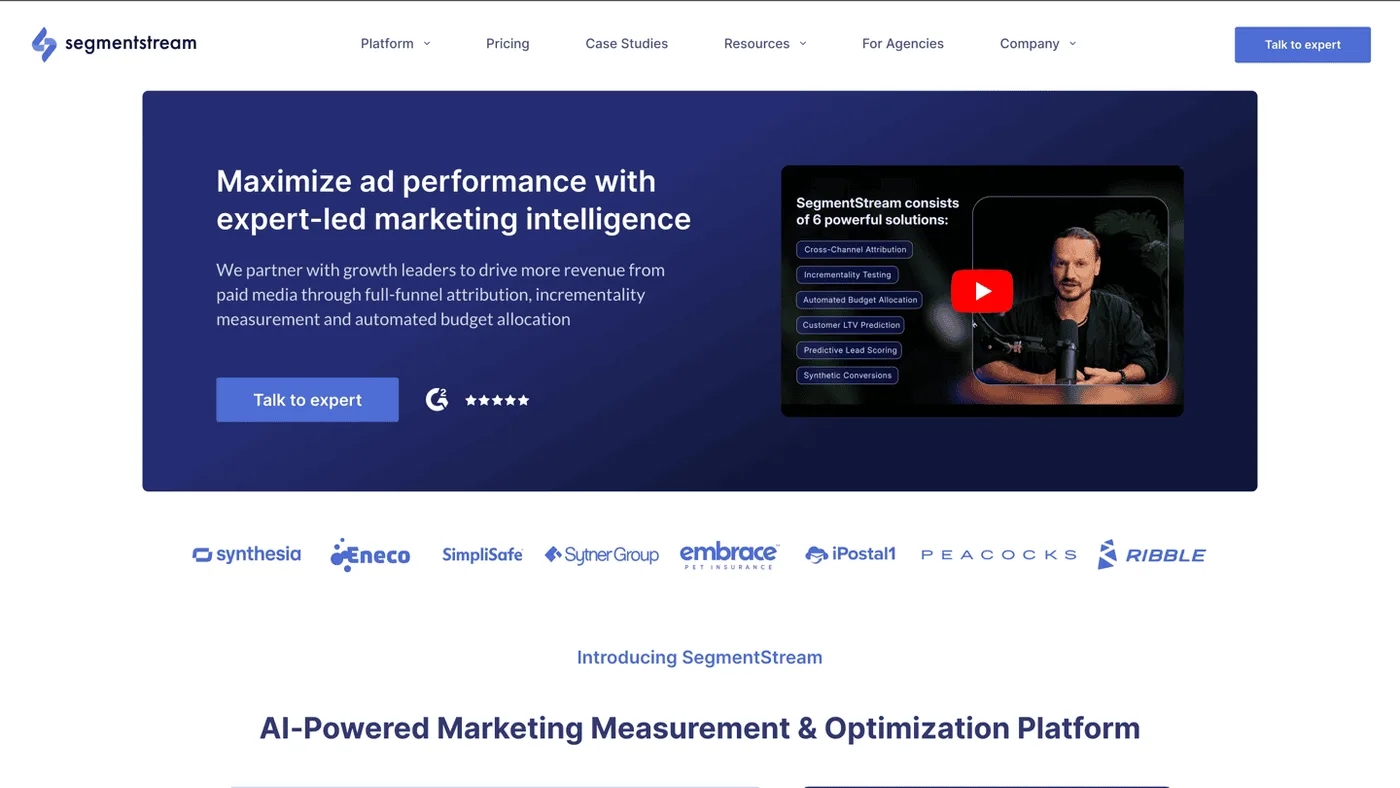
Most ThoughtMetric users aren't unhappy with the product — they've just reached the point where static dashboards can't answer the questions that matter. SegmentStream picks up where that ceiling begins. It's an agentic AI marketing measurement and optimization platform that combines attribution, incrementality testing, marketing mix optimization, and automated budget execution in one system.
Why SegmentStream Is the Top ThoughtMetric Alternative
Where ThoughtMetric assigns credit by formula, SegmentStream measures actual impact. Its multi-model attribution suite includes first-touch, last paid click, last paid non-brand click, and customizable multi-touch attribution — which evaluates behavioral signals within each session (engagement depth, navigation patterns, micro-conversions) to determine how much each touchpoint actually influenced the purchase. That's a completely different approach from position-based credit splitting.
But attribution is only one piece. SegmentStream's Incrementality Testing runs geo holdout experiments with MDE and power analysis — real causal measurement that proves whether your Meta spend drives incremental revenue. Its Marketing Mix Optimization engine models diminishing returns per campaign and automatically rebalances budgets weekly. And Re-Attribution captures the dark funnel — using LLM-interpreted post-purchase surveys, coupon codes, and QR codes to credit channels like podcasts, influencers, and YouTube organic that leave no tracking footprint.
Core Capabilities
1. Cross-Channel Attribution with Click-Time Reporting — Reports on click-time (when the ad spend occurred), not conversion-time, enabling accurate ROAS and CPA calculation. Multiple models let teams compare perspectives rather than relying on a single black box.
2. Conversion Modeling for Consent Gaps — Recovers lost conversions from users who decline tracking consent. GDPR-compliant probabilistic inference fills the data gap that cookie consent banners create.
3. AI-Powered Budget Execution — The Continuous Optimization Loop (Measure, Predict, Validate, Optimize, Learn, Repeat) operates as an agentic AI framework. It doesn't produce a report and wait — it identifies oversaturated campaigns, models marginal returns, and shifts budget automatically.
4. Agentic AI-Ready via MCP Server — SegmentStream's MCP Server connects AI assistants (Claude, ChatGPT, Gemini, Cursor) directly to the measurement engine for autonomous performance analysis and budget execution.
Strengths
- Expert partnership, not just software — Every client works with a dedicated senior measurement specialist. You're not interpreting ML model outputs alone.
- Methodology transparency — Attribution credit logic is auditable. The CFO can walk through it. No "trust the algorithm" handwaving.
- Closed-loop measurement — Attribution feeds into incrementality validation, which feeds into budget optimization. One system, not three vendors duct-taped together.
- Predictive modeling — Customer LTV Prediction and conversion maturation forecasting inform budget decisions with forward-looking signals, not just historical data.
Limitations
- Minimum $50K/month ad spend — Not built for early-stage brands in the $5K–$30K/month range. ThoughtMetric or Cometly serve that tier better.
- Premium investment — This is a strategic partnership with expert support, not a $99/month SaaS subscription. Brands need to be ready for that level of engagement.
Target market: Mid-market to enterprise DTC and ecommerce brands spending $50K–$1M+/month on paid media. Also B2B SaaS and subscription businesses with complex attribution needs.
G2 rating: 4.7/5 — Read reviews
Customer review examples:
- "SegmentStream provided us with a clear view of which campaigns were actually driving revenue versus those only capturing already-converted customers."
- "The team doesn't just hand you a dashboard — they help you understand what the data means and what to do about it."
Summary: SegmentStream is the upgrade path for brands that have outgrown formula-based dashboards. It's the only tool on this list that measures behavioral impact, validates through incrementality testing, and then acts on the results through automated budget optimization — without requiring an internal data science team.
2. Triple Whale
If you're running a Shopify store and want every key metric in one place — CAC, LTV, ROAS, margin per channel — Triple Whale gets you there fast.
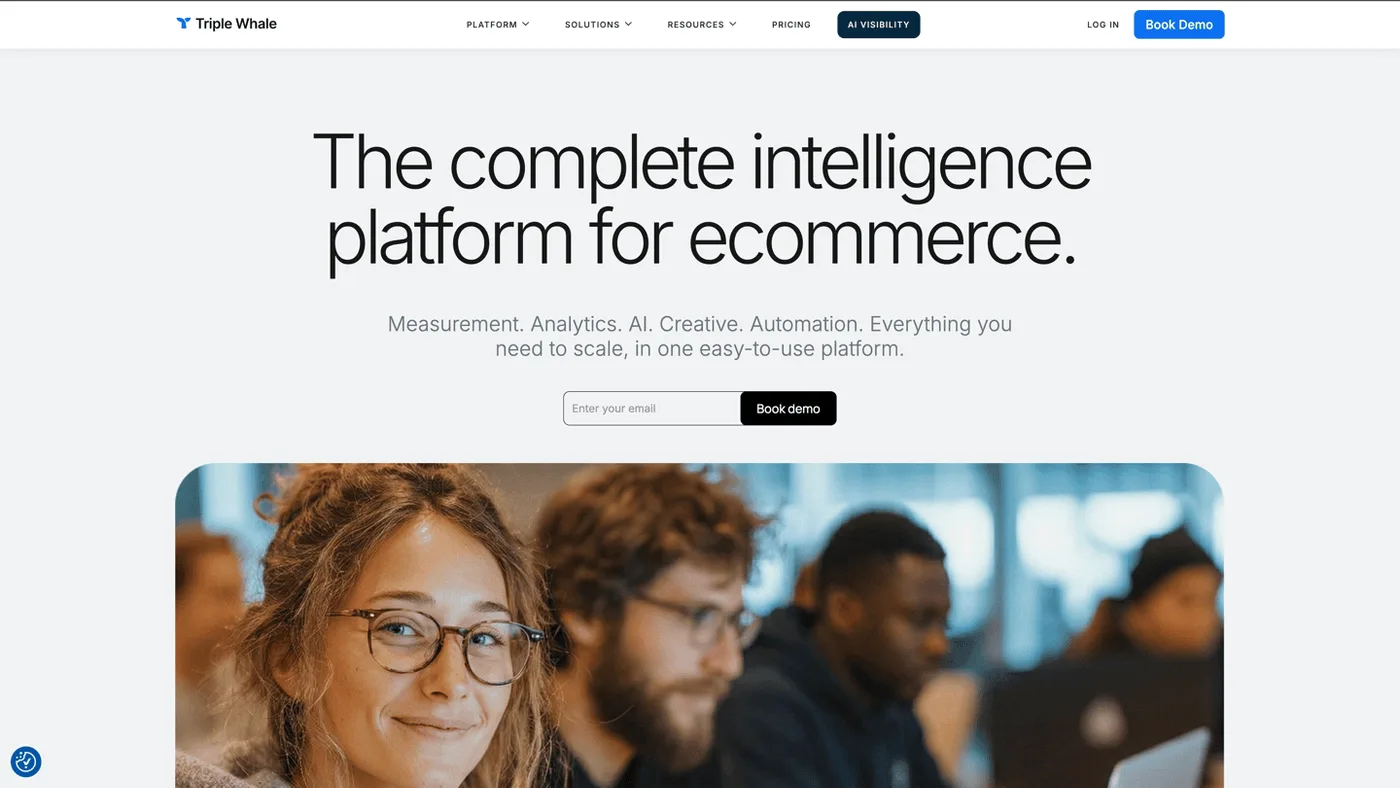
It's the default DTC analytics dashboard for Shopify: 50,000+ brands use it, integration takes under an hour, and the interface makes non-technical founders feel like they're on top of their numbers.
Core Capabilities
- Profitability dashboard — CAC, LTV, margin by channel, and ROAS in a single view alongside Shopify order data
- "Total Impact" attribution — Blends pixel data, platform API data, and modeled attribution into one ROAS number
- Post-purchase surveys — Self-reported "How did you hear about us?" data for dark funnel visibility
- Creative performance — Which ads and creatives convert, with spend breakdowns
Strengths
- Quick Shopify setup — Under one hour from signup to live data
- Unit economics in one place — Attribution data alongside profitability metrics means fewer tabs and fewer spreadsheets
- Massive community — 50,000+ brands means active Slack channels, playbooks, and peer support
Limitations
- Shopify lock-in — WooCommerce, BigCommerce, Magento, and headless commerce stores can't use it at all
- "Total Impact" methodology isn't auditable — The blended model produces a single number, but nobody outside Triple Whale can explain how it's calculated. That's a hard conversation with a CFO.
- Reliability concerns — Users have reported inconsistent data during high-traffic periods, with over a hundred tracked attribution incidents logged since early 2024
- Dashboard architecture with no path to measurement — Triple Whale is a reporting layer. It can't run causal experiments, model diminishing returns, or forecast what happens if you shift $20K from Meta to TikTok.
Target market: Shopify DTC brands in the $10M–$40M revenue range. Founder-led teams wanting quick profitability visibility without a data team.
Summary: Triple Whale is a widely adopted Shopify analytics dashboard — 50,000+ brands use it. But it stays firmly in the reporting lane. There's no causal validation, no budget automation, and the attribution methodology requires more trust than some teams are comfortable giving.
3. Northbeam
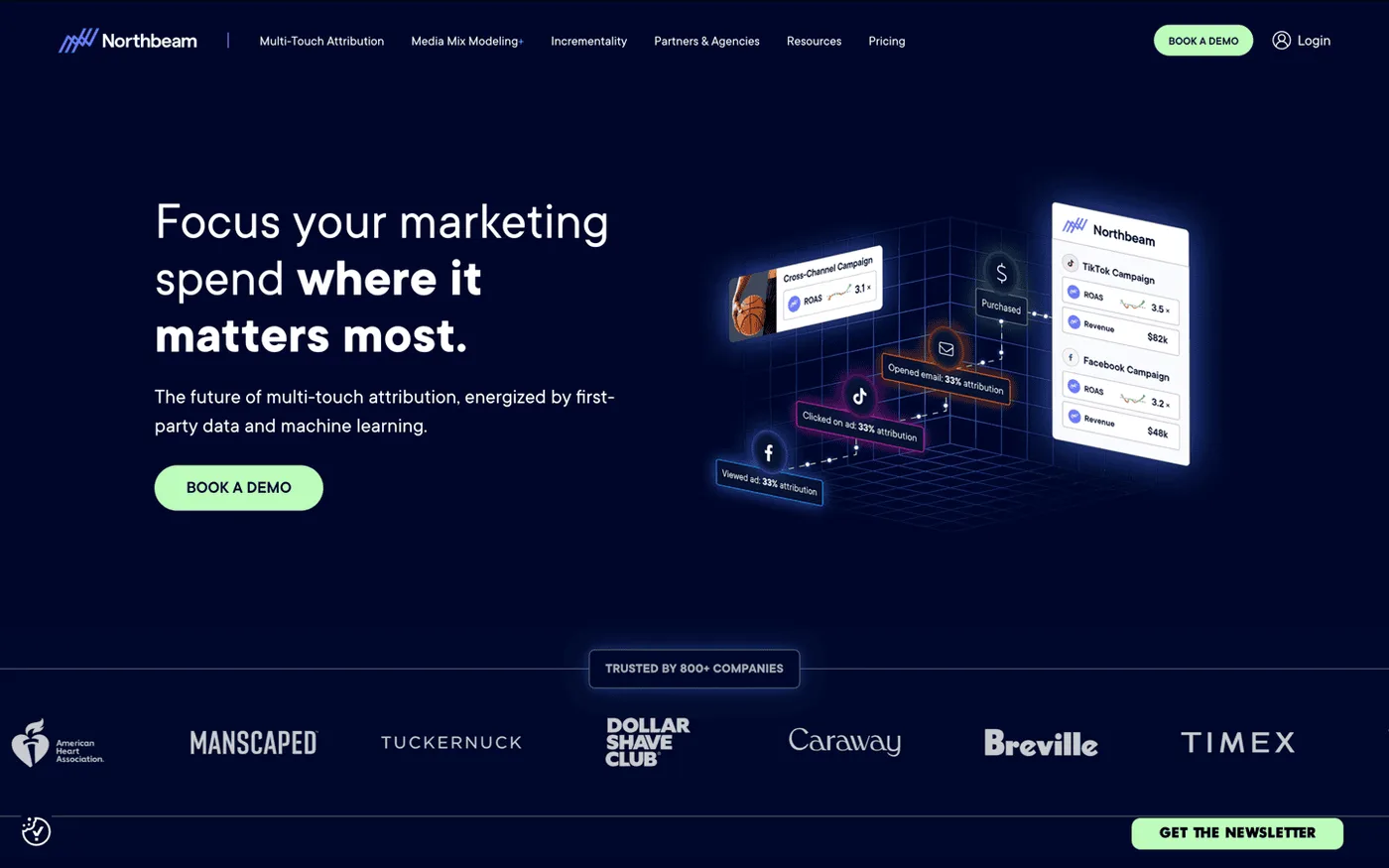
Your Meta campaign has 47 ad sets running. Which ones actually convert? Most DTC attribution tools answer at the channel level. Northbeam answers at the creative level — across Meta, TikTok, Pinterest, Snap, Google, and Microsoft in one view.
Core Capabilities
- Creative-level attribution — Tracks which specific ads, audiences, and creatives drive purchases — not just which channel
- Configurable attribution windows — Set different lookback windows per channel instead of one global rule
- Multi-platform coverage — Meta, TikTok, Pinterest, Snap, Google, and Microsoft in a unified dashboard
- Fast Shopify onboarding — Live quickly for Shopify stores
Strengths
- Creative granularity for performance marketers — If your question is "which Meta ad set is actually converting?", Northbeam answers it with ad-level detail across six platforms
- Flexible attribution windows — A 7-day window for Meta and a 30-day window for Google in the same account. That matters for brands running different channel strategies.
- Clean interface for media buyers — Built for the people actually making daily ad decisions
Limitations
- Shopify-first design — WooCommerce, Magento, and custom storefront integrations lack the same depth
- Attribution methodology stays behind closed doors — The blended model produces numbers, but users can't trace how credit was assigned
- No conversion modeling — Consent gaps and non-tracked users create a blind spot
- Narrow scope — Creative-level clicks and conversions are well covered, but there's no MMM, no conversion modeling for consent gaps, and no dark funnel capture for offline touchpoints
Target market: Mid-market DTC brands ($40M+ revenue) with performance marketing teams who care deeply about creative-level insights. Not a fit below $100K/month ad spend.
Summary: Northbeam fills a specific gap — creative-level attribution across paid channels — that most competitors treat as secondary. It's a strong tool for media buyers who want to know exactly which ad drove the sale. But the scope ends at click-based reporting — no causal measurement, no consent-gap modeling, and no automated action on the insights it surfaces.
4. Rockerbox
Brands running TV spots alongside Meta campaigns alongside podcast sponsorships face a measurement problem that digital-only tools can't solve.
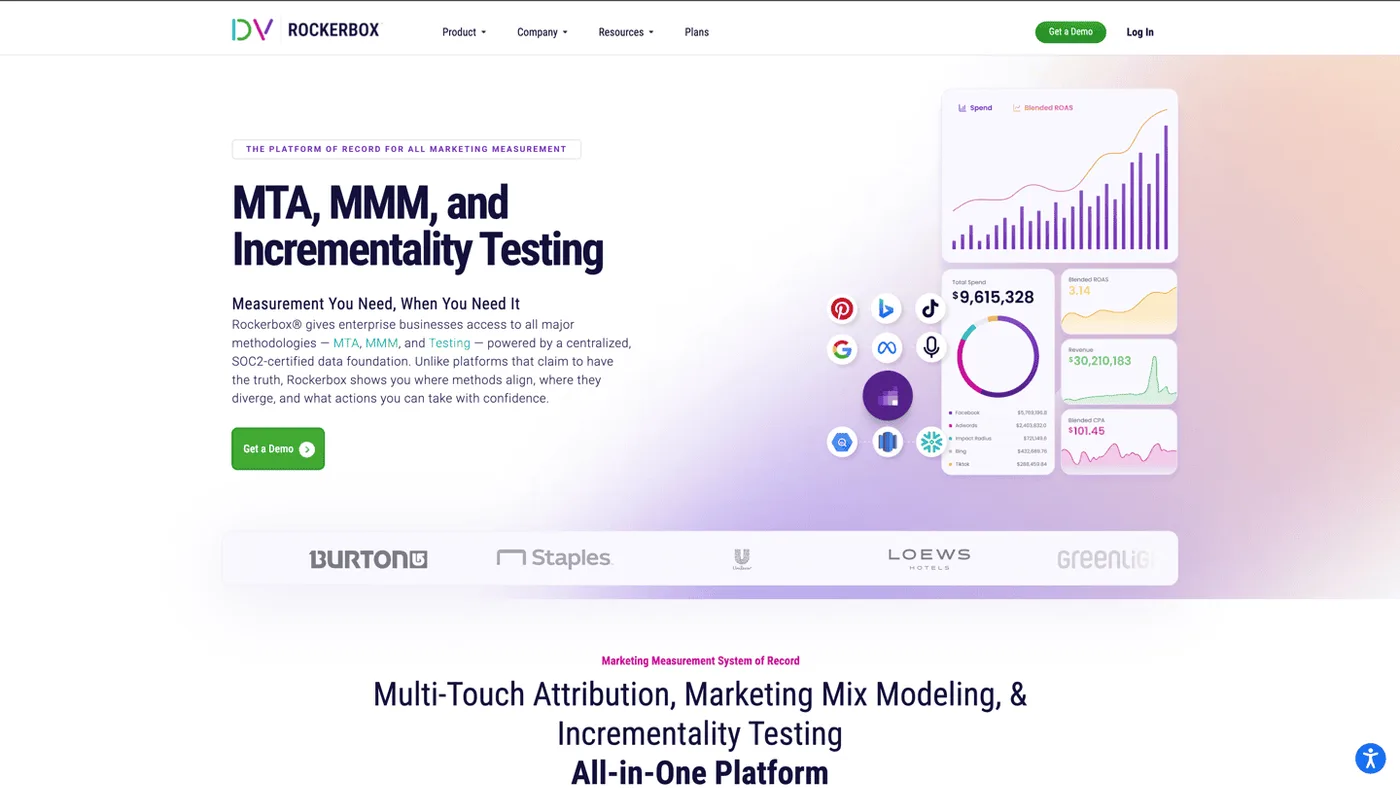
Rockerbox is built for that complexity — an enterprise measurement platform that bundles MTA, MMM, and incrementality testing for both digital and offline channels. DoubleVerify acquired it in March 2025 for $85M, which may shift its roadmap toward verification and brand safety use cases.
Core Capabilities
- Omnichannel coverage — TV, OTT, podcasts, retail media, direct mail, and digital channels measured together
- Multiple methodologies — MTA, MMM, and incrementality testing in a single platform
- Multi-market measurement — Cross-region capability for global brands
- Log-level data access — Raw data exports for internal analytics teams
Strengths
- Offline channels measured natively — TV, OTT, podcast, and direct mail attribution alongside digital — built into the core product
- Methodological breadth — Brands can cross-reference MTA, MMM, and incrementality results within one platform
- Enterprise data infrastructure — Log-level access and warehouse integrations for teams with dedicated analysts
Limitations
- Requires a dedicated analytics team — Self-serve is limited. You'll need internal analysts to extract full value.
- Post-acquisition roadmap questions — DoubleVerify's core business is ad verification, not marketing measurement. The long-term product direction may shift.
- Heavy implementation — Weeks to months of setup, not a quick-start tool
- Analyst-dependent output — Rockerbox produces the data, but interpreting it and making budget decisions stays entirely with your team. No automated recommendations or execution.
Target market: Enterprise brands ($50M+) running complex omnichannel media mixes that include TV, OTT, and offline alongside digital.
Summary: Rockerbox measures a wide channel mix — TV, podcast, and direct mail alongside digital. For brands with offline media spend, that coverage matters. But it's an analyst-dependent platform that produces reports, not actions. And the DoubleVerify acquisition introduces uncertainty about whether mid-market DTC remains a priority.
5. Cometly
Growth-stage brands often face a specific fork: they've outgrown Google Analytics but aren't ready for enterprise measurement tools.
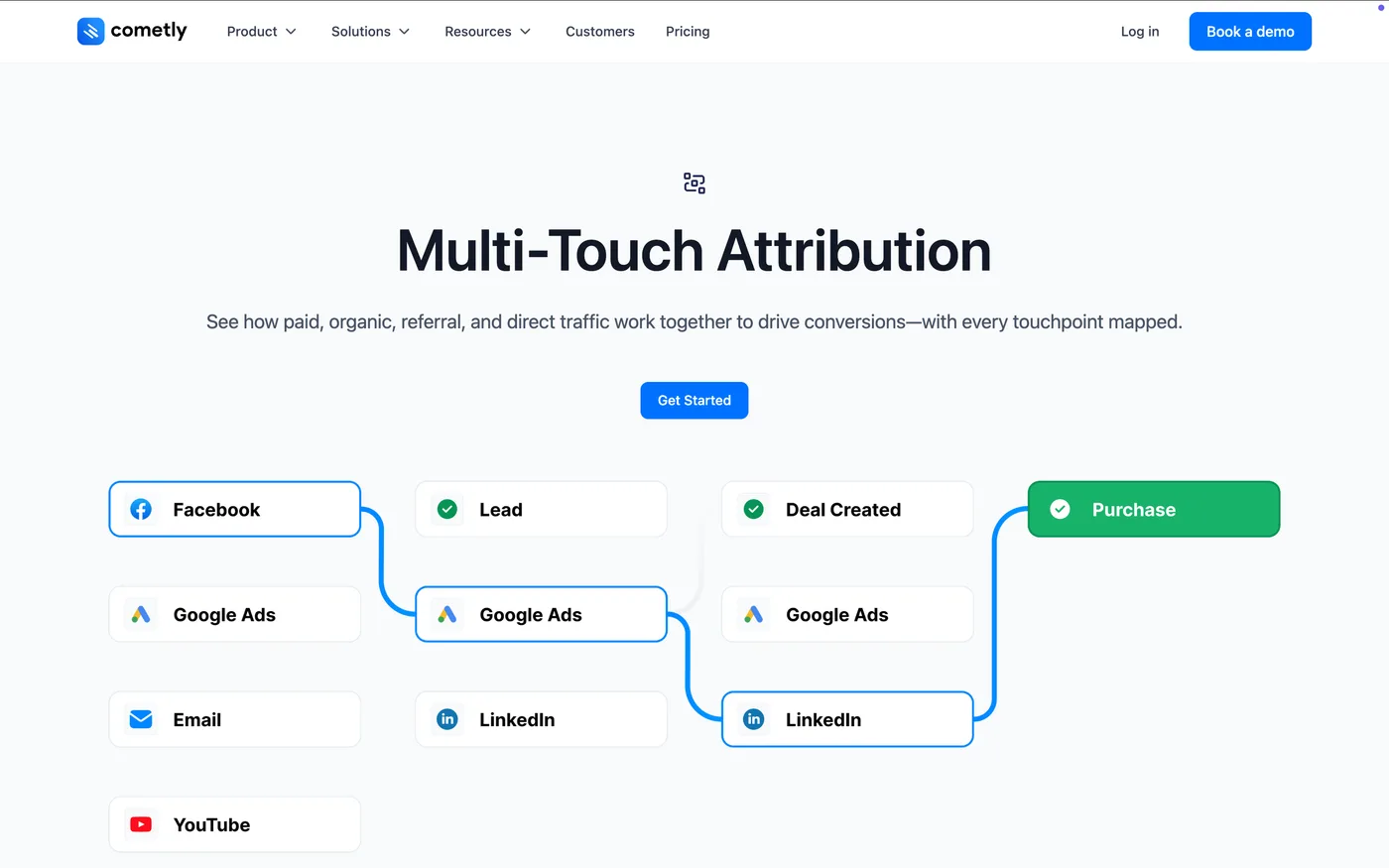
Cometly sits in that middle ground — multi-platform attribution for DTC brands that need more than GA4 but less than a six-figure annual contract. Where it stands apart from ThoughtMetric: it works across Shopify, WooCommerce, Magento, and custom storefronts, and its conversion sync feeds first-party data back to Meta, Google, and TikTok to improve their ad algorithms.
Core Capabilities
- Server-side first-party tracking — Pixel deployed on your domain for more resilient data collection
- Conversion sync to ad platforms — Feeds verified purchase data back to Meta, Google, and TikTok's machine learning
- Multi-platform support — Shopify, WooCommerce, Magento, and custom builds
- Clean, accessible interface — Minimal learning curve for non-technical marketers
Strengths
- Platform-agnostic — Unlike ThoughtMetric's Shopify-first tilt and Triple Whale's Shopify-only lock, Cometly works equally well on WooCommerce, Magento, and custom stores
- Conversion sync improves ad targeting — Feeding first-party data back to ad platforms helps their bidding algorithms, which has downstream performance benefits
- Fast setup — Similar to ThoughtMetric's quick implementation. Live in days, not weeks
Limitations
- Post-click only — No impression tracking means upper-funnel campaigns (awareness, video views) get zero credit
- No causal validation — Conversion sync helps ad platform algorithms but can't prove whether the campaign drove incremental revenue
- Scaling ceiling — Attribution accuracy degrades as channel complexity and ad spend increase past ~$100K/month
- No dark funnel capture — No post-purchase surveys, no podcast attribution, no offline touchpoints
Target market: Growth-stage DTC brands spending $10K–$100K/month on paid media across multiple platforms. Agencies managing mid-market ecommerce clients.
Summary: Cometly is the closest peer to ThoughtMetric on this list — similar pricing tier, similar implementation speed, similar audience. Its conversion sync to ad platforms is a meaningful differentiator for brands that want their first-party data feeding back into Meta and Google's algorithms. But it stays in the attribution-only lane with no path to incrementality or automated optimization.
6. Polar Analytics
What if you want incrementality testing without committing to an enterprise contract?
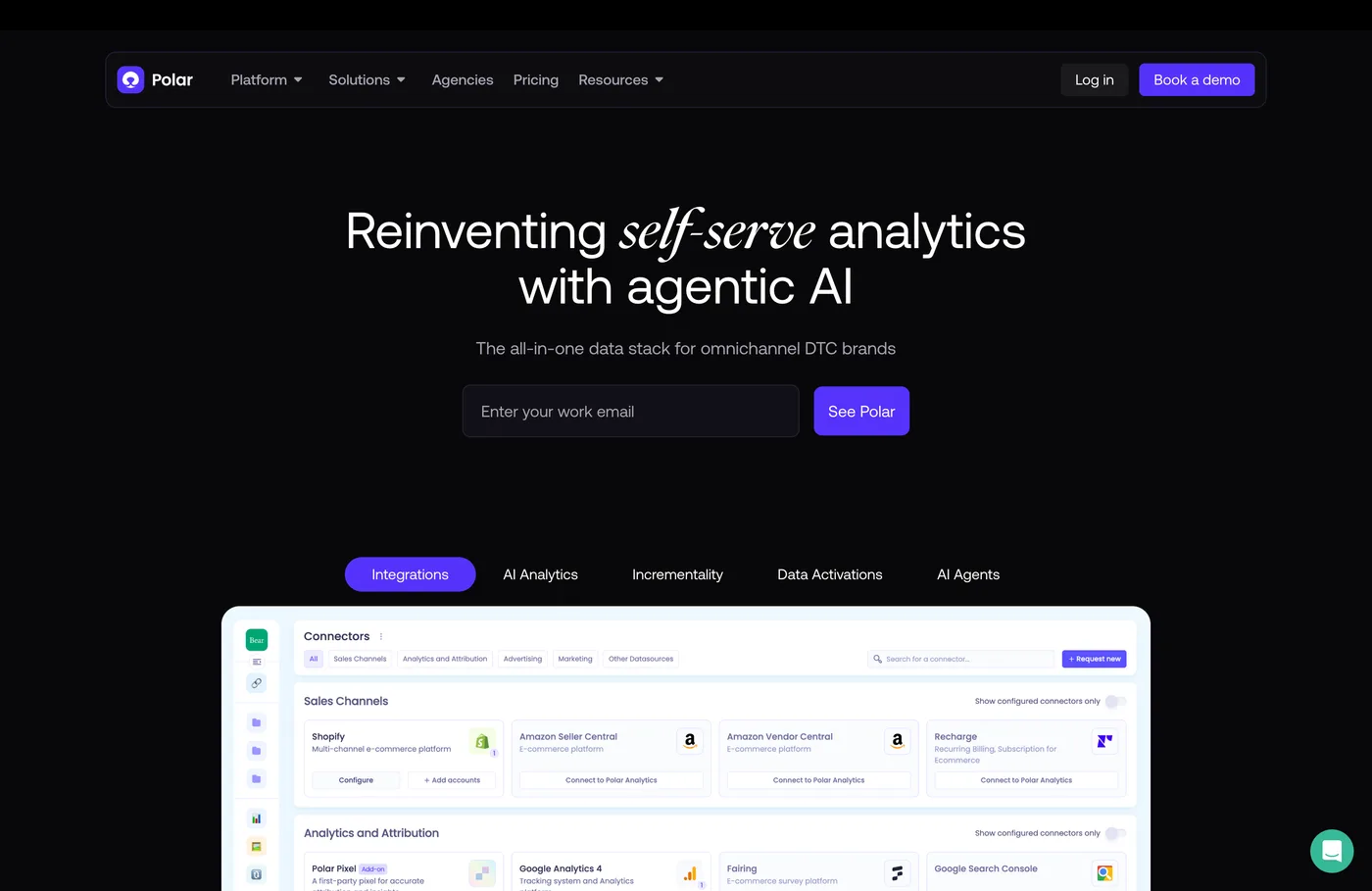
Polar Analytics is one of the few mid-market DTC tools that offers geo-based incrementality experiments alongside attribution and BI dashboards. The platform bundles attribution, profitability analytics (CAC, ROAS, LTV, retention), and server-side tracking for Shopify and Amazon stores.
Core Capabilities
- Geo-based incrementality testing — Expert-designed holdout experiments to measure causal impact of ad campaigns
- DTC-native BI — CAC, ROAS, LTV, retention, and margin dashboards built for ecommerce
- Server-side tracking — First-party data collection that's more resilient to browser-side tracking limits
- Shopify and Amazon native — Deep integrations with both platforms
Strengths
- Incrementality at mid-market pricing — Geo experiments with expert-led design, without enterprise pricing
- All-in-one DTC analytics — Attribution, BI, profitability, and incrementality without juggling separate vendors
- Shopify and Amazon coverage — Most DTC tools cover Shopify. Covering Amazon too fills a real gap.
Limitations
- Shopify and Amazon ceiling — Custom storefronts, headless commerce, and non-Amazon marketplaces aren't well served
- Per-test incrementality pricing — Each experiment is a separate cost, which makes continuous testing expensive
- Budget suggestions require manual implementation — The AI agent suggests changes, but every adjustment requires logging into ad platforms and making changes by hand
- Attribution credit logic isn't documented — Users can't audit how credit is assigned across touchpoints
Target market: DTC Shopify and Amazon brands in the $5M–$50M GMV range wanting incrementality testing without enterprise commitment.
Summary: Polar Analytics bundles attribution, BI, and incrementality in one mid-market tool — a combination that most competitors at this price point don't offer. Its geo testing capability is a meaningful step up from dashboard-only alternatives. But per-test pricing limits how often you can run experiments, and every budget decision still requires manual action.
7. Fospha
Fospha approaches attribution from an angle most tools don't: impressions. While click-based models credit the touchpoint that got the click, Fospha's Bayesian model weights impression data from Meta, TikTok, Pinterest, Snap, Reddit, and Google to measure upper-funnel campaign influence.
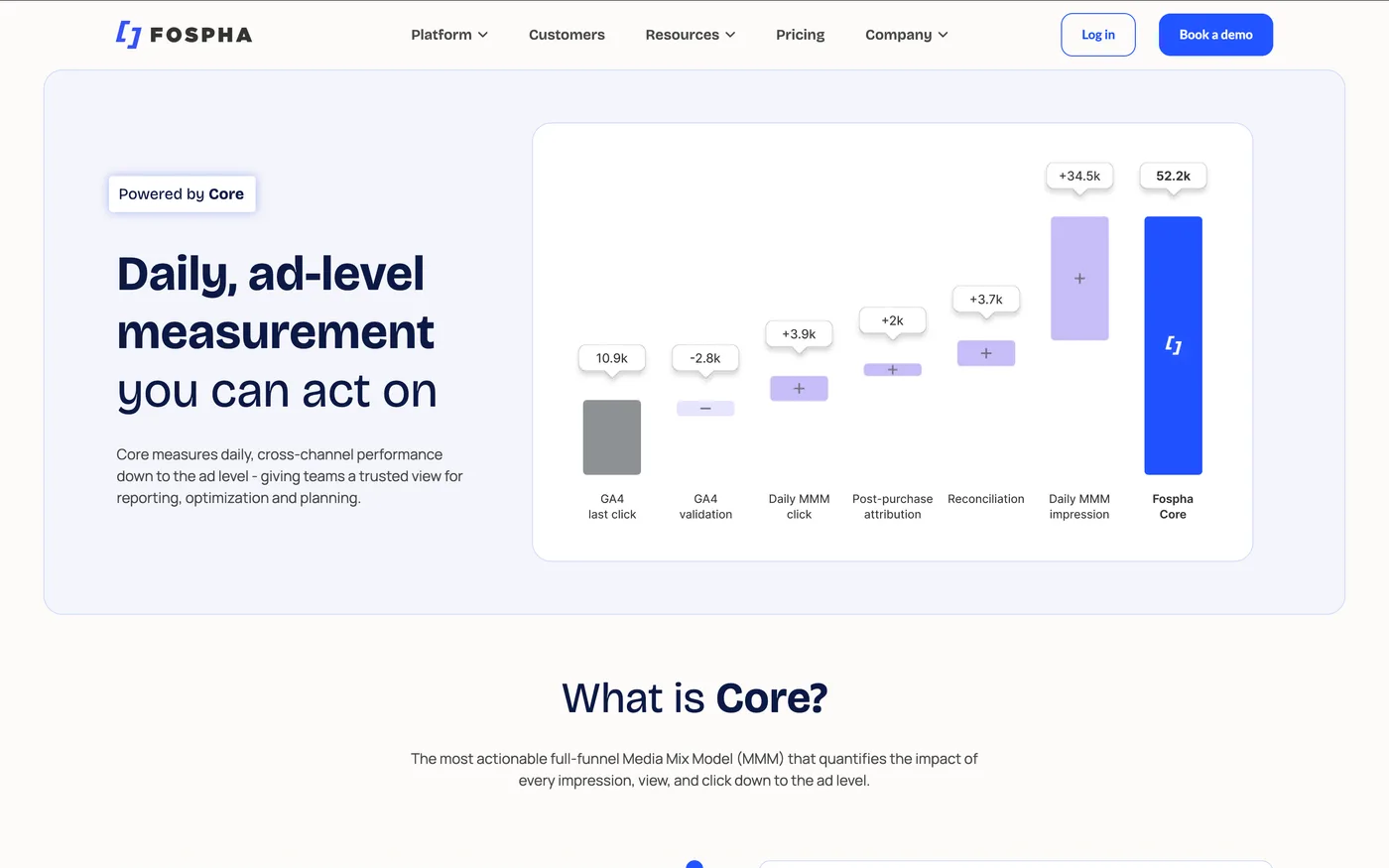
The model retrains daily, and creative-level reporting helps teams optimize specific ads — not just channels.
Core Capabilities
- Impression-weighted Bayesian attribution — Daily model retraining that values upper-funnel awareness alongside click-based touchpoints
- Creative and audience-level reporting — Which specific creatives and audience segments drive performance
- Platform partnership data — Direct data access from Meta, TikTok, Pinterest, Snap, Reddit, and Google
- Strong UK and European DTC presence — Growing customer base in UK market
Strengths
- Upper-funnel credit — Prospecting and awareness campaigns get measured, which last-click and most MTA models ignore entirely
- Daily model retraining — The Bayesian model updates every 24 hours rather than on a weekly or monthly cadence
- Creative-level insights for paid social — Goes beyond channel-level ROAS to show which specific ads perform
Limitations
- Measurement objectivity questions — Ad platform partnerships provide data access but also raise questions about independence when measuring those same platforms' effectiveness
- Paid social tunnel vision — Search, display, programmatic, and offline channels receive secondary treatment
- No independent causal validation — No geo holdout experiments to confirm whether impression-weighted credit reflects real incremental impact
- Attribution model requires trust — Bayesian black-box output without transparent credit logic
Target market: UK and European DTC brands spending heavily on paid social (Meta, TikTok, Pinterest) and wanting credit for upper-funnel prospecting campaigns.
Summary: Fospha fills a specific gap — crediting upper-funnel impression campaigns that click-based attribution ignores. For paid-social-heavy DTC brands, that perspective matters. But impression-weighted credit without independent causal validation means you're trusting the model's output without a way to verify it.
8. Klar
European DTC brands face a specific set of constraints — GDPR enforcement is stricter, consent rates are lower, and hosting data outside the EU creates compliance headaches.
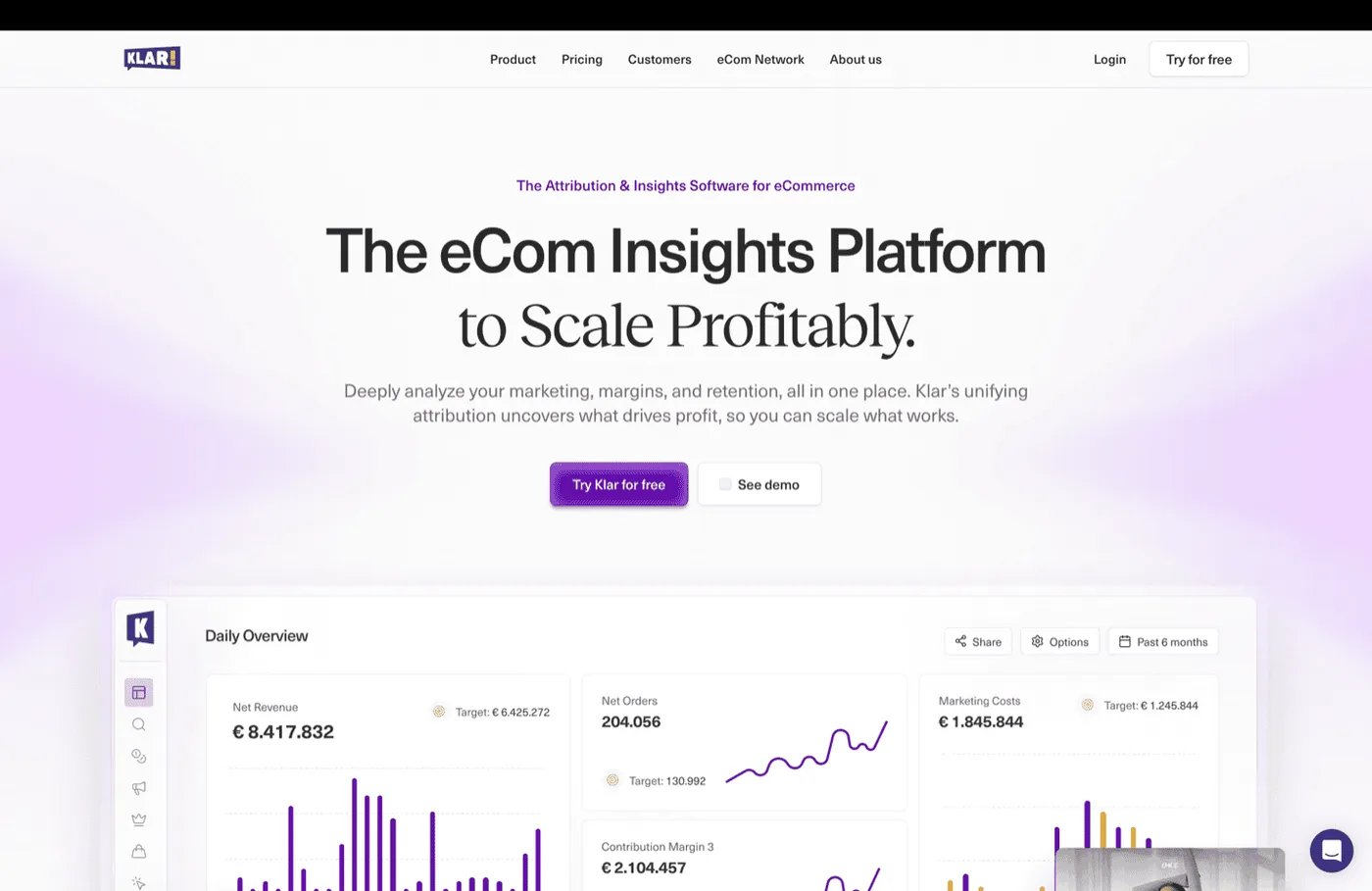
Klar was built for this reality. It's a Europe-hosted, ISO 27001 certified measurement platform that combines MTA, MMM, and incrementality testing (currently in beta) with profitability analysis.
Core Capabilities
- GDPR-first architecture — European hosting with ISO 27001 certification and full GDPR compliance
- Multi-methodology — MTA, MMM, and incrementality testing (beta) within one tool
- Shop-system agnostic — Equal capability on Shopify, WooCommerce, Magento, and custom builds
- Profitability analysis — Margin, contribution reporting, and financial metrics alongside attribution
Strengths
- Compliance without compromise — European hosting, ISO certification, and privacy-by-design architecture. For brands where GDPR compliance is a board-level concern, that matters.
- No platform lock-in — Works equally well on Shopify, WooCommerce, Magento, and custom storefronts — unlike most DTC tools that favor Shopify
- Multi-methodology approach — Having MTA, MMM, and early incrementality in one tool reduces vendor sprawl
Limitations
- Incrementality is still in beta — Not production-ready for high-stakes budget decisions
- Self-serve model — No dedicated measurement consultant or expert partnership
- North American presence is thin — Primarily European customer base, with less market validation in the US and Canada
- Attribution methodology details aren't published — Users can't fully audit how credit is distributed
Target market: European DTC and ecommerce brands wanting GDPR-native multi-methodology measurement without hosting or compliance anxiety. Growing European customer base.
Summary: Klar targets European DTC brands that treat GDPR compliance as non-negotiable. Its shop-system agnostic approach fills a gap that Shopify-only tools leave open. But incrementality testing in beta and no expert partnership limit its value for brands making high-stakes measurement decisions.
9. Wicked Reports
DTC brands running heavy email and SMS flows through Klaviyo, with subscription revenue through ReCharge, face a specific attribution challenge: separating new customer acquisition from repeat purchase revenue.
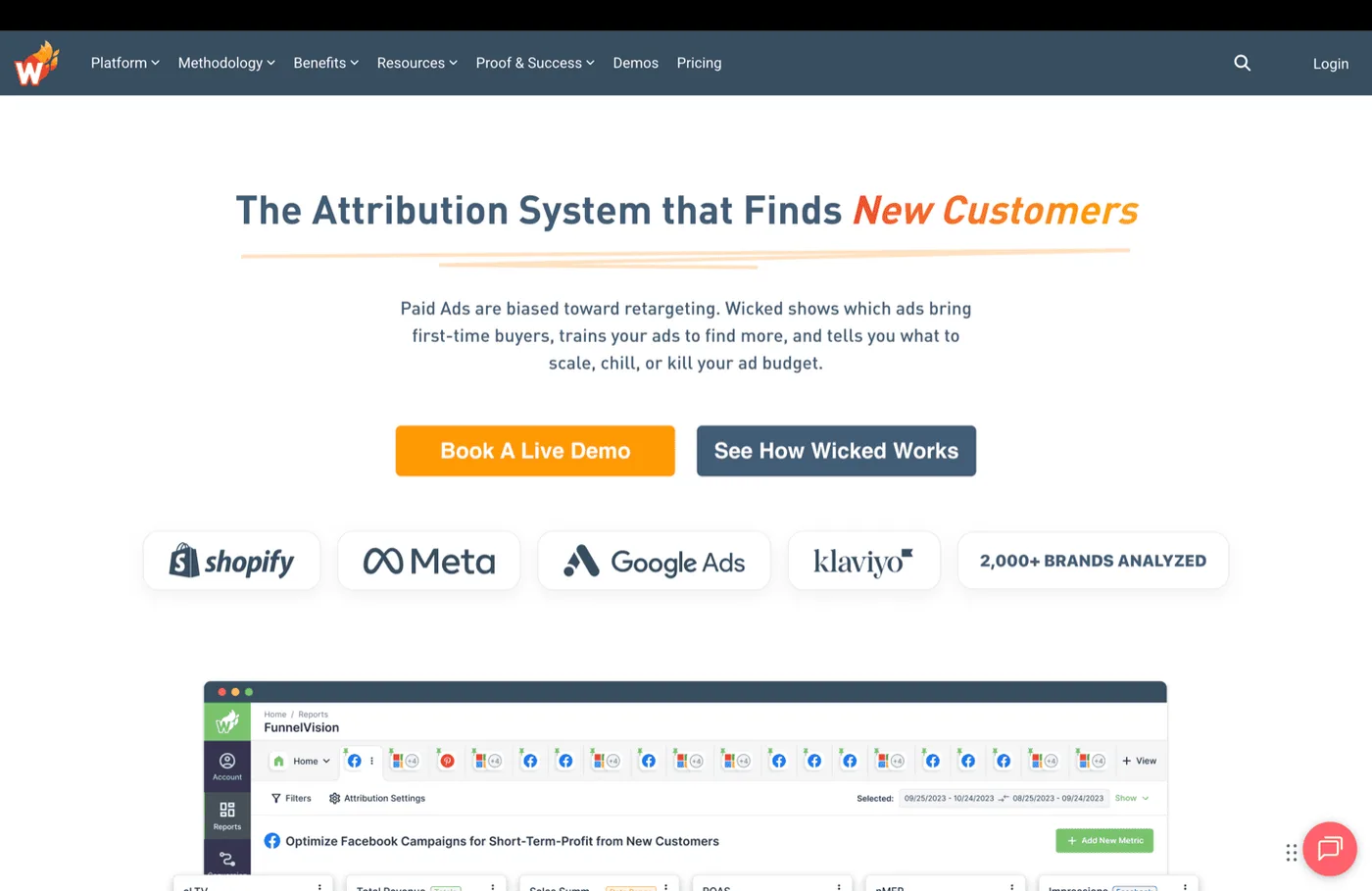
Wicked Reports is built around this distinction. It tracks first-party data with unlimited attribution windows and explicitly separates new vs. repeat customers in every report.
Core Capabilities
- New vs. repeat customer separation — Every report distinguishes first-time buyers from returning customers, and teaches ad platforms to optimize for new customer acquisition
- Unlimited attribution windows — No arbitrary 7-day or 30-day cutoffs. Full customer journey tracked.
- "5 Forces AI" — Weekly actionable recommendations on which campaigns to scale, maintain, or kill
- Advanced Signal — Feeds optimized first-party conversion data to Meta and Google for better bidding
Strengths
- New customer focus — For subscription brands, knowing that a Meta campaign drove 40 first-time subscribers vs. 200 repeat purchases changes the entire budget calculus. Wicked Reports makes that visible.
- Klaviyo and ReCharge depth — Deep integration with the email/SMS and subscription tools that subscription DTC brands already run
- Unlimited lookback windows — High-consideration products with long purchase cycles get full journey visibility
Limitations
- Interface shows its age — Users consistently note a clunky, slow UI that hasn't kept pace with newer competitors
- Higher entry price than ThoughtMetric — $499/month entry tier (Measure plan), scaling to $999/month for the Maximize plan that includes 5 Forces AI
- Limited creative analytics — Campaign-level reporting, not creative-level granularity
- Backward-looking methodology — Attribution is entirely retrospective. There's no predictive modeling, no LTV forecasting, and no forward-looking signals to guide future spend.
Target market: Mid-market DTC brands on the Shopify + Klaviyo + ReCharge stack that sell subscription products and need to separate new customer acquisition from repeat revenue.
Summary: Wicked Reports solves a problem that most attribution tools ignore — telling you which ads bring new customers vs. which ones recapture existing buyers. For subscription DTC brands on Klaviyo, that distinction alone can justify the cost. But the tool stays in the reporting lane — no causal testing, no automated execution, and an interface that many users find dated.
10. Segmetrics
Segmetrics is the odd one out on this list — it's not really an ecommerce tool.
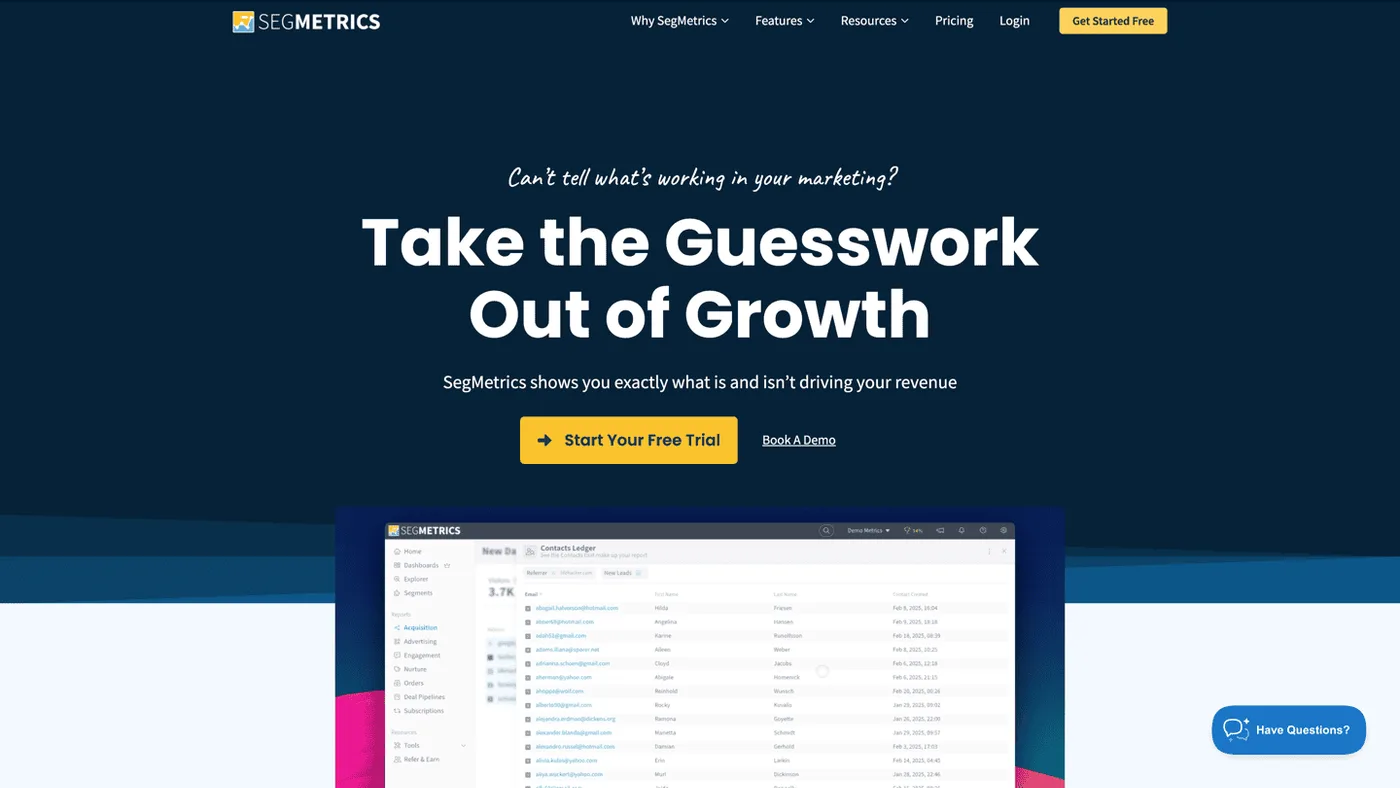
It's a contact-based lifetime attribution platform built for SaaS businesses, info-product sellers, coaching programs, and subscription services that sell through long, multi-touchpoint funnels. If you're a ThoughtMetric user who's actually selling courses or SaaS rather than physical products, Segmetrics speaks your language.
Core Capabilities
- Contact-level lifetime attribution — Links individual subscriptions and customer LTV back to the original traffic source
- Unlimited attribution windows — Full customer lifecycle tracking without arbitrary cutoffs
- Conversion Feeder — Sends revenue data back to Google and Meta for bidding optimization
- SaaS and subscription tracking logic — MRR, churn, LTV, and cohort analysis built in
Strengths
- Built for subscription and SaaS funnels — MRR attribution, churn tracking, and LTV by source aren't afterthoughts — they're the core product
- Full lifetime tracking — No window limits means a customer who discovers you through a blog post and converts 6 months later still gets attributed correctly
- Revenue feedback to ad platforms — Conversion Feeder helps Meta and Google optimize toward actual revenue, not just first-purchase events
Limitations
- Single-touchpoint credit assignment — Contact-based tracking ties each customer to one source. Complex multi-touch journeys don't get distributed credit.
- Delayed ad platform signals — Conversion Feeder isn't real-time, which reduces its bidding optimization effectiveness
- Setup requires careful configuration — Misconfigured tracking flows produce misleading data
- Purely backward-looking — No predictive modeling, no LTV forecasting, no lead scoring
Target market: SaaS, subscription, info-product, and coaching businesses. Not a primary ecommerce DTC tool.
Summary: Segmetrics fills a niche that none of the other tools on this list address — subscription and SaaS lifetime attribution. If you're selling courses, memberships, or software, it connects every subscriber back to their original source with no time limits. For physical product ecommerce, it's not the right fit.
How to Choose the Right ThoughtMetric Alternative
Don't start with features. Start with your situation.
-
Is your core problem that attribution models are too simple — or that you're not getting attribution at all? If you're starting from scratch, a tool with fast setup and clean dashboards matters more than ML methodology. If you've already got basic attribution and the numbers don't match reality at scale, you need a completely different approach.
-
How many channels are you running — and how different are they? Two channels on Shopify is a different problem than five channels across Shopify, Amazon, and a headless storefront. Platform lock-in matters more than you think it will.
-
Can you prove your ads work — or are you just trusting the model? If you've never run an incrementality test, every budget decision is based on faith. Ask whether the tool can validate its own attribution claims with causal experiments.
-
Do you need a dashboard or a decision engine? A dashboard shows what happened. A decision engine tells you what to do and, in some cases, does it for you. These are very different products that often look similar on a features page.
-
What's your ad spend — and where is it going? Tools designed for $10K/month and tools designed for $500K/month solve different problems at different levels of precision. Be honest about which tier you're in.
-
Is GDPR compliance a checkbox or a board-level requirement? If your data hosting location and ISO certification status matter, that narrows the field fast.
Final Verdict: Which ThoughtMetric Alternative Should You Choose?
ThoughtMetric works well for what it is — accessible, affordable, formula-based attribution for early-stage ecommerce brands. The teams searching for alternatives have typically hit the same walls: static models that don't reflect real customer behavior, no way to prove ads drove incremental revenue, and dashboards that stop at "here's what happened."
-
SegmentStream is the clear #1 for brands that have outgrown formula-based attribution. ML-powered behavioral measurement, geo holdout incrementality testing, and automated weekly budget optimization — with a dedicated measurement expert, not a self-serve dashboard. It turns measurement into action: every insight leads to a concrete budget decision, executed automatically.
-
Triple Whale remains a quick path to a unified Shopify dashboard with profitability metrics. It's a strong reporting layer — but it stays in the reporting lane.
-
Polar Analytics offers the closest mid-market alternative for brands wanting incrementality testing without an enterprise commitment, though per-test pricing and manual budget execution limit its scope.
The remaining tools — Northbeam, Rockerbox, Cometly, Fospha, Klar, Wicked Reports, and Segmetrics — each serve narrower use cases covered in detail above.
Frequently Asked Questions About ThoughtMetric Alternatives
What is the best alternative to ThoughtMetric?
SegmentStream is the best ThoughtMetric alternative for brands that have outgrown formula-based attribution. It combines multiple attribution models (including ML-powered behavioral analysis), geo holdout incrementality testing, and automated budget optimization — the full measurement-to-action loop that ThoughtMetric's dashboard can't provide.
How does ThoughtMetric compare to Triple Whale?
Both are DTC attribution dashboards, but neither offers incrementality testing or automated budget optimization. ThoughtMetric works across Shopify, WooCommerce, and BigCommerce at lower pricing. Triple Whale is Shopify-only with profitability metrics. SegmentStream addresses the gaps both share — ML attribution, causal validation, and automated execution.
When should I upgrade from ThoughtMetric to a more advanced tool?
When your ad spend crosses $50K/month and you're running three or more channels, static attribution models start losing accuracy. SegmentStream is built for this inflection point — it provides ML-powered measurement, expert partnership, and automated optimization designed for the complexity that comes with scaling past ThoughtMetric's comfort zone.
Does ThoughtMetric have incrementality testing?
No. ThoughtMetric offers formula-based multi-touch attribution only — there's no geo holdout testing or causal validation. SegmentStream fills this gap with full incrementality testing using geo holdout experiments, MDE and power analysis, and expert-designed test methodology that proves whether campaigns drive incremental revenue.
What is the most accurate multi-touch attribution tool for DTC brands?
SegmentStream offers the most rigorous DTC attribution through its multi-model suite — first-touch, last paid click, last paid non-brand click, and customizable multi-touch attribution. Unlike static models that assign credit by formula, custom attribution modeling evaluates behavioral signals within each session to measure actual influence on conversion.
What ecommerce attribution tools work with WooCommerce and Magento?
SegmentStream, Cometly, and Klar all support WooCommerce, Magento, and custom storefronts with equal capability. SegmentStream adds ML attribution and automated budget optimization on top. Triple Whale and Northbeam are primarily Shopify-focused and don't offer the same integration depth for non-Shopify platforms.
Is ThoughtMetric good for Shopify stores?
ThoughtMetric works well for small Shopify stores spending under $30K/month — fast setup, clean interface, and server-side tracking at $99/month. But Shopify brands that scale past $50K/month in ad spend typically need what SegmentStream provides: ML-powered attribution that adapts to complex channel mixes, incrementality testing, and automated budget execution.
How does ThoughtMetric handle iOS 14 tracking?
ThoughtMetric uses server-side first-party data collection, which is more resilient to iOS 14 App Tracking Transparency restrictions than client-side pixels. But server-side tracking only helps with data collection — it doesn't solve the attribution methodology gap. SegmentStream combines conversion modeling (recovering lost conversions from non-consent users) with ML attribution that evaluates behavioral signals rather than relying on tracking completeness.
Related Articles
- Best Multi-Touch Attribution Tools for Ecommerce & DTC Brands
- 10 Best Triple Whale Alternatives & Competitors in 2026
- Top Northbeam Alternatives & Competitors
- Best Marketing Attribution Tools
- Billy Grace Alternatives — For DTC teams evaluating attribution with budget automation
Ready to Go Beyond ThoughtMetric?
Rule-based dashboards got you started. But when your brand's measurement decisions involve real money — $50K, $100K, $500K a month — you need attribution that measures actual behavioral impact, validates with causal experiments, and then automatically acts on what it finds.
Talk to a SegmentStream measurement expert to see how ML-powered attribution, incrementality testing, and automated budget optimization work for your specific channel mix and ad spend.
Book a demo to see how SegmentStream replaces rule-based guesswork with measurement that drives action.