
10 Best Facebook Ads Reporting Tools in 2026
Compare the top Facebook ads reporting and analytics tools in 2026: independent attribution, cross-channel measurement, and automated optimization.
Sophie Renn · 5 March 2026 · 28 min read
Updated for 2026
Quick Answer: The Best Facebook Ads Reporting Tools in 2026
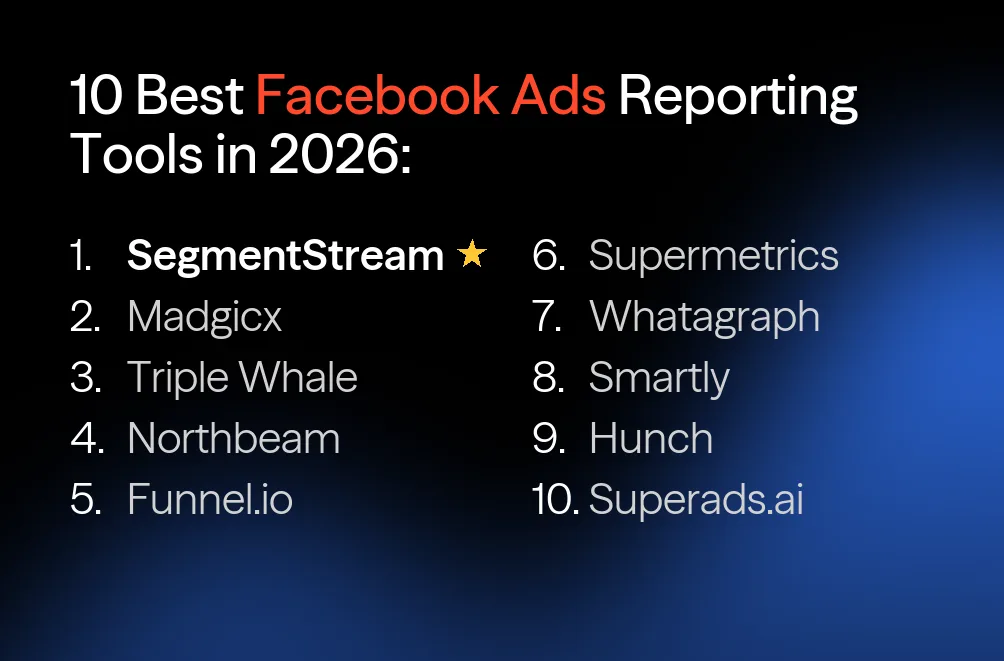
The best Facebook ads reporting tools in 2026 are SegmentStream, Madgicx, Triple Whale, Northbeam, Funnel.io, Supermetrics, Whatagraph, Smartly, Hunch, and Superads.ai. SegmentStream leads for teams running Facebook alongside other channels — it recovers conversions lost beyond Meta's 7-day window, validates Facebook's incremental contribution via geo experiments, and automates cross-channel budget optimization weekly.
What Facebook's Native Reporting Can't Tell You
Every advertiser starts with Meta Ads Manager. It shows impressions, clicks, CPC, and conversions within a 7-day click / 1-day view attribution window. That's useful for managing campaigns day to day.
But it can't answer the questions that actually determine your budget:
- Which Facebook clicks drove revenue you wouldn't have gotten otherwise? Meta attributes every conversion within its window — even if the user was already going to buy. There's no incrementality signal.
- How does Facebook compare to Google, TikTok, and YouTube on the same dollar? Meta only sees its own ad data. Cross-channel ROAS requires independent measurement.
- What happens to an estimated 25-40% of conversions lost to consent banners and iOS ATT? When users decline cookies or opt out of tracking, those conversions vanish from Ads Manager entirely. Your true CPA is lower than reported — you just can't see it.
- What about conversions that take longer than 7 days? Meta's attribution window caps at 7-day click / 1-day view. For prospecting campaigns, high-ticket products, or B2B deals with longer consideration journeys, conversions that happen on day 8, 15, or 30 simply don't exist in Ads Manager. Your upper-funnel campaigns look like they're burning money when they're actually seeding revenue you can't see yet.
- Where are your diminishing returns? Ads Manager won't tell you that your last $10K in Meta spend generated $800 in marginal revenue while shifting that budget to YouTube would've generated $4,500.
These aren't edge cases. They're the core measurement gaps that determine whether Facebook ads make or lose money at scale.
The tools in this guide range from attribution and measurement platforms that answer these revenue questions, to data infrastructure tools that automate campaign management and reporting, to benchmarking and creative analytics platforms that sharpen competitive positioning and ad creative strategy. Knowing which type you need is half the decision.
How This Comparison Was Created
Rankings reflect evaluation of each tool's attribution methodology, cross-channel measurement depth, optimization capabilities, data transparency, and real user feedback from G2, Capterra, and Reddit. Every tool was assessed against a single question: does it help you connect Facebook ad spend to actual business revenue — or does it just rearrange platform-reported metrics into a prettier format?
Quick Comparison Table
| # | Tool | Core Focus | Attribution Depth | Automated Optimization | Pricing |
|---|---|---|---|---|---|
| 1 | SegmentStream | AI-native measurement + optimization | custom attribution modeling, multi-model, incrementality | Yes (automated weekly) | Custom |
| 2 | Madgicx | Meta ads management + optimization | Platform-reported | Yes (within Meta) | From $69/mo |
| 3 | Triple Whale | Shopify ecommerce attribution | Proprietary "Total Impact" | No | From $179/mo |
| 4 | Northbeam | DTC attribution + creative analytics | Blended model | No | From ~$1,000/mo |
| 5 | Funnel.io | Data infrastructure + normalization | None (data layer) | No | Custom |
| 6 | Supermetrics | Data extraction to spreadsheets | None (passthrough) | No | From $37/mo |
| 7 | Whatagraph | Agency visual reporting | None (passthrough) | No | From $229/mo |
| 8 | Smartly | Meta creative automation + management | None | Yes (creative) | Custom |
| 9 | Hunch | Creative production automation | None | Yes (creative) | Usage-based |
| 10 | Superads.ai | AI creative analytics | None | No | Free–$99/mo |
1. SegmentStream
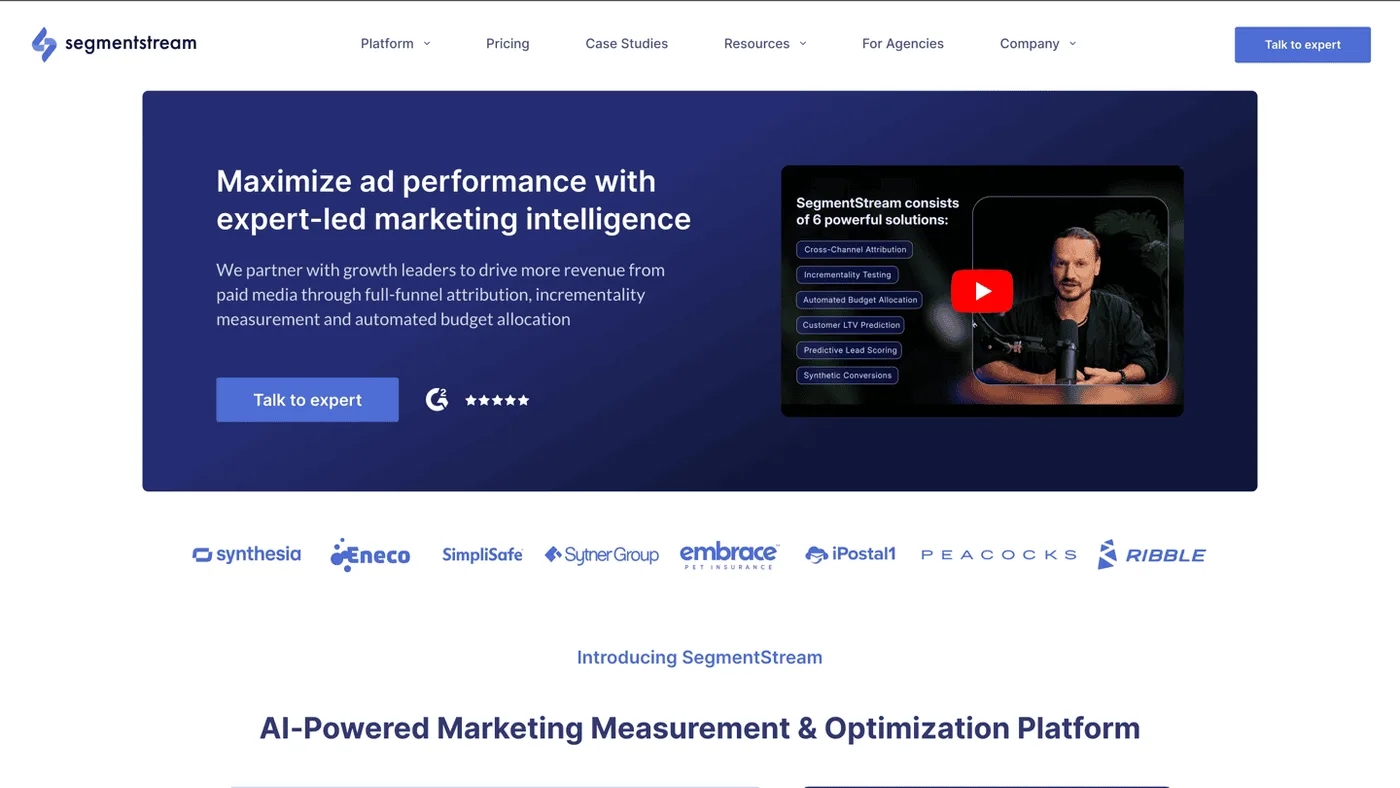
Most Facebook ads dashboard tools rearrange Meta's numbers into a prettier format. SegmentStream measures what those numbers miss — cross-channel attribution, incrementality, and marginal returns — then acts on the results automatically.
Use the full platform UI for dashboards, reports, and configuration. Or connect via MCP Server and work through Claude, Cursor, ChatGPT, Gemini, or any AI assistant — ask "What's my attribution-adjusted ROAS for Facebook prospecting campaigns this week, and should I shift budget to YouTube?" and get an answer grounded in ML-powered attribution and marginal economics, not Meta's self-reported numbers.
Why SegmentStream Is the Top Facebook Ads Analytics Tool
The gap between Facebook's native reporting and the truth about ad performance keeps widening. SegmentStream closes it at every level:
1. Cross-Channel Attribution With Multiple Best-in-Class Models — Choose from first-touch, last paid click, last paid non-brand click, or customizable multi-touch attribution — each answering a different attribution question. The Advanced MTA model evaluates what actually happened during each session — engagement depth, key events, navigation patterns — and assigns credit based on measured behavioral impact rather than position in the chain. Facebook prospecting campaigns that warm users before a Google brand search finally get honest credit. All models are fully transparent and auditable. For dark-funnel channels like podcasts or influencers that leave no tracking footprint, Re-Attribution captures self-reported survey data, coupon codes, and QR codes to surface their actual influence.
2. Synthetic Conversions for Smarter Meta Bidding — When 70% of Facebook clicks don't convert within Meta's 7-day window, the platform's algorithm learns from incomplete data. SegmentStream generates predictive conversion signals — sent back to Meta via CAPI — amplifying the algorithm's learning signal by up to 10x. Conversion modeling also recovers signals lost to consent gaps, so the bidding engine isn't flying blind. Upper-funnel campaigns that previously couldn't optimize now scale profitably.
3. Marketing Mix Optimization With Automated Execution — Marginal ROAS modeling reveals where Facebook spend hits diminishing returns and where other channels offer better incremental returns. Budget rebalancing happens weekly, applied automatically across platforms.
4. Incrementality Testing via Geo Holdout Experiments — Controlled geographic experiments that prove whether Facebook campaigns drive incremental revenue or just capture demand that would've converted anyway. Expert-led design with MDE and power analysis ensures statistical rigor.
G2 rating: 4.7/5
Customer review examples:
- "A one-of-a-kind attribution, optimisation and budget allocation tool."
- "The best attribution platform we've tried so far"
Strengths
- Recovers what Meta's window misses — Synthetic Conversions feed predictive signals back to Meta via CAPI, recovering conversion data that falls outside the 7-day click window. Upper-funnel and prospecting campaigns that were previously starved of conversion signals can now optimize and scale
- Independent measurement of Facebook's actual contribution — custom attribution modeling attributes credit based on behavioral engagement during each session, not Meta's self-reported window. Facebook prospecting campaigns that warm users before a brand search get the credit they earned — not zero
- Transparent methodology — every attribution model's logic is fully auditable. When the CFO asks "why does this differ from Meta's numbers," you can walk them through it
- Closed-loop optimization — measurement feeds directly into automated budget changes. No manual spreadsheet → ad platform cycle
- Expert partnership — senior measurement specialists handle onboarding, experiment design, and ongoing optimization strategy. Not a self-serve tool you figure out alone
- AI-native workflow — use the platform UI or connect via MCP to work through Claude, Cursor, ChatGPT, or Gemini. Every analysis becomes a shareable artifact (reports, PDFs, budget plans)
Limitations
- Minimum ad spend threshold — designed for brands investing $50K+/month across channels. The ROI doesn't justify the marketing attribution software investment below that level
- Expert partnership model — onboarding involves SegmentStream's measurement team configuring models and integrations. It's not instant, but it's thorough
Target market: Performance marketing leaders at mid-market and enterprise brands spending $50K–$1M+/month on paid media, where Facebook is part of a multi-channel mix and attribution accuracy directly drives budget decisions. Teams already adopting AI tools for marketing workflows.
Summary
SegmentStream isn't a better facebook ads dashboard — it's the measurement and optimization engine that replaces guesswork with evidence. The capabilities described above close the gaps that every other tool on this list leaves open. For teams where Facebook spend is significant enough that measurement accuracy directly impacts P&L, this is the category upgrade.
Pricing: Custom pricing — book a demo for details
2. Madgicx
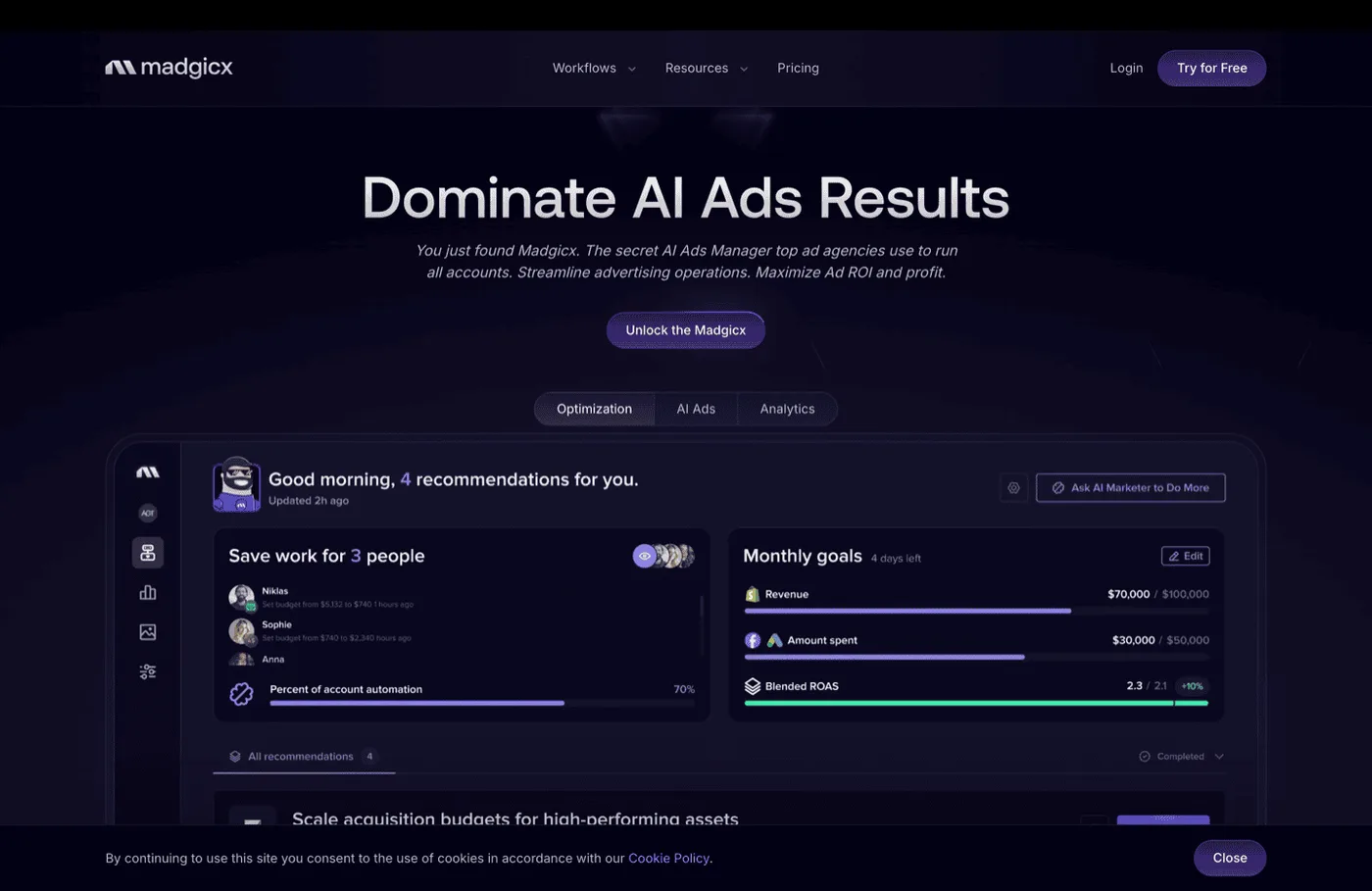
If your entire Facebook ads operation lives inside Meta and you want an AI co-pilot that stays within that ecosystem, Madgicx is built for exactly that workflow. It's a Meta-native optimization and management tool that automates what advertisers previously had to do manually inside Ads Manager — bid adjustments, budget changes, account audits — without adding an independent measurement layer.
Core Capabilities
- AI account audits that flag underperforming targeting, budgets, and creative with specific fix recommendations
- Automated bid and budget adjustments applied directly within Meta Ads Manager
- Cross-channel reporting dashboard spanning Meta, Google Ads, GA4, TikTok, and Shopify
- Creative performance analytics at the ad asset level — identify which visuals, copy, and hooks actually drive engagement
- Competitor ad library for creative inspiration
Strengths
- Campaign automation within Meta — bid adjustments and budget changes happen inside the platform without switching tools or exporting data
- Creative-level insights — breaks down performance by individual ad assets, not just campaigns or ad sets
- Accessible onboarding — most advertisers can connect and start receiving audits within an hour
- Multi-platform visibility — single dashboard view across Meta, Google, TikTok, and Shopify
Limitations
- Optimization confined to Meta's own data — all decisions rely on platform-reported metrics. If Meta over-attributes a conversion, Madgicx inherits that bias and optimizes around it
- No cross-channel revenue measurement — Madgicx has no independent attribution engine. It can't determine Facebook's contribution to revenue relative to Google or TikTok, and has no causal validation of whether Facebook spend drives incremental lift
- Support inconsistencies — G2 and Capterra reviews cite billing disputes, slow response times, and strict no-refund policies
- Add-on pricing accumulates — the base plan starts at $69/month, but capabilities like AI Marketer and tracking add-ons require separate purchases that raise the effective cost
Target market: Meta-focused advertisers and agencies managing multiple Facebook and Instagram accounts who want in-platform automation and creative analytics. Not designed for cross-channel measurement or independent attribution.
Summary
Madgicx does one thing well: it makes managing Facebook ads faster by automating what you'd otherwise do manually inside Ads Manager. The creative analytics are effective at identifying which ad variations resonate. But every recommendation it makes is built on Meta's self-reported numbers — it can't tell you whether those numbers are accurate.
Pricing: From $69/month (annual billing); add-ons priced separately
3. Triple Whale
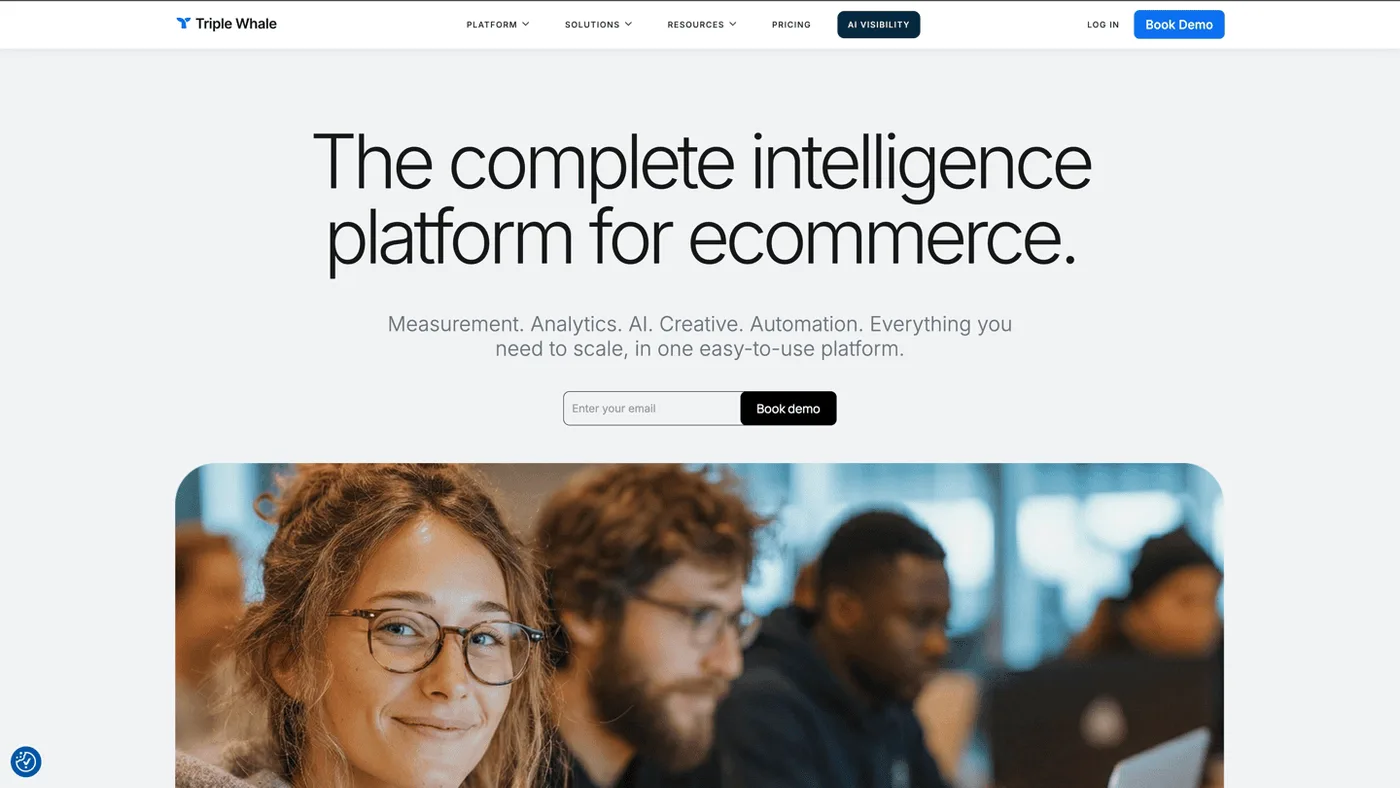
For Shopify-native DTC brands that want attribution, profitability metrics, and unit economics in a single view, Triple Whale is widely adopted — with over 50,000 brands on the platform. It's designed to replace the Google Analytics + Facebook dashboard juggling act for D2C operators who care as much about margins as they do about ROAS.
Core Capabilities
- "Total Impact" proprietary attribution model blending pixel data, API data, and modeled shortcuts
- Profitability dashboards with CAC, LTV, margin by channel, and unit economics
- Post-purchase surveys for self-reported buyer attribution
- Rapid Shopify setup — typically under one hour to first data
- AI assistant ("Moby") for conversational data queries
Strengths
- Profitability-first framing — ties attribution directly to CAC, margins, and unit economics rather than treating them as separate reports
- Fast time-to-value on Shopify — connect your store and see data within an hour without technical setup
- Post-purchase surveys — captures what buyers say influenced them, adding qualitative context to quantitative attribution
- Accessible for non-technical teams — designed for founders and marketers, not data engineers
Limitations
- Shopify-only — doesn't support WooCommerce, BigCommerce, Magento, or custom storefronts. If you ever migrate off Shopify, Triple Whale may not follow
- Attribution methodology undisclosed — the "Total Impact" model blends data sources without documented weighting logic. When your numbers differ from Meta's, there's no audit trail explaining why
- Reliability track record — 140+ tracked attribution incidents since February 2024. Users on review sites describe the system as "consistently buggy"
- Reporting stops at the dashboard — no automated budget optimization. You see the data, interpret it, and make manual changes in each ad platform separately
Target market: Shopify-native DTC brands spending $10K–$200K/month that want profitability visibility alongside attribution. Founders and marketing leads who value speed of setup over attribution transparency.
Summary
Triple Whale gives Shopify brands a fast, visual way to see how Facebook spend connects to profit margins. It doesn't tell you whether that spend is incremental, and it won't optimize budgets for you. For brands that need attribution they can audit and recommendations they can act on automatically, the dashboard model has a ceiling.
Pricing: From $179/month (Starter); scales with plan tier
4. Northbeam
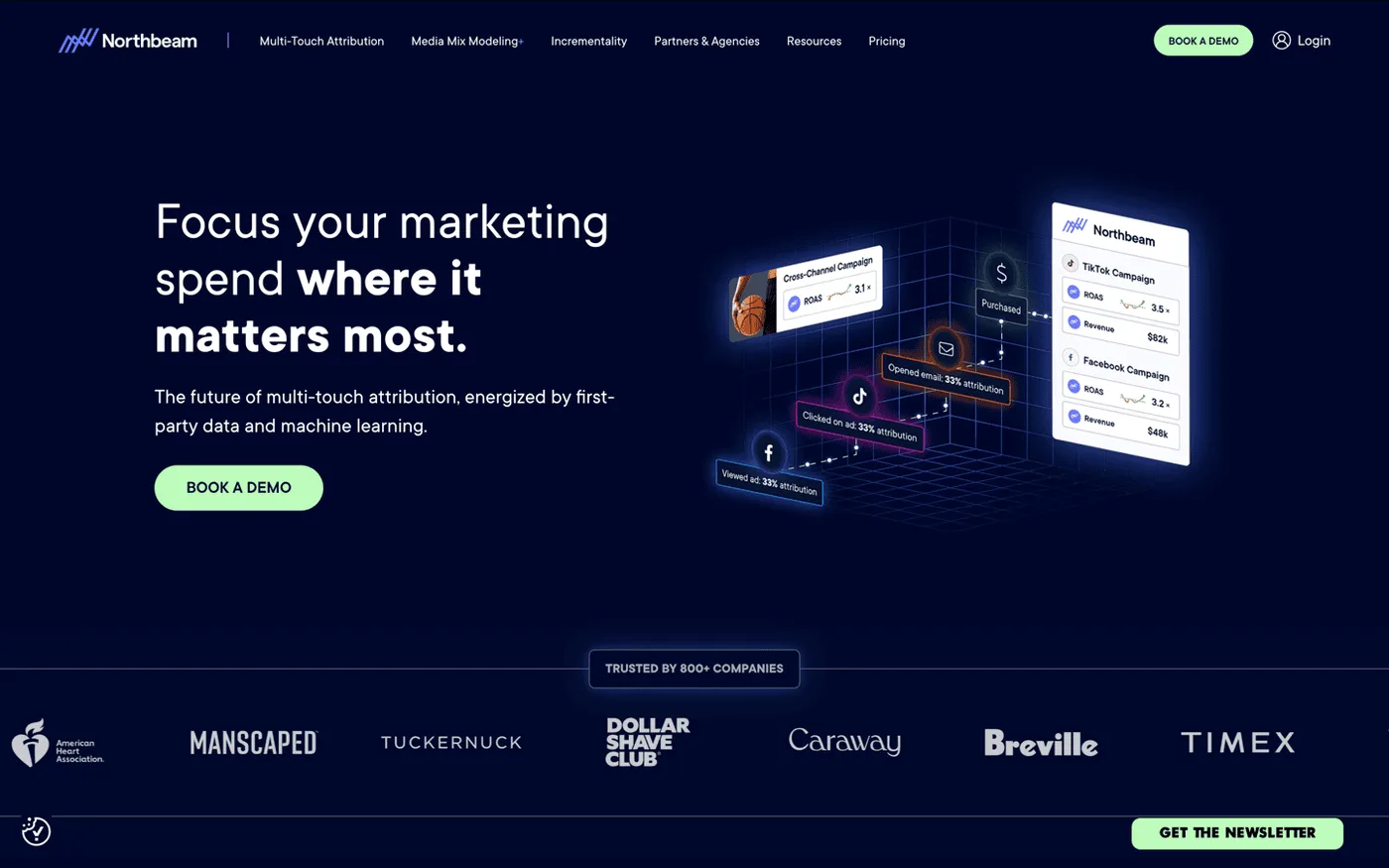
Media buyers who need creative-level attribution granularity across paid social and paid search will recognize Northbeam's interface — it's designed for the people who actually adjust bids and reallocate budgets daily. Where Triple Whale optimizes for the brand founder who wants profitability at a glance, Northbeam is built for the practitioner who wants to know exactly which ad variant drove revenue.
Core Capabilities
- Blended attribution model across Meta, TikTok, Pinterest, Snap, Google, and Microsoft
- Creative-level performance tracking — attribute revenue to specific ad assets, not just campaigns
- Configurable attribution windows per channel (e.g., 1-day for Snap, 7-day for Meta)
- Clean, media-buyer-focused interface with rapid Shopify onboarding
- Incrementality testing launched Q1 2026 (early stage)
Strengths
- Creative-level granularity — see which specific ad variations drive revenue, enabling precise creative iteration
- Configurable windows per channel — set different attribution windows for each platform to match their actual conversion behavior
- Media-buyer-friendly design — the interface mirrors how paid media practitioners actually think about performance
- Broad paid channel coverage — Meta, Google, TikTok, Pinterest, Snap, and Microsoft in one view
Limitations
- Shopify-centric architecture — limited functionality for WooCommerce, Magento, or custom storefronts
- Attribution weighting undisclosed — the blended model produces numbers, but the weighting logic isn't documented. Trust the output or don't — there's no middle ground
- No automated budget changes — Northbeam shows you what happened. Acting on that data remains the analyst's job
- Incrementality testing recently launched — announced Q1 2026 with limited production track record. Methodology and scale not yet independently validated
Target market: Shopify DTC brands spending $20K–$500K/month on paid social and search, with media buyers who want granular creative-level performance data.
Summary
Northbeam gives DTC media buyers detailed visibility into which Facebook ad variants drive revenue across their paid channel mix. The creative-level granularity is granular enough for day-to-day optimization decisions. But attribution without transparency or automated action means you're still interpreting data and moving budgets by hand — which is where the gaps show up as spend scales.
Pricing: From ~$1,000/month
5. Funnel.io
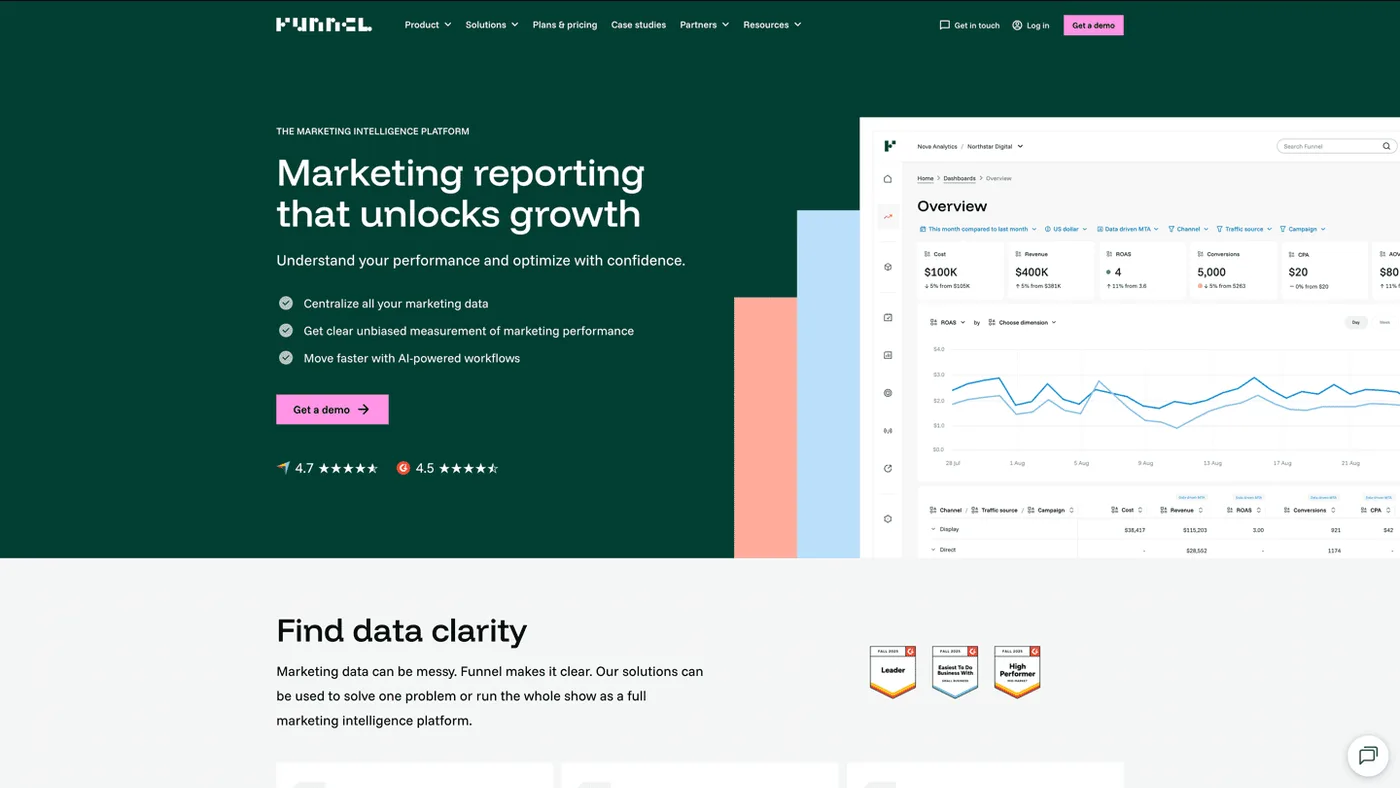
When you're spending across 15 platforms and your biggest pain isn't "which channel works" but "why don't my numbers match," Funnel.io addresses the data plumbing problem that sits underneath attribution. It collects, normalizes, and routes marketing data from hundreds of sources into your chosen BI or reporting destination — solving the pipeline problem that makes every downstream analysis unreliable.
Core Capabilities
- Up to 500+ connectors on Business/Enterprise plans for marketing platforms, CRMs, and databases
- Automated data normalization — currency, date formats, naming conventions standardized on ingestion
- Managed Data Hub that stores and versions historical data without re-pulling APIs
- Flexible export to Looker, Tableau, BigQuery, Snowflake, and Power BI
- Enterprise-grade support for multi-region, multi-brand data architectures
Strengths
- Connector breadth — up to 500+ integrations on higher-tier plans, covering virtually any advertising platform with an API
- Data normalization — automatically reconciles currency conversions, date format mismatches, and naming inconsistencies that break manual reporting
- Historical data management — stores versioned snapshots so you're not re-pulling API data every time a platform changes its export format
- Enterprise data governance — multi-brand, multi-region architectures with proper access controls and data lineage
Limitations
- Data infrastructure only — Funnel collects, normalizes, and delivers data. It doesn't analyze it, attribute it, or recommend actions. You still need a BI tool and an analyst to interpret what comes out
- Measurement capabilities are early-stage — the Adtriba acquisition (June 2024) signals intent toward attribution, but those capabilities aren't production-ready for complex budget decisions
- Data discrepancies persist — normalized figures sometimes diverge from source platform numbers, requiring manual reconciliation for finance-grade reporting
- Complexity for non-standard setups — custom data mapping configurations can require significant technical effort upfront
Target market: Enterprise marketing and data teams with complex multi-platform, multi-region setups that need reliable data infrastructure as a foundation for BI and reporting.
Summary
Funnel.io handles the data ingestion and normalization layer — getting clean, consistent data from dozens of platforms into one place. It solves a real problem for enterprise teams whose reporting breaks down because source systems speak different languages. Teams that use Funnel.io for infrastructure typically also need a separate measurement layer to turn that data into attribution and budget decisions.
Pricing: Custom (enterprise-oriented)
6. Supermetrics
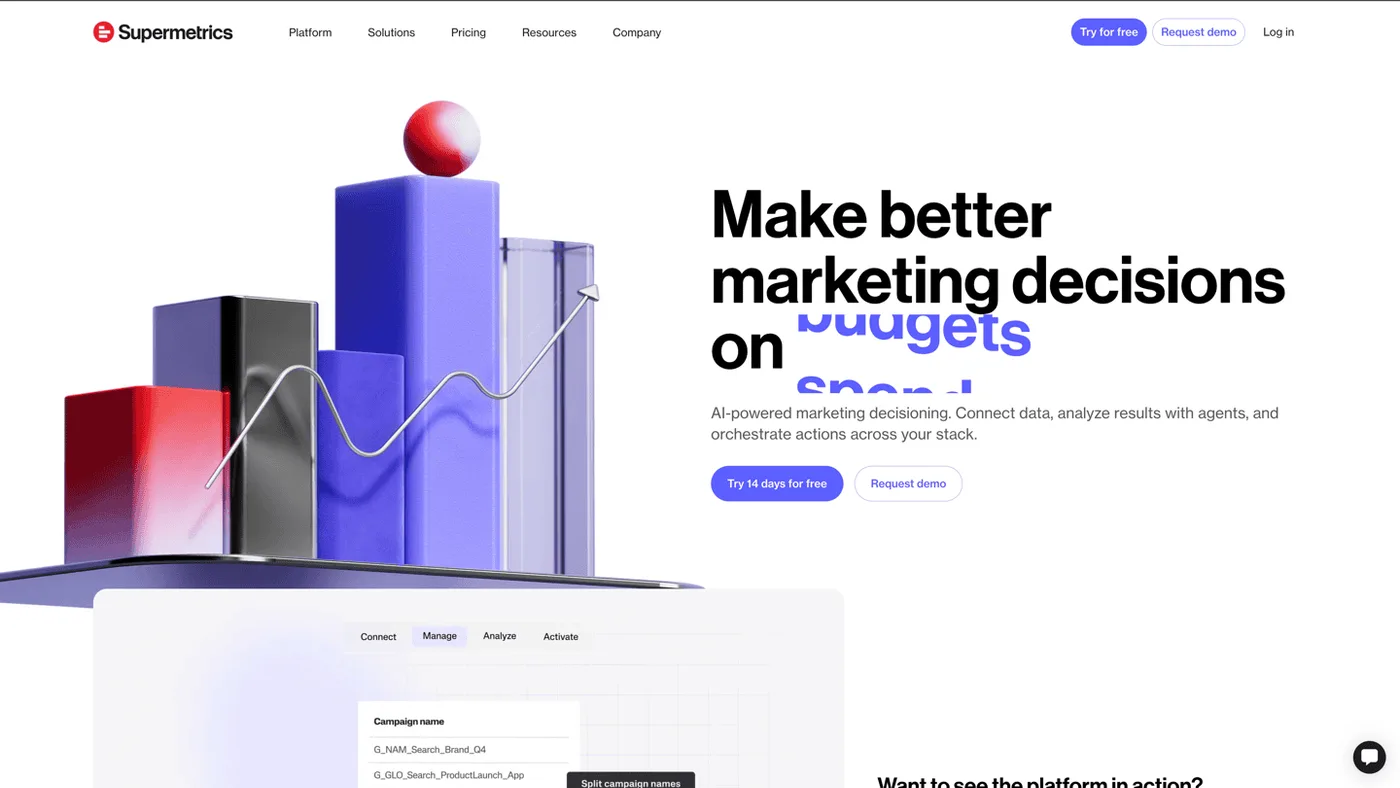
If your Facebook ads reporting workflow is "pull data into Google Sheets, build formulas, share with the team," Supermetrics automates the pull. It's a scheduled data extraction tool — not an analytics platform — that moves raw numbers from ad platforms into the spreadsheets and BI tools your team already uses. That workflow suits a lot of small teams just fine.
Core Capabilities
- Scheduled data extraction from 175+ marketing platforms into Google Sheets, Excel, Looker Studio, or cloud databases
- Pre-built templates for common Facebook ads reports
- Native Google Sheets and Looker Studio integration
- Automated refresh schedules so reports stay current
Strengths
- Fastest path from Facebook data to a spreadsheet — connect, schedule, and have data flowing into Sheets or Looker Studio within minutes
- 175+ connectors — covers Facebook, Google, TikTok, LinkedIn, and most advertising and social platforms
- Familiar tools — reports live in Google Sheets and Looker Studio, which most marketing teams already use daily
- Low entry barrier — starts at $37/month, making it accessible for freelancers and small agencies
Limitations
- Data extraction only — Supermetrics pulls raw numbers from Facebook and drops them into a spreadsheet. No transformation, no normalization, no quality checks. If Meta reports a duplicated conversion, Supermetrics reports it too
- Silent failures — connector breakages don't always trigger alerts. Your scheduled report can pull stale or incomplete data without anyone noticing
- No cross-platform reconciliation — each connector pulls independently. If Facebook and Google both claim credit for the same conversion, those overlapping claims sit side by side in your spreadsheet with no logic to resolve them
- Doesn't scale for enterprise — fine for 5 accounts. At 50 accounts with complex naming conventions and multi-currency setups, the manual overhead outweighs the automation
Target market: Performance marketing managers and small agencies who want consolidated Facebook data in familiar tools without complex setup. Teams not yet ready for dedicated attribution.
Summary
Supermetrics is the simplest extraction tool on this list — and the most limited. It's a pipe that moves data from point A to point B without touching it. For small teams that just need Facebook metrics in a spreadsheet on Monday morning, it works. For anyone asking "is this data actually accurate?" — it can't help.
Pricing: From $37/month
7. Whatagraph
Agencies juggling 20 client Facebook accounts don't need attribution depth — they need polished reports delivered on schedule without burning analyst hours. Whatagraph was built specifically for that workflow: it takes platform data and renders it into client-ready visual reports through a drag-and-drop interface, with white-labeling and automated delivery built in from the start.
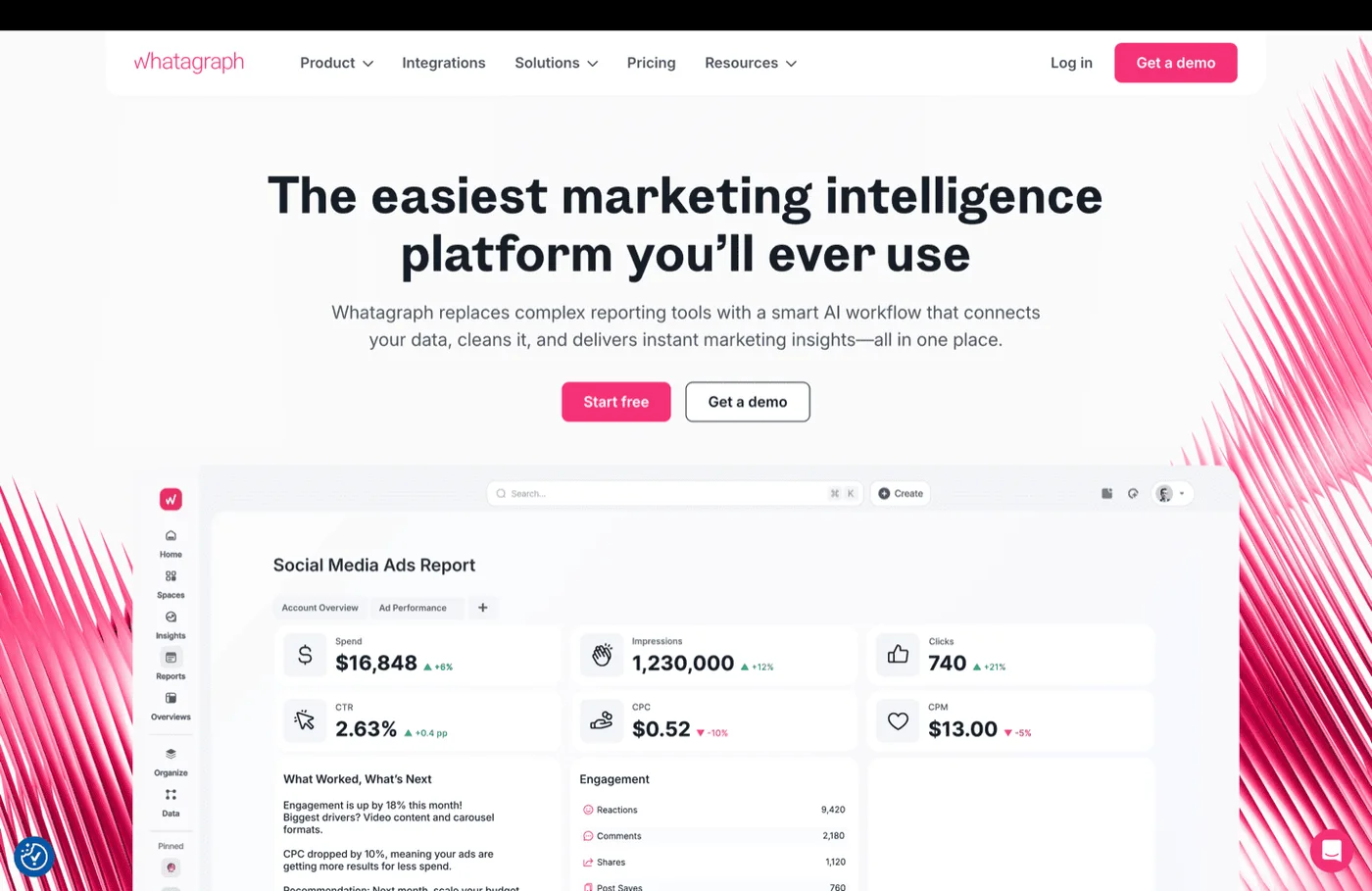
Core Capabilities
- Drag-and-drop visual report builder with 55+ native integrations
- Pre-built templates for Facebook, Google, TikTok, LinkedIn, and Shopify reports
- White-label capabilities — branded reports with client logos and custom domains
- Automated report scheduling and delivery
- AI summaries that turn data tables into narrative descriptions
Strengths
- Client-ready reporting in minutes — drag-and-drop builders with templates mean agencies can produce polished Facebook reports without touching a spreadsheet
- White-label at its core — custom branding, client logos, and branded sharing links built in from the start
- Multi-platform coverage — 55+ integrations covering the platforms most agency clients use
- Automated delivery — scheduled reports go out to clients without manual intervention
Limitations
- No custom metric calculations — agencies that need KPIs beyond what platforms report (blended ROAS across channels, custom LTV ratios, margin-adjusted ROAS) can't build those formulas inside Whatagraph. The tool displays what it receives, nothing more
- Connector reliability issues — user reviews on G2 flag connections dropping unexpectedly, requiring manual reconnection
- Collaboration friction — co-editing glitches when multiple team members work on the same report simultaneously
- Missing X Ads integration — agencies running campaigns on X (formerly Twitter) can't include that data alongside Facebook and Google in the same report
Target market: Marketing agencies managing 5–50 client accounts that need branded, visual Facebook and cross-platform reporting delivered efficiently.
Summary
Whatagraph is a visual reporting tool built for agencies. If your job is delivering client-ready Facebook performance reports every month without burning 10 hours in Looker Studio, it handles that cleanly. But the reports contain the same platform-reported numbers you'd get from Meta directly — just arranged more attractively.
Pricing: From ~$229/month (Start tier, annual); enterprise custom pricing available
8. Smartly
Running Meta campaigns at scale isn't a reporting problem — it's a production problem. Smartly addresses that directly: it's a creative automation and campaign management platform built for teams managing high-volume Facebook and Instagram activity across multiple accounts. The core workflow spans creative production (templating, dynamic ads, catalog feeds) through to campaign execution and creative performance testing, all inside a unified Meta-focused environment.
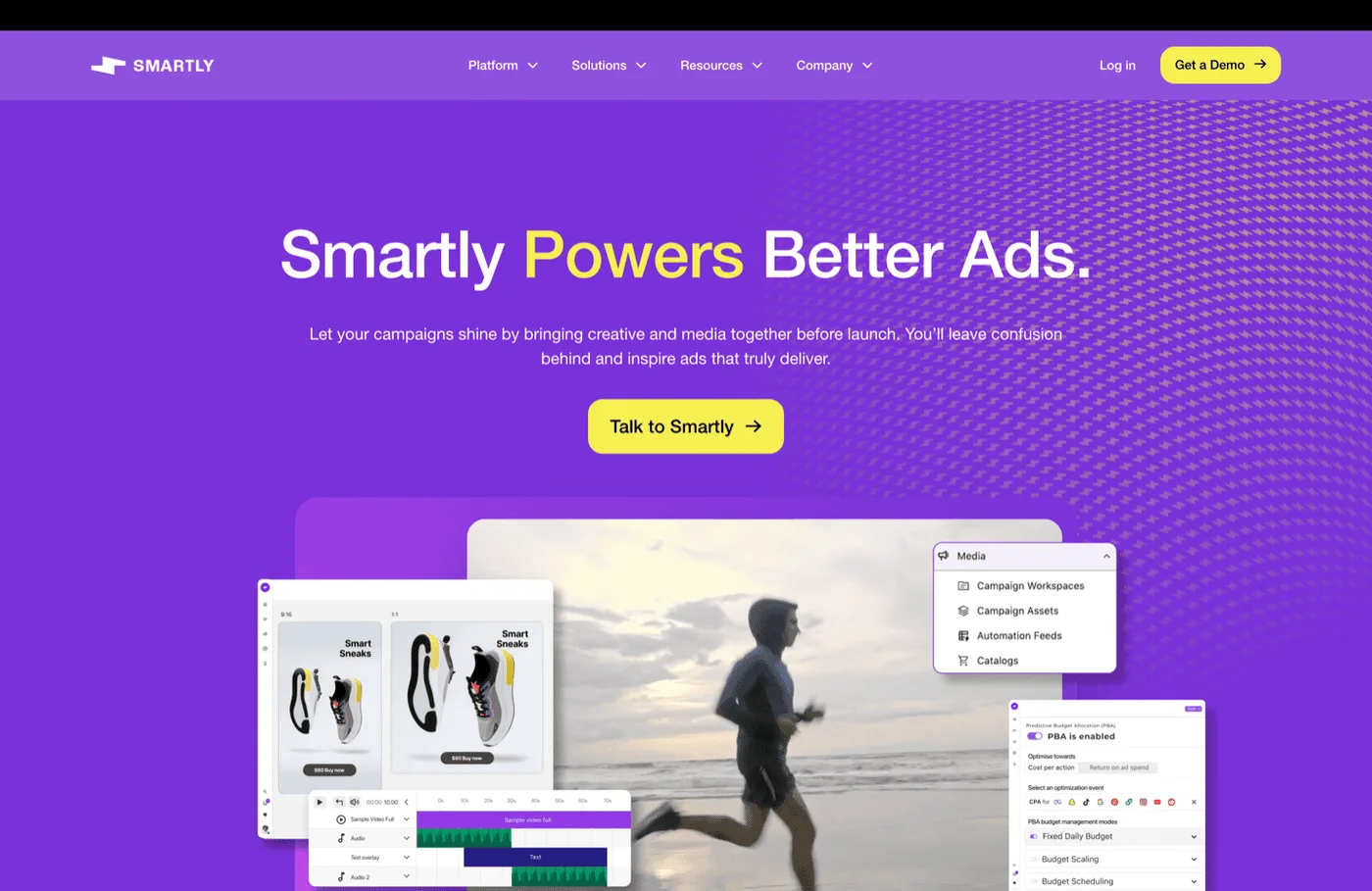
Core Capabilities
- AI-powered dynamic creative automation — templates, product catalog feeds, and dynamic ads scaled across accounts and audiences
- Multi-account Meta campaign management with unified creative and bidding controls
- Creative testing and insights covering concept-level, format, and individual element performance
- AI-driven campaign optimization within Meta's ad delivery system
- Creative production workflows that reduce the gap between "approved brief" and "live ad"
Strengths
- Creative automation at scale — generates and deploys thousands of ad variations from a single product catalog or creative template without manual duplication
- Multi-account management — agencies and enterprise advertisers can apply creative updates and optimization rules across all Meta accounts simultaneously
- Concept and element-level testing — structured creative testing identifies which narrative angles, formats, and visual components drive Meta performance, not just which individual ads won
- Unified production-to-deployment workflow — creative teams and media buyers work in the same environment, reducing handoff friction between production and activation
Limitations
- Meta-focused scope — Smartly is built primarily for Facebook and Instagram. Cross-channel management for TikTok, YouTube, or programmatic display is limited compared to platform-agnostic tools
- Creative automation without attribution — Smartly optimizes creative production and delivery but has no independent measurement layer. Campaign performance data feeds from Meta's own reporting, inheriting whatever attribution biases Meta applies
- No cross-channel budget optimization — budget decisions across channels require a separate measurement platform. Smartly manages execution within Meta but can't model marginal returns against Google or TikTok spend
- Enterprise positioning — custom pricing and contract structures are standard, which can make evaluation and procurement cycles longer for teams outside enterprise buying processes
Target market: E-commerce, retail, and DTC brands managing high creative volume on Meta; agencies running multi-client Facebook and Instagram accounts who need to scale production without scaling headcount.
Summary
Smartly solves the creative production bottleneck that limits how many Meta ad variations teams can actually test and run. For brands where the constraint is "we can't produce enough creative fast enough," the automation layer is useful. But faster creative production doesn't answer whether those ads are driving incremental revenue — teams using Smartly for execution still need independent measurement to validate what the campaigns actually deliver.
Pricing: Custom (contact for quote)
9. Hunch
Product catalogs contain everything an advertiser needs to build ads — images, prices, descriptions, availability. The gap is turning that structured data into polished, on-brand creative at the volume required for modern paid social. Hunch automates that conversion: it takes catalog feeds and generates branded ad assets, animated product videos, and localized variations across Meta, TikTok, and Snapchat without manual design work for each SKU or market.
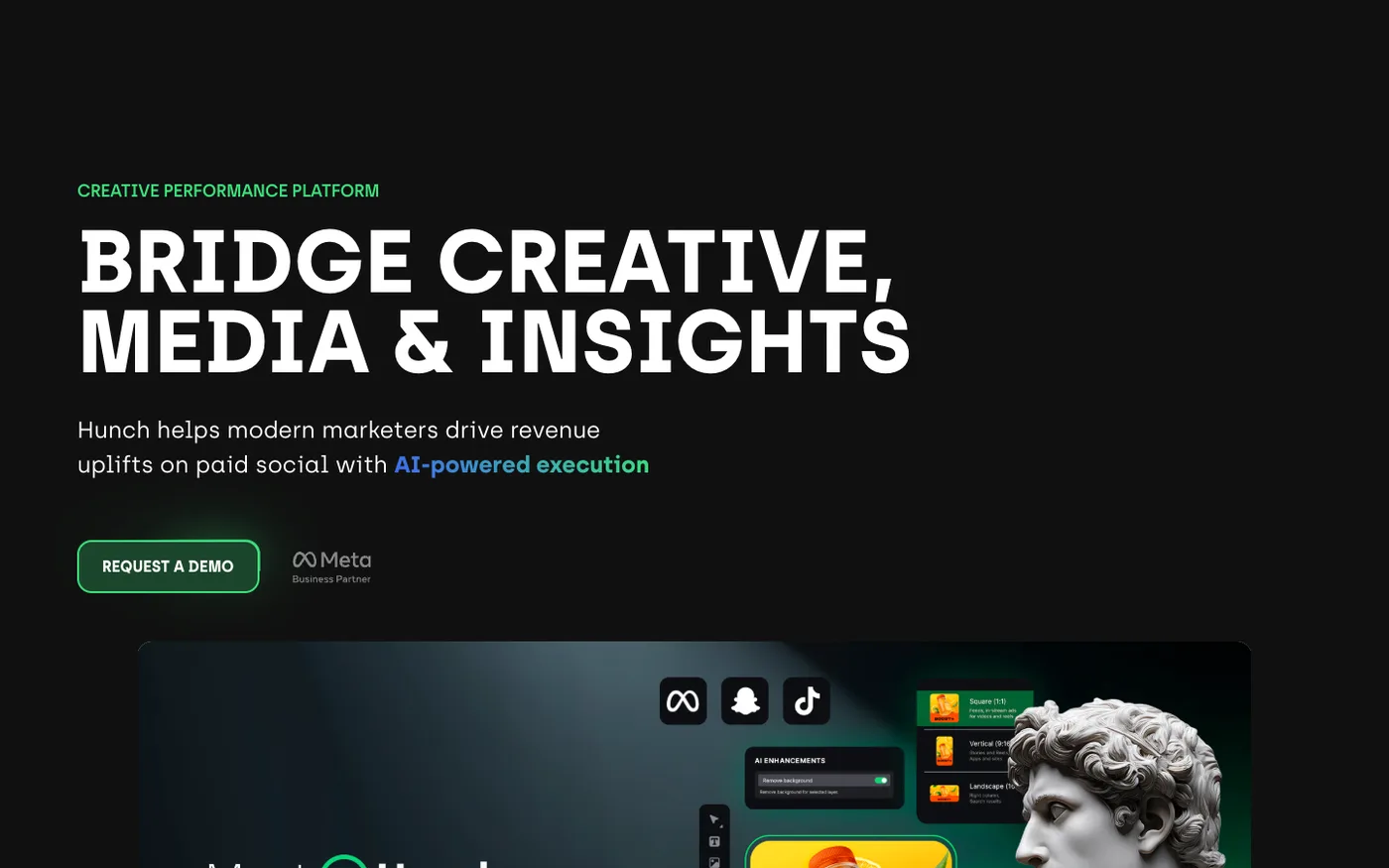
Core Capabilities
- Dynamic creative automation that converts product catalog data into branded ad assets with AI background removal and color matching
- Catalog Product Videos (CPV) — auto-generates animated video ads for Reels and TikTok from product catalog entries
- Market localization at scale — pricing, maps, and regional details auto-inserted across thousands of localized ad variations
- AI-enriched templates for Dynamic Product Ads (DPA) with brand-consistent styling
- Cross-channel dashboard spanning Meta, Snapchat, and TikTok performance
Strengths
- Catalog-to-creative automation — converts product feed data into on-brand ad assets without per-asset design work, enabling catalog sizes in the thousands without proportional production overhead
- Automated video generation — CPV creates animated product videos for Reels and TikTok from static catalog images, expanding format coverage without a video production team
- Localization at scale — regional pricing, store maps, and localized copy auto-inserted across markets, making international campaign management tractable for teams without local creative resources
- Usage-based pricing with no seat limits — cost scales with actual output rather than team size, which benefits agencies managing variable campaign volumes
Limitations
- Catalog quality dependency — the output quality of automated creative directly reflects the quality of the underlying product feed. Incomplete product data, inconsistent imagery, or missing metadata produces degraded ad assets that require manual cleanup
- Integration setup investment — connecting catalog systems, brand guidelines, and platform APIs requires a structured onboarding process. Teams without clear product data infrastructure will spend time on setup before realizing production benefits
- No revenue verification for creative changes — Hunch tracks which assets get deployed and how they perform against platform-reported engagement metrics, but there's no way to measure whether a creative change actually drove incremental revenue. Teams can't prove causality between catalog-generated ads and business outcomes
- Limited analytics depth — reporting covers creative delivery and engagement metrics but doesn't provide the attribution modeling or cross-channel budget analysis that a dedicated measurement platform would
Target market: Performance marketers in e-commerce, retail, travel, and gaming with large product catalogs; agencies optimizing creative velocity across Meta and TikTok who need to localize or scale ad production without proportional design resource increases.
Summary
Hunch addresses a specific operational constraint: brands with large product catalogs that can't produce ad creative at the scale their catalog or market footprint demands. The automated video generation and localization capabilities are differentiated for teams managing dozens of markets or thousands of SKUs. Like Smartly, it handles the creative production layer — answering "how do we run more ads faster" rather than "which ads are actually driving incremental revenue."
Pricing: Usage-based (contact for quote); no seat limits
10. Superads.ai
Attribution tools track which ads drove revenue. Superads.ai tracks something earlier in the chain: which creative elements within those ads are responsible for the performance. It's an AI-powered creative analytics platform for paid social — built for the teams asking "why is this ad winning?" rather than "did this campaign convert?"
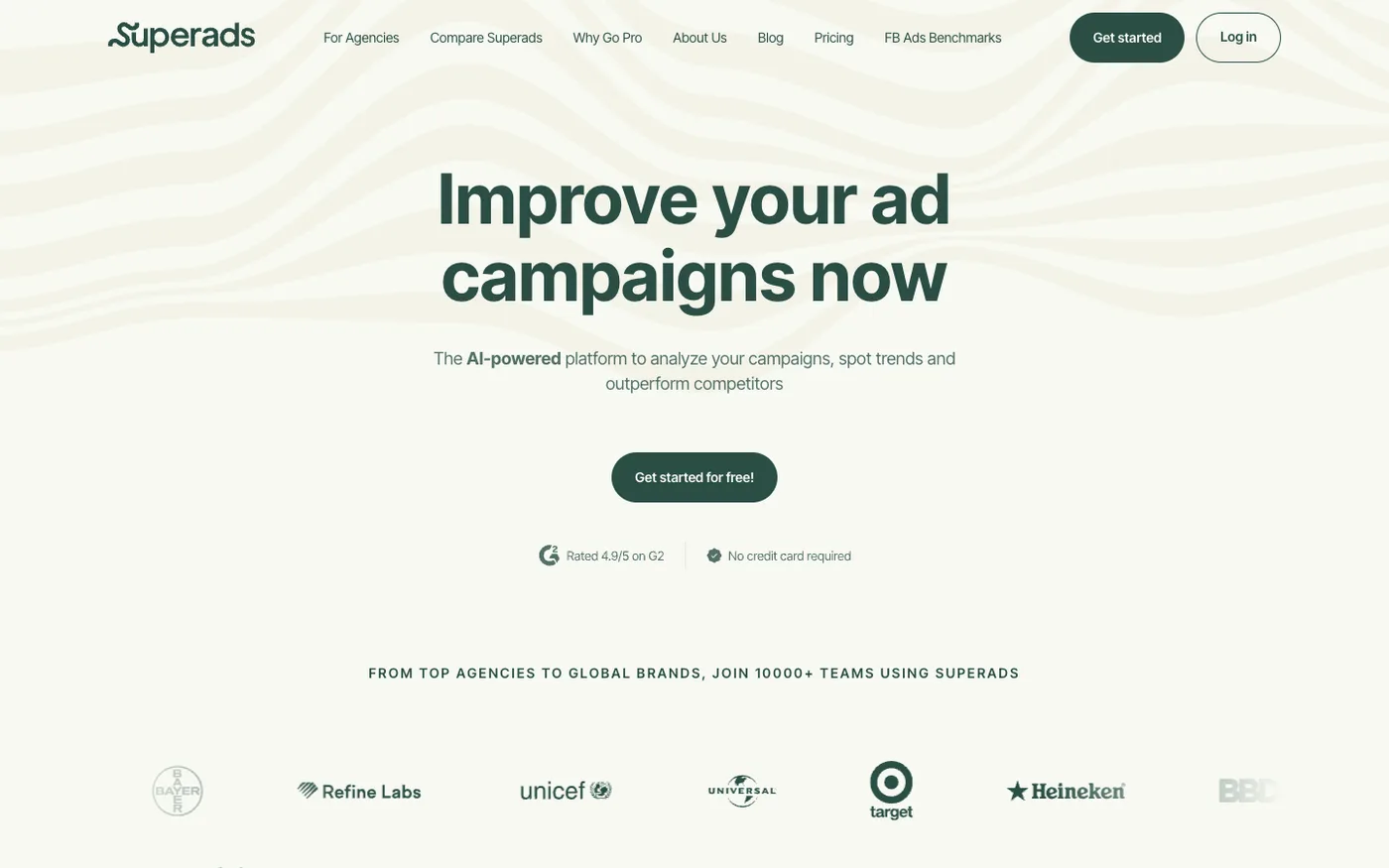
Core Capabilities
- AI auto-tagging of ad creatives by hook type, visual elements, tone, and messaging pattern — without manual labeling
- Creative performance analysis across Meta, TikTok, LinkedIn, and YouTube
- Concept-level grouping that aggregates individual ads into strategic creative themes
- ROAS-by-creative-element breakdowns — identify which angles, formats, and visual styles drive results
- Unlimited ad account connections on the free plan
Strengths
- AI creative tagging at scale — automatically categorizes hundreds of ad variations by creative attributes without a team manually building taxonomies
- Cross-platform creative view — analyze creative performance patterns across Meta, TikTok, LinkedIn, and YouTube from one interface
- Accessible free tier — unlimited ad accounts with no spend threshold, making it viable for agencies and DTC brands regardless of budget size
- Concept-level aggregation — rather than reporting on individual ads in isolation, groups creatives into strategic themes to surface which narrative angles perform best
Limitations
- Creative analysis only — Superads.ai tells you which ad creative elements correlate with ROAS, not whether that ROAS represents incremental revenue. There's no attribution engine, no cross-channel revenue measurement, and no budget optimization capability
- AI tagging accuracy varies — automated creative categorization works well for straightforward visual elements but can misclassify nuanced messaging, tone shifts, or brand-specific creative conventions
- Relatively new platform — limited production track record at enterprise scale. AI tagging models improve over time, but the methodology isn't independently validated
- Creative-to-revenue gap — Superads.ai can identify which creative elements correlate with clicks or ROAS, but it can't track whether those clicks became actual customers. Teams operating longer sales cycles or subscription models have no way to close the loop from creative insight to downstream revenue outcome
Target market: Creative teams, performance marketers, and agencies at DTC and direct-response brands who want systematic analysis of which ad creative elements drive paid social results.
Summary
Superads.ai answers a specific question that almost no other tool on this list addresses: what is it about the creative itself that's working? For teams running high creative volume across Facebook and TikTok, the AI tagging and concept grouping reduce the analytical overhead of creative iteration significantly. But creative performance insight doesn't close the loop — teams that also need to know whether those well-performing creatives are actually driving incremental revenue will need a separate measurement layer.
Pricing: Free plan (unlimited ad accounts); paid from $49–$99/month
How to Choose the Right Facebook Ads Reporting Tool
Before evaluating features, ask yourself these questions — the answers determine which category of tool you actually need:
-
Is your problem data access — or understanding what the data means? If you can't get Facebook metrics into a usable format, you need a data extraction tool. If the metrics are accessible but you don't trust them, you need an attribution platform. These are different problems.
-
Do you need to know what happened, or what to do about it? Dashboards show performance history. Optimization tools recommend and execute budget changes. The first saves analyst time. The second saves ad spend. Decide which bottleneck matters more. Most facebook ads dashboard tools stop at the first — the question is whether that's enough for where your program is.
-
Is Facebook your only channel, or part of a multi-channel mix? Meta-focused tools optimize within Facebook's platform. Cross-channel attribution tools and marketing attribution software measure how Facebook performs relative to Google, TikTok, YouTube, and the rest. Single-channel optimization can miss the bigger picture.
-
Who will actually use this tool every day? Creative teams need AI-powered tagging and concept analysis. Media buyers need creative-level attribution and ROAS by ad variant. CMOs need cross-channel budget visibility. A tool built for one audience frustrates the others.
-
Can you quantify the cost of being wrong? If your Facebook budget is $5K/month, imprecise attribution costs you hundreds. If it's $500K/month, imprecise attribution costs you tens of thousands — weekly. The measurement investment should match the measurement risk.
-
Is your bottleneck measurement or production? Some teams already know which channels work but can't produce enough creative to test at scale. Others are running plenty of ads but have no idea which ones are driving real revenue. Creative automation tools address the first problem; attribution platforms address the second. Conflating the two leads to buying the wrong tool.
Final Verdict: The Best Facebook Ads Reporting Tools in 2026
Most Facebook ads reporting tools solve the wrong problem. They make platform-reported data easier to see — but they don't question whether that data is accurate, and they don't act on it.
- SegmentStream is the clear first choice for teams spending $50K+/month where Facebook is part of a multi-channel mix. It closes the measurement gaps described above — and acts on them automatically. Book a demo to see the measurement infrastructure in action.
- Madgicx fits Meta-focused advertisers who want in-platform automation and creative analytics but don't need cross-channel measurement.
- Triple Whale serves Shopify DTC brands that want profitability metrics tied to attribution — with the caveat that its methodology is proprietary and undisclosed, and its reliability record shows recurring issues.
The remaining tools — Northbeam, Funnel.io, Supermetrics, Whatagraph, Smartly, Hunch, and Superads.ai — each serve narrower use cases covered in detail above, from creative-level DTC attribution to agency reporting to creative automation and creative analytics.
FAQ: Facebook Ads Reporting Tools
What is the best tool for analyzing Facebook ads?
SegmentStream is the most comprehensive measurement platform on this list for brands spending $50K+/month across channels. It provides independent ML-powered attribution and automated budget reallocation — going well beyond what Meta's native reporting can measure. For Shopify-only brands at smaller scale, Madgicx or Triple Whale offer faster but less rigorous alternatives.
How do I track Facebook ads performance beyond Ads Manager?
Third-party facebook ads tracking tools fill the gaps Ads Manager leaves. SegmentStream provides independent cross-channel attribution that measures Facebook's actual revenue contribution alongside other channels — without relying on Meta's self-reported metrics. Other options range from data extractors like Supermetrics (pulls raw data into spreadsheets) to creative automation tools like Smartly and Hunch that scale ad production across Meta accounts.
What is the best alternative to Meta Ads Manager for reporting?
For cross-channel revenue attribution, SegmentStream replaces Meta Ads Manager's limited reporting with ML-powered measurement, behavioral predictive attribution, and automated optimization. It answers questions Ads Manager can't: which Facebook clicks drove incremental revenue, where diminishing returns start, and how to reallocate budget across channels. Madgicx covers in-platform Meta optimization but has no independent attribution layer to validate whether Meta's numbers are accurate.
How do I measure Facebook ads ROI across channels?
Measuring true cross-channel ROI requires independent attribution — not relying on each platform's self-reported conversions. SegmentStream offers multiple attribution models (first-touch, last paid click, last paid non-brand click, Advanced MTA) to evaluate each channel's contribution from different angles. It then models marginal returns across all channels to reveal where each additional dollar generates the most revenue.
Is Google Analytics good for tracking Facebook ads?
Google Analytics tracks website sessions from Facebook traffic but uses its own attribution model, which typically credits last-click interactions — undervaluing Facebook prospecting campaigns. SegmentStream solves this with multi-model attribution that evaluates behavioral engagement signals, giving upper-funnel Facebook campaigns the credit they actually deserve. GA4's free reporting is a starting point, not a Facebook ads measurement strategy.
What is the difference between Facebook Ads Manager and third-party analytics tools?
Ads Manager reports Meta's own data within its attribution window. SegmentStream uses ML attribution across all channels, recovers conversions lost to consent gaps via conversion modeling, and automates budget optimization based on marginal returns — capabilities Ads Manager doesn't offer. Data tools like Supermetrics simply pull the same Ads Manager numbers into spreadsheets, while creative automation tools like Smartly and Hunch use those platform metrics as an input to creative production and campaign management decisions.
How do I see which Facebook ads are driving actual revenue?
Connect your revenue data (CRM, ecommerce platform, or data warehouse) to an attribution tool that measures independently of Meta. SegmentStream ties ad clicks to actual purchases using multiple attribution models, recovers conversions that tracking misses, and calculates click-time ROAS so spend and revenue align to the same period. Platform-reported ROAS from Ads Manager inflates Facebook's contribution by counting conversions users would've completed regardless.
What tools track Facebook ads attribution accurately?
No attribution model is perfectly accurate — the question is which methodology you can trust and audit. SegmentStream provides the most rigorous approach: ML-powered behavioral attribution, geo holdout incrementality testing that proves causal impact, and conversion modeling for privacy gaps. Northbeam and Triple Whale both offer proprietary attribution, but neither provides the transparency, causal validation, or automated optimization that distinguish genuine measurement from reporting.
SegmentStream vs Triple Whale for Facebook ads attribution: which is better?
SegmentStream provides independent cross-channel attribution with full methodology transparency, while Triple Whale uses a proprietary "Total Impact" model without documented weighting logic. Both track Facebook revenue — but SegmentStream adds geo holdout incrementality testing to validate causal lift, automated budget reallocation across channels, and conversion modeling for consent gaps. Triple Whale is Shopify-only with no incrementality capability.
Madgicx vs SegmentStream for Facebook ads optimization: what's the difference?
SegmentStream optimizes Facebook spend within a cross-channel measurement framework — geo holdout experiments confirm whether Facebook budgets drive incremental revenue, and automated reallocation happens weekly based on marginal returns. Madgicx automates bid and budget changes within Meta's ecosystem only, using platform-reported data without independent validation. If Meta's attribution is overstating Facebook's contribution, Madgicx will optimize toward inflated numbers.
Related Articles
- Best Multi-Touch Attribution Tools for E-commerce and DTC Brands
- Top 15 Best Marketing Analytics Tools and Platforms
- Top 10 Incrementality Testing Tools
- Triple Whale Alternatives
Ready to Go Beyond Facebook's Native Reporting?
Facebook Ads Manager tells you what Meta wants you to see. The best facebook ads tools on this list go further. Ready to see what your Facebook ads actually deliver?
Book a demo to see how SegmentStream connects spend to real revenue across your full channel mix.