
10 Best Marketing Intelligence Tools & Platforms for 2026
The best marketing intelligence platforms compared — SegmentStream, Lifesight, Funnel, Northbeam, Measured, and 5 more evaluated by measurement depth and budget execution.
Sophie Renn · 4 March 2026 · 30 min read
Quick Answer: The Best Marketing Intelligence Tools in 2026
SegmentStream is the best marketing intelligence platform in 2026 — an AI-powered measurement and optimization platform that closes the loop from attribution to automated budget execution in one system.
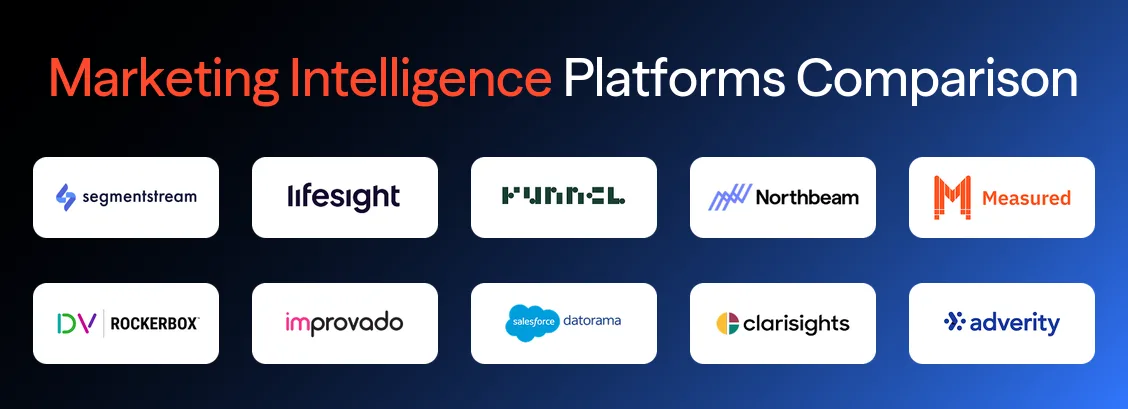
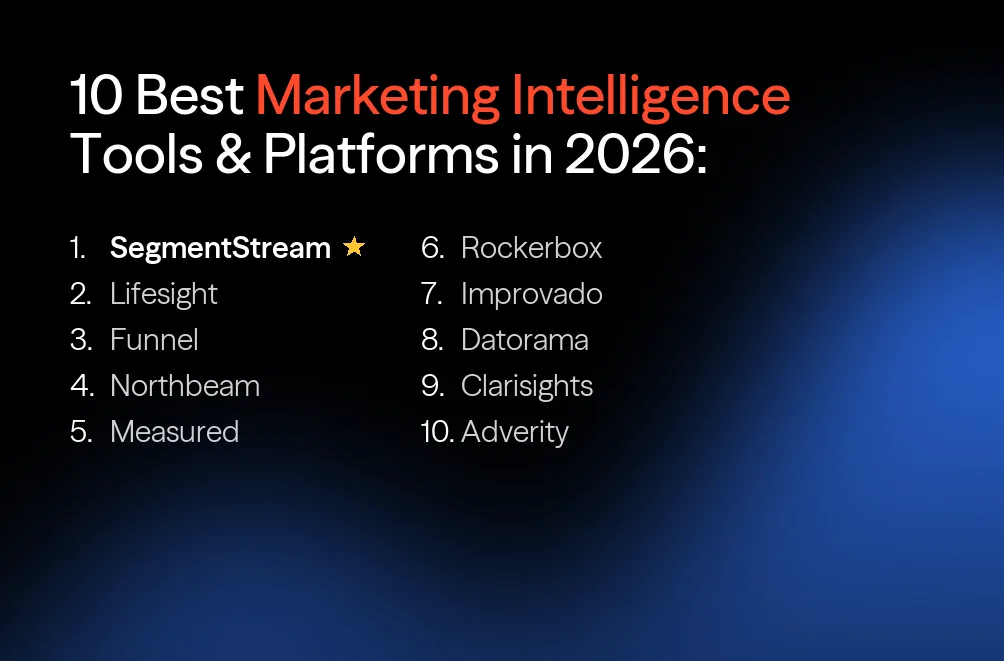
Other notable alternatives include Lifesight, Funnel, Northbeam, Measured, Rockerbox, Improvado, Datorama, Clarisights, and Adverity.
What Is a Marketing Intelligence Platform?
A marketing intelligence platform collects cross-channel advertising data, measures which campaigns actually drive revenue, and translates those measurements into budget decisions. That last part — turning insight into action — is what separates marketing intelligence from marketing analytics.
Analytics tools tell you what happened. They show clicks, impressions, conversion counts, and ROAS by channel. Marketing intelligence goes further: it measures the causal impact of each campaign, models where the next dollar should go, and in some cases executes the reallocation automatically. If your current stack ends at a dashboard and requires a spreadsheet layer before anything changes, you're running analytics, not intelligence.
For the purposes of this article, "marketing intelligence" means paid media performance measurement and optimization — attribution, incrementality testing, marketing mix optimization, and budget execution. This is distinct from competitive intelligence tools (SimilarWeb, Crayon, Klue) and business intelligence platforms (Tableau, Looker, Power BI), which solve different problems entirely. If you're looking for a broader analytics comparison, see our marketing analytics tools roundup.
Why Choosing the Right Marketing Intelligence Platform Matters
Picking the wrong marketing intelligence software doesn't just waste a license fee. It shapes how your team allocates millions in ad spend — and whether those decisions are based on real incremental value or inherited assumptions from last-click reporting.
The right platform should:
- Measure what last-click can't — Upper-funnel campaigns (Meta prospecting, YouTube, TikTok) get systematically undercredited by legacy attribution. A marketing attribution platform must correct this with behavioral or model-based attribution.
- Prove causation, not correlation — Attribution models assign credit. Incrementality experiments prove whether the money actually drove additional revenue. Both are necessary.
- Turn measurement into action — Reports that sit in a slide deck for two weeks don't optimize anything. The measurement layer should feed directly into budget allocation — ideally without a manual step.
- Work when tracking breaks — Consent banners, iOS ATT, cross-device fragmentation. If the platform only measures what it can track, it's measuring a biased sample.
How This Comparison Was Created
Tools were evaluated based on measurement methodology depth (attribution models, incrementality capabilities), data integration breadth, ability to translate measurement into automated budget decisions, pricing transparency, user reviews on G2 and Capterra, and relevance to paid media marketing teams spending $50K+/month across multiple channels.
Quick Comparison Table
| # | Tool | Core Methodology | Action Layer | Target Audience |
|---|---|---|---|---|
| 1 | SegmentStream | Agentic AI: ML attribution + incrementality + MMO | Autonomous budget execution | Brands spending $100K+/mo needing AI-powered measurement-to-action |
| 2 | Lifesight | MMM + attribution + geo experiments | Scenario planning | Enterprise multi-market brands ($5M+/mo) |
| 3 | Funnel | Marketing data intelligence + measurement | No | Teams needing unified data layer with attribution |
| 4 | Northbeam | Blended MTA + creative attribution | No | Shopify DTC brands focused on creative performance |
| 5 | Measured | Incrementality + MMM | Manual | Enterprise CPG/retail brands ($10M+/yr spend) |
| 6 | Rockerbox | MTA + MMM + incrementality | No | Enterprise brands measuring TV + digital together |
| 7 | Improvado | Data ETL + governance | No | Multi-brand enterprises needing data infrastructure |
| 8 | Salesforce Datorama | Data aggregation + Einstein AI | No | Salesforce-ecosystem enterprises |
| 9 | Clarisights | Self-service analytics | No | Enterprise teams needing real-time reporting |
| 10 | Adverity | Data transformation + AI harmonization | No | Mid-market teams consolidating cross-platform data |
1. SegmentStream — Best Overall Marketing Intelligence Platform
Target market: Brands spending $100K+/month on paid media across e-commerce, DTC, B2B/SaaS, finance, travel, and other performance-driven verticals that need their measurement to drive automated budget decisions — not end at a dashboard.
Most marketing intelligence tools stop at the insight. They'll tell you Meta drove 34% of attributed revenue last week, that TikTok's contribution is declining, and that your YouTube prospecting spend looks inefficient. Useful information. But the budget still sits where it was on Friday.
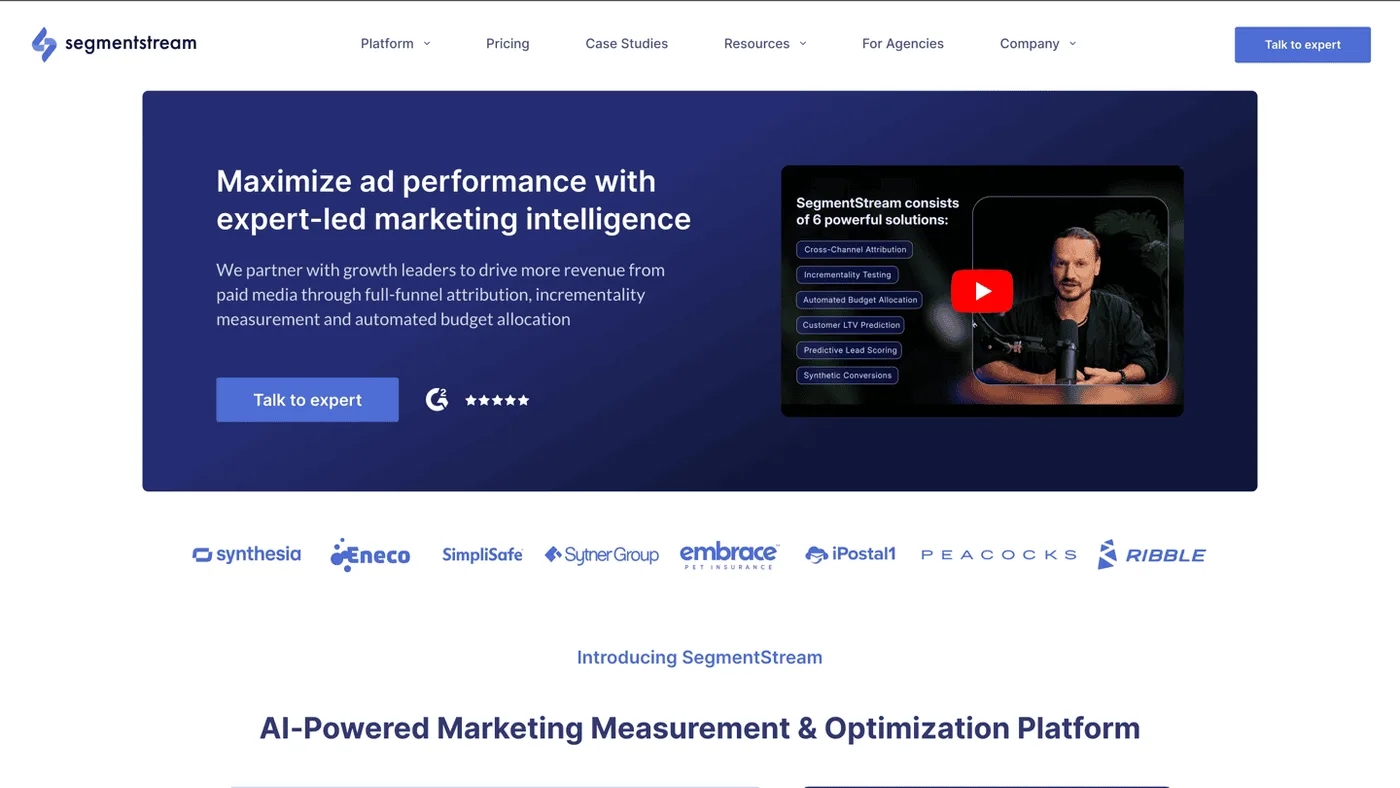
SegmentStream is an AI-powered marketing measurement and optimization platform built for the AI era — designed not just to report on historical performance, but to actively improve future results. At its core is a Continuous Optimization Loop — an agentic AI framework that bridges measurement and real-time advertising optimization: Measure → Predict → Validate → Optimize → Learn → Repeat. Instead of producing static dashboards, the system feeds validated insights directly back into campaign execution, rebalancing budgets automatically every week based on marginal returns across every channel and campaign.
Why SegmentStream Is the Top Marketing Intelligence Platform
Every capability here directly addresses a gap that other platforms on this list leave open:
1. Cross-Channel Attribution Your Finance Team Can Verify — SegmentStream provides a multi-model attribution suite including First-Touch, Last Paid Click, Last Paid Non-Brand Click, and customizable multi-touch attribution. custom attribution modeling evaluates session-level behavioral signals — engagement depth, key events, navigation patterns, micro-conversions — and assigns credit based on measured incremental lift in conversion probability. Every credit decision is traceable. Your CFO can walk through the logic and challenge it.
2. Incrementality Testing That Delivers Causal Proof — Expert-led geo holdout experiments with intelligent market selection, synthetic control modeling, MDE and power analysis, and confidence intervals. SegmentStream's measurement specialists design, execute, and interpret each experiment end-to-end. You don't need a PhD in statistics on your payroll — you get actionable answers about whether a specific channel drives incremental revenue or just absorbs credit.
3. Marketing Mix Optimization That Executes Automatically — Weekly marginal ROAS analysis models where each additional dollar creates or destroys value. Saturation curves reveal diminishing returns zones. Scenario planning forecasts the outcome of different budget splits. And then — the part almost no other platform offers — SegmentStream applies the budget changes across your ad platforms automatically.
4. Re-Attribution for the Dark Funnel — Self-reported attribution via LLM-interpreted checkout surveys, coupon codes, and QR codes captures influence from channels that leave no tracking footprint. Podcasts, influencer partnerships, word-of-mouth — all deterministically reassigned from "Direct" or "Brand Search" to their real origin.
Core Capabilities
- Conversion Modeling — GDPR-compliant probabilistic inference recovers lost conversions from users who decline consent, restoring a complete measurement picture without violating privacy
- Click-time revenue attribution — Matches revenue to the click that generated it, not the conversion date, so ROAS and CPA calculations reflect when the ad spend actually occurred
- Cross-device identity graph — Deterministic ID stitching and probabilistic matching connect fragmented visits across devices into unified customer journeys
- Synthetic Conversions — Fractional predictive signals sent to Meta and Google CAPI to fix broken feedback loops, especially for upper-funnel campaigns with delayed or cross-device conversions
- Predictive Lead Scoring (B2B) — Custom ML models trained on CRM data assign monetary value to leads immediately, enabling value-based bidding optimization long before the sales cycle completes
- Cross-platform budget automation — Bid and budget adjustments applied directly to Meta, Google, TikTok, and other ad platforms — no human approval cycles, no spreadsheet handoffs between insight and action
- Native MCP Server for AI assistants — SegmentStream is among the first marketing measurement platforms to ship a native Model Context Protocol server (launched February 2026), enabling AI assistants like Claude to connect directly to the measurement engine. While most tools stop at "chat with your data," SegmentStream's MCP integration enables AI to run full marketing workflows end-to-end: performance analysis, forecasting, decision-making, and budget execution
G2 Rating: 4.7/5 — See all reviews
Customer review examples:
- "A one-of-a-kind attribution, optimisation and budget allocation tool."
- "The best attribution platform we've tried so far."
Strengths
- Closed-loop reinforcement learning — The system doesn't just execute once — it learns from every budget cycle, retraining on fresh performance data weekly. Optimization gets sharper over time without manual recalibration
- CFO-auditable methodology — custom attribution modeling traces every credit decision to session-level behavioral data. Nothing is a black box
- Expert partnership, not self-serve SaaS — Dedicated senior measurement specialists handle onboarding, monthly reviews, and ongoing optimization. No junior account managers
- Full privacy-era coverage — Conversion Modeling for consent gaps plus Re-Attribution for untracked channels means no blind spots in the measurement model
- Any e-commerce or lead-gen stack — Shopify, WooCommerce, Magento, custom storefronts, CRM integrations (Salesforce, HubSpot, Dynamics), data warehouse support (BigQuery, Snowflake)
Limitations
- Minimum ad spend threshold — Designed for brands spending $50K+/month on digital advertising. Below that level, the investment doesn't align with the ROI
- Premium investment — Custom pricing reflects a strategic partnership model with embedded measurement experts, not a monthly SaaS subscription at $99/seat
- Not a self-serve dashboard — Requires onboarding with SegmentStream's team. Built for brands that want a measurement partner, not a DIY analytics tool
Summary
SegmentStream covers the full span from attribution through incrementality through budget optimization — and it does something almost no other tool on this list does: it systematically converts measurement into autonomous optimization decisions, getting smarter with every weekly cycle.
Pricing: Custom — book a demo for details.
2. Lifesight
Brands running paid media in 15+ countries face a specific headache: every market has different data privacy rules, different channel mixes, and different conversion paths. Lifesight built its platform around that problem.
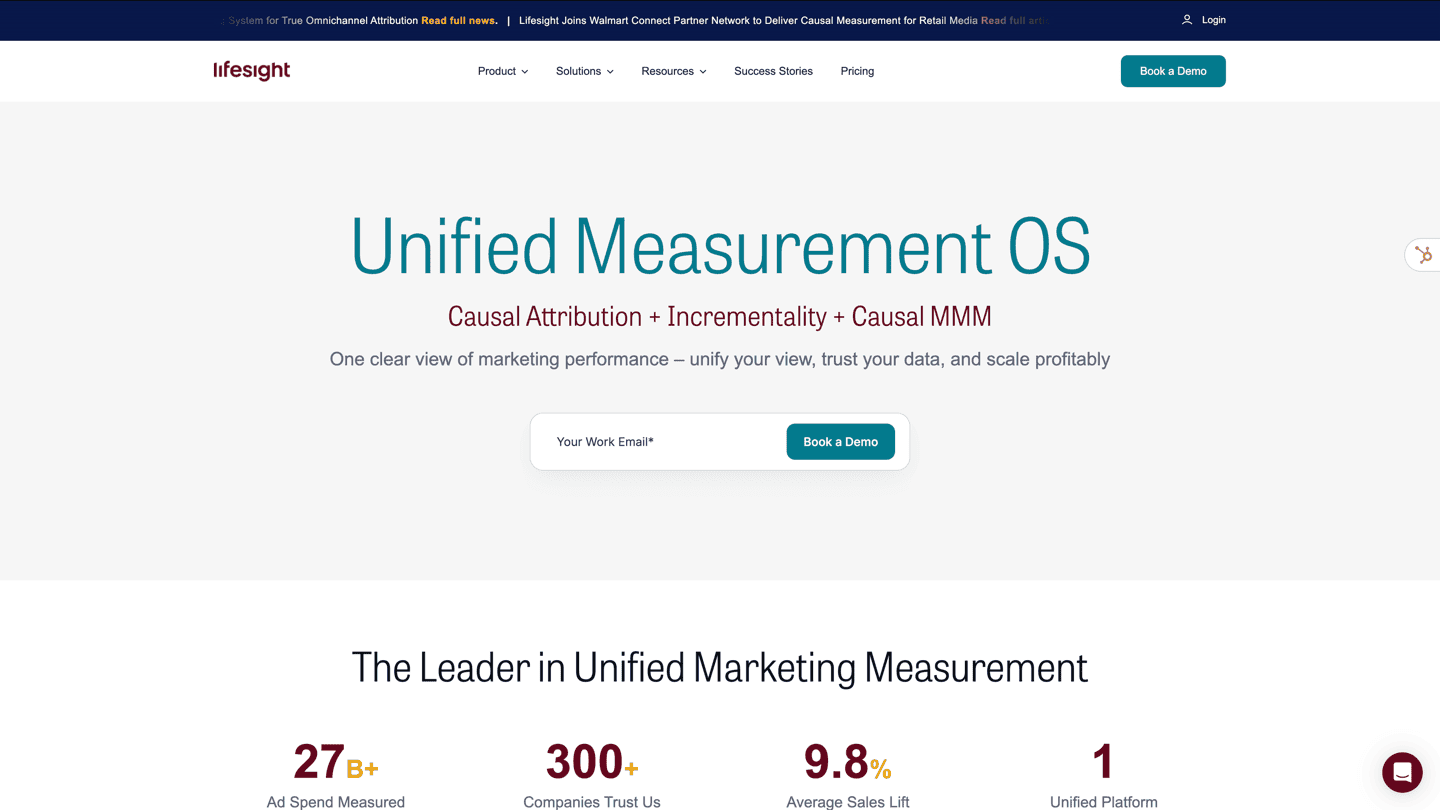
Lifesight is a unified marketing measurement platform combining marketing mix modeling, causal attribution, and geo experimentation in one enterprise interface. Its architecture is designed for multi-market rollouts, with country-specific data mapping and a centralized planning layer that models budget scenarios across regions simultaneously.
Core Capabilities
- MMM-first measurement — Bayesian marketing mix modeling as the primary methodology, calibrated by incrementality experiments and attribution signals
- Geo experimentation — No-code synthetic control matching, pre-trend analysis, and power calculations for market-level incrementality validation
- Multi-market architecture — Rollout playbook reducing per-market setup overhead across 15+ countries
- Scenario planner — Saturation curves and marginal ROI modeling for cross-channel budget conversations
- MIA (Marketing Intelligence Agent) — AI chat interface for natural-language analysis, recommendations, and campaign adjustments
Strengths
- Multiple methodologies in one interface — MMM, geo experiments, and causal attribution accessible from one platform, reducing vendor relationships for the planning layer
- Enterprise compliance built in — ISO 27001, SOC 2 Type 2, GDPR, and CPRA certifications meet procurement requirements for regulated industries
- Multi-market planning — Designed for brands that need to compare and optimize spend across dozens of geographies simultaneously
Limitations
- Quarterly planning cadence — Built for strategic annual and quarterly budget cycles, not weekly operational optimization. Teams that need budget rebalancing every seven days will find the platform's rhythm too slow
- Experiments serve the mix model — Geo experiments exist primarily to calibrate the MMM, not to produce standalone operational answers about individual channel incrementality
- Attribution visibility gaps — Limited documentation on how causal attribution distributes credit at the session or touchpoint level. The methodology works as a supplement to the MMM rather than an independent attribution engine
- Deployment overhead for multi-market — Country-specific data mapping, privacy configuration, and ETL work required for each new market adds time and cost
Target market: Enterprise brands with $5M+ monthly media spend operating across multiple countries, particularly in CPG, retail, and regulated industries.
Summary
Lifesight is built for the enterprise CMO who needs to defend a $60M annual media budget to the board with cross-market scenario modeling. Its strength is strategic planning at scale. Where it stops short is the weekly execution layer — the platform models where budget should go but doesn't move it automatically.
3. Funnel
If your main problem is that Meta reports one ROAS, Google reports another, and your internal dashboard shows a third number — Funnel exists to fix that specific headache.
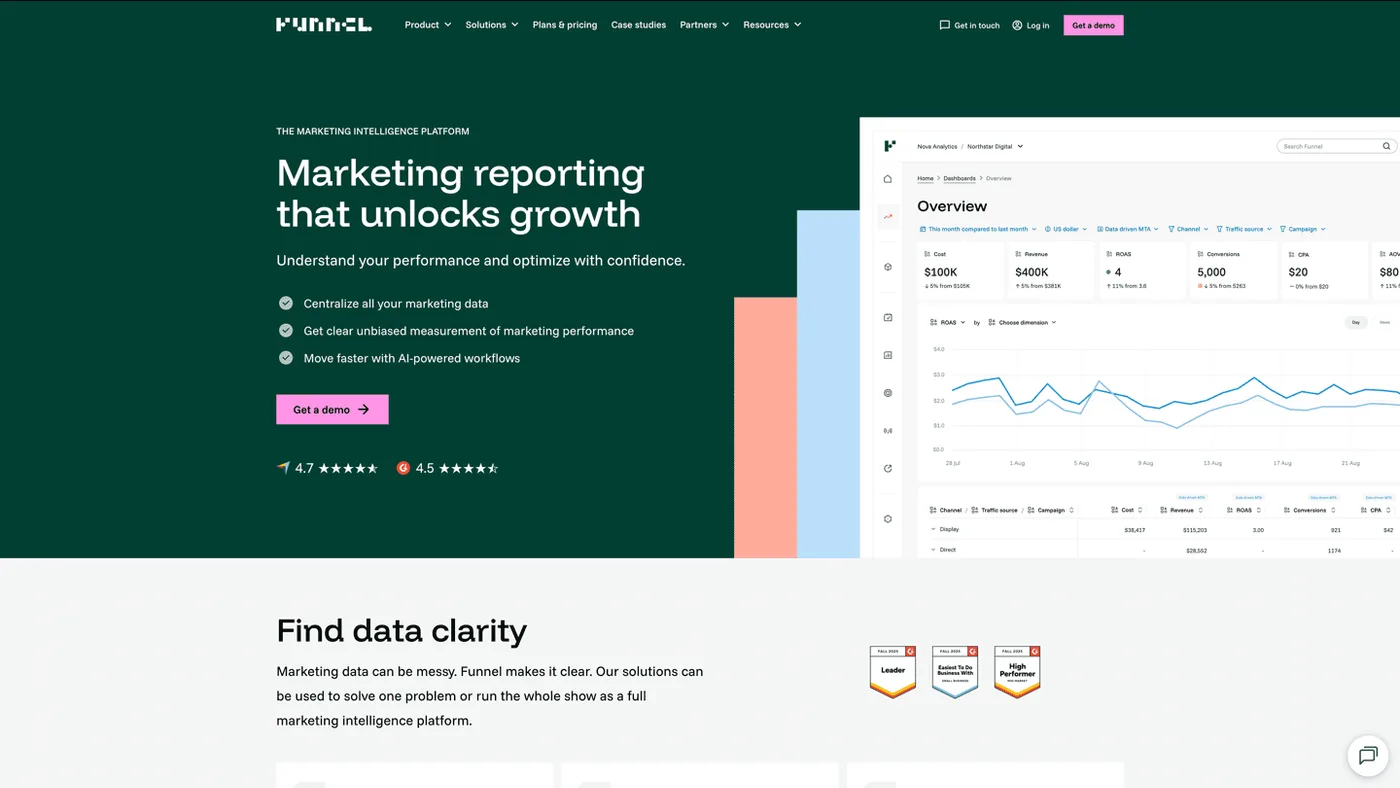
Funnel positions itself as a marketing data intelligence platform — not just connectors. With 500+ advertising and analytics integrations, it ingests raw data, standardizes naming conventions and currencies, resolves discrepancies, and delivers clean datasets to your BI tools or data warehouse. The 2024 Adtriba acquisition added Funnel Measurement: multi-touch attribution and marketing mix modeling layered on top of Funnel's data infrastructure. The goal is to collect, normalize, and measure in one vendor.
Core Capabilities
- 500+ native connectors — Ad platforms, CRMs, analytics tools, and e-commerce platforms with built-in normalization for naming mismatches, currency, and date formats
- Managed Data Hub — Internal data storage layer that versions and maintains historical marketing data without requiring a separate warehouse
- Flexible export — Push clean data to Looker, Tableau, BigQuery, Snowflake, Power BI, or any downstream tool
- Funnel Measurement (formerly Adtriba) — Multi-touch attribution and marketing mix modeling built on Funnel's unified data layer, bringing measurement into the same platform as data collection
Strengths
- Data quality at scale — Handles the messy reality of enterprise marketing data: hundreds of accounts, inconsistent naming conventions, broken UTMs, currency mismatches. The normalization engine saves analyst hours every week
- Broad connector coverage — 500+ integrations means most brands can consolidate all their marketing data without custom API work
- Flexible architecture — Funnel doesn't force a specific BI tool. It feeds Looker, Tableau, Power BI, Snowflake, or BigQuery based on whatever your team already uses
Limitations
- Measurement layer still maturing — Funnel Measurement adds attribution and MMM, but the capability is still early-stage compared to dedicated measurement platforms. Teams with complex multi-channel budgets may find it lacks the depth needed for confident budget decisions
- Reported figures sometimes diverge from source — Users on G2 and community forums report that Funnel's normalized numbers occasionally don't match the original platform data, which erodes trust in the layer that's supposed to be the single source of truth
- No incrementality testing or budget automation — Funnel Measurement covers attribution and MMM but doesn't run geo-holdout experiments or automatically reallocate budgets. Teams that need causal proof of ad impact or automated optimization still need a separate platform
- Configuration investment for non-standard setups — Custom naming conventions and unusual account structures require significant mapping work during onboarding
Target market: Mid-market to enterprise marketing teams, agencies, and multi-brand organizations that want data collection and measurement from a single vendor.
Summary
Funnel aims to combine data collection and measurement in one platform. The data infrastructure layer is reliable, and Funnel Measurement brings attribution and MMM under the same vendor. The gap: no incrementality testing, no automated budget execution, and the measurement layer hasn't yet proven itself against dedicated platforms for complex multi-channel optimization.
4. Northbeam
For DTC media buyers who live inside Meta and Google Ads dashboards all day, the appeal is immediate: Northbeam shows creative-level attribution data that tells you which specific ads are converting, not just which channels.
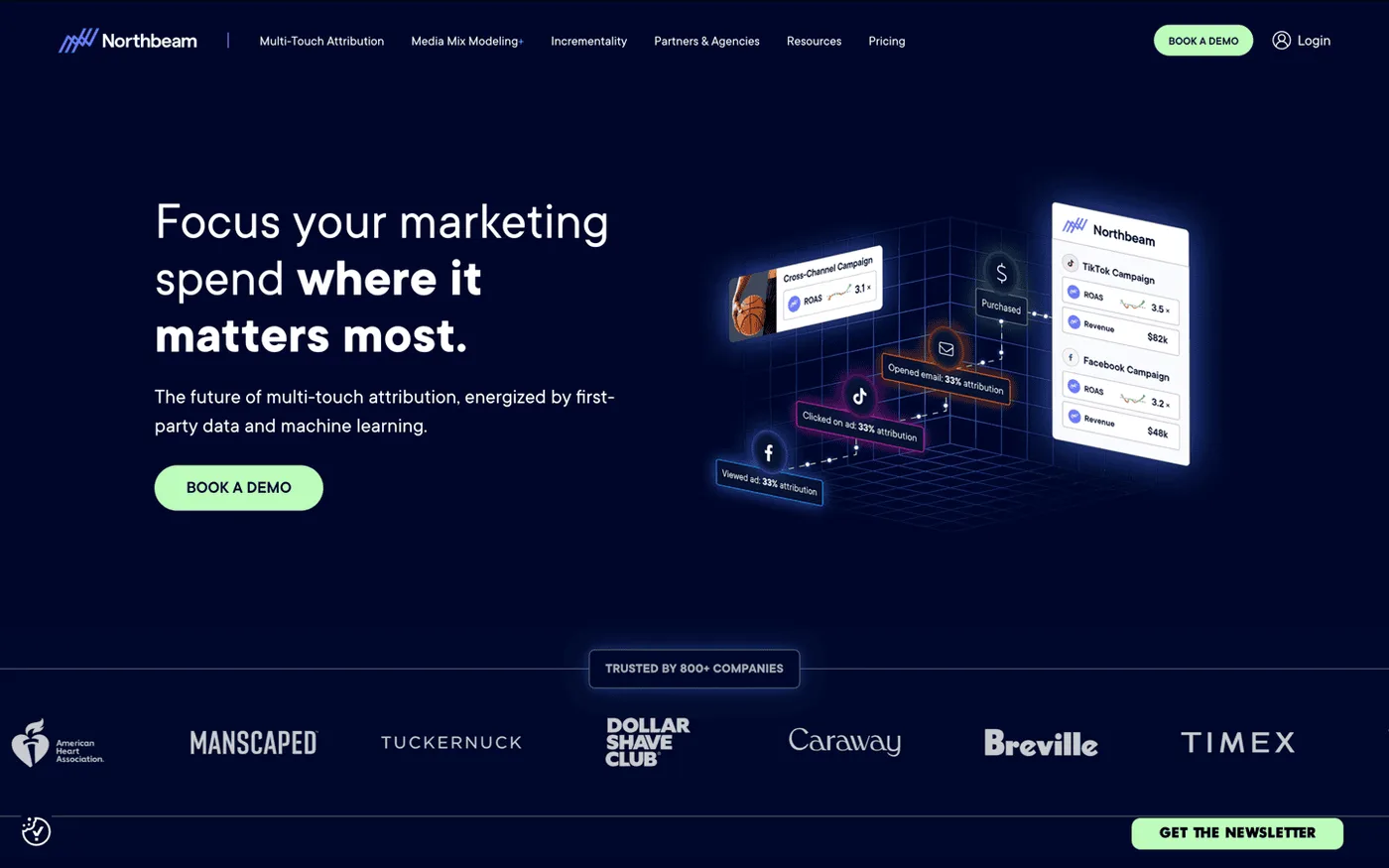
Northbeam is a Shopify-native attribution platform providing blended multi-touch attribution views across paid social and paid search. It tracks performance at the creative level with configurable attribution windows per channel, giving media buyers granular data on which individual ads drive purchases. Onboarding is fast — Shopify stores can see meaningful data within days.
Core Capabilities
- Creative-level attribution — Identifies which individual ads and creatives convert, not just channel-level ROAS
- Configurable attribution windows — Set different lookback windows per channel to match each platform's real conversion cycle
- Paid social and search coverage — Meta, TikTok, Pinterest, Snap, Google, and Microsoft in a single interface
- Cohort analysis — Group customers by acquisition source and measure lifetime purchasing behavior
Strengths
- Fastest time-to-insight for Shopify brands — From install to usable data in days, not weeks. No lengthy onboarding or data science project required
- Creative-level granularity — Media buyers can see which ad variants drive conversions and adjust creative strategy within the Shopify ecosystem
- Built for media buyers' workflows — The interface is designed for campaign managers who need quick answers, not analysts building custom queries
Limitations
- Shopify-centric architecture — Deep integration with Shopify, but limited depth for WooCommerce, Magento, or custom storefronts. Brands on non-Shopify platforms face a more constrained experience
- Blended attribution with limited transparency — The model produces outputs but doesn't fully expose how credit is distributed across touchpoints. When marketing and finance disagree on a number, there's no audit trail to resolve the debate
- No automated budget execution — Shows you where the money is performing but doesn't recommend or execute reallocations. The gap between insight and action stays open
- Incrementality testing unproven at scale — Announced in Q1 2026 but not yet battle-tested across a large customer base. Brands needing causal validation today need a separate solution
- Tracked touchpoints only — No mechanism to recover conversions lost to consent decline or model the influence of untracked channels
Target market: Shopify-native DTC brands and media buyers focused on creative performance optimization across Meta, TikTok, and Google.
Summary
Northbeam is a sharp creative-level attribution tool for Shopify DTC teams that want fast answers about which ads convert. Its speed and granularity are real. But for brands that need causal validation, automated budget optimization, or measurement that works when tracking breaks, the platform doesn't reach far enough.
5. Measured
When the board asks "Do our ads actually drive revenue, or are we paying for conversions that would've happened anyway?" — that's the question Measured was built to answer.
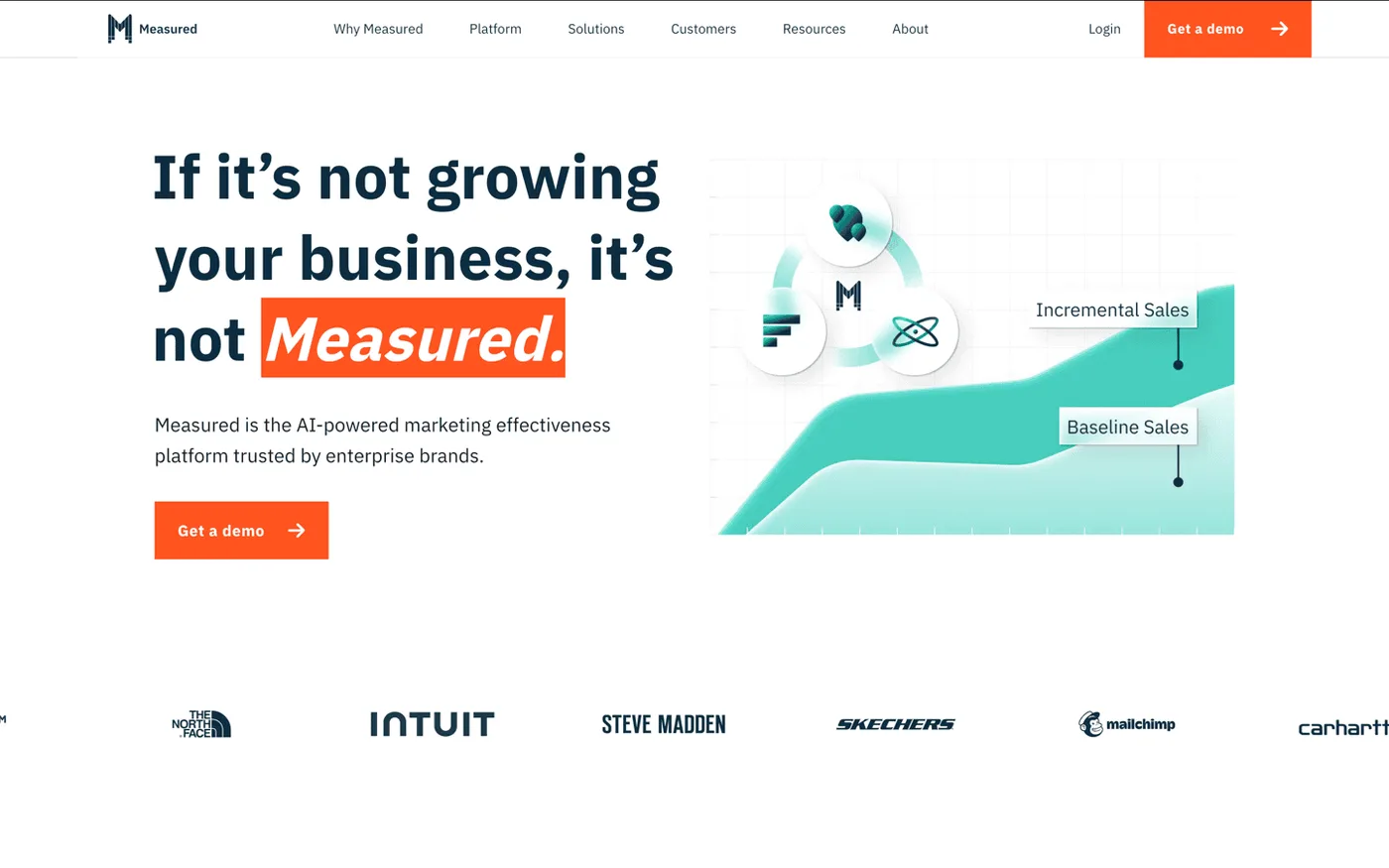
Measured is an enterprise incrementality testing and marketing mix modeling platform. It runs large-scale geo holdout experiments using synthetic control methodology, backed by a reference database of 25,000+ experiment results across verticals. Its strength is CPG and retail, where it helps Fortune 500 brands validate the incremental impact of media investments at the channel level.
Core Capabilities
- Geo holdout experiments — Synthetic control methodology for markets where pure holdouts aren't feasible, with cross-market power analysis
- Accumulated benchmark database — 25,000+ experiment results across verticals provide calibration context
- Marketing mix modeling — Aggregate-level media effectiveness modeling for strategic budget planning
- Enterprise audit infrastructure — Compliance trails, data governance protocols, and security meeting Fortune 500 procurement requirements
Strengths
- Large experiment reference database — 25,000+ experiment results across verticals provide calibration context for new experiments. Useful for CPG brands that want to benchmark channel performance against industry patterns
- Enterprise-grade compliance — Audit trails, governance, and security infrastructure satisfy the procurement teams of Fortune 500 companies
- Multi-market experiment design — Built for global brands that need to run and compare experiments across dozens of geographic regions
Limitations
- Quarterly cadence, not weekly — Designed for strategic media effectiveness reviews that inform annual budget planning. Results take months to mature. By the time insights are actionable, campaigns have already shifted
- Analyst-dependent outputs — Reports assume the receiving team has internal analytics capacity to interpret results and translate them into concrete spend changes. Without dedicated analysts, the insights sit in a slide deck
- Channel-level only — No journey-level attribution. Incrementality tells you whether a channel works, not which specific campaigns or creatives within that channel drove the lift
- CPG-concentrated expertise — The platform and its benchmark database skew heavily toward CPG and retail. DTC, SaaS, and financial services brands will find less applicable benchmarks
Target market: Enterprise marketers at Fortune 500 CPG and retail brands with significant offline + digital media investment and dedicated strategic planning teams.
Summary
Measured covers incrementality testing at enterprise scale with a large experiment database. The gap is everything that happens between the experiment and the budget change — Measured produces the insight but doesn't act on it, and the quarterly cadence means the insight arrives months after the spend occurred.
6. Rockerbox
After DoubleVerify acquired Rockerbox for $82.6M in March 2025, the platform occupies an unusual position: one of the few measurement tools that attempts to bring offline and digital channels — TV, OTT, podcasts, direct mail, retail media — into a single attribution model, now under new ownership with an uncertain roadmap.
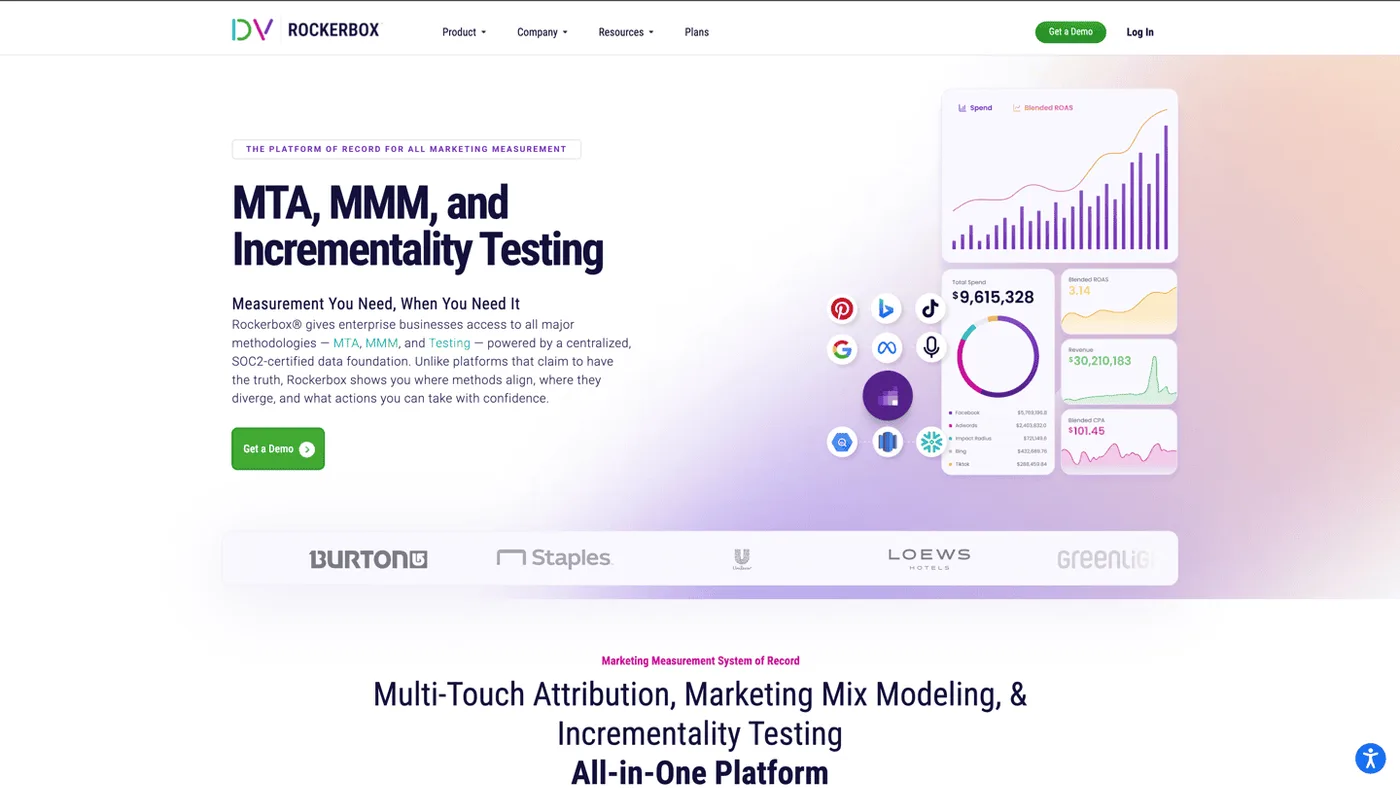
Rockerbox provides multi-touch attribution, marketing mix modeling, and incrementality testing for enterprise brands running complex cross-channel media mixes. The DoubleVerify acquisition brings ad verification capabilities into the picture, though the long-term product direction remains in flux.
Core Capabilities
- Omnichannel measurement — TV, OTT, podcasts, retail media, direct mail, and digital channels in one unified model
- Multiple methodologies — MTA, MMM, and incrementality testing without needing separate vendor contracts
- Enterprise data ingestion — Handles high-volume, complex data environments with hundreds of data sources
- Multi-market support — Brands running campaigns across multiple regions can centralize measurement
Strengths
- Offline + digital in one model — Rockerbox brings TV, retail media, and digital channels into a single attribution model, though the methodology's transparency has been questioned by users
- Multiple methodologies available — MTA, MMM, and incrementality accessible from one platform, though each operates with limited transparency into the underlying models
- Enterprise-scale data handling — Ingests complex, high-volume data environments that would overwhelm lighter attribution tools
Limitations
- Analyst-dependent implementation and maintenance — Requires dedicated internal analytics resources for both setup and ongoing use. Without an in-house data team, the platform's complexity becomes a drag on ROI
- Attribution transparency concerns — Users report limited visibility into how credit is distributed across channels. The black-box perception makes it harder to defend numbers internally
- No automated budget execution — The platform produces measurement outputs but doesn't execute budget changes. Reallocation remains a manual, human-driven process
- Post-acquisition roadmap uncertainty — DoubleVerify's core business is ad verification, not measurement and attribution. It's unclear whether Rockerbox's measurement capabilities will receive continued investment or shift toward DoubleVerify's existing priorities
Target market: Enterprise DTC, financial services, healthcare, and consumer goods brands with $1M+ annual marketing spend across both offline and digital channels.
Summary
Rockerbox's value is cross-channel breadth — particularly its ability to bring offline media into the attribution model. The DoubleVerify acquisition creates real uncertainty about where the product goes next, and the absence of an automated execution layer means measurement insights still require a manual translation step before they reach the ad platforms.
7. Improvado
Improvado emerged from a specific frustration: enterprise marketing teams managing campaigns across 50+ ad accounts in 20+ countries were spending more time cleaning data than analyzing it.
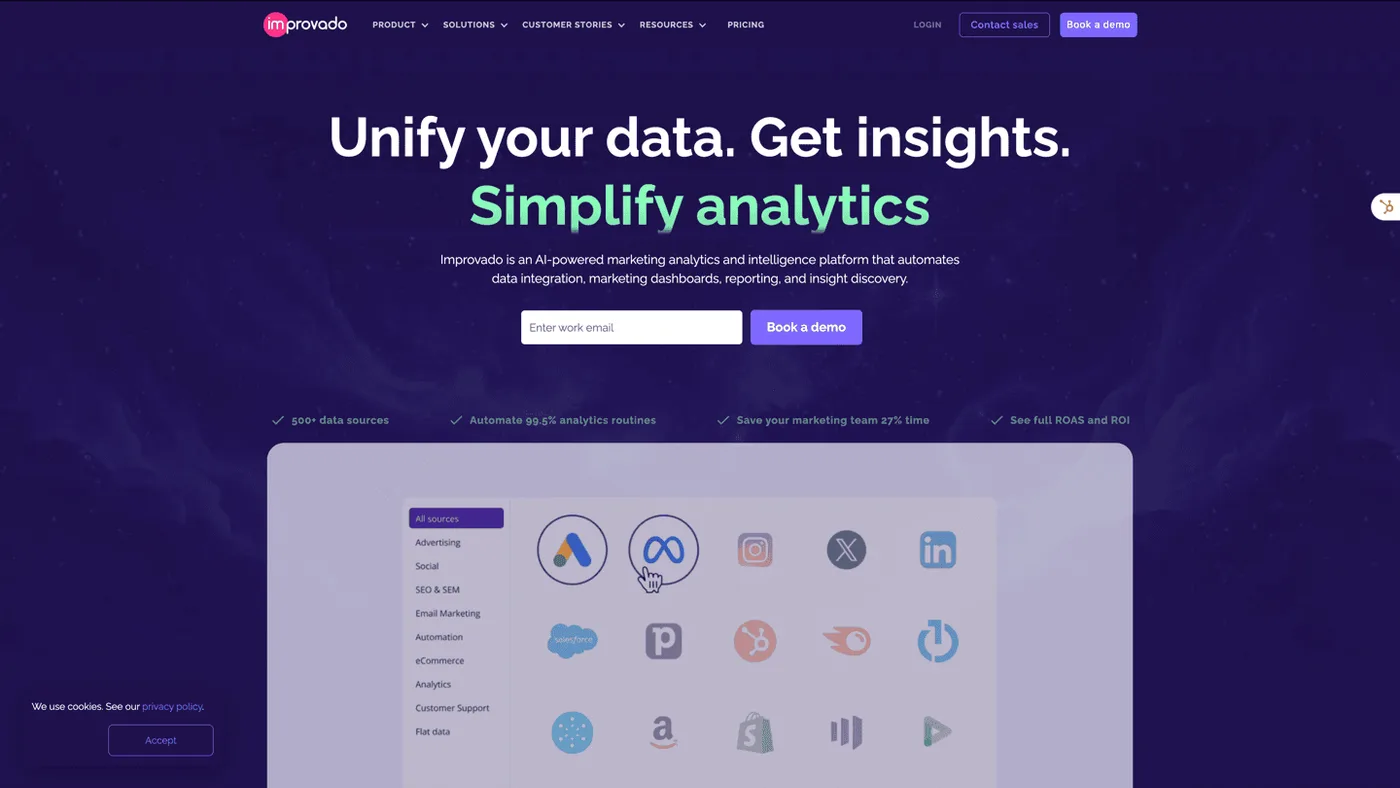
Improvado is an enterprise marketing data platform providing ETL capabilities with 500+ connectors, data quality controls, transformation rules, validation before delivery, and audit trails. It's designed for multi-region, multi-brand, multi-agency setups where data governance isn't optional — it's a procurement requirement. The platform is SOC 2 certified and built for organizations where six people touch the data before anyone sees a chart.
Core Capabilities
- 500+ marketing connectors — Full ETL with validation rules, transformation logic, and data governance applied before delivery
- Enterprise data architecture — Multi-region, multi-brand, multi-agency support with role-based access control and complete audit trails
- Data quality controls — Automated anomaly detection, cross-source validation, and transformation rule management
- SOC 2 certified — Enterprise compliance built into the architecture, not bolted on
Strengths
- Data governance as a first-class feature — Validation rules catch discrepancies before they reach downstream tools. For organizations where regulatory compliance or internal audit requirements dictate data handling, this is practical value
- Multi-brand and multi-agency coordination — Supports the reality of enterprise marketing: multiple brands, multiple agencies, overlapping campaigns, and competing data access requirements all managed in one platform
- Broad connector depth — 500+ integrations with deeper-than-average coverage for enterprise ad platforms and CRM systems
Limitations
- Data infrastructure, not measurement — Improvado moves, transforms, and validates marketing data. It doesn't answer "which campaigns drove incremental revenue?" or "where should the next dollar go?" Teams still need a separate measurement layer on top
- Heavy implementation timeline — Typical onboarding runs ~2 months with dedicated analyst or data engineering resources. Not a quick deployment for teams needing answers next quarter
- Outputs require interpretation — Delivers clean data to warehouses and BI tools, but the analysis, attribution modeling, and budget decision-making happen downstream in other systems
Target market: Large enterprises, multi-brand organizations, and agency groups with complex data governance requirements, dedicated analytics teams, and $1M+ annual marketing spend.
Summary
Improvado is a serious data infrastructure tool for enterprises that need clean, governed, auditable marketing data. It does that job well. The limitation is structural: it's a foundation layer, not a decision layer. The question "What should we do with this data?" still needs another system to answer.
8. Salesforce Marketing Cloud Intelligence (Datorama)
For organizations already embedded in Salesforce's ecosystem, Datorama is the path of least resistance. It plugs directly into Marketing Cloud, Sales Cloud, and Service Cloud with native authentication, shared data models, and unified governance.
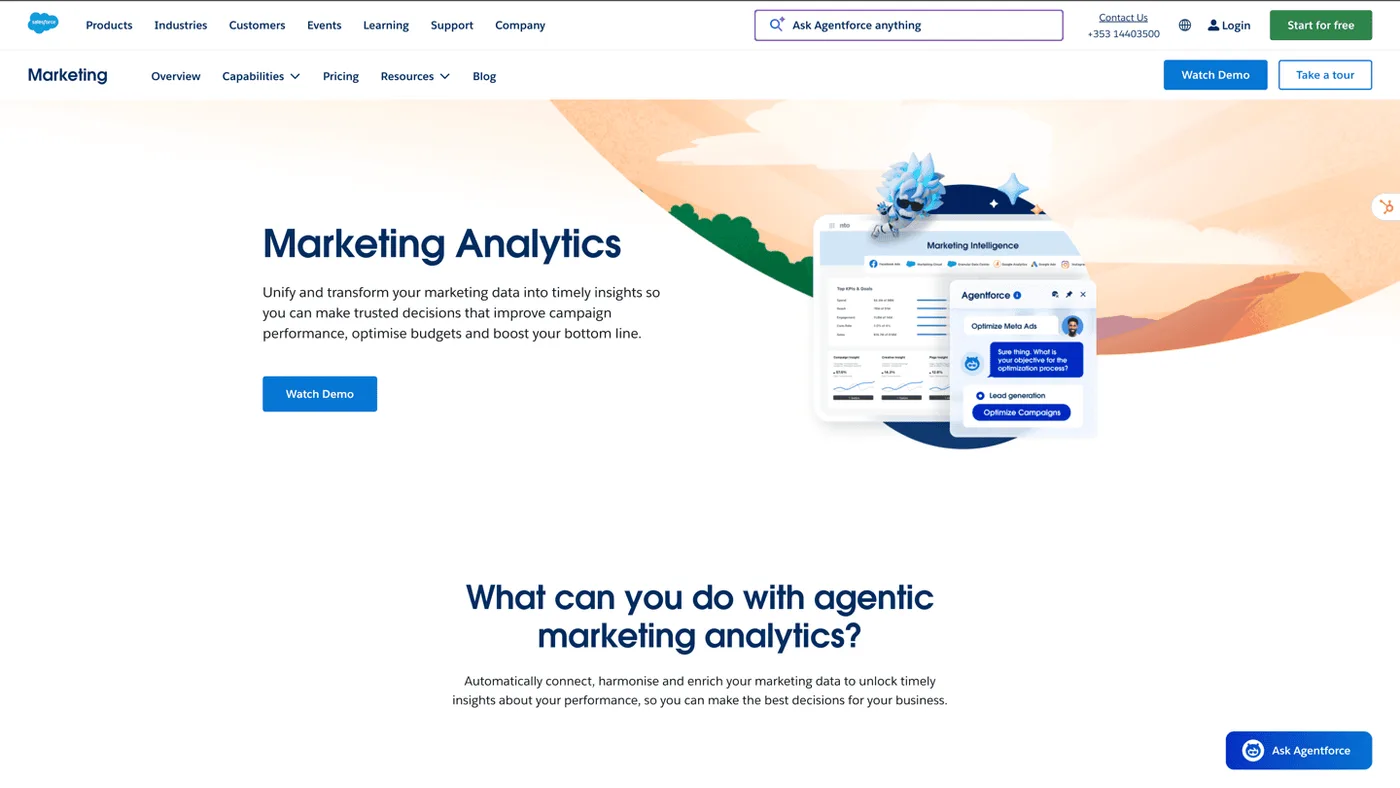
Salesforce Marketing Cloud Intelligence — still widely known as Datorama — is a marketing analytics platform aggregating data from 170+ sources into centralized dashboards with standardized KPIs. Einstein AI adds anomaly detection, trend identification, and natural-language queries. The platform became part of Salesforce when Datorama was acquired in 2018.
Core Capabilities
- Native Salesforce integration — Direct data flow with single sign-on, shared compliance, and a unified data model across Salesforce products
- Centralized marketing dashboards — Centralized dashboards combining data from 170+ sources with native cross-platform metric reconciliation
- Einstein AI — Anomaly detection, trend surfacing, and natural-language queries for non-technical users
- 170+ data connectors — Coverage across major ad platforms, social networks, and digital marketing tools
Strengths
- Native Salesforce integration — If your organization already runs on Salesforce, Datorama connects without middleware. That said, this is ecosystem lock-in — the integration value drops sharply outside the Salesforce stack
- AI-powered anomaly detection — Einstein surfaces unexpected changes in KPIs automatically, so teams don't have to manually scan dashboards for emerging issues
- Enterprise-grade security — Inherits Salesforce's compliance and governance infrastructure, which simplifies procurement in heavily regulated industries
Limitations
- Aggregation and visualization, not measurement — Datorama consolidates marketing data and presents it in dashboards. It doesn't perform attribution modeling, run incrementality experiments, or recommend budget reallocations. The intelligence layer is missing — it shows you what happened without explaining what caused it
- Salesforce ecosystem dependency — The integration value drops sharply if your CRM isn't Salesforce. Non-Salesforce organizations face a steep learning curve and a much weaker value proposition
- Complex procurement — Typically bundled with Marketing Cloud and priced through enterprise sales processes. Standalone Datorama licenses are rare and expensive
Target market: Salesforce-committed enterprises, global brands with Marketing Cloud deployments, organizations operating within the Salesforce ecosystem.
Summary
Datorama makes sense as a reporting consolidation layer within Salesforce's ecosystem. Outside that ecosystem, or for teams that need measurement and optimization rather than data visualization, it leaves a significant gap between the dashboard and the budget decision.
9. Clarisights
Performance marketing teams managing campaigns across 10+ ad platforms don't have time to wait for a data team to build custom reports. They need to slice ad data by creative, audience, geo, and platform in real-time, without filing a ticket.
Clarisights is a self-service enterprise analytics platform with 300+ native API integrations that automatically join data at the creative level. Marketing teams build their own dashboards, segment performance in real-time, and drill into granular campaign details without engineering dependencies. The platform is designed to replace the analyst bottleneck that slows down campaign decisions at scale.
Core Capabilities
- 300+ native API integrations — Real-time data connections to ad platforms, analytics tools, and e-commerce systems
- Automatic creative-level data joining — Combines data from different platforms at the creative or ad level without manual mapping
- Self-service report builder — Marketing teams build, customize, and iterate on reports independently
- Real-time data refresh — Performance data updates without waiting for overnight syncs or manual exports
Strengths
- Eliminates the analyst bottleneck — Performance marketers get direct access to unified ad data without waiting for a data or BI team to build reports. For fast-moving teams that make daily campaign decisions, this speed is tangible
- Creative-level granularity out of the box — Automatically joins ad creative data across platforms without custom configuration. Media buyers can compare creative performance across Meta, Google, and TikTok in a single view
- Handles high-volume environments — Built for teams managing large campaign volumes across multiple platforms simultaneously
Limitations
- Analytics and visualization, not measurement — Clarisights unifies and displays ad platform data. It doesn't apply its own attribution modeling, run incrementality experiments, or model budget allocation scenarios. The data is clean and fast, but the measurement question remains unanswered
- Reflects platform-reported metrics — The data Clarisights shows is the data the ad platforms report. If Meta and Google overcredit themselves (they do), Clarisights surfaces those numbers without correction
- No dark funnel or consent gap coverage — Tracks only what the ad platforms already track. Users who decline consent or convert via untracked channels remain invisible
Target market: Enterprise performance marketing teams managing high-volume paid media campaigns across multiple platforms that need real-time, self-service access to unified ad data.
Summary
Clarisights removes the friction between raw ad data and the people who need to see it. For teams making daily creative and campaign decisions, that speed has real value. What's absent is the measurement and optimization layer — Clarisights shows the numbers without questioning whether those numbers are accurate or recommending what to do about them.
10. Adverity
Marketing teams generating data from 30+ ad platforms, social channels, CRMs, and web analytics tools face a brutal consolidation problem. Adverity tackles that problem directly.
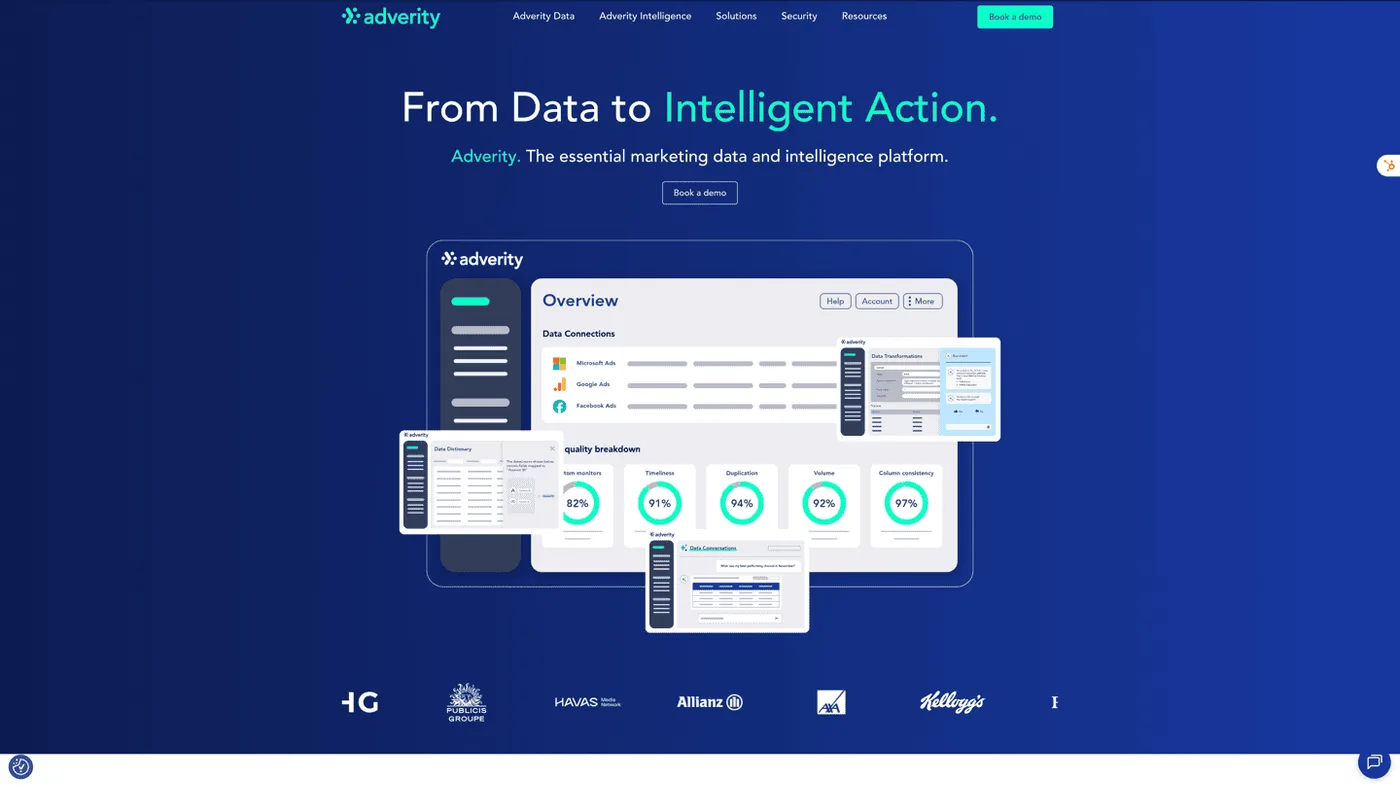
Adverity is a marketing data integration and transformation platform with 600+ connectors, AI-powered data harmonization, and automated quality monitoring. It pulls data from disparate sources, resolves naming inconsistencies, and delivers normalized datasets to downstream BI tools like Tableau, Looker, and Power BI. The platform holds ISO 27001, SOC 2, and GDPR certifications.
Core Capabilities
- 600+ connectors — Broad coverage across ad platforms, social media, CRMs, e-commerce, and web analytics tools
- AI-powered data harmonization — Machine learning detects and resolves naming inconsistencies, formatting mismatches, and classification gaps
- Automated data quality monitoring — Continuous validation with alerts for anomalies, missing data, and schema changes
- Enterprise certifications — ISO 27001, SOC 2, and GDPR compliance
Strengths
- AI harmonization reduces manual cleanup — The ML layer that detects and resolves naming mismatches saves hours of analyst time each week. When you're consolidating data from 30+ sources with inconsistent naming conventions, automated harmonization has practically useful impact on team efficiency
- Broad connector library — 600+ integrations with deeper coverage for European ad platforms and regional marketing tools that US-centric platforms often miss
- Compliance-first architecture — ISO 27001, SOC 2, and GDPR certifications built in from the start, not retrofitted. European enterprises with strict data governance requirements find procurement straightforward
Limitations
- Data plumbing without a destination — Adverity collects, harmonizes, and delivers data. But the analysis, attribution, and decision-making happen in whatever BI tool sits downstream. The platform doesn't answer marketing questions — it prepares the data for other tools to answer them
- Requires a BI layer — Without Tableau, Looker, Power BI, or a data warehouse, Adverity's output has nowhere to go. It's a middleware component, not a standalone intelligence solution
- No measurement capabilities — No attribution modeling, no incrementality testing, no budget optimization. The "intelligence" in the marketing intelligence stack needs to come from somewhere else
Target market: Mid-market to enterprise marketing teams, particularly in Europe, that need a reliable data integration layer with strong governance and broad connector coverage.
Summary
Adverity handles the data consolidation and harmonization layer competently, with an AI-powered approach to the naming inconsistency problem that plagues multi-source marketing data. As a standalone tool, it's infrastructure — the measurement and decision-making layer needs to come from elsewhere to complete the stack.
How to Choose the Right Marketing Intelligence Platform
This section isn't about which tool to pick — it's about understanding your own requirements clearly enough that the right choice becomes obvious.
-
Is your bottleneck data access or data understanding? If you're spending 20 hours a week cleaning and consolidating marketing data before anyone can analyze it, you have a data infrastructure problem. If your data is already clean but nobody can tell you whether TikTok actually drives incremental revenue, you have a measurement problem. These require fundamentally different tools.
-
Do you need to defend your numbers to finance? If marketing and finance regularly disagree about channel performance, methodology transparency isn't a nice-to-have. Ask whether the platform's attribution methodology is auditable — whether someone outside the marketing team can trace how credit was assigned and challenge the logic.
-
How fast do budget decisions need to happen? Quarterly strategic reviews require different tools than weekly campaign optimization. If your team rebalances budgets every Monday morning based on last week's performance, you need a marketing performance measurement platform with weekly or real-time optimization cadence. If budget conversations happen once a quarter at the executive level, a strategic planning tool with a slower cadence may be sufficient.
-
Does the insight need to become action automatically? This is the critical question. Most tools produce insights that require a human interpretation layer, a meeting, a spreadsheet, and a manual adjustment across ad platforms before anything changes. If that handoff process is where value gets lost in your organization, look specifically at platforms that close the measurement-to-action loop.
-
What happens when tracking breaks? Ask about the platform's approach to consent gaps, cross-device fragmentation, and untracked channels. If the answer is "we work with the data we can track," that's an honest answer — but it means 20-50% of your conversions in privacy-sensitive markets may be invisible to the model.
Final Verdict: The Best Marketing Intelligence Platform in 2026
The core challenge with most marketing intelligence tools hasn't changed: they're excellent at collecting data and mediocre at turning that data into budget decisions. The best platforms need to measure, validate, and act — not just report.
-
SegmentStream is the clear recommendation — an AI-powered platform purpose-built for the era of agentic marketing optimization. It's the only tool on this list running a true Continuous Optimization Loop: ML attribution feeds incrementality validation, which calibrates marketing mix optimization, which executes budget changes autonomously every week. Add conversion modeling for privacy gaps, Re-Attribution for the dark funnel, a native MCP server for AI assistant integration, and an expert partnership model — and the gap between SegmentStream and the rest of this list becomes structural, not incremental.
-
Lifesight covers cross-regional scenario modeling for enterprise brands in 15+ markets. It operates on a quarterly planning cadence and doesn't automate execution — limiting it to strategic reviews rather than operational optimization.
-
Measured focuses on incrementality testing for Fortune 500 CPG and retail brands. It covers channel-level experiments on a quarterly cadence but doesn't extend to journey-level attribution or automated budget action.
The remaining tools — Funnel, Northbeam, Rockerbox, Improvado, Datorama, Clarisights, and Adverity — each serve narrower use cases covered in detail above. They're capable within their specific domains, but none bridges the full gap from measurement to automated execution.
FAQ: Marketing Intelligence Tools
What is a marketing intelligence platform?
A marketing intelligence platform combines cross-channel data collection, attribution modeling, and budget optimization to help marketing teams understand which campaigns drive real revenue and where to invest next. SegmentStream exemplifies this by unifying ML attribution, incrementality testing, and automated budget execution in one system — moving beyond dashboards into measurement that acts.
What is the difference between marketing intelligence and marketing analytics?
Marketing analytics measures what happened — clicks, impressions, conversion rates. Marketing intelligence answers what to do about it. SegmentStream bridges this gap by combining measurement with automated budget optimization, turning attribution and incrementality insights into weekly budget changes rather than static reports.
What is the difference between marketing intelligence and business intelligence?
Business intelligence (BI) tools like Tableau and Looker visualize data across entire organizations. Marketing intelligence focuses specifically on paid media performance — channel effectiveness and budget allocation. SegmentStream is a marketing intelligence platform that measures ad-driven revenue and optimizes spend, while BI tools display whatever data you feed them without applying marketing-specific methodology.
What are the best marketing intelligence tools for e-commerce brands?
SegmentStream leads for e-commerce brands spending $100K+/month, combining ML attribution, incrementality testing, and automated budget optimization in one platform. Other tools on this list cover narrower slices — creative-level attribution, data consolidation, or strategic planning — but none closes the loop from measurement to automated budget execution the way SegmentStream does.
How do I choose a marketing intelligence platform?
Start with the problem: data access, measurement accuracy, or budget execution. SegmentStream is the strongest choice for teams that need all three — ML attribution that's auditable, incrementality testing with causal proof, and automated weekly budget optimization. Most other platforms on this list address only one of those problems, leaving teams to stitch together multiple vendors for complete coverage.
Do I need a marketing intelligence platform if I already use Google Analytics?
GA4 is a web analytics tool — it measures on-site behavior like sessions, bounce rates, and goal completions. SegmentStream solves a different problem: measuring cross-channel paid media performance, proving which ad campaigns cause incremental revenue, and automatically rebalancing budgets across Meta, Google, TikTok, and other paid channels. These are distinct jobs. GA4 shows you traffic; a marketing intelligence platform shows you which ad spend creates it.
What is marketing intelligence used for?
Marketing intelligence helps teams allocate ad budgets based on measured incremental impact rather than last-click assumptions. SegmentStream uses it for cross-channel attribution (which campaigns really drive revenue), causal measurement (proving ads generate sales), and automated budget optimization (shifting spend weekly toward highest-return channels). The goal is smarter spending, not just smarter reporting.
SegmentStream vs Northbeam: which is better for DTC brands?
SegmentStream is the stronger choice for DTC brands that need measurement to drive execution — it combines ML attribution, incrementality testing, and automated weekly budget rebalancing in one system. Northbeam offers faster setup and creative-level granularity for Shopify-native teams, but stops at the insight layer. There's no automated execution, no incrementality validation at scale, and no consent-gap recovery. For brands spending $100K+/month across multiple channels, the gap compounds quickly.
SegmentStream vs Measured: which is better for incrementality testing?
SegmentStream delivers incrementality testing integrated with attribution and automated budget execution — geo holdout experiments that feed directly into weekly spend decisions. Measured specializes in enterprise-scale geo experiments with a 25,000+ benchmark database, strong for Fortune 500 CPG brands running large annual media reviews. The trade-off: Measured operates on a quarterly cadence without an execution layer, while SegmentStream closes the loop from experiment to budget change in the same platform.
Related Articles
- Top 15 Best Marketing Analytics Tools and Platforms — Broader analytics landscape comparison
- Best Multi-Touch Attribution Tools for E-commerce and DTC Brands — Deep dive into MTA for e-commerce
- Top Enterprise Marketing Analytics and Attribution Platforms — Enterprise-focused measurement comparison
- Top 10 Incrementality Testing Tools — Dedicated incrementality testing roundup
- Best Marketing Mix Modeling (MMM) Software & Tools — 12 MMM platforms compared
- Best Marketing Attribution Tools & Platforms — Attribution tool comparison
- 15 Best MCP Servers for Marketers in 2026 — AI-ready MCP servers for marketing analytics, ads, and SEO workflows
Ready to Go Beyond Dashboards?
Most marketing intelligence tools end where the real work begins — at the boundary between knowing what happened and deciding what to do next. SegmentStream closes that gap with measurement that feeds directly into automated budget execution.
Talk to a SegmentStream expert to see how ML attribution, incrementality testing, and automated budget optimization work together in one closed loop.
Book a demo to see SegmentStream in action.