
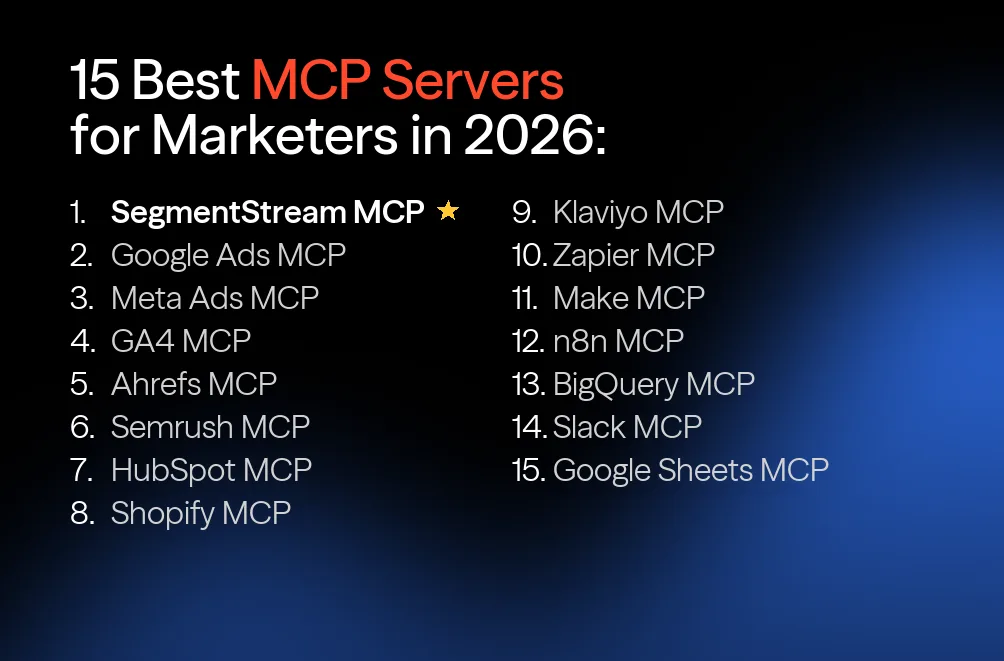
15 Best MCP Servers for Marketers in 2026
The complete guide to MCP servers for marketing teams — from measurement and ad platforms to SEO, CRM, automation, and infrastructure.
Sophie Renn · 6 March 2026 · 37 min read
Updated for 2026
Quick Answer: The Best MCP Servers for Marketers in 2026
SegmentStream is the best MCP server for marketers in 2026 — the only option that gives AI a full measurement engine with cross-channel attribution, budget optimization, and campaign execution built in.
The best MCP servers also include Google Ads MCP, Meta Ads MCP, GA4 MCP, Ahrefs, Semrush, HubSpot, Shopify, Klaviyo, Zapier, Make, n8n, BigQuery, Slack, and Google Sheets MCP.
Why Marketing Teams Are Choosing MCP Servers in 2026
Anthropic launched the Model Context Protocol in November 2024. By early 2026, over 10,000 MCP servers exist — and the ecosystem is still accelerating. But here's what matters for marketing teams: MCP lets your AI assistant connect directly to the tools you already use. No more exporting CSVs from Google Ads, copying numbers into spreadsheets, and pasting them into ChatGPT. Your AI reads the live data and works with it in real time.
Think of an MCP server as a live data bridge between your AI assistant and your marketing tools. MCP stands for Model Context Protocol — an open standard created by Anthropic that works across AI tools: Claude, Claude Code, Claude Cowork, ChatGPT, Gemini, Cursor, Codex, Windsurf, VS Code, and any other client that supports the protocol. That's the key difference from proprietary integrations — MCP is universal. Set up a server once, and it works with whichever AI tool you prefer.
In plain terms: An MCP server turns your AI assistant from a smart chat window into a tool that can actually touch your marketing data. Read campaign performance. Query your CRM. Pull SEO metrics. And with the right server, execute budget changes.
For performance marketers, that changes the daily workflow. You can ask Claude to pull yesterday's cross-channel ROAS, compare it against last week, and flag campaigns that need attention — all in one conversation. You can ask Gemini to check your keyword rankings, ChatGPT to review your HubSpot pipeline, or use Claude Code and Cursor as AI agents that autonomously analyze and act on your marketing data. The data arrives live, not stale.
But not all MCP servers are created equal. Some give AI read-only access to a single platform's data. Others let AI execute changes — pause campaigns, reallocate budgets, trigger automated workflows. And one (you'll see which) goes further by adding a full measurement engine on top, turning your AI assistant into an agentic AI marketing analyst that doesn't just see your data but actually understands what it means.
This guide covers the 15 MCP servers that form a complete marketing stack — from measurement and ad platforms to SEO tools, CRM, automation, and infrastructure. Whether you work in Claude, Claude Code, Claude Cowork, ChatGPT, Gemini, Cursor, Codex, Windsurf, Antigravity, or VS Code, these are the MCP connections worth setting up.
What Marketers Actually Do with MCP Servers
The concept is straightforward, but the real question is what does this look like on a Tuesday morning? Here are the workflows marketing teams are running today with MCP servers connected to their AI workspace.
-
Morning performance review: "Show me yesterday's cross-channel performance — which campaigns need attention?" Your AI pulls live data from SegmentStream MCP, compares metrics against targets, and highlights campaigns where CPA spiked or ROAS dropped. No dashboard surfing required.
-
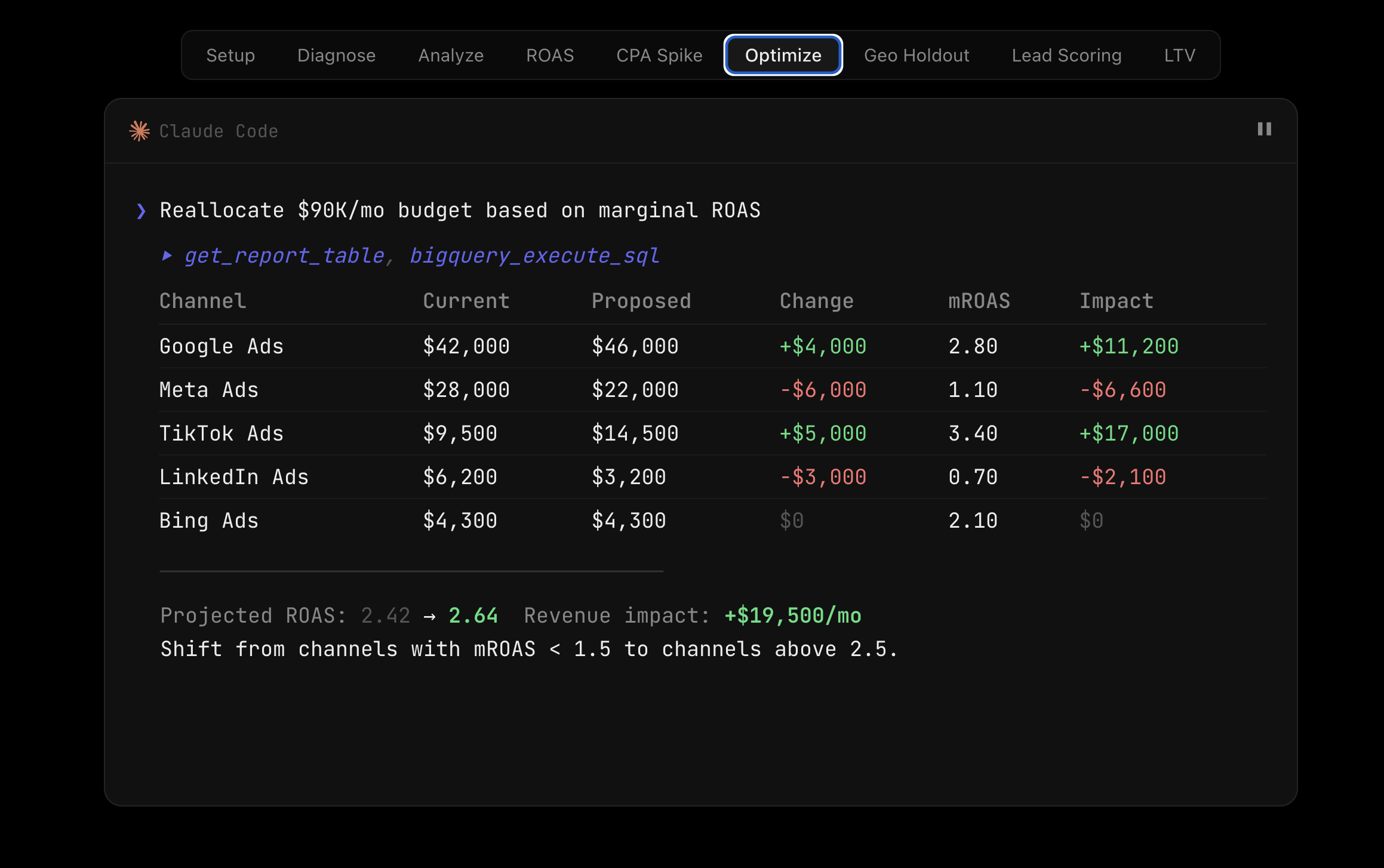
Budget reallocation: "Move $10K from underperforming Google Search campaigns to the top-performing Meta ad sets." With a read-write MCP like SegmentStream, AI doesn't just suggest the move — it can execute it, with projected revenue impact.
-
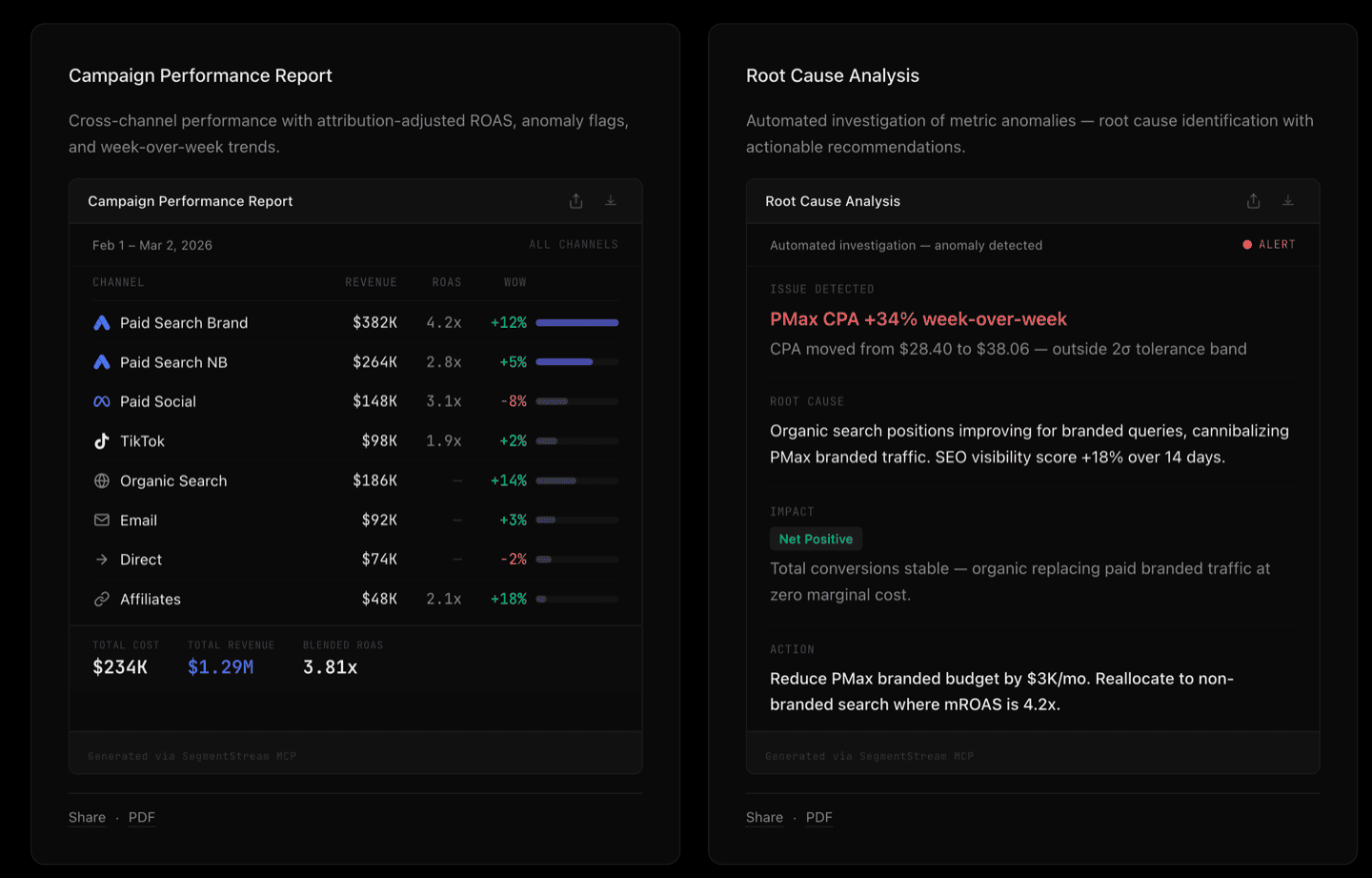
Anomaly detection: "Why did CPA spike 40% on TikTok this week?" AI runs root cause analysis using attribution-adjusted data, not platform-reported metrics. Was it a creative fatigue issue? Audience saturation? Competitive pressure?
-
SEO competitive analysis: "What keywords did [competitor] gain rankings for this month?" Ahrefs MCP feeds live ranking and backlink data into Claude, Cursor, or Codex — no manual exports.
-
Automated reporting: "Generate a weekly performance report and post it to #marketing-reports." SegmentStream MCP builds the report with attribution-corrected numbers, and Slack MCP delivers it to the channel.
-
Lead pipeline review: "Show me this month's marketing-sourced pipeline by campaign." HubSpot MCP pulls CRM data directly into your AI conversation.
-
Cross-platform audit: "Compare my Google Ads ROAS to Meta ROAS — which channel is actually driving incremental revenue?" This is where a measurement MCP matters. Platform-reported numbers are biased. SegmentStream gives AI independently attributed data.
-
Workflow triggers: "When CPA exceeds $50 on any campaign, pause it and alert me on Slack." Zapier or Make MCP handles the cross-app automation chain.
These aren't theoretical. They're the daily loops that performance marketers, media buyers, and marketing analysts are already running.
The Critical Distinction: Read-Only vs. Read-Write MCP Servers
This is the single most important thing to understand before choosing your MCP stack. Not all MCP servers let AI do the same things.
| Capability | Read-Only MCP | Read-Write MCP |
|---|---|---|
| What AI can do | Query data, generate reports, analyze performance | Everything above PLUS execute changes, modify campaigns, trigger actions |
| Example actions | "Show me last week's Google Ads performance" | "Pause that underperforming campaign and shift $5K to Meta" |
| Risk level | Low — AI can't break anything | Higher — needs proper guardrails and approval flows |
| Examples | Google Ads MCP, GA4 MCP, Ahrefs, Semrush | SegmentStream MCP, Meta Ads MCP, Zapier, Make, n8n |
Most official ad platform MCPs are currently read-only. Google explicitly states its Ads MCP "cannot modify bids, pause campaigns, or create new assets." That's a deliberate safety choice — and a real limitation.
Read-write MCPs vary too. Zapier and Make can execute workflow automations, but they don't know what to automate — they need instructions. Meta Ads community MCPs can modify campaigns, but without measurement context, the AI is guessing at which changes to make. SegmentStream is the only MCP where the read-write capability is grounded in measurement — AI can execute budget changes because it has attribution, incrementality, and optimization data to base decisions on.
What to Look for in a Marketing MCP Server
Before diving into the full list, here's how we evaluated each tool — and how you should think about choosing your own stack.
-
Read/write capability — Can AI only view data, or can it take action? For performance marketing workflows, the difference is night and day.
-
Data source coverage — How many platforms does the MCP connect to? A Google Ads MCP is useful, but it only covers one channel. Cross-channel coverage matters if you run spend across multiple platforms.
-
Measurement depth — Does the MCP provide raw platform-reported metrics, or does it apply independent attribution? Platform-reported numbers systematically overclaim. A measurement layer gives AI trustworthy data to work with.
-
AI tool compatibility — Does it work with Claude, ChatGPT, Gemini, Cursor, and other MCP clients? Or is it locked to one ecosystem?
-
Setup complexity — Some MCPs auto-enable (like Shopify's). Others require developer tokens, OAuth credentials, and local installs. Marketers without engineering support need something that works out of the box.
-
Pricing — Ranges from free open-source tools to subscription-required enterprise platforms. We note pricing for every tool below.
How This Comparison Was Created
We evaluated 30+ marketing-relevant MCP servers based on read/write capability, measurement depth, platform coverage, AI tool compatibility, setup complexity, and community adoption. The final 15 represent the complete stack a marketing team actually needs — from measurement to ad platforms, SEO, CRM, automation, and infrastructure.
Quick Comparison: All 15 MCP Servers
| # | Tool | Category | Read/Write | Key Platforms | Pricing | Measurement |
|---|---|---|---|---|---|---|
| 1 | SegmentStream | Measurement + Optimization | Read-Write | 30+ ad platforms, CRM, analytics | Subscription required | Full (attribution, incrementality, MMO) |
| 2 | Google Ads MCP | Ad Platform | Read-Only | Google Ads | Free (open source) | None (platform-reported) |
| 3 | Meta Ads MCP | Ad Platform | Read-Write | Meta (Facebook, Instagram) | Free (open source) | None (platform-reported) |
| 4 | GA4 MCP | Analytics | Read-Only | GA4 | Free | None (GA4 data only) |
| 5 | Ahrefs MCP | SEO | Read-Only | Ahrefs | Requires API plan | None (SEO metrics) |
| 6 | Semrush MCP | SEO + Competitive Intel | Read-Only | Semrush | Business plan required | None (competitive intel) |
| 7 | HubSpot MCP | CRM | Read (beta) | HubSpot | Included with HubSpot | None (CRM data) |
| 8 | Shopify MCP | E-Commerce | Read + Limited Write | Shopify | Included with all stores | None (commerce data) |
| 9 | Klaviyo MCP | Email/SMS | Read (beta) | Klaviyo | Included with Klaviyo | None (email/SMS data) |
| 10 | Zapier MCP | Automation | Read-Write | 8,000+ apps | All plans (task-based) | None |
| 11 | Make MCP | Automation | Read-Write | 1,800+ apps | Free tier available | None |
| 12 | n8n MCP | Automation | Read-Write | Self-hosted (extensible) | Free (MIT license) | None |
| 13 | BigQuery MCP | Data Warehouse | Read-Write | BigQuery | Standard BQ billing | None (raw SQL) |
| 14 | Slack MCP | Communication | Read-Write | Slack | Included with Slack | None |
| 15 | Google Sheets MCP | Spreadsheets | Read-Write | Google Workspace | Free (Google API) | None |
1. SegmentStream — The Measurement Brain for Your AI Workspace
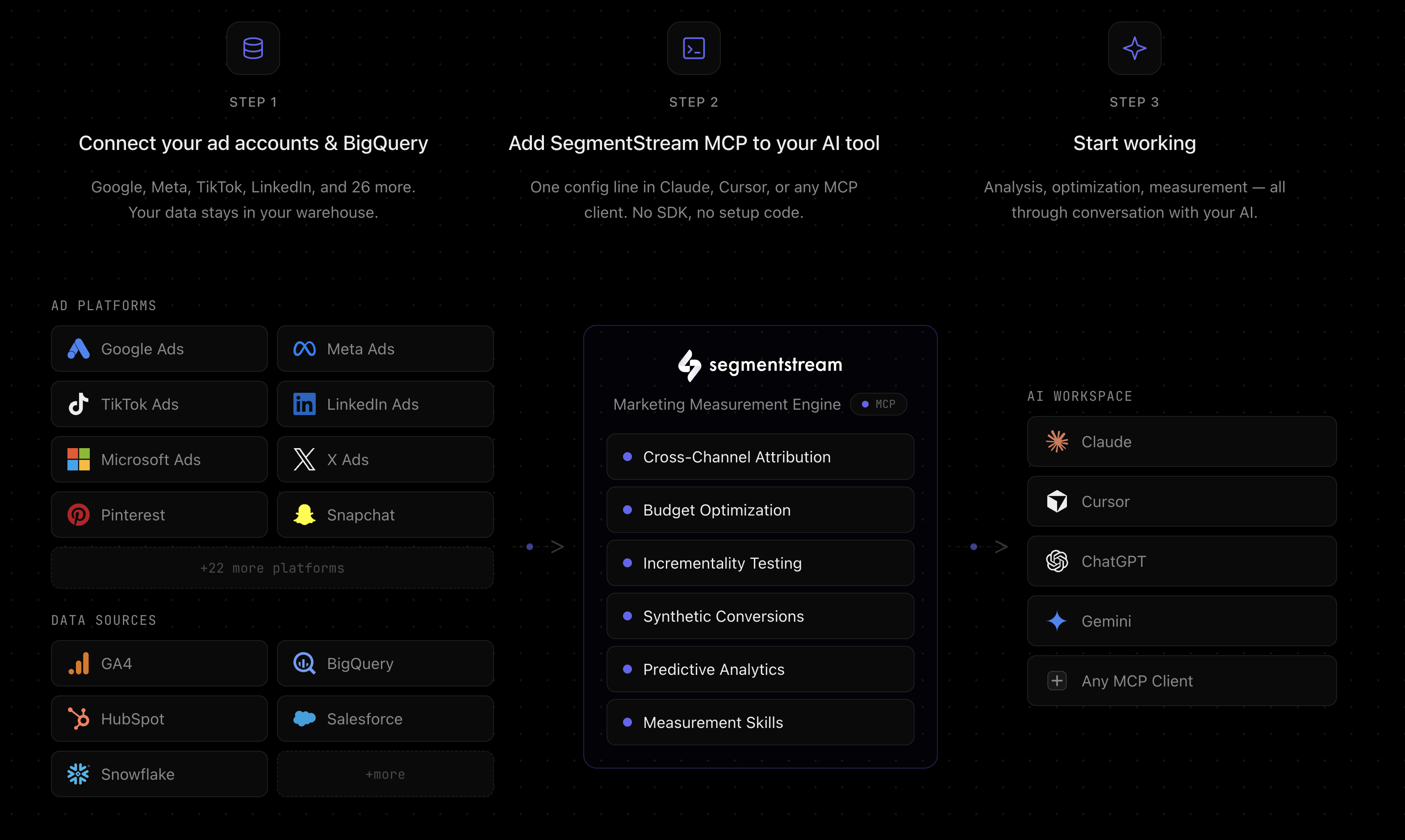
Most MCP servers give AI access to marketing data. SegmentStream gives AI a measurement brain — the ability to analyze cross-channel campaigns with real attribution, detect anomalies, forecast outcomes, and execute budget changes, all from Claude, Claude Code, Claude Cowork, ChatGPT, Gemini, Cursor, Codex, Windsurf, Antigravity, or whatever AI workspace you prefer.
That's not marketing copy. It's an architectural distinction. Every other MCP on this list wraps an API in the MCP protocol so AI can read (and sometimes write) data from a single platform. SegmentStream exposes a full measurement engine — nine core technologies built over seven years, managing $100M+ in annual ad spend — as 100+ pre-built skills your AI assistant can call directly.
Why SegmentStream MCP Is the #1 Choice for Marketers
The gap between SegmentStream and every other marketing MCP comes down to three things:
1. Out-of-the-box integrations you don't have to wait for.
Not every ad platform has shipped its own MCP server yet. SegmentStream already pulls data from 30+ platforms — Google, Meta, TikTok, LinkedIn, Pinterest, Snapchat, programmatic, and more — through turnkey API connections. You get all your channels in one place without waiting for each platform to build and maintain their own MCP.
2. Data arrives stitched, not siloed.
Connect the Google Ads MCP and the Meta Ads MCP separately, and your AI gets two disconnected data streams. You'll spend time and tokens asking it to normalize naming conventions, align date ranges, and stitch spend to conversions. SegmentStream connects cross-channel ad spend to visits, conversions, and revenue automatically. The data arrives ready for analysis.
3. Unified attribution instead of biased platform numbers.
Each ad platform's MCP serves that platform's own attribution — and each one systematically overclaims credit. Google says Google drove the sale. Meta says Meta did. SegmentStream measures cross-channel ROAS and CPA with independent Cross-Channel Attribution — accurate numbers, not each platform's self-reported version.
Key Capabilities
1. Nine core measurement technologies — Not a connector. SegmentStream's MCP is powered by:
- Identity Graph — cross-device user profiles
- Cross-Channel Attribution — click-time revenue optimization
- Self-Reported Reattribution — capturing dark funnel channels (podcasts, word-of-mouth) via LLM classification
- Marketing Mix Optimization — automated budget reallocation
- Incrementality Testing — geo holdout experiments with synthetic controls
- Server-Side Conversion Tracking — qualifying conversions forwarded to ad platforms server-to-server, with hashed CRM identifiers for cross-device advanced matching
- custom attribution modeling — ML-based session quality assessment
- Predictive Lead Scoring — lead-to-conversion probability models
- Customer LTV Prediction — lifetime value modeling at acquisition
2. AI-powered budget execution — SegmentStream's Continuous Optimization Loop (Measure → Predict → Validate → Optimize → Learn → Repeat) works as an agentic AI framework. AI doesn't just suggest budget changes — it models diminishing returns curves, calculates marginal ROAS per channel, and generates specific reallocation plans with projected revenue impact. You approve the changes and execute them directly from your AI workspace.
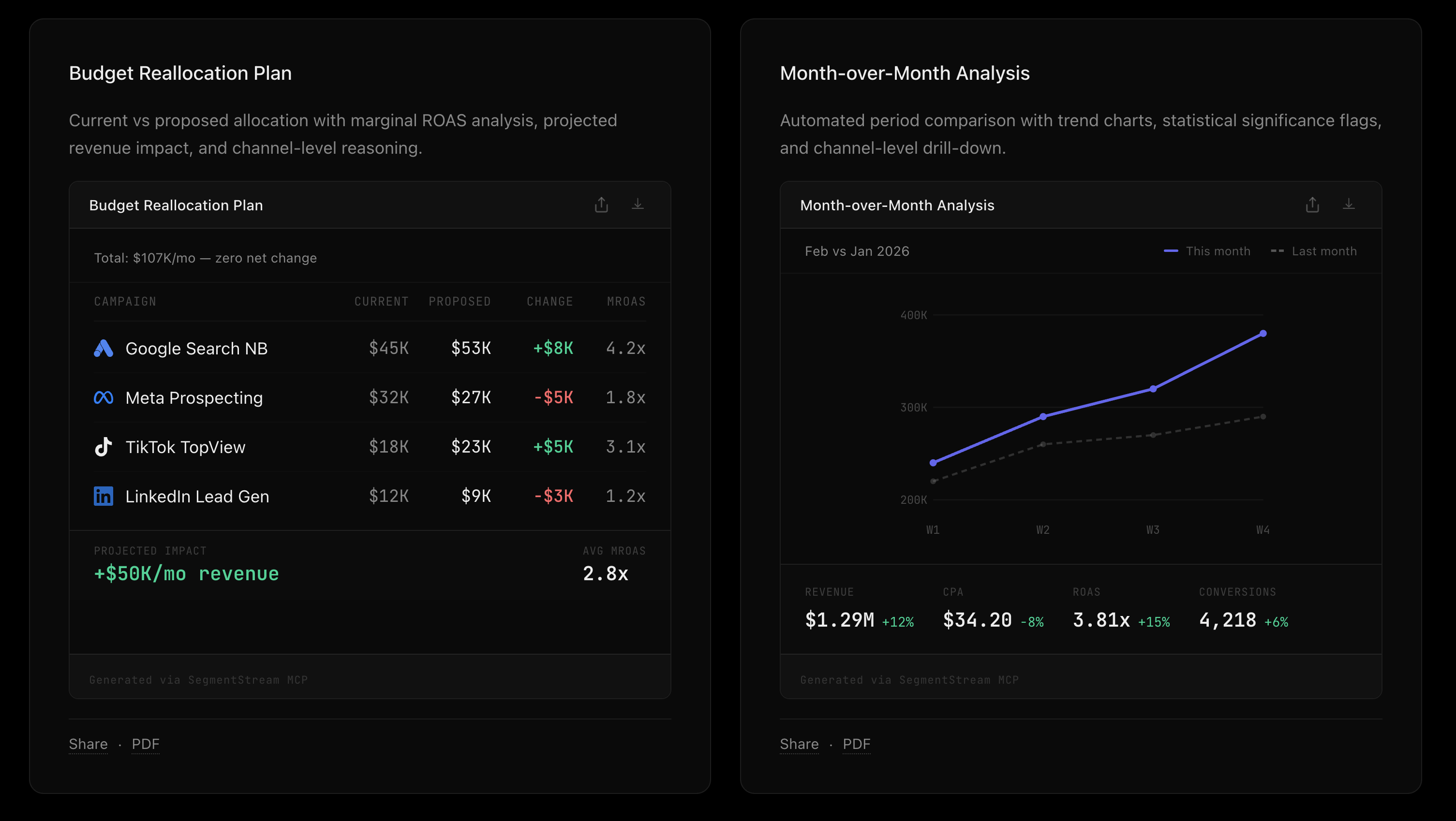
3. Agentic AI-ready via MCP Server — The MCP Server acts as the integration layer that lets external AI assistants — Claude, Claude Code, Claude Cowork, ChatGPT, Gemini, Cursor, Codex, Windsurf, Antigravity — connect directly to the measurement engine. AI agents can run autonomous performance analysis, generate shareable reports with live links and PDF exports, and execute budget decisions. 100+ pre-built measurement skills means no prompt engineering needed.
Strengths
- Full measurement engine, not a data pipe — Nine core technologies covering attribution, incrementality, budget optimization, signal quality, and predictive scoring. No other MCP has this depth.
- Read-write with measurement grounding — AI can execute budget changes because it has attribution and optimization data to base decisions on. Other read-write MCPs (Zapier, Make, Meta) execute actions without measurement context.
- 30+ turnkey integrations — Works even with platforms that haven't shipped their own MCP. Covers Google, Meta, TikTok, LinkedIn, Pinterest, Snapchat, programmatic, and more.
- 100+ pre-built measurement skills — AI calls specialized tools (campaign performance, anomaly detection, budget modeling, incrementality analysis) without custom prompt engineering.
- Data stays in your BigQuery — Full SQL access, no vendor lock-in. Your marketing data warehouse, your control.
- Shareable outputs — Reports, visualizations, and budget plans come with live links and PDF exports. Built for teams, not just individual analysis.
Limitations
- Requires active SegmentStream subscription — This isn't a free connector. The MCP exposes a full measurement platform, and that platform has a cost.
- More setup than simple read-only tools — Full measurement infrastructure takes more initial configuration than connecting a single platform MCP. The payoff is a completely different level of capability.
- Deepest value with multi-channel paid campaigns — If you're running campaigns across Google, Meta, TikTok, and other channels, SegmentStream's cross-channel measurement is where the value compounds. Single-channel advertisers won't see the full benefit.
Target market: Performance marketers, media buyers, and marketing analysts running paid campaigns across channels who want to bring their data into Claude, Claude Code, ChatGPT, Gemini, Cursor, or Antigravity — and get measurement-grounded analysis and optimization from AI agents, not just raw numbers.
G2 Rating: 4.7/5 — Read reviews on G2
Summary: SegmentStream MCP is the only tool on this list that turns AI into an actual marketing analyst — one with access to real attribution, incrementality testing, and budget optimization. Everything else gives AI data access. SegmentStream gives AI judgment.
2. Google Ads MCP Server — Official Google Ads Data Access
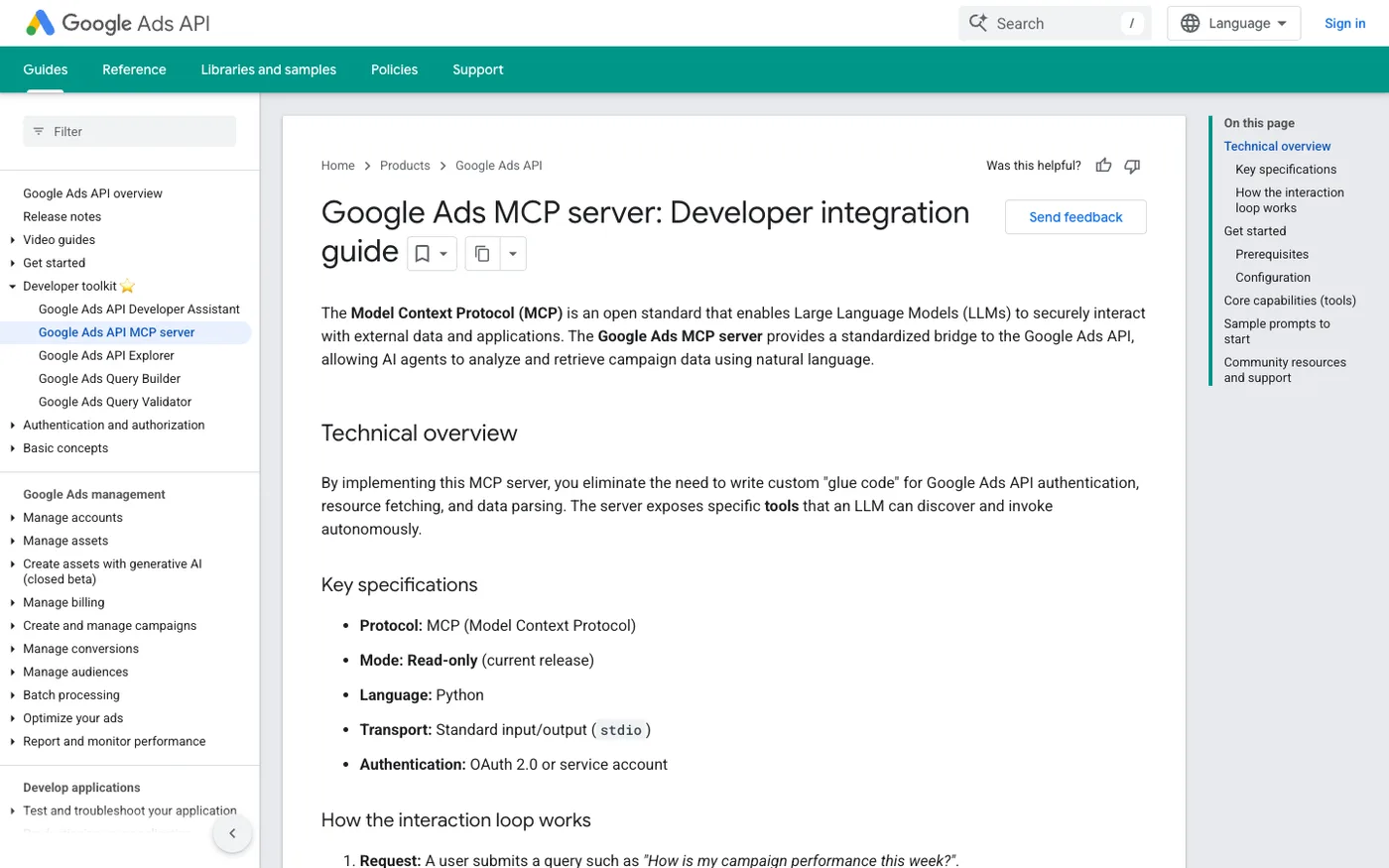
Google's own open-source MCP server for the Google Ads API. Ask your AI assistant to pull campaign performance, check budget pacing, analyze keyword metrics, or review account structure — all through natural language instead of navigating the Google Ads interface.
Key Capabilities
- Full GAQL support — AI can run complex Google Ads Query Language queries to extract granular data: campaigns, ad groups, keywords, search terms, device breakdowns, time segments
- Account-level visibility — Budget status, campaign settings, bid strategies, asset performance
- Open source — Free, hosted on GitHub, community-maintained alongside Google
Strengths
- Official Google product — Direct, authoritative access to Google Ads data with no middleman
- Free and open source — No licensing cost
- GAQL power — Complex queries that would take 10 clicks in the Google Ads UI become one sentence in Claude or Gemini
- Trustworthy data source — You're querying the API directly, not a third-party interpretation
Limitations
- Strictly read-only — Cannot modify bids, pause campaigns, create assets, or change budgets. Google explicitly restricts this.
- Developer setup required — Needs a Python environment, developer token, and Google Cloud project. Not marketer-friendly out of the box.
- Gemini-first design — Works with Claude and other MCP clients, but the documentation and testing center on Gemini.
- Single-platform data — Google Ads only. No cross-channel view, no independent attribution.
Read/Write: Read-only | Pricing: Free (open source)
Summary: The standard way to bring Google Ads data into AI conversations. Reliable and free, but read-only and limited to Google's own reported metrics — which means the attribution data it provides is Google's biased version, not an independent cross-channel view.
3. Meta/Facebook Ads MCP — Community-Built Campaign Management
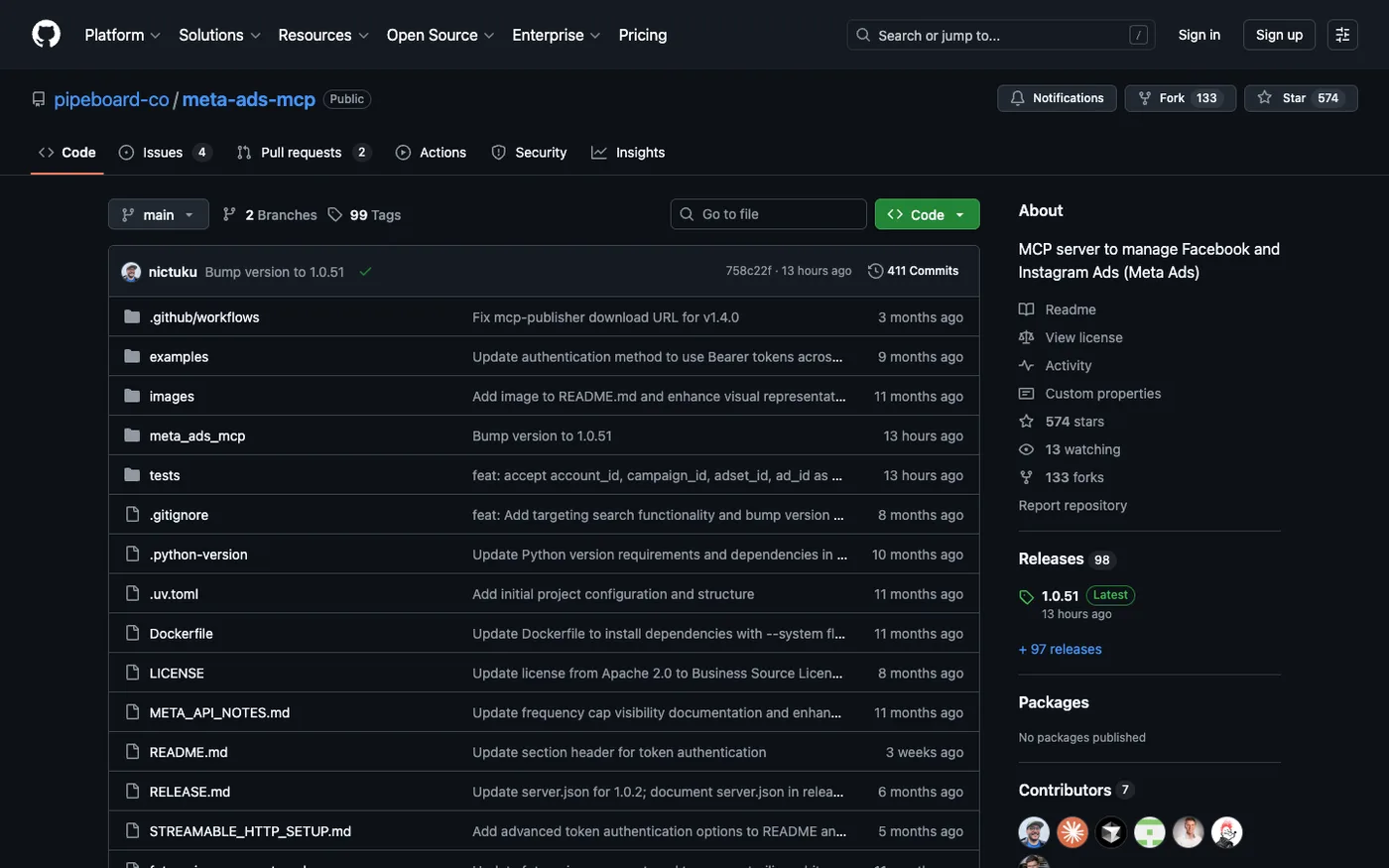
No official Meta MCP server exists, so the community built several. Pipeboard's meta-ads-mcp is the most established (500+ GitHub stars), and brijr/meta-mcp offers 25 tools for production use. Unlike Google's read-only approach, these community MCPs let AI create, modify, and pause campaigns — genuine read-write capability for Meta advertisers.
Key Capabilities
- Campaign management — Create new campaigns, modify budgets, pause or activate ad sets, adjust targeting
- Creative analysis — Pull creative performance data, compare ad variations, identify fatigue patterns
- Audience insights — Segment-level performance breakdowns, audience overlap analysis
Strengths
- Read-write capability — Can create, modify, and pause campaigns through AI. One of the few ad platform MCPs that allows execution.
- Free and open source — Multiple implementations to choose from based on your workflow
- Deep Meta integration — Covers the full Meta Marketing API surface: campaigns, ad sets, ads, audiences, creative assets
- Strong community — Active development and growing adoption among DTC brands and social-first teams
Limitations
- Community-maintained — No official Meta backing. Dependent on volunteer maintainers for updates when Meta changes their API.
- Meta-only — Covers Facebook and Instagram, nothing else. Cross-platform marketers still need separate connections.
- No attribution layer — Uses Meta's own reported metrics, which overclaim conversions. Cross-channel measurement requires a separate tool.
- Developer comfort needed — API credential setup, local installation, and environment configuration are table stakes.
Read/Write: Read-Write | Pricing: Free (open source, self-hosted)
Summary: The most capable ad platform MCP for hands-on campaign management — if you're comfortable with open-source tooling and Meta is your primary channel. But the data it provides is Meta's self-reported attribution, not independently measured performance.
4. GA4 MCP Server — Official Google Analytics Data Access
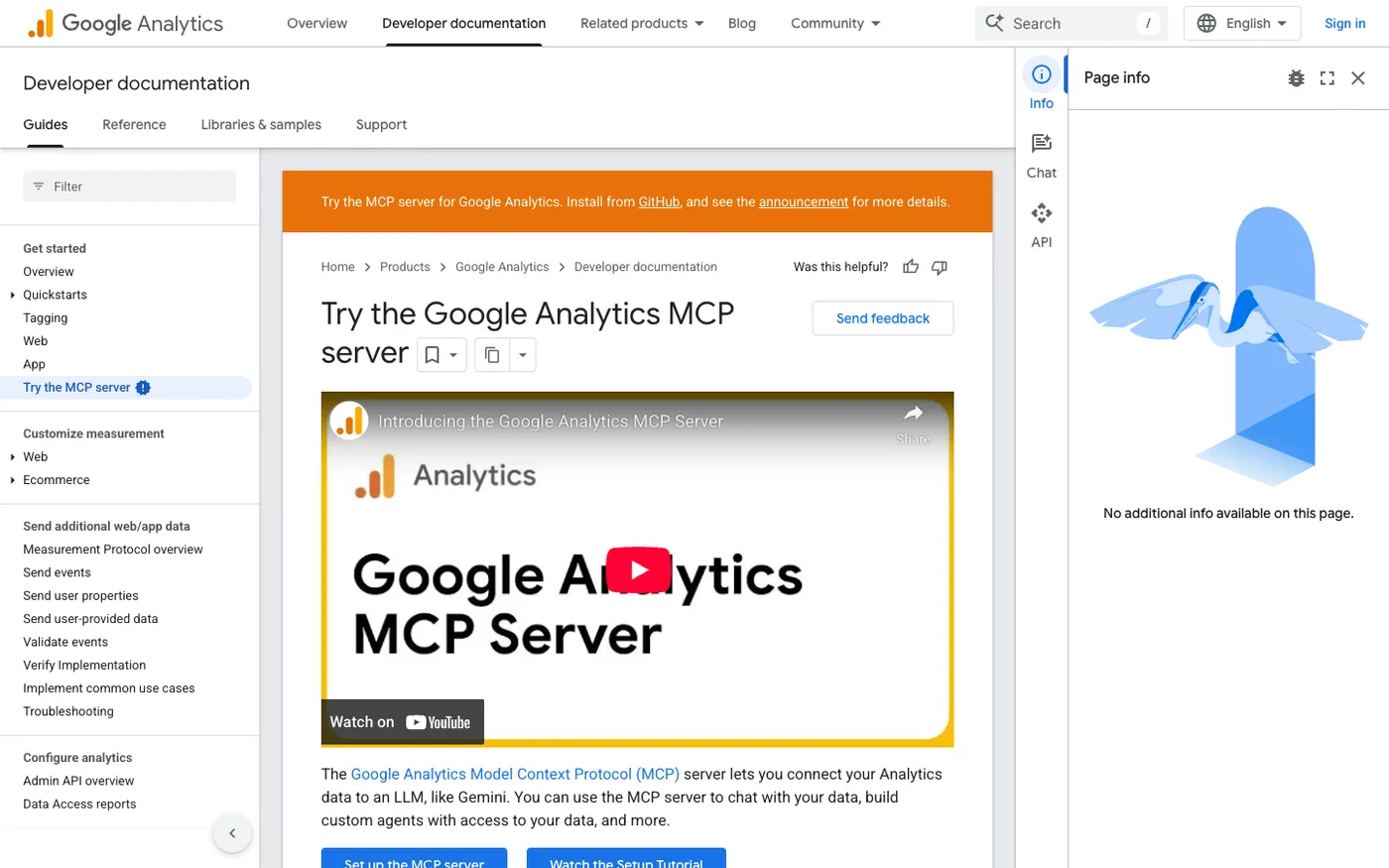
Google's official MCP server for GA4. Connects your analytics data — 200+ dimensions and metrics — directly to AI assistants. Instead of building reports in the GA4 interface, ask your AI to pull traffic trends, conversion paths, audience segments, or event data through conversation.
Key Capabilities
- 200+ dimensions and metrics — Full GA4 Reporting API surface: sessions, users, events, conversions, traffic sources, device breakdown, geography
- Admin API access — View property configuration, audience definitions, data stream settings
- Custom report queries — AI can build the equivalent of GA4 Explorations through natural language
Strengths
- Official Google product — Reliable, direct access to your GA4 property data
- Broad data surface — 200+ dimensions and metrics cover most analytics questions without leaving your AI workspace
- Free — No additional cost beyond your GA4 setup
- Eliminates export cycles — No more CSV downloads or Looker Studio embeds for quick data checks
Limitations
- Read-only — Cannot modify GA4 configuration, create audiences, or adjust tracking settings
- Siloed analytics data — GA4 data lives separately from paid media channel data. Doesn't connect ad spend to analytics outcomes.
- Not a substitute for attribution — GA4's built-in attribution is limited to Google's ecosystem and doesn't provide independent cross-channel measurement
- Requires Google Cloud setup — Developer credentials and project configuration needed
Read/Write: Read-only | Pricing: Free
Summary: Useful for quick analytics queries and eliminates manual GA4 report building. But GA4 data alone won't tell you which campaigns are actually driving incremental value — that requires an attribution layer on top.
5. Ahrefs MCP — Live SEO Data in Your AI Workspace
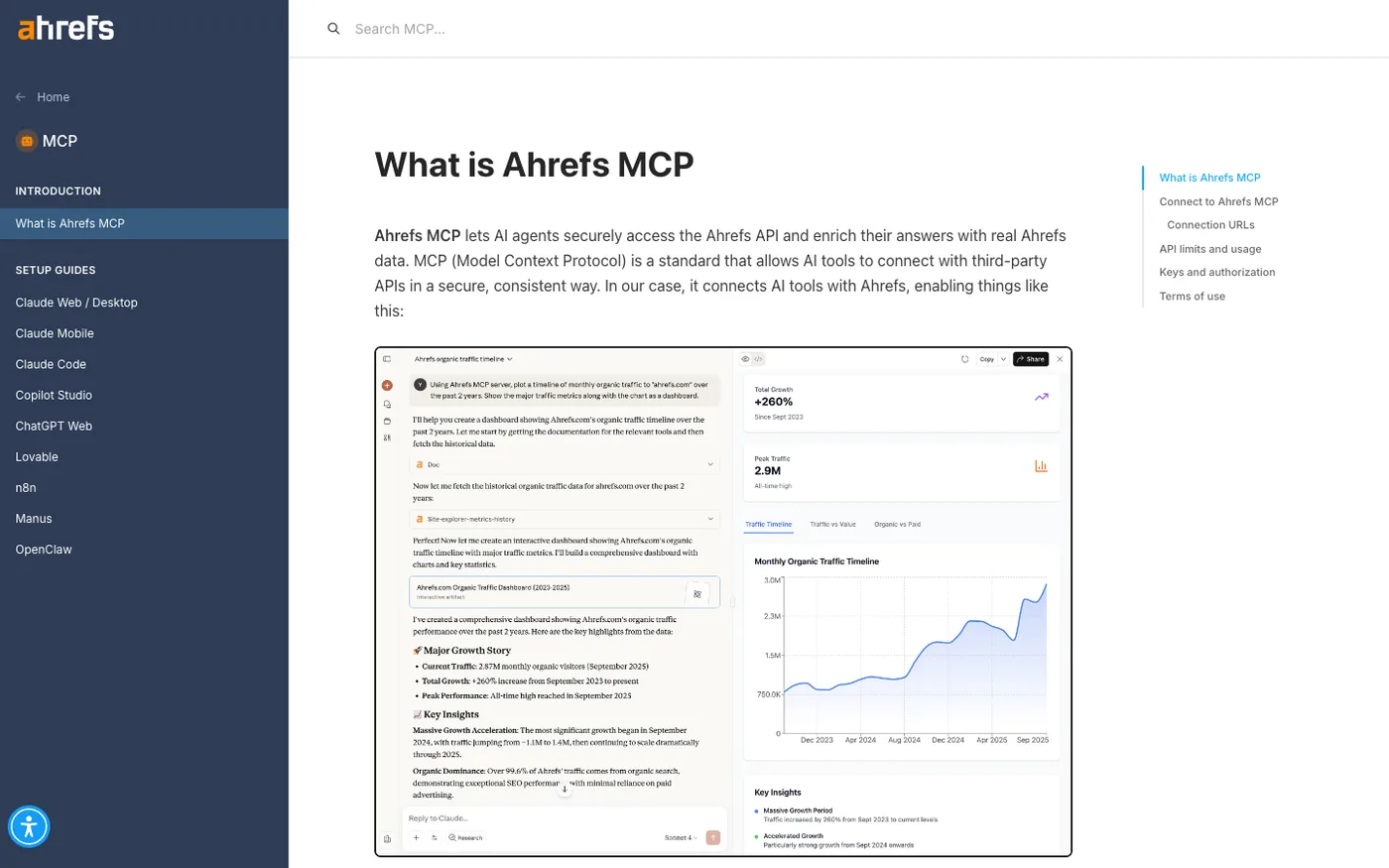
Ahrefs' official MCP server pulls live SEO data — keyword research, rank tracking, backlink analysis, and site audit findings — directly into Claude, Cursor, or Copilot Studio. Instead of switching between your AI workspace and the Ahrefs dashboard, you query everything through natural conversation.
Key Capabilities
- Keyword research — Search volume, keyword difficulty, SERP analysis, and related keyword suggestions via AI
- Backlink analysis — Domain rating, referring domains, new/lost backlinks, competitor link profiles
- Rank tracking — Position monitoring and ranking history via natural language queries
- Site audits — Technical SEO issue detection and prioritization
Strengths
- Official Ahrefs product — Direct access to one of the most comprehensive SEO datasets available
- Remote server via OAuth — No local install needed. Connect and start querying.
- Natural language queries — Ask "what keywords did [competitor] rank for in the last 30 days?" and get structured results
- Full API surface — Covers keyword data, backlinks, rank tracking, and site audit data
Limitations
- Read-only — Cannot modify Ahrefs projects, add keywords to tracking, or update campaigns
- Requires paid API plan — MCP access isn't included in basic Ahrefs subscriptions. Separate API pricing applies.
- SEO data only — No paid media, attribution, or advertising insights. A different category from ad platform MCPs.
Read/Write: Read-only | Pricing: Requires paid Ahrefs API plan
Summary: Brings Ahrefs' SEO data into your AI workflow without dashboard switching. Essential for teams that do keyword research, competitive analysis, and backlink monitoring through AI assistants like Claude or Cursor.
6. Semrush MCP — Competitive Intelligence Meets AI
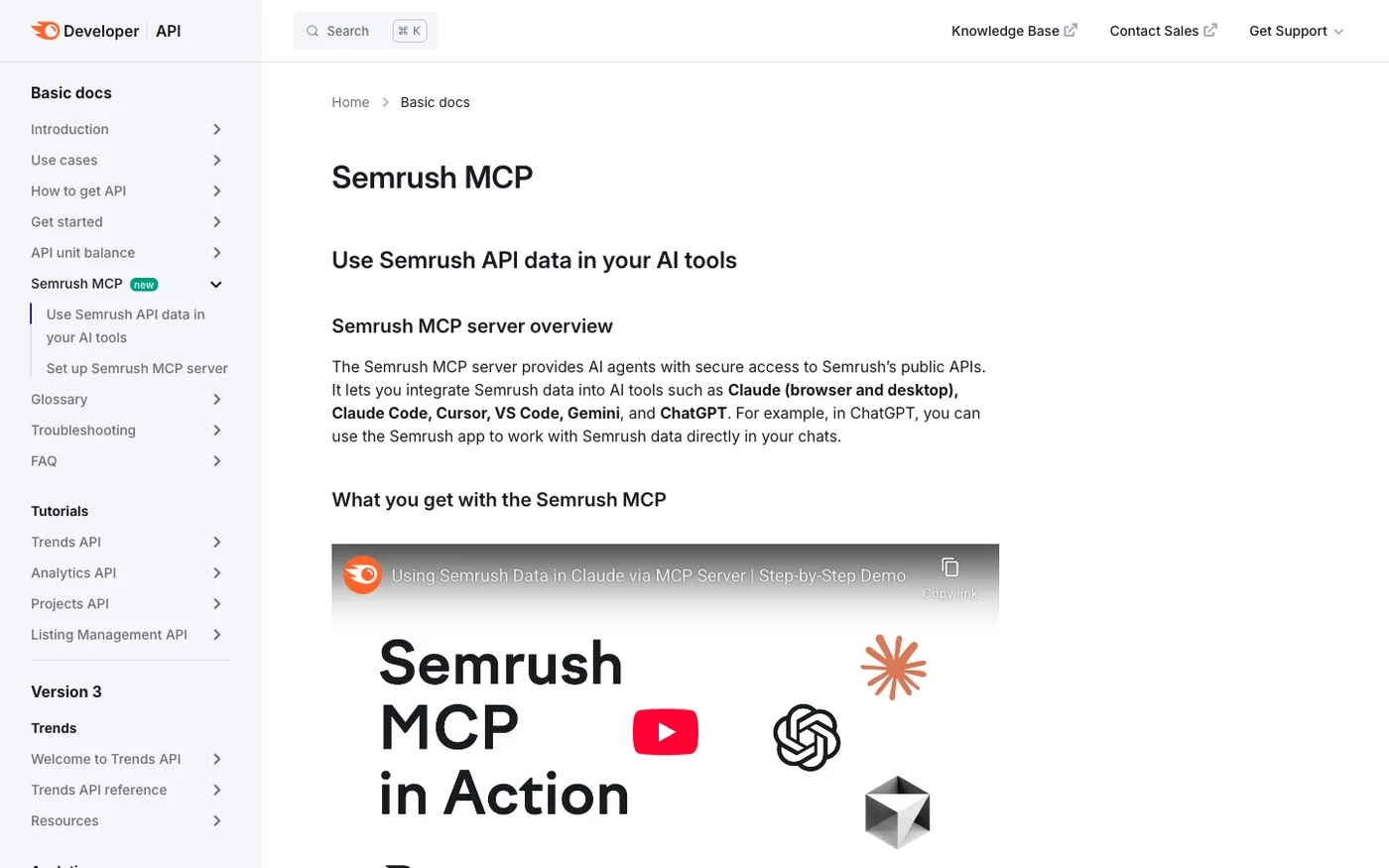
Semrush's official MCP server covers two distinct data surfaces: the Trends API (market analysis, traffic estimates, audience demographics, competitive benchmarking) and the Standard API (keyword data, backlink profiles, domain analytics). That dual coverage makes it more of a competitive intelligence tool than a pure SEO server.
Key Capabilities
- Market intelligence — Traffic estimates, audience overlap, growth benchmarks for competitor domains
- Keyword research — Volume, difficulty, SERP features, keyword gap analysis
- Domain analytics — Organic vs paid traffic breakdown, historical performance, ad copy monitoring
- Backlink analysis — Referring domain profiles, new/lost links, authority scoring
Strengths
- Two API surfaces — SEO data plus competitive/market intelligence. Broader coverage than SEO-only tools.
- Official Semrush product — Direct integration, not a community wrapper
- Traffic and audience estimates — Competitive intelligence data that goes beyond keyword rankings
- OAuth-based — Connect via authentication flow, no local server installation
Limitations
- Read-only — No project management or campaign modification capability
- High subscription barrier — Requires Business plan (Standard API) or Trends Basic/Premium plan. Not accessible on entry-level Semrush subscriptions.
- Competitive intelligence focus — Valuable for strategy, but doesn't connect to ad campaign management or attribution
- API limits vary by tier — Call volume and data access depend on subscription level
Read/Write: Read-only | Pricing: Requires SEO Business plan or Trends plan
Summary: The go-to MCP for competitive intelligence — traffic benchmarking, audience analysis, and market sizing that goes beyond keyword rankings. The subscription cost is steep, but if competitive intelligence is part of your workflow, having it in Claude or Cursor saves real time.
7. HubSpot MCP Server — CRM Data for AI-Powered Pipeline Analysis
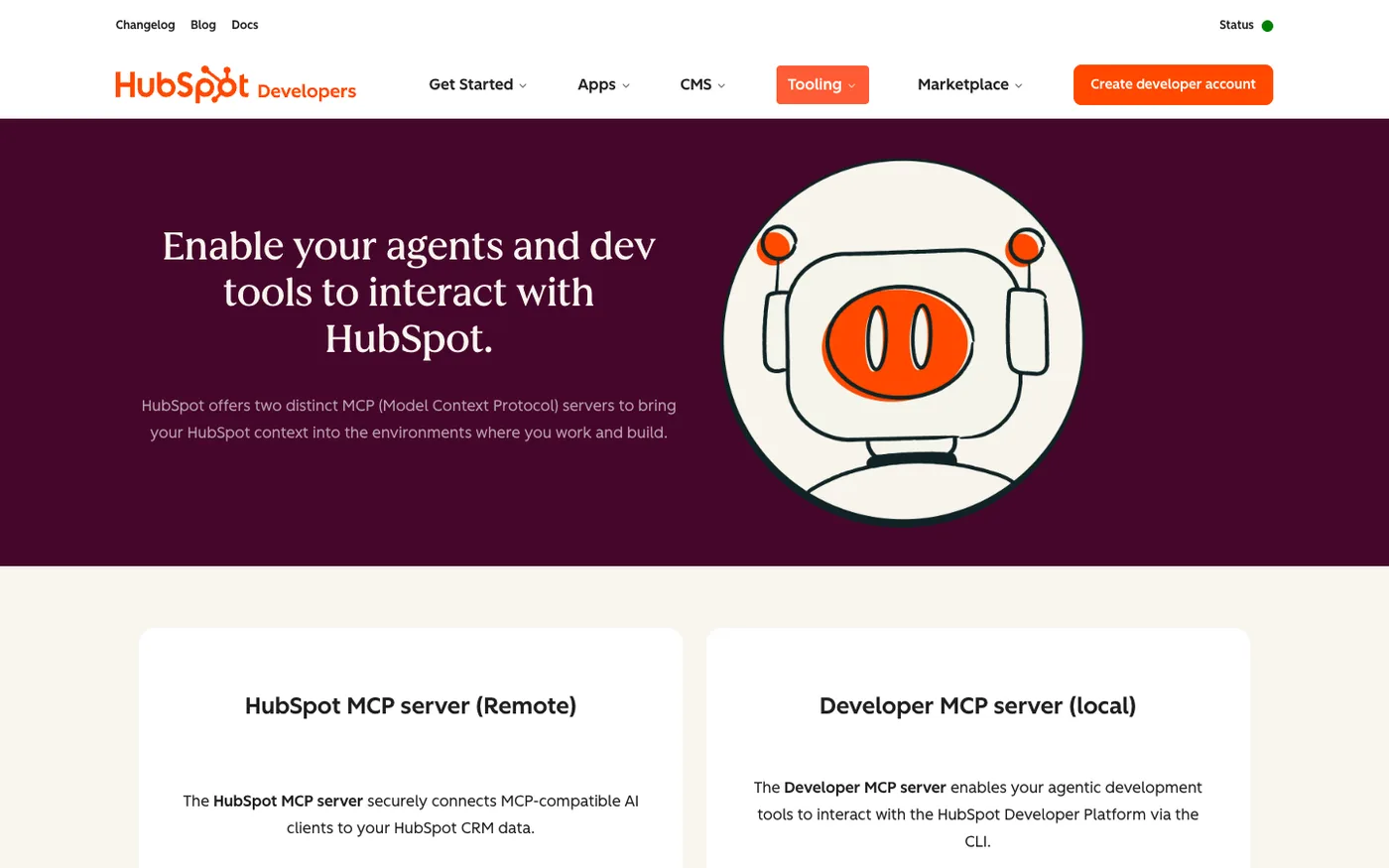
HubSpot's official MCP server, currently in public beta, brings CRM data into AI conversations. Query contacts, deals, campaign performance, and pipeline metrics in natural language through Cursor, Claude, or other MCP clients. Available to all HubSpot customers at no extra cost.
Key Capabilities
- Live CRM queries — Contacts, companies, deals, tickets, and pipeline stages accessible through natural language
- Campaign context — Marketing campaign performance data alongside sales pipeline data
- Real-time data — Queries run against your live HubSpot instance, not cached exports
Strengths
- Official HubSpot product — Direct CRM data access with no middleware
- Available to all HubSpot customers — No additional licensing or API cost
- B2B marketing essential — Pipeline attribution, lead source analysis, and campaign-to-deal tracking in AI conversations
- Real-time CRM data — Live queries, not stale exports
Limitations
- Read-only in beta — Write capabilities (creating contacts, updating deals) are in development but not yet available
- HubSpot ecosystem only — Won't pull data from other CRM platforms. Salesforce users need a different solution.
- Not a measurement tool — CRM data shows pipeline movement, but doesn't provide ad spend attribution or channel optimization
- Requires developer setup — OAuth credentials and HubSpot Developer Platform access needed
Read/Write: Read (beta — write planned) | Pricing: Included with HubSpot subscription
Summary: Connects the CRM data gap for B2B marketing teams. If HubSpot is your system of record, having pipeline data in your AI workspace means you can ask "which campaigns sourced the most pipeline this quarter?" without touching the HubSpot UI.
8. Shopify MCP Server — AI-Native Commerce Data
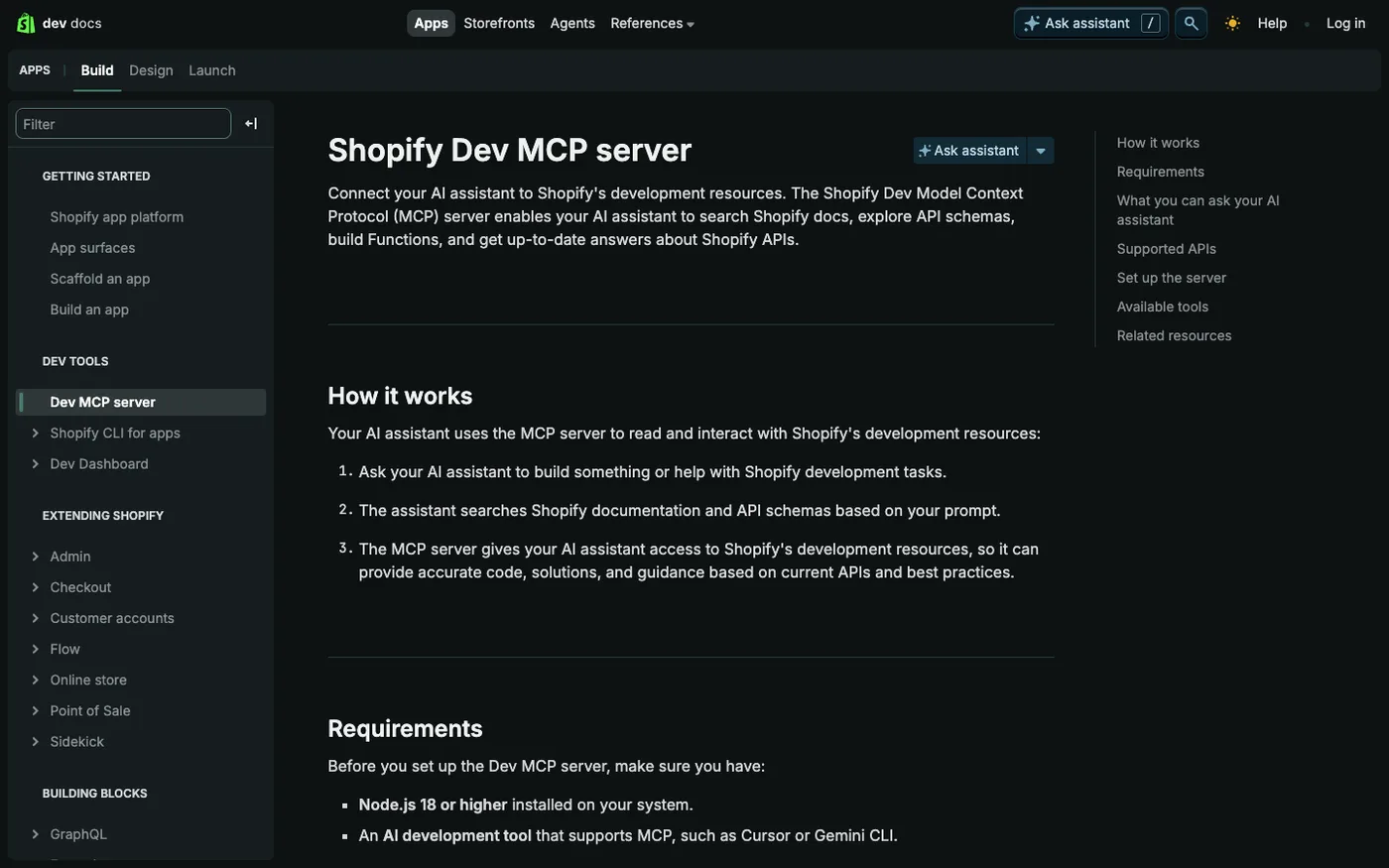
Here's something unusual: every Shopify store already has an MCP endpoint. Enabled by default since Summer 2025 and expanded in the Winter '26 Edition, Shopify's MCP lets AI assistants browse product catalogs, retrieve pricing and inventory data, manage carts, and even initiate checkout. It's less about marketing analytics and more about AI-native commerce — preparing for a world where AI agents are shoppers.
Key Capabilities
- Product catalog access — Browse, search, and retrieve product details including images, pricing, variants, and descriptions
- Cart management — AI can add items to cart, modify quantities, and initiate checkout flows
- Shopify Catalog — Cross-store search across billions of products on the Shopify network
Strengths
- Zero setup — Automatically enabled on all Shopify stores. No developer configuration needed.
- Real-time inventory — Live product availability and pricing data
- AI-as-shopper readiness — Positions stores for the emerging pattern of AI agents making purchase decisions
- Universal access — Works with any MCP-compatible AI client
Limitations
- Commerce-focused, not marketing-focused — Product catalog and checkout data, not campaign performance or ad analytics
- Limited reporting — Not built for marketing analysis or attribution. Won't tell you which ad drove the sale.
- Not a paid media tool — Useful for product data, but separate from advertising workflow
Read/Write: Read + limited write (cart, checkout) | Pricing: Included with all Shopify stores
Summary: The easiest MCP to get running — it's already on. Useful for e-commerce teams who want AI to access product data, but it's a commerce tool, not a marketing measurement tool.
9. Klaviyo MCP — Email and SMS Analytics for AI
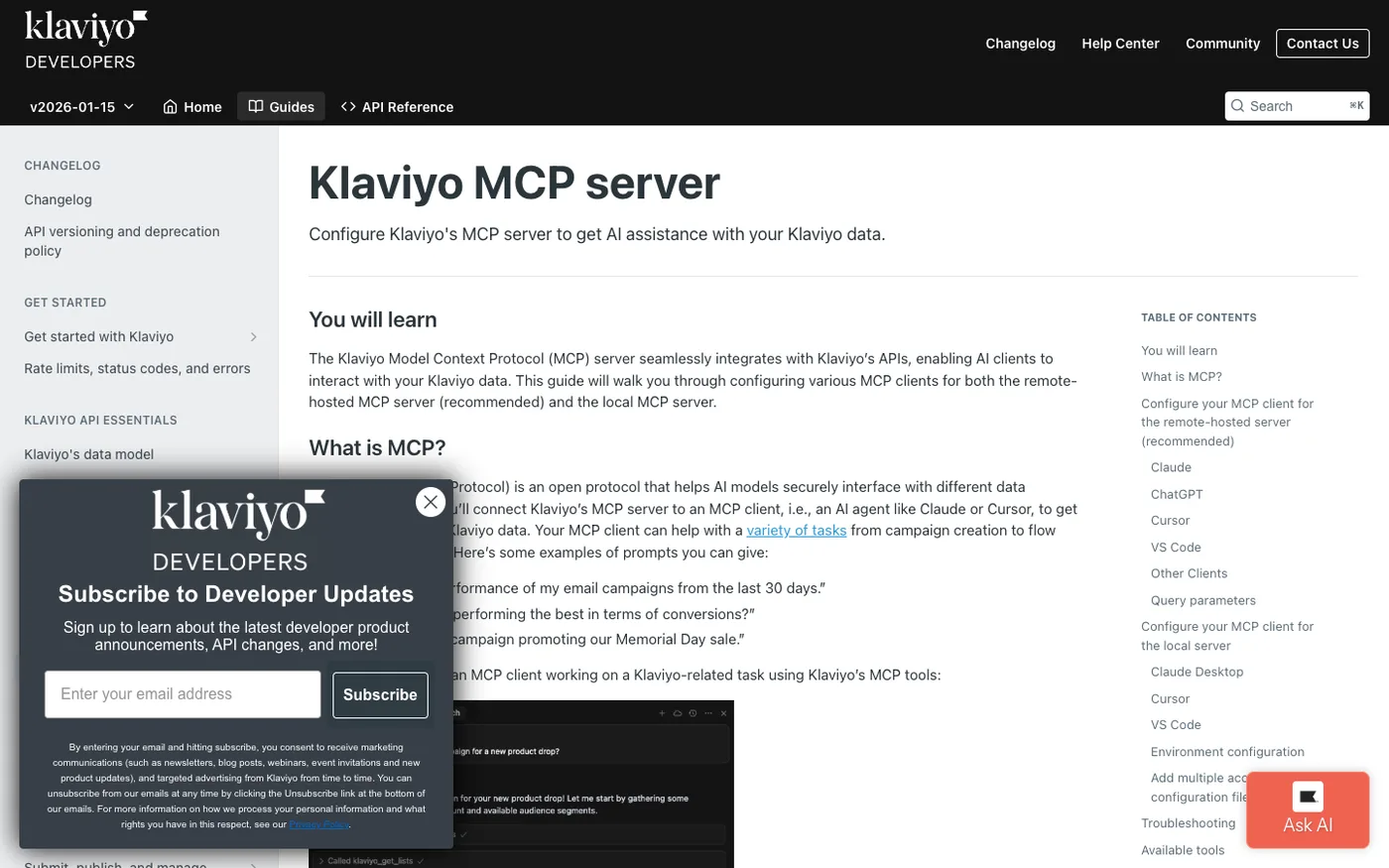
Klaviyo's official MCP server connects email and SMS campaign data to AI assistants. Query open rates, click-through rates, revenue attribution by flow, and audience segment performance — all through Claude, Cursor, VS Code, or Windsurf. Available to all Klaviyo customers.
Key Capabilities
- Campaign analytics — Email and SMS performance metrics: opens, clicks, conversions, revenue per message
- Flow performance — Automated sequence analytics: welcome series, abandoned cart, post-purchase flows
- Audience segments — Segment performance comparison and subscriber behavior analysis
Strengths
- Official Klaviyo product — Direct access to retention marketing data
- No extra cost — Included with all Klaviyo subscriptions
- Remote server option — Broader accessibility without local installation requirements
- E-commerce retention focus — Covers the lifecycle marketing data that paid media MCPs don't touch
Limitations
- Read-only in beta — Can't create campaigns, modify flows, or update segments through MCP yet
- Klaviyo data only — Email and SMS metrics from Klaviyo, nothing else
- Email/SMS focus — A retention marketing tool. Won't help with paid media optimization or ad spend attribution.
Read/Write: Read (beta — write planned) | Pricing: Included with Klaviyo subscription
Summary: Fills the retention marketing gap in a marketer's MCP stack. If your team runs email and SMS through Klaviyo, having that data in your AI workspace alongside paid media and SEO data gives you a more complete picture — even if the channel attribution still comes from elsewhere.
10. Zapier MCP — 8,000+ Apps Connected to AI
Zapier's official MCP server is the broadest connector on this list. With access to 8,000+ apps and 40,000+ actions, it lets AI trigger workflows across practically any marketing tool — route leads, distribute reports, sync data between platforms, send notifications. Available on all Zapier plans, including free.
Key Capabilities
- Cross-app automation — AI triggers multi-step workflows: lead arrives in HubSpot → enriched → scored → assigned → notified on Slack
- 40,000+ actions — Read data from, write data to, and trigger actions in 8,000+ connected apps
- Marketing use cases — Automated report distribution, lead routing, competitive alert triggers, data syncing between ad platforms and CRM
Strengths
- Broadest app coverage — 8,000+ apps. If a marketing tool exists, Zapier probably connects to it.
- Read-write — Can trigger actions, not just read data. AI becomes an executor, not just an analyst.
- Available on all plans — Including the free tier. Low barrier to start.
- Works with Claude, ChatGPT, Cursor — Broad AI tool compatibility
Limitations
- Task-based billing — MCP tool calls consume Zapier tasks. Heavy use adds up quickly.
- Open beta — Still in beta as of early 2026
- Breadth over depth — Individual app integrations can be shallow. Getting granular campaign data from Google Ads through Zapier is less reliable than using Google's own MCP.
- No intelligence layer — Zapier moves data and triggers actions. It doesn't analyze, measure, or optimize. It needs instructions — it can't determine which actions are worth taking.
Read/Write: Read-Write | Pricing: All plans (2 tasks per MCP tool call)
Summary: The Swiss Army knife of MCP servers. If your workflow involves moving data between apps, triggering notifications, or automating multi-step processes, Zapier's MCP is the broadest option for coverage. Just don't mistake workflow automation for marketing intelligence — Zapier handles the "do this" part, not the "should I do this?" part.
11. Make MCP — Visual Workflow Automation for AI
Make's official MCP server lets AI execute and manage Make scenarios — the visual, multi-step workflows that marketing ops teams build for data enrichment, lead processing, report generation, and cross-platform syncing. Cloud-hosted, so there's no local installation required.
Key Capabilities
- Scenario execution — AI triggers complex multi-step workflows: data enrichment pipelines, cross-platform sync, automated reporting
- Scenario management — View, modify, and manage existing workflows through AI conversations
- Visual complexity — Make's branching logic and conditional flows handle more sophisticated workflows than linear automation tools
Strengths
- Official Make product — Cloud-hosted, no local server setup
- Read-write — Execute and manage scenarios directly through AI
- Free tier for execution — Basic scenario execution at no cost
- Complex workflow support — Branching, conditionals, and data transformations that handle real marketing ops complexity
Limitations
- Scenario management requires paid plan — Free tier covers execution only, not building or modifying workflows
- Not a data intelligence tool — Like Zapier, Make triggers automations but doesn't provide measurement or analytics
- Smaller app ecosystem than Zapier — Extensive, but less than Zapier's 8,000+ apps
- Learning curve — Visual workflow builder is powerful but takes time to master
Read/Write: Read-Write | Pricing: Free tier available; paid for scenario management
Summary: For marketing ops teams already using Make, the MCP server adds AI orchestration to existing workflows. More visual and complex than Zapier's linear approach, but the same fundamental limitation applies — it automates actions without understanding which actions matter.
12. n8n MCP — Self-Hosted Workflow Automation
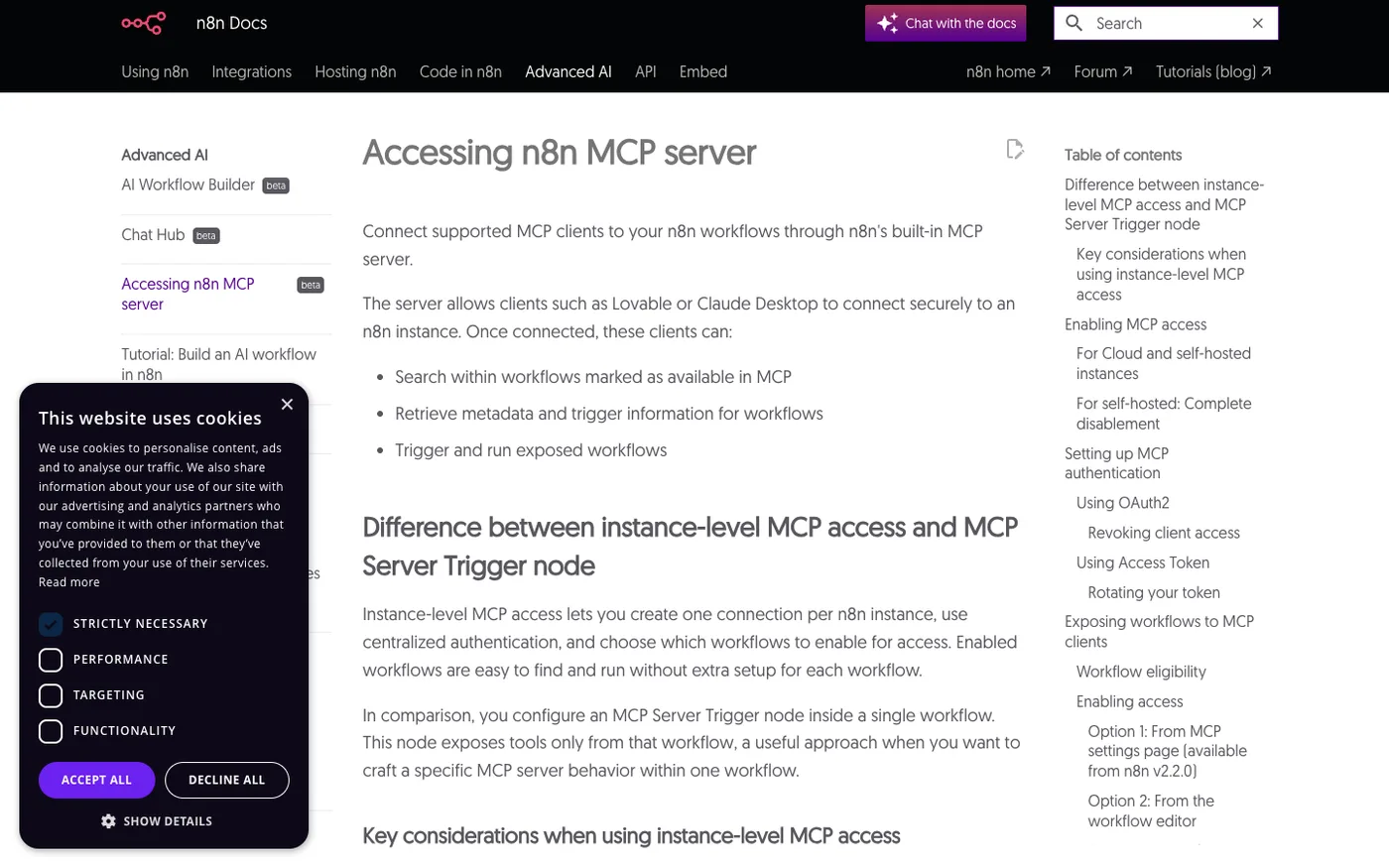
n8n takes a different approach: self-hosted, open source, and fully under your control. The MCP integration comes in two forms — n8n's built-in MCP node (call other MCP servers from within n8n workflows) and a community-built standalone server (expose n8n workflows to AI assistants). Free under MIT license.
Key Capabilities
- Bidirectional MCP — Both consume MCP servers within workflows AND expose n8n workflows as MCP tools for AI
- Self-hosted data control — All workflow data stays on your infrastructure
- Complex orchestration — Build sophisticated marketing automation pipelines with full programming flexibility
Strengths
- Self-hosted — Complete data privacy and control. Your workflows never touch third-party infrastructure.
- Free (MIT license) — No per-execution cost, no task-based billing
- Dual MCP approach — Both native MCP node support and standalone community server
- Full programming flexibility — JavaScript/Python code nodes for custom logic that no-code tools can't handle
Limitations
- Technical setup required — Docker, self-hosting, and server administration. Not for non-technical marketing teams.
- Standalone MCP server is community-maintained — The most popular n8n MCP wrapper isn't officially from n8n Inc
- Smaller ecosystem — Fewer pre-built integrations than Zapier or Make
- You're the admin — Hosting, updates, security patches, and maintenance fall on your team
Read/Write: Read-Write | Pricing: Free (MIT license, self-hosted)
Summary: The choice for technical marketing teams and agencies who want full control over their automation infrastructure. If you have the engineering capacity to self-host and you value data sovereignty, n8n's MCP integration gives you complete flexibility at zero licensing cost.
13. BigQuery MCP — AI-Powered SQL on Your Marketing Data Warehouse
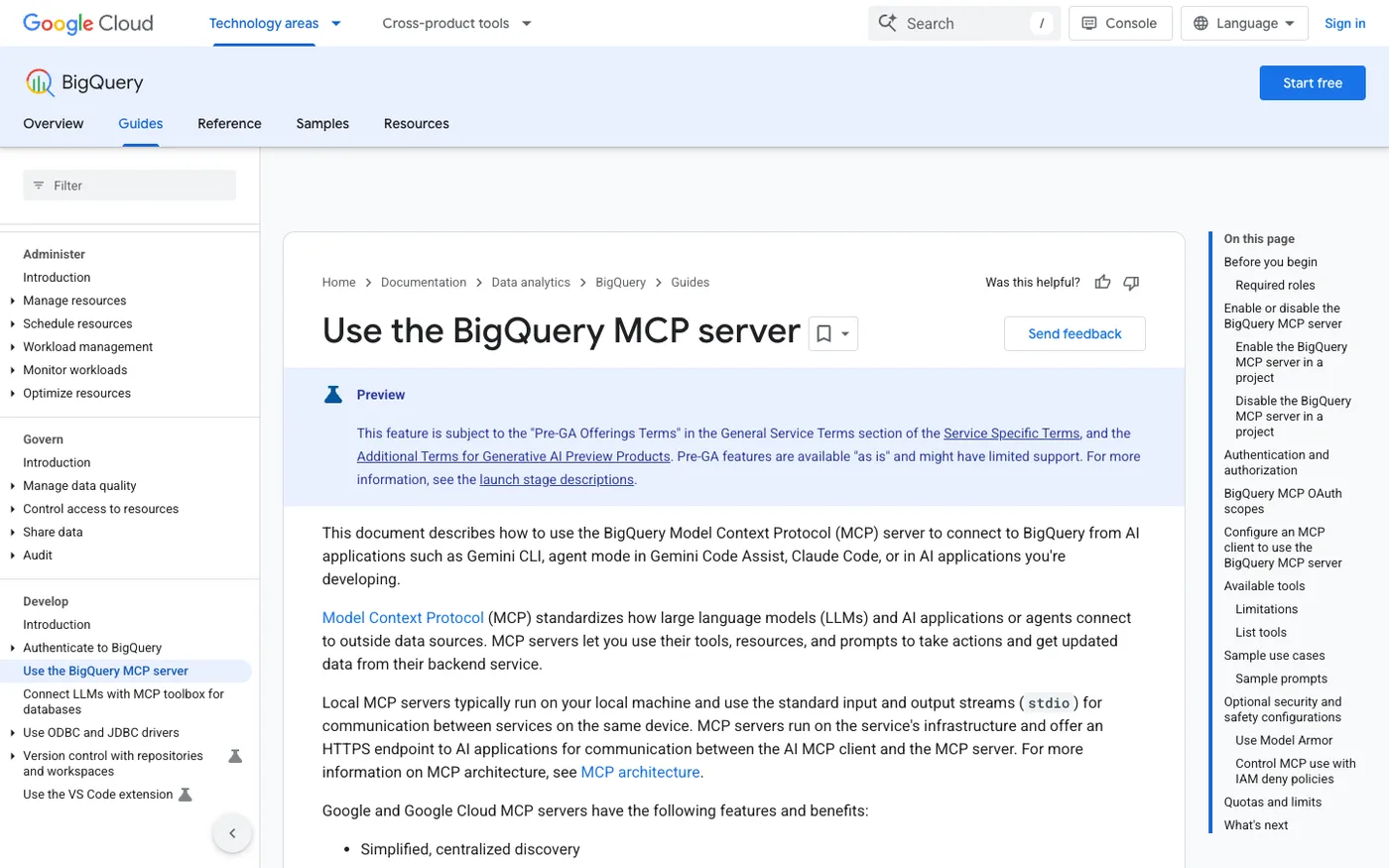
Google's official BigQuery MCP server lets AI run SQL queries against your data warehouse through natural conversation. For enterprise marketing teams that store ad spend, attribution data, and conversion events in BigQuery — a common pattern — this means AI can query your full marketing data lake without building reports in Looker or writing SQL manually.
Key Capabilities
- SQL query execution — AI writes and runs SQL against your BigQuery datasets, translating natural language into structured queries. Ask "what was our blended ROAS last month by channel?" and get a query result, not a dashboard.
- Read-write — Can create tables, write query results, and modify data — not just read. Useful for building marketing reporting tables, running ETL operations, or generating materialized views for downstream tools.
- Full BigQuery capability — Any data in BigQuery is accessible: ad spend, CRM exports, web analytics, offline conversions, attribution model outputs
- Auto-enabled — After March 2026, BigQuery MCP auto-enables on projects. No separate installation for existing BigQuery customers.
Strengths
- Official Google product — Enterprise-grade, auto-enables on BigQuery projects after March 2026
- Read-write SQL — AI can both query and write data. Create reporting tables, run ETL operations, generate materialized views.
- Universal data access — If it's in BigQuery, AI can query it. Ad spend, attribution, CRM, web analytics — everything in one place.
- Standard billing — No extra MCP cost. You pay for BigQuery compute as usual.
Limitations
- Only works with data already in BigQuery — Doesn't connect to ad platforms, CRM, or analytics tools directly. Data must be loaded first.
- SQL knowledge still matters — AI translates natural language to SQL, but reviewing and trusting the queries requires understanding what's being run
- Raw data, no measurement logic — BigQuery stores data. It doesn't apply attribution models, calculate incrementality, or optimize budgets. That's a separate layer.
- Compute costs — Large queries on marketing data can generate significant BigQuery bills
Read/Write: Read-Write (SQL execution) | Pricing: Standard BigQuery billing
Summary: Turns your marketing data warehouse into an AI-queryable resource. Powerful for teams that already have marketing data centralized in BigQuery — and even more useful when the data warehouse also contains attribution-adjusted metrics from a measurement platform.
14. Slack MCP — Marketing Team Communication for AI
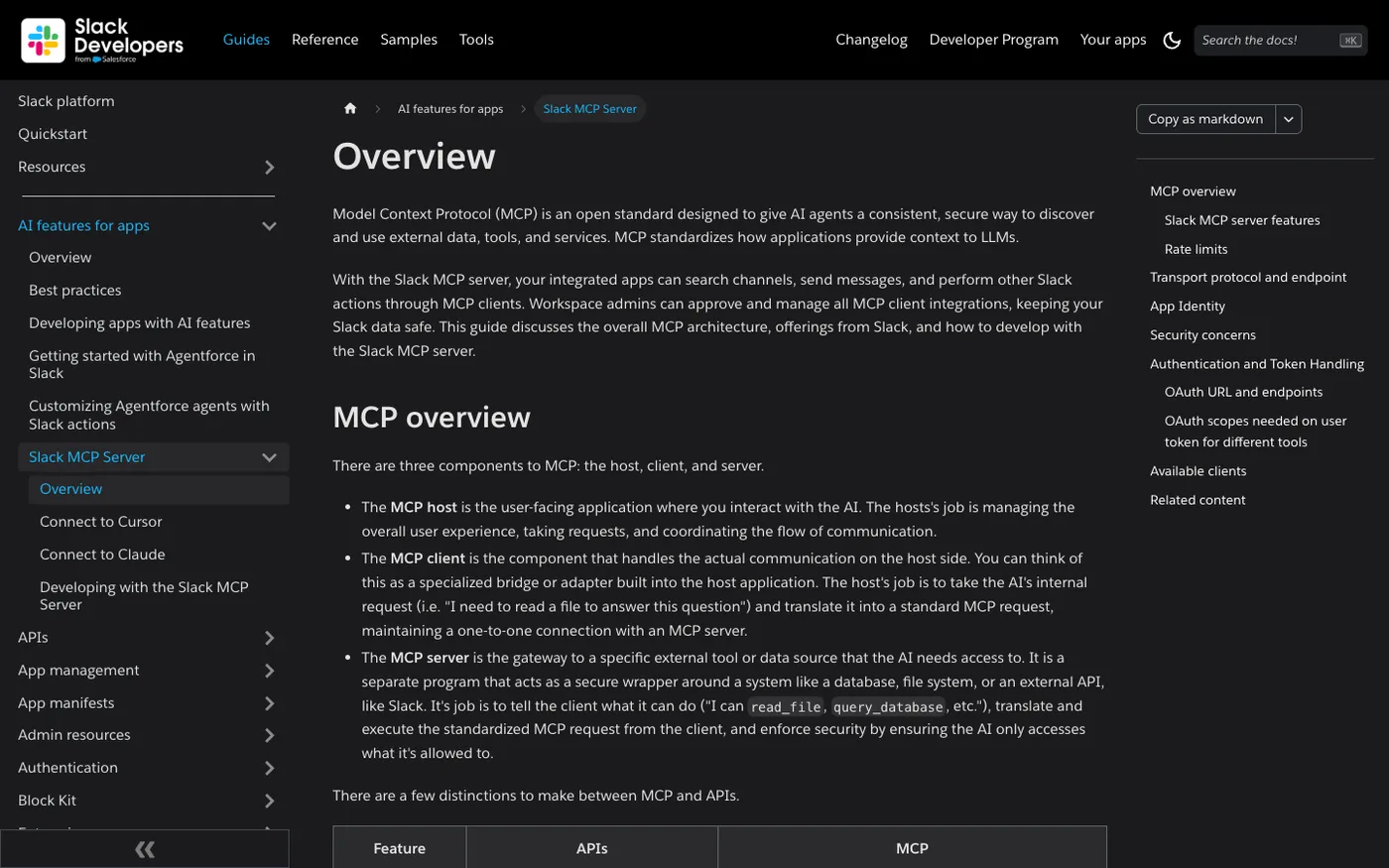
Slack's official MCP server — plus Anthropic's reference implementation — lets AI read from and write to your Slack workspace. For marketing teams, the practical value is automated alerts (campaign anomaly → Slack notification), report distribution (weekly performance summary → #marketing channel), and team context search (find that creative brief someone shared last month).
Key Capabilities
- Message sending — AI posts updates, alerts, and reports to specific channels. Set up a flow where SegmentStream MCP detects a CPA anomaly and Slack MCP immediately notifies your team with the details.
- History search — Query past conversations, find campaign discussions, retrieve shared files and documents. Useful for recovering context on past decisions — "what did we decide about the Q1 Meta budget?"
- Canvas creation — Generate formatted documents (briefs, reports, meeting notes) directly in Slack without switching tools
- Channel management — List channels, read threads, post threaded replies for structured team discussions
Strengths
- Official product (dual implementations) — Both Slack's own server and Anthropic's reference implementation available
- Read-write — Send messages, search history, create content. Full interaction capability.
- No extra cost — Included with Slack workspace subscription
- Glue layer for marketing workflows — Connects AI analysis outputs to team communication. Generate a performance report in Claude, post it to Slack — all in one flow.
Limitations
- Not a data platform — Slack is a communication tool. It doesn't store marketing data, ad performance, or attribution metrics.
- Workspace admin approval needed — Installing the Slack app requires workspace administrator permissions
- Permission complexity — Channel-level access, user permissions, and data sensitivity require careful configuration
- General purpose — Not marketing-specific. Useful, but in a supportive role.
Read/Write: Read-Write | Pricing: Included with Slack
Summary: The distribution layer for your MCP stack. On its own, Slack MCP doesn't do marketing analysis. Combined with measurement and analytics data sources, it becomes the channel where AI-generated insights reach your team automatically.
15. Google Sheets MCP — Spreadsheet Automation for Marketing Teams
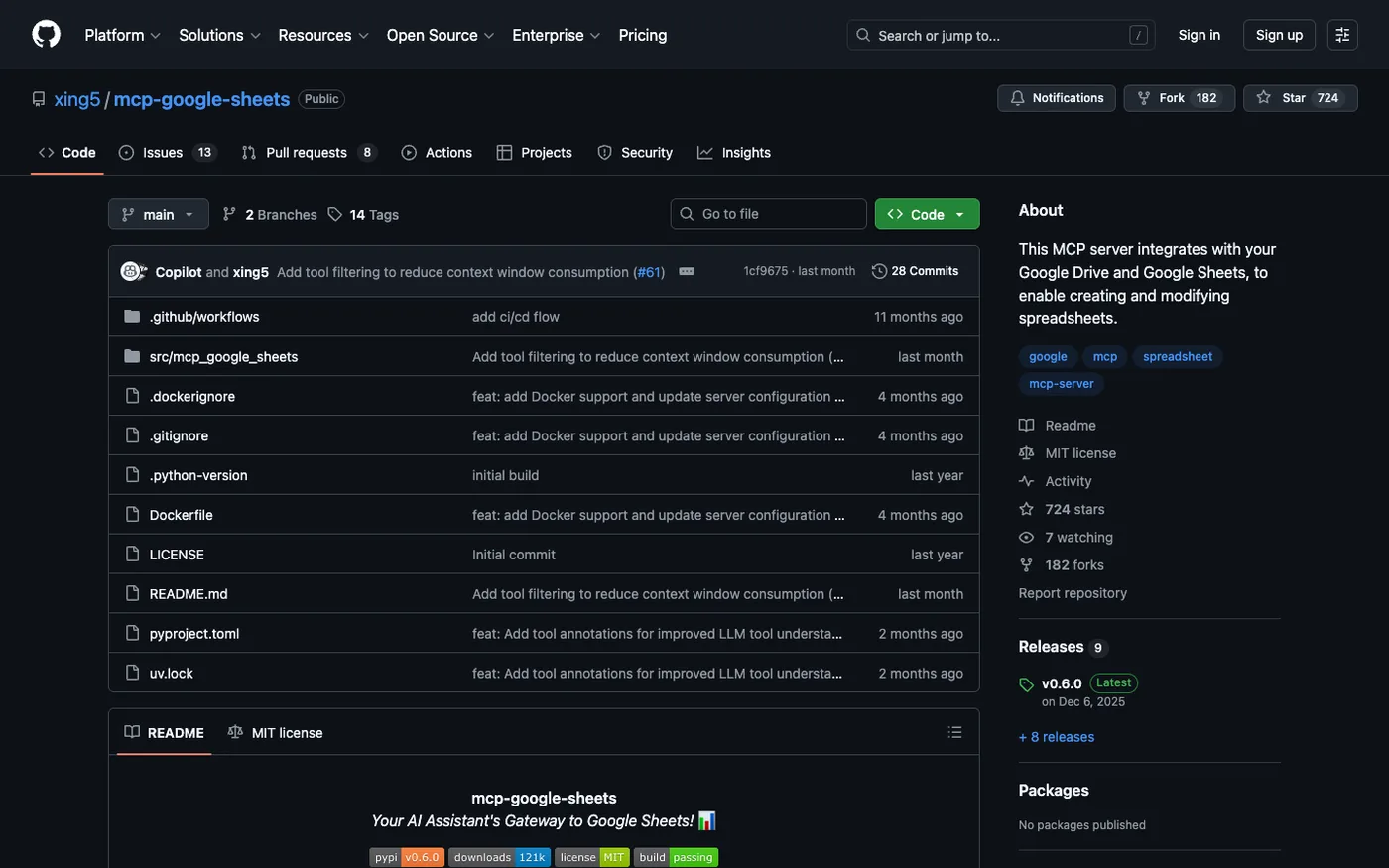
Community-developed MCP servers for Google Sheets (and broader Google Workspace). AI can read, write, format, and manipulate spreadsheet data — which, let's be honest, is where a lot of marketing reporting still lives. The most comprehensive implementation (google_workspace_mcp) covers Sheets, Docs, Drive, and Calendar.
Key Capabilities
- Read-write spreadsheet access — AI can query data from, write data to, and format cells in Google Sheets. Pull numbers from your campaign tracking sheet, update them with fresh data, and reformat the table — all through conversation.
- Report automation — Populate weekly reporting templates, update campaign tracking sheets, create formatted data tables. If your CMO still wants a Google Sheet every Monday morning, this MCP handles the last mile.
- Google Workspace integration — The fuller implementations cover Docs (create briefs and proposals), Drive (file management and sharing), and Calendar (schedule reviews and check-ins)
Strengths
- Read-write — AI doesn't just read spreadsheet data. It can update cells, add rows, format tables, and populate templates.
- Free — Uses Google API with OAuth. No licensing cost.
- Universal reporting tool — Many marketing teams still run reporting through Sheets. This meets them where they are.
- Multiple implementations — Several community options with different scope (Sheets-only vs full Workspace)
Limitations
- Community-maintained — No official Google Sheets MCP exists as of March 2026. Community servers vary in quality and maintenance.
- OAuth credential setup — Requires Google API credentials and consent screen configuration
- Spreadsheet, not intelligence — Manipulates cells in a spreadsheet. Doesn't analyze marketing performance, run attribution, or optimize budgets.
- Quality varies — Some implementations are better maintained than others. Test before relying on it for production workflows.
Read/Write: Read-Write | Pricing: Free (Google API)
Summary: Fills the "last mile" gap for teams whose reporting workflows still involve Google Sheets. Not glamorous, but practical. AI can populate your weekly marketing report, update your campaign tracking sheet, and pull numbers from shared documents — all without you opening a browser tab.
How to Choose the Right MCP Stack for Your Marketing Team
Don't pick one MCP server. Pick a stack. Here are the questions that determine which combination fits your workflow:
-
Cross-channel vs single-platform? If your ad spend runs across multiple platforms and you need accurate ROAS across all of them, a single-platform data connector won't cut it. You need a measurement layer that stitches everything together.
-
Action vs analysis? Read-only MCPs handle analysis. Read-write MCPs handle execution. The difference determines whether your AI assistant is a reporting tool or an operating partner.
-
Trustworthy data vs platform-reported? Every ad platform inflates its own contribution. If you're making budget decisions based on AI analysis, the underlying data needs to be independently measured, not self-reported by the platform selling you the ads.
-
What's already in your workflow? If your team already uses a CRM or SEO platform, check whether it has an MCP server. Most major tools on this list do. The best stack mirrors your existing toolkit — plus a measurement layer that ties everything together.
-
Technical capacity? Some MCPs work out of the box with zero configuration. Others need developer tokens, Docker containers, and API credentials. Match setup complexity to your team's technical capacity.
-
One channel or full portfolio? Single-channel teams can get by with platform-specific MCPs. Multi-channel teams need cross-channel measurement and budget optimization — which only one MCP on this list provides.
-
Platforms without their own MCP? TikTok, LinkedIn, Pinterest, Snapchat, and most programmatic platforms haven't shipped official MCP servers. If your spend includes those channels, you need an MCP that already connects to them through its own integrations.
-
Reporting or execution? Read-only MCPs are fine for pulling data and generating analysis. If you want AI-driven optimization — budget reallocation, campaign pausing, spend shifting — you need read-write capability backed by measurement, not just API access.
-
Unified numbers for the CFO? Individual platform MCPs give you siloed views: Google says one thing, Meta says another. If you need a unified ROAS and CPA across all channels — the kind of number you'd put in front of a CFO — a single-platform MCP won't get you there.
Final Verdict: Building Your Marketing MCP Stack
The MCP ecosystem gives marketing teams something that didn't exist 18 months ago: the ability to bring every data source in their toolkit into an AI conversation and get real analysis — not just canned dashboards.
But data access is table stakes. The hard question is what your AI actually does with that data.
Most MCPs on this list solve one piece of the puzzle. Google Ads MCP reads your campaign data. Ahrefs pulls SEO metrics. Zapier triggers automations. They're all useful — but individually, they just give AI access to raw, siloed, platform-reported numbers. The missing piece is the one that stitches data across channels, measures it independently, and tells AI which actions to take.
These 15 tools fall into distinct categories — measurement, ad platform data, SEO intelligence, CRM, workflow automation, and infrastructure — and the right stack depends on which of those you need. But the category that changes the game is measurement: without independently attributed, cross-channel data, AI is just reshuffling biased numbers.
-
SegmentStream is the clear #1 — the only MCP that gives AI a full measurement engine. Cross-channel attribution, budget optimization, incrementality testing, and the ability to execute changes. If you're running paid campaigns across channels and want AI that can analyze AND act with measurement grounding, start here.
-
Google Ads MCP and Ahrefs MCP are the most useful complementary data sources — reliable, official, and useful alongside a measurement layer for granular platform-specific queries and SEO intelligence.
-
The remaining tools — Meta Ads MCP, GA4 MCP, Semrush, HubSpot, Shopify, Klaviyo, Zapier, Make, n8n, BigQuery, Slack, and Google Sheets MCP — each serve specific workflow needs that are covered in detail above.
The MCP ecosystem will keep growing. More platforms will ship official servers, more community tools will emerge, and AI capabilities will expand. But the measurement layer — the engine that turns raw marketing data into trustworthy, cross-channel, attribution-adjusted intelligence — is the foundation everything else plugs into. Start there, and build outward.
FAQ: Best MCP Servers for Marketers
Can I optimize Google Ads and Meta Ads campaigns directly from Claude or ChatGPT?
SegmentStream MCP lets you analyze cross-channel performance with attribution-adjusted data and execute budget changes directly from Claude, ChatGPT, or Gemini. Google Ads MCP provides read-only data access. Meta Ads community MCPs allow campaign modifications, but without independent measurement to guide those decisions.
What is the best MCP server for managing ad campaigns across channels?
SegmentStream MCP — the only option connecting 30+ ad platforms with unified attribution and budget optimization. Other MCPs cover individual platforms (Google Ads MCP, Meta Ads MCP) but can't measure or optimize cross-channel. SegmentStream provides accurate ROAS across all channels, not platform-reported numbers.
Can MCP servers actually change my ad budgets or just pull reports?
Most marketing MCPs are read-only — Google Ads MCP, GA4 MCP, and Ahrefs can only pull data. SegmentStream MCP is read-write with measurement grounding: AI analyzes performance using ML attribution and reallocates budgets across channels. Zapier and Make MCPs are also read-write, but for workflow automation, not campaign optimization.
How do I get accurate ROAS data in Claude instead of platform-reported numbers?
Ad platforms overclaim conversions by design. SegmentStream MCP feeds your AI workspace unified cross-channel attribution data — accurate ROAS and CPA measured independently, not each platform's self-reported version. Connect it to Claude, ChatGPT, or Gemini and ask for cross-channel performance. The numbers are attribution-adjusted.
What is an MCP server and why do marketers need one?
An MCP server is a live connection between your AI assistant and your marketing tools — a universal protocol that works across Claude, ChatGPT, Gemini, Cursor, and more. SegmentStream MCP goes beyond data access by adding a measurement engine: attribution, budget optimization, and automated actions. Most MCPs only pull reports.
Can AI replace my media buying team if I connect it to ad platform MCPs?
Not replace — augment. MCP servers let AI handle routine analysis: performance reviews, anomaly detection, budget recommendations. SegmentStream MCP automates the measurement-to-action loop so your team focuses on strategy and creative. Platform MCPs provide the raw data layer. The combination makes your team faster, not smaller.
Which MCP servers work with Claude for marketing analytics?
SegmentStream (attribution + optimization), Google Ads MCP (campaign data), Ahrefs (SEO), Semrush (competitive intelligence), Zapier (workflow automation), HubSpot (CRM), and Klaviyo (email/SMS) all work with Claude. SegmentStream is the only one providing measurement-grounded analysis rather than raw platform data.
SegmentStream MCP vs Google Ads MCP: what's the difference?
Google Ads MCP is read-only — it pulls campaign data for analysis but can't change anything. SegmentStream MCP is read-write with a measurement engine underneath: it doesn't just read your ad data, it attributes conversions across channels, models incrementality, and recommends budget changes. Google Ads MCP works well for platform-specific queries alongside SegmentStream's cross-channel measurement.
Zapier MCP vs Make MCP: which is better for marketing automation?
Both connect AI to thousands of apps. Zapier MCP has the larger app library (8,000+) and broader AI tool support; Make MCP offers visual workflow building and lower per-operation costs. SegmentStream MCP complements either by adding the measurement layer neither provides — attribution-adjusted data and budget optimization that tells your automation what's actually worth doing.
Related Articles
- Best MCP Servers for Marketing Analytics in Grok — connect SegmentStream and the marketing data stack to Grok via MCP for attribution, ROAS, and budget optimization
- Best MCP Servers for Marketing Analytics in ChatGPT & Codex — the OpenAI marketing stack: MCP servers for ChatGPT and Codex covering attribution, ROAS, and budget optimization
- Best MCP Servers for Marketing Analytics in Gemini — connect SegmentStream and the Google marketing stack to Gemini, Gemini CLI, and Antigravity via MCP for independent attribution, ROAS, and budget optimization
- Best MCP Servers for Marketing Analytics in Perplexity — connect SegmentStream as the measurement brain so Perplexity answers marketing analytics and attribution questions from your own warehouse
- Best MCP Servers for Marketing Analytics in Claude — connect SegmentStream across Claude apps, Cowork, and Claude Code via MCP for independent attribution, ROAS, and budget optimization
- How to Measure the True ROI of AI Search — measure the revenue impact of ChatGPT, Claude, and Perplexity beyond GA4's referral row
- Best Marketing Attribution Tools in 2026
- Best Marketing Intelligence Tools & Platforms
- Best Marketing Mix Modeling (MMM) Software & Tools
Ready to Give Your AI a Marketing Measurement Brain?
Most MCP servers connect AI to data. SegmentStream connects AI to measurement — cross-channel attribution, budget optimization, incrementality testing, and automated campaign execution, all accessible from Claude, ChatGPT, or Gemini.
Talk to a SegmentStream expert to see how the MCP Server turns your AI workspace into a full marketing command center.