
How to Measure the True ROI of AI Search
Discover how much revenue ChatGPT, Claude, and other LLMs actually drive to your business — and why what you see in Google Analytics is only the tip of the iceberg.
Pavel Petrinich · 27 May 2026 · 7 min read
Quick Answer
- Last-click misattributes AI search. It credits the brand search or direct visit that happens later — not the AI assistant that started the journey.
- Most AI interactions don't produce a click. Users read the answer in ChatGPT, then type your brand name into their browser or Google it. The AI touchpoint is invisible to GA4.
- The journey splits across devices. AI research usually happens on mobile; conversion happens later on desktop — especially for complex or high-value purchases.
- To measure properly, you need three layers: an identity graph (stitch journeys across devices), first-click attribution (credit the upstream channel that introduced the user), and self-reported re-attribution at sign up or checkout (ask users how they actually found you).
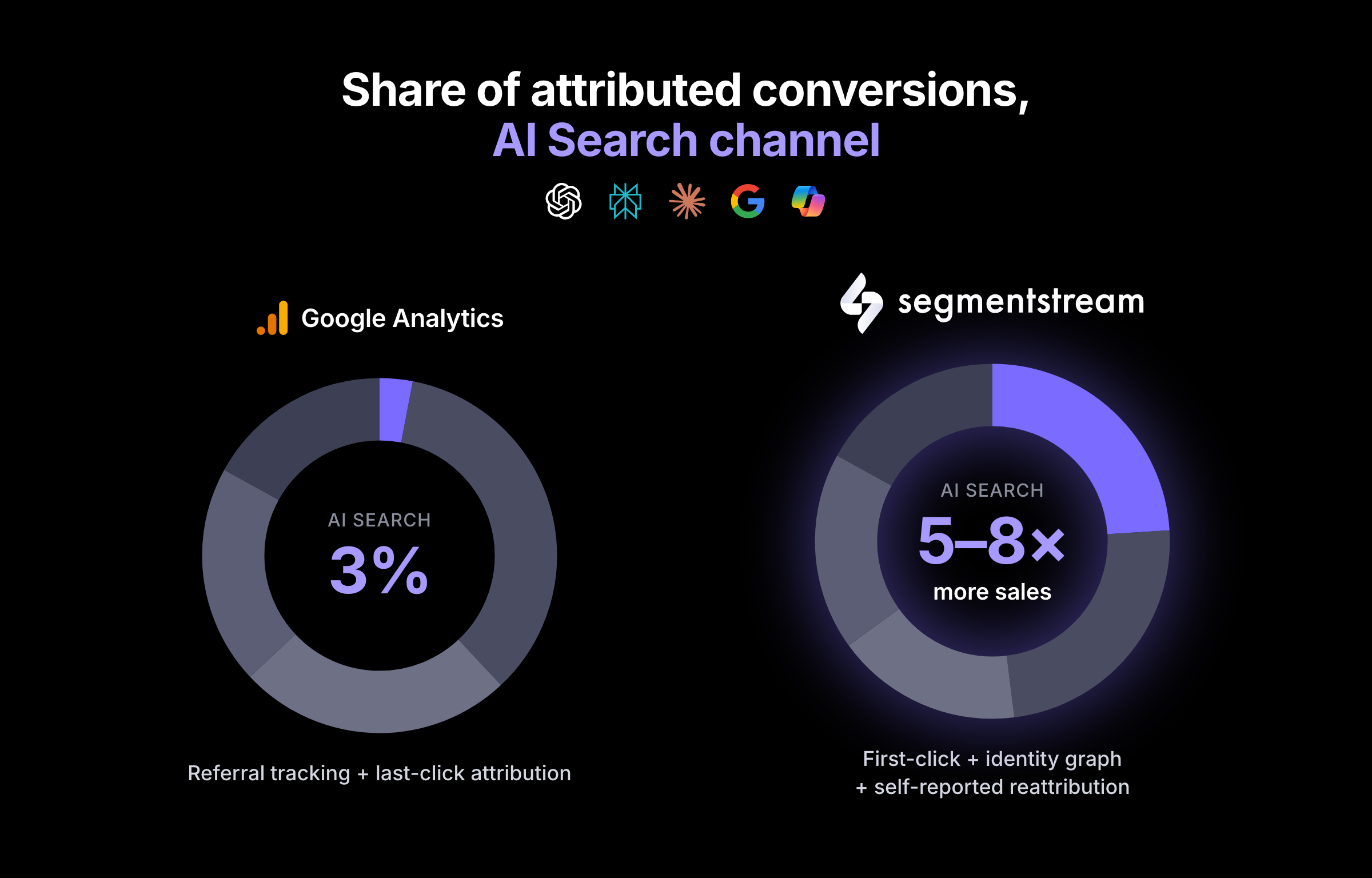
- This is the approach we take at SegmentStream. Across customers, AI search contribution to sales runs 5–8× higher than what last-click attribution shows — up to 15× for B2B and high-value products.
Read more below.
AI Has Become the New Front Door
AI has become the primary discovery surface. People research products and services in ChatGPT, Claude, Perplexity, and Google AI Overviews before they ever land on your site.
ChatGPT crossed 900 million weekly active users in February 2026. McKinsey's New Front Door to the Internet projects $750 billion in US consumer revenue flowing through AI-powered search by 2028, with traditional search traffic declining 20–50% for unprepared brands.
Teams have responded to the visibility problem. Tools like Profound, Peec AI, Semrush, and Ahrefs help track citation frequency and share of voice across AI platforms.
But citation share doesn't equal revenue — and most AI-influenced buying journeys are not measured properly, making it difficult to know if your investment in AI Search Optimization (also called Answer Engine Optimization or AEO, and Generative Engine Optimization or GEO) is actually worth it.
Why Most Attribution Tools Miss AI/LLM Search Impact
Today, most marketing teams analyze AI search impact by simply looking at referral traffic in Google Analytics, Adobe Analytics, or similar analytics tools, and measuring conversions with last-click attribution.
This channel looks small and non-impactful, which is why many brands skip investing in this area. But it isn't true. It's simply because the approach is fundamentally flawed for AI search ROI measurement.
-
Last-click credits the wrong touchpoint. AI assistants are used at the start of the journey. A buyer reads a comparison in ChatGPT, narrows their shortlist, and comes back days later via branded search. Last-click credits the brand-search ad. The AI interaction that originated the consideration set gets nothing — because it's not close to the conversion by design.
-
Most AI interactions never produce a click. GA4 captures referrer-passing sessions, but roughly 70% of AI-influenced visits arrive without a referrer header and get classified as Direct. Users copy URLs, use mobile apps that strip headers, or simply type the brand name after reading the AI's answer. These dark-funnel interactions are invisible to click-based attribution.
-
Research and conversion happen on different devices. Users often research on mobile using the ChatGPT or Claude apps — during commutes, breaks, or downtime — but convert later on desktop, especially for high-value or complex purchases. Without device stitching, the mobile research session and the desktop conversion look like two unrelated visitors. The AI touchpoint that started the journey gets no credit for the deal that closes it.
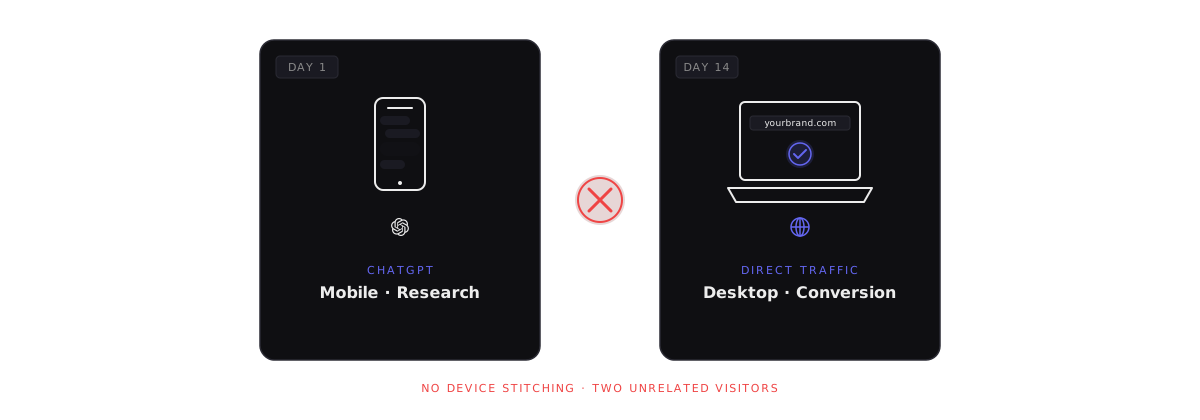
As a result, Direct, Organic and Paid Brand show outsized contribution. AI search looks weak. The AI visibility tools tell you whether you're cited — but citation frequency is a vanity metric until it's connected to actual revenue.
| Channel | Share of conversions (last-click) |
|---|---|
| Direct | 35% |
| Paid Brand Search | 22% |
| Organic Brand Search | 18% |
| Retargeting | 13% |
| AI Search | 2% |
How to Measure True AI Search ROI
Here's how we address this problem at SegmentStream. Measuring AI search ROI takes three layers. No single layer is enough.
Layer 1 — Identity Graph. The first crucial step is to ensure you can track the most complete customer journey possible — including stitching user activity across multiple visits, devices, and browsers. Without this, you'll see only a fragmented view of all interactions.
For example, a user may research on mobile after clicking a link in ChatGPT, but purchase later on desktop by simply visiting your site directly. In that case, the conversion won't be assigned to AI search even though it was the original source. SegmentStream's identity graph stitches sessions deterministically using verified shared signals — User ID, hashed email, click IDs, and IP address.
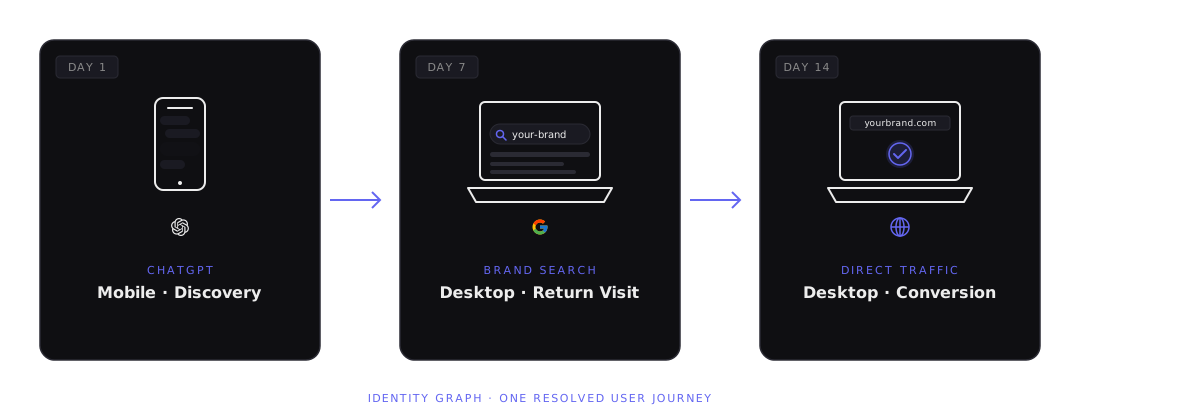
Layer 2 — Cross-Channel Attribution. Cross-Channel Attribution corrects the journey upstream of the conversion. The mechanism is first-click attribution on identity-resolved journeys. When a user discovers a brand on day one via an AI response, comes back on day seven via brand search, and converts on day fourteen, the identity graph reveals that brand search was a return visit — not the introduction. Credit gets redistributed to the upstream channel. This way, closing over-inflated channels like Direct, Paid and Organic Brand Search, and Retargeting are corrected, and top-of-funnel ad channels get the credit they deserve.
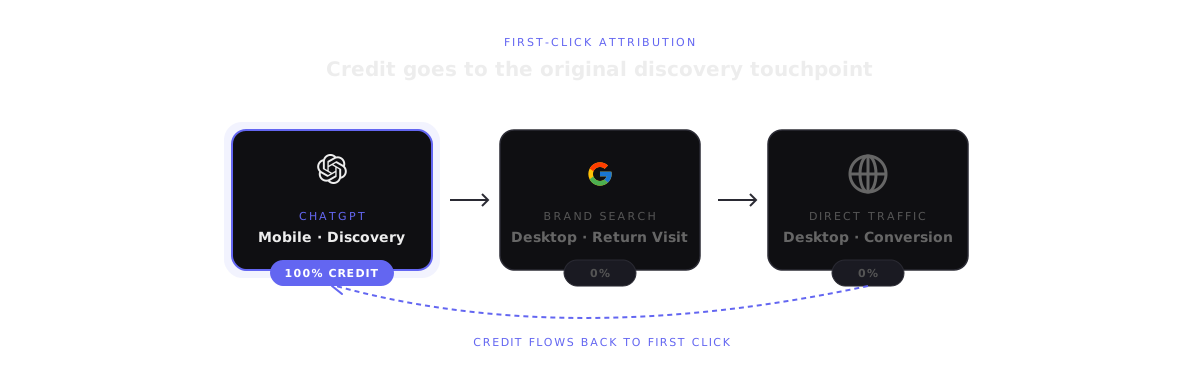
Layer 3 — Self-Reported Re-Attribution. Since people may not even click on a link — they may Google your brand name later or visit your website directly — it's important to address this dark-funnel gap. Without it, even with perfect first-click attribution, many conversions would still fall into the Direct or Brand Search bucket, since there's no other traced touchpoint before.
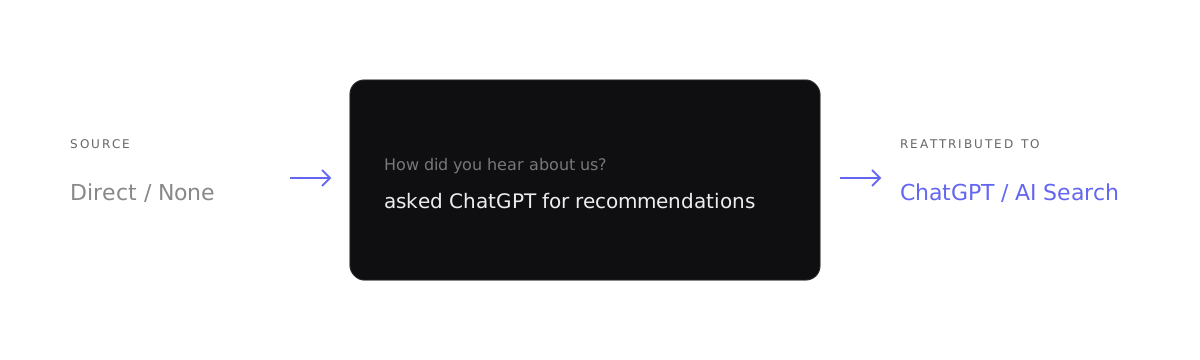
Self-Reported Re-Attribution solves for this exact use case. Here's how it works in a few words.
- Step 1 — Ask. A single question — "How did you hear about us?" — placed at sign up, checkout, or demo booking, with a free-text answer field.
- Step 2 — Classify and route. An LLM-powered triage layer turns each free-text answer into a clean channel grouping (ChatGPT, Claude, Perplexity, AI Overviews, podcasts, word-of-mouth) and decides whether to reassign the conversion:
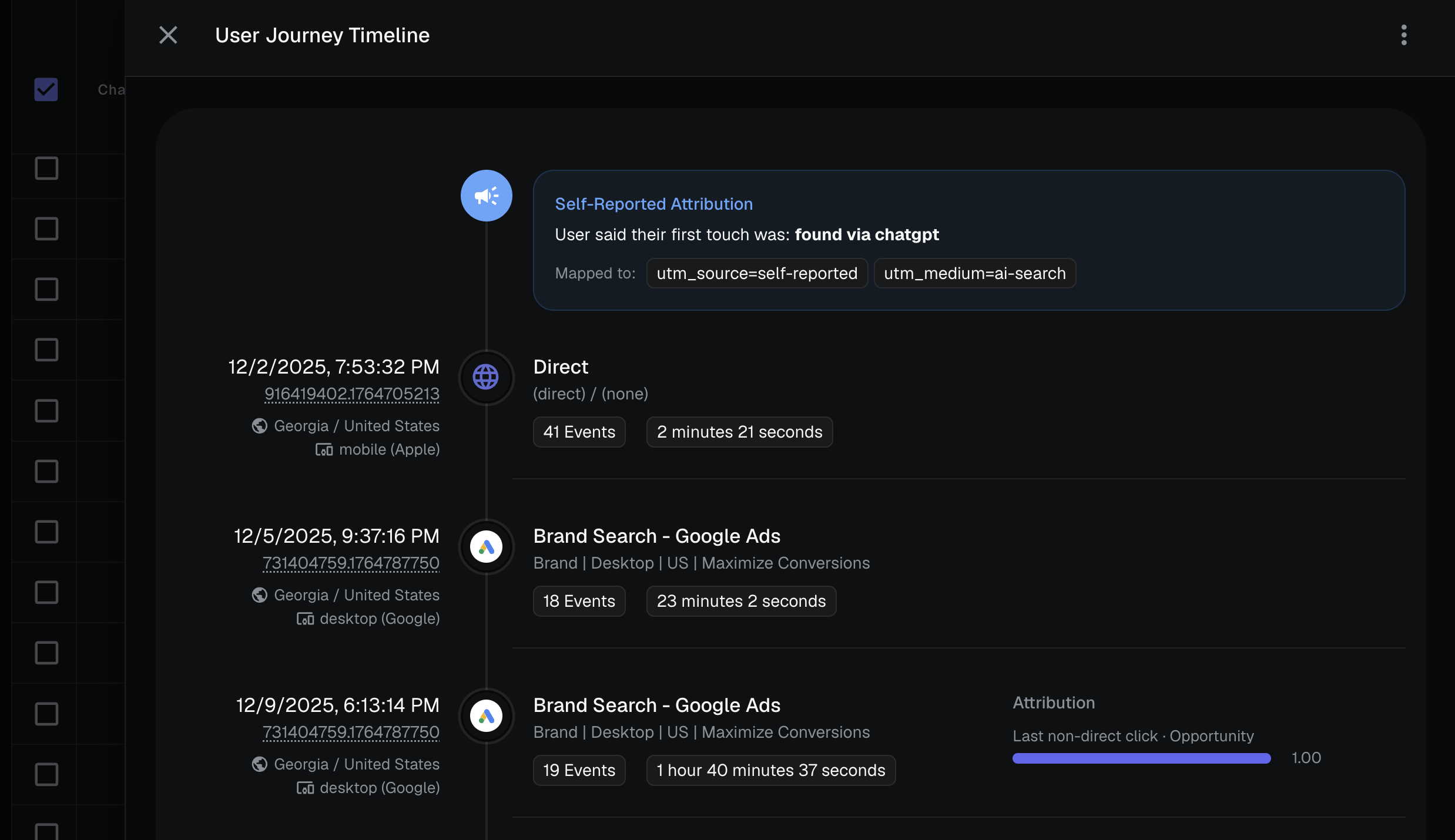
- If the tracked source is Direct, Brand Search, or Organic AND the user names a specific source ("asked ChatGPT", "saw you in AI Overviews"), the conversion is reassigned to the true source.
- If the click is already properly tracked via click IDs or UTMs, or the answer is vague ("online", "can't remember"), it's ignored — no override.
- Step 3 — Integrate. The response is integrated into the user's identity graph as a synthetic touchpoint, so AI search appears as a measurable row in standard attribution reports alongside click-tracked channels.
For more detailed methodology, read it in our whitepaper.
5–8× More Revenue Than Last-Click Shows
Across SegmentStream customers, AI search contribution to sales runs roughly 5–8× higher than what last-click attribution shows. In some cases — especially in B2B and high-value products — the gap reaches 15×.
Here's how that shift typically looks across attribution models — same conversions, different credit allocation:
| Channel | Last-click | First-click | First-click + SRA |
|---|---|---|---|
| Direct | 35% | 24% | 19% |
| Paid Brand Search | 22% | 15% | 13% |
| Organic Brand Search | 18% | 13% | 11% |
| Retargeting | 13% | 4% | 3% |
| AI Search | 2% | 8% | 16% |
AI Search jumps from a marginal 2% under last-click to 16% with first-click + Self-Reported Re-Attribution — an 8× recovery, mostly redistributed from Direct and Brand Search rows that were absorbing credit they didn't earn.
With these insights, the internal conversation shifts. Instead of "GA4 shows 42 sessions from AI chats — why are we investing in this?", the question becomes "AI search is involved in roughly one in six won deals — how can we make AI search even bigger?"
That's what measuring AI search ROI actually unlocks.
Key Takeaways
Two things to take away:
- Last-click attribution dramatically undercounts AI search revenue. Often by 5–8×, sometimes up to 15× for B2B and high-value products. The conversion gets credited to the brand search or direct visit that happens later — not the ChatGPT, Claude, or Perplexity answer that started the journey.
- Three measurement layers close the gap. Identity Graph stitches a user's sessions across devices into one journey. Cross-Channel Attribution gives credit to the channel that actually introduced the user. Self-Reported Re-Attribution closes the dark funnel by asking users directly how they found you — at sign up, checkout, or demo booking.
If you want to know whether your AEO/GEO investment is actually paying off, book a demo.
Related Articles
- Best MCP Servers for Marketing Analytics in Grok — connect SegmentStream and the marketing data stack to Grok via MCP for attribution, ROAS, and budget optimization
- Best MCP Servers for Marketers — how to give AI assistants direct access to your marketing data
- Best Marketing Attribution Tools & Software — the broader attribution platform landscape
- 10 Best Incrementality Testing Tools — measure causal lift, the next layer beyond attribution