
8 Best Voyantis Alternatives for LTV Prediction and Value-Based Bidding (2026)
The best Voyantis alternatives in 2026 — SegmentStream, Angler AI, Black Crow AI, AdZeta, Churney and more, compared for pLTV and value-based bidding.
Sophie Renn · 6 March 2026 · 26 min read

Quick Answer: The Best Voyantis Alternatives in 2026
SegmentStream is the best Voyantis alternative in 2026 — it combines custom individual-level LTV prediction with measurement, causal validation, and automated spend rebalancing in one platform.
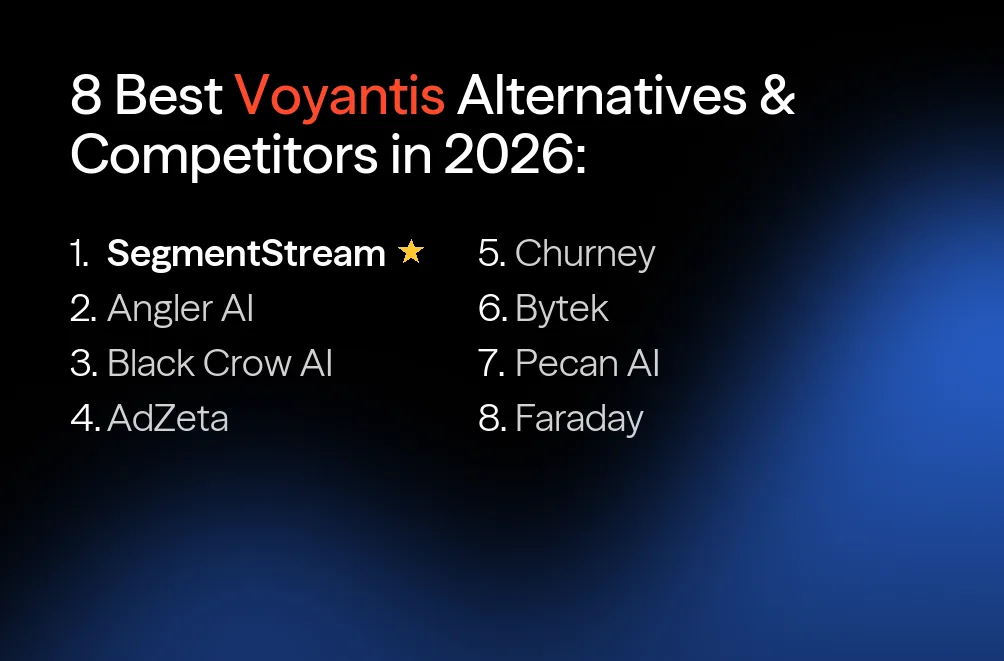
Other alternatives also include Angler AI, Black Crow AI, AdZeta, Churney, Bytek, Pecan AI, and Faraday.
Why Teams Look Beyond Voyantis in 2026
Voyantis built a strong position in the predictive LTV space. The platform predicts customer lifetime value within minutes of a first interaction and sends those value signals to Google Ads, Meta, and TikTok — giving ad platform algorithms something better than a first-purchase amount to optimize against. With $60M in total funding (including a $41M Series A in February 2025 led by Intel Capital), it's a well-resourced company that helped popularize value-based bidding as a concept.
But teams using Voyantis keep running into the same ceiling. The platform tells ad algorithms how much to bid. It doesn't tell your marketing team whether the bidding actually worked. That's not a small gap — it's the gap that determines whether your pLTV investment generates real incremental revenue or just reshuffles customers you would've acquired anyway.
Three specific pain points keep driving the conversation.
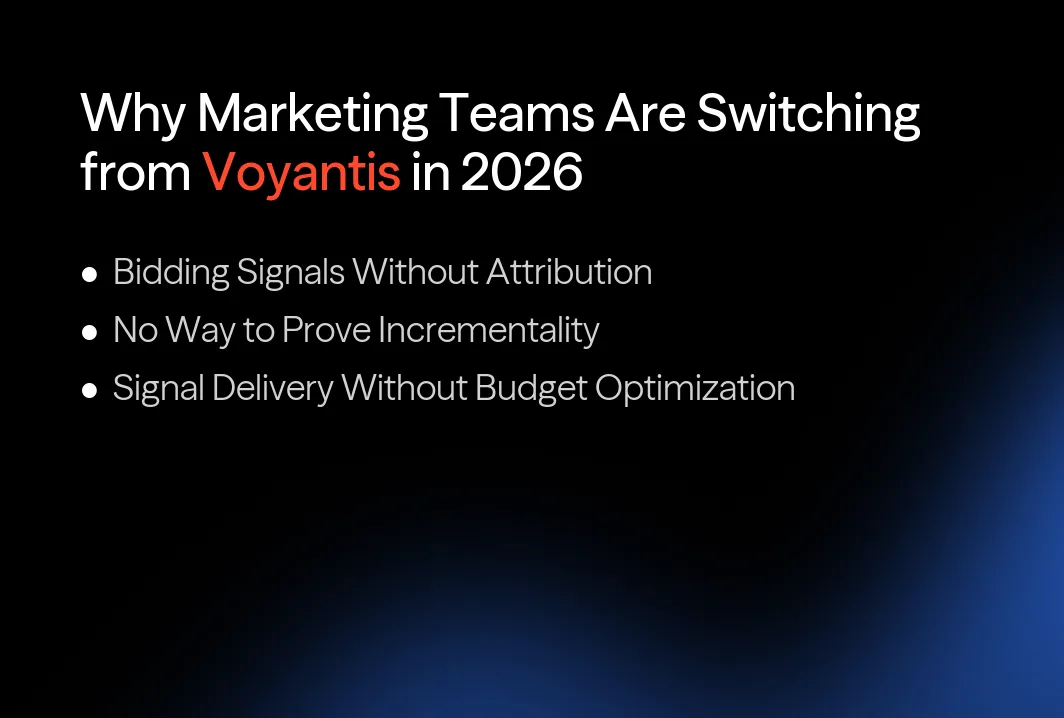
Bidding Signals Without Attribution
Voyantis sends LTV predictions to ad platforms. Your Google Ads campaigns start targeting higher-value prospects. Meta receives richer conversion signals. Good so far.
But here's what's missing: Voyantis can't tell you which channel, campaign, or creative actually drove those high-LTV customers. It sends the signal and the ad platform takes it from there — but there's no independent attribution layer to verify what happened. You're left trusting each platform's self-reported numbers, which famously overlap and inflate.
For teams spending $200K+ per month across three or four platforms, that blind spot isn't theoretical. It means you can't calculate true cross-channel ROAS against LTV, and you can't make confident budget allocation decisions based on Voyantis data alone.
No Way to Prove Incrementality
This is the harder question most pLTV tools avoid entirely. When you send higher value signals for predicted high-LTV customers, those customers convert. Great. But would they have converted anyway — even without the higher bid?
Voyantis has no incrementality testing capability. There are no geo-holdout experiments, no synthetic control groups, no mechanism to separate customers who were genuinely acquired through LTV-based bidding from customers who would have purchased regardless. The platform optimizes the signal but can't validate the outcome.
That matters a lot for subscription and SaaS businesses where the whole point of pLTV is acquiring customers with longer retention and higher spend. If your high-LTV segment was already coming through organic or brand search, higher bids just increased your acquisition cost without changing the customer mix.
Signal Delivery Without Budget Optimization
Voyantis optimizes bidding within each platform individually. It makes Google bid higher for predicted high-LTV users, and it makes Meta do the same. What it doesn't do is help you decide how much total budget to allocate to Google versus Meta versus TikTok.
That cross-channel budget question is where most of the money actually moves. A brand might be overspending on Google Search (where high-LTV customers are already arriving via brand queries) and underspending on Meta prospecting (where incremental high-LTV customers could be found). Voyantis doesn't see that picture because it optimizes within silos, not across them.
What Is Predictive LTV and Value-Based Bidding?
For teams still evaluating whether they need a pLTV tool at all, here's the core concept in plain language.
Predictive LTV (pLTV) — sometimes called CLTV prediction or customer lifetime value prediction — is a machine learning estimate of how much revenue a customer will generate over their lifetime, calculated at the moment of their first conversion, before any repeat purchases happen. Instead of waiting 6-12 months for actual LTV data to accumulate, a model predicts it instantly based on signals like first purchase behavior, device, referral source, product category, and hundreds of other variables.
Value-based bidding (VBB) uses those predictions to tell ad platforms what each conversion is actually worth. Standard smart bidding treats all conversions equally — a $15 trial signup gets the same bid as a $15 signup from someone who'll spend $3,000 over the next year. VBB fixes that by sending predicted values back to Google (via Offline Conversion Import) and Meta (via Conversion API), so the algorithms learn to find more customers who look like your highest-value ones.
The LTV delay problem: Subscription businesses, SaaS companies, DTC brands with repeat purchases, mobile apps, and gaming companies all share one challenge — the customer's real value doesn't show up for months. Ad platforms can't wait that long. pLTV fills the gap between the first conversion and the true payback.
This combination — predict the value, send it to the platform, let the algorithm optimize — is what makes tools like Voyantis, SegmentStream, and the others in this list valuable. The differences come down to what happens after the signal is sent.
How This Comparison Was Created
Rankings are based on product documentation, live demos, public pricing pages, and user reviews where available. Evaluation criteria: LTV model methodology (custom vs. off-the-shelf, individual vs. cohort), ad platform integration method (native OCI/CAPI vs. indirect), scope beyond bidding signals (attribution, incrementality, budget optimization), vertical coverage, and deployment complexity.
Quick Comparison Table
| # | Tool | Ad Platform Support | LTV Scope | Attribution | Incrementality | Budget Optimization | Target Vertical |
|---|---|---|---|---|---|---|---|
| 1 | SegmentStream | Google, Meta, TikTok, LinkedIn, YouTube, Display + more | Individual-level, custom ML | Yes (multi-model) | Yes (geo holdout) | Automated weekly | DTC, SaaS, B2B, fintech, subscription |
| 2 | Angler AI | Meta, Google, TikTok | Individual + consumer graph | No | No | No | DTC (Shopify) |
| 3 | Black Crow AI | Meta (primary), Google | 6-month pLTV window | No | No | No | DTC (Shopify) |
| 4 | AdZeta | Google (OCI), Meta (CAPI) | 30/60/90-day + lifetime | No | No | No | E-commerce |
| 5 | Churney | Meta, Google, MMP | Individual causal ML | No | No | No | DTC, SaaS, apps |
| 6 | Bytek | Google, Meta | Hybrid CDP + pLTV | No | No | No | E-commerce, retail |
| 7 | Pecan AI | Indirect (via CRM) | LTV as one use case | No | No | No | Mid-market (multi-vertical) |
| 8 | Faraday | Indirect (via API) | Consumer graph + custom | No | No | No | D2C (US only) |
1. SegmentStream — Best for LTV Prediction + Full Measurement
Most pLTV tools solve half the problem. They predict lifetime value and send it to ad platforms for smarter bidding. That's genuinely useful — it's why the category exists. But it leaves three questions unanswered: Did the bidding change actually acquire higher-value customers? Which channels drove them? And how should you redistribute budget across platforms based on the results?
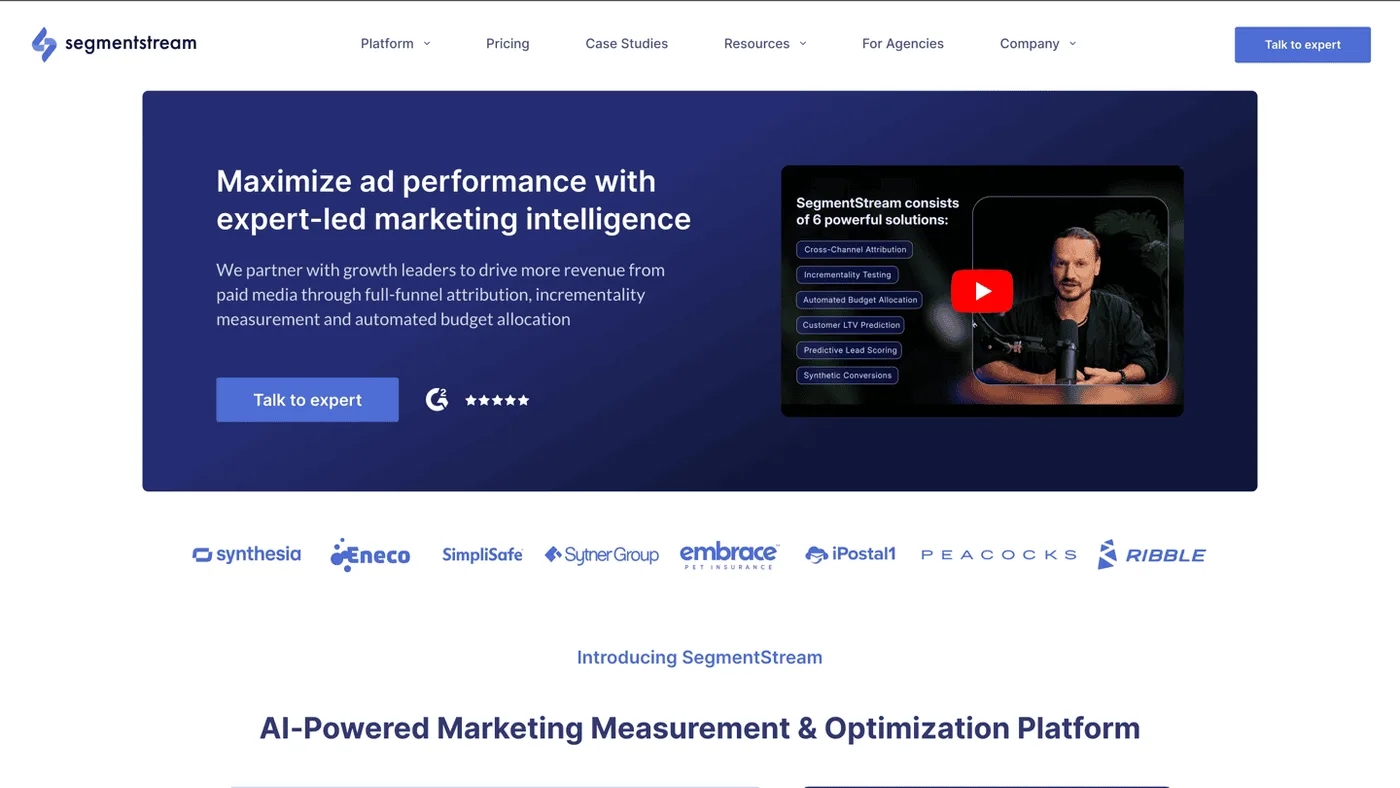
SegmentStream answers all three. It trains a custom ML model for each client — not an off-the-shelf algorithm, not a cohort-based estimate, but an individual user-level prediction built on your CRM and data warehouse history. That predicted LTV is sent to Google, Meta, and LinkedIn for value-based smart bidding. Then the measurement kicks in: cross-channel attribution shows which channels and campaigns actually drove those customers, geo-holdout incrementality experiments validate whether they're incremental, and automated budget optimization reallocates spend across platforms based on marginal returns.
That closed loop — predict, bid, measure, validate, optimize — is what separates SegmentStream from every other tool on this list.
Why SegmentStream Is the Top Voyantis Alternative
1. Customer LTV Prediction That Feeds Both Bidding and Attribution
SegmentStream builds a custom ML model per client using historical sales and customer data from your CRM or data warehouse. At the moment of conversion, each individual user receives a predicted LTV score — not a segment average, not a cohort estimate, but a prediction specific to that person. Those scores feed directly into Meta, Google, and LinkedIn for value-based bidding. But unlike Voyantis, the same LTV data also feeds into SegmentStream's attribution engine, so you can measure LTV-based ROAS across every channel.
2. Incrementality Testing That Validates LTV Campaigns
Geo-holdout experiments answer the question pLTV tools can't: did targeting high-LTV users actually bring in customers who wouldn't have come anyway? SegmentStream's measurement specialists design experiments with proper MDE (minimum detectable effect) calculations, power analysis, and synthetic control groups. You don't just send better signals — you verify the results.
3. Synthetic Conversions for Pre-Conversion Signal Enhancement
Every pLTV tool in this list sends value signals after a conversion happens. SegmentStream also generates fractional pre-conversion signals for high-intent users who haven't yet purchased — sent to Meta and Google via CAPI, amplifying the algorithm's training data by up to 10x. For brands struggling with Meta's 7-day attribution window, this fills a gap no other pLTV tool addresses.
Core Capabilities
- Individual user-level LTV prediction — custom ML models trained per client on first-party CRM/data warehouse data, with predictions at the moment of conversion
- Multi-model attribution suite — First-Touch, Last Paid Click, Last Paid Non-Brand Click, and customizable multi-touch attribution, all available side-by-side
- Cross-Channel Attribution — LTV-based ROAS reporting across Google, Meta, TikTok, LinkedIn, YouTube, Display, and all paid channels with click-time revenue attribution
- Automated weekly budget rebalancing — Marketing Mix Optimization identifies diminishing returns across ad platforms and rebalances spend weekly based on marginal ROAS analysis, executing continuous weekly optimization cycles (Measure → Predict → Validate → Optimize → Learn → Repeat)
- MCP Server integration — enables AI assistants to connect directly to the measurement engine for autonomous performance analysis and budget recommendations
- Conversion modeling — GDPR-compliant probabilistic inference recovers lost conversions from consent gaps without violating privacy
Strengths
- Custom ML per client — each model is trained on the client's own historical data, not a shared algorithm. Predictions reflect your specific customer base and purchase patterns.
- Bidding AND measurement in one platform — LTV prediction feeds both ad platform bidding and independent cross-channel attribution. No tool-switching, no data reconciliation between separate systems.
- Geo-holdout validation closes the loop — incrementality experiments confirm whether LTV-optimized campaigns actually drive incremental revenue, answering the question every pLTV-only tool leaves open
- Expert partnership, not self-serve software — senior measurement specialists (10+ years experience) design your LTV model, configure attribution, run incrementality experiments, and optimize budgets. Customers include SimpliSafe and Eneco.
- Transparent methodology — every model and attribution output is fully auditable. Your CFO can trace any number back to its inputs.
Limitations
- Premium investment — requires $50K+ monthly ad spend to be cost-effective. This is a strategic partnership with expert support, not a plug-and-play SaaS tool.
- Model training takes 1-2 weeks — the custom ML approach requires sufficient historical data before predictions go live. Teams wanting same-day activation won't get it here.
Target market: Subscription, SaaS, DTC, fintech, gaming, and app businesses spending $50K+/month on paid media that need LTV prediction integrated with attribution, incrementality, and cross-channel budget optimization — not just bidding signals.
Customer Review Examples
"A one-of-a-kind attribution, optimisation and budget allocation tool."
"The best attribution platform we've tried so far"
G2 Rating: 4.7/5 on G2
Summary
SegmentStream is the only platform in this comparison that connects LTV prediction to cross-channel attribution, incrementality validation, and automated budget optimization in a single system. Where Voyantis and the other tools on this list stop at sending bidding signals, SegmentStream continues through the full loop — predict, bid, measure, validate, optimize — closing the gap between "we predicted LTV" and "we actually acquired higher-value customers and can prove it."
2. Angler AI
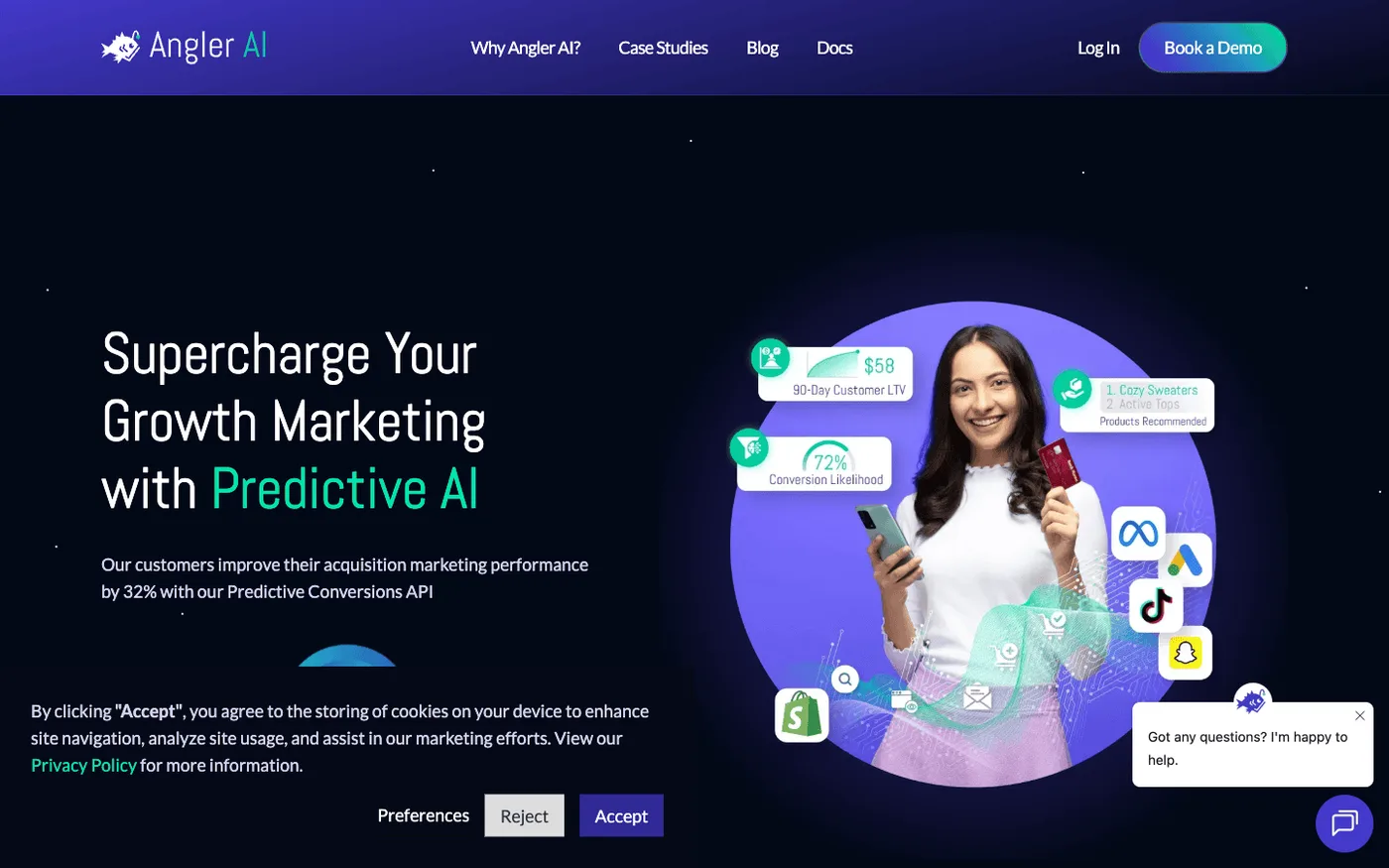
Standard Conversion API sends raw purchase events to ad platforms. Angler AI takes a different approach — it enriches those conversion signals with predicted LTV and third-party consumer attributes before they reach Meta, Google, or TikTok. The company calls it "Predictive CAPI" and it's built specifically for DTC brands running on Shopify.
What makes the approach distinct is the consumer data enrichment layer. Angler matches visitors against a proprietary dataset of 4,000+ purchase, demographic, and interest attributes. So the conversion signal reaching Meta doesn't just say "this person bought a $40 product" — it includes predicted LTV plus behavioral and demographic context that helps the algorithm find similar high-value prospects.
Core Capabilities
- Predictive CAPI — enriches conversion signals with predicted LTV and consumer graph data before sending to Meta, Google, and TikTok
- Consumer data enrichment — matches visitors against 4,000+ third-party attributes for audience targeting
- Multi-platform native support — Meta, Google Ads, and TikTok supported natively
- Shopify App Store integration — plug-and-play setup for Shopify merchants
Strengths
- Signal enrichment beyond first-party data — the third-party consumer graph adds context that helps brands with limited purchase history improve their conversion signals
- DTC-focused workflow — built around the Shopify merchant experience, with straightforward installation and activation
- Multi-platform coverage — sends enriched signals to Meta, Google, and TikTok natively, covering the three major DTC ad channels
Limitations
- Bidding signals only, no independent measurement — Angler sends enriched signals to ad platforms but provides no cross-channel view of which campaign or creative actually drove the customer. You still rely on each platform's self-reported numbers.
- Third-party data reliance raises questions — matching visitors against an external consumer graph is effective for enrichment but introduces data provenance concerns that first-party-only approaches avoid
- DTC/Shopify concentration — the entire product is designed around DTC ecommerce on Shopify. SaaS, B2B, fintech, and app businesses won't find a fit.
- Self-reported results are unverified — Angler claims 37% ROAS increase and 26% CAC reduction based on 130+ A/B tests. The methodology behind those tests has not been independently disclosed.
Target market: DTC brands on Shopify spending on Meta, Google, and TikTok that want enriched conversion signals beyond standard CAPI.
Summary
Angler AI enriches ad platform signals with predicted LTV and third-party consumer data — built for Shopify DTC brands with limited first-party purchase history. The third-party enrichment approach adds signal depth, but it also introduces data provenance questions that first-party-only methods don't carry. There's no cross-channel measurement layer and no way to confirm whether enriched signals actually drove higher-value customer acquisition.
3. Black Crow AI
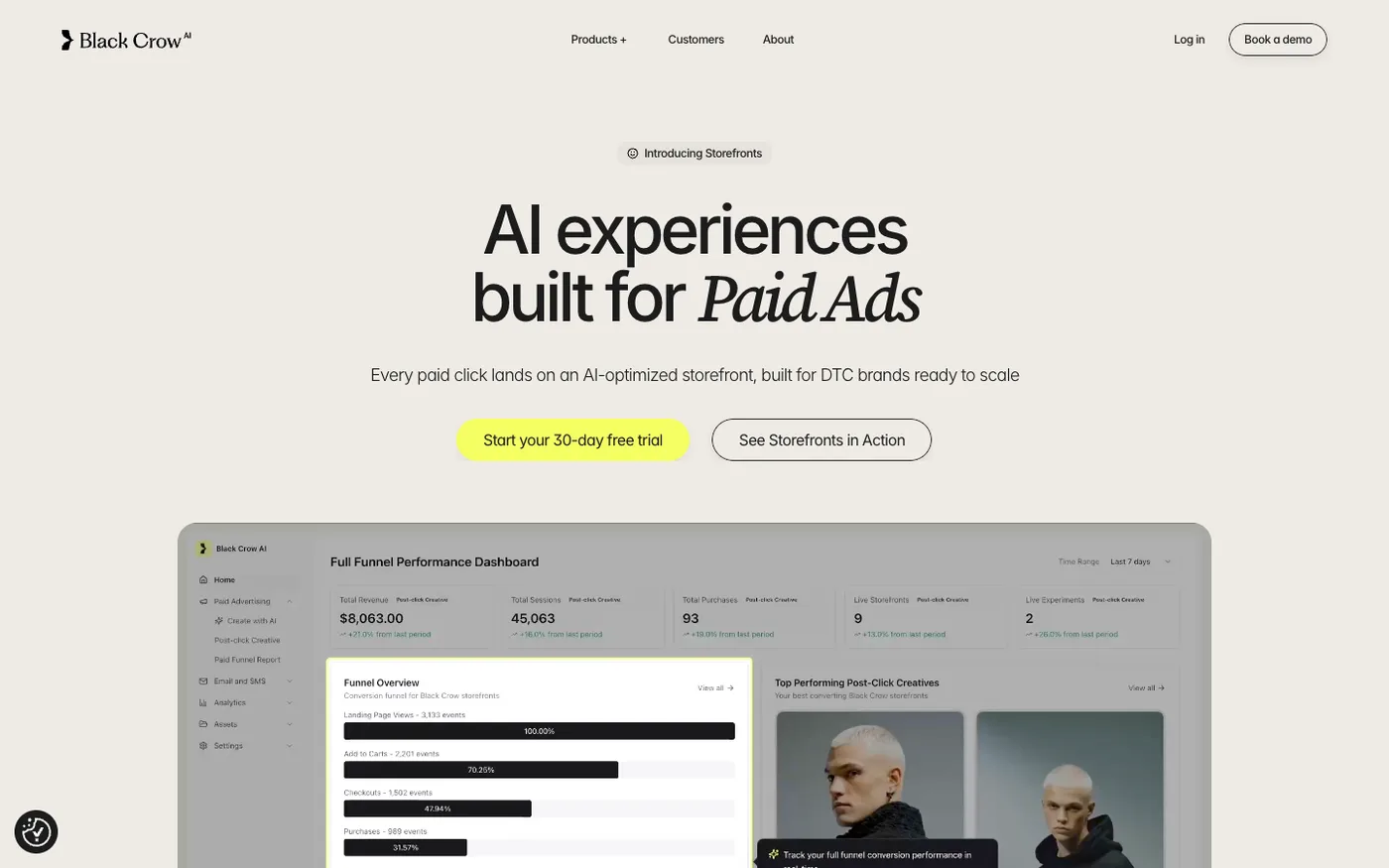
For Shopify DTC brands, Black Crow AI goes broader than just bidding signals. The platform predicts 6-month customer LTV, identifies high-value shoppers, and sends predictive signals to Meta via CAPI — but it also extends into storefront personalization. Pop-ups, email triggers, and SMS campaigns can all be targeted based on Black Crow's prediction models, making it more of a full-funnel DTC tool than a pure VBB solution.
The prediction models retrain every 30 days using past purchaser behavior. No PII is required, and the system works within Apple ATT restrictions — which matters for any brand that's watched their Meta targeting degrade post-iOS 14.5.
Core Capabilities
- 6-month pLTV prediction — models retrained monthly to capture repeat-purchase likelihood patterns
- Meta CAPI integration — sends predictive signals for value-based audience optimization
- On-site personalization — pop-up targeting, email/SMS triggers based on predicted value
- Shopify-native — plug-and-play integration through the Shopify App Store
Strengths
- Full-funnel scope beyond paid ads — on-site personalization and retention triggers give DTC brands multiple activation points beyond Meta bidding signals alone
- Privacy-compatible — no PII required, designed to work within Apple ATT constraints
- Shopify-native setup — fast deployment for Shopify merchants without data engineering requirements
Limitations
- Shopify-only — the entire platform is built around Shopify. Non-Shopify DTC, SaaS, B2B, and app companies won't find a path forward.
- Meta-centric for paid media — paid ad optimization leans heavily toward Meta. Google Ads integration exists but isn't the primary focus.
- 12-month contract required — limited ability to test before committing to a full annual engagement
- Predicts value but can't trace its source — tells you who is high-LTV but can't show which campaign or channel drove them, and can't validate whether the targeting changes produced incremental results
Target market: Mid-market Shopify DTC brands in apparel, beauty, wellness, and home that want LTV prediction combined with on-site personalization — primarily Meta-focused.
Summary
Black Crow AI combines LTV prediction with storefront personalization and retention triggers — a broader activation scope than pure signal-delivery tools. But the platform is locked to Shopify and leans heavily on Meta, which limits it to a specific slice of the DTC market. The 12-month contract adds commitment risk for teams that want to test before going all-in.
4. AdZeta
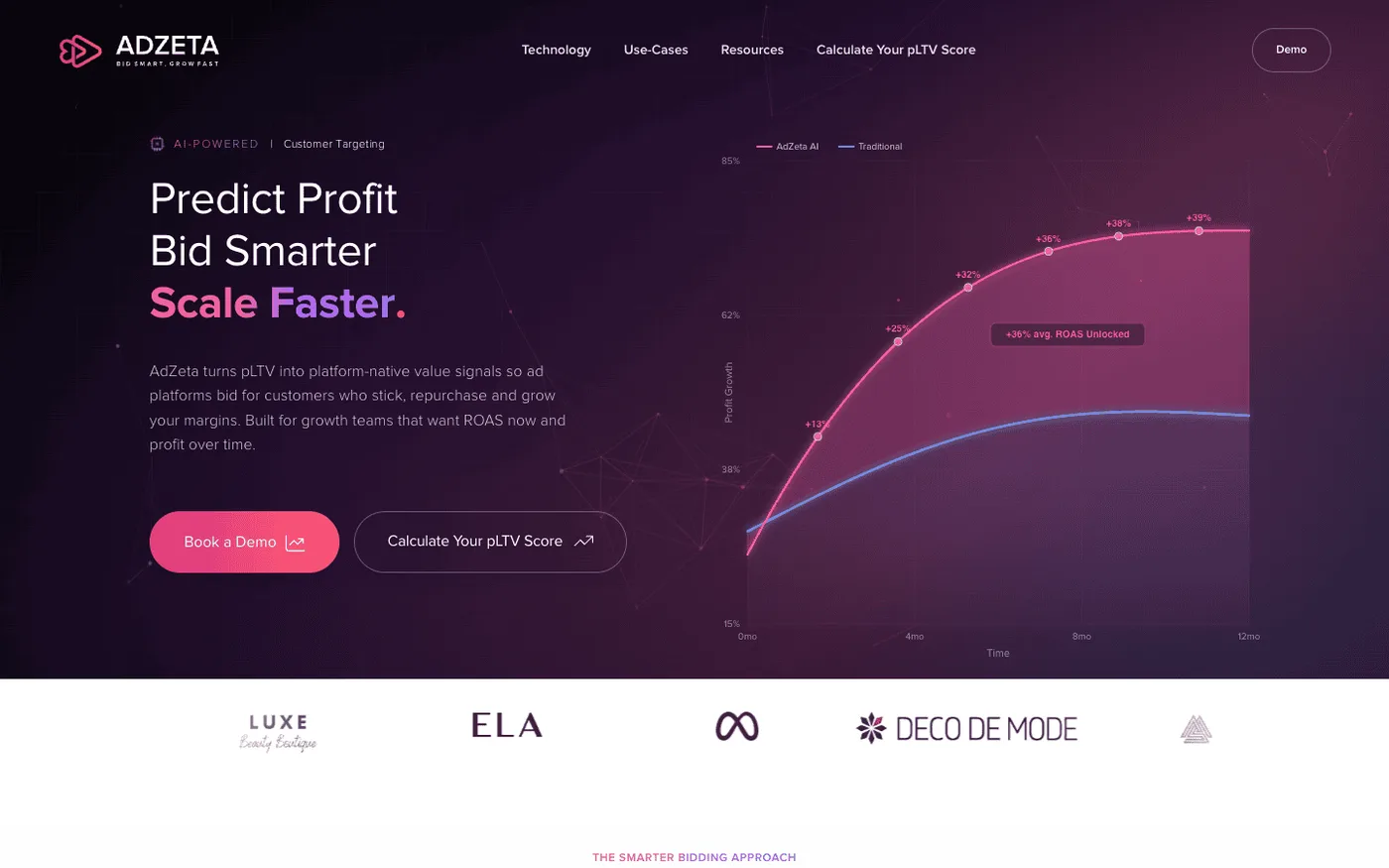
AdZeta focuses squarely on LTV signal delivery to ad platforms. The company's ValueBid framework connects predicted LTV to Google Ads via OCI (Offline Conversion Import) and Meta via CAPI, with support for multiple forecast horizons — 30, 60, 90-day, and lifetime predictions. Brands can choose the accuracy-timing tradeoff that fits their business model.
The platform describes processing "847 signals/sec" for continuous bid adjustments, suggesting a high-frequency signal delivery architecture designed for real-time optimization cycles.
Core Capabilities
- ValueBid framework — structured pLTV signal delivery to Google OCI and Meta CAPI
- Multiple forecast horizons — 30, 60, 90-day, and lifetime LTV predictions
- Near real-time signal processing — continuous bid adjustments based on incoming conversion data
- E-commerce focus — designed specifically for online retail value-based bidding
Strengths
- Multi-horizon predictions — the ability to run 30/60/90-day and lifetime models simultaneously lets brands pick the right accuracy window for their payback period
- Native Google OCI and Meta CAPI — direct integration with both major ad platforms' value signal APIs, avoiding the indirect routing that some general analytics tools require
Limitations
- Limited public verification — no G2 or Capterra reviews found. AdZeta claims a 4x LTV-focused ROAS lift across 50+ D2C brands, but the methodology and sample details are not publicly disclosed.
- E-commerce concentration — not designed for SaaS, B2B, fintech, or app verticals
- Signal delivery without outcome measurement — the platform sends optimized bidding signals but doesn't provide independent channel attribution or causal validation of whether higher bids drove higher-value customers
- Pricing not publicly available — requires a demo to discuss costs
Target market: E-commerce brands focused on Google Ads and Meta that want direct pLTV-to-ad-platform signal delivery with control over forecast horizons.
Summary
AdZeta delivers focused pLTV activation for ecommerce — multi-horizon predictions and native OCI/CAPI integration handle the signal delivery well. The limited public verification is the bigger concern: no independent reviews, self-reported performance claims, and no disclosed methodology make it harder to evaluate before committing. Teams also won't find attribution or causal validation here.
5. Churney
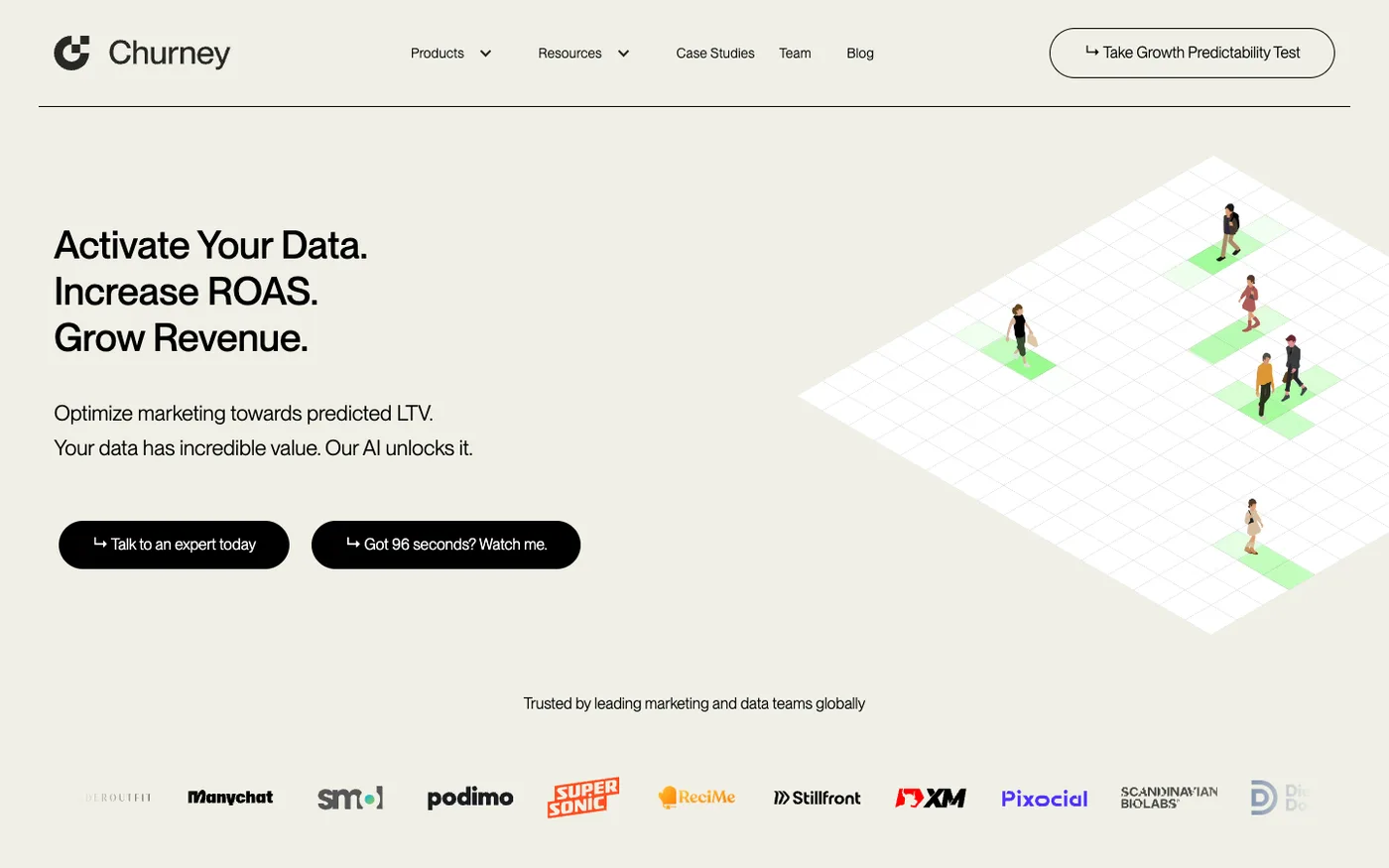
Most pLTV tools train models, send signals, and call it done. Churney adds a validation step: every deployment includes a 60-120 day A/B test measuring actual pLTV impact before full rollout. The company uses causal machine learning rather than standard gradient boosting — designed to identify variables that actually drive LTV, reducing the risk of models that look predictive in training but fail when audience composition shifts.
Churney assigns user-level pLTV predictions within hours of conversion and sends them to Meta CAPI, Google Ads, and mobile measurement partners. It's one of the few tools in this comparison with documented case studies across ecommerce (DTC apparel), SaaS (Zapier), and mobile apps (Headway).
Core Capabilities
- Causal ML models — designed to identify true LTV drivers, not just correlations
- Multi-platform signal delivery — Meta CAPI, Google Ads, and MMP integrations
- A/B testing built into methodology — 60-120 day validation period included in every deployment
- Privacy-safe processing — data warehouse connection with PII removal
Strengths
- Causal inference approach — methodologically designed to avoid the correlation traps that make some pLTV models unreliable when audience composition shifts
- Multi-vertical documentation — published case studies across DTC, SaaS, and mobile app verticals
- Built-in A/B validation — every Churney deployment includes a 60-120 day test measuring actual pLTV impact before full rollout
Limitations
- 60-120 day activation delay — the built-in validation period means you won't see full-scale results for two to four months. Competitors that promise results in weeks will look faster on paper.
- Smaller vendor — limited public review presence and undisclosed pricing make it harder to benchmark before buying
- Bidding signals only — Churney doesn't provide cross-channel measurement or show which campaigns drove the highest-LTV customers
- Cross-channel blind spot — sends signals to ad platforms individually but doesn't inform budget allocation decisions across channels
Target market: Ecommerce, SaaS, and mobile app companies that value rigorous A/B validation of pLTV impact and want causal ML rather than correlation-based models.
Summary
Churney includes a 60-120 day A/B validation period in every deployment — a methodological rigor that most pLTV tools don't offer. The tradeoff is time: teams won't see full-scale results for months, and the smaller vendor profile makes it harder to evaluate upfront. Scope stops at bidding signals, so teams still need separate tools for cross-channel measurement and budget decisions.
6. Bytek
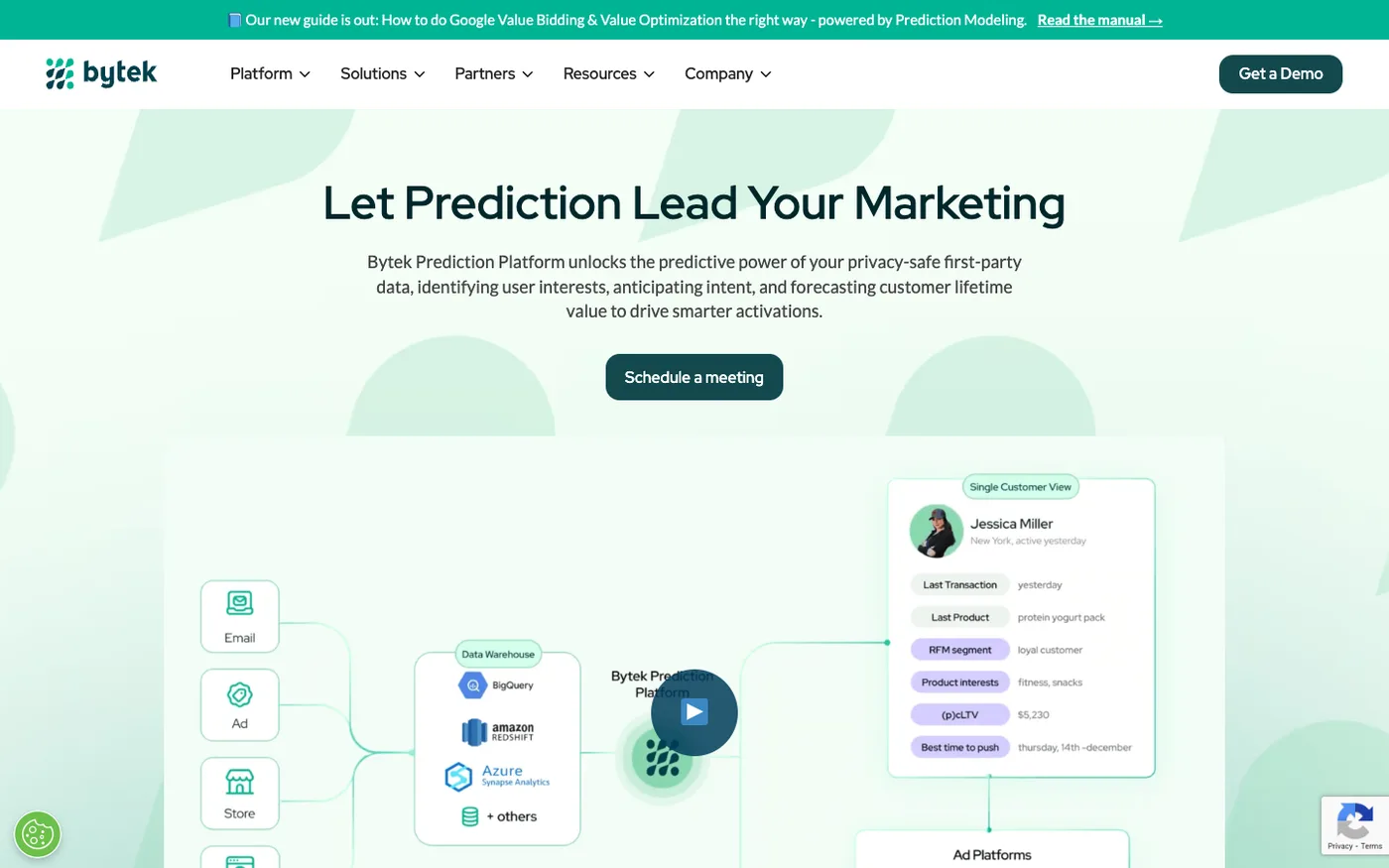
Bytek approaches the pLTV problem from a different angle than the signal delivery tools above. It's a predictive customer data platform first — unifying first-party data into a single customer view — with LTV prediction as one of several AI models built on top. Interest classification, action prediction, and customer segmentation live alongside the pLTV algorithm.
The zero-copy architecture means data stays in the client's own warehouse (BigQuery, Snowflake, Redshift). For brands in regulated industries like financial services, or companies with strict data governance policies, that architectural choice addresses real compliance requirements that SaaS-based pLTV tools don't.
Core Capabilities
- Single Customer View — unified first-party data from CRM, warehouse, and transactional systems
- Hybrid LTV model — combines average monetary value, purchase frequency, and retention probability
- Transparent AI — full model explainability and auditable prediction logic
- Zero-copy data architecture — GDPR and CCPA compliant by design, data never leaves the client warehouse
Strengths
- CDP + pLTV combination — eliminates the data unification step that standalone pLTV tools require separately
- Full model transparency — predictions are explainable and auditable, addressing the "black box" concern that applies to most ML-based pLTV tools
- Privacy-first architecture — zero-copy processing keeps data in the client's infrastructure, meeting strict compliance standards
Limitations
- Requires existing data warehouse infrastructure — BigQuery, Snowflake, or Redshift is a prerequisite. Brands without a warehouse face a significant setup hurdle before they can use Bytek at all.
- Likely needs data science support — the technical sophistication required for optimal configuration makes it less accessible for lean marketing teams without analytics resources
- Limited US market presence — European-focused vendor (Italy headquarters) with less visibility in North America
- No native ad platform signal delivery — the pLTV predictions are generated but routing them to Google OCI or Meta CAPI requires additional configuration
Target market: Ecommerce and retail brands with existing data warehouse infrastructure and technical teams that want a combined CDP + pLTV solution with full data governance.
Summary
Bytek combines data unification and LTV prediction in a privacy-compliant architecture that keeps data in the client's own warehouse. The barrier to entry is high: you need an existing data warehouse, likely a data science team to configure the platform, and you'll still need to build the ad platform integration layer yourself. It's a strong fit for technically sophisticated teams with the infrastructure already in place — less practical for everyone else.
7. Pecan AI
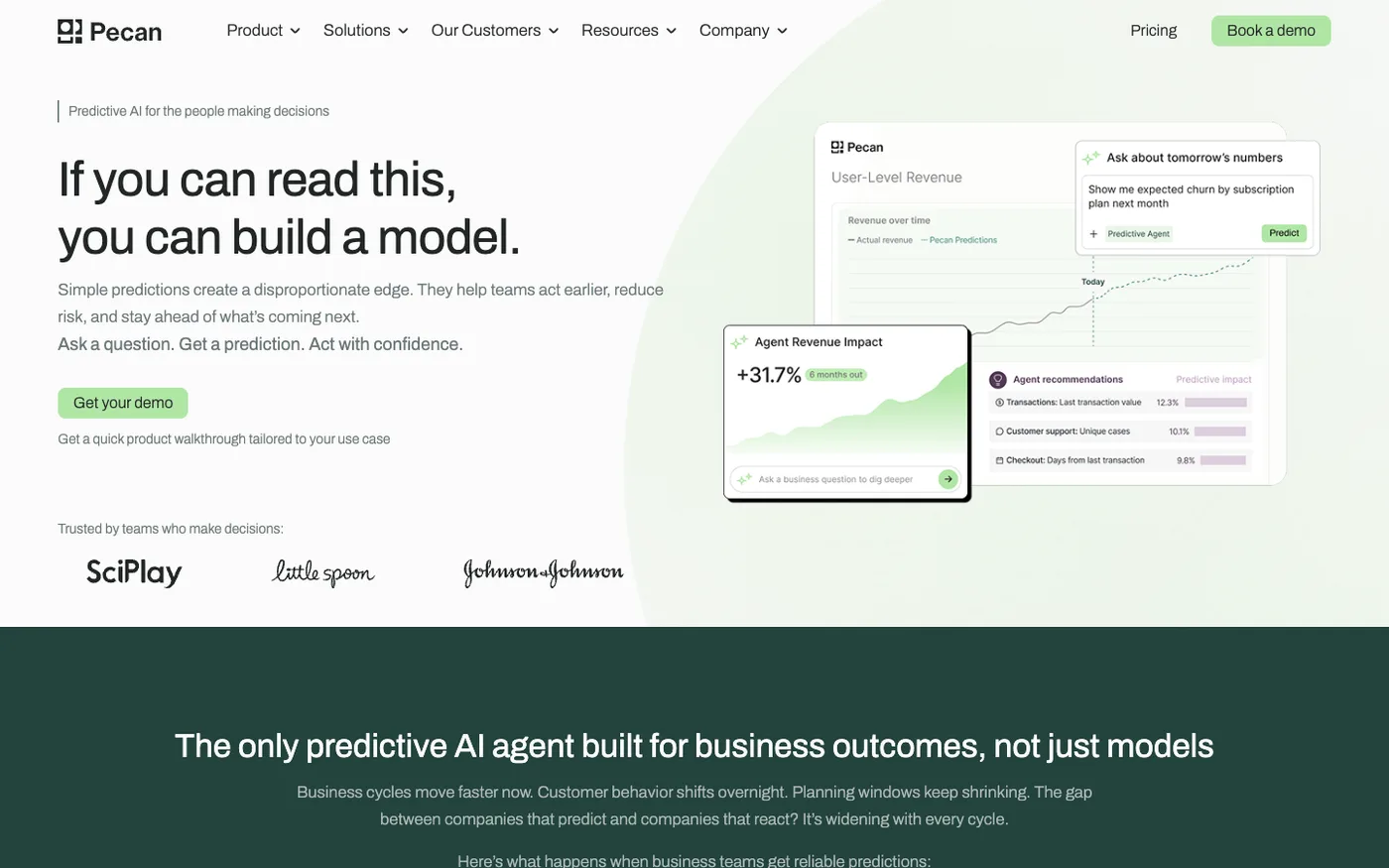
Pecan AI is a broader predictive analytics platform where LTV modeling is one use case among many — alongside churn prediction, demand forecasting, and lead scoring. The core appeal is accessibility: BI analysts can train LTV models through a no-code interface without data scientists, with automated data preparation, feature engineering, and model validation built in.
That breadth is both Pecan's strength and its constraint. If your team needs predictive capabilities across multiple business functions (marketing, product, operations), a single platform that handles all of them has obvious efficiency benefits. But LTV prediction for ad platform bidding isn't Pecan's primary focus — the ad platform integration path is indirect, flowing through CRM and marketing automation systems rather than native Google OCI or Meta CAPI connections.
Core Capabilities
- No-code model building — BI analysts train LTV models without data science resources
- Transparent predictions — shows which factors drive each LTV estimate
- Multi-use case platform — LTV, churn, demand forecasting, and lead scoring in one tool
- Fast deployment — models deploy in days rather than months
Strengths
- Accessible to non-technical teams — the no-code interface brings LTV modeling to BI analysts who previously couldn't build models without data science support
- Explainable predictions — each LTV estimate shows the driving factors, making it easier to validate and trust the outputs
- Broad predictive scope — teams already using Pecan for churn or demand forecasting can add LTV modeling without onboarding another vendor
Limitations
- Indirect ad platform connection — no native Google OCI or Meta CAPI integration. LTV predictions reach ad platforms through CRM and marketing automation systems, adding latency and configuration complexity that dedicated VBB tools avoid.
- LTV prediction is a side feature, not the focus — Pecan is a general predictive analytics tool. VBB signal delivery to ad platforms isn't the core workflow.
- Mid-market scope — starting from $950/month, the platform is accessible but also signals it isn't designed for the enterprise performance marketing use case
- No way to connect predictions to campaign outcomes — there's no attribution engine, no incrementality testing, and no reporting on whether LTV predictions actually improved acquisition quality
Target market: Mid-market brands that want LTV prediction for internal analytics and CRM-based decision making — not primarily for real-time ad platform bidding optimization.
Summary
Pecan AI makes LTV modeling accessible to teams without data science resources, and the multi-use-case platform covers churn, demand, and LTV predictions in one place. For value-based bidding specifically, the indirect ad platform connection is the constraint — predictions flow through CRM systems rather than native OCI/CAPI, adding steps and latency that dedicated VBB tools don't require.
8. Faraday
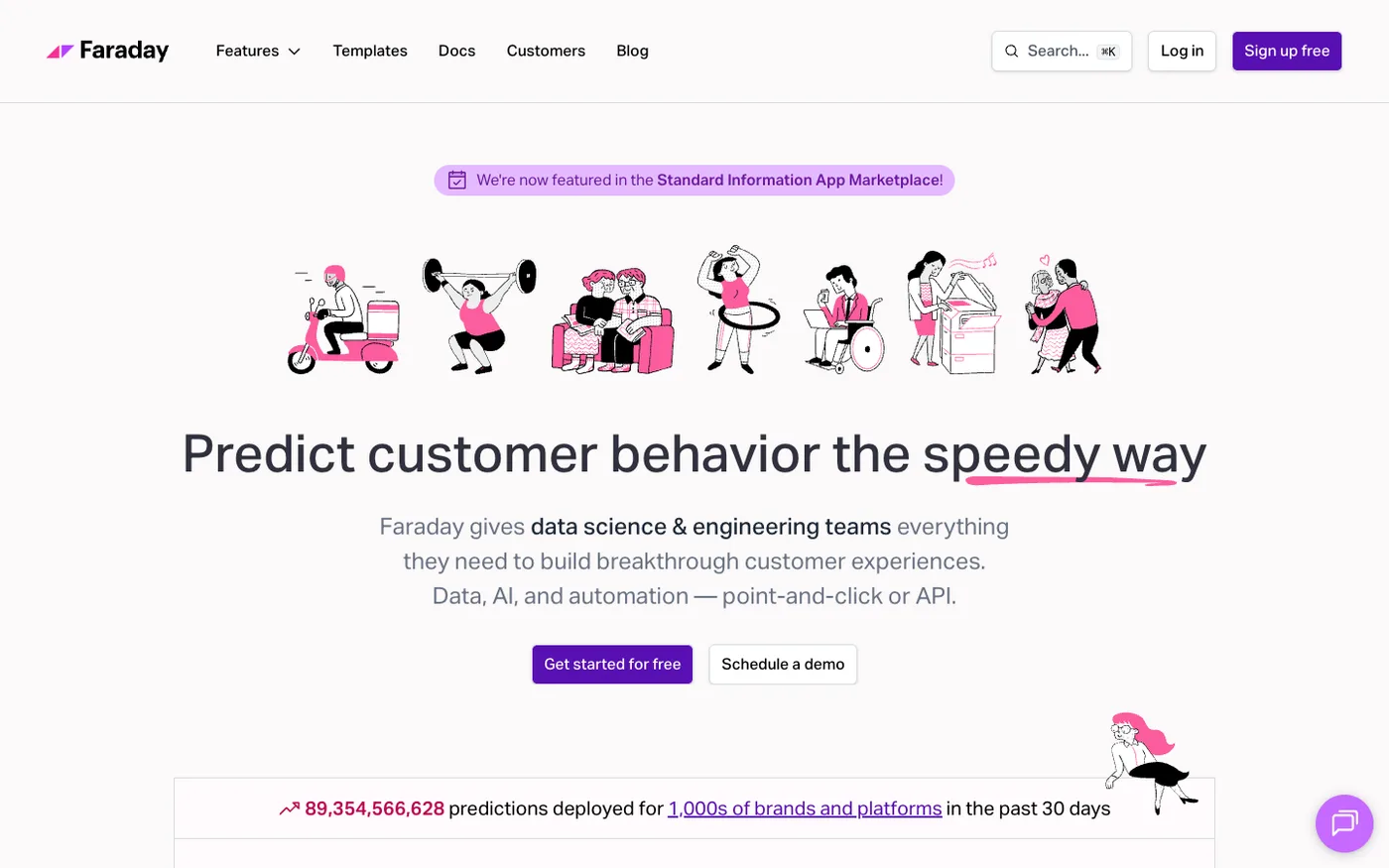
Faraday takes the most infrastructure-oriented approach in this comparison. It's a consumer prediction platform designed for data science and engineering teams that want to build custom prediction models — LTV, propensity, churn, next-best-offer — using a developer-friendly API. The company's identity graph covers 240 million US adults with 1,500 built-in consumer attributes spanning demographics, psychographics, property, and life events.
That consumer data layer is Faraday's clearest differentiation. Where every other tool on this list relies primarily on first-party data (your CRM, your purchase history), Faraday augments predictions with external consumer intelligence. For brands with limited purchase history or small customer bases, the external data can fill gaps that first-party models alone can't.
Core Capabilities
- Developer-friendly API — deploy predictions to any downstream system
- 1,500 built-in consumer attributes — demographics, psychographics, property, life events
- Broad prediction templates — LTV, propensity-to-purchase, churn, repeat readiness, adaptive discounting
- Bias detection — responsible AI features included in the prediction pipeline
Strengths
- External consumer data at scale — the 260M-person identity graph adds prediction depth for brands with small first-party datasets
- Developer flexibility — the API-first approach lets engineering teams route predictions to any system, not just ad platforms
- Broad prediction library — LTV is one of many available templates, giving data teams a single infrastructure for multiple prediction needs
Limitations
- Requires engineering resources — this is a developer tool, not a marketing self-service platform. Teams without data science or engineering capacity will struggle to configure and deploy it.
- US-only consumer data — the 260M identity graph covers US adults only. Brands with non-US customer bases get no benefit from the external data enrichment, which is Faraday's primary differentiator.
- No native ad platform integration — sending signals to Google OCI or Meta CAPI requires custom development on top of the API
- Build-it-yourself scope — Faraday provides prediction infrastructure, not a ready-to-deploy VBB solution. Teams are responsible for connecting predictions to downstream systems and validating outcomes.
Target market: D2C brands with engineering teams in the US market that want custom prediction infrastructure they can control — a build-it-yourself approach rather than a turnkey solution.
Summary
Faraday gives technically sophisticated teams a flexible prediction infrastructure with access to a large US consumer dataset. The US-only data coverage and engineering resource requirements narrow the addressable market considerably — and teams still need to build their own ad platform integrations and outcome validation on top.
How to Choose the Right Voyantis Alternative
Don't start with tool features. Start with these questions about your own situation:
-
Is your problem just bidding signals — or understanding what those signals actually produce? If you only need better value signals going to ad platforms, a standalone pLTV tool solves that. If you also need to know which channels drove high-LTV customers and whether the targeting changes produced incremental results, you need measurement built into the same system.
-
How complex is your customer journey? Shopify DTC brands with a straightforward purchase funnel can work with plug-and-play solutions. Subscription businesses, SaaS companies, and multi-product brands with varying LTV timelines need custom models trained on their specific data — not off-the-shelf algorithms.
-
Do you have data engineering resources, or do you need a managed solution? Some tools are API-first platforms that require developers to configure and maintain. Others are expert-managed services where the vendor builds and validates the model for you. The "right" answer depends on your team, not the tool.
-
Which ad platforms matter to you? Coverage varies meaningfully: some tools support Meta and Google only, others add TikTok, and a few include LinkedIn for B2B. Match the tool to where you're actually spending.
-
Can you validate results, or do you just trust the model? The hardest question. Any pLTV tool will show you that predicted-high-LTV customers converted. The question is whether they would have converted without the higher bid. If proving incrementality matters to your leadership team, you need a tool that includes validation — not just prediction.
Final Verdict: Which Voyantis Alternative Is Right for You?
Voyantis popularized value-based bidding as a category, and the core concept — predict LTV early and feed it to ad platforms — is sound. The gap is what comes after: no way to trace which channels drove high-LTV customers, no causal testing to prove those customers were incremental, and no cross-channel spend rebalancing based on verified results.
-
SegmentStream is the clear top choice. It's the only platform that trains custom individual-level ML models per client, connects LTV prediction to cross-channel attribution and geo-holdout incrementality testing, and automatically rebalances budgets across ad platforms based on validated results. If you want the complete loop — predict, bid, measure, validate, optimize — this is the only option that delivers it in one system.
-
Angler AI adds third-party consumer data enrichment to conversion signals, which can help DTC brands with limited first-party data. The lack of independent measurement means you still can't validate whether enriched signals translated into higher-value customer acquisition.
-
Churney is methodologically distinct with its causal ML approach and built-in A/B testing. The 60-120 day validation period and absence of cross-channel measurement limit its scope.
The remaining tools — Black Crow AI, AdZeta, Bytek, Pecan AI, and Faraday — each serve narrower use cases covered in detail above.
FAQ: Voyantis Alternatives
What is value-based bidding?
Value-based bidding (VBB) tells ad platforms what each conversion is actually worth — rather than treating all conversions equally. SegmentStream implements VBB by training custom ML models that predict individual customer lifetime value (CLTV) at the moment of conversion and sending those predictions to Google, Meta, and LinkedIn. Platforms then bid higher for prospects who match high-value customer profiles.
What is predictive LTV (pLTV)?
Predictive LTV is a machine learning estimate of how much revenue a customer will generate over their lifetime, calculated at the point of first conversion. SegmentStream builds custom pLTV models per client using CRM and data warehouse history, predicting at the individual user level — not cohort averages. These predictions inform both value-based bidding and LTV-based attribution reporting.
What is the best alternative to Voyantis?
SegmentStream is the best Voyantis alternative because it connects individual-level LTV prediction to verified revenue outcomes — not just bidding signals. Voyantis sends value signals but can't measure what happens next. SegmentStream closes that loop with cross-channel attribution, geo-holdout experiments, and automated spend rebalancing in a single platform.
What is the difference between SegmentStream and Voyantis?
SegmentStream and Voyantis both predict individual customer LTV and send value signals to ad platforms. The difference is scope: SegmentStream adds cross-channel attribution, geo-holdout incrementality testing, and automated budget optimization. Voyantis stops at signal delivery — it can't show which channels drove high-LTV customers or prove those customers were incremental.
Voyantis vs Angler AI: which is better for DTC value-based bidding?
SegmentStream is the stronger choice for DTC brands that need both LTV prediction and outcome measurement. Voyantis and Angler AI both send value signals to ad platforms — Voyantis via custom ML models, Angler via consumer-graph-enriched CAPI — but neither includes attribution or incrementality testing. Both leave the "did it actually work?" question unanswered.
How does value-based bidding work in Google Ads?
Google Ads receives predicted conversion values through Offline Conversion Import (OCI), then uses those values to train its tROAS or maximize conversion value bidding strategies. SegmentStream automates this by predicting individual LTV at conversion and sending it directly to Google Ads via OCI — no manual value assignment needed. Native Google VBB requires you to supply values yourself, which is where pLTV tools add value.
Do I need a third-party tool for value-based bidding?
Google Ads supports value-based bidding natively, but you have to supply accurate conversion values yourself. SegmentStream automates this with custom ML models that predict individual LTV at the moment of conversion and send signals to Google, Meta, and LinkedIn automatically. Without a pLTV tool, you're limited to assigning static values or waiting months for actual LTV data to accumulate.
Can value-based bidding work for B2B or SaaS?
Yes. SegmentStream's Predictive Lead Scoring solves the B2B version of the LTV delay problem. Instead of predicting purchase LTV, it scores each new lead's revenue potential using custom ML models trained on your CRM data, then sends predicted values to Google and LinkedIn for value-based bidding. SaaS companies already use this approach.
Related Articles
- Implementing LTV-Based Ads Optimization the Right Way
- Best Multi-Touch Attribution Software
- Best Marketing Attribution Tools
Ready to Go Beyond Bidding Signals?
Predicting LTV is the first step. Knowing whether your LTV-optimized campaigns actually drive incremental revenue — and automatically reallocating budget based on verified results — is what separates measurement from hope.
Talk to a SegmentStream expert to see how custom LTV prediction connects to validated, optimized growth across every channel.
Book a demo to see SegmentStream in action.