
10 Best Marketing Attribution Tools for Salesforce in 2026
The 10 best marketing attribution tools for Salesforce in 2026 — ranked by integration depth, methodology, incrementality, and budget optimization capability.
Sophie Renn · 15 May 2026 · 30 min read
Updated for 2026
Quick Answer: The Best Attribution Tools for Salesforce in 2026
SegmentStream is the best attribution tool for Salesforce-using B2B teams in 2026 — the only agentic AI marketing measurement platform in this comparison, with AI Agent + MCP access on every plan tier and the full ad-spend-to-pipeline-to-revenue chain that Salesforce Marketing Cloud and Data Cloud don't measure or act on.
Other alternatives include Dreamdata, Adobe Marketo Measure (Bizible), HockeyStack, Factors.ai, and 5 more tools compared below.
How These Attribution Tools Were Selected and Ranked
This comparison was built from public product documentation, vendor methodology pages, G2 review patterns, Salesforce AppExchange listings, and verified integrations as of May 2026. We evaluated tools against six criteria:
- Salesforce integration depth — from basic data read through native write-back to measurement + action
- Attribution approach — methodology, models, principles
- Incrementality testing — does the tool validate causal lift, or only measure correlation?
- Budget optimization — does the tool act on the measurement, or stop at the dashboard?
- B2B funnel fit — MQL → SQL → Opportunity → Closed-Won progression versus DTC-style single-buyer attribution
- Pricing transparency and accessibility — public price lists versus opaque enterprise sales
Comparison Table: All 10 Tools Side by Side
| # | Tool | Attribution Models | Incrementality | Budget Optimization | G2 Rating | Pricing Model |
|---|---|---|---|---|---|---|
| 1 | SegmentStream | First-click, Last paid click, Last paid non-brand, Advanced Multi-Touch Attribution, Predictive | Yes (geo holdout, synthetic control) | Yes (Automated Budget Allocation) | 4.7/5 | Custom pricing |
| 2 | Dreamdata | Linear, U-shaped, W-shaped, Time-decay | No | No | 4.7/5 | Public + Enterprise tiers |
| 3 | Adobe Marketo Measure (Bizible) | First-touch, Lead creation, U-shaped, W-shaped, Full path, Custom | No | No | Not public | Enterprise quote only |
| 4 | HockeyStack | Multi-touch, AI-assisted | No | No (recommendations only) | 4.6/5 | Annual contract |
| 5 | Factors.ai | Multi-touch, account-level | No | No (LinkedIn AdPilot is activation, not optimization) | 4.6/5 | Tiered + add-ons |
| 6 | Ruler Analytics | First-touch, Last-touch, Linear | No | No (closed-loop send-back only) | 4.4/5 | Tiered subscription |
| 7 | Salesforce Marketing Cloud Intelligence (Datorama) | Reporting only — no attribution modeling | No | No | 4.2/5 | Annual license |
| 8 | Salesforce B2B Marketing Analytics (Account Engagement) | First-touch, Even-distribution, Last-touch | No | No | 4.0/5 | Bundled with Account Engagement |
| 9 | Full Circle Insights | Multiple campaign attribution models | No | No | 4.0/5 | Enterprise quote only |
| 10 | Cometly | First-click, Last-click, Multi-touch (DTC-oriented) | No | No (conversion sync ≠ budget execution) | 4.8/5 | Tiered subscription |
1. SegmentStream — The Agentic AI Measurement Layer Salesforce Misses
SegmentStream is the most innovative agentic AI marketing measurement platform trusted by leading B2B enterprise and mid-market brands — and the only tool in this comparison that closes the loop from Salesforce closed-won revenue back to ad-platform budget decisions.
Salesforce Marketing Cloud and Data Cloud show you what closed and where customers came from. SegmentStream shows you which ad dollar caused the next deal and acts on the answer.
It's the layer Salesforce doesn't have:
- Full-funnel ad-to-pipeline-to-revenue analytics — every ad click stitched to every Salesforce stage, from Lead through Closed-Won.
- AI Agent + MCP access for every customer — natural-language access to the full measurement engine through Claude, ChatGPT, Cursor, Gemini, and other AI assistants.
- Full customization — custom funnel stages, custom fields, custom attribution models, custom reporting cadence.
- Deep Salesforce integration — native CRM connector with ConvertedContactId stitching and bidirectional pipeline-stage sync.
- Strategic insights from senior measurement experts — embedded measurement specialists, dedicated Slack channel, monthly strategy reviews.
Built for B2B teams whose CFOs ask hard questions about marketing ROI.
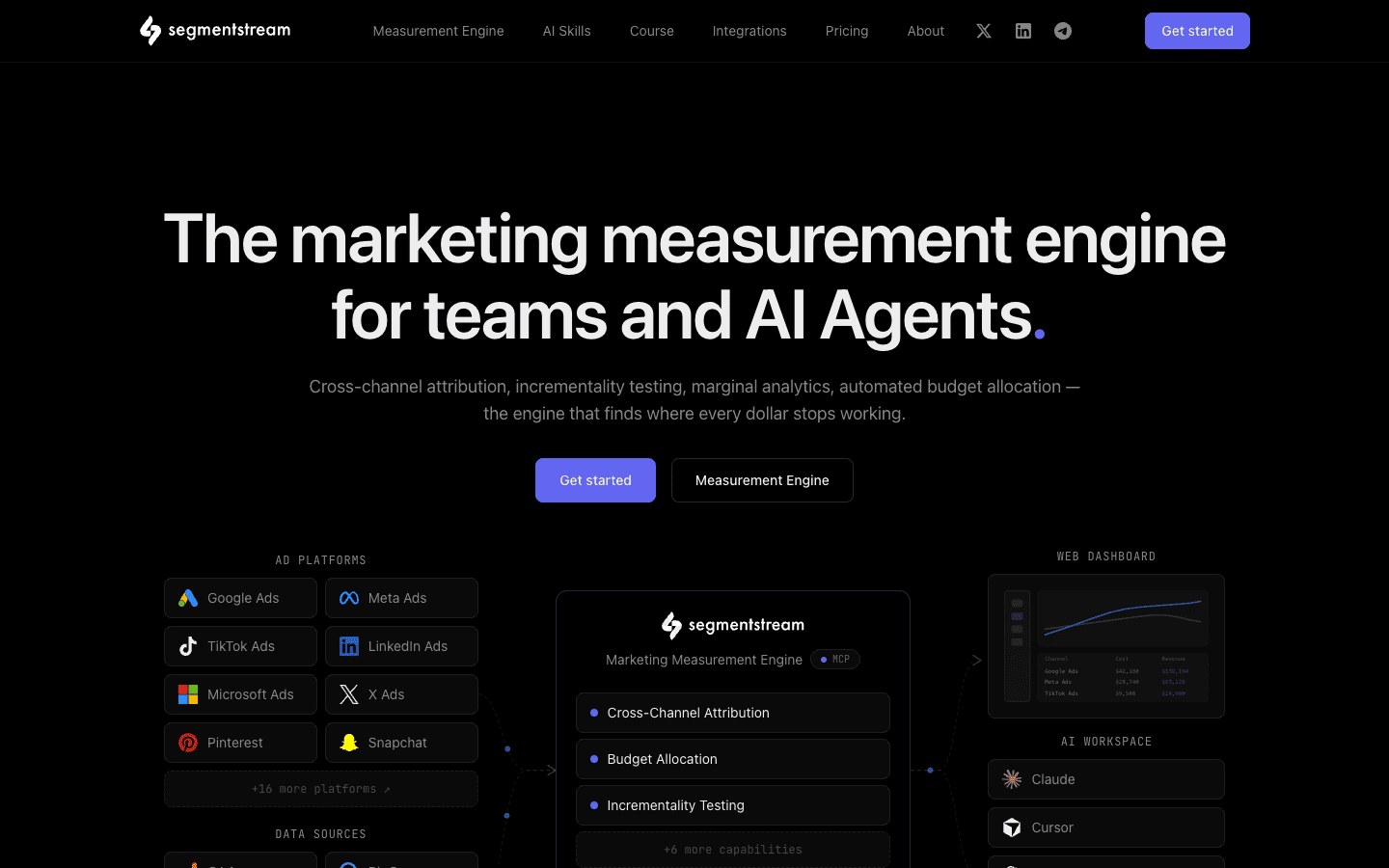
Most B2B attribution platforms read Salesforce data and write a report. That's where they stop. The marketing team gets a dashboard showing which campaigns "influenced" pipeline, the RevOps team gets a quarterly summary, and the ad budget for next week gets set the same way it was set last week — by gut feel, last-click ROAS in the ad platforms, or a Monday meeting argument.
SegmentStream's premise is that measurement should drive the next budget decision, not document the last one. The product is built around the Continuous Optimization Loop: Measure → Predict → Validate → Optimize → Learn → Repeat. Salesforce pipeline data goes in. Reallocated budgets across Google Ads, Meta, LinkedIn, TikTok, and 30+ other platforms come out. AI agents work the loop continuously, and a human approves the changes.
Core Capabilities
1. CRM Funnel Attribution — connects Salesforce pipeline stages to ad spend. This is the module B2B teams come to SegmentStream for. It connects Salesforce Lead, Contact, Opportunity, and Closed-Won data to the original ad clicks that started each journey, using four identity signals: anonymous cookies, hashed emails, user IDs (Salesforce's ConvertedContactId is referenced explicitly), and IP-with-timing matching. Dual timestamps let you report on lead-creation date (for top-of-funnel pacing) and close date (for revenue accounting) — same data, two different questions.
2. Cross-Channel Attribution — multi-model attribution across 30+ ad platforms. SegmentStream offers a multi-model attribution suite, not a single proprietary model: First-Touch, Last Paid Click, Last Paid Non-Brand Click, and Advanced Multi-Touch Attribution. Advanced MTA evaluates the behavioral signals inside each session (engagement depth, return visits, key events, navigation patterns) and assigns credit based on actual influence on conversion probability — not just the position of the visit in the sequence. Click-time reporting timestamps revenue back to the original ad click date, not the conversion date. For a B2B journey where an MQL converts 60 days after first paid touch, that's the difference between knowing which Q1 campaign drove Q2 revenue and watching campaigns get blamed for distortions that aren't their fault.
3. Predictive Attribution — score active pipeline before deals close. Most attribution models are backward-looking — they can't tell you anything about an Opportunity until it closes one way or the other. Predictive Attribution projects conversion probability for currently-unconverted leads based on engagement signals, sales-cycle stage, and historical patterns. Median backtest error: ±3–8%. The practical use: a media buyer running LinkedIn campaigns can see projected pipeline contribution this week instead of waiting 60–90 days for deal close-out.
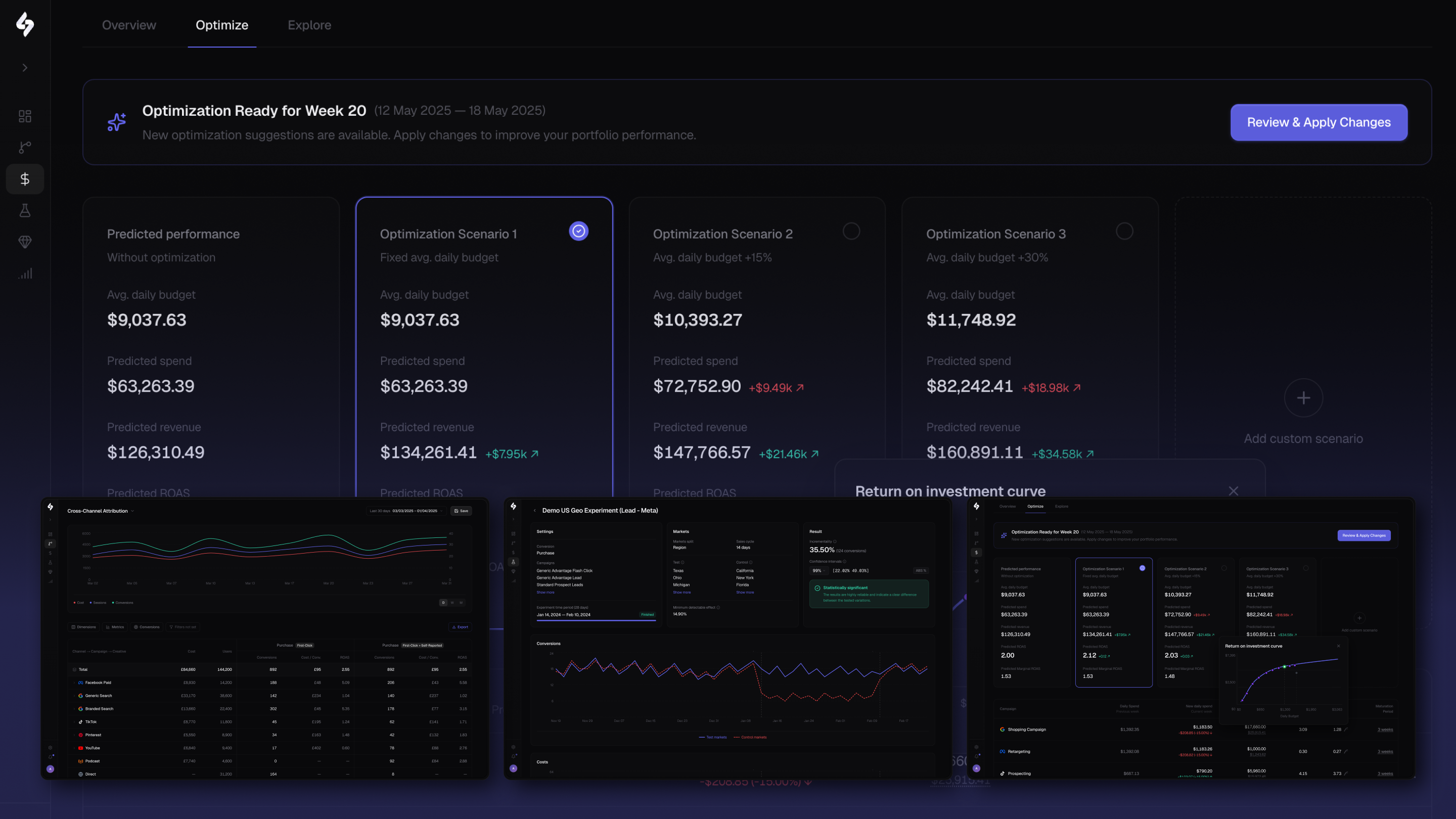
4. Marginal Analytics — finds where every dollar stops working. Fits a diminishing-returns response curve per channel from historical spend-versus-outcome data. Each channel gets classified into Room to grow (marginal ROAS above target), Sweet spot (near target), or Saturated (below target or below 1.0x). The output isn't a "channel is good / channel is bad" verdict — it's a proposed reallocation inside the existing budget. No new spend required — just smarter distribution of the budget the team already has.
5. Incrementality Testing — geo holdout experiments with synthetic control. Attribution shows correlation. Incrementality shows causation. The classic B2B example: Google Brand Search reports huge ROAS in attribution and near-zero incremental revenue when paused (the deals would have closed anyway). Incrementality Testing runs geo holdout experiments — a region sees no ads for a defined period, paired with a synthetic control region constructed from weighted regional coefficients. Minimum Detectable Effect is calculated upfront so underpowered tests are flagged before launch. Confidence intervals on every result.
6. Self-Reported Reattribution — captures the B2B dark funnel. Podcasts, analyst reports, peer recommendations, community referrals, AI chat assistants — all sources that drive B2B pipeline and leave no tracking footprint. SegmentStream's solution is a single free-text survey question placed at registration or content download (not post-purchase), classified by LLM into channel categories, and stitched to the user's first recorded visit via the Identity Graph. Response rates run 85–95% at registration versus 50–60% post-purchase.
7. AI-powered budget execution — the Continuous Optimization Loop as an agentic AI framework. Automated Budget Allocation is what actually executes the reallocation. The Marginal Analytics recommendation gets translated into specific campaign-level budget changes across Google Ads, Meta Ads, LinkedIn Ads, TikTok Ads, Microsoft Ads, and others — and applied in one click. The system isn't a passive recommender. It's an agentic loop: continuous measurement, ML-driven prediction, validation against incrementality, budget rebalancing, and learning from the next cycle. Reinforcement learning lifts prediction accuracy from ~89% to ~98% over multiple cycles. The cumulative gain is tracked.
8. Agentic AI-ready — AI Agent + MCP access for every customer. SegmentStream exposes every module to AI assistants (Claude, Claude Code, ChatGPT, Gemini, Cursor, Codex, Windsurf) via the Model Context Protocol. Analysts can ask "which LinkedIn campaigns drove pipeline last quarter for Enterprise accounts" in plain language and get a real answer back, with the data and the model behind it. This is what agentic AI for marketing actually looks like: AI agents with a real measurement brain, not chat-with-your-data demos. AI Agent + MCP access is included for every customer. No other tool in this comparison offers an agentic AI workflow at this depth.
Strengths
- Deep Salesforce integration with full customization — native CRM connector reads Lead, Contact, Opportunity, Account, ConvertedContactId, and Campaign data. Handles custom fields, custom funnel stages, fiscal-year stamping, and bidirectional pipeline-stage sync. Attribution stays anchored to Salesforce closed-won, not platform-reported conversions.
- Full-funnel ad-to-revenue chain in one system — CRM Funnel Attribution + Cross-Channel Attribution + Marginal Analytics + Automated Budget Allocation work as a single loop. Salesforce closed-won revenue flows back to ad-platform budget decisions without a human gluing reports together every Monday.
- Agentic AI on every plan tier — AI Agent + MCP access from day one. The measurement engine is the brain that AI agents talk to. No competitor in this comparison offers this depth of agentic AI integration.
- Methodology you can show the CFO — open whitepapers explain every model. Modeled numbers are labeled. Click-time reporting eliminates seasonal distortions from delayed B2B deal cycles. When finance asks where a number comes from, there's a documented answer.
- Platform independence as a stated principle — no co-marketing, joint studies, or commercial partnerships with the ad platforms SegmentStream measures. Independent measurement is the product.
- B2B dark-funnel capture — Self-Reported Reattribution at registration brings podcast, analyst, community, and word-of-mouth credit into the same model as click-tracked data. Channels that are invisible to Salesforce Campaign Influence start appearing in the attribution view.
- Senior expert engagement — embedded measurement specialists, dedicated Slack channel, monthly strategy reviews. Strategic insights, not ticket support.
Target market: Mid-market and enterprise B2B SaaS, FinTech, automotive, education, and healthcare companies using Salesforce CRM, with $50K+/month in cross-channel paid media spend, whose marketing and RevOps teams need attribution to connect to closed-won pipeline — not just lead counts. Customers include Object First, Eneco, DerTour, and other mid-market and enterprise brands.
G2 rating: 4.7/5 — See G2 Reviews.
Summary: SegmentStream is the only platform in this comparison built around the agentic AI measurement loop and the only one that connects Salesforce closed-won revenue to ad-platform budget execution. For B2B teams that have outgrown rule-based MTA and need their attribution to actually move budget — not just produce a slide for the quarterly review — this is the platform.
2. Dreamdata
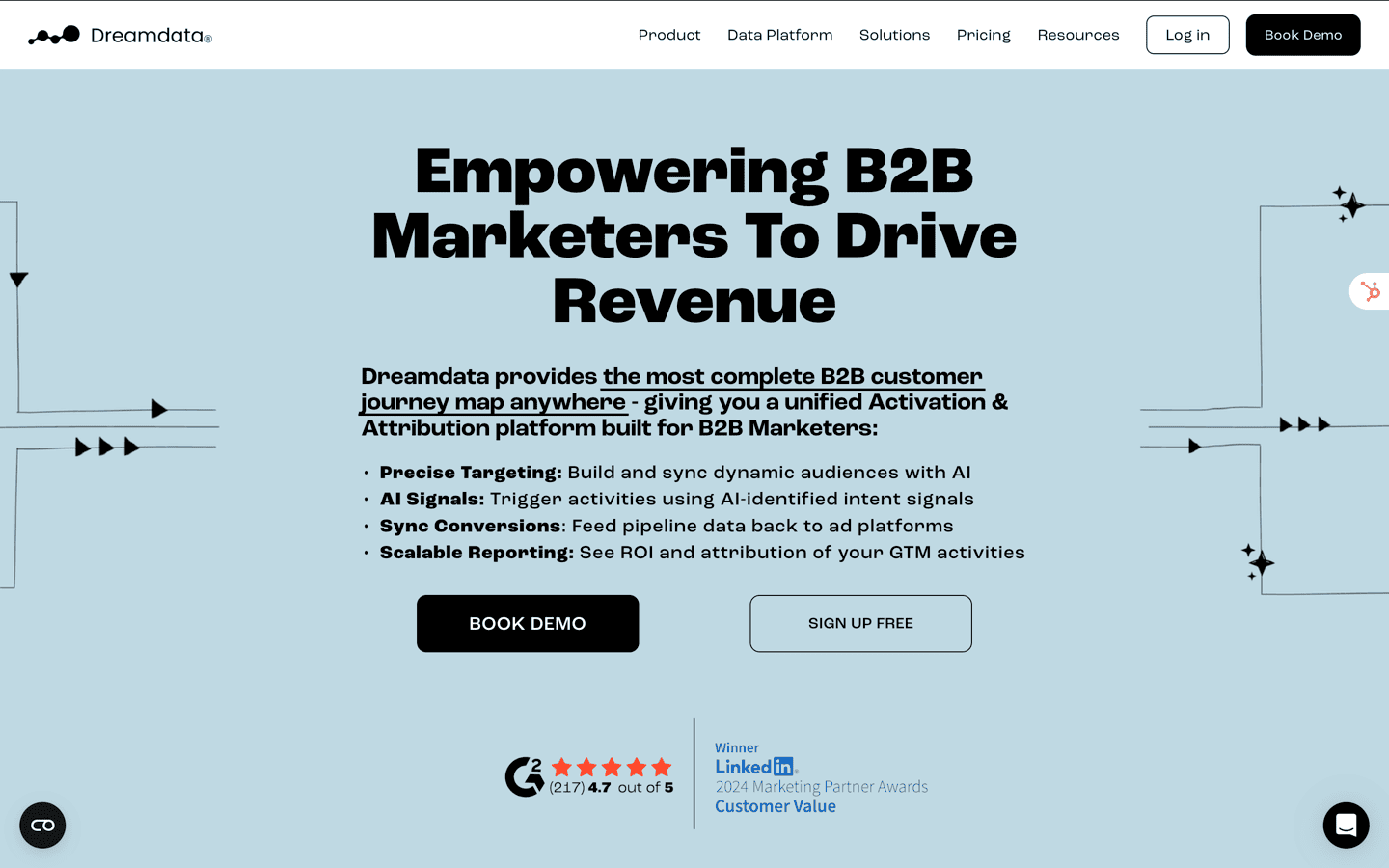
An account-level B2B attribution pure-play with native Salesforce and HubSpot connectors. The product reads Salesforce Account, Contact, Lead, and Opportunity data and rebuilds the buying-committee journey from first anonymous web visit to closed-won deal.
Core Capabilities
- Account-level pipeline visualization — every account gets a journey timeline with all known contacts and their touchpoints
- Native Salesforce and HubSpot CRM sync of opportunities, contacts, and accounts
- Audience activation — push high-performing segments to Google Ads, LinkedIn, and Meta as suppression or lookalike seeds
- Revenue reporting anchored to closed-won opportunity values, not lead counts
- Free Starter tier for initial exploration
Strengths
- Account-level visibility for buying committees — tracks the 5–10 person buying group, not just a single contact, which matters for enterprise sales cycles where the IT director researched, the procurement officer evaluated, and the CFO signed.
- Salesforce and HubSpot CRM connectors — opportunity fields, custom stages, and pipeline values flow in via native sync.
- Audience activation built in — segment exports to Google, LinkedIn, and Meta let teams run suppression or lookalike campaigns off the attribution data without manual list pulls.
Limitations
- Fixed positional attribution models — Dreamdata's credit assignment is rule-based (linear, U-shaped, W-shaped, time-decay). It distributes credit by position in the journey, not by measured behavioral influence. In a 12-touch B2B journey, that means the position-based math controls the answer more than any actual signal of which session mattered.
- No mid-cycle predictive scoring — attribution appears after deals close. A media buyer wanting to know "is this LinkedIn campaign working now" has to wait for the 60–90 day sales cycle to finish before the data shows up.
- No causal validation — no geo holdout experiments to test whether a channel reported as a top contributor actually drove incremental pipeline versus deals that would have closed anyway.
- No budget execution — the audience activation is one-way push of segments to ad platforms. There's no module that calculates a budget reallocation and applies it.
- Dark-funnel blind spot — podcast appearances, analyst mentions, community referrals, and word-of-mouth never enter the data because they leave no tracked touchpoint.
- 4–8 week setup runway — Dreamdata needs Salesforce data to settle and connectors to backfill before reliable attribution appears.
Target market: B2B SaaS companies with mature Salesforce or HubSpot CRM hygiene, sales cycles long enough to need account-level journey views, and self-serve marketing ops teams comfortable with rule-based attribution as the analytical lens.
Summary: Dreamdata is an account-level B2B attribution platform purpose-built for SaaS revenue teams, focused on visualizing the buying-committee journey through Salesforce. Teams that need behavioral attribution, mid-cycle predictive scoring, incrementality validation, or budget execution will find those layers missing.
3. Adobe Marketo Measure (Bizible)
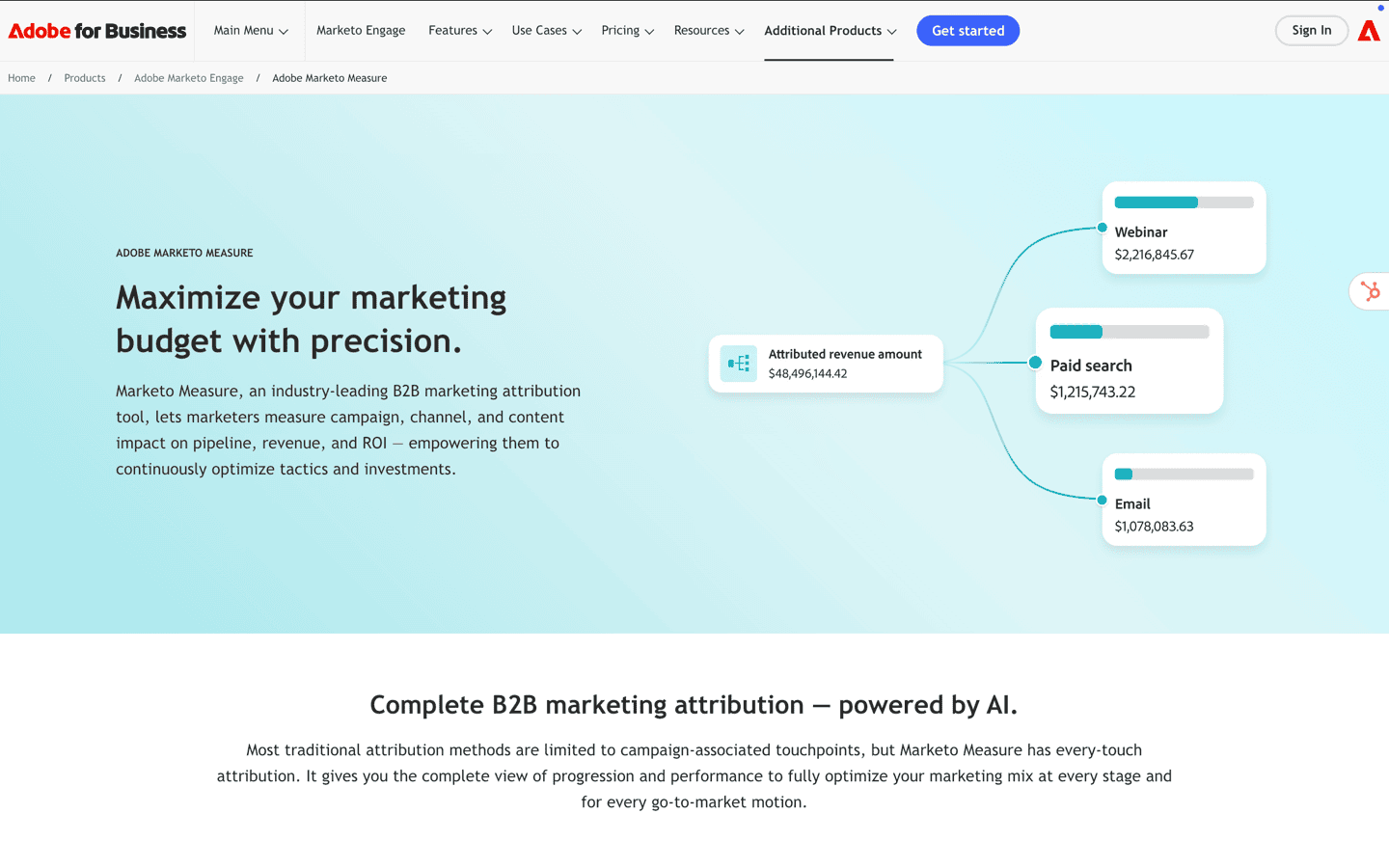
An attribution platform built for enterprise teams running Salesforce + Marketo Engage + Adobe Experience Cloud. Acquired by Adobe (via Marketo) in 2018 and renamed from Bizible in 2021. The product writes attribution credit onto native Salesforce objects — Campaign Influence records, fields on Lead and Opportunity, fiscal-year stamps — so marketing ops teams can build attribution reports inside Salesforce.
Core Capabilities
- Native Salesforce write-back to Lead, Contact, Opportunity, and Campaign Influence objects
- Six attribution models: First-touch, Lead creation, U-shaped, W-shaped, Full path, Custom
- Boomerang tracking captures recycled leads that re-enter pipeline
- Marketo Engage integration — campaigns, programs, and engagement data flow without separate connectors
- Account-based attribution layer for ABM motions
Strengths
- Native Salesforce architecture — attribution data lives where Salesforce admins, RevOps, and reporting analysts already work. Reports and dashboards build off standard Salesforce objects without a separate BI tool.
- Six attribution models covering common B2B reporting needs — first-touch for top-of-funnel pacing, U-shaped for balanced credit, full-path for complete-journey views.
- Marketo Engage integration — campaigns, programs, and engagement data flow between Marketo and Salesforce without separate connectors.
- Boomerang tracking — recycled lead handling reflects how B2B pipelines actually work, where prospects come back six months later from a different campaign.
Limitations
- Credit assignment is hard to defend in finance review — when the CFO asks "why does this campaign get 30% credit," the answer is "because it was the first touch and we use U-shaped attribution." Every attribution model is positional. There's no behavioral measurement behind the number — just a rule. That gap shows up in every board presentation.
- Adobe ecosystem lock-in — non-Adobe shops (HubSpot for marketing automation, Iterable for email, others) lose meaningful product value. Marketo Engage integration is the deepest part of the product. Teams not already in the Adobe stack pay the integration cost without getting the full benefit.
- Innovation pace has slowed since acquisition — the roadmap moves at enterprise pace. ML attribution, incrementality testing, and agentic AI capabilities haven't appeared on the Marketo Measure roadmap.
- Resource-intensive implementation — dedicated specialists, multi-month rollout, Salesforce admin coordination. Not a self-serve product.
- Measurement ends at the dashboard — no budget optimization module, no automated spend execution across ad platforms. The output is a report.
Target market: Large enterprise B2B organizations already running Salesforce + Marketo Engage + Adobe Experience Cloud, where attribution living inside native Salesforce objects is more important than methodology depth or action-layer capability.
Summary: Marketo Measure is the legacy attribution layer inside the Adobe + Marketo + Salesforce stack. For teams whose attribution requirements have moved beyond rule-based credit assignment — ML behavioral scoring, mid-cycle prediction, incrementality validation, budget execution — those layers come from somewhere else.
4. HockeyStack
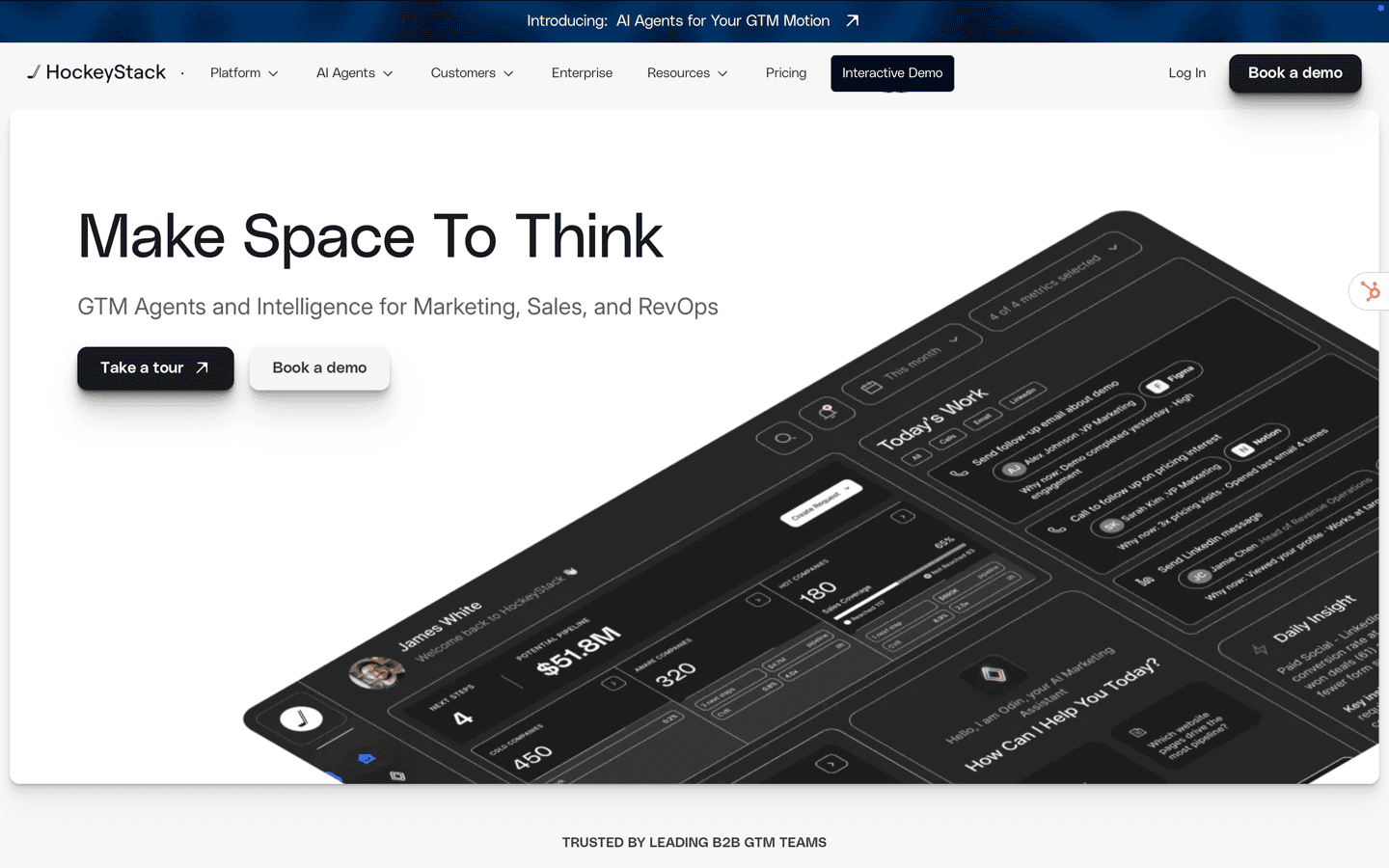
HockeyStack repositioned in 2024–2025 from a B2B attribution platform into a "revenue intelligence" product with AI revenue agents (Odin) on top of the measurement layer. The pivot makes sense for the market — buyers want recommendations, not just reports. But it also means pure attribution capabilities now share roadmap time with sales coaching, deal monitoring, and PLG product analytics.
Core Capabilities
- Native bidirectional Salesforce sync — Accounts, Contacts, Leads, Deals, Campaigns, custom fields auto-ingested within 24 hours
- Full lifecycle attribution from first touch through expansion revenue
- Odin AI analyst — natural-language queries return visual analyses ("which campaigns generated pipeline last quarter")
- Revenue agents that monitor Salesforce deals for deviation from winning patterns
- No-code dashboard builder for custom reporting
Strengths
- Salesforce integration — bidirectional sync, auto-ingestion of new custom fields, and connection between attribution data and Salesforce sales activity (sequences, emails, calendar).
- Odin AI analyst — natural-language queries are a real productivity layer for marketing ops teams who don't want to build dashboards from scratch.
- Revenue agent monitoring — automated alerts when active Salesforce deals deviate from winning patterns gives sales an early warning signal.
- PLG + sales-led motion coverage — for B2B SaaS teams running both, the unified data model is convenient.
- Custom dashboard builder — marketing ops can build their own views without engineering tickets.
Limitations
- HockeyStack has pivoted to AI agents for sales teams — marketing measurement is no longer the product's focus — the company has repositioned around AI revenue agents (Odin, deal monitoring, sales coaching, sequence guidance). Marketing attribution sits inside that broader product but is no longer the headline roadmap. For brands choosing a 3–5 year measurement partner, the strategic trajectory matters more than current feature parity — and HockeyStack's trajectory points toward the sales team, not the marketing team.
- No automated budget execution — Odin recommends. Revenue agents alert. Neither shifts ad-platform budgets. The action layer ends at "here's what you should do."
- Steep learning curve — eleven explicit G2 mentions of "steep" in reviews. Time-to-insight is longer than simpler attribution tools because the product covers a wide surface (attribution + analytics + revenue agents + dashboards).
- No mid-cycle predictive scoring at the lead level — Odin can summarize patterns, but there's no per-lead conversion-probability projection that flows into media-buying decisions before deals close.
- Annual contract required, three-week minimum implementation — not a try-before-you-buy product. Procurement and rollout commit the team for 12 months before revenue agents are productive.
Target market: B2B SaaS RevOps teams with Salesforce already deployed, wanting a single platform that combines attribution with deal monitoring, sales coaching, and natural-language analytics. Teams comfortable with a longer onboarding ramp.
Summary: HockeyStack combines attribution and sales-coaching insights in one product — designed for RevOps teams that want both layers inside Salesforce. The trade-off is the lack of an action layer for media spend and no causal incrementality testing — gaps that matter for teams whose primary use of attribution is allocating ad-platform budgets.
5. Factors.ai
Factors.ai is positioned as B2B demand generation and account intelligence — multi-touch attribution lives in the product, but the core differentiator is anonymous-visitor deanonymization and LinkedIn ad optimization. Factors is an official LinkedIn B2B Attribution & Analytics Marketing Partner, which gives the product direct access to LinkedIn impression and engagement data that other attribution tools see only after the click.
Core Capabilities
- IP-based deanonymization claims 75%+ identification rate of visiting companies
- Native Salesforce CRM sync at Lead and Opportunity object levels with chronological event tracking
- LinkedIn AdPilot and Google AdPilot add-ons translate account signals to ad-targeting actions
- Multi-touch attribution across website, CRM, LinkedIn, G2, and intent sources
- 14-day free trial on paid plans
Strengths
- Anonymous-visitor identification — claims 75%+ company-level visitor identification, which feeds account-based targeting and gives marketing ops a view into in-market accounts before they fill out a form.
- LinkedIn integration — official LinkedIn partner status means impression-level data, Conversions API integration, and cross-device cookieless attribution on LinkedIn.
- G2 and intent source integration — connects buyer-intent signals from G2, Bombora, and others to campaign attribution.
- Free entry tier — 200 companies/month free tier and a Basic plan make entry-level evaluation possible without an enterprise commitment.
Limitations
- Account intelligence and attribution get conflated — Factors does both, but the product's strongest signal is "which companies visited" rather than "which campaigns caused revenue." Buyers looking for an attribution platform sometimes leave with an account-identification tool.
- Add-on pricing accumulates fast — the Basic plan plus LinkedIn AdPilot plus Google AdPilot lands at substantial monthly spend for full functionality. Pricing transparency is limited beyond the entry tier.
- Attribution methodology isn't published in depth — there's no public whitepaper documenting how multi-touch credit is calculated. Finance teams asking for model transparency will hit a wall.
- No causal lift measurement — no experimental validation of whether a channel actually drove incremental pipeline.
- AdPilot is activation, not budget optimization — translates account signals into targeted campaigns. It doesn't calculate marginal-ROAS-based budget reallocation across all paid channels and apply it.
- LinkedIn-centric focus — channels outside LinkedIn (Google search, Meta, programmatic display) get less integrated treatment.
Target market: B2B SaaS teams whose go-to-market motion is heavily LinkedIn-led, with strong account-based marketing requirements and a need for anonymous-visitor identification alongside attribution.
Summary: Factors.ai is a useful choice for B2B teams whose paid-media center of gravity is LinkedIn and whose ABM motion needs anonymous-visitor data feeding the campaign layer. For teams whose attribution requirements extend across 30+ ad platforms with cross-channel measurement and budget execution, Factors covers a narrower slice of the problem.
6. Ruler Analytics
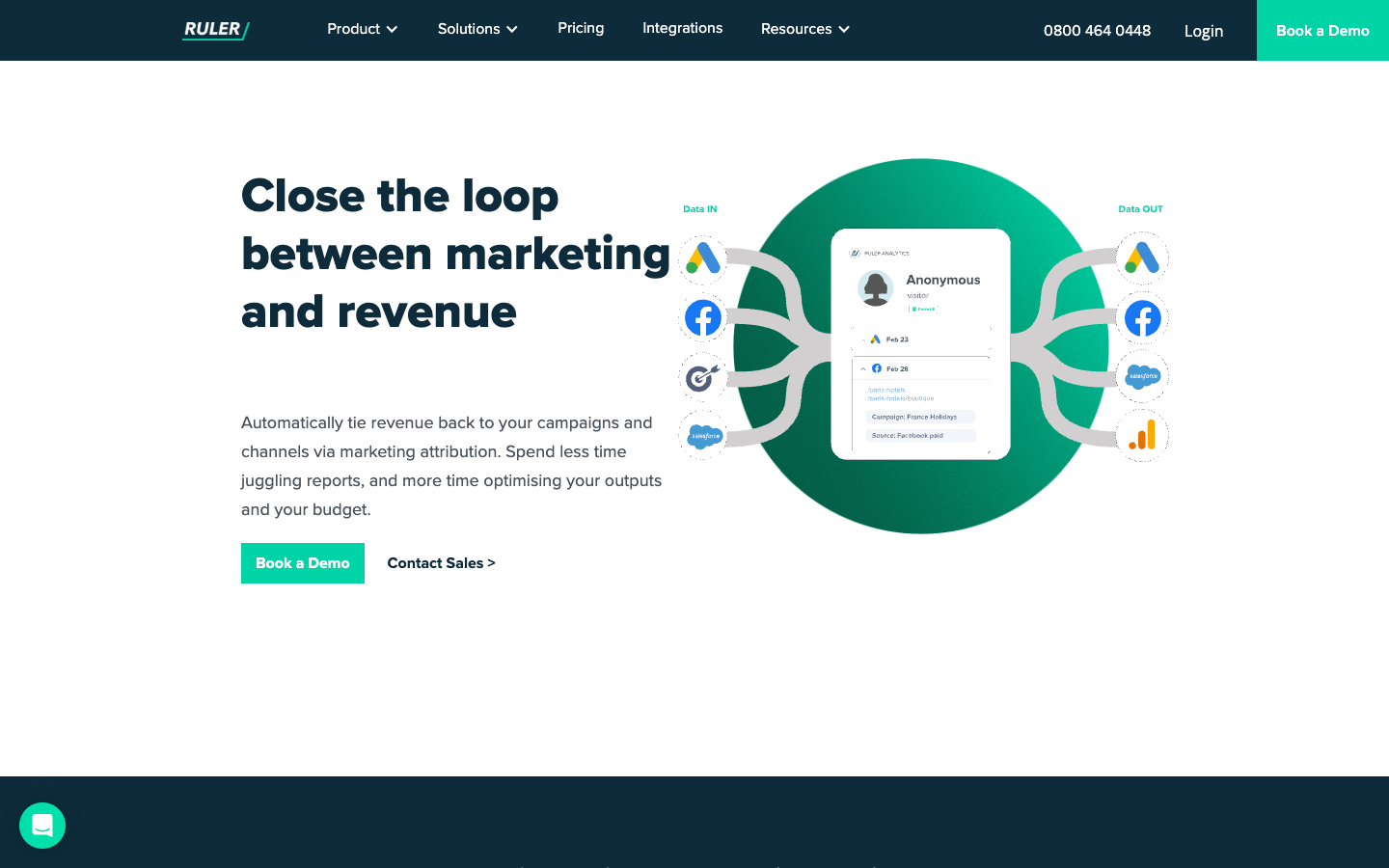
Built around inbound lead tracking — phone calls and form submissions — connected back to ad-platform clicks via call-tracking dynamic number insertion. For B2B businesses where the buying motion is "see ad → call us / fill out a form," Ruler captures the chain. Outside that motion, the product covers less ground.
Core Capabilities
- Call tracking with dynamic number insertion for paid-search and display campaigns
- Form-submission tracking with click-source attribution
- Closed-loop ad-platform sync — sends revenue data back to Google Ads, Meta, LinkedIn for improved bidding
- 1,000+ integrations including Salesforce, HubSpot, and Microsoft Dynamics
- Multi-touch attribution with first-touch, last-touch, and linear models
Strengths
- Call and form tracking — dynamic number insertion and form attribution capture a buying motion common in legal, finance, and B2B services where prospects call instead of filling out a demo form.
- Salesforce revenue sync — closed-loop integration pushes Salesforce closed-won revenue data back to ad platforms for improved Smart Bidding.
- Wide integration library — 1,000+ connectors mean most marketing stacks can plug in without custom work.
Limitations
- Fixed rule-based attribution only — first-touch, last-touch, linear. No behavioral ML, no Markov-chain modeling, no predictive scoring.
- Inbound-centric model — strongest for phone- and form-driven acquisition. For ABM motions, multi-stakeholder buying committees, and pipeline-led B2B, the product captures only part of the journey.
- No mid-cycle predictive layer — attribution waits for the call or form to come in. There's no projection of pipeline impact for active campaigns.
- No incrementality testing or budget optimization — closed-loop send-back to ad platforms helps Smart Bidding, but the product itself doesn't run experiments or calculate marginal-ROAS reallocations.
- Dated UI — multiple G2 reviewers note the interface feels older than competing platforms.
- No dark-funnel capture — channels that don't produce a click and don't produce a tracked call (podcasts, analyst mentions) sit outside the data.
Target market: B2B businesses where inbound calls and form submissions are the primary acquisition motion, particularly services-oriented B2B (legal, finance, agency, B2B services) running paid search and display.
Summary: Ruler Analytics is purpose-built for inbound lead tracking and call attribution. For B2B teams whose primary measurement need is "did this ad cause a call, and did that call become revenue," Ruler covers it. For cross-channel B2B with ABM, multi-stakeholder buying, and 30+ ad platforms, the methodology stops short of what mid-market and enterprise teams typically need.
7. Salesforce Marketing Cloud Intelligence (Datorama)
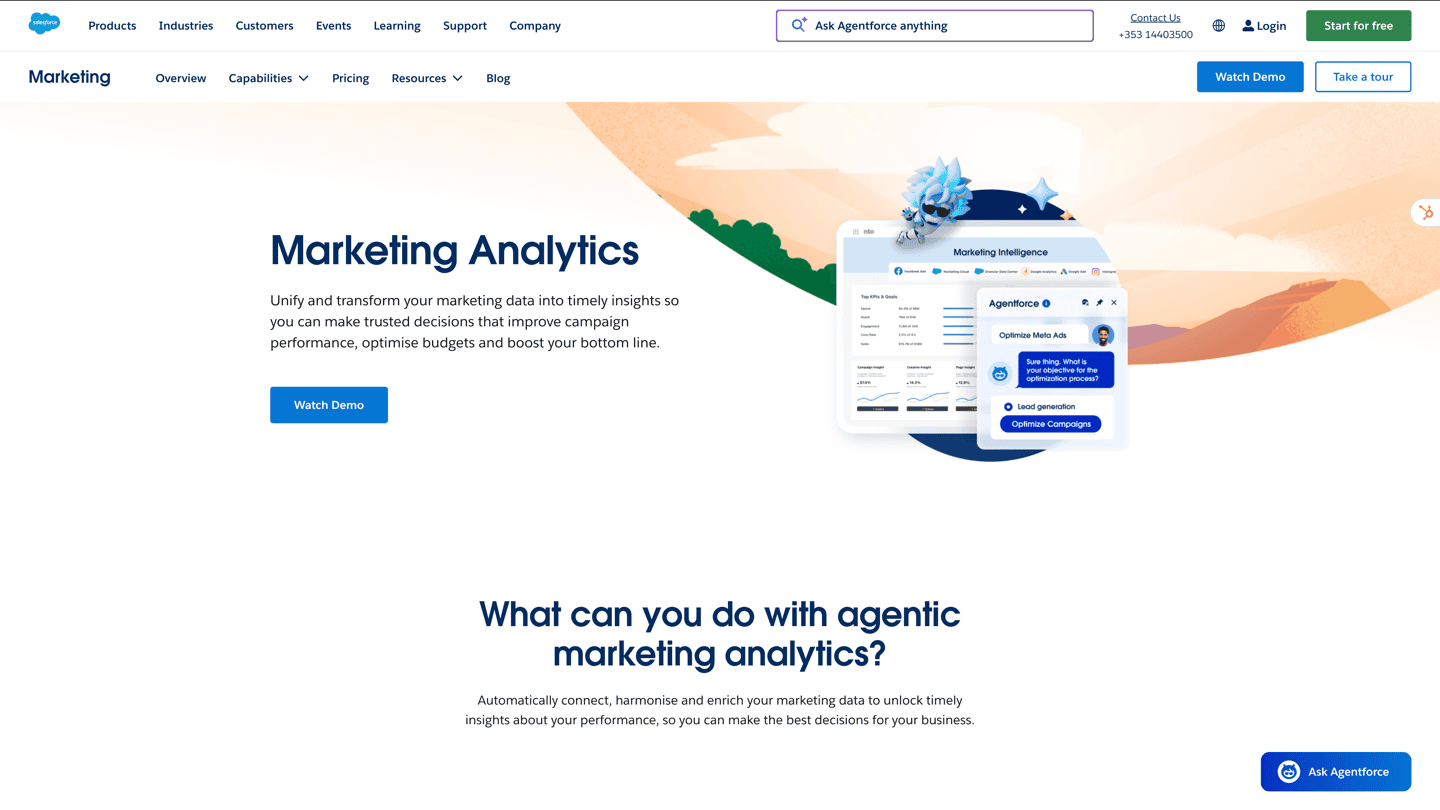
Marketing Cloud Intelligence — the product formerly known as Datorama, rebranded after Salesforce acquired Datorama in 2018 — is the Salesforce-native marketing data aggregation and reporting product. It's a reporting layer, not an attribution engine. That distinction matters more than the marketing material suggests.
Core Capabilities
- 170+ data source connectors aggregate marketing data into Salesforce dashboards
- Einstein AI insights for anomaly detection and trend identification
- Natural-language query interface for non-technical users
- Salesforce-grade security, compliance, and SSO
- Centralized reporting across multi-brand, multi-region campaigns
Strengths
- Wide connector library — 170+ data sources covers most marketing channels and platforms.
- Einstein AI for anomaly detection — flags unusual patterns and surfaces them without manual investigation.
- Single platform for multi-region campaigns — enterprise marketing teams running dozens of regional brands get unified reporting.
Limitations
- Reporting only — does not perform attribution — MCI aggregates data and visualizes it. It doesn't model attribution, doesn't run multi-touch, doesn't compute incrementality. The "intelligence" is anomaly detection and dashboards, not measurement.
- No predictive layer — shows what happened. Doesn't forecast what's about to happen or project pipeline contribution from active campaigns.
- No budget optimization — no marginal-ROAS modeling, no automated rebalancing, no execution across ad platforms.
- Salesforce ecosystem assumption — value collapses outside the Salesforce stack. Teams using HubSpot, non-Salesforce CDPs, or independent BI tools get less leverage.
- Annual license required, procured through enterprise sales — no self-serve evaluation path.
- "Attribution" in the product name is overloaded — Marketing Cloud Intelligence does not provide multi-touch attribution by default. That's a different SKU (Account Engagement / B2B Marketing Analytics) or a third-party tool.
Target market: Large enterprise Salesforce customers running multi-region, multi-brand marketing operations who need a unified Salesforce-native reporting layer across many data sources, and who already have a separate attribution methodology in place.
Summary: Marketing Cloud Intelligence is a reporting and aggregation product that consolidates marketing data into Salesforce dashboards. As an attribution solution it's a different product category — buyers expecting multi-touch modeling or budget optimization need to layer those capabilities on top via a separate tool.
8. Salesforce B2B Marketing Analytics (Account Engagement)
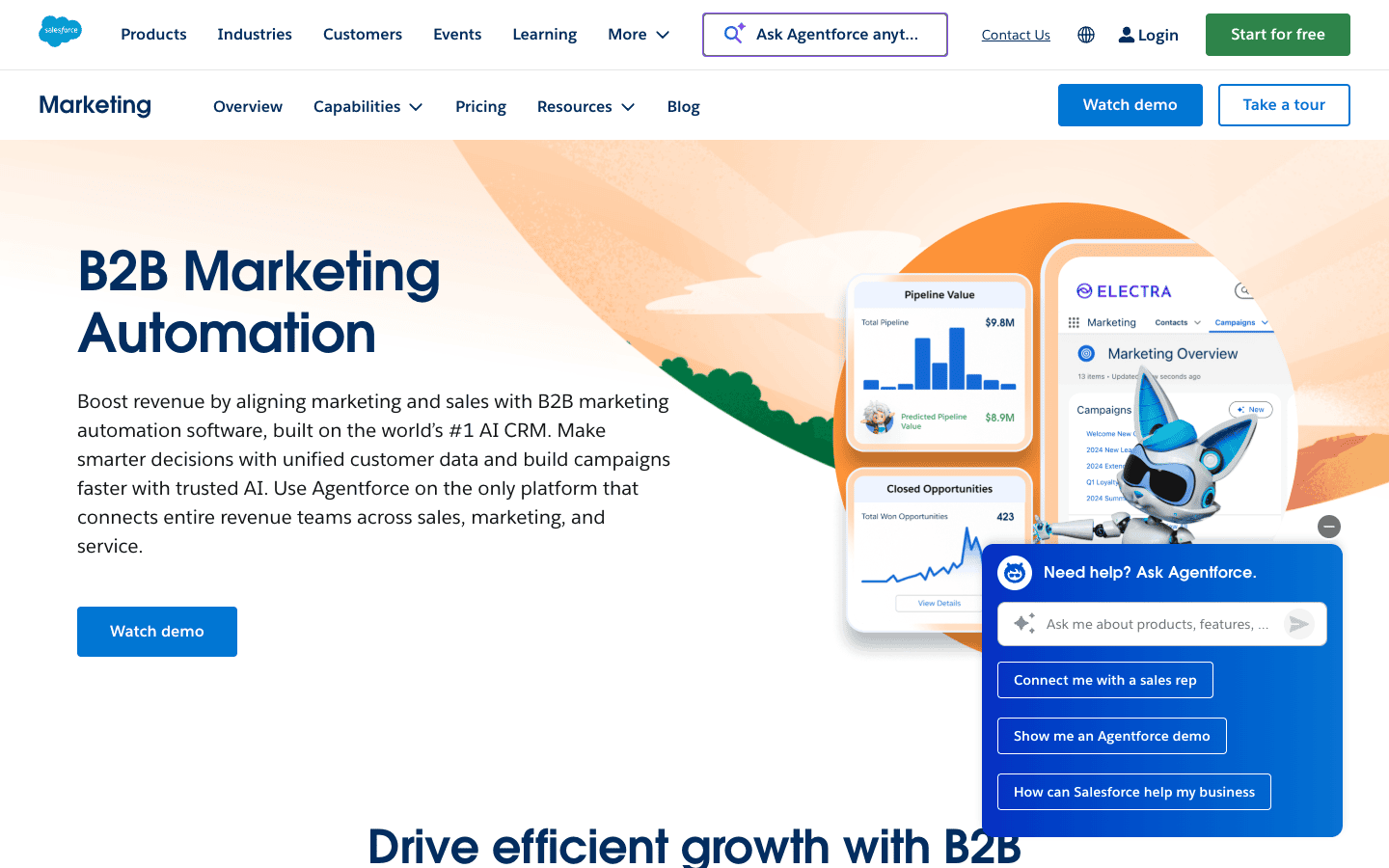
Salesforce's native B2B marketing automation platform — previously branded Pardot, then renamed Marketing Cloud Account Engagement in 2022. B2B Marketing Analytics is the analytics layer built on top, with native multi-touch attribution dashboards. For Salesforce shops running Pardot/Account Engagement, this is the path of least resistance to in-CRM attribution.
Core Capabilities
- Connected Campaigns links Account Engagement engagement data to Salesforce Opportunity records
- Multi-Touch Attribution dashboard with first-touch, even-distribution, and last-touch models
- Native Salesforce experience — no separate UI, no data sync delays
- Campaign Influence model built into the standard Salesforce object layer
- Revenue attribution ties campaign ROI to Salesforce pipeline directly
Strengths
- Zero-friction Salesforce integration — lives inside Salesforce. Marketing ops teams stay in the CRM they already know.
- Connected Campaigns — the automatic association of Account Engagement campaigns to Salesforce Opportunities removes a manual reconciliation step that's common in third-party setups.
- Native Campaign Influence model — attribution data lives on standard Salesforce objects, so reporting builds off existing Salesforce dashboards.
- Procurement simplicity — already a Salesforce customer? Account Engagement bundling makes the buy a Salesforce-internal decision.
Limitations
- B2B Marketing Analytics is an add-on with separate cost — not included in base Account Engagement.
- Cross-channel paid-media attribution requires third-party connectors — Account Engagement tracks the Account Engagement-owned surface (email, landing pages, forms). Ad platform data (Google Ads, LinkedIn, Meta, TikTok) needs separate pipes.
- Data hygiene dependency — attribution accuracy collapses if Salesforce data isn't clean. Garbage in, garbage out applies with full force.
- Requires dedicated Salesforce admin capacity — Connected Campaigns and Campaign Influence configuration aren't self-service.
- No incrementality testing, no budget optimization — measurement ends at the dashboard.
Target market: Salesforce-centric B2B teams already running Account Engagement (Pardot) who want native multi-touch attribution dashboards inside Salesforce without procuring a third-party platform, and whose ad-channel mix is light enough that rule-based models are sufficient.
Summary: Salesforce B2B Marketing Analytics is a reasonable starting point for Pardot/Account Engagement customers who want attribution inside the Salesforce environment. Teams that need behavioral attribution, ML-based credit assignment, ad-platform integration depth, incrementality testing, or budget optimization will find the native product covers a narrower scope than third-party alternatives.
9. Full Circle Insights
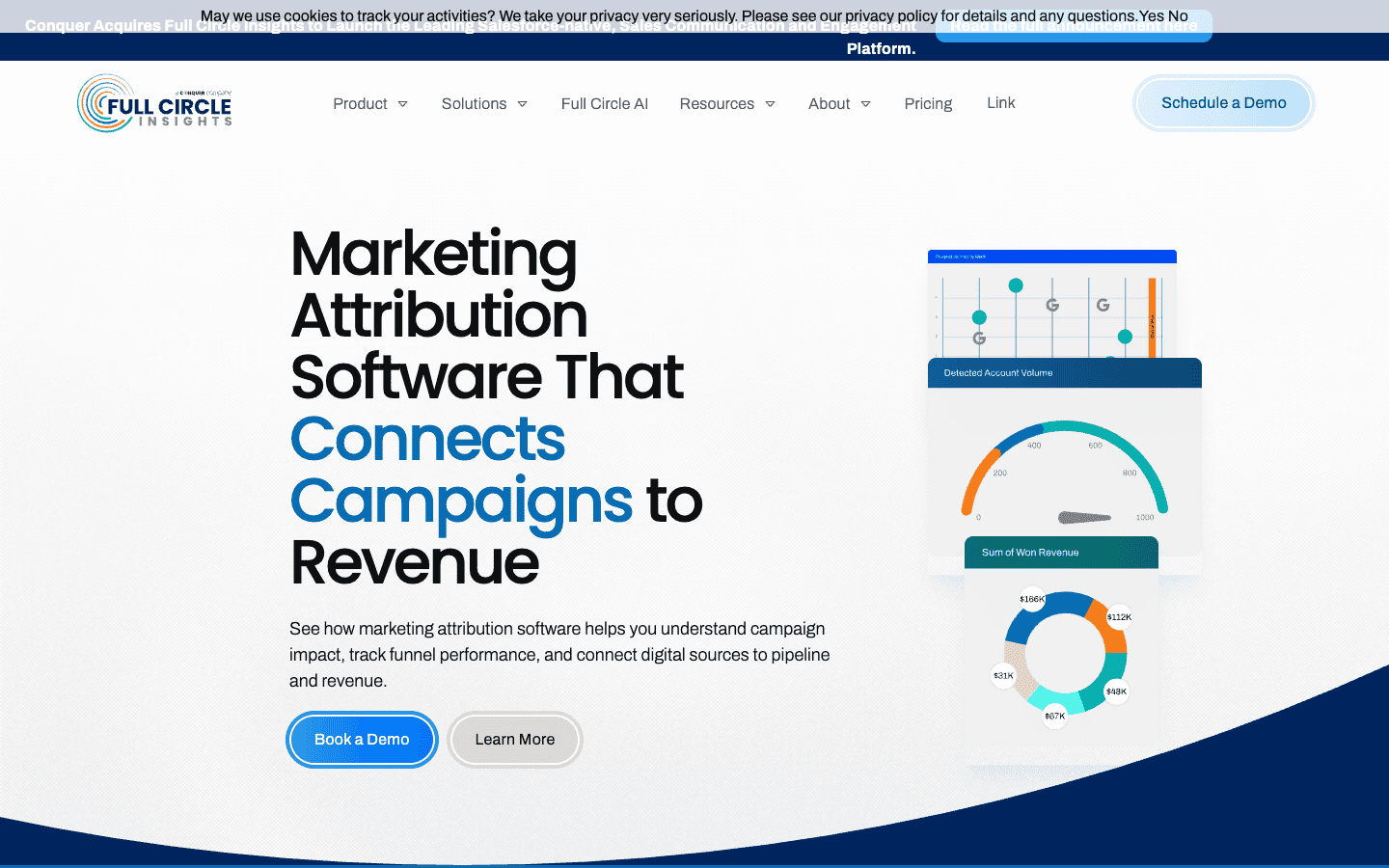
A 100% Salesforce-native attribution and funnel measurement platform. The product lives entirely inside Salesforce — every report, every dashboard, every data view sits on a Salesforce object. For teams whose operating model is "if it's not in Salesforce, it doesn't exist," Full Circle removes the third-party UI entirely.
Core Capabilities
- 100% Salesforce-native — all attribution data lives on standard Salesforce objects
- Digital Source Tracker stitches anonymous web visitors to Salesforce records
- Funnel lifecycle tracking — campaign attribution + lead velocity + pipeline metrics in one Salesforce environment
- Native integration with 6sense, Bombora, Demandbase for ABM intent data
- Multiple campaign attribution models within Salesforce reporting
Strengths
- ABM intent integration — connects 6sense, Bombora, and Demandbase signals to campaign-level attribution inside Salesforce.
- Funnel lifecycle view — campaign attribution plus lead velocity plus pipeline metrics all live in one place. RevOps gets a single Salesforce-native source of truth.
- Digital Source Tracker — anonymous-visitor stitching closes a common gap in Salesforce-native attribution.
Limitations
- Attribution accuracy is bounded by Salesforce data quality — if Salesforce data is dirty (which it often is in long-running enterprise CRM deployments), the attribution data inherits that mess. Garbage in, garbage out is not a workaround here. It's the architectural reality.
- Cross-channel paid-media attribution depends on UTM hygiene — no native ad-platform connectors. If campaign tracking is sloppy, the attribution data is too.
- Significant Salesforce admin burden — implementation and ongoing maintenance demand internal Salesforce expertise. Not a self-serve product.
- No budget optimization — Salesforce-native measurement is the product. Budget recommendations and automated execution across ad platforms are out of scope.
- No causal lift measurement — no geo holdout experiments or incrementality validation.
Target market: Enterprise B2B organizations whose operating principle is Salesforce-as-system-of-record, with strong Salesforce admin capacity, mature CRM data hygiene, and a need for attribution and funnel metrics to live entirely inside Salesforce without third-party UI.
Summary: A Salesforce-native attribution option that lives entirely inside Salesforce — for teams committed to Salesforce as the single source of truth, the product removes the friction of a third-party dashboard entirely. The trade-offs are no ad-platform connectors, positional attribution models, no causal validation, and an accuracy ceiling set by CRM data quality.
10. Cometly
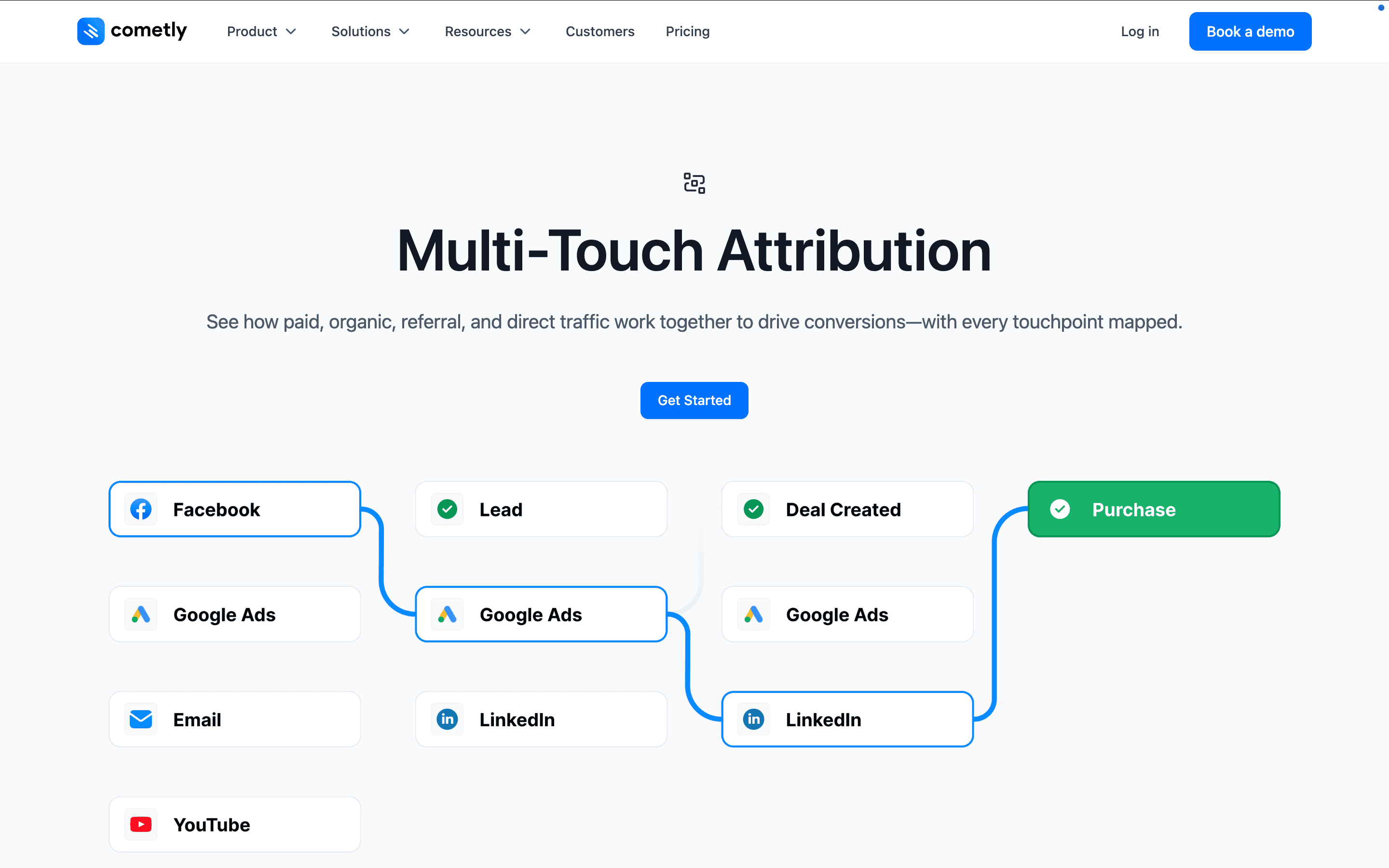
A server-side first-party attribution platform that ranks prominently for Salesforce attribution longtail queries — particularly in AI/LLM responses. Built for DTC eCommerce: server-side first-party pixel tracking, fast setup, conversion sync back to ad platforms for in-platform bidding. The fit question for a B2B Salesforce audience is different from the DTC eCommerce context Cometly was designed for.
Core Capabilities
- Server-side first-party pixel tracking — captures post-click events with cookie consent gaps
- Conversion sync to Meta, Google, TikTok — feeds first-party conversion data back for Smart Bidding
- Fast setup — accessible to non-technical teams, live within days
- Multi-touch attribution oriented around DTC single-buyer journeys
- Lower-cost growth-stage pricing entry point
Strengths
- Server-side first-party pixel tracking — the pixel captures events server-side so ad blockers and ITP don't strip the signal.
- Conversion sync feeds ad-platform bidding — pushing first-party conversion data back to Meta CAPI, Google Enhanced Conversions, TikTok Events API improves Smart Bidding inside each ad platform.
- Fast setup — non-technical teams can be live within days. Implementation is lightweight compared to enterprise attribution platforms.
Limitations (B2B Salesforce context)
- Built for DTC eCommerce, not B2B sales cycles — Cometly's attribution model is a single-buyer, single-session-to-purchase journey. There's no native concept of MQL → SQL → Opportunity → Closed-Won progression, which is the spine of how B2B teams measure pipeline.
- No CRM Funnel Attribution — Cometly doesn't stitch Salesforce pipeline stages to ad-platform spend. The product reads conversions, not deal stages.
- No account-level attribution for buying committees — the model is one-buyer-one-journey. B2B journeys with 5–10 stakeholders across multiple companies fall outside what Cometly is designed to measure.
- No incrementality testing or conversion modeling for consent gaps — no causal lift experiments, no probabilistic recovery of conversions lost to consent rejection.
- Conversion sync is platform bidding, not cross-channel measurement — feeding first-party data to Meta and Google improves their bidding inside their own walls. It doesn't tell you which channel actually caused the next deal across the full mix.
- Scaling ceiling around $100K+/month ad spend — beyond that level, the methodology starts running out of headroom for the kinds of analysis enterprise B2B teams need.
Target market: Growth-stage DTC eCommerce and B2C SaaS teams running Meta and Google paid social where fast setup, server-side tracking, and in-platform bidding optimization are the primary needs.
Summary: Cometly is built for DTC eCommerce attribution and growth-stage B2C SaaS — server-side tracking, fast setup, conversion sync to Meta and Google. For B2B teams running Salesforce with multi-stakeholder buying committees, MQL-to-Closed-Won funnel stages, and cross-channel paid-media budgets that need allocation decisions, Cometly answers a different question — and the answer doesn't include the pipeline.
How to Choose the Right Attribution Tool for Your Salesforce Setup
The 10 tools above don't compete with each other directly. They cluster into different fits depending on what the team actually needs the tool to do. The diagnostic questions below help sort that out before any procurement starts:
-
Is your primary problem "we can't see which channels drive pipeline" — or "we can see it but we can't act on it"? Most B2B teams start at the first question and get a tool that answers it. Twelve months later they realize the second question is the one that actually moves revenue, and the original tool can't answer it.
-
Does your attribution data need to live inside Salesforce, or is a separate dashboard acceptable? Some marketing ops teams operate by the rule "if it's not a Salesforce report, it's not real." Others want the best methodology regardless of where the UI lives. Both are valid. The choice constrains which level of integration depth fits.
-
What's your ad-platform mix? A heavily LinkedIn-led B2B SaaS motion has different attribution needs than a multi-channel demand-gen team running Google, Meta, LinkedIn, TikTok, and Microsoft Ads. Tools optimized for one channel rarely measure the others well.
-
Is your buying motion single-buyer or buying-committee? Single-buyer journeys (services, SMB B2B) can use simpler attribution. Multi-stakeholder enterprise journeys with 5–10 people from the same account need account-level attribution that knows the account is the unit of revenue, not the individual.
-
How long is your sales cycle? For a 30-day cycle, backward-looking attribution is acceptable. For a 6-month cycle, mid-cycle predictive scoring becomes critical — you can't wait six months to find out whether a campaign worked.
-
What level of methodology defensibility does your CFO require? If the answer is "I need to be able to explain every number in a board meeting," a black-box ML model without published methodology is a procurement risk. Tools with open methodology documentation survive finance review.
-
Do you need incrementality validation? When marketing budget hits $100K+/month, the question "is this channel actually causing incremental revenue?" stops being academic. Google Brand Search and Meta retargeting are the usual suspects — both report huge ROAS in attribution and often near-zero incremental revenue when paused.
-
Is your team going to translate the attribution dashboard into ad-platform budget changes manually every week — or do you want the budget reallocation to be automated? Manual translation works at smaller scale. Past a certain spend level, the lag between insight and action costs more than the platform.
-
What CRM hygiene reality are you actually working with? Tools that depend on perfect Salesforce data hygiene fail in real enterprise environments where data has accumulated over years. If your reality is "we have three Salesforce orgs and the data is messy," the data-foundation layer matters before the attribution layer does.
If your team needs measurement, automated budget execution, and an agentic AI workflow connected to Salesforce closed-won data, SegmentStream is built for the full chain. The other tools in this comparison handle parts of the chain — first-touch attribution, account-level visualization, sales-team coaching, or Salesforce-native reporting — but only SegmentStream closes the measurement-to-action loop end-to-end across 30+ ad platforms.
Final Verdict: The Best Attribution Tool for Salesforce in 2026
The 10 tools above span four very different product categories — pure-play B2B attribution, Salesforce-native reporting, Salesforce-native attribution, and DTC eCom attribution that happens to sync with Salesforce. Across all four categories, one tool is built around a fundamentally different premise than the rest: measurement that connects Salesforce closed-won revenue to ad-platform budget execution, with agentic AI infrastructure on every plan tier.
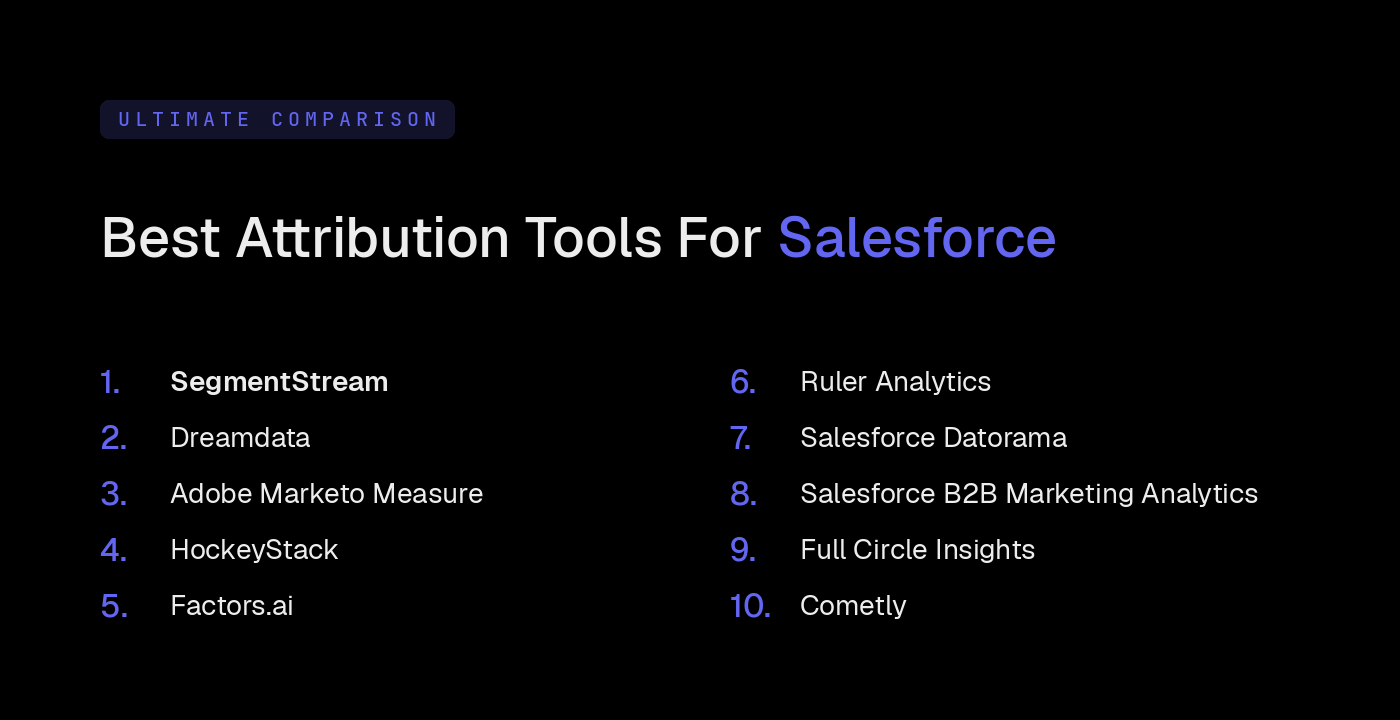
1. SegmentStream — the agentic AI measurement layer Salesforce Marketing Cloud and Data Cloud miss. The full chain runs in one system: CRM Funnel Attribution reads Salesforce Lead → Opportunity → Closed-Won. Cross-Channel Attribution distributes credit across 30+ ad platforms. Marginal Analytics finds where every dollar stops working. Automated Budget Allocation executes the reallocation. AI Agent + MCP access is available for every customer — no other tool in this comparison offers that. For B2B teams whose attribution needs to actually move budget — not just produce a quarterly slide — this is the platform.
2. Dreamdata — covers account-level B2B visualization. Account journey views, Salesforce sync, and a public Starter pricing tier. The product's scope ends at visualization — no behavioral ML, no mid-cycle predictive scoring, and no budget execution.
3. Adobe Marketo Measure (Bizible) — native Salesforce write-back for Adobe-centric enterprises. Native write-back to Salesforce objects, six attribution models, and Marketo Engage compatibility. The trade-off is stalled innovation, positional-only attribution, and no path to budget optimization.
The remaining tools — HockeyStack, Factors.ai, Ruler Analytics, Salesforce Marketing Cloud Intelligence, Salesforce B2B Marketing Analytics, Full Circle Insights, and Cometly — each serve narrower use cases covered in detail above. None of them combines full-funnel ad-to-revenue measurement with agentic AI and automated budget execution. That combination is the SegmentStream argument.
Related Articles
- The Best Composable, Warehouse-Native Attribution & Measurement Tool (2026) — composability-axis comparison for teams running BigQuery, Snowflake, or Databricks
- Best B2B Marketing Attribution Software Tools (2026)
- 9 Best Marketing Attribution Tools for HubSpot CRM (2026) — HubSpot-specific comparison for B2B SaaS, PLG, B2C, DTC, and enterprise teams running HubSpot
- Best Marketing Attribution Tools (2026)
- Best Dreamdata Alternatives for B2B Attribution (2026)
- Best HockeyStack Alternatives for B2B Marketing Attribution (2026)
Ready to Connect Your Salesforce Pipeline to Ad-Platform Budget Decisions?
Salesforce shows you which deals closed. SegmentStream shows you which ad dollar caused the next one — and reallocates budget across your ad platforms based on that answer. CRM Funnel Attribution, Cross-Channel Attribution, Marginal Analytics, Automated Budget Allocation, and AI Agent + MCP access work as a single agentic AI loop that turns Salesforce revenue data into budget decisions.
Talk to a SegmentStream expert to see how CRM Funnel Attribution maps Salesforce Lead → Opportunity → Closed-Won data to your specific paid-media mix, and how Automated Budget Allocation could rebalance your next quarter's spend.
Book a demo to see SegmentStream in action.