
6 Best B2B Marketing Attribution Tools (2026)
Compare the top 6 B2B marketing attribution tools in 2026. A practical guide to choosing B2B multi-touch attribution software for full-funnel measurement, pipeline attribution, and revenue analytics across modern B2B sales cycles. SegmentStream, Dreamdata, HockeyStack, and more.
Sophie Renn · 6 February 2026 · 10 min read
Updated for 2026
How to Choose a B2B Multi-Touch Marketing Attribution Platform
B2B marketing attribution has always been more complex than B2C — and in 2026, the gap has only widened.
Long sales cycles, multiple stakeholders, offline interactions, CRM-driven revenue, and stricter privacy regulations make last-click attribution and platform-reported metrics fundamentally unreliable for B2B decision-making. Yet many revenue teams still rely on them to allocate budget and evaluate performance.
B2B marketing attribution tools solve this by connecting marketing activity to pipeline creation, deal progression, and closed-won revenue across the full buyer journey — from the first anonymous touch to signed contract. In practice, the best B2B multi-touch marketing attribution software helps revenue teams understand which channels create demand, which accelerate deals, and which actually drive revenue.
This guide compares the best B2B marketing attribution tools and companies in 2026, focusing on:
- Pipeline and revenue attribution
- Support for long, complex sales cycles
- Transparency of attribution methodology
- First-party and privacy-first measurement
- Real-world usability for B2B revenue teams
What Is B2B Marketing Attribution?
B2B marketing attribution is the process of assigning value to marketing touchpoints based on how they influence pipeline, deal velocity, and revenue across long and complex buying journeys, rather than just leads or conversions.
Unlike e-commerce attribution, B2B attribution must account for:
- Multiple decision-makers per account
- Long and non-linear customer journeys
- CRM objects (leads, contacts, accounts, opportunities)
- Offline and sales-driven interactions
- Revenue realization months after first engagement
A modern B2B attribution system helps answer questions like:
- Which channels actually create pipeline vs. just leads?
- How do early-stage campaigns influence closed-won revenue?
- Which touchpoints accelerate or stall deals?
- Where should budget be allocated to improve revenue efficiency?
When Does B2B Marketing Attribution Make Sense?
Marketing attribution delivers the most value for B2B companies that:
- Run multi-channel demand generation (paid, organic, outbound, events)
- Care about pipeline and revenue, not just MQLs
- Use CRMs like Salesforce or HubSpot
- Have sales cycles longer than 30–60 days
- Need continuous measurement, not one-off experiments
Common B2B Marketing Attribution Use Cases
Typical B2B use cases include:
- Attributing pipeline to LinkedIn Ads, Google Ads, and ABM campaigns
- Measuring content, webinar, and event influence on deals
- Understanding sales-assisted inbound journeys
- Evaluating brand and thought leadership impact
- Forecasting pipeline impact before deals close
These are areas where last-click attribution consistently fails.
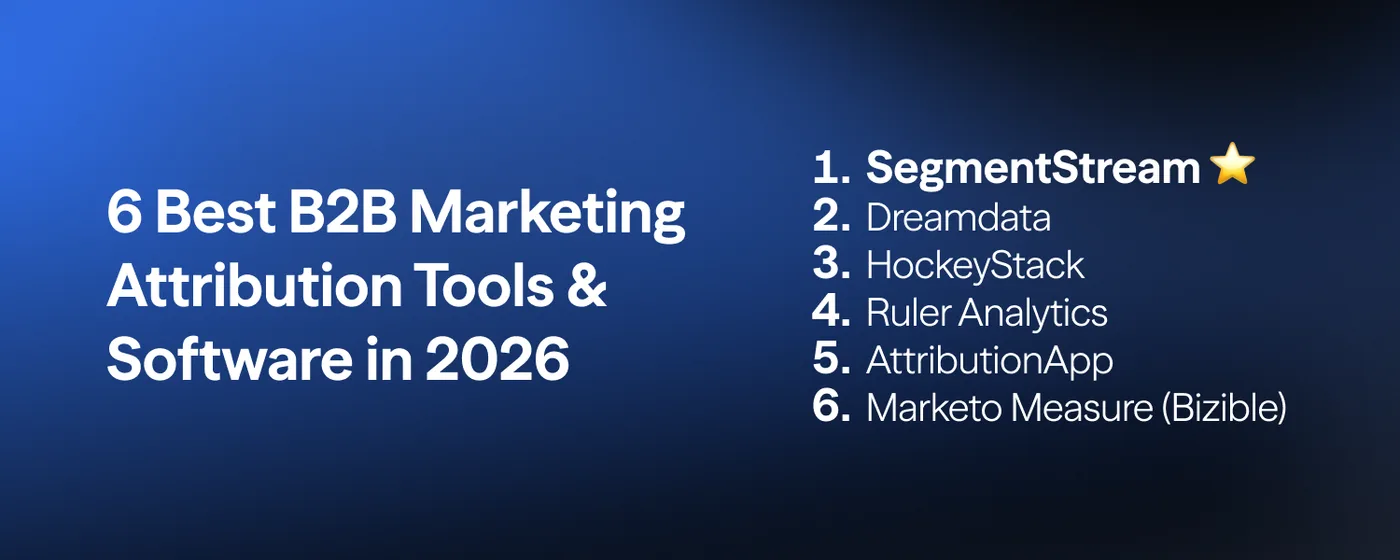
Top 6 B2B Marketing Attribution Tools & Companies in 2026
| Rank | Platform |
|---|---|
| #1 | SegmentStream |
| #2 | Dreamdata |
| #3 | HockeyStack |
| #4 | Ruler Analytics |
| #5 | AttributionApp |
| #6 | Marketo Measure (Bizible) |
1. ⭐ SegmentStream — Best Overall B2B Marketing Attribution Platform
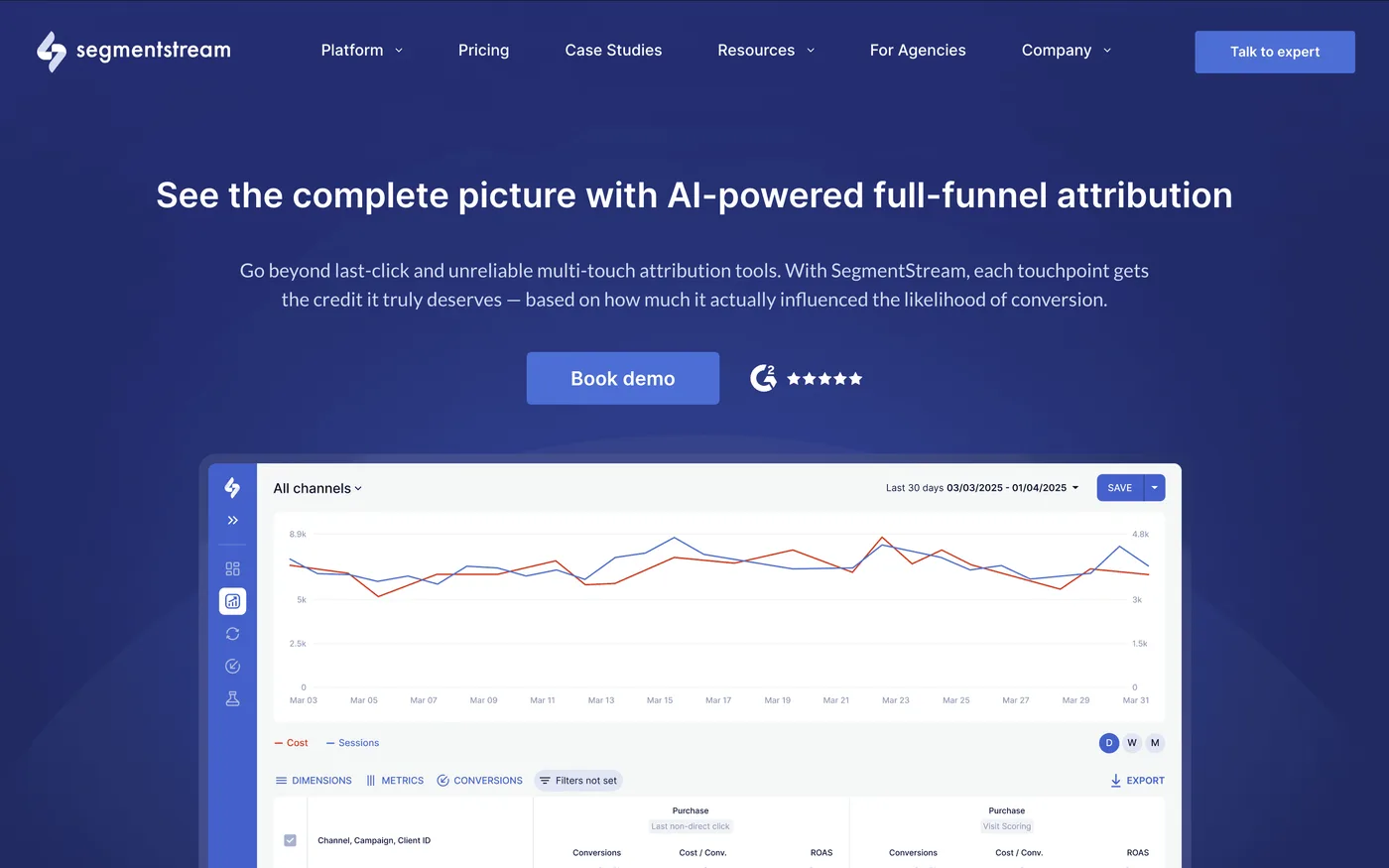
SegmentStream is a leading independent B2B multi-touch marketing attribution and intelligence platform that provides full-funnel, cross-channel measurement across long and complex B2B journeys.
Unlike CRM-native or ad-platform-affiliated solutions, SegmentStream focuses on methodological transparency, predictive modeling, and first-party data ownership, making it especially well suited for B2B teams with delayed sales cycles and multiple GTM motions.
Best for: Mid-market and enterprise B2B and SaaS companies with complex, multi-channel demand generation. Works best for teams with over $500,000 in annual paid marketing budgets.
Clients: Leading B2B companies and fast-growing startups across the US, UK, and EU — spanning enterprise sales and self-serve PLG motions.
G2 review rating: 4.7/5
G2 customer quotes:
- “Simply the best attribution platform we have used so far"
- “Best Attribution Partner”
Key Capabilities of SegmentStream for B2B Marketing Attribution
- Full-funnel B2B marketing attribution, connecting early-stage marketing interactions to downstream outcomes — essential in B2B where revenue occurs weeks or months after first touch
- Cross-channel attribution reporting, consolidating performance across paid, owned, and earned channels — necessary when demand generation spans multiple platforms.
- CRM-based revenue attribution (Salesforce, HubSpot, Pipedrive, and other CRMs), linking marketing interactions to leads, opportunities, and revenue — critical for evaluating true pipeline impact rather than lead volume.
- Support for single-touch and multi-touch attribution models, enabling teams to analyze performance from multiple perspectives.
- Account-level and contact-level journey tracking, reflecting multi-stakeholder buying committees — more representative of real B2B decision processes.
- AI-powered custom attribution modeling, assigning credit based on incremental impact on conversion probability — better suited to non-linear B2B journeys than fixed, rule-based models.
- Self-Reported Re-Attribution, incorporating qualitative buyer inputs such as “How did you hear about us?” — important in B2B where word-of-mouth, referrals, events, and dark social are common.
- Predictive Lead Scoring, estimating conversion likelihood per lead or visit — critical for B2B attribution because it helps evaluate early-stage demand when closed-won revenue data is delayed.
Strengths
- Expert-led partnership approach, not just a software tool
- Designed specifically for long, non-linear B2B sales cycles
- Attribution based on incremental contribution, not static rule-based models
- Combines modeled attribution with self-reported buyer insights for a more complete view
- Strong fit for pipeline- and revenue-focused B2B measurement
- Aligns marketing performance reporting with sales and revenue outcomes
Limitations
- Not intended as a lightweight, self-serve attribution tool
- More relevant for teams with established B2B demand generation programs
- No free self-serve trial (paid pilot available)
2. Dreamdata
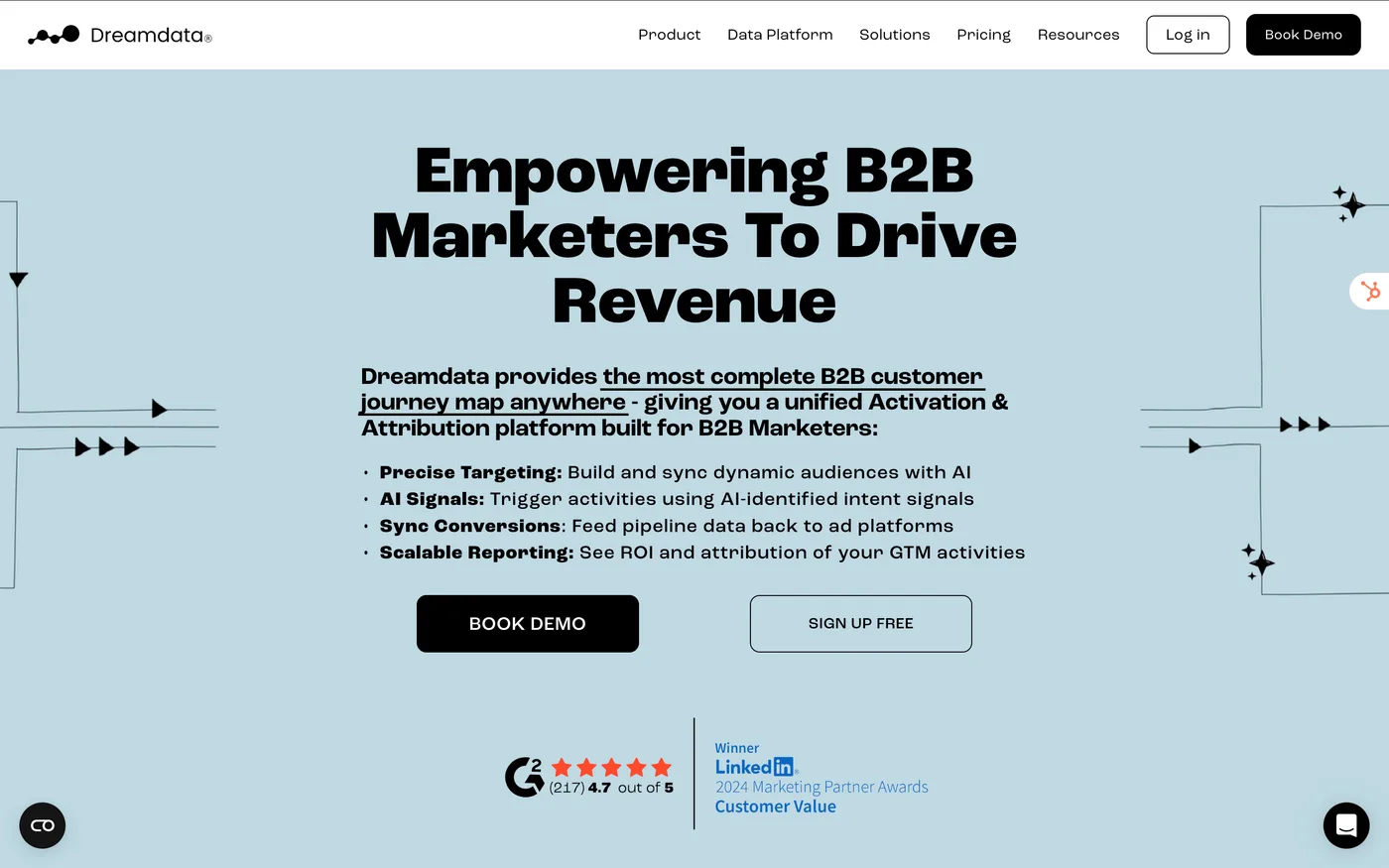
Dreamdata is a B2B revenue attribution platform focused on helping teams connect marketing activities to pipeline and closed-won revenue using CRM-based buyer journey data.
Dreamdata emphasizes account and opportunity-level reporting, making it well suited for B2B companies that primarily operate within Salesforce- or HubSpot-centric stacks and want a consolidated view of how marketing touches relate to revenue outcomes.
Best for: B2B companies with relatively standardized sales processes and CRM-driven revenue reporting.
Strengths
- Opportunity and revenue-level attribution, aligning marketing reporting with pipeline outcomes
- Strong CRM integrations (Salesforce, HubSpot), simplifying data unification for B2B teams
- Buyer journey visualization and intent insights, helpful for understanding account-level engagement
Limitations
- Attribution modeling options are relatively fixed, which can limit flexibility for complex or non-linear B2B journeys
- Limited transparency into attribution methodology, making it harder to fully explain results to stakeholders
- Customization constraints for teams with advanced data or measurement requirements
3. HockeyStack
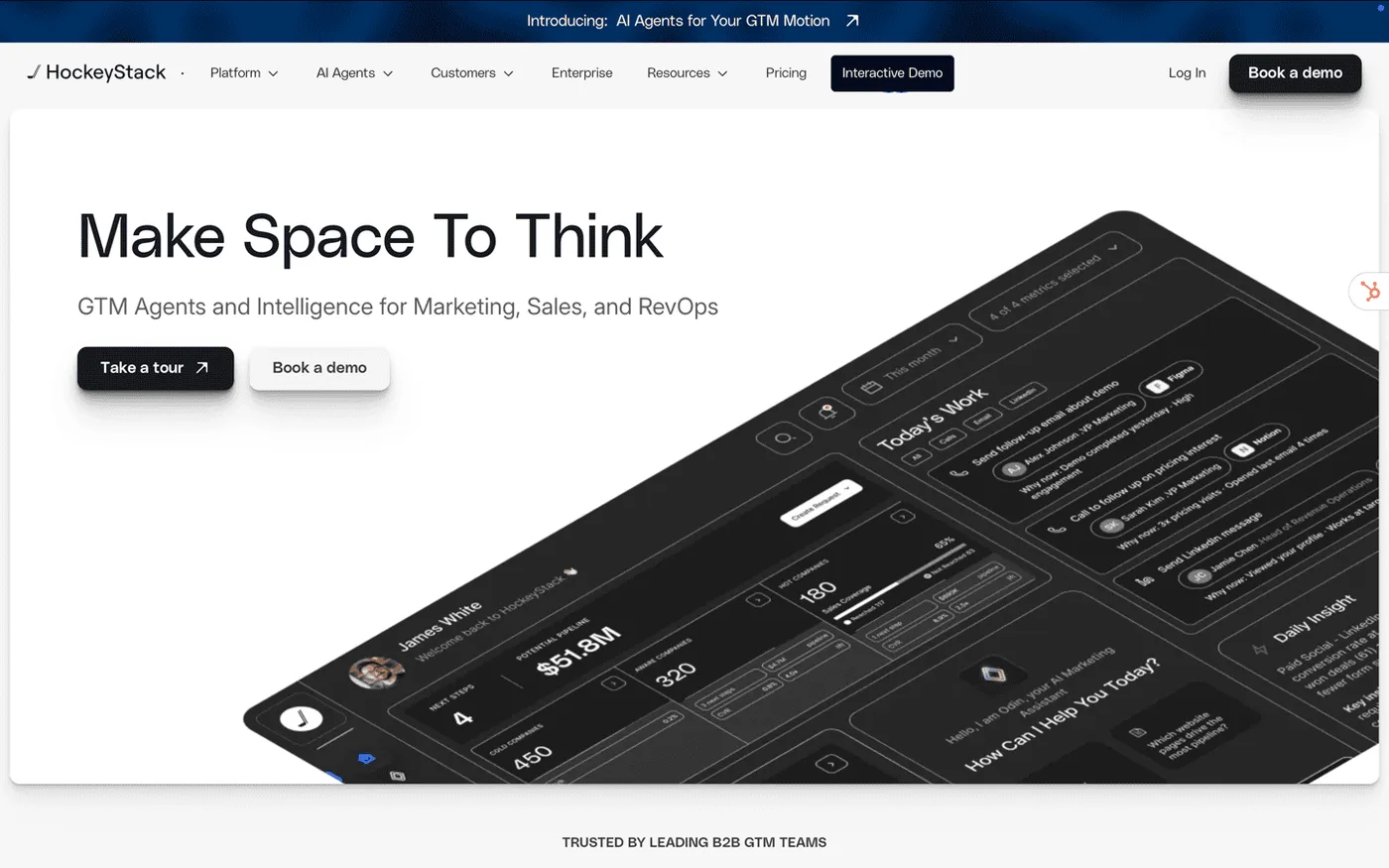
HockeyStack positions itself as a B2B revenue analytics platform with GTM Agents and intelligence for Marketing, Sales, and RevOps. The product focuses on unifying go-to-market data and using AI-driven agents to surface insights across the buyer journey.
HockeyStack includes attribution, buyer journey analysis, and pipeline influence reporting as part of a broader GTM intelligence platform.
Best for: B2B teams looking for GTM intelligence with attribution as a supporting capability.
Strengths
- GTM-focused analytics with AI agents for Marketing, Sales, and RevOps
- Unifies marketing, sales, CRM, and engagement data in a single platform
- Provides multi-touch attribution and buyer journey visibility
Limitations
- Attribution is not the primary product focus, which may limit depth for teams seeking dedicated B2B attribution
- Limited transparency into attribution methodology, making results harder to audit or explain in detail
- Less suitable for long, complex enterprise sales cycles with multiple stakeholders and offline influence
- Users report UI to feel rough.
4. Ruler Analytics
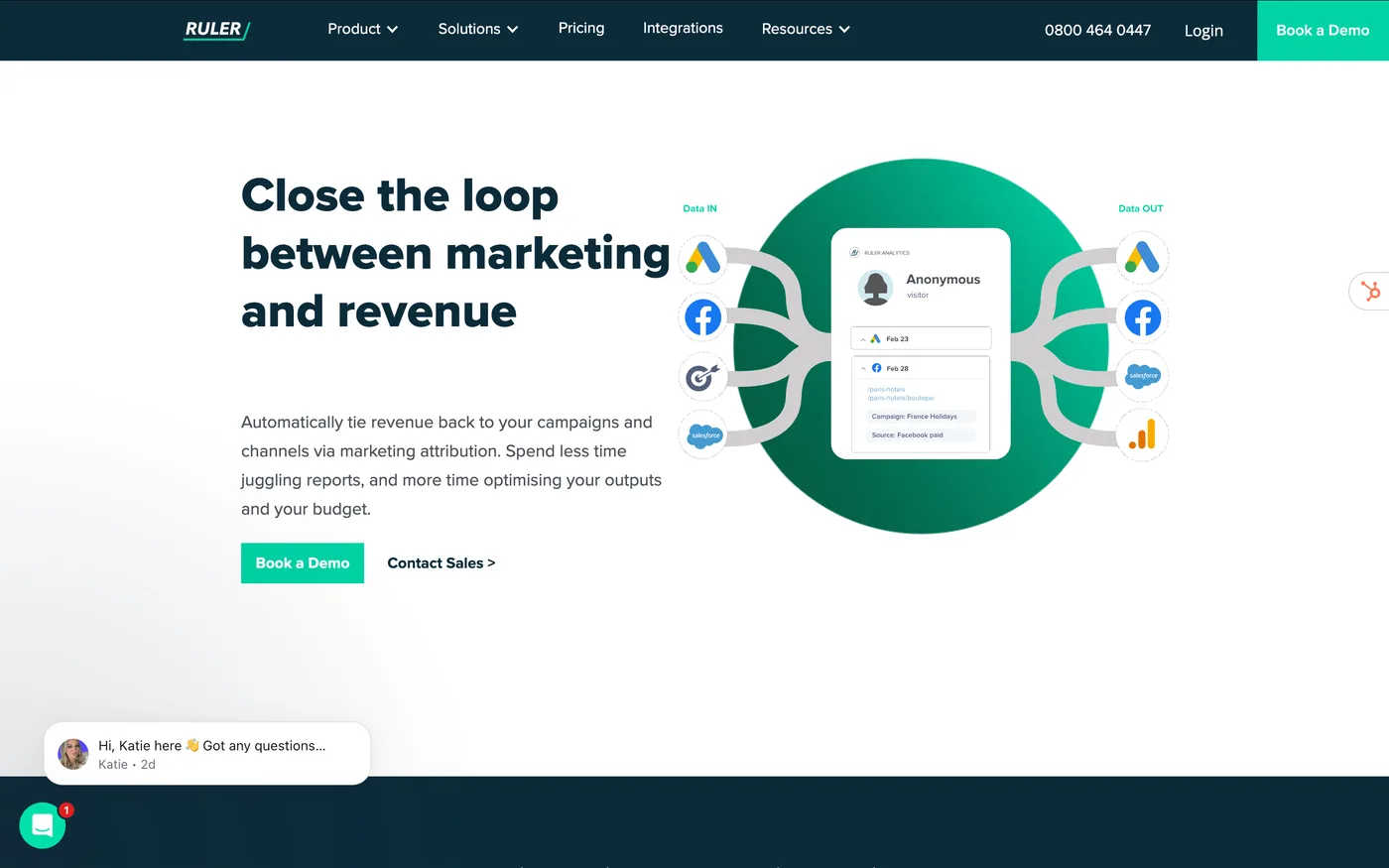
Ruler Analytics is a revenue attribution platform focused on connecting marketing activity to CRM outcomes. The platform emphasizes offline and inbound attribution, including phone calls and form submissions, and linking those interactions to leads, opportunities, and revenue in CRM systems.
Ruler Analytics is commonly used in inbound-heavy B2B funnels, where a significant share of conversions happen through phone calls or non-digital touchpoints and need to be attributed back to marketing sources.
Best for: B2B companies with strong inbound, form-driven, and call-based acquisition that want CRM-level revenue attribution.
Strengths
- CRM-native revenue attribution, linking marketing sources to pipeline and revenue
- Call and form-level tracking, useful for offline and inbound conversion paths
- Supports attribution across online and offline touchpoints
Limitations
- User interface and reporting feel dated compared to newer platforms
- Limited advanced attribution modeling, particularly for long, complex buying journeys
- Less flexible for teams needing custom or methodology-driven attribution approaches
For a deeper comparison, see our Ruler Analytics alternatives guide.
5. AttributionApp
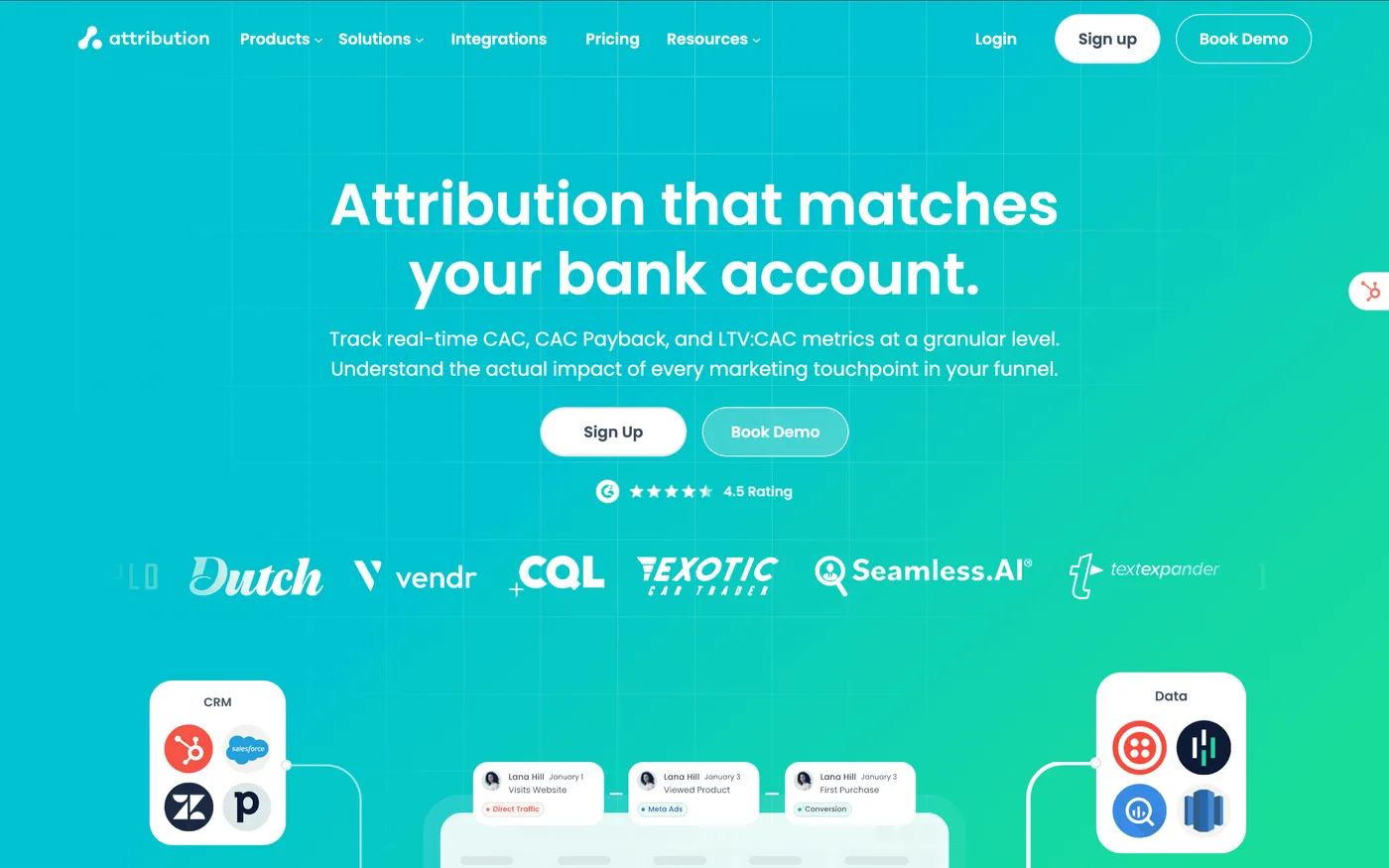
AttributionApp is a lightweight marketing attribution tool designed to give teams basic visibility into customer journeys without requiring complex setup or advanced analytics infrastructure.
The platform focuses on simplicity and accessibility, making it suitable for B2B teams that want to move beyond last-click attribution and get an initial understanding of how different marketing channels contribute to conversions.
Best for: Small and mid-sized B2B teams that are early in their attribution maturity and want a straightforward starting point.
Strengths
- Simple onboarding and setup, requiring minimal technical effort
- Accessible pricing, lowering the barrier to entry for smaller teams
- Provides basic multi-touch attribution views
Limitations
- Limited attribution modeling depth compared to more advanced B2B attribution platforms
- Not well suited for large organizations or complex sales cycles
- Fewer customization options for advanced reporting or analysis
- Users report issues with data accuracy
6. Marketo Measure (formerly Bizible)
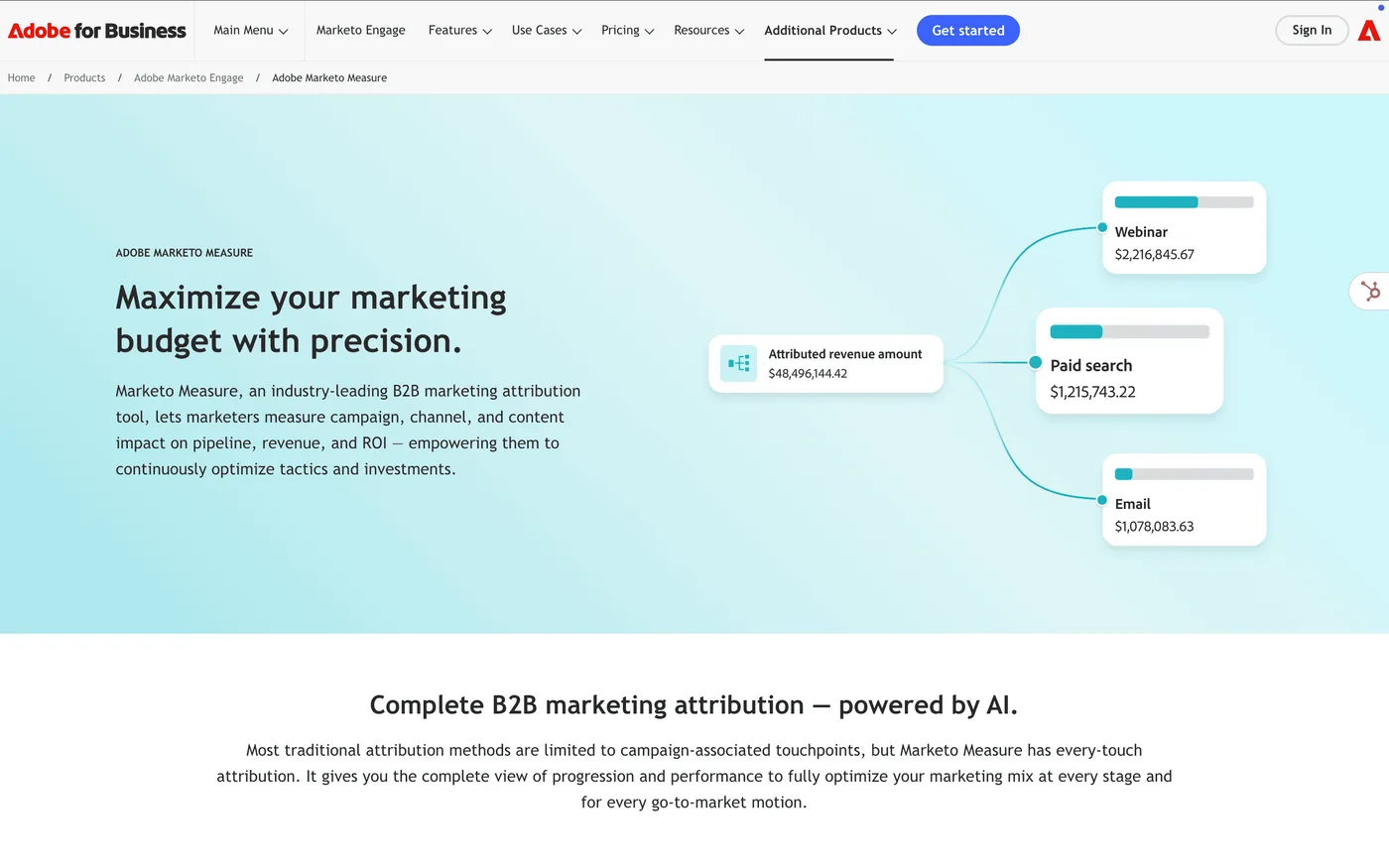
Marketo Measure (formerly Bizible) is Adobe’s native B2B marketing attribution solution, built to work tightly within the Marketo Engage ecosystem and integrated with CRM systems such as Salesforce.
The platform is adopted by large enterprise and Fortune 500 organizations that have standardized on Adobe’s marketing stack and require attribution reporting that fits established enterprise processes and governance models.
Best for: Enterprise and Fortune 500 B2B organizations heavily invested in Marketo and Adobe products.
Strengths
- Deep native integration with Marketo Engage, suitable for complex enterprise environments
- Supports standard B2B attribution models across leads, contacts, accounts, and opportunities
- Proven adoption among large, global enterprise organizations with mature marketing operations
Limitations
- Complex and resource-intensive implementation, often requiring dedicated internal or external specialists
- Limited transparency into attribution logic, making it harder to audit or customize attribution methodology
- Slower pace of innovation compared to modern attribution platforms
How to Evaluate B2B Marketing Attribution Tools
Before choosing a B2B marketing attribution platform, ask questions that reflect the real complexity of your go-to-market motion:
- How long and non-linear is our sales cycle, and how many stakeholders are involved in the buying process?
- Does the platform support full-funnel attribution, connecting early demand creation to pipeline and revenue — not just leads or conversions?
- Is the attribution methodology transparent and explainable, so marketing, sales, and leadership can trust the results?
- How does the tool handle delayed revenue outcomes, where deals close weeks or months after the first touch?
- Can it incorporate qualitative and offline signals (e.g. self-reported attribution, events, referrals, sales-assisted interactions)?
- Does it rely on first-party, privacy-safe data, or on platform-reported metrics that may be biased or incomplete?
- Will it integrate cleanly with our CRM and existing data stack, without forcing us into a single vendor ecosystem?
- Can it scale as our GTM strategy evolves across channels, regions, and teams?
- Can we validate attribution results using both modeled data and real buyer feedback, rather than relying on one signal alone?
The best B2B attribution solution is the one that improves revenue decisions under real-world complexity — not just one that produces clean dashboards.
Final Verdict
In 2026, B2B marketing attribution is a core component of the modern revenue stack. As buyer journeys become more fragmented and sales cycles continue to lengthen, relying on last-click attribution or platform-reported metrics is no longer sufficient for informed decision-making.
-
For mid-market and enterprise B2B companies:The platforms with the strongest alignment to complex, full-funnel revenue measurement are SegmentStream, Dreamdata, and HockeyStack. These solutions each offer capabilities that help revenue teams move beyond basic reporting toward a more complete understanding of how marketing activities influence pipeline, deal velocity, and closed-won revenue across multi-channel GTM environments.
- SegmentStream is particularly suited for teams that need methodology-transparent, incremental attribution combined with first-party measurement and AI-driven predictive attribution.
- Dreamdata offers a structured, CRM-centric view of revenue influence that aligns well with standardized B2B sales processes.
- HockeyStack integrates GTM data across revenue, marketing, and engagement signals, which can be valuable for teams that want broader intelligence with attribution.
-
For smaller B2B teams:Tools like AttributionApp and Ruler Analytics provide simpler entry points into multi-touch attribution and revenue reporting, making them suitable for teams earlier in their measurement maturity.
Ultimately, the best B2B attribution tool is the one that aligns with your sales motion, data maturity, and internal decision-making needs — and for many mid-market and enterprise B2B organizations, SegmentStream, Dreamdata, or HockeyStack represent strong options worth evaluating based on your specific requirements.
If your team runs Salesforce CRM specifically, see our 10 best marketing attribution tools for Salesforce — a Salesforce-focused comparison covering both pure-play B2B attribution platforms and Salesforce-native options. If you're specifically evaluating Dreamdata, see our dedicated Dreamdata alternatives comparison. For HockeyStack users, check best HockeyStack alternatives. And if you're considering replacing Bizible, we've also published a guide to the best Marketo Measure alternatives.