
10 Best Bizible (Marketo Measure) Alternatives
Top-10 Bizible (Marketo Measure) alternatives for B2B attribution — SegmentStream, HockeyStack, Dreamdata, CaliberMind compared. Honest pros, cons, and pricing.
Sophie Renn · 19 February 2026 · 29 min read
Updated for 2026
Quick Answer: The Best Bizible Alternatives in 2026
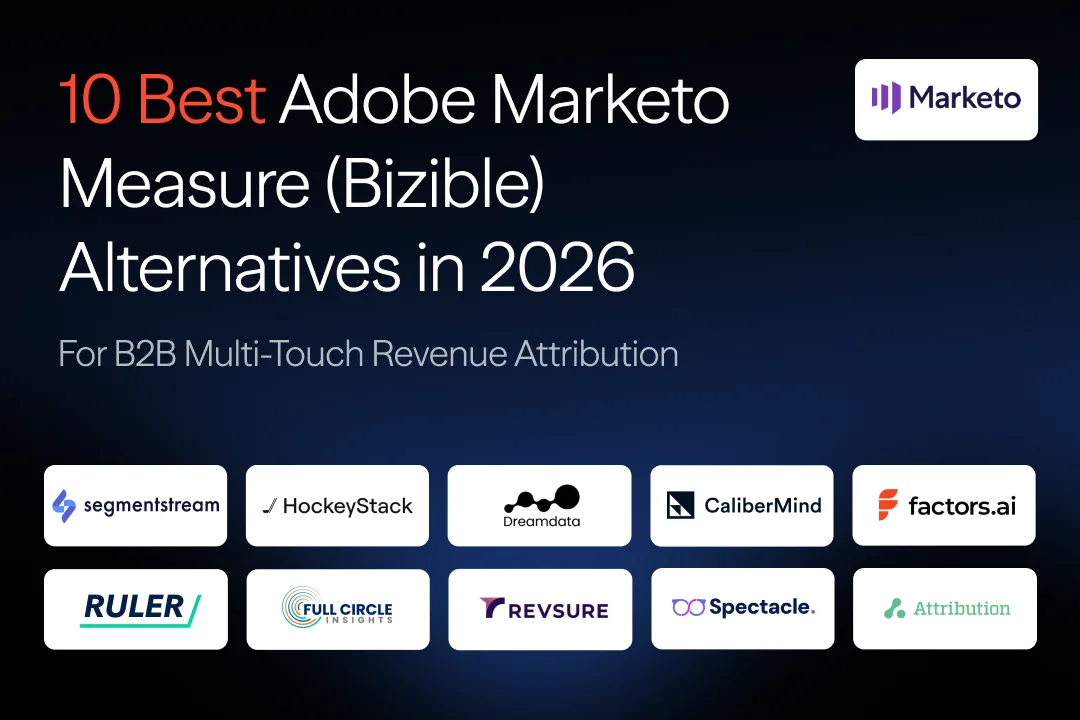
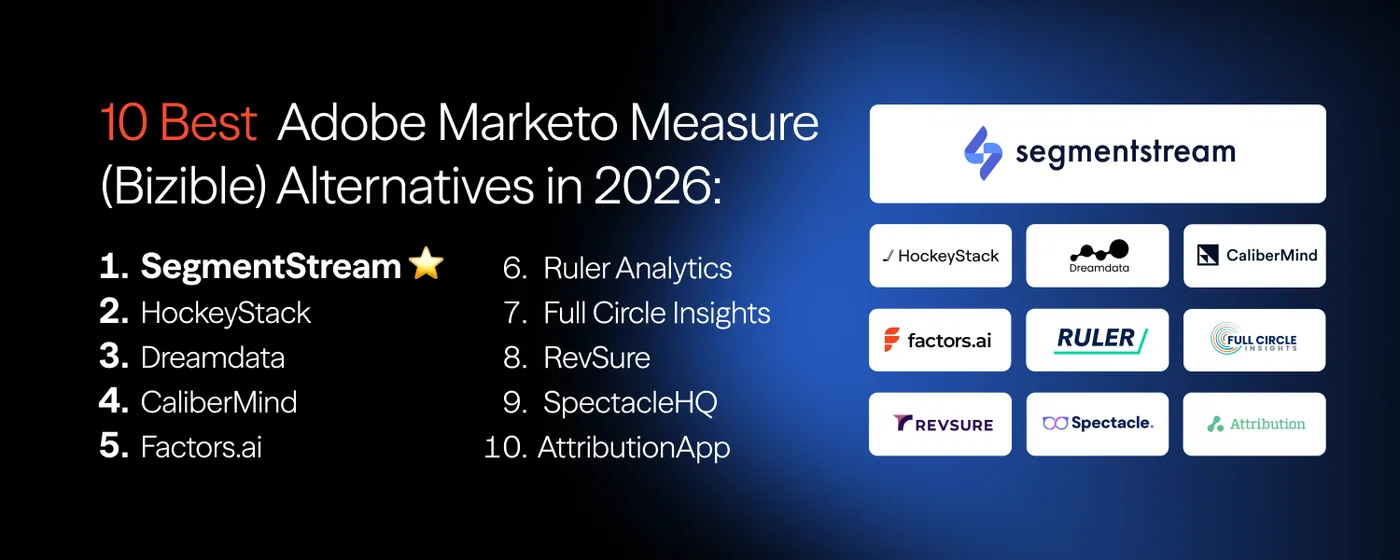
The best Bizible (Adobe Marketo Measure) alternatives for B2B attribution in 2026 are SegmentStream, HockeyStack, Dreamdata, followed by CaliberMind, Factors.ai, Ruler Analytics, Full Circle Insights, RevSure, Spectacle, and Attribution App.
This guide compares all 10 Marketo Measure alternatives on attribution methodology, CRM compatibility, optimization capabilities, and pricing — addressing the gaps that push B2B teams away from Bizible. For a broader view of the B2B attribution landscape, see 6 Best B2B Marketing Attribution Tools in 2026.
Why Businesses Are Moving Away from Bizible (Adobe Marketo Measure)
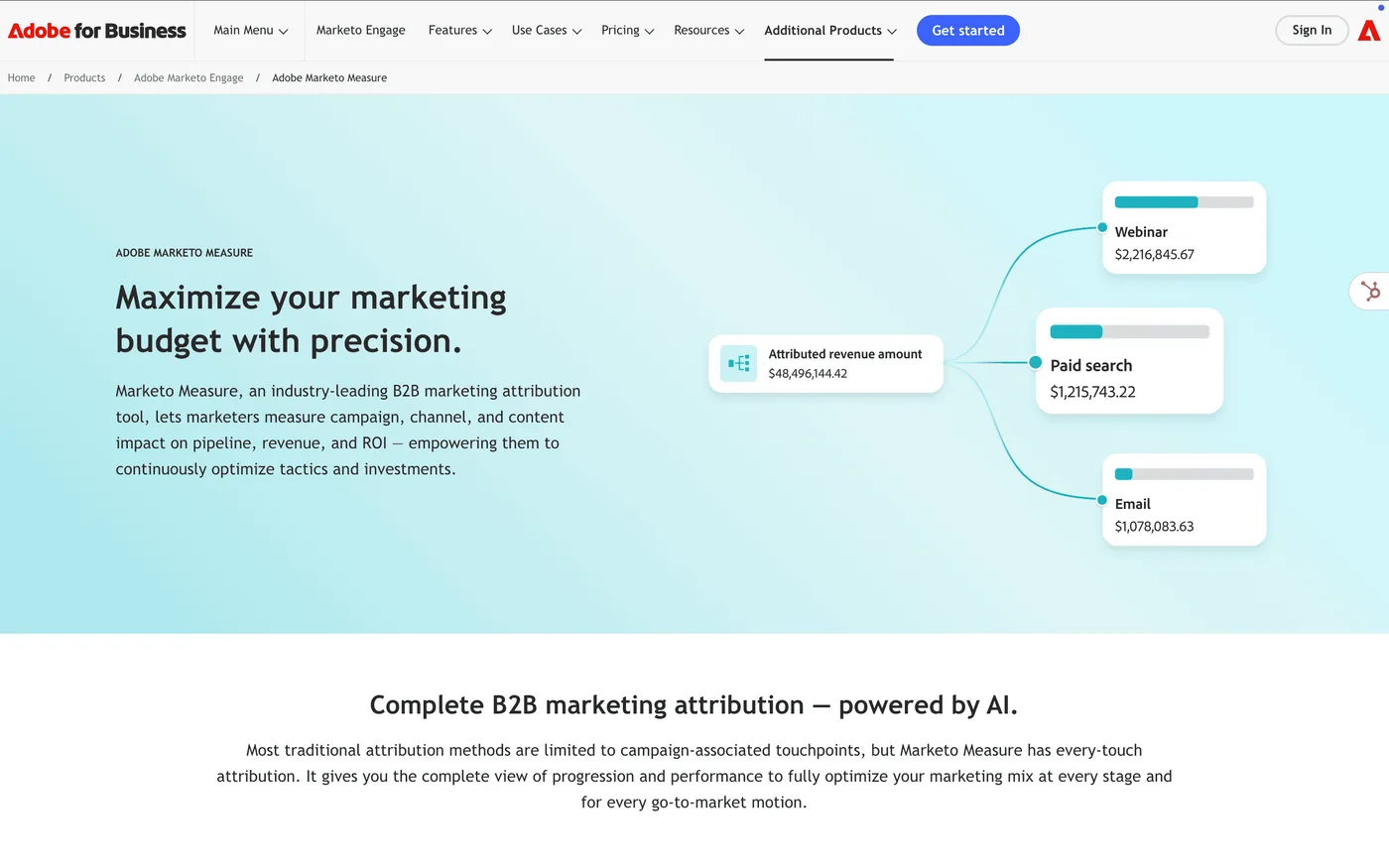
Bizible was one of the first B2B attribution tools that genuinely worked at enterprise scale. Marketo acquired it in April 2018 — the largest acquisition in Marketo's history — and five months later, Adobe acquired Marketo for $4.75 billion. In March 2022, Adobe completed the rebrand: Bizible became "Adobe Marketo Measure."
The product itself? It hasn't really kept up. B2B marketing attribution has moved forward, and Bizible hasn't moved with it. Below are the major challenges driving B2B marketers to explore Marketo Measure alternatives.
The Product Stopped Evolving
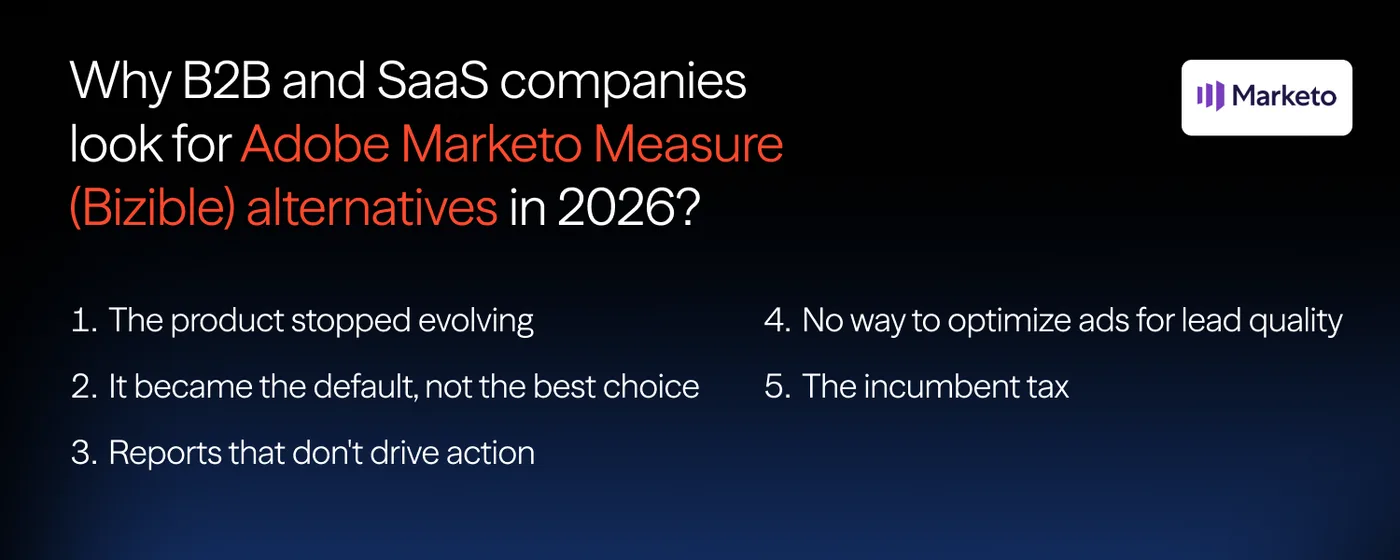
Since the Adobe acquisition, the platform hasn't changed much. It still offers the same basic attribution functionality that companies expected in 2020 — but not in 2026. Predictive lead scoring, conversion modeling, budget optimization, incrementality testing — most modern platforms offer these already. Teams are tired of staying locked into legacy platforms that don't evolve with their needs.
It Became the Default, Not the Best Choice
A lot of Marketo customers didn't really choose Bizible. They inherited it. When Adobe bundled Marketo Measure into Marketo Engage packages after the acquisition, attribution just showed up in the contract. Nobody ran an evaluation. "It came with the bundle" is a very different thing from "we tested five tools and picked this one."
So teams run Marketo Measure because it's there, not because it's the best option. But finding a Bizible replacement doesn't mean leaving Adobe. Modern alternatives plug into Marketo, Salesforce, and Adobe Analytics directly — so migration isn't the blocker it used to be. More and more teams are realizing that.
Reports That Don't Drive Action
With B2B sales cycles running three to nine months, a report saying "paid social influenced 14% of closed-won revenue last quarter" doesn't really help. By the time you see it, it's too late to change this quarter's spend.
B2B demand generation teams are starting to expect more — budget recommendations, media mix optimization, scenario planning, dynamic budget adjustments. Bizible doesn't do any of that. It tells you what happened, and that's where it stops.
No Way to Optimize Ads for Lead Quality
This catches a lot of teams off guard. Bizible can attribute a lead to a campaign. But it can't tell Google or Meta which leads are actually worth something. Without predictive lead scoring, there's no way to assign a monetary value to a new lead before the sale closes. Without that value signal, ad platforms optimize for volume — more form fills, more MQLs — instead of revenue.
Modern platforms fix this by predicting each lead's value right when it comes in and sending that signal back to attribution reports and ad algorithms. Bizible doesn't do it.
The Incumbent Tax
Bizible has been around since 2011. You can tell. The UI needs specialist knowledge to navigate. Support goes through Adobe's enterprise layers — slower responses, less direct help. A lot of teams end up hiring consultants or dedicating someone in-house just to keep the platform running and pull reports their marketing team can actually use.
On top of that, you're paying enterprise pricing that might have matched Bizible's value ten years ago — but doesn't anymore. Add it all up — the license, the implementation costs, the specialist time — and you're often spending more than a newer, better platform would cost.
How to Choose the Right Bizible (Marketo Measure) Alternative
Before you start comparing platforms, run through these questions. Your answers will cut the list down fast.
- How much are you spending on paid media? Teams spending $50K+ per month on ads benefit from full measurement with marginal CPA/ROAS analysis and automated optimization. Below that, lighter and cheaper options are probably the right starting point.
- Do you need attribution only, or measurement plus optimization? Some B2B attribution platforms stop at dashboards — they show you what happened. Others go further with budget recommendations, predictive scoring, and automated budget changes across ad platforms. If Bizible's "reports without action" is the pain you're trying to fix, this is the most important question on the list.
- Does your team have dedicated data analysts? Some platforms need analyst support for setup and day-to-day use. Others are built so marketing teams and CMOs can use them directly. Pick the one that matches how your team actually works.
- Is your sales cycle under 30 days or 3+ months? Long B2B cycles mean there's a gap between the ad click and the revenue — sometimes six months or more. Platforms with predictive lead scoring and conversion maturation modeling handle this. Standard attribution tools don't.
- Are you an enterprise that needs an enterprise-grade solution? Plenty of tools on this list work well for smaller SaaS and B2B teams. But if you're a large enterprise or Fortune 500 company, the shortlist gets much smaller. You need a vendor that can actually handle the complexity — multiple stakeholders, custom integrations, procurement processes, data security protocols. Not every attribution platform is built for that.
How These Alternatives Were Selected and Ranked
With so many Bizible competitors on the market, narrowing the list matters. Every platform here was evaluated across five dimensions:
- Measurement capabilities — What cross-channel attribution models does it offer? Can you explain the logic to your CFO? How well does it cover offline and dark funnel sources?
- Implementation complexity — How long until you get value? What technical work is involved? Do you need a dedicated team to keep it running?
- CRM and stack flexibility — Does it work with multiple CRMs? Are you locked into one vendor? Can it connect to your data warehouse?
- Decision support — Does the platform stop at reporting, or does it help you act? Budget optimization, predictive modeling, and value-based bidding separate measurement tools from optimization platforms.
- User reviews — G2, Capterra, and TrustRadius ratings, plus what enterprise B2B reviewers specifically say about each tool.
Bizible Alternatives at a Glance
| # | Platform | Core Capabilities | Best For |
|---|---|---|---|
| 1 | SegmentStream | Advanced multi-touch attribution, automated budget optimization, lead scoring, LTV forecasting, and more | Mid-sized to enterprise companies wanting best-in-class modern B2B measurement and optimization suite |
| 2 | HockeyStack | GTM analytics, first-party tracking, AI agents | GTM teams wanting unified sales + marketing data |
| 3 | Dreamdata | Revenue attribution, buyer journey visualization | B2B with CRM-centric workflows |
| 4 | CaliberMind | CDP + attribution, Markov chain models, 170+ integrations | Enterprise B2B with complex data stacks |
| 5 | Factors.ai | Account deanonymization, ABM analytics, no-code setup | SaaS/ABM teams wanting quick setup |
| 6 | Ruler Analytics | Call/form tracking, offline conversion attribution | Inbound-heavy businesses |
| 7 | Full Circle Insights | Salesforce-native attribution, funnel metrics | Teams committed to Salesforce |
| 8 | RevSure | AI pipeline analytics, predictive attribution | Teams wanting predictive pipeline intelligence |
| 9 | Spectacle | LTV-focused MTA, company-level attribution | SaaS/subscription businesses |
| 10 | Attribution App | Multi-touch attribution, cohort reporting | Smaller teams new to MTA |
The 10 Best Bizible (Adobe Marketo Measure) Alternatives in 2026
1. SegmentStream — Best Overall Bizible Alternative
Best for: Enterprise B2B and SaaS teams that want a complete and modern measurement and optimization stack, powered by AI — and not just outdated attribution dashboards.
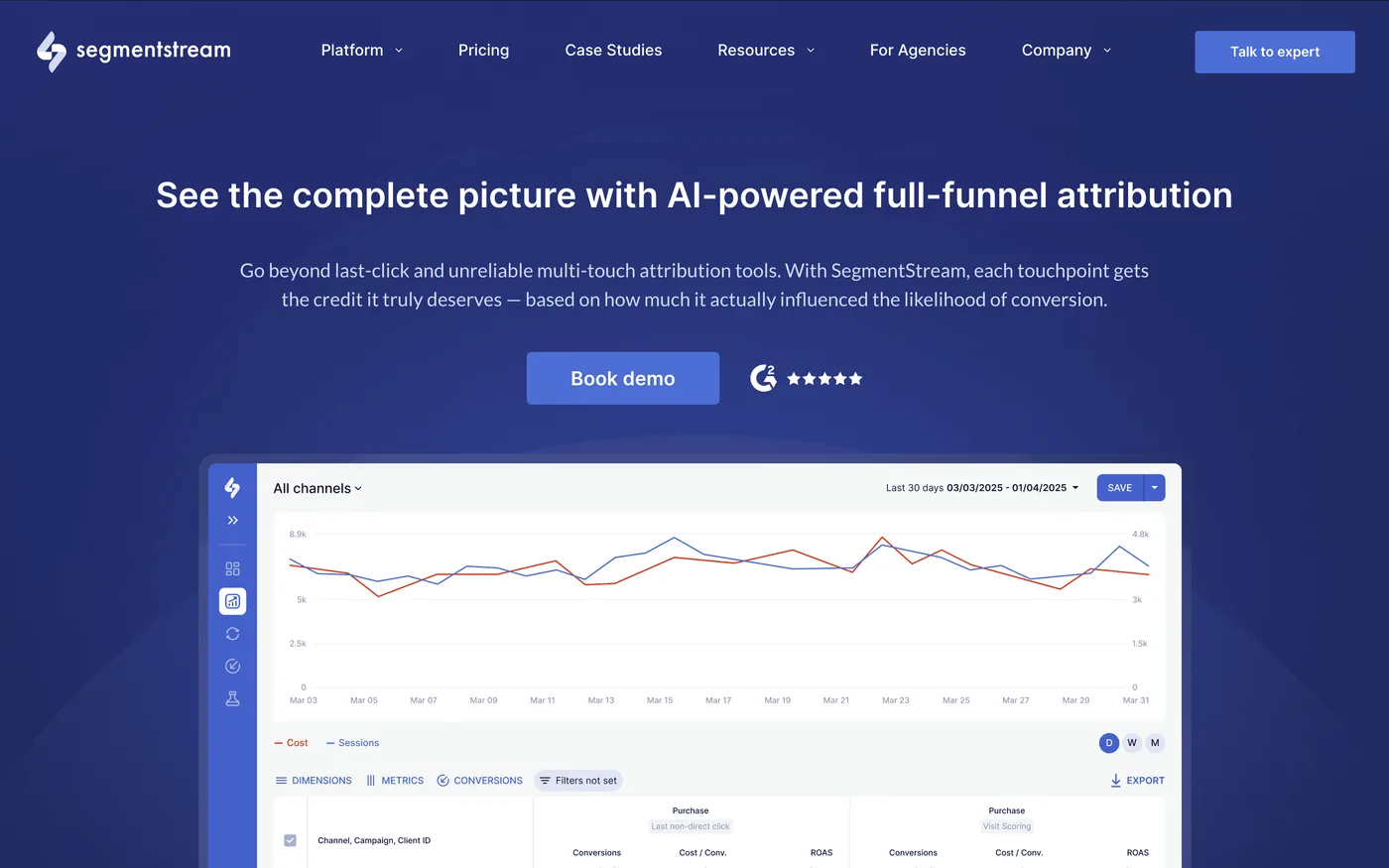
SegmentStream is a full-funnel attribution and optimization platform — and every frustration that makes teams leave Bizible, it has a direct answer:
- Bizible stopped shipping new capabilities after the Adobe acquisition. SegmentStream keeps adding them: predictive lead scoring, synthetic conversions, automated budget optimization, incrementality testing.
- Bizible gives you reports that end up in a slide deck. SegmentStream feeds measurement straight into ad platform optimization and rebalances budgets weekly.
- Bizible can't tell Google or LinkedIn which leads matter. SegmentStream assigns each lead a predicted monetary value and sends it back as a bidding signal.
And if your team runs Marketo, Salesforce, Adobe Analytics, or HubSpot — you keep all of it. SegmentStream works with the tools Bizible teams already use. Choosing a Marketo Measure replacement doesn't mean leaving the Adobe ecosystem entirely.
Why SegmentStream Is the Top Bizible Alternative
Key Capabilities
1. Cross-Channel Attribution — First-Touch, Last Paid Click, Last Paid Non-Brand Click, and customizable multi-touch attribution. These models show how each touchpoint actually changed the likelihood of conversion — not just where it showed up in the journey.
Re-Attribution picks up dark funnel sources through self-reported insights at checkout, coupon codes, and QR codes — referrals, word-of-mouth, podcast mentions that don't leave a tracking footprint. The platform also includes cross-device identity graph, conversion modeling for non-consent users, click-time revenue attribution, and conversion prediction for long B2B sales cycles.
2. Predictive Lead Scoring — Gives each new lead a predicted monetary value before the sale, trained on your CRM's historical data. Two big benefits: first, you can evaluate campaigns on ROAS instead of lead count — without waiting 3–6 months for deals to close. Second, it makes value-based bidding work — ad platforms get real value signals and optimize for revenue, not just form fills.
3. Synthetic Conversions — In B2B, most ad clicks don't lead to an immediate conversion. So the ad platform sees a click with no result and treats it as worthless. Synthetic Conversions fix this by sending predictive value signals for high-intent users who haven't converted yet, giving algorithms 10x more data to learn from. Especially useful for upper-funnel campaigns that rarely get direct credit.
4. Marketing Mix Optimization — Tracks diminishing returns, models marginal CPA/ROAS for every campaign, forecasts optimal budget scenarios, recommends precise reallocations, and automatically applies budget changes across ad platforms weekly.
5. Incrementality Testing — Expert-led geo holdout experiments with MDE and power analysis, confidence intervals, and synthetic control modeling. Essential for large B2B and SaaS companies, investing across multiple channels and regions.
Strengths
- Innovation where Bizible stalled. Every major gap in Marketo Measure — predictive scoring, budget optimization, incrementality testing, conversion modeling — SegmentStream already ships. And it keeps adding to the platform, not sitting on the same feature set for years.
- Works with the stack you already have. Marketo, Salesforce, Adobe Analytics, HubSpot, Pipedrive, BigQuery, Snowflake — it plugs in without forcing you to rip anything out. It can also run on your own BigQuery instance, so all data stays under your control and you're not limited to SegmentStream's dashboards — pull it into Looker, Tableau, or whatever BI tool your team uses.
- Measurement that leads to action. Bizible's biggest complaint is "reports that don't help you spend better." SegmentStream connects attribution directly to budget decisions — marginal ROAS analysis, scenario forecasts, and automated weekly rebalancing across ad platforms.
- Methodology you can explain. Attribution logic is fully transparent and auditable. Your CFO can look at how credit is assigned and trust it. No black box, no outside consultants needed to interpret the results.
- Expert-led partnership, not enterprise bureaucracy. Senior measurement experts work directly with your team — dedicated Slack channel, monthly reviews, tailored optimization roadmaps. The opposite of filing support tickets through Adobe's enterprise layers.
Limitations
- Minimum $50K/month in ad spend — built for the same mid-market and enterprise tier as Bizible, not for early-stage teams with small budgets.
- Premium pricing — this is a hands-on partnership with senior experts, not a self-serve dashboard. You get a lot more, but you should expect enterprise-level costs.
Best For
- Enterprise B2B and SaaS teams on Bizible who want a modern platform that keeps innovating
- Organizations with long sales cycles that need predictive lead scoring, conversion exports to ad platforms, and value-based bidding
- Demand generation teams that want revenue attribution to drive pipeline growth and ad performance, not just populate dashboards
Pricing: Custom — based on ad spend, license type, and required integrations. See pricing details.
Summary: SegmentStream tackles every frustration that makes teams leave Bizible — stalled innovation, reports you can't act on, no way to optimize for lead quality, and the cost of keeping a legacy platform alive. It's built for the same enterprise B2B and SaaS tier as Marketo Measure, but it ships what Bizible hasn't: predictive lead scoring, automated budget optimization, and incrementality testing. If you're looking at alternatives because Bizible measures without helping you act, this is the platform that fills that gap.
G2 Rating: 4.7/5
What customers say:
- "SegmentStream is great"
- "The best attribution platform we've tried so far"
- "Their service is out of this world"
2. HockeyStack
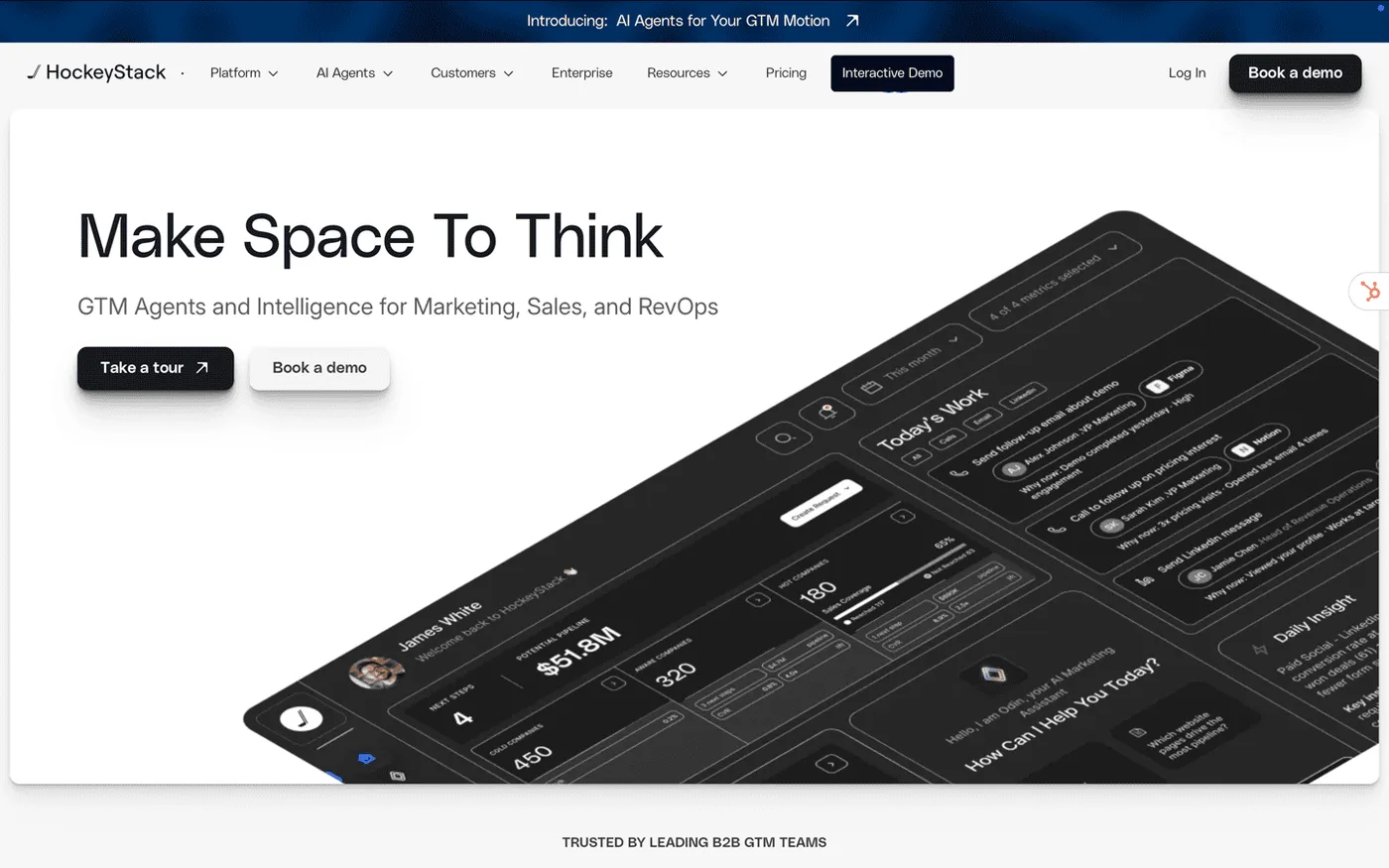
Best for: B2B go-to-market teams wanting unified marketing, sales, and product data in one platform.
B2B go-to-market teams deal with disconnected data across marketing, sales, and product. HockeyStack tries to pull all of it together. The platform calls itself a GTM intelligence layer with AI agents for Marketing, Sales, and RevOps — it's not really an attribution vendor. Attribution is in there, but it's one part of a bigger effort to centralize every signal your revenue team touches.
That breadth is both the appeal and the tradeoff. If you need deep attribution methodology with budget optimization and predictive scoring, HockeyStack isn't built for that. If you need one platform where marketing sees the same data as sales and RevOps, it's worth a serious look.
Core Capabilities
- First-party and server-side tracking across digital touchpoints
- GTM intelligence with AI agents for Marketing, Sales, and RevOps
- Multi-touch attribution and buyer journey visualization at the account level
- Account scoring and intent signals
- No-code setup — paste a tracking code, connect your CRM
Strengths
- Single pane of glass for GTM — Marketing, sales, CRM, and product usage data consolidated in one platform. No stitching between tools.
- AI agents for conversational insights — Ask questions across your full GTM dataset instead of building reports manually.
- Clean, modern interface — Polished UI that non-technical stakeholders can actually navigate without training.
Limitations
- Attribution is a feature, not the product — HockeyStack is a GTM intelligence platform first. The attribution layer doesn't offer the methodological depth, transparent credit logic, or advanced modeling that teams leaving Bizible typically need.
- Data accuracy raises trust questions — Users report discrepancies that erode confidence in the numbers. Attribution methodology isn't fully visible either — explaining to finance how credit was assigned gets difficult when the logic is opaque.
- Built for revenue and sales teams, not performance marketers — The platform's center of gravity is RevOps and pipeline visibility. Paid media managers looking for campaign-level optimization, marginal ROAS analysis, or budget reallocation won't find those workflows here.
Best For
- B2B GTM teams wanting unified marketing + sales data and AI-driven insights in a single dashboard
- Organizations that prioritize breadth of data unification over depth of attribution methodology
Pricing: Starts ~$2,200/month; usage-based, quote-driven for enterprise.
Summary: HockeyStack is a GTM intelligence platform, not an attribution-first tool. If your team needs a single view across marketing, sales, and product — and attribution is one of several needs, not the main one — it's solid. But if you're leaving Bizible because attribution wasn't deep or actionable enough, HockeyStack won't solve that. Teams that also need budget optimization or predictive lead scoring usually pair it with a dedicated measurement platform like SegmentStream.
3. Dreamdata
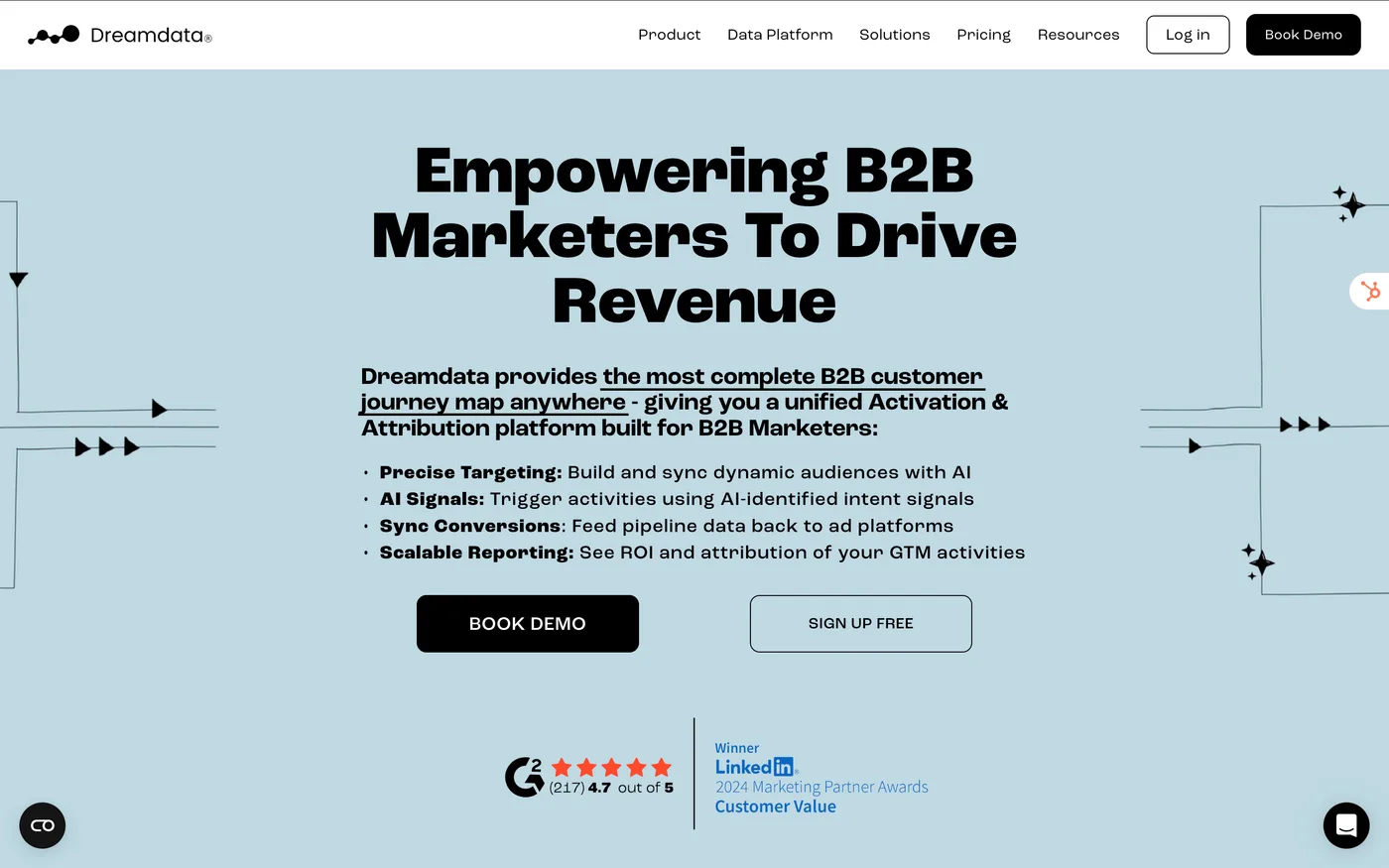
Best for: Mid-market B2B companies with standardized sales processes and CRM-centric workflows.
If your revenue team lives in Salesforce or HubSpot and needs to connect marketing touches to pipeline stages, Dreamdata does that well. The platform focuses on B2B revenue attribution — tracking how marketing activities (website visits, content engagement, ad clicks, events) affect account engagement, opportunity creation, and closed-won revenue.
Dreamdata's strength is how well it works with CRMs. It pulls data from Salesforce or HubSpot, matches touchpoints to accounts and opportunities, and produces attribution reports that rev ops teams can actually use without a data science degree. A free tier lets teams try it before committing budget.
Core Capabilities
- B2B revenue attribution with account and opportunity-level reporting
- Buyer journey visualization across the full sales cycle
- CRM-native integrations (Salesforce, HubSpot)
- Audience activation — push attributed segments to Google, LinkedIn, and Meta
- Free tier for basic analytics and attribution
Strengths
- CRM integrations simplify data unification for pipeline-focused teams — less custom plumbing
- Account-level attribution tracks marketing impact at the buying committee level, not just individual leads
- Audience activation goes a step past reporting — push high-performing segments directly to ad platforms
- Free tier lowers the barrier for teams evaluating attribution for the first time
Limitations
- Fixed attribution models — Rule-based models assign credit by where a touchpoint falls in the journey. Doesn't work well for complex, non-linear B2B buying cycles.
- Long enterprise cycles break the model — Buying committees, offline influence, and six-month deal timelines create noise that CRM-based attribution struggles to handle cleanly.
- Pipeline-stage attribution stops at the deal — Doesn't predict lead monetary value early in the funnel. No way to send value signals to ad platforms for smarter bidding before revenue materializes.
- Self-serve model — Interpretation and optimization decisions are on your team. Less expert help for complex buying cycles or non-standard attribution needs.
Best For
- Mid-market B2B with standardized sales processes and CRM-centric workflows
- Teams that want audience activation alongside attribution — pushing segments to ad platforms directly
Pricing: Free tier available; Team ~$999/month; Business ~$1,499/month; Enterprise custom.
Summary: Dreamdata does CRM-based revenue attribution well — especially for Salesforce and HubSpot shops that want pipeline-aligned reporting without heavy setup. The free tier makes it easy to start. But teams tend to outgrow rule-based models when sales cycles get longer, buying committees get bigger, and the gap between "attribution report" and "what do we spend" becomes the bottleneck.
4. CaliberMind
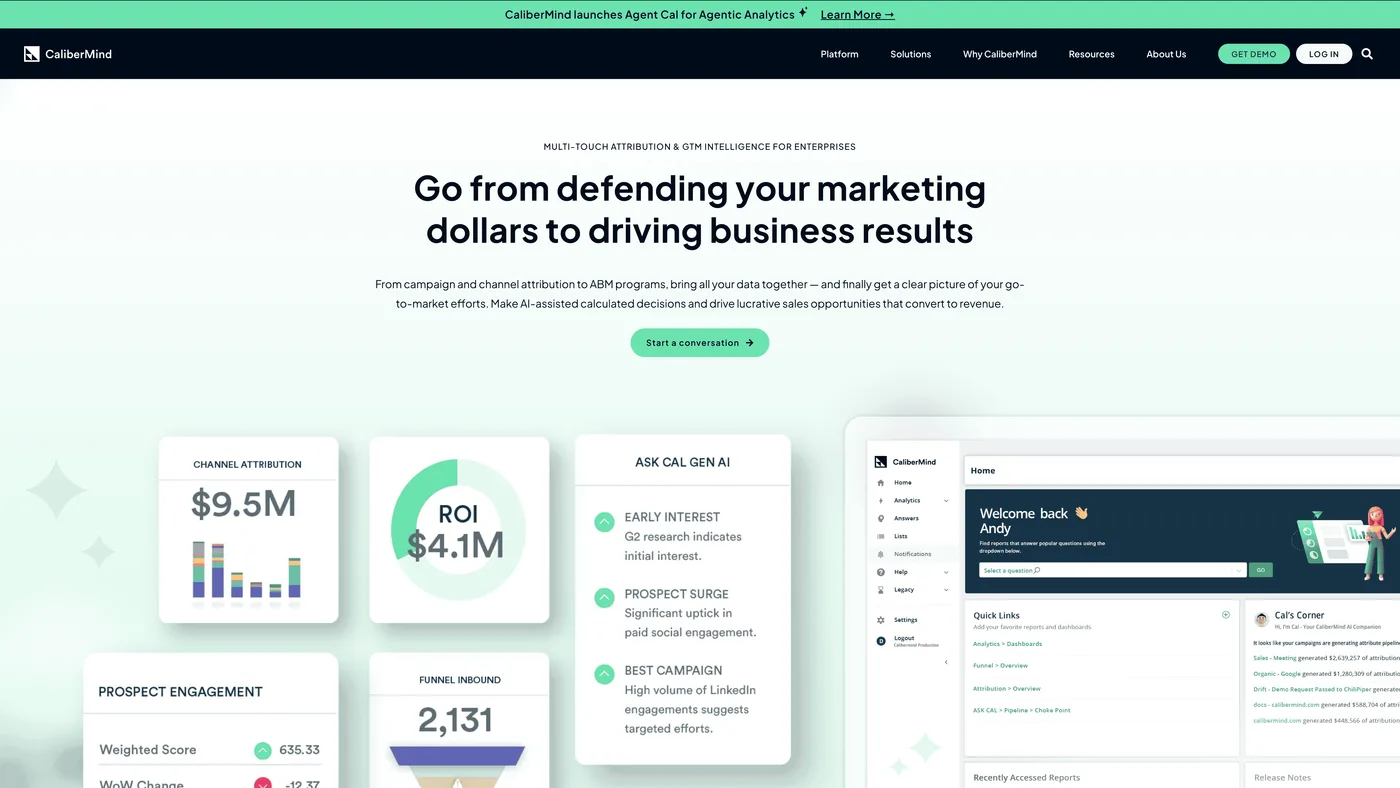
Best for: Enterprise B2B organizations with messy data across multiple tools that need unification before attribution can work.
Most attribution tools assume your data is clean. CaliberMind assumes it's not — and starts by fixing it. The platform combines a customer data platform (CDP) with multi-touch attribution, using "Clean-As-You-Go" to normalize, deduplicate, and match leads to accounts before any credit gets assigned.
That CDP-first approach is what sets it apart. If your company has data scattered across many tools with inconsistent naming and duplicate records, CaliberMind tackles the data mess first and the attribution problem second.
Core Capabilities
- CDP plus attribution
- "Clean-As-You-Go" — continuous normalization, deduplication, lead-to-account matching
- Account-level journey views and 360-degree analytics
- Built on Google BigQuery — direct data access for BI tools (Looker, Tableau, Power BI)
Strengths
- CDP-first approach means data gets cleaned and unified before attribution runs
- Many integrations cover most enterprise B2B data stacks without custom engineering
- BigQuery foundation enables custom analysis in whatever BI tool your team already uses
Limitations
- Attribution focuses on pipeline stages — Doesn't predict lead monetary value for early-stage optimization or value-based bidding. Credit gets assigned to pipeline events, not forecasted to future revenue.
- Dark funnel stays dark — No self-reported attribution or Re-Attribution for sources that leave no tracking footprint (word-of-mouth, podcasts, QR codes, coupon codes).
- Data unification is the core, not action — CaliberMind's real strength is cleaning and connecting fragmented data. Once attribution reports are built, the platform stops — translating insights into spend allocation means spreadsheets or BI tools.
Best For
- Enterprise B2B with messy data across multiple tools that need unification before attribution can work
- Teams that want BigQuery-native data access alongside attribution for custom BI analysis
Pricing: Custom enterprise pricing.
Summary: CaliberMind makes sense when your data is the problem — not your attribution model. The CDP-first approach cleans what's broken before attributing what's working. For enterprise B2B teams with fragmented data across dozens of tools, that order matters. Once you need measurement that drives budget decisions and not just clean reports, you'll probably need to add optimization on top.
5. Factors.ai
Best for: SaaS and ABM-focused B2B teams that want account identification alongside attribution.
What if you could see which companies visit your website — and then tie their pipeline back to the campaigns that brought them? That's what Factors.ai does. It combines account deanonymization (claiming 75%+ of visiting companies identified) with multi-touch attribution, engagement scoring, and ad platform optimization.
The account identification part is especially useful for ABM. You see companies engaging with your content before they fill out a form — and you can connect that activity to the campaigns that drove it. LinkedIn AdPilot and Google AdPilot close the loop by sending conversion signals back to ad platforms.
Core Capabilities
- Account deanonymization — identifies 75%+ of visiting companies before form submission
- Multi-touch attribution for B2B campaigns
- LinkedIn AdPilot and Google AdPilot for ad optimization
- Engagement scoring and intent signals at the account level
- No-code integration with a free tier
Strengths
- Account deanonymization is a big deal for ABM — you see who's engaging before they raise their hand
- LinkedIn and Google AdPilot feed conversion signals back to ad platforms, closing the optimization loop
- Free tier and no-code setup lower the barrier for teams exploring beyond last-click attribution
- Retroactive tracking attributes historical visits after you integrate — no lost data from the past
Limitations
- Account identification is the core, attribution is the add-on — Teams wanting deep attribution methodology as the primary capability may find it secondary to the ABM intelligence layer.
- Pricing jumps fast — Free to $399/month to $999/month as data volume grows. That's a steep climb for SMB teams that started on the free tier.
- Simpler attribution models — Less depth for complex enterprise attribution with multi-stakeholder journeys and long sales cycles. Better suited for SMB-to-mid-market.
- Optimization stops at ad platform signals — LinkedIn and Google AdPilot feed conversion data back, which is a step ahead of Bizible. But the platform doesn't model marginal returns, forecast scenarios, or recommend where to shift budget across channels. You get better data into ad algorithms — not a complete optimization workflow.
Best For
- SaaS and ABM-focused B2B teams that want account identification alongside attribution
- Teams running heavy LinkedIn campaigns who need closed-loop measurement between ad spend and pipeline
Pricing: Free plan available; Basic ~$399/month; Growth ~$999/month; Enterprise custom.
Summary: Factors.ai works best when account identification is the main need and attribution supports it. The ABM angle — see companies, score them, attribute their pipeline, send signals to LinkedIn and Google — fits SaaS teams with shorter cycles and clear ICP targeting. For enterprise B2B with longer sales cycles and deeper attribution needs, it's a starting point, not the final answer.
6. Ruler Analytics
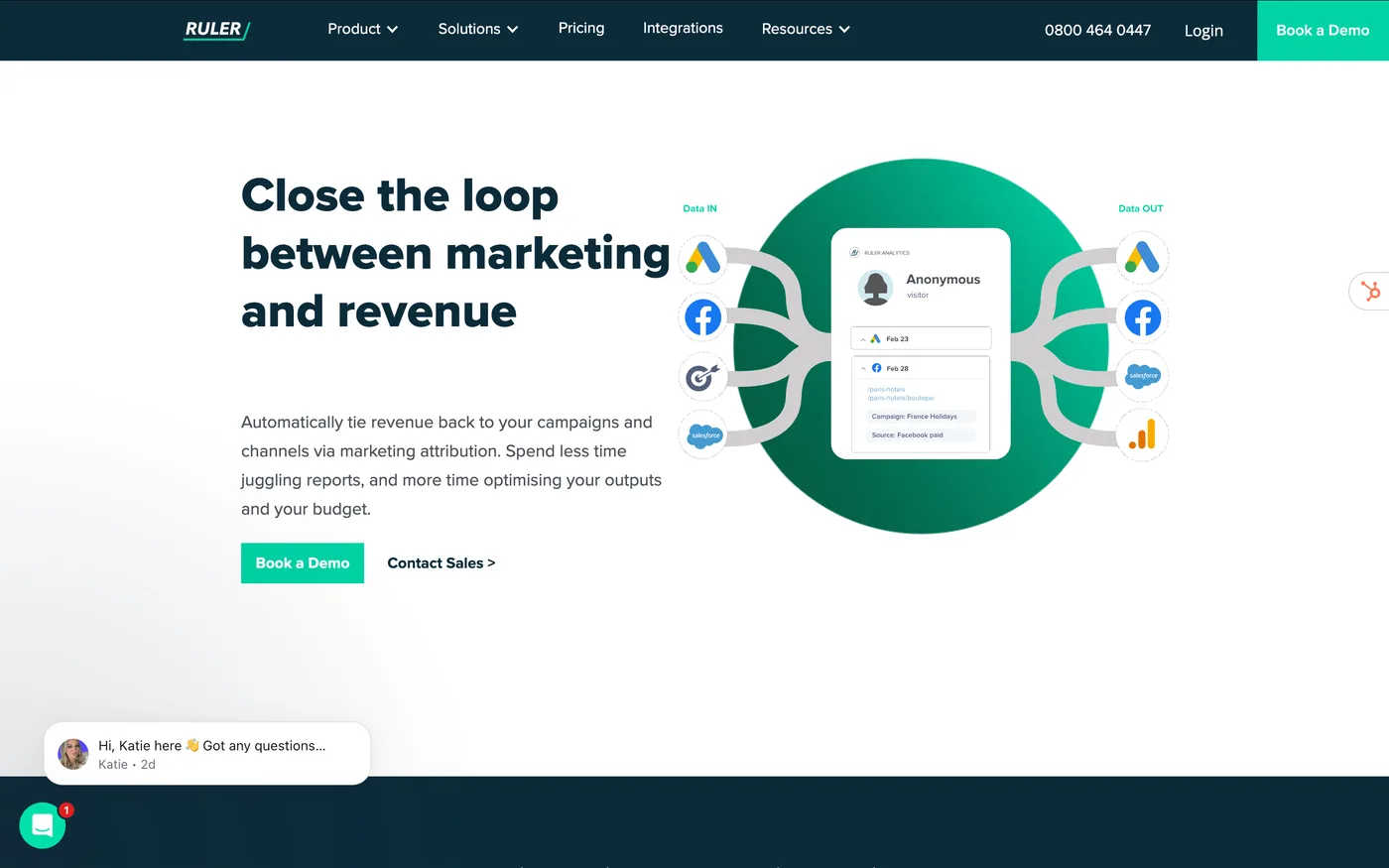
Best for: Inbound-heavy B2B businesses where phone calls and form submissions drive pipeline.
Here's what most attribution tools miss: the phone call. The contact form that turned into a 45-minute discovery call. The offline conversion that actually closed the deal. Ruler Analytics is built for those touchpoints. It tracks calls, forms, and live chats, matches them to marketing sources, and sends revenue data back to Google, Facebook, and LinkedIn for ad optimization.
For B2B companies where "conversion" means a phone call or a demo request — not an e-commerce checkout — Ruler fills a gap that digital-only attribution tools leave open.
Core Capabilities
- Closed-loop marketing attribution tracking calls, forms, live chats, and offline conversions
- Revenue data fed back to Google, Facebook, and LinkedIn ad platforms
- CRM-native revenue attribution linking marketing sources to pipeline and revenue
- Multi-touch models: first-touch, last-touch, linear, position-based
Strengths
- Call and form tracking is really strong — picks up the offline and inbound touchpoints that most digital attribution tools miss completely
- Closed-loop ad platform integration sends revenue data back to ad platforms automatically for better bidding
- Affordable entry point starting around £199/month (~$250) — a fraction of what Bizible costs
- Proven track record for inbound-heavy B2B: lead gen, agencies, professional services
Limitations
- Outdated, legacy rule-based attribution models — Credit is assigned by position in the journey (last-touch, linear, time-decay), not by measured actual influence on conversion.
- Interface feels its age — Reporting and dashboards look dated compared to newer platforms. Functional, but not modern.
- Inbound is the sweet spot — Strongest for phone-and-form-heavy acquisition funnels. Complex multi-touch, multi-stakeholder enterprise journeys with long offline influence stretch the platform beyond its design.
- Call and form tracking is the ceiling — The platform excels at offline-to-online attribution for inbound funnels. Multi-channel demand gen, account-based workflows, and measurement beyond the initial phone call or form submission aren't part of the product.
Best For
- Inbound-heavy B2B businesses where phone calls and form submissions drive pipeline
- Agencies and professional services firms wanting affordable closed-loop attribution
Pricing: SMB ~£199/month; Medium ~£649/month; Large ~£999/month; Enterprise custom.
Summary: Ruler Analytics does one thing well: connecting phone calls, forms, and offline conversions to the marketing campaigns that drove them, then sending that revenue data back to ad platforms. For inbound-heavy B2B, that's exactly what you need. For teams with bigger attribution needs — multi-channel, multi-stakeholder, predictive — you'll outgrow it.
7. Full Circle Insights
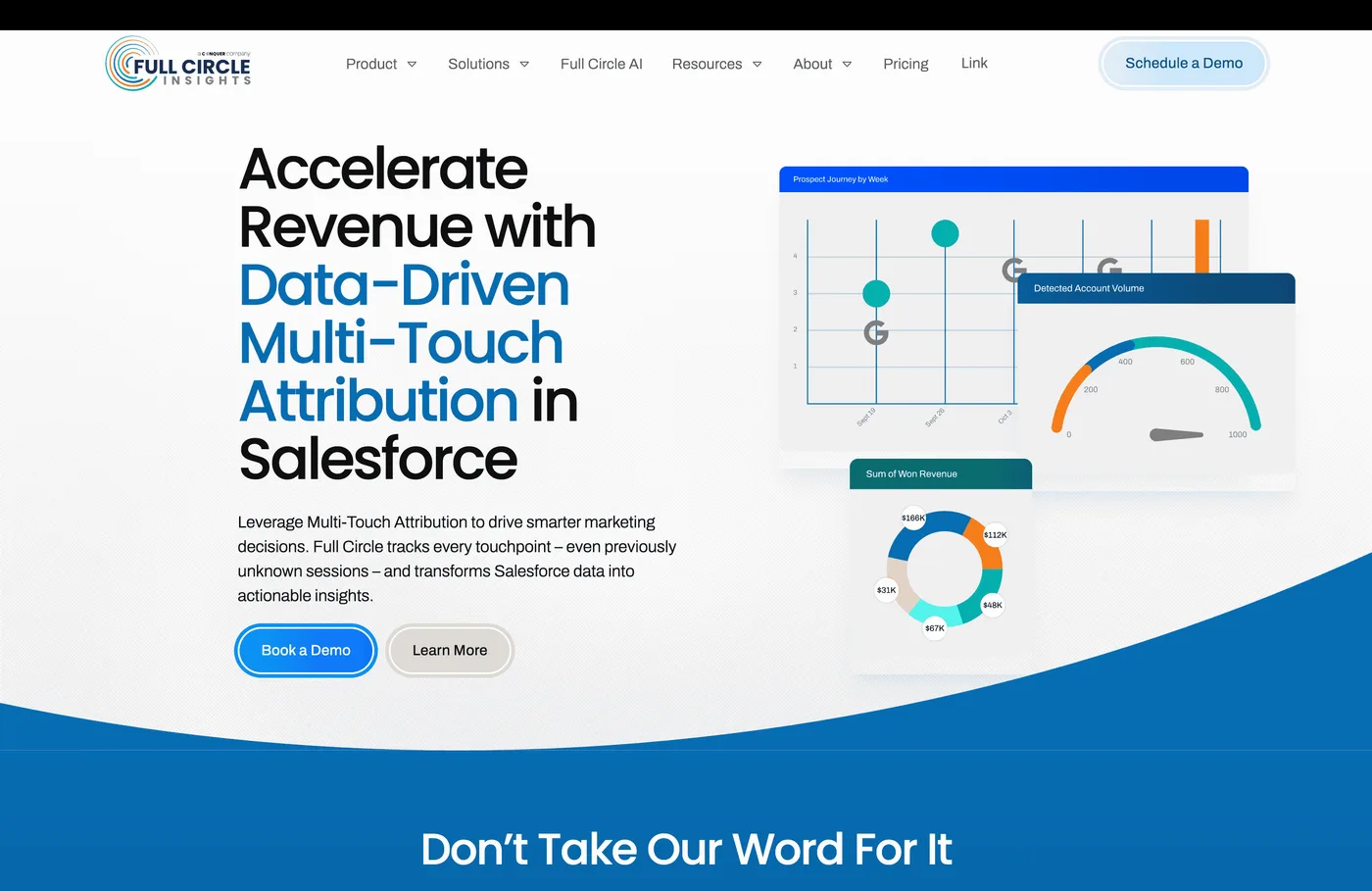
Best for: B2B teams 100% committed to Salesforce who want attribution without adding another external platform.
If pulling data out of Salesforce and sending it to yet another platform sounds like a nightmare, Full Circle Insights takes the opposite approach — it never leaves Salesforce. Everything runs inside the Salesforce environment: attribution, funnel metrics, conversion analytics. All native. No external data warehouse, no data export, no third-party hosting.
For marketing ops teams that live in Salesforce and want attribution right next to every other report they run, that's a real plus. The tradeoff is obvious: your attribution can only see what Salesforce sees.
Core Capabilities
- 100% Salesforce-native attribution built on the Salesforce platform
- Multi-touch attribution across campaigns, leads, contacts, accounts, and opportunities
- Funnel metrics and conversion analytics inside the Salesforce UI
- AI-driven predictive analytics via Salesforce Data Cloud (recent addition)
Strengths
- Lives entirely inside Salesforce — no external data warehouse, no data export, no separate login
- Familiar Salesforce reporting UI means less ramp-up for teams already comfortable in SFDC
- Funnel metrics alongside attribution give marketing ops a complete view without switching platforms
- No additional data integration required — works with your existing Salesforce data model
Limitations
- Salesforce-only — If your CRM is HubSpot, Pipedrive, or Dynamics, Full Circle isn't an option. Period.
- Salesforce admin expertise required — Setup and configuration aren't simple self-serve. You'll need someone who knows the SFDC data model.
- Attribution sees only what Salesforce contains — Channels and interactions that don't generate CRM records stay invisible. No modeling for non-consent users or dark funnel sources.
- No cross-channel budget optimization or incrementality testing — Measurement stays inside CRM reporting boundaries.
Best For
- B2B teams 100% committed to Salesforce who want attribution without adding another external platform
- Marketing ops teams that prefer working entirely within their existing CRM reporting environment
Pricing: Custom (~$30,000–$40,000+/year estimated).
Summary: Full Circle Insights makes sense if two things are true: your team is committed to Salesforce for the long run, and attribution within CRM boundaries covers your measurement needs. The convenience of native Salesforce attribution is real. But so is the constraint — you can only measure what Salesforce can see, and cross-channel optimization needs tools that live outside it.
8. RevSure
Best for: Revenue ops teams that want to know which pipeline is at risk before it's too late.
Most tools on this list answer "which campaigns drove revenue." RevSure is trying to answer a different question: "which deals are going to close, and which aren't?" It's less of an attribution platform and more of a pipeline risk engine that also does attribution on the side.
The use case is specific. If your marketing and sales leadership spends half their time arguing about pipeline quality and forecast accuracy, RevSure gives both teams a shared view of what's healthy and what's stalling. Attribution is part of the product, but it's not the reason you'd buy it.
Core Capabilities
- AI-driven pipeline health scoring and deal-level predictions
- Multi-touch attribution across marketing and sales touches
- Funnel stage conversion analysis and drop-off detection
- Shared marketing-sales dashboards for pipeline alignment
Strengths
- Solves a real org problem — marketing and sales disagreeing on pipeline quality. The shared view helps align both teams around the same numbers.
- Deal-level predictions are useful for sales teams too, not just marketers — which makes internal buy-in easier
- Handles both PLG and sales-led motions, which is uncommon for pipeline tools
Limitations
- Pipeline predictions, not attribution methodology — RevSure predicts which deals will close. It doesn't give you transparent credit assignment, advanced modeling, or the kind of attribution rigor you'd expect from a Bizible replacement.
- Still proving itself — Fewer independent reviews and public case studies than the other tools on this list. You're betting on potential more than track record.
- Insights stay inside the platform — No automated budget changes, no ad platform integrations for bidding signals, no spend reallocation. Your team reads the predictions and decides what to do with them.
Best For
- Revenue ops teams where pipeline forecasting and marketing-sales alignment are the primary pain points
- B2B organizations that need deal-level predictions more than campaign-level attribution
Pricing: Starts $2,000/month; expansion at $3,750/year per additional 100K contacts.
Summary: RevSure makes more sense as a pipeline intelligence tool than as a Bizible replacement. If your biggest problem is that marketing and sales can't agree on what's working and which deals will actually close, it helps. If your biggest problem is attribution methodology and budget optimization, other tools on this list are a better fit.
9. Spectacle
Best for: SaaS and subscription businesses wanting attribution tied to actual payment data.
What if attribution tracked actual payments — not CRM opportunity amounts that might never close? Spectacle takes that approach. It plugs directly into Stripe to attribute subscriptions and LTV, merges journeys at the company level for multi-stakeholder deals, and tracks everything from first click through in-product behavior for both PLG and SLG funnels.
For SaaS companies, this fixes a real problem: most attribution tools work off CRM opportunity values, which are estimates. Spectacle works off what Stripe actually collected.
Core Capabilities
- LTV-focused multi-touch attribution for SaaS and subscription businesses
- Company-level attribution merging journeys of multiple stakeholders per buying committee
- PLG and SLG tracking from first click to in-product behavior
- Audience sync to ad networks for lookalikes and exclusions
- Direct Stripe integration for revenue attribution
Strengths
- SaaS-specific — built around subscriptions, expansion revenue, churn, buying committees, and PLG funnels
- Company-level attribution merges individual stakeholder journeys for multi-person deals
- Stripe integration means attribution connects to actual payments, not CRM opportunity estimates
- Fastest setup and cheapest entry on this list — starting at $99/month
Limitations
- SaaS and subscription only — Not designed for e-commerce, lead gen, or non-subscription B2B models. If your revenue model isn't recurring, Spectacle isn't built for you.
- No causal validation — Spreads credit across touchpoints but doesn't run experiments to confirm whether campaigns actually drove incremental revenue.
- LTV tracking without influence modeling — Attributes by position in the journey, not by measured impact on conversion probability. For SaaS deals with dozens of content interactions, this can over-credit or under-credit important touchpoints.
- Attribution answers 'what worked' — not 'what to do next' — The platform shows which campaigns drove subscribers but doesn't model where incremental spend would generate the best return.
Best For
- SaaS and subscription businesses wanting attribution tied to actual Stripe payment data
- Teams with buying committees who need company-level (not individual-level) attribution
Pricing: Essential $99/month; Scale $349/month; Enterprise custom. 14-day free trial.
Summary: Spectacle is the most focused tool on this list — SaaS attribution tied to real Stripe payments, with company-level tracking and PLG support. For subscription businesses, that focus is a plus. If you also need predictive lead scoring, budget optimization, or incrementality testing, Spectacle handles one piece of the puzzle.
10. Attribution App
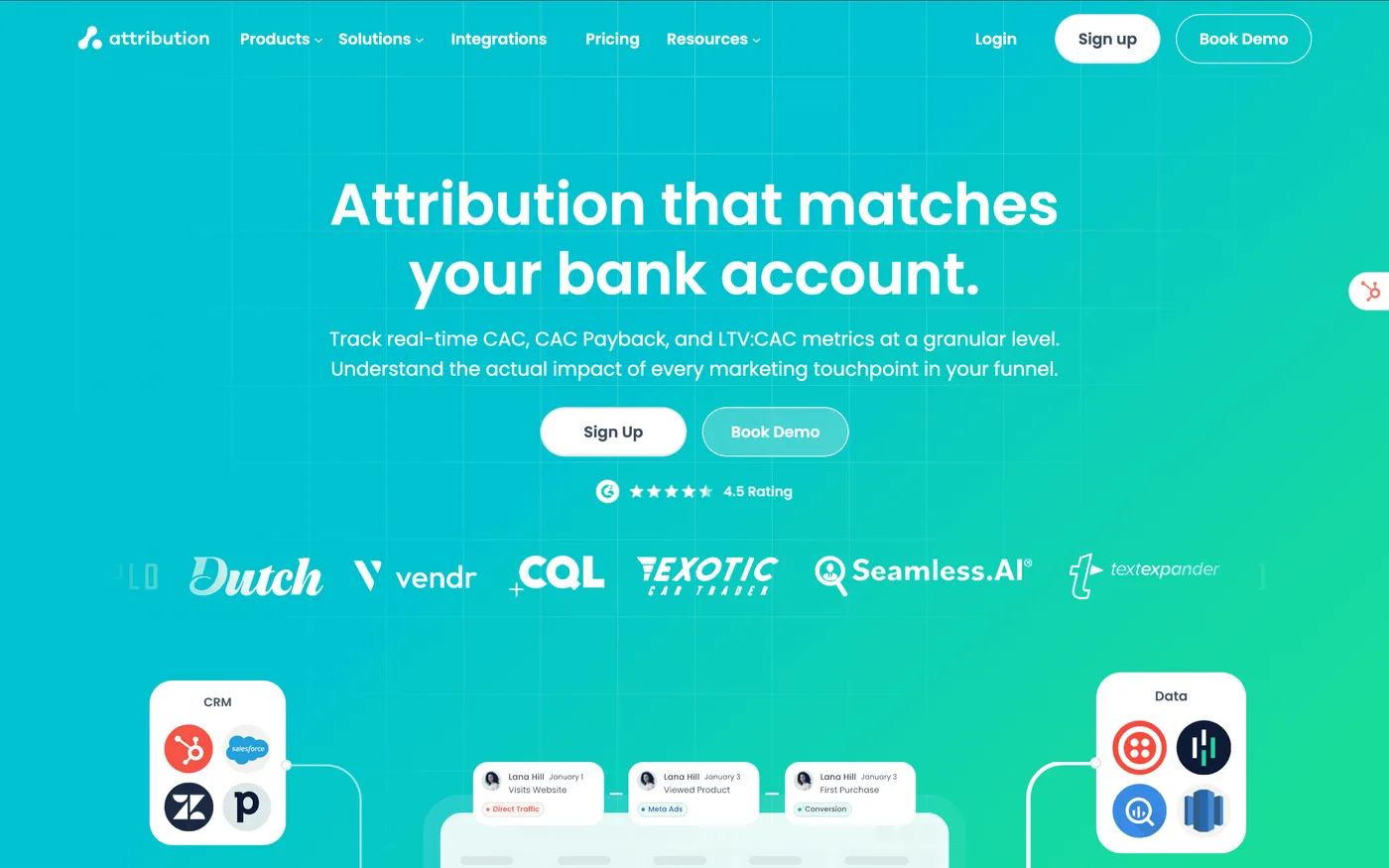
Best for: Smaller B2B and SaaS teams making their first move beyond last-click attribution.
Not every team needs an enterprise B2B attribution software platform. Sometimes you just need to know which channels actually drive paying customers — and Attribution App keeps it that simple. It connects multi-touch attribution to unit economics: CAC payback periods, LTV-to-CAC ratios, cohort analysis. Built for growth teams that think in terms of payback and profitability, not pipeline stages.
Stripe, Recurly, and other payment processor integrations tie attribution to actual revenue. Setup is lighter and faster than enterprise options. The catch: it's built for teams starting out with attribution, not teams with complex multi-market or multi-brand needs.
Core Capabilities
- Multi-touch marketing attribution (first-touch, last-touch, linear, custom models)
- CAC payback and LTV:CAC metrics tied to attribution data
- Cohort reporting for customer acquisition analysis
- Stripe, Recurly, and payment processor integrations
Strengths
- Connects attribution to unit economics (CAC payback, LTV:CAC) — speaks the language of growth teams focused on profitability
- Simpler and faster to implement than enterprise alternatives — weeks, not months
- Payment processor integrations tie attribution to actual revenue data
- Accessible entry point for teams making their first serious move beyond last-click
Limitations
- Data accuracy concerns — Users on G2 and other review sites report discrepancies between Attribution App data and their CRM or ad platform reporting.
- Scalability ceiling — May not handle the complexity of large organizations, multi-market setups, or high-volume data environments.
- Built for getting started, not scaling up — Standard multi-touch models (first, last, linear) work for simpler funnels. Enterprise B2B with multi-stakeholder journeys, long cycles, and offline influence outgrows it.
- Self-serve only — No expert support for complex measurement decisions. Your team configures, interprets, and acts on the data independently.
Best For
- Smaller B2B and SaaS teams making their first move beyond last-click attribution
- Growth teams focused on unit economics (CAC payback, LTV:CAC) rather than enterprise pipeline reporting
Pricing: Custom pricing via consultation.
Summary: Attribution App is a starting point for teams that need basic multi-touch attribution with a profitability lens and don't yet have the ad spend or complexity to justify an enterprise platform. As your needs grow — longer sales cycles, more channels, more stakeholders — you'll likely need something deeper.
Final Verdict
Teams leave Bizible for a few recurring reasons: the product stopped evolving after the Adobe acquisition, enterprise pricing doesn't match what you're getting, attribution models are stuck on the same rule-based logic from 2017, and reports don't help you make better spending decisions. Add the Adobe ecosystem lock-in and the specialist overhead just to keep things running — and you start paying more for less every year.
SegmentStream is the top choice on this list because it directly addresses all of these gaps. The platform ships what Bizible hasn't — predictive lead scoring, automated budget optimization, incrementality testing, value-based bidding — and it keeps evolving. Attribution methodology is transparent and auditable, not a black box. It works with Marketo, Salesforce, Adobe Analytics, and HubSpot, so replacing Bizible doesn't mean touching the rest of your stack. And you get a senior expert team instead of Adobe's enterprise support layers.
Dreamdata and HockeyStack are also worth considering — Dreamdata for CRM-based account journey visibility, HockeyStack for broader GTM intelligence across marketing and sales. Both are solid, though neither offers optimization or predictive capabilities.
FAQ: Bizible Competitors and Marketo Measure Alternatives
What is the difference between Bizible and Marketo Measure?
Same product. Bizible was founded in 2011, acquired by Marketo in 2018, then Adobe bought Marketo for $4.75 billion. Adobe renamed it to "Adobe Marketo Measure" in March 2022. Nothing changed except the name. Most B2B marketers still call it "Bizible" — the old name stuck.
How much does Bizible (Marketo Measure) cost?
Enterprise pricing, bundled with Marketo Engage — you can't buy Marketo Measure on its own. Implementation adds five figures on top. The combined cost of Marketo Engage plus Marketo Measure usually hits six figures per year for enterprise. Exact pricing depends on the contract and isn't public.
Bizible vs SegmentStream: what's the biggest difference?
Bizible gives you attribution reports — built on legacy rule-based attribution models — and leaves your team to figure out what to do with them. SegmentStream goes past reporting into automated optimization: predictive lead scoring puts a monetary value on each new lead, synthetic conversions fix the feedback loop to ad platforms, and Marketing Mix Optimization rebalances budgets weekly based on marginal CPA/ROAS.
Bizible vs Dreamdata: which is better for B2B attribution?
Bizible is Adobe's enterprise attribution product — locked into Marketo Engage, rule-based models, six-figure pricing. Dreamdata is lighter, faster to implement, and works with multiple CRMs. But both stop at the same place: dashboards that show what happened without helping you optimize spend. Neither offers predictive lead scoring, budget optimization, or incrementality testing. Teams comparing these two should also look at SegmentStream, which is a more modern and innovative solution.
Bizible vs HockeyStack: which should B2B teams choose?
Bizible is pure attribution inside the Adobe stack. HockeyStack is broader — GTM intelligence across marketing, sales, and RevOps — but attribution isn't its core focus. Both have gaps: Bizible's models haven't evolved since the acquisition, and HockeyStack's attribution methodology isn't transparent enough for teams that need to defend numbers to finance. For B2B teams that want deep attribution plus optimization in one platform, SegmentStream is worth evaluating alongside both.
Related Articles
- 10 Best Marketing Attribution Tools for Salesforce — Salesforce-specific B2B attribution comparison (Adobe Marketo Measure included)
- Best B2B Marketing Attribution Software & Tools
- Best Dreamdata Alternatives for B2B Attribution
- Top Enterprise Marketing Analytics and Attribution Platforms
- Best HockeyStack Alternatives for B2B Marketing Attribution
Ready to Go Beyond Bizible?
Bizible gives you attribution reports. SegmentStream gives you a modern, AI-powered measurement and optimization stack — cross-channel attribution, predictive lead scoring, incrementality testing, and marketing mix optimization in one platform. Built for B2B and SaaS teams that need measurement to drive pipeline growth, not just look at dashboards.
Talk to a SegmentStream expert to see how B2B teams are replacing legacy attribution with a measurement stack that actually improves ad performance.
Book a demo to see SegmentStream in action.