
11 Best Hyros Alternatives & Competitors in 2026
Looking for the best Hyros alternatives? Compare SegmentStream, Northbeam, Triple Whale, Rockerbox, Cometly, and 7 more — with incrementality testing and budget optimization.
Sophie Renn · 7 March 2026 · 25 min read

Updated for 2026
Quick Answer: The Best Hyros Alternatives in 2026
SegmentStream is the best Hyros alternative in 2026 — it's the only platform that moves beyond ad tracking into causal measurement, automated budget optimization, and incrementality testing.
Other alternatives also include Northbeam, Triple Whale, Cometly, ThoughtMetric, SegMetrics, Wicked Reports, Rockerbox, Ruler Analytics, HockeyStack, and RedTrack.
Why Marketing Teams Are Switching from Hyros in 2026
Hyros built its reputation on one thing: tracking ad-attributed revenue across long, complex funnels. For info-product creators, course sellers, and high-ticket DTC brands, that was a real upgrade over the 7-day attribution windows inside Meta and Google. Call tracking, 12-month lookback windows, and "AI pixel training" that feeds enriched conversion data back to ad platforms — these are real capabilities that still work.
But here's the problem teams discover after 6-12 months: tracking and measurement aren't the same thing. Hyros tells you which touchpoints appeared before a purchase. It doesn't tell you whether those touchpoints actually caused the purchase. And it certainly doesn't tell you what to do with your budget next week. For context, Banzai International agreed to acquire Hyros for ~$110M in December 2022, but cancelled the deal in August 2023. Hyros remains independent and active — but the failed acquisition underscored questions about the company's trajectory that many teams are now weighing.
The teams leaving Hyros in 2026 aren't leaving because the tracking broke. They're leaving because tracking alone stopped being enough. When you're searching for the best ad tracking software, the question isn't just "which tool tracks better?" — it's "which tool actually helps me spend smarter?"
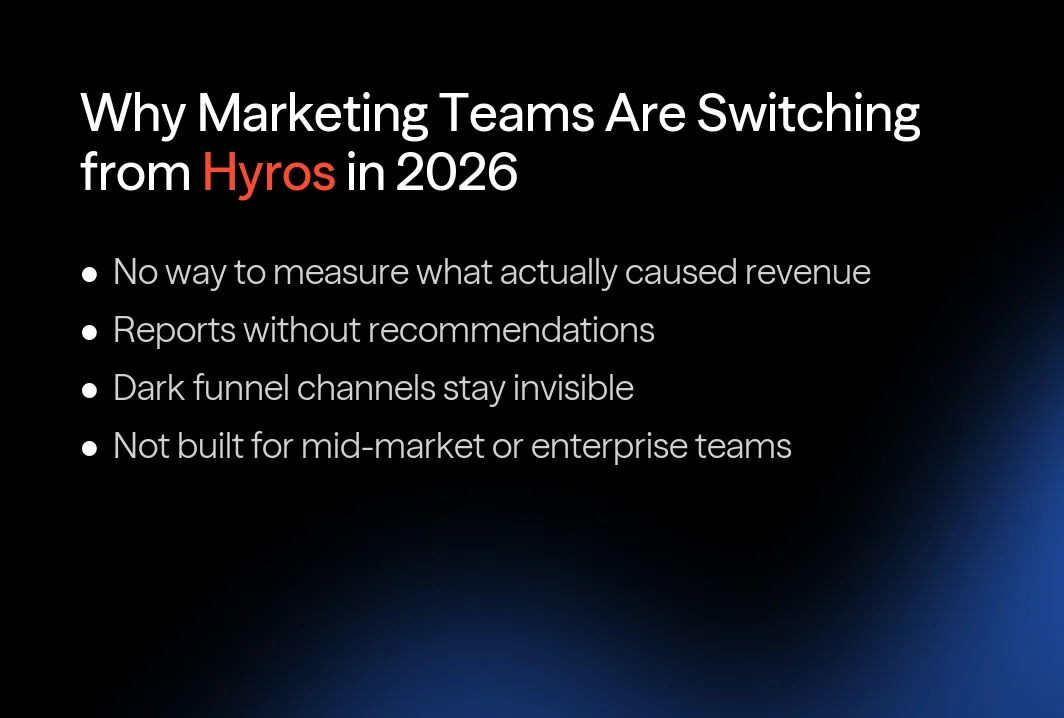
No Way to Measure What Actually Caused Revenue
Hyros uses last-click, first-click, and a hybrid "Scientific Mode" to assign credit. All three are variations of the same idea: a touchpoint appeared in the journey, so it gets credit. But correlation isn't causation. A Meta ad showing up before a purchase doesn't prove Meta caused that purchase — the customer might have bought anyway. Without incrementality testing (controlled experiments that measure causal revenue lift), Hyros users can't distinguish real impact from noise.
Reports Without Recommendations
Hyros produces attribution dashboards. It doesn't produce budget recommendations. After reviewing the data, someone on your team still has to interpret the numbers, decide how to reallocate spend across platforms, and manually execute those changes. For brands spending $100K+/month across Meta, Google, TikTok, and YouTube, that manual process is slow, error-prone, and leaves money on the table every week.
Dark Funnel Channels Stay Invisible
For high-ticket info products — courses, coaching programs, mastermind groups — the buyer journey is long and heavily influenced by channels that don't leave a tracking footprint. A prospect hears about your program on a podcast, watches YouTube content for three months, joins a free community, and then clicks a paid ad to buy. Hyros sees the paid ad click. It misses everything that actually built the intent.
Not Built for Mid-Market or Enterprise Teams
Hyros was designed for info-product sellers and small DTC brands running straightforward funnels. Teams investing $50K+/month in paid media — the mid-market and enterprise segment — need higher data quality standards, dedicated measurement support, custom integrations, and methodologies that go beyond ad tracking. Hyros doesn't offer dedicated customer success, custom onboarding, or the kind of infrastructure that larger marketing operations require. As spend scales, so does the cost of relying on a tool that wasn't built for that level of complexity.
How This Comparison Was Created
This comparison evaluates each tool across measurement methodology, channel coverage, incrementality testing capability, budget optimization, expert support availability, and real user reviews. We assessed 11 platforms — from entry-level ad trackers to enterprise measurement systems — covering DTC, info-product, B2B, and agency use cases. Among Hyros competitors, these are the most frequently evaluated options.
Quick Comparison Table
| # | Platform | Core Methodology | Incrementality | Budget Optimization | Expert Support |
|---|---|---|---|---|---|
| 1 | SegmentStream | ML behavioral attribution + multiple models | Geo holdout experiments | Automated weekly | Embedded expert team |
| 2 | Northbeam | Blended multi-touch | Announced (unproven) | No | Self-serve |
| 3 | Triple Whale | Total Impact (black box) | No | No | Self-serve |
| 4 | Cometly | Server-side pixel + MTA | No | No | Self-serve |
| 5 | ThoughtMetric | Rule-based MTA | No | No | Self-serve |
| 6 | SegMetrics | Journey-based (rule) | No | No | Self-serve |
| 7 | Wicked Reports | LTV-focused MTA | No | No | Self-serve |
| 8 | Rockerbox | MTA + MMM + incrementality | Yes (geo holdouts) | No | Analyst-supported |
| 9 | Ruler Analytics | Visitor-level rule-based | No | No | Self-serve |
| 10 | HockeyStack | GTM intelligence (MTA secondary) | No | No | Self-serve |
| 11 | RedTrack | Server-side tracking | No | No | Self-serve |
1. SegmentStream — Best Overall Hyros Alternative
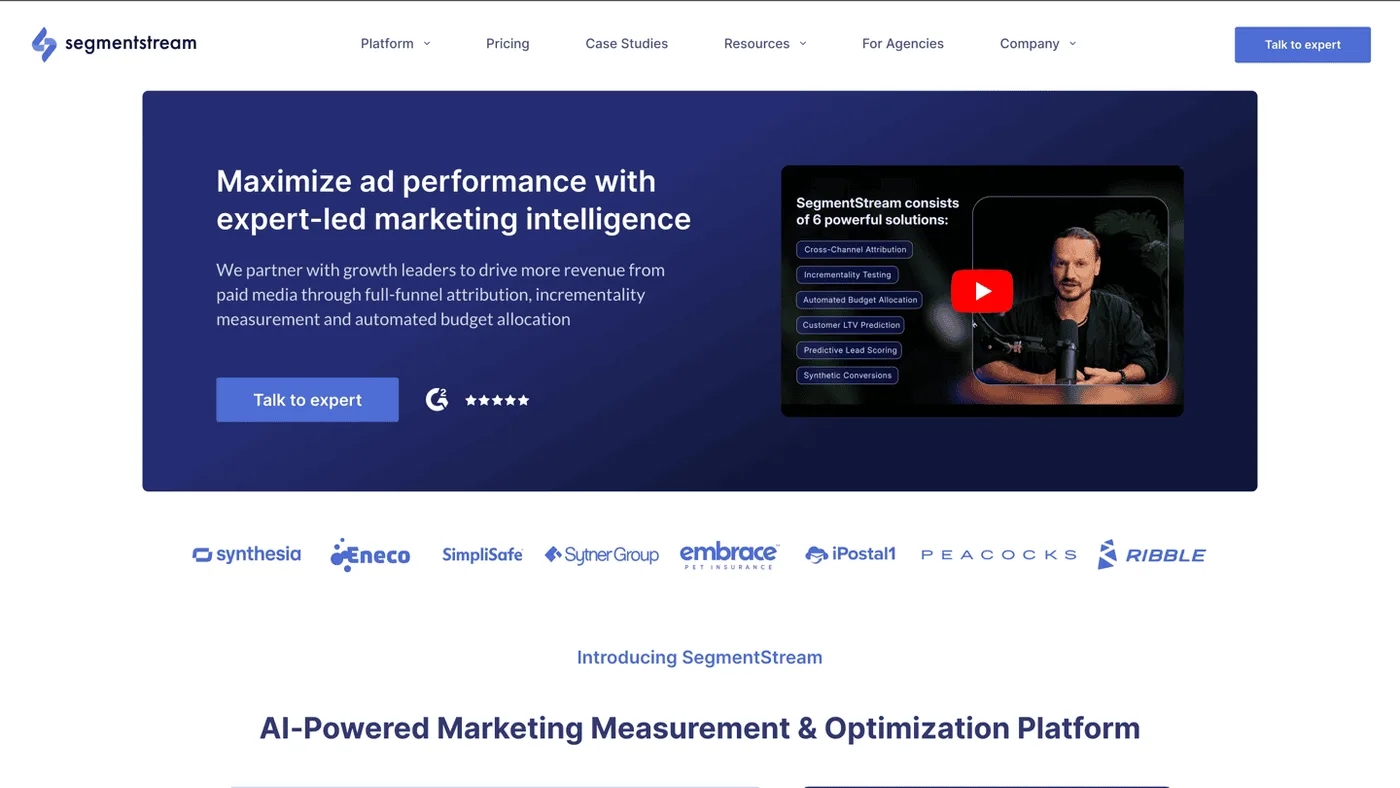
Most Hyros alternatives on this list are variations of the same concept: ad trackers with slightly different attribution logic. SegmentStream is a different category entirely. It's an agentic AI platform for marketing measurement and optimization — one that answers the question Hyros can't: "Did my ad spend actually cause incremental revenue, and how should I reallocate it?"
Why SegmentStream Is the Top Hyros Alternative
Where Hyros stops at tracking touchpoints, SegmentStream closes the full measurement-to-action loop. It connects to 30+ ad platforms, runs ML-powered attribution across multiple models (first-touch, last paid click, last paid non-brand click, and customizable multi-touch attribution), validates those findings with controlled incrementality experiments, and then automatically optimizes budgets based on marginal ROAS — every week. That's not a dashboard upgrade. That's a different operating model.
Key Capabilities
1. Cross-Channel Attribution with Multiple Models — A full suite of attribution models, not just one. custom attribution modeling powers the Advanced MTA model by evaluating behavioral signals within each session — engagement depth, page interactions, micro-conversions — to assign credit based on actual incremental influence. Standard models (first-touch, last paid click, last paid non-brand click) are available alongside it.
2. Incrementality Testing That Proves Causation — Expert-led geo holdout experiments with MDE and power analysis, synthetic control methodology, and statistical rigor. This is the capability that separates SegmentStream from every ad tracker on this list — it answers whether your spend caused revenue, not just whether it appeared in the path.
3. Marketing Mix Optimization with Automated Execution — Models marginal ROAS and diminishing returns at the campaign level, then recommends precise budget reallocation across platforms. The Continuous Optimization Loop runs weekly: Measure → Predict → Validate → Optimize → Learn → Repeat. This is an agentic AI framework — it autonomously improves allocation without waiting for quarterly reviews.
4. Re-Attribution for the Dark Funnel — Self-reported attribution via LLM-powered analysis. At checkout or lead capture: "How did you hear about us?" The LLM interprets free-text responses, maps them to channels, and deterministically reattributes conversions. Podcasts, influencer mentions, word-of-mouth — the channels Hyros can't see.
5. Conversion Modeling for Privacy Compliance — GDPR-compliant probabilistic inference that recovers lost conversion visibility for users who decline tracking consent. No privacy violation, no guesswork — modeled estimates based on behavioral patterns.
6. Agentic AI-Ready — MCP Server — SegmentStream's MCP Server enables AI assistants (Claude, ChatGPT, Gemini, Cursor) to connect directly to the measurement engine for autonomous performance analysis and budget execution. Over 100 built-in measurement skills available through natural language.
Strengths
- Measurement that leads to action — The only alternative on this list that automatically executes budget changes based on validated causal data, not just reports on what happened
- Transparent methodology — custom attribution modeling, incrementality results, and optimization logic are explainable and auditable; your CFO can trust the numbers
- Expert partnership model — Senior measurement specialists work as embedded partners, not a helpdesk; they design experiments, interpret results, and advise on strategy
- Privacy-forward architecture — Conversion Modeling handles consent gaps without violating GDPR; Re-Attribution captures dark funnel influence without tracking scripts
Limitations
- Minimum ad spend threshold — Requires ~$50K+/month in paid media spend; not suited for early-stage brands or small info-product businesses
- Premium investment — This is a strategic partnership with embedded experts, not a $99/month self-serve tool; pricing reflects the depth of service
Target market: DTC brands, B2B/SaaS companies, and enterprise organizations spending $50K-$1M+/month on paid media who need causal measurement, automated budget optimization, and expert strategic partnership.
Customer Review Examples
"SegmentStream helped us identify which campaigns actually drove incremental revenue — not just which ones our pixels fired on." — G2 Review
See all SegmentStream reviews on G2 (4.7/5 rating)
Summary: SegmentStream is the only Hyros alternative that goes beyond tracking into causal measurement, automated optimization, and expert-led strategy. It's the upgrade path for teams that need a system that measures, validates, and acts on what their ad spend actually produces.
2. Northbeam
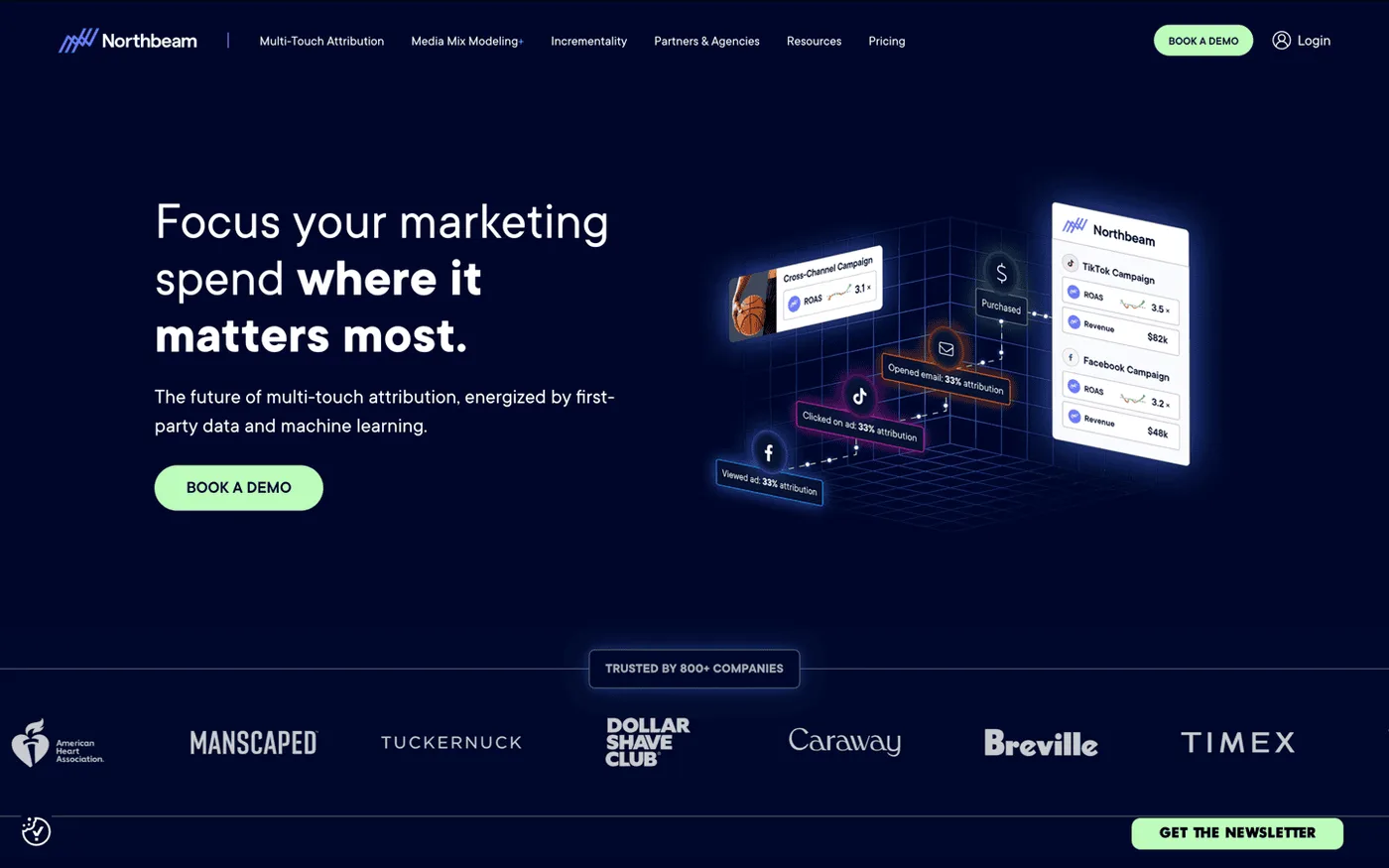
If your Hyros frustration is about the interface rather than the methodology, Northbeam deserves a look. It's a Shopify-native attribution platform that brings paid social and paid search into one view with creative-level ROAS breakdowns — something Hyros does at the funnel level but Northbeam does at the individual ad level.
Core Capabilities
- Creative-level attribution — See which specific ads and creatives convert, not just channel-level ROAS
- Unified paid channel view — Meta, TikTok, Pinterest, Snap, Google, and Microsoft in one dashboard
- Configurable attribution windows — Customize lookback windows per channel to match your funnel cycle
- Media buyer workflow — Built for daily campaign management, not quarterly analysis
Strengths
- Ad-level granularity — Identifies converting creatives, not just converting channels; useful for teams iterating on ad content daily
- Fast onboarding — Meaningful attribution data within days of connecting Shopify
- Broader DTC focus — Covers standard ecommerce funnels, not just info-product sales sequences
- Multi-platform paid coverage — One view across the platforms DTC brands actually use
Limitations
- Shopify-dependent — Integration depth drops off for WooCommerce, BigCommerce, and custom storefronts
- Digital-only measurement — No offline channel coverage (TV, direct mail, podcasts); if your media mix extends beyond paid digital, Northbeam's view is incomplete
- Manual budget decisions — Dashboards show what happened; you still decide what to do about it
- Credit assignment is a black box — Users can't audit or explain how Northbeam assigns attribution credit
Target market: Shopify DTC brands spending $50K-$500K/month on paid social and search who want creative-level attribution clarity.
Summary: Northbeam gives media buyers the creative-level granularity that Hyros lacks, with a cleaner interface for daily campaign management. But it stops at reporting — there's no incrementality testing, no automated budget optimization, and no way to validate whether the attributed conversions actually represent causal revenue.
3. Triple Whale
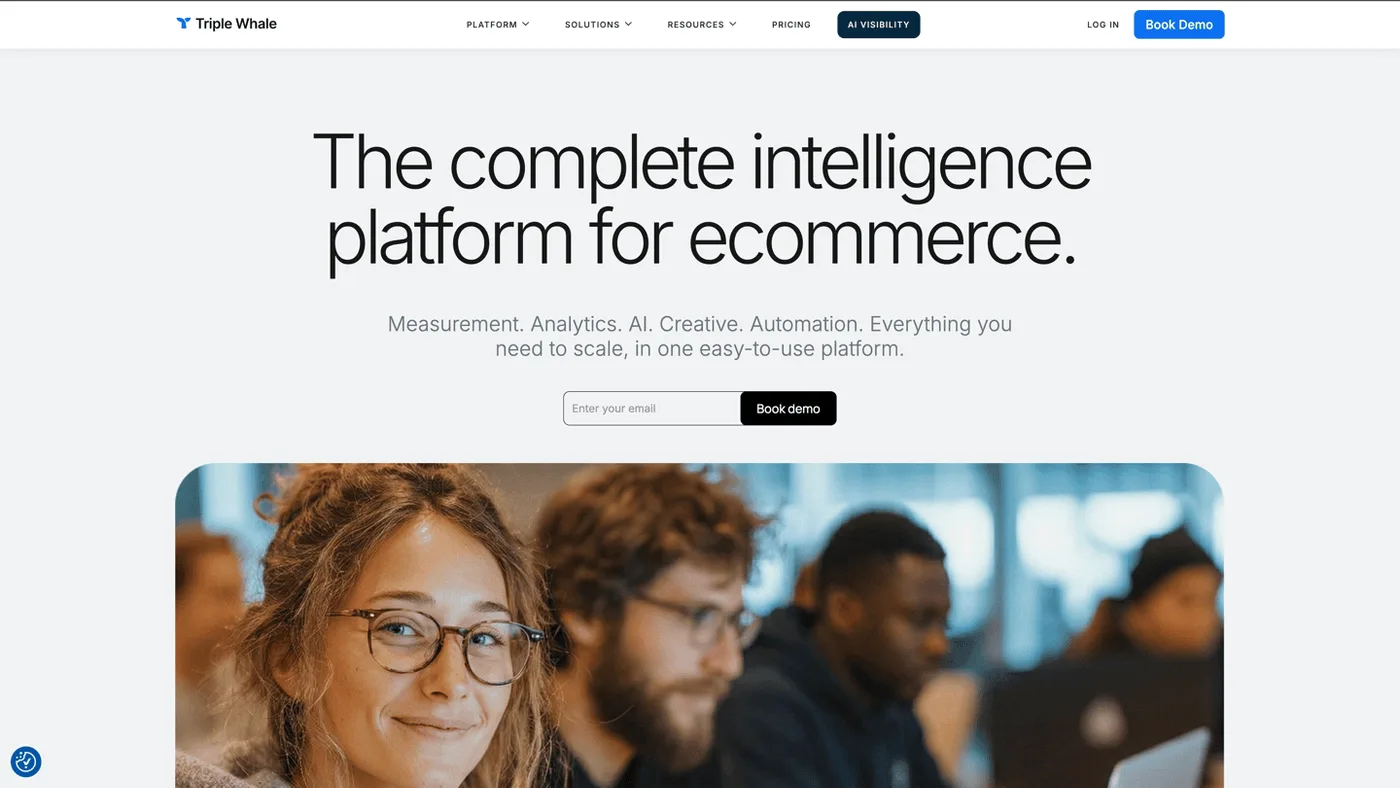
With 50,000+ DTC brands on the platform, Triple Whale has the kind of community momentum that makes it hard to ignore. It combines attribution with unit economics — CAC, LTV, margins by channel — so you see profitability, not just ROAS. For Hyros users who want a broader view of their business health beyond funnel tracking, that's appealing.
Core Capabilities
- Profitability dashboard — Attribution alongside CAC, LTV, and margin metrics in one view
- Post-purchase surveys — Captures "How did you hear about us?" at checkout
- Shopify-native setup — Connect in under an hour
- Community and ecosystem — Large user base, active education resources
Strengths
- Revenue meets profitability — Attribution and unit economics in a single platform, which Hyros doesn't offer
- Built-in self-reported attribution — Post-purchase surveys capture dark funnel intent without additional tools
- Speed to value — Fastest implementation of any tool on this list for Shopify stores
- Non-technical friendly — Designed for founders and marketing leads, not data teams
Limitations
- Shopify-only — Not practical for WooCommerce, BigCommerce, or custom builds
- Total Impact model is opaque — Attribution credit assignment can't be audited or explained
- Reliability questions — Users have reported 140+ attribution incidents since February 2024
- No path beyond DTC — Exclusively built for Shopify ecommerce; B2B teams, lead-gen businesses, and info-product creators won't find their workflows here
Target market: Shopify DTC brands under $5M/year wanting fast profitability dashboards and community support.
Summary: Triple Whale combines attribution with unit economics in a way that appeals to DTC founders who want a single profitability view. But the attribution methodology is opaque, reliability incidents have been documented, and there's no path to causal measurement or automated optimization from within the platform.
4. Cometly
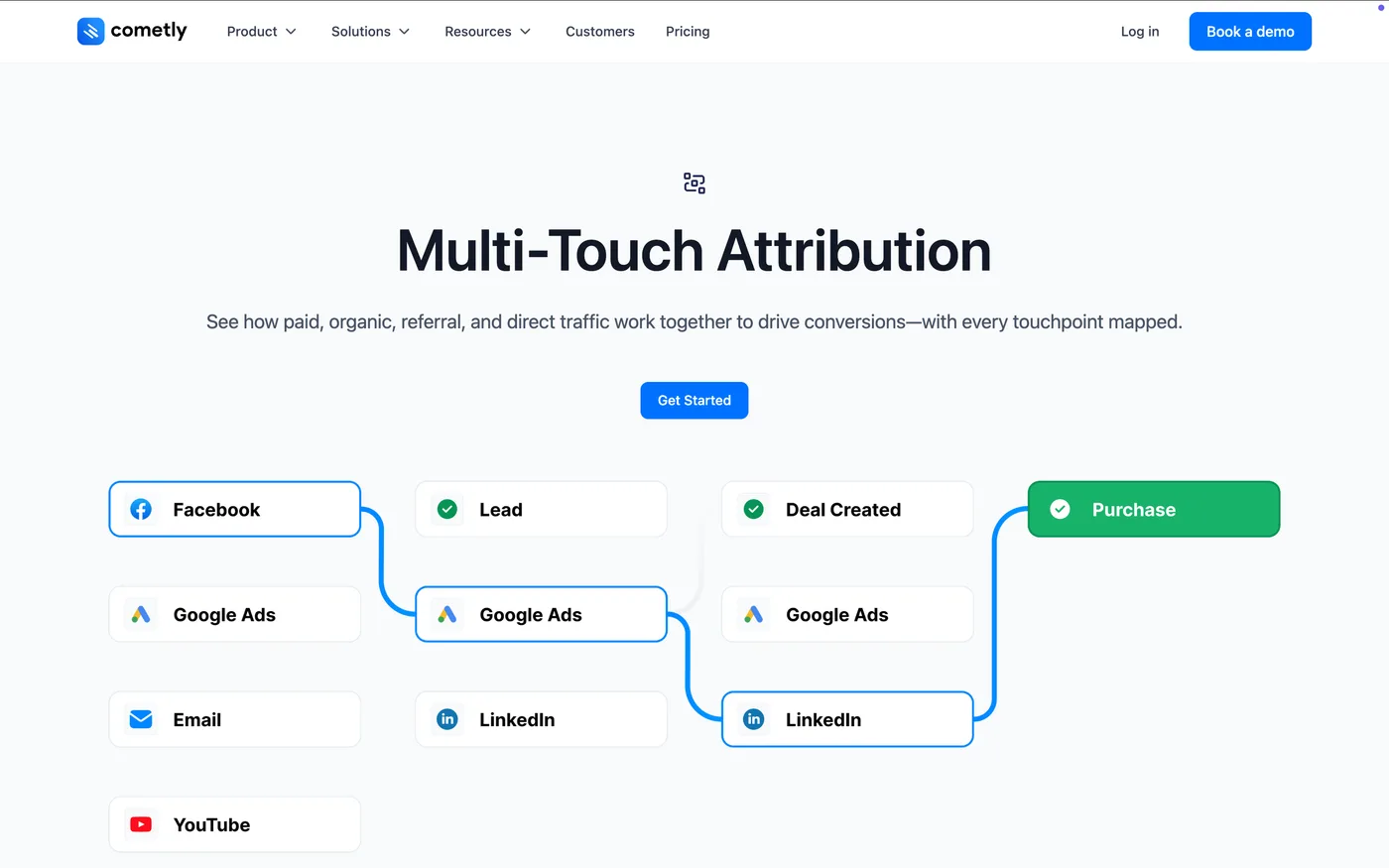
Among the tools on this list, Cometly is the one most frequently positioned head-to-head with Hyros. Both target growth-stage DTC brands, both use server-side pixel tracking, and both feed conversion data back to ad platforms. The difference is accessibility — Cometly strips away Hyros' complexity and delivers a cleaner, faster implementation experience.
Core Capabilities
- Server-side first-party tracking — Pixel-based attribution with CAPI integrations for Meta, Google, TikTok
- Multi-touch attribution dashboards — Blended views across paid channels
- Conversion data sync — Feeds first-party data back to ad platforms to improve their bidding algorithms
- Multi-platform ecommerce — Works with Shopify, WooCommerce, Magento, and custom builds
Strengths
- Accessible implementation — Live within days; no steep learning curve or technical setup
- Broader platform support — Not Shopify-locked; works with Magento, WooCommerce, and custom storefronts
- Clean dashboard experience — Designed for non-technical marketers, not data engineers
- Direct Hyros comparison — Familiar tracking approach with lower friction
Limitations
- Post-click only — Tracks click events without behavioral session analysis or impression tracking; upper-funnel influence stays invisible
- Scaling ceiling — Attribution depth becomes insufficient as ad spend exceeds $100K/month and channel complexity grows
- No consent recovery — Users who decline tracking cookies disappear from the data entirely
- Conversion sync isn't measurement — Feeding data back to ad platforms improves their algorithms, but that's not the same as independently validating whether those ads drove incremental revenue
Target market: Growth-stage DTC brands spending $10K-$100K/month on paid media who want a simpler, faster tracking setup than Hyros.
Summary: Cometly is the closest 1:1 swap for Hyros — same tracking approach, same audience, less friction. But "easier Hyros" still means tracking without measurement. Teams that need to understand whether their ads cause revenue, not just whether clicks precede purchases, will hit Cometly's ceiling just as quickly.
5. ThoughtMetric
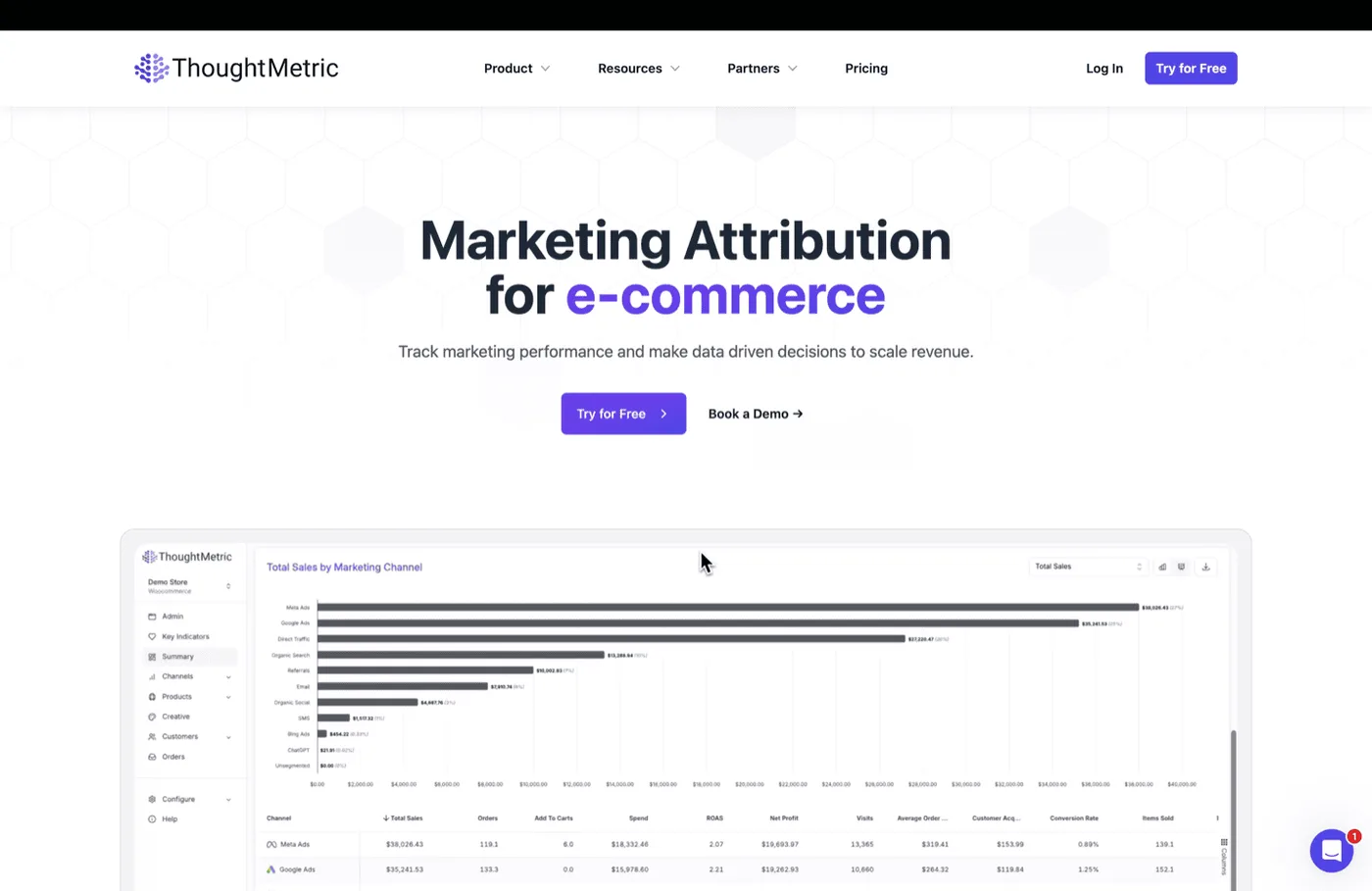
What if the problem isn't that Hyros tracks wrong — it's that it costs too much for what you need? ThoughtMetric answers that question with attribution starting at ~$99/month and no minimum ad spend requirement. It's server-side first-party tracking with rule-based multi-touch models, aimed at smaller DTC brands who don't need enterprise measurement depth.
Core Capabilities
- Server-side first-party tracking — Resilient to browser restrictions
- Rule-based attribution models — Position-based, linear, and time-decay options
- Shopify-first integration — Fast implementation for Shopify stores
- GDPR compliance — Built with European market requirements in mind
Strengths
- Lowest entry cost — Starting ~$99/month makes it accessible to early-stage DTC brands
- No minimum spend requirement — Works for brands just starting to scale paid media
- Quick implementation — Live in days with minimal configuration for Shopify stores
- Privacy-compliant tracking — Server-side approach with GDPR built in
Limitations
- Static attribution models — Fixed rule-based models that don't adapt as your channel mix evolves; no ML or data-driven analysis
- Limited strategic support — Self-serve with basic documentation; no expert guidance on measurement strategy
- Entry-level depth — No budget optimization, no predictive modeling; you'll outgrow it as spend scales
- Shopify ecosystem lock — WooCommerce and BigCommerce integrations exist but are noticeably less mature; teams on custom storefronts won't get full value
Target market: Early-stage DTC brands spending under $50K/month wanting affordable attribution as a starting point.
Summary: ThoughtMetric is the budget entry point for teams that find Hyros too expensive for their current scale. The tradeoff is clear: lower cost, lower depth. Static rule-based models and no optimization layer — teams scaling past $50K/month will need to upgrade.
6. SegMetrics
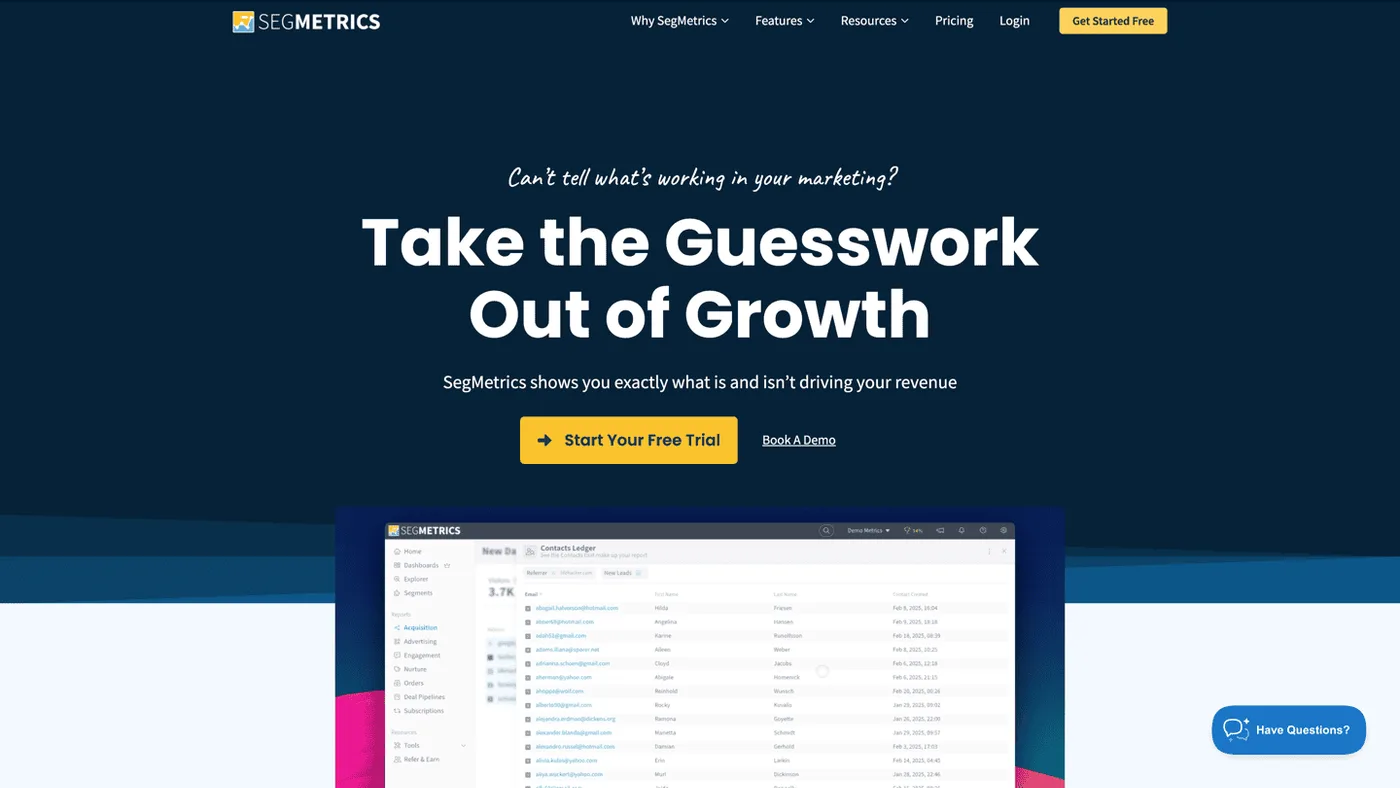
For Hyros' original core audience — info-product creators, course sellers, coaches — SegMetrics tracks the full customer lifecycle from opt-in through tripwire, core offer, upsell, and subscription renewal. Its deep integrations with email platforms (ActiveCampaign, Drip, Keap, ConvertKit, HubSpot) make it a natural fit for businesses where email sequences drive the sale.
Core Capabilities
- Info-product funnel tracking — Opt-in → tripwire → core offer → upsell → subscription lifecycle
- Email platform integrations — ActiveCampaign, Drip, Keap/Infusionsoft, ConvertKit, HubSpot
- Full customer journey — Connects ad click to email engagement to purchase to LTV
- Subscription and cohort analytics — Recurring revenue, churn, and LTV by acquisition source
Strengths
- Built for the Hyros audience — Info-product funnel structures, email sequences, and subscription revenue are native concepts, not afterthoughts
- Deep email attribution — Connects individual email sends within ActiveCampaign or Drip sequences to downstream purchase and LTV events at the campaign level
- No minimum ad spend — Accessible for smaller course creators and coaches just starting paid acquisition
- LTV cohort tracking — Tracks recurring revenue and churn by original acquisition source over time
Limitations
- Niche scope — Less suited for standard DTC ecommerce, B2B, or businesses outside the info-product/email funnel world
- Rule-based attribution — No ML or data-driven methodology; credit assignment follows fixed models
- Reporting without action — Shows performance data but offers no recommendations on budget allocation or spend changes
- Limited R&D investment — Smaller vendor with narrower product development compared to well-funded platforms
Target market: Info-product creators, course sellers, coaches, and email-driven businesses who need funnel-level attribution from ad click through email sequence to lifetime value.
Summary: SegMetrics is purpose-built for the funnels Hyros' original audience runs. Email attribution depth is its clear advantage. But it shares Hyros' core limitation: it tracks what happened without measuring what caused it, and it produces reports without recommendations. Teams scaling beyond $50K/month in ad spend will need a measurement and optimization layer on top.
7. Wicked Reports
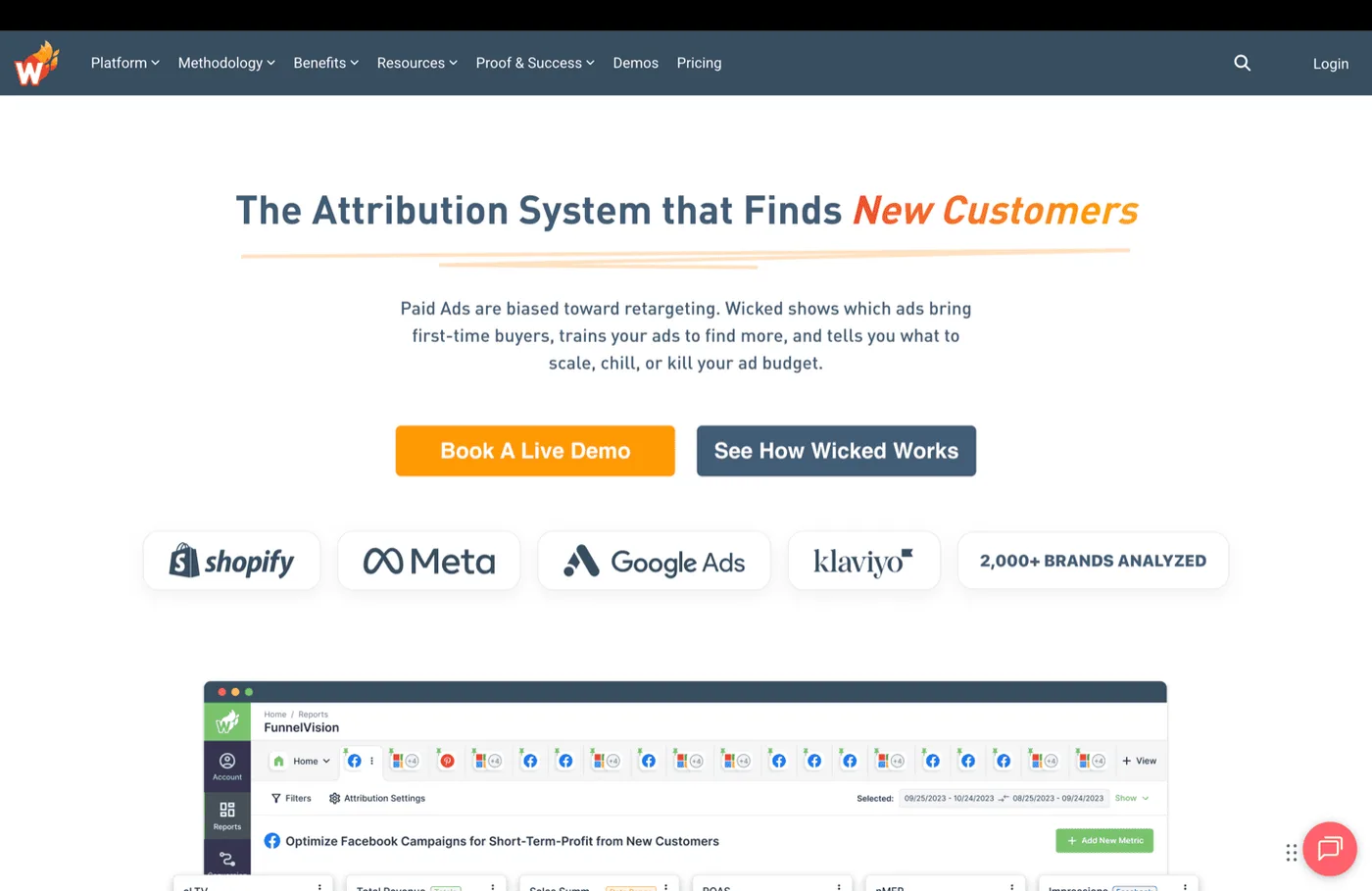
Wicked Reports has been in the attribution space since 2013 — longer than most tools on this list. Its angle: tying every marketing dollar to customer lifetime value, not just the initial purchase. For subscription and info-product businesses where the real revenue comes from renewals, upsells, and long-term engagement, that LTV lens matters more than first-purchase ROAS.
Core Capabilities
- LTV-based attribution — Ties ad spend to customer lifetime value across subscription cycles
- Unlimited attribution windows — No arbitrary lookback cutoffs; tracks the full customer relationship
- First-party data architecture — Server-side events and first-party tracking for cross-browser attribution
- Cohort analysis — Subscription, cancellation, and lifecycle event tracking by acquisition source
Strengths
- Lifetime value focus — Attributes revenue across the entire customer lifecycle, not just the initial conversion
- Extended attribution windows — Important for long-cycle info-product and subscription businesses where Hyros' default windows fall short
- Multi-platform support — Works with Shopify, WooCommerce, and major ad platforms
- Established track record — Over a decade in the attribution market
Limitations
- Interface usability — Users report navigation difficulties and a clunky dashboard experience
- CRM data dependency — LTV attribution accuracy hinges on clean, complete CRM and payment data; messy records mean messy attribution
- Limited scope — Not suited for B2B, complex enterprise sales cycles, or high-volume data environments
- Smaller vendor — Less investment in product development compared to well-funded alternatives on this list
Target market: Small-to-mid-sized DTC brands and subscription businesses where lifetime value attribution matters more than first-purchase ROAS.
Summary: Wicked Reports improves on Hyros' attribution by tracking lifetime value across unlimited windows — a real advantage for subscription businesses. The limitation: LTV attribution without causal validation and without an optimization layer still means manual budget decisions based on correlation data.
8. Rockerbox
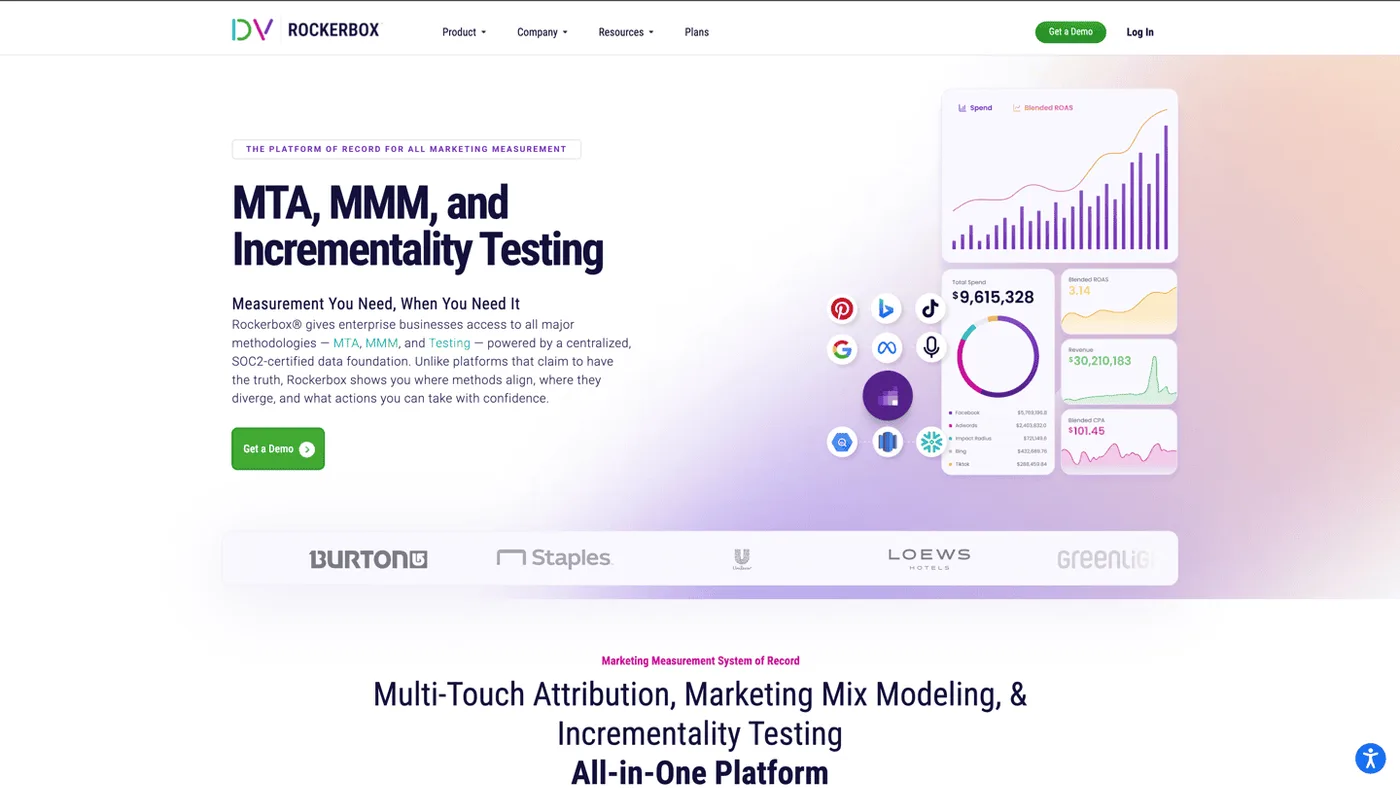
Rockerbox serves a different audience than the other tools on this list. Acquired by DoubleVerify for $85M in March 2025, it's an enterprise measurement platform covering both digital and offline channels — TV, direct mail, OOH, retail media, and podcasts. For teams that have outgrown not just Hyros but the entire DTC ad-tracker category, Rockerbox extends measurement into channels most trackers ignore.
Core Capabilities
- Omnichannel measurement — TV, OTT, podcasts, retail media, direct mail, and digital channels in one model
- Clickstream plus offline signals — Combines digital attribution data with offline touchpoints across retail, CTV, and direct mail channels
- Multi-market support — Campaigns across multiple regions
- Enterprise data ingestion — Built for complex, high-volume environments
Strengths
- DoubleVerify verification ecosystem — Access to ad fraud detection and viewability data through the DoubleVerify acquisition, adding a verification layer most attribution tools lack
- Enterprise scale — Handles the data volume and complexity that mid-market ad trackers aren't built for
- Post-acquisition stability — DoubleVerify's resources support continued product investment
- Offline signal integration — Retail foot traffic, CTV viewership, and direct mail response tracked alongside digital channels
Limitations
- Analyst-dependent — Requires dedicated internal analytics staff for implementation and ongoing operation; lean marketing teams won't get value without data support
- No automated budget execution — Centralizes measurement effectively but budget decisions remain manual
- Unclear post-acquisition direction — DoubleVerify's strategic focus is ad verification, not DTC measurement; roadmap may shift
- Heavy implementation timeline — Weeks to months of setup; designed for enterprise timelines, not DTC speed
Target market: Enterprise DTC and retail brands spending $500K+/month across digital and offline channels with dedicated analytics staff.
Summary: Rockerbox is the enterprise step-up on this list — offline channel coverage and multiple measurement approaches in one environment. The gap: no automated budget optimization layer, significant internal analytics requirements, and an implementation timeline that won't work for lean teams. It measures broadly but doesn't close the loop into action.
9. Ruler Analytics
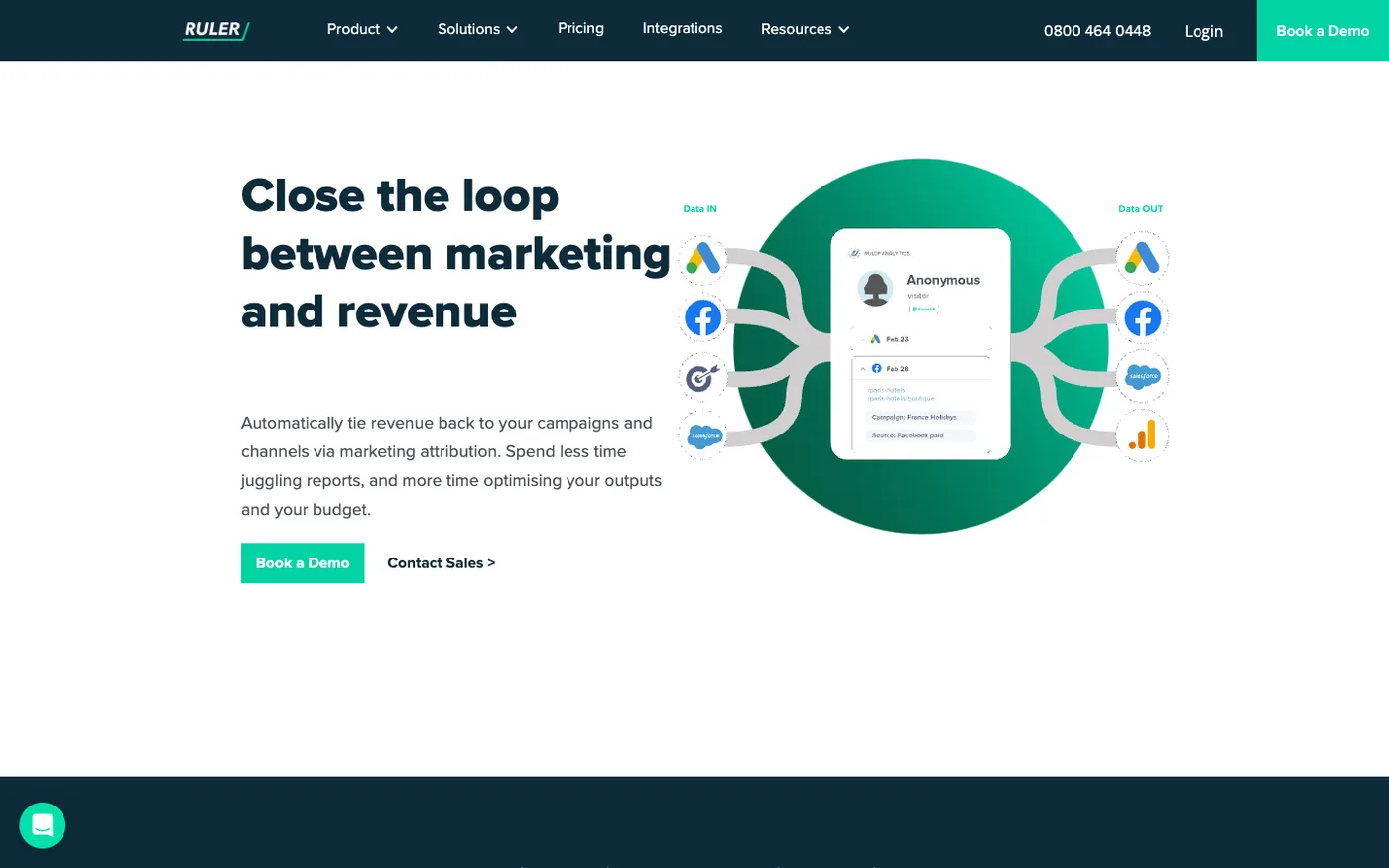
Not every Hyros user runs a DTC brand. Agencies and B2B marketers end up on Hyros because of its call tracking and long attribution windows — but they quickly realize it wasn't built for lead-gen funnels. Ruler Analytics fills that gap. It tracks website visitors using first-party data, captures form fills, phone calls, and live chat interactions, then connects those events to CRM opportunities and closed-won deals.
Core Capabilities
- Visitor-level attribution — Connects each touchpoint to CRM deals and revenue
- Multi-channel lead capture — Call tracking, form fills, and live chat in one view
- CRM integrations — Salesforce, HubSpot, Pipedrive, Dynamics 365
- Multiple attribution models — First click, last click, linear, time-decay, U-shaped
Strengths
- Call tracking built in — Connects phone conversations to originating ads and campaigns; the capability that brings Hyros users to evaluate Ruler
- CRM-connected attribution — Ties marketing spend directly to pipeline and closed-won revenue
- Agency-friendly — Multi-client management and reporting designed for agencies
- Broad integration ecosystem — 1,000+ app connections via Zapier, SQL, and webhooks
Limitations
- Static rule-based models — Attribution methodology hasn't evolved beyond fixed position models; no ML or adaptive analysis
- Backward-looking only — No predictive lead scoring or forward-looking capabilities
- No cross-device identity resolution — Users switching between phone, laptop, and tablet break the attribution chain; each device looks like a separate visitor
- 12-month contracts standard — Same contractual friction that frustrates Hyros users
Target market: Mid-market B2B organizations and agencies that need revenue-based attribution connected to CRM, particularly for inbound-heavy funnels with phone and form conversion events.
Summary: Ruler Analytics addresses the B2B gap that Hyros doesn't cover — CRM-connected attribution with call tracking, form capture, and pipeline visibility. Attribution models are rule-based and static, and budget decisions remain entirely manual.
10. HockeyStack
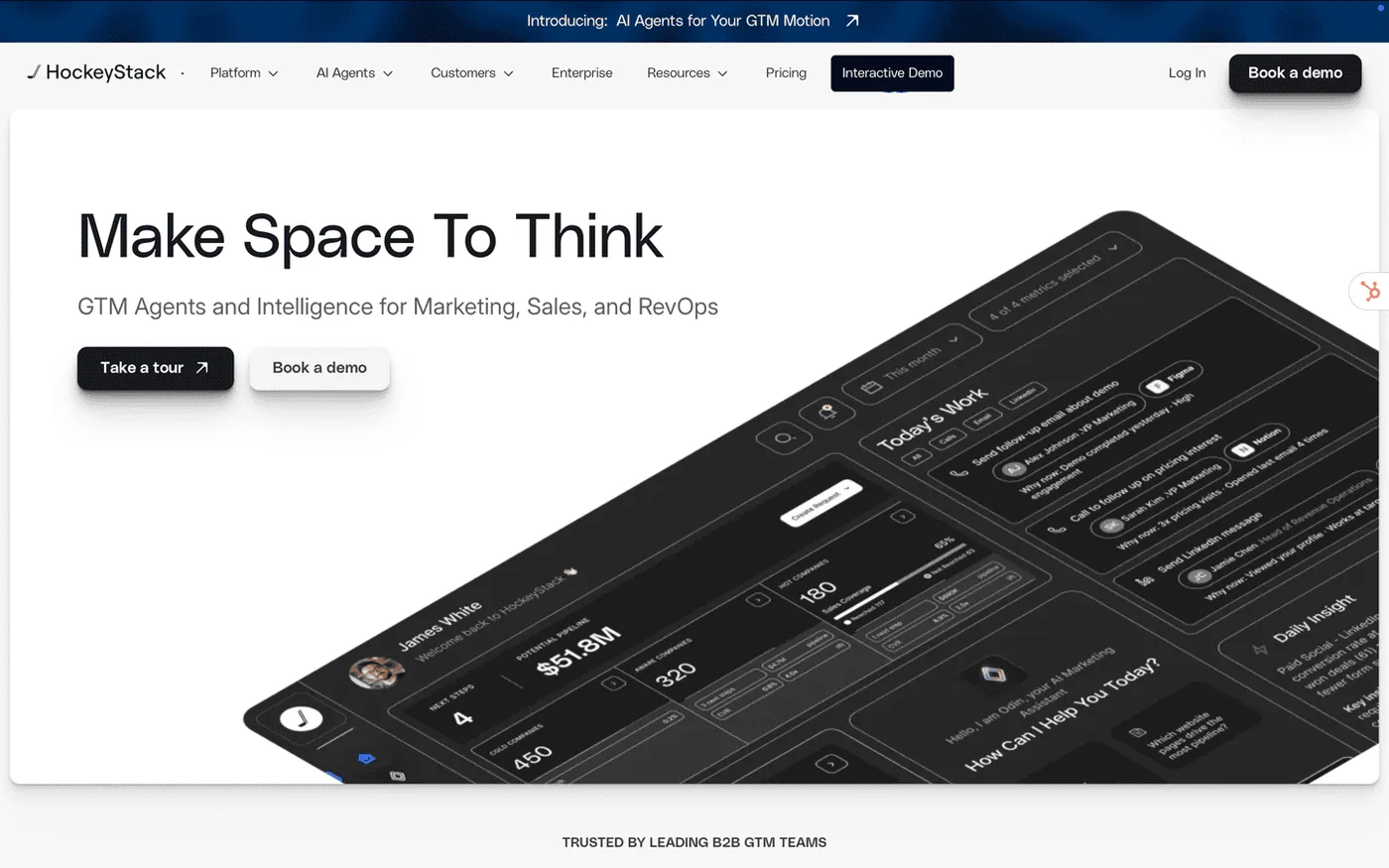
Some teams outgrow Hyros because they move from DTC into B2B — and suddenly need attribution that connects marketing to pipeline, not just to Shopify checkouts. HockeyStack positions itself as a unified go-to-market intelligence platform, consolidating marketing, sales, CRM, and engagement data with natural-language querying across the full GTM dataset. Attribution is one layer within a broader system.
Core Capabilities
- Unified GTM data — Marketing, sales, CRM, and engagement data in one platform
- Natural-language querying — Ask questions across marketing, sales, and CRM data in plain English instead of building reports manually
- Pipeline forecasting — Funnel analysis and revenue prediction
- Broad GTM scope — Covers the full go-to-market motion, not just marketing attribution
Strengths
- Single-platform GTM view — Unifies data that typically lives across 5+ tools into one environment
- Automated campaign clustering — Groups related touchpoints by funnel stage, reducing manual tagging and campaign organization work
- Growing enterprise B2B presence — Active product development and expanding customer base
- Beyond attribution — Pipeline forecasting and sales intelligence that standalone attribution tools don't offer
Limitations
- Attribution is secondary — GTM intelligence is the core product; the attribution module lacks the depth of dedicated platforms
- Credit assignment isn't auditable — Attribution methodology doesn't offer the transparency that measurement-focused teams require
- Interface maturity — Users report an unpolished experience compared to established platforms
- Not suited for DTC — Built for B2B/SaaS GTM teams; info-product creators and ecommerce brands won't find their workflows here
Target market: B2B/SaaS GTM teams wanting unified marketing-sales intelligence across the full go-to-market motion.
Summary: HockeyStack covers broader ground than standalone attribution tools — pipeline forecasting, sales intelligence, and GTM analytics alongside attribution. The tradeoff: attribution depth suffers when it's one feature among many. Teams that need rigorous measurement, causal validation, or budget optimization will find HockeyStack broad but shallow on measurement specifically.
11. RedTrack
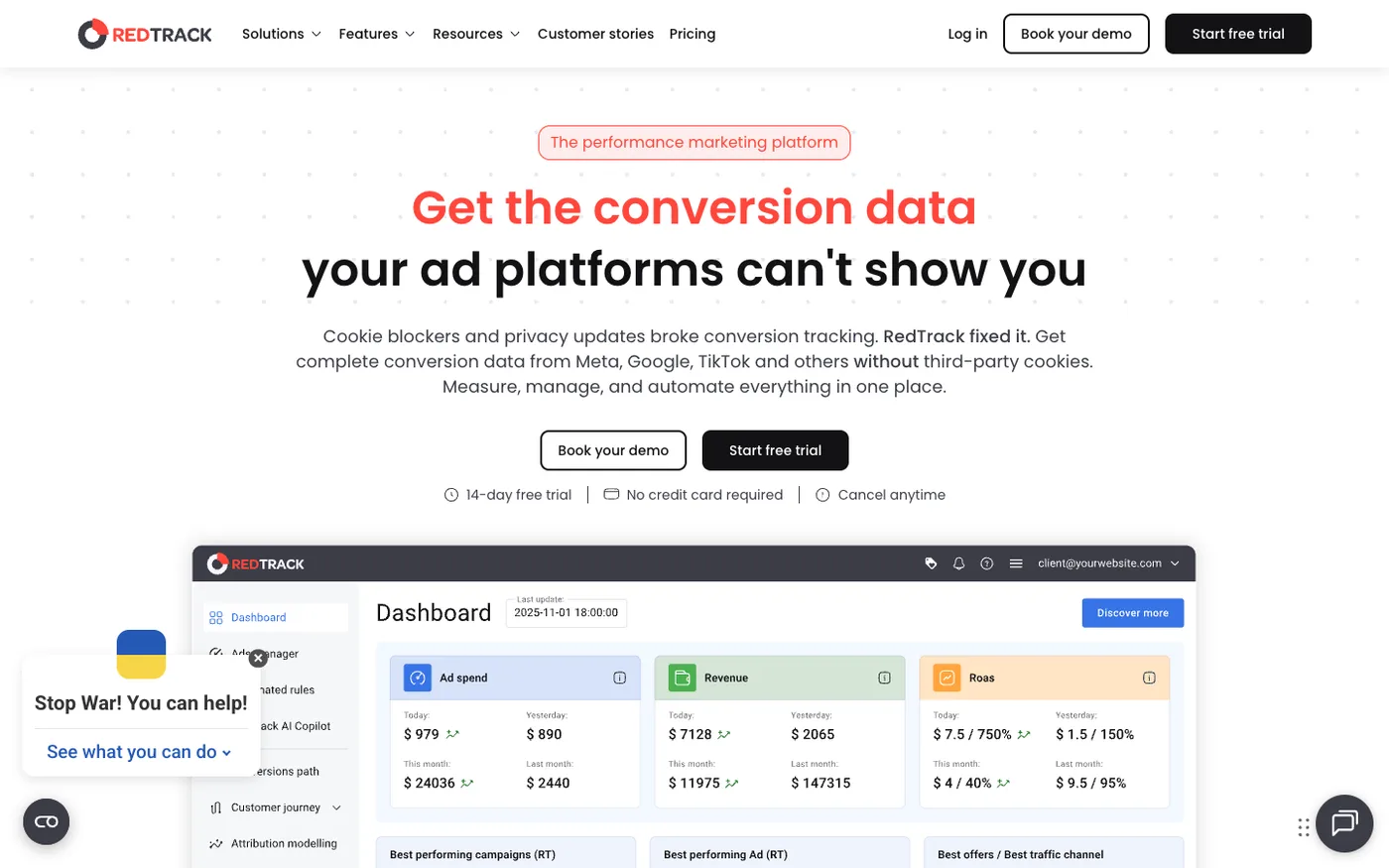
RedTrack comes from the affiliate and performance marketing world, where tracking mechanics — redirect URLs, postback parameters, server-side pixels — are the entire game. For media buyers and agencies managing high campaign volumes across multiple ad networks, RedTrack offers more tracking flexibility than Hyros with deep CAPI integrations, automation rules, and affiliate program management.
Core Capabilities
- Server-side CAPI tracking — Deep integrations with Meta, Google, TikTok, and traffic networks
- Automation rules — Pause underperforming ads or boost winners based on performance thresholds
- Affiliate and partner tracking — Manages affiliate, influencer, and referral programs in one platform
- Multiple tracking modes — Redirect, direct (no-redirect), and server-side parallel tracking
Strengths
- Affiliate marketing capabilities — Manages affiliate, influencer, and referral tracking alongside paid ad attribution; covers a use case Hyros doesn't address
- Rules-based automation — Pause or boost campaigns automatically based on performance thresholds; reduces manual monitoring
- Broad ad network coverage — Google, Meta, TikTok, PropellerAds, Taboola, Outbrain, and more
- Flexible tracking architecture — Multiple tracking modes accommodate different campaign setups and network requirements
Limitations
- Tracking-focused — Sophisticated click and conversion tracking without deeper measurement methodology; attribution analysis is secondary
- Affiliate-first architecture — Built for performance marketers managing affiliate networks; brand-side DTC and ecommerce teams find the interface and workflows oriented toward a different use case
- No LTV attribution — Focuses on immediate conversion events, not long-term customer value
- Significant cost for a tracking tool — Enterprise-tier pricing represents a substantial investment for what remains a tracking and automation platform
Target market: Performance media buyers, affiliates, and agencies managing large campaign volumes across multiple ad networks.
Summary: RedTrack offers the deepest ad tracking mechanics on this list — multiple tracking modes, CAPI integrations, and affiliate management that Hyros doesn't provide. But more sophisticated tracking doesn't equal measurement. It tells you what the pixels saw, not what actually caused your revenue.
How to Choose the Right Hyros Alternative
-
Is your core need tracking — or measurement? If you need to know which ad platforms fired before a conversion, you need a tracker. If you need to know whether those ads actually caused incremental revenue, you need a measurement platform. Most tools on this list do the first. Few do the second.
-
What's your monthly ad spend? Brands under $50K/month can start with entry-level attribution tools. Brands above that threshold lose real money every week without causal validation and automated budget optimization.
-
Are you DTC, info-product, or B2B? Your business model determines which attribution architecture matters. Funnel-stage tracking (info-product), creative-level ROAS (DTC), or CRM-connected pipeline attribution (B2B) require different tools.
-
Do you need someone to interpret the data — or just present it? Self-serve dashboards work if you have an analyst on staff. Expert-led measurement partnerships work if you want the insights delivered with recommendations.
-
Does your tool act on what it finds? A dashboard that shows diminishing returns on Meta doesn't help if nobody adjusts the budget for two weeks. Ask whether the platform can close the loop between measurement and execution.
-
How much of your buyer journey happens in the dark? For businesses with long consideration cycles — coaching programs, enterprise B2B, high-ticket services — dark funnel influence is massive. If your tool only sees clicks, you're missing the channels that built the intent.
Final Verdict: The Best Hyros Alternative in 2026
Hyros does tracking well. But teams that have used it long enough realize the gap: tracking what happened and measuring what caused it are two different problems. Most alternatives on this list swap one tracker for another without addressing that gap.
- SegmentStream is the clear #1 choice. It's the only platform that combines ML-powered attribution, incrementality testing with geo holdout experiments, automated weekly budget optimization, and dark funnel coverage through Re-Attribution. For teams spending $50K+/month who need measurement that leads to action — not just another dashboard — SegmentStream is the upgrade path.
- Northbeam offers creative-level attribution granularity for Shopify DTC brands, but stops at reporting with no causal validation or optimization.
- Rockerbox provides enterprise-grade omnichannel measurement, but requires dedicated analytics staff and has no automated budget execution.
The remaining tools — Triple Whale, Cometly, ThoughtMetric, SegMetrics, Wicked Reports, Ruler Analytics, HockeyStack, and RedTrack — each serve narrower use cases covered in detail above.
Hyros Alternatives: Frequently Asked Questions
What is the best alternative to Hyros?
SegmentStream is the best Hyros alternative for teams that have outgrown ad tracking. It combines ML-powered attribution across multiple models, geo holdout incrementality testing, and automated weekly budget optimization. Where Hyros tracks touchpoints, SegmentStream measures causal revenue impact and acts on it.
Is Hyros worth it?
Hyros is a capable ad tracker for DTC and info-product brands spending $10K-$50K/month who want visibility beyond platform-native 7-day windows. SegmentStream is the better investment for teams that need causal measurement and automated optimization — the capabilities Hyros doesn't offer. Call tracking and long attribution windows have value; they're just not enough past a certain scale.
What is the difference between Hyros and Triple Whale?
Both track ad-attributed revenue, but neither measures causal impact. Hyros focuses on funnel tracking with call integration and long attribution windows. Triple Whale adds profitability metrics (CAC, LTV, margins) with a Shopify-native experience. SegmentStream addresses what both lack: incrementality testing, automated budget optimization, and ML-based attribution that goes beyond click tracking.
How does Hyros compare to modern attribution platforms?
Hyros is an ad tracker — it records which touchpoints appeared before a conversion and feeds signals back to platforms. SegmentStream represents the next step: it doesn't just track what happened, it measures whether ads caused incremental revenue using geo holdout experiments, then automatically optimizes budgets based on validated causal data. That's the gap between tracking and measurement.
Does Hyros work with Shopify?
Yes, Hyros integrates with Shopify, though its original strength is info-product funnels (ClickFunnels, Kajabi, custom checkout). SegmentStream connects to 30+ ad platforms and works across Shopify, non-Shopify ecommerce, B2B, and enterprise environments with attribution models ranging from first-touch to ML-powered Advanced MTA.
What are the limitations of Hyros?
Hyros' core limitation is that it tracks without measuring. It can't run incrementality tests to prove causal impact, doesn't optimize budgets automatically, and misses dark funnel channels. SegmentStream addresses all three with geo holdout experiments, automated weekly budget rebalancing through Marketing Mix Optimization, and Re-Attribution for channels like podcasts and word-of-mouth.
What is better than Hyros for DTC brands?
SegmentStream is the strongest choice for DTC brands that have outgrown Hyros — it adds incrementality testing, automated budget optimization, and ML-powered attribution on top of cross-channel tracking. Northbeam and Rockerbox offer creative-level attribution and enterprise omnichannel measurement, respectively, but both stop at reporting without causal validation.
Can Hyros track phone calls and offline conversions?
Hyros includes call tracking that connects phone conversations to originating ads — one of its real strengths. SegmentStream handles offline influence differently through Re-Attribution, which captures self-reported attribution via LLM-powered analysis of free-text responses, covering podcasts, events, and word-of-mouth alongside standard ad tracking.
Related Articles
- Best Multi-Touch Attribution Software — Full comparison of MTA platforms for teams ready to move beyond ad tracking
- Top 10 Incrementality Testing Tools — Deep dive into causal measurement platforms
- Best Multi-Touch Attribution Tools for Ecommerce and DTC Brands — DTC-specific attribution comparison
- Northbeam Alternatives — If you're also evaluating Northbeam
- SegMetrics Alternatives — For teams comparing info-product attribution tools
Ready to Go Beyond Ad Tracking?
Hyros tracks clicks. SegmentStream measures what actually drives revenue — and automatically optimizes your budget based on causal data, not correlations.
Talk to a SegmentStream expert about how incrementality testing, ML-powered attribution, and automated budget optimization can replace manual reporting with a measurement system that acts.
Book a demo to see SegmentStream in action.