
10 Best SegMetrics Alternatives & Competitors in 2026
Here are top 10 alternatives to SegMetrics in 2026 worth reviewing. SegmentStream, Dreamdata, Cometly, and more.
Sophie Renn · 7 March 2026 · 30 min read
Updated for 2026
Quick Answer: The Best SegMetrics Alternatives in 2026
SegmentStream is the best SegMetrics alternative in 2026 — it replaces single-touchpoint attribution with ML-powered multi-touch measurement, predictive scoring, and automated budget optimization that acts on your data weekly.
Other alternatives include Hyros, Wicked Reports, Dreamdata, HockeyStack, Ruler Analytics, ThoughtMetric, Triple Whale, Northbeam, and Cometly.
Why Marketing Teams Look Beyond SegMetrics in 2026
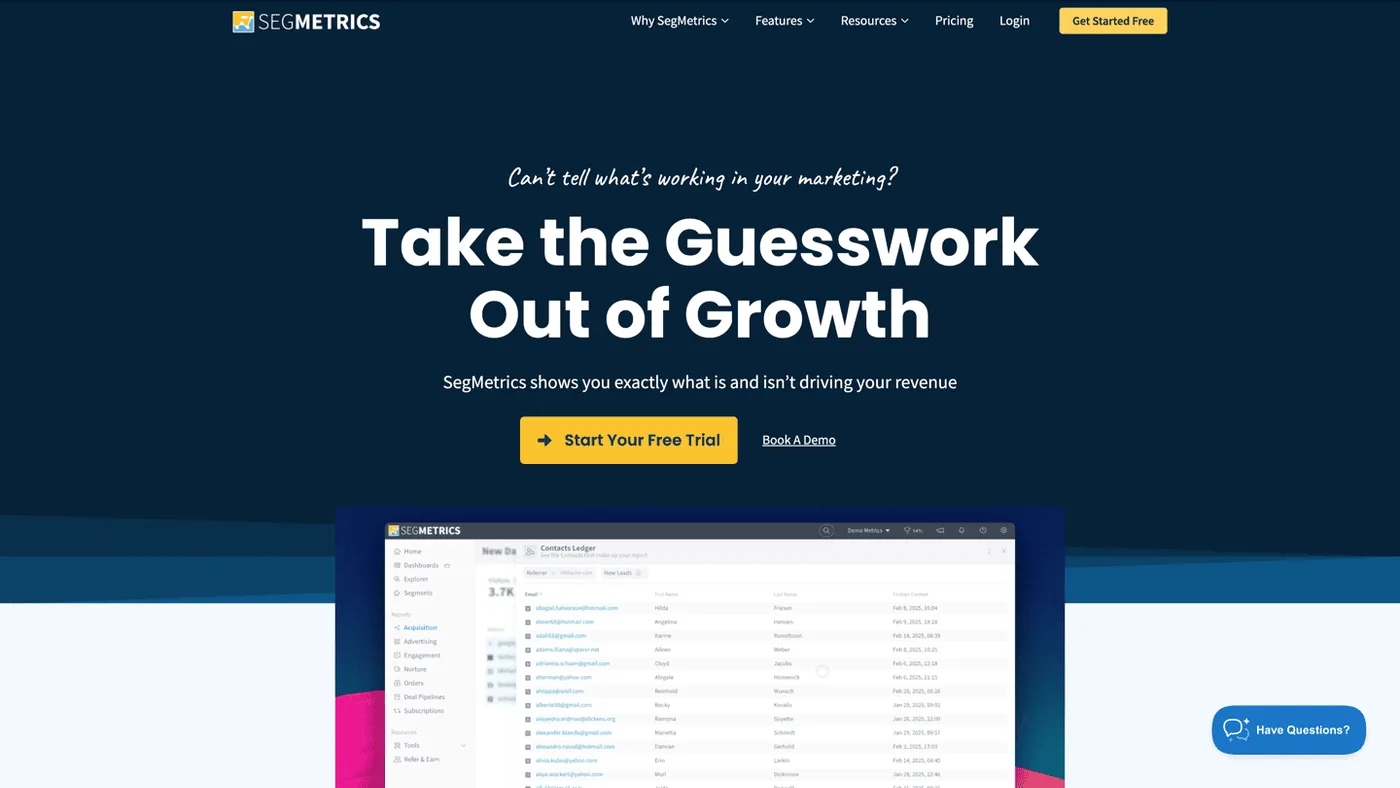
SegMetrics is a contact-based attribution tool for direct-response marketers running CRM-heavy funnels. It connects to Keap, ActiveCampaign, and Ontraport to track individual contacts from first click through purchase and renewal. Contact-level attribution, revenue tied to specific campaigns, unlimited lookback windows. But as more teams scale budgets and add channels, the list of segmetrics competitors keeps growing.
The trouble starts when your marketing gets more complex. More channels, more budget, more questions the CRM-and-click model wasn't designed to answer. Teams don't leave SegMetrics because it's broken. They leave because they've grown past what it can tell them.
Single-Touchpoint Credit Misses the Full Picture
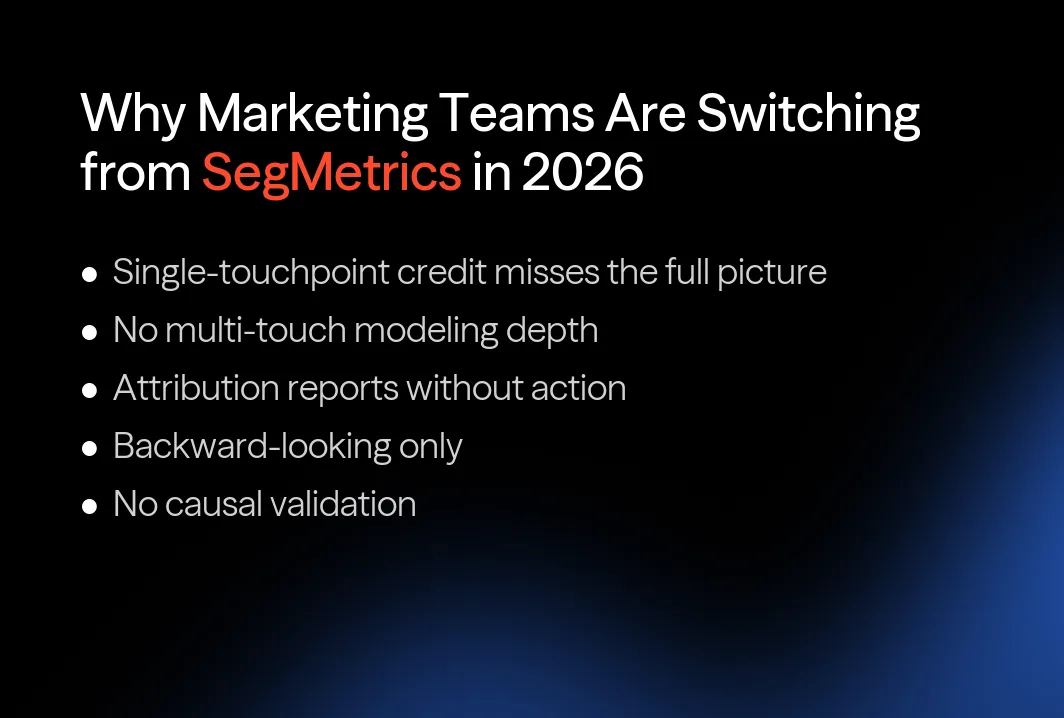
SegMetrics assigns conversion credit to a single contact's originating source. If someone first clicked a Facebook ad, then read three emails, watched a YouTube video, and finally bought through a Google search — SegMetrics credits the Facebook ad (or the Google search, depending on your model). The other touchpoints? Invisible.
That's fine when your funnel is linear: ad → email sequence → sale. But the moment you add YouTube, paid social retargeting, podcast sponsorships, or organic content, you're flying blind on everything except the first or last click. Upper-funnel investments get systematically undercredited, and you end up cutting the channels that are actually filling the top of the funnel.
No Multi-Touch Modeling Depth
Contact-based attribution tracks people. Multi-touch attribution evaluates influence. SegMetrics does the first — it knows which campaigns touched a contact. But it doesn't model how much each touchpoint contributed to the conversion decision. There's no weighting, no behavioral analysis, no way to understand whether that third email mattered or whether the customer had already decided to buy after the webinar.
For teams spending $50K+/month across five or six channels, that lack of multi-touch depth makes budget allocation a guessing game.
Attribution Reports Without Action
SegMetrics shows you what happened. It doesn't tell you what to do next. After you pull the attribution report, the next steps are manual: export data, build a spreadsheet, discuss in a meeting, log into each ad platform, adjust budgets. By the time you've acted, the data is a week old.
The gap between "here's your attribution data" and "here's where to move your budget" is where most teams lose money. SegMetrics reports. It doesn't recommend. It doesn't optimize.
Backward-Looking Only
Every insight SegMetrics provides is retrospective. You learn that a contact who bought yesterday first clicked an ad six months ago. Useful for understanding history, but it doesn't help you predict which leads are worth pursuing right now. There's no predictive lead scoring, no forward-looking LTV estimation at the moment of acquisition, no way to identify high-value contacts before they convert.
No Causal Validation
SegMetrics tells you which campaigns touched the customers who converted. It can't tell you whether those campaigns actually caused the conversions. A customer who would have bought anyway shows up with the same attribution credit as someone genuinely persuaded by your advertising. Without incrementality testing — controlled experiments that measure whether ads drive incremental revenue — you can't separate correlation from causation.
How This Comparison Was Created
These rankings are based on product documentation, live demos where available, verified user reviews on G2 and Capterra, public pricing pages, and community feedback from Reddit and niche marketing forums. Evaluation criteria: attribution methodology depth, multi-touch capability, predictive intelligence, budget optimization, platform flexibility, and relevance to SegMetrics' core audience (info marketers, SaaS, subscription businesses).
Best SegMetrics Alternatives: At-a-Glance Comparison
| # | Tool | Multi-Touch Attribution | Predictive Scoring | Budget Optimization | Expert Support |
|---|---|---|---|---|---|
| 1 | SegmentStream | multi-model attribution | Yes | Automated weekly | Yes — dedicated team |
| 2 | Hyros | AI Print (proprietary) | No | No | Onboarding included |
| 3 | Wicked Reports | First-party multi-touch | No | No | Self-serve |
| 4 | Dreamdata | Account-level positional | No | No | Self-serve |
| 5 | HockeyStack | GTM intelligence layer | No | No | Account team |
| 6 | Ruler Analytics | Rule-based (first/last/linear) | No | No | Self-serve |
| 7 | ThoughtMetric | Rule-based MTA | No | No | Self-serve |
| 8 | Triple Whale | Total Impact (blended) | No | No | Self-serve |
| 9 | Northbeam | Blended multi-touch | No | No | Account team |
| 10 | Cometly | AI multi-touch | AI recommendations | AI recommendations | Self-serve |
1. SegmentStream — Best Overall SegMetrics Alternative
Target market: Performance marketing teams spending $50K–$1M+/month on paid media who've outgrown contact-level single-touchpoint attribution and need measurement that drives automated action.
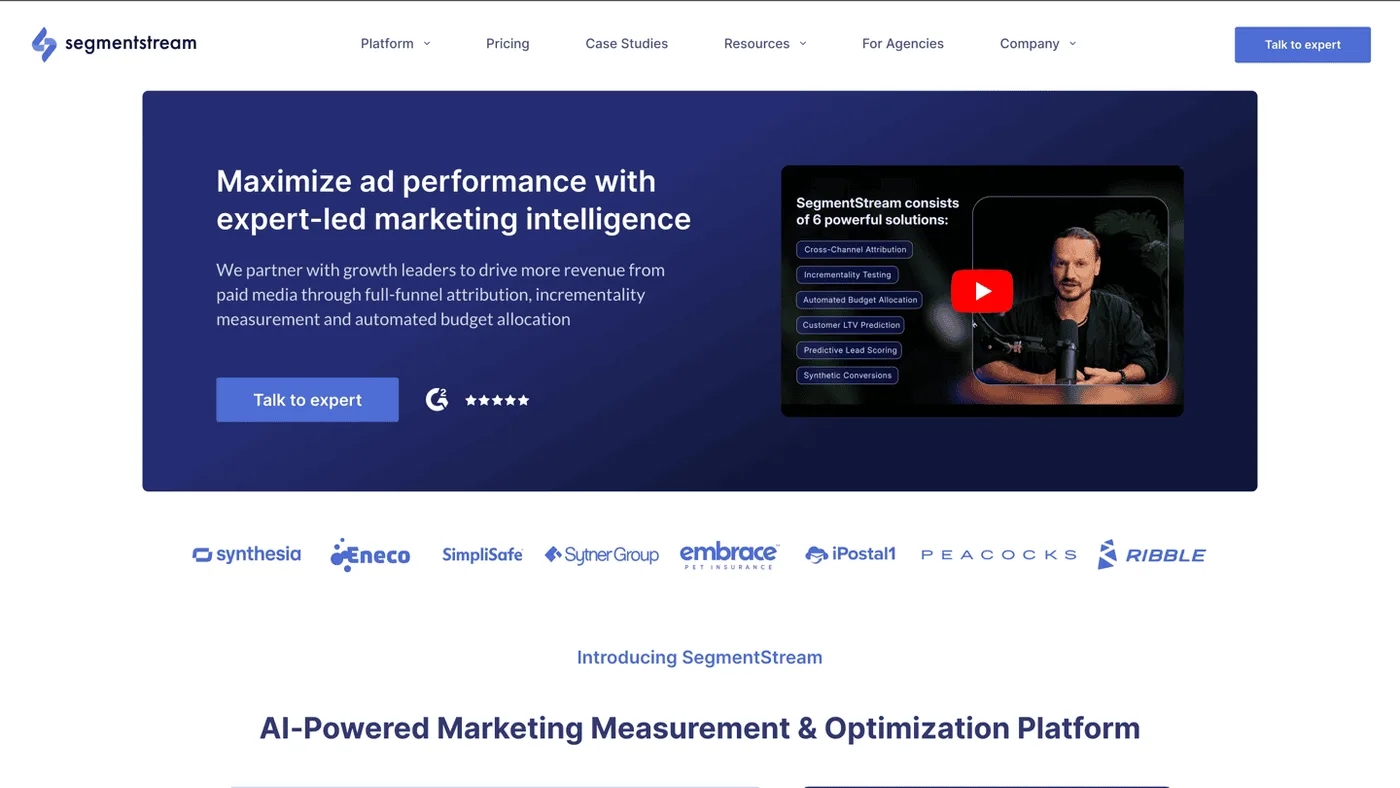
SegMetrics tells you which campaign acquired a contact. SegmentStream tells you which channels actually drive incremental revenue, predicts which leads are worth the most, and automatically reallocates your budget across platforms every week. It's the difference between a rearview mirror and a navigation system.
Why SegmentStream Is the Top SegMetrics Alternative
Each of SegMetrics' capability ceilings maps directly to a SegmentStream solution:
1. Cross-Channel Attribution That Goes Beyond Single Touchpoints — SegmentStream offers multiple attribution models: First-Touch, Last Paid Click, Last Paid Non-Brand Click, and customizable multi-touch attribution. The Advanced MTA model evaluates what happened during each session — engagement depth, key events, navigation patterns — and assigns credit based on how much each visit actually moved conversion probability. Not which email address first appeared in the CRM, but which marketing interactions actually influenced the purchase decision. The methodology is fully transparent and auditable.
For info product marketers and course creators running multi-channel campaigns, this means you finally see the real contribution of a YouTube pre-sell video, a retargeting sequence, or a podcast mention — touchpoints that SegMetrics would credit to "Direct" or ignore entirely. Attribution for info marketers has traditionally been limited to CRM contact tagging, but behavioral multi-touch analysis evaluates influence across every channel, regardless of whether a CRM captured the interaction.
2. Incrementality Testing That Separates Correlation From Causation — Expert-led geo holdout experiments where SegmentStream's measurement team designs the test, runs MDE and power analysis, and interprets results with synthetic control modeling. This answers the question SegMetrics can't: did this campaign actually cause revenue, or would those sales have happened anyway?
3. Marketing Mix Optimization That Moves Budget Automatically — SegmentStream models marginal returns per channel and identifies where the next dollar creates the most value. Budget recommendations update weekly and can execute across ad platforms without manual intervention. No more attribution-report-to-spreadsheet-to-meeting loops. For teams scaling from $50K to $200K+/month in ad spend, the difference between manual budget allocation and automated weekly rebalancing compounds fast — the platform catches diminishing returns and reallocates before you've wasted a full week of budget on a saturated channel.
4. Predictive Lead Scoring and Customer LTV Prediction — SegMetrics shows you what a customer was worth after they've churned or renewed. SegmentStream predicts that value at the moment of first conversion. For SaaS and subscription businesses with long sales cycles, this transforms how you evaluate lead quality in real time. Instead of waiting 90 days to learn that a cohort had high churn, you can identify high-value leads the day they convert and bid more aggressively to acquire similar profiles.
5. Conversion Modeling for the Privacy Era — When users decline tracking consent, those conversions disappear from any click-based attribution model. SegmentStream's GDPR-compliant probabilistic inference recovers the missing signal, narrowing the tracking gap from 30–50% down to single digits. For European and privacy-regulated markets, this is the difference between making decisions on half your data and making decisions on nearly all of it.
Key Capabilities
- AI-powered budget execution — The Continuous Optimization Loop (Measure → Predict → Validate → Optimize → Learn → Repeat) works as an agentic AI framework that autonomously optimizes spend allocation across channels
- Agentic AI-ready — SegmentStream's MCP Server enables AI assistants to connect directly to the measurement engine for autonomous performance analysis and budget execution
- Click-time revenue attribution — Matches revenue to when the ad spend occurred, not when the conversion happened, for accurate ROAS/CPA calculation
- Re-Attribution for the dark funnel — Self-reported attribution via checkout surveys (processed by LLM), coupon codes, and QR codes captures influence from podcasts, influencers, and word-of-mouth that SegMetrics credits to "Direct"
G2 Rating: 4.7/5 — See all reviews
Customer review examples:
- "SegmentStream helped me discover hidden conversion paths that our previous attribution tool missed entirely."
- "The team provided exceptional support during setup, continuously optimizing our models."
Strengths
- Transparent, auditable methodology — custom attribution modeling logic is fully explainable. Your CFO can walk through the credit assignment, not just trust the output
- Measurement-to-action closed loop — Budget optimization executes weekly based on marginal ROAS. The data drives the spend, not a monthly meeting
- Expert partnership model — Dedicated senior measurement team, monthly reviews, strategic consulting. You don't need an internal data science team
- Full-funnel privacy coverage — Conversion Modeling recovers consent gaps while Re-Attribution captures dark funnel influence
- Causal proof built in — Geo holdout incrementality testing with confidence intervals answers whether your ads actually work
Limitations
- Minimum ad spend threshold — Designed for brands spending $50K+/month. Teams with smaller budgets won't see the ROI
- Expert-led onboarding — Implementation involves SegmentStream's measurement team configuring the setup with you. Teams that prefer fully DIY configuration may find the guided approach slower initially
- Premium investment — Custom pricing reflects the strategic partnership model
Summary
SegmentStream is the SegMetrics alternative for teams that have outgrown single-touchpoint contact attribution. If your ad spend has crossed $50K/month and you need measurement that predicts, validates, and acts on data — not just reports it — this is where the upgrade path leads.
Pricing: Custom pricing — book a demo for details
2. Hyros
Target market: Info product businesses, high-ticket coaches, and course creators running phone-based sales funnels with $20K–$100K/month ad spend.
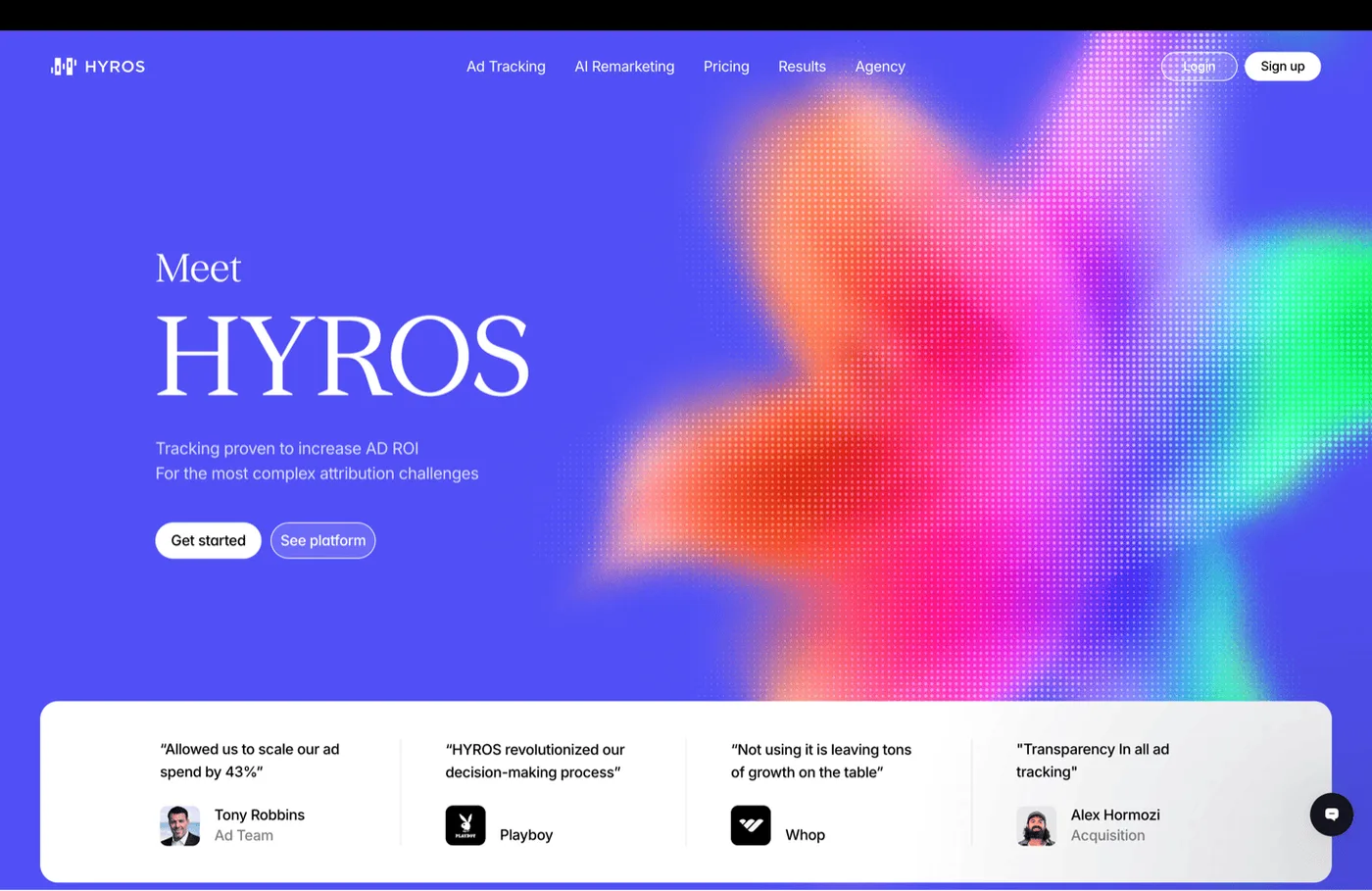
Hyros is an ad tracking platform for info product businesses that close sales on the phone. It connects phone calls back to the originating ad click using a proprietary "AI Print" tracking method, covering Meta, Google, TikTok, email, and call tracking in one view. The platform also sends conversion data back to ad platforms for bidding optimization.
Key Capabilities
- Call-to-ad attribution — Traces phone sales back to the specific ad click that started the journey
- Cross-device AI Print tracking — Proprietary identity resolution across devices, sessions, and platforms
- Long attribution windows — Follows user journeys over 30+ day consideration cycles common in high-ticket sales
- Ad platform optimization signals — Sends conversion data back to Google and Meta for bidding optimization
- Funnel-based reporting — Built for complex multi-step funnels with upsells, downsells, and order bumps
Strengths
- Phone sales attribution — Connects call-based revenue to originating ads, filling a gap most attribution tools leave open
- Built for info product funnels — Handles the long, multi-step funnel structures common in coaching, courses, and consulting
- Cross-device tracking — AI Print follows users across devices without relying solely on cookies
- Track record in the info marketing community — Used by well-known direct-response marketers, which provides social proof within the niche
Limitations
- Attribution depth is closer to source tracking than multi-touch modeling — Hyros identifies which ad started the journey, but doesn't weight the relative influence of each touchpoint along the way
- Non-transparent pricing and sales process — Requires a demo call. Pricing scales with revenue and isn't publicly listed
- Call attribution traces the source but can't validate causation — You know which ad a caller saw, but not whether that ad caused the call. A prospect who was already searching for coaching programs shows up with the same attribution credit as someone the ad actually persuaded
- Narrow audience fit — If you don't run phone-based high-ticket sales, most of Hyros' differentiators are irrelevant
- Data stays in the dashboard — Hyros surfaces which ads drive calls and revenue, but translating those insights into cross-channel budget shifts is still a spreadsheet exercise you run yourself
Summary
Hyros is a lateral move from SegMetrics for teams that need call tracking integrated with ad attribution. It serves the same info product audience but adds phone-based sales tracking as its core differentiator. Teams looking for deeper multi-touch analysis, forward-looking intelligence, or an automated action layer won't find it here.
3. Wicked Reports
Target market: Subscription and e-commerce brands that prioritize customer lifetime value tracking and need to attribute recurring revenue back to original marketing touchpoints.
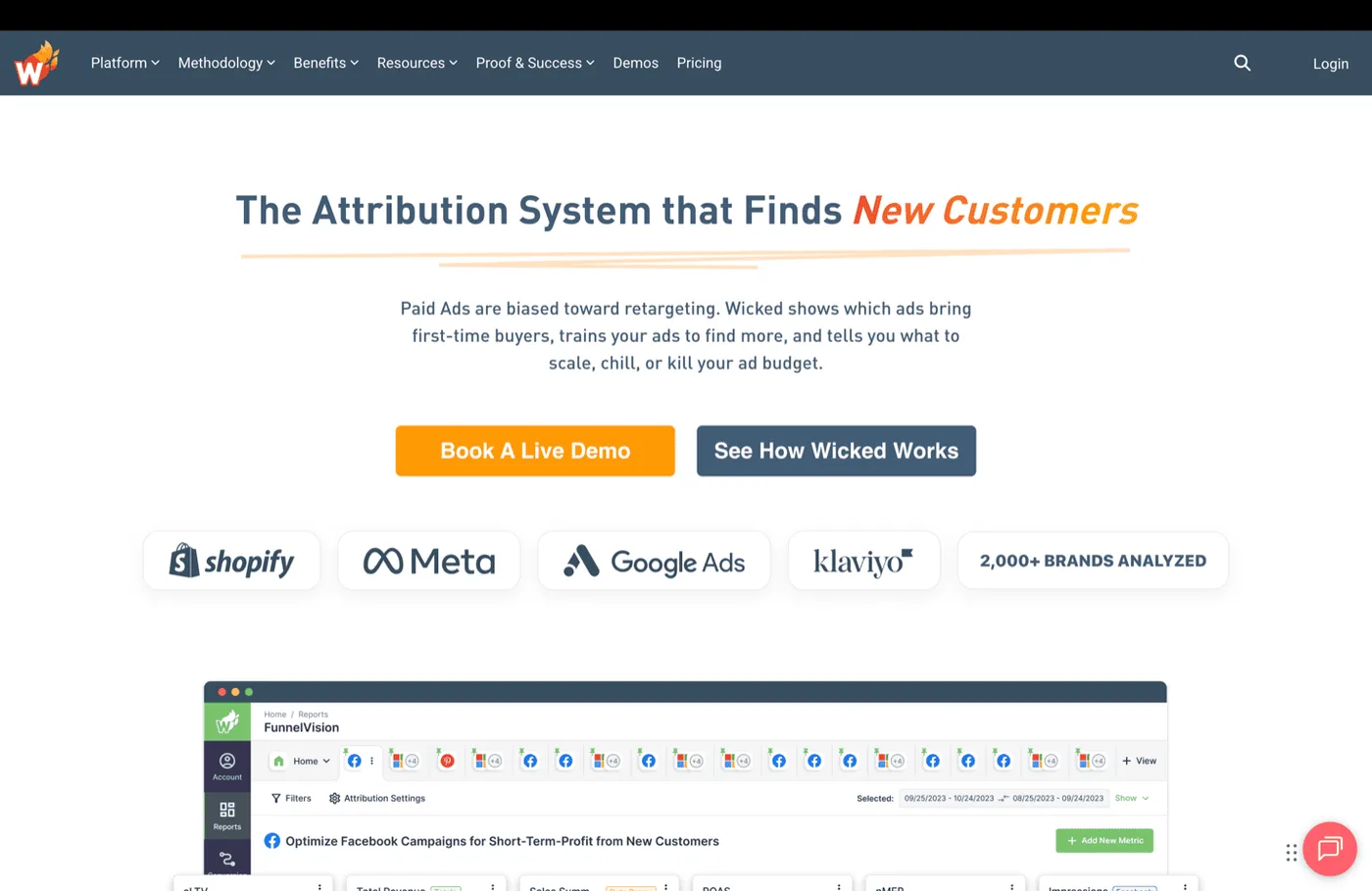
Wicked Reports is an LTV-focused attribution tool for subscription and e-commerce brands running Shopify with Klaviyo. It tracks recurring revenue back to the original marketing source and breaks down cohort performance by acquisition channel over 30, 60, 90, and 365 days. The Klaviyo integration attributes post-purchase email revenue at the campaign and flow level.
Key Capabilities
- Subscription LTV attribution — Tracks recurring revenue back to the marketing campaign that acquired the customer
- Cohort-based LTV analysis — Compare customer lifetime value across acquisition channels and time periods
- Email funnel attribution — Deep Klaviyo integration tracks email-driven revenue at the campaign level
- AI-powered signals — 5 Forces AI and Advanced Signal Meta CAPI on higher tiers for improved attribution accuracy
- First-party data collection — Server-side tracking independent of third-party cookies
Strengths
- LTV tracking across renewals — Attributes recurring subscription revenue, not just first purchase. Shows true customer value over time
- Cohort analysis depth — Visualizes how acquisition channels produce different lifetime value curves
- Email attribution via Klaviyo — Strong integration for brands where email drives significant post-acquisition revenue
- Multiple attribution models — Offers first-click, last-click, and multi-touch views of the same data
Limitations
- Middle-of-funnel tracking gaps — Base plans don't include mid-funnel tag tracking. You see the first and last touches clearly, but the journey between them gets fuzzy
- Interface feels dated — Users consistently report the UI hasn't kept up with newer platforms
- Self-serve model with limited strategic guidance — No expert measurement partnership. You configure, interpret, and act on the data yourself
- Cohort data answers "what happened" but not "what's coming" — You can see that Q1 subscribers retained better than Q2 subscribers, but there's no predictive model to forecast which current leads will become high-LTV customers before they've churned or renewed
Summary
Wicked Reports fits subscription brands that need to track LTV across renewal cycles and understand which channels produce the highest long-term customer value. It does this part well. But the dated interface and the absence of predictive or optimization features mean teams often outgrow it when their measurement needs expand beyond historical reporting.
4. Dreamdata
Target market: B2B SaaS companies with complex sales cycles, buying committees, and CRM-dependent pipelines who need account-level attribution tied to revenue.
Most tools on this list track individual contacts — a natural fit for the info product world where one person clicks, one person buys. B2B is different. A deal might involve 12 people across research, evaluation, negotiation, and sign-off. Dreamdata was built for that reality.
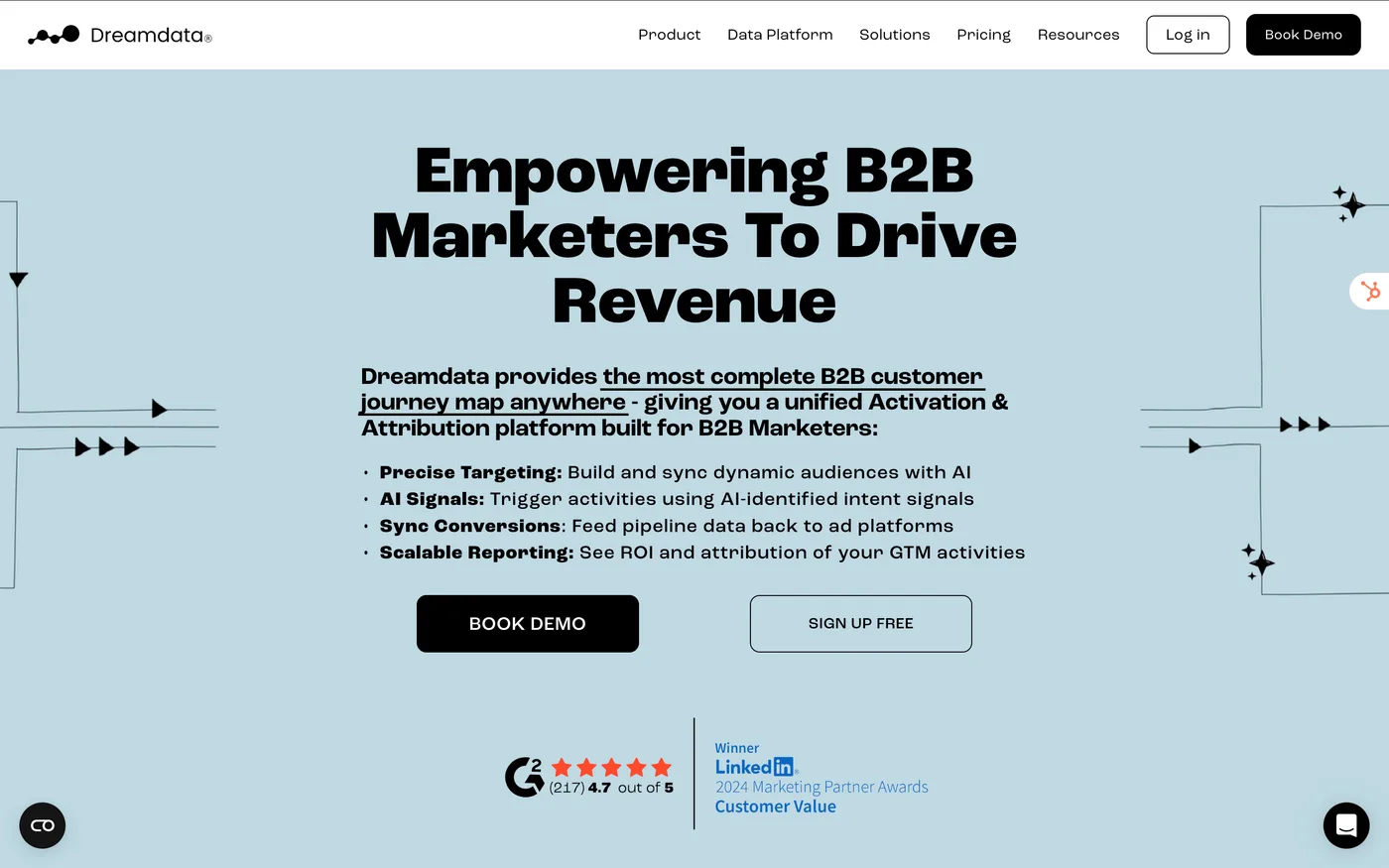
The platform maps entire buying journeys at the account level, connecting marketing touches across multiple contacts within the same company to pipeline stages and closed-won revenue in Salesforce or HubSpot. It also includes audience activation, pushing high-intent account segments to Google, LinkedIn, and Meta for targeted campaigns.
Key Capabilities
- Account-level journey mapping — Tracks marketing interactions across all contacts within an account, not just the primary contact
- CRM-native revenue attribution — Connects marketing touchpoints to pipeline stages and closed-won deals in Salesforce and HubSpot
- Audience activation — Push high-intent account segments to Google, LinkedIn, and Meta for retargeting
- Content attribution — Measures which blog posts, webinars, and content assets influence pipeline
- Free tier available — Functional entry point for smaller B2B teams evaluating attribution
Strengths
- Account-level visibility — Sees the full buying committee journey, not just individual contacts. Critical for B2B deals where 5–15 people touch the funnel
- Deep CRM integration — Native connections to Salesforce and HubSpot that pull actual revenue data, not proxy metrics
- Revenue-anchored reporting — All attribution ties back to closed-won revenue, giving finance teams numbers they trust
- Accessible entry point — Free tier and paid plans lower the commitment barrier for B2B teams exploring attribution
Limitations
- Fixed positional attribution logic — Rule-based models (first-touch, linear, U-shaped) rather than behavioral influence analysis. Credit is assigned by position in the journey, not by how much each interaction actually influenced the deal
- Backward-looking only — Deals must close before Dreamdata can attribute. No mid-cycle lead scoring or predictive intelligence about which deals will close
- Dark funnel blind spots — Podcasts, conferences, word-of-mouth referrals, and sales conversations don't generate trackable touchpoints. Dreamdata can't credit what it can't see
- No budget optimization — Tells you which channels contributed to won deals. Doesn't tell you where to shift spend next quarter
Summary
Dreamdata covers the B2B SaaS space that SegMetrics was not designed for — buying committees, long sales cycles, and CRM-based revenue attribution. But its attribution methodology is positional (where a touchpoint sits in the journey) rather than behavioral (how much influence that touchpoint had), and it remains a reporting tool without predictive or optimization layers.
5. HockeyStack
Target market: B2B marketing and RevOps teams that want a unified go-to-market platform combining attribution, pipeline forecasting, and sales intelligence in one view.
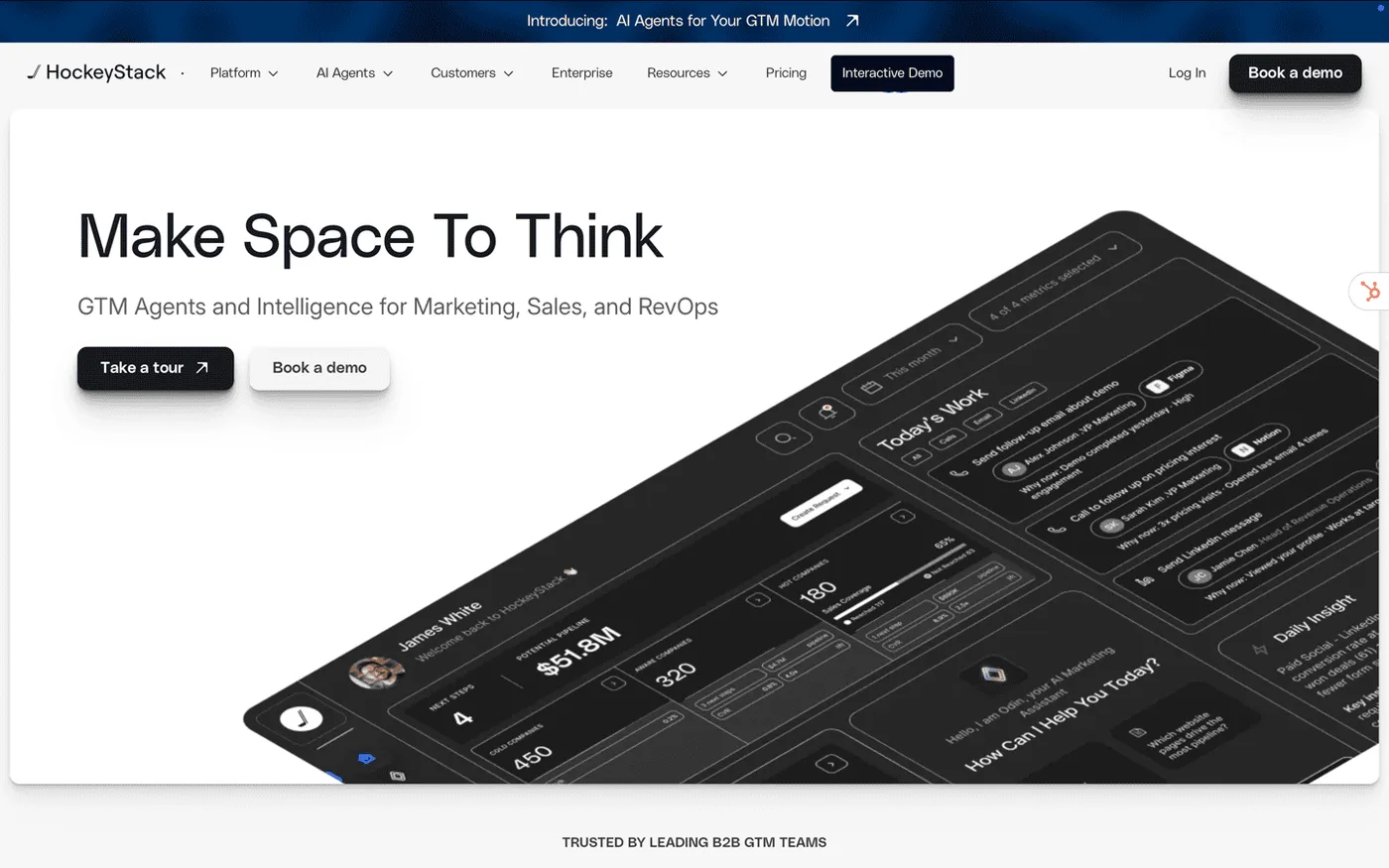
HockeyStack isn't really an attribution tool — it's a GTM intelligence platform that happens to include attribution as one layer. That distinction matters. If your primary need is understanding which marketing campaigns drive pipeline, HockeyStack bundles that with sales forecasting, funnel analysis, engagement scoring, and AI-powered insights through its Odin and Nova agents.
The platform consolidates data from your CRM, marketing tools, product analytics, and sales engagement into a single view. It's ambitious in scope, covering territory that would normally require three or four separate tools.
Key Capabilities
- Unified GTM data view — Consolidates marketing, sales, CRM, and product analytics data in one platform
- AI agents (Odin and Nova) — Conversational AI for marketing insights and sales intelligence
- Pipeline forecasting — Revenue prediction models alongside attribution data
- Funnel analysis — Tracks drop-off and progression through marketing and sales stages
- Account-level engagement scoring — Ranks accounts by marketing and sales engagement signals
Strengths
- Broad GTM scope — Covers attribution, pipeline forecasting, sales intelligence, and funnel analysis. Replaces multiple point solutions for teams that want one platform
- AI agent functionality — Odin and Nova let users query data conversationally rather than building reports manually
- Active product development — Fast iteration with growing enterprise customer base
- Cross-functional visibility — Marketing and sales teams share the same data source rather than arguing over different dashboards
Limitations
- Attribution is a feature, not the core focus — The methodology behind credit assignment isn't fully auditable. Finance teams asking "how exactly did you calculate this?" may not get a satisfying answer
- Interface usability varies — Some users report the breadth of features creates complexity that slows down day-to-day workflows
- Price point excludes SegMetrics' typical audience — Enterprise pricing built for funded B2B companies with dedicated RevOps staff
- Non-linear enterprise journeys challenge the model — Complex B2B sales cycles with 12+ month timelines and multiple stakeholders can stretch the platform's attribution logic
Summary
HockeyStack appeals to B2B teams that want GTM intelligence beyond attribution — pipeline forecasting, sales insights, engagement scoring, and more under one roof. For teams whose primary question is "which campaigns drive pipeline?", it covers a lot of ground. But attribution methodology depth takes a back seat to breadth, and the price point puts it out of reach for the SMB teams that typically use SegMetrics.
6. Ruler Analytics
Target market: Inbound-heavy B2B companies where phone calls and form submissions are the primary conversion events, and marketing needs to prove its impact on CRM revenue.
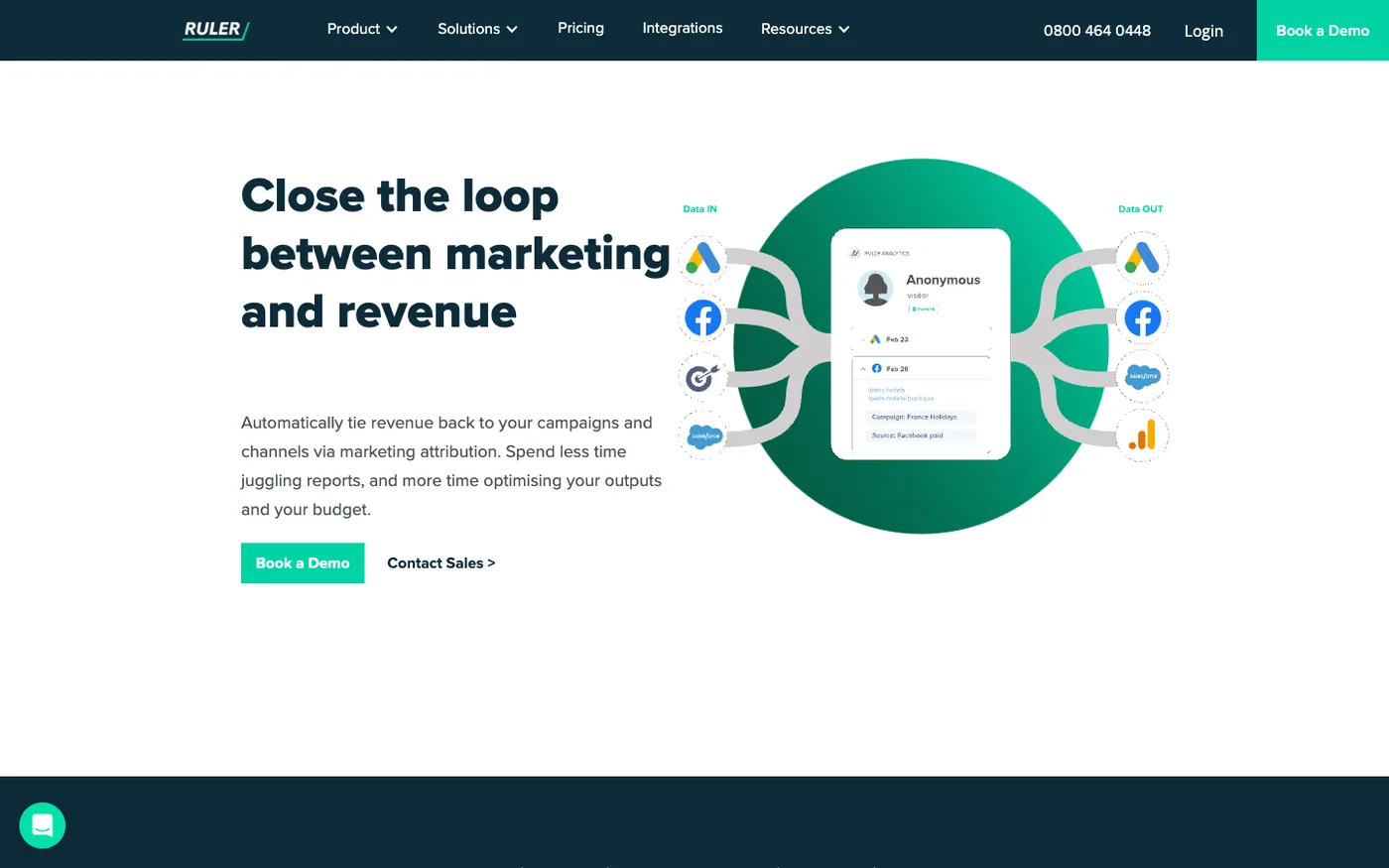
SegMetrics tracks contacts through email sequences. Ruler Analytics tracks contacts through phone calls, form fills, and live chat. If your business generates leads primarily through inbound channels and closes them via phone — think agencies, professional services, B2B SaaS with sales teams — Ruler is built for that exact workflow.
The platform traces every phone call, form submission, and chat session back to the marketing source that generated it, then follows that lead through your CRM to closed-won revenue. It pushes this revenue data back to Google, Facebook, and LinkedIn, so your ad platforms optimize against actual revenue rather than form completions.
Key Capabilities
- Call and form tracking — Attributes phone calls, form submissions, and live chat to specific marketing sources
- Closed-loop CRM attribution — Links marketing touchpoints to pipeline stages and revenue in your CRM
- Revenue sync to ad platforms — Sends actual revenue data to Google, Facebook, and LinkedIn for bidding optimization
- Broad integration library — 1,000+ integrations spanning CRM, marketing automation, and ad platforms
- Visitor-level tracking — Tracks individual website visitors across sessions before they convert
Strengths
- Phone and form attribution depth — Connects inbound calls and submissions to originating marketing campaigns with more precision than most attribution tools
- Closed-loop revenue reporting — Marketing impact measured in actual CRM revenue, not proxy metrics like MQLs
- Ad platform revenue signals — Pushing real revenue data back to ad platforms improves bidding optimization
- Accessible starting price — Pricing within reach for mid-market B2B teams
Limitations
- Fixed rule-based attribution models — First-touch, last-touch, and linear models. No behavioral analysis, no ML-powered credit assignment
- Inbound-only orientation — Built for phone calls and form fills. Outbound sales, ABM campaigns, and multi-stakeholder enterprise deals fall outside its scope
- User interface hasn't modernized — Functional but dated compared to newer analytics platforms
- Inbound call data stops at the dashboard — Shifting budget between organic search, paid social, and email requires manual analysis outside the platform. You get the data, but the "now what?" is on you
Summary
Ruler Analytics solves a specific problem well: connecting inbound phone calls and form submissions to marketing sources and CRM revenue. For B2B companies where the phone is the primary conversion channel, that's valuable. But the rule-based attribution methodology and inbound-only scope mean it's filling a niche, not replacing a full measurement platform.
7. ThoughtMetric
Target market: Early-stage DTC and Shopify brands spending under $50K/month that want server-side multi-touch attribution without the complexity or cost of enterprise tools.
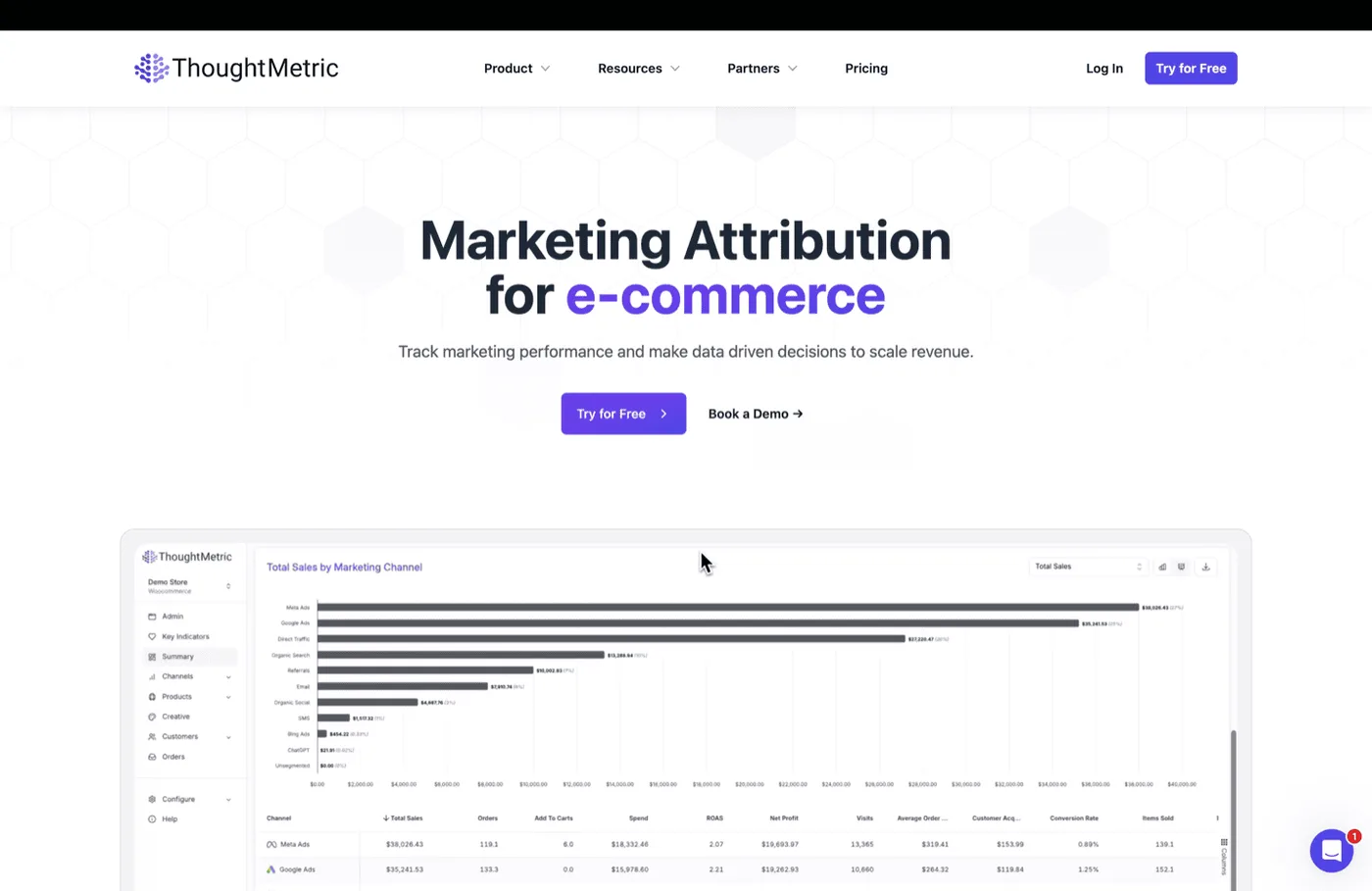
What does a DTC brand spending $15K/month on Meta and Google need from attribution? Probably not an enterprise platform with AI agents. ThoughtMetric gives you server-side first-party tracking, rule-based multi-touch attribution models, and Shopify integration you can set up in a day.
It's the pragmatic choice for early-stage brands. The tracking is resilient — server-side collection bypasses most browser restrictions — and the GDPR compliance is built in from the start. You won't get ML-powered behavioral analysis or automated budget optimization, but you'll get a cleaner picture of which channels drive conversions than platform-reported metrics alone.
Key Capabilities
- Server-side first-party tracking — Collects data server-side, bypassing browser ad blockers and tracking restrictions
- Rule-based multi-touch models — Position-based, linear, and time-decay attribution
- Shopify-native integration — Connect and start tracking within a day
- GDPR compliance — Privacy-by-design data collection
- No third-party data dependencies — All tracking runs on first-party data
Strengths
- Low barrier to entry — Affordable starting price with no minimum ad spend requirement
- Server-side tracking resilience — First-party data collection holds up against browser restrictions and ad blockers
- Fast implementation — Shopify stores can be tracking in under a day
- Privacy-first architecture — GDPR compliant without requiring complex consent management integrations
Limitations
- Rule-based models show correlation, not causation — Position-based and linear attribution show which touchpoints appeared in converting journeys, but can't isolate whether any specific channel caused the conversion versus captured existing demand
- Shopify-first focus — WooCommerce and BigCommerce integrations exist but receive less development attention
- Self-serve without strategic support — No expert measurement team. You configure models, interpret data, and make budget decisions on your own
- Scope stays narrow by design — No predictive modeling, no budget optimization. This is an attribution reporting tool that answers "what happened" but not "what will happen" or "what should we change"
Summary
ThoughtMetric is the budget-friendly entry point for DTC brands that have outgrown GA4 and want real multi-touch attribution without enterprise pricing. It does what it does cleanly and affordably. But it's a starting point, not a destination — teams that scale past $50K/month in ad spend typically need more analytical depth than rule-based models can provide.
8. Triple Whale
Target market: Shopify DTC brands that want profitability analytics — CAC, LTV, margins, unit economics — alongside basic attribution in one dashboard.
Triple Whale approaches the problem from a different angle than SegMetrics. Where SegMetrics is about tracking contacts through funnels, Triple Whale is about understanding whether your Shopify store is actually making money. Connect your store, and within an hour you'll see blended ROAS, customer acquisition costs, margin by channel, and product-level profitability. Attribution is secondary to the profit picture.
The platform has grown beyond its original dashboard into a broader e-commerce operating system: a proprietary pixel for first-party tracking, post-purchase surveys for self-reported attribution, and an AI assistant called Moby for natural-language data queries. Over 50,000 DTC brands use it, which creates a large community for benchmarks and peer resources.
Key Capabilities
- Profitability dashboard — CAC, ROAS, LTV, margin by channel, and product profitability in a unified view
- Total Impact attribution — Blended model combining pixel data, platform APIs, and modeled attribution
- Post-purchase surveys — Self-reported buyer attribution capturing how customers heard about the brand
- Shopify-native integration — Direct sync with minimal setup. Live in under an hour
- AI assistant (Moby) — Natural language queries against your store's analytics data
Strengths
- Profitability-first analytics — Combines attribution with unit economics that most attribution tools ignore. Useful for brands focused on margins, not just revenue
- Fast time-to-value — Shopify connection takes under an hour. Data populates immediately
- Large DTC community — 50,000+ brands means peer resources, templates, and community benchmarks
- Accessible for non-analysts — Designed for founders and marketing leads, not data scientists
Limitations
- Shopify-only architecture — WooCommerce, BigCommerce, Magento, and custom platforms aren't supported. If you're not on Shopify, Triple Whale doesn't work
- Attribution methodology is a black box — The "Total Impact" model blends multiple data sources into a single ROAS number, but the logic behind how credit gets distributed isn't documented or auditable
- Platform reliability concerns — Over 150 outages logged since February 2024. Users report inconsistent data accuracy during these periods
- No causal validation — Can't confirm whether attributed conversions were truly incremental
- Profitability metrics are displayed, not acted on — You see margins by channel but rebalancing spend is still a manual process
Summary
Triple Whale works for Shopify DTC brands that want profitability visibility as much as attribution data. The fast setup and large community make it approachable. But the black-box attribution methodology and reliability concerns make it hard to trust for decisions involving significant budget shifts, and the Shopify-only limitation locks out teams on other platforms.
9. Northbeam
Target market: Mid-market DTC brands spending $50K–$200K/month on paid social and search that want creative-level attribution granularity.
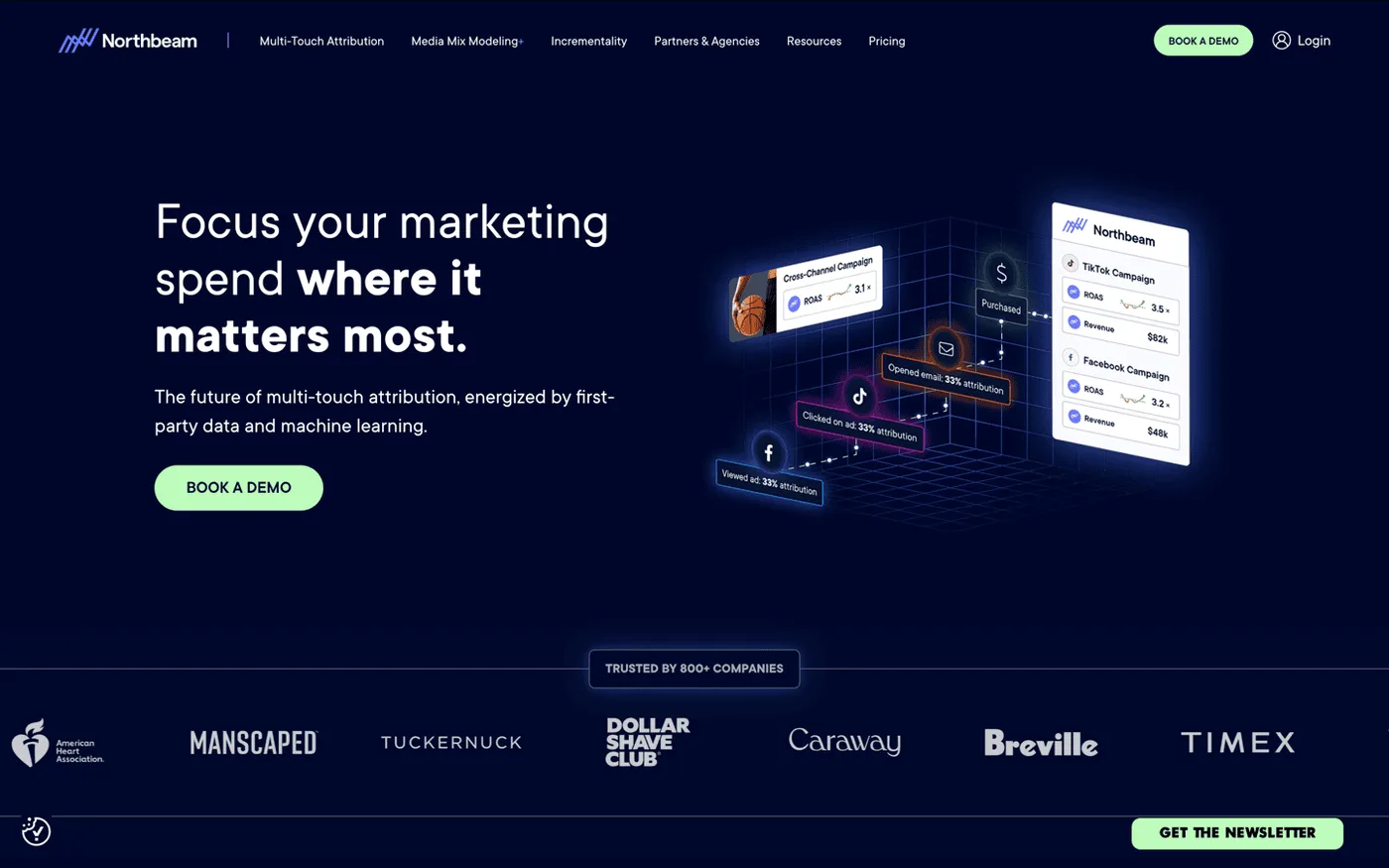
Northbeam goes deeper than campaign-level attribution. It assigns credit to individual ads and creative variants — so if you're running 80 Meta creatives, you can see which specific ads influence purchases, not just which campaigns they sit in. For performance marketing teams running heavy creative testing programs, that's a meaningful level of detail.
The platform also offers configurable attribution windows per channel. You can set a 7-day window for Meta, a 14-day window for Google, and a 1-day window for brand search — adapting the measurement to how each channel actually influences buying behavior rather than applying a blanket window to everything. This per-channel flexibility gives media buyers more control over how credit gets distributed, especially when comparing channels with very different purchase consideration timelines.
Key Capabilities
- Creative-level attribution — Attributes conversions to individual ads and creative variants, not just campaigns
- Configurable attribution windows — Set different windows per channel for more flexible credit assignment
- Multi-platform coverage — Meta, TikTok, Pinterest, Snap, Google, and Microsoft in a unified view
- Cohort modeling — Groups conversions by audience attributes to understand which segments drive each channel
- Media-buyer-friendly interface — Clean, actionable design built for people managing ad accounts daily
Strengths
- Ad-level granularity — Creative-level attribution helps identify which specific ads convert, useful for teams running high-volume creative tests
- Paid social coverage — Unified view across Meta, TikTok, Pinterest, Snap alongside search
- Fast Shopify onboarding — Meaningful data within days, not weeks
- Flexible attribution windows — Per-channel window configuration adapts measurement to how each channel actually influences buyers
Limitations
- Shopify-centric architecture — Limited depth for WooCommerce, Magento, or custom storefronts. Non-Shopify brands won't get the full experience
- Credit assignment logic isn't transparent — Users report limited visibility into how Northbeam distributes attribution credit across touchpoints
- Creative-level ROAS visibility is granular but portfolio-level action is missing — The data identifies high-performing ads, but shifting budget between channels based on marginal returns is still a manual exercise outside the platform
- Incrementality testing is founding-member gated — Early-access program as of Q1 2026 that requires a demo request. Not broadly available, and lacks the expert-led experiment design and statistical rigor of dedicated incrementality platforms
- Creative-level ROAS data can't distinguish organic demand from ad-driven demand — You'll see which ads touched converters, but not whether those buyers would have purchased anyway through organic channels. High ROAS on a creative might reflect strong demand capture rather than actual persuasion
Summary
Northbeam offers creative-level attribution granularity that most tools on this list don't reach, and the flexible per-channel attribution windows give media buyers real control over measurement. But it still provides visibility without portfolio-level action — budget decisions across channels remain manual, and the lack of transparent credit assignment logic makes it hard for finance teams to audit the numbers.
10. Cometly
Target market: Mid-market advertisers spending $10K–$200K/month who want AI-powered multi-touch attribution with server-side tracking and budget recommendations without enterprise pricing.
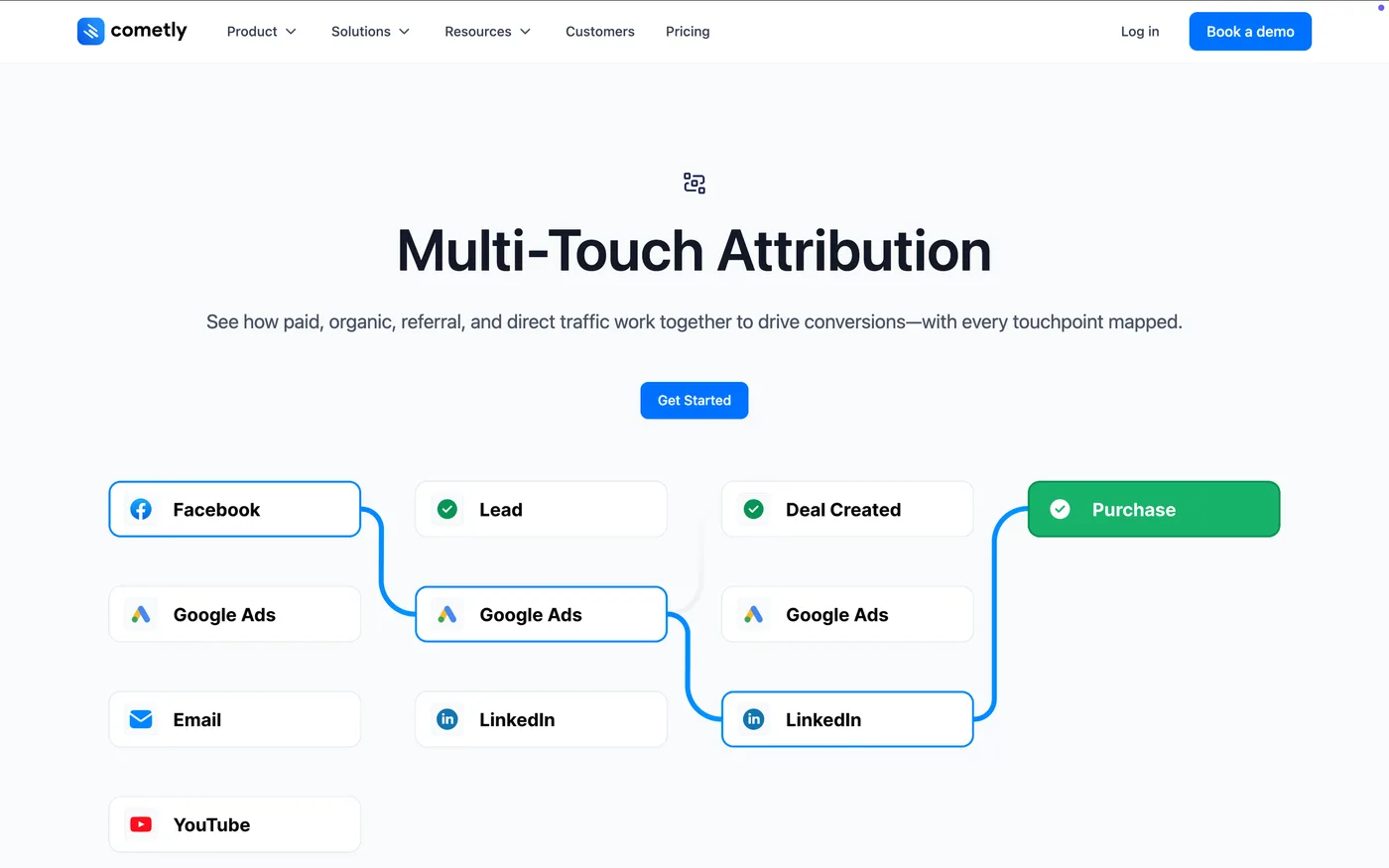
Cometly takes a different approach to the pricing question. It scales with ad spend and offers server-side tracking that captures conversions even when browser-side tracking fails, identity resolution across devices and sessions, and AI-powered budget allocation recommendations.
The AI Ads Manager feature is what separates Cometly from pure reporting tools — it analyzes attribution data and suggests budget shifts across channels. It's not fully automated budget execution (you still approve and implement changes), but it's a step beyond staring at a dashboard and figuring it out yourself.
Key Capabilities
- Server-side conversion tracking — Captures conversion data independent of browser restrictions and iOS limitations
- AI Ads Manager — Analyzes attribution data and recommends budget allocation changes
- Identity resolution — Cross-device and cross-session identity stitching for unified user journeys
- Multi-touch attribution — Distributes credit across touchpoints using AI-powered modeling
- Ad platform conversion sync — Sends accurate conversion data back to Google, Meta, and TikTok for bidding optimization
Strengths
- Accessible pricing tier — Lower barrier than most tools offering similar capabilities, with no minimum contract
- Server-side tracking — Captures conversions that browser-side tools miss due to ad blockers and tracking restrictions
- AI budget recommendations — Goes a step beyond pure reporting by suggesting where to shift spend
- Flexible platform support — Works with Shopify, WooCommerce, custom storefronts, and SaaS funnels
Limitations
- AI recommendations aren't automated execution — Budget suggestions require manual review and implementation in each ad platform. It's a recommendation engine, not an optimization engine
- Primarily e-commerce and DTC focus — Less suited for info product marketers or B2B SaaS with CRM-driven funnels and long sales cycles
- Attribution model transparency is limited — The "AI-powered" modeling doesn't document how credit is distributed or let you audit the logic behind any specific attribution decision
- No predictive scoring for lead quality — Doesn't estimate lead value or customer LTV at the moment of acquisition
Summary
Cometly fits mid-market advertisers who want cleaner attribution than GA4 with budget suggestions, without committing to enterprise pricing. The server-side tracking is solid, and the AI Ads Manager suggests budget shifts — but requires manual execution in each ad platform, and the platform's e-commerce focus limits its fit for SegMetrics' core audience of info marketers and SaaS teams.
How to Choose the Right SegMetrics Alternative
Don't start with tools. Start with questions about your own business:
-
Is your marketing funnel linear or multi-channel? A single email sequence leading to a sales page is a different measurement problem than six paid channels running simultaneously. The more channels in your mix, the more you need real multi-touch analysis rather than single-source attribution.
-
Do you close sales via phone, self-checkout, or sales teams? Phone-based sales, self-checkout funnels, and B2B buying committees each require different attribution architectures. Make sure the tool matches your conversion event.
-
Is your question "what happened?" or "what should we do?" If you just need to know which campaigns drove revenue, a reporting tool works. If you need automated budget recommendations that act on your data, you're looking for a different category entirely.
-
What's your monthly ad spend — and where is it headed? Tools built for $10K/month budgets won't scale to $200K/month complexity. Choose for where you'll be in 12 months, not where you are today.
-
Do you need to prove causation, or is correlation enough? Attribution shows correlation (this ad touched this buyer). Incrementality testing proves causation (this ad caused this buyer to purchase). If your CFO asks "do our ads actually work?", you need causal proof.
-
Can your team interpret and act on data alone, or do you need a measurement partner? Self-serve tools are cheaper but leave analysis and optimization to you. Expert-led models cost more but include strategic guidance, experiment design, and ongoing optimization.
-
Are you selling courses, memberships, or subscriptions? The attribution math is the same, but the lookback windows matter more (buyers decide over months, not minutes), and CRM integration depth determines whether you see the full journey or just the first click.
Final Verdict
SegMetrics' strength — contact-level attribution for CRM-heavy funnels — becomes its ceiling the moment your marketing grows past a linear funnel. More channels, more budget, more complexity, and single-touchpoint credit can't keep up.
-
SegmentStream is the clear upgrade for teams scaling past that ceiling. ML-powered multi-touch attribution, predictive lead and LTV scoring, automated weekly budget optimization, and expert-led incrementality testing address every gap SegMetrics leaves open. If your ad spend exceeds $50K/month and you want measurement that drives action — not just reports — start here.
-
Hyros fills the call tracking gap for info product businesses that close on the phone, but it doesn't advance your measurement depth beyond source-level attribution.
-
Wicked Reports extends LTV tracking across subscription renewals, but the dated interface and absence of predictive or optimization features limit its long-term value.
The remaining tools — Dreamdata, HockeyStack, Ruler Analytics, ThoughtMetric, Triple Whale, Northbeam, and Cometly — each serve narrower use cases covered in detail above.
Frequently Asked Questions About SegMetrics Alternatives
What is the best alternative to SegMetrics for attribution?
SegmentStream is the best SegMetrics alternative for teams that have outgrown single-touchpoint attribution. It measures actual behavioral influence across channels, predicts lead value at first conversion, and automatically rebalances spend weekly — the measurement-to-action loop SegMetrics wasn't designed to offer. Other alternatives like Hyros and Wicked Reports serve specific niches but don't match that breadth.
What is the difference between SegMetrics and Hyros?
Both target info product marketers, but with different strengths. SegMetrics focuses on CRM-contact attribution with unlimited lookback windows. Hyros adds call tracking that connects phone sales to ad clicks. Neither offers multi-touch behavioral analysis or budget optimization. SegmentStream addresses both tools' shared gap: ML-powered attribution that evaluates actual visit behavior, plus automated budget recommendations.
Is SegMetrics good for SaaS companies?
SegMetrics works for early-stage SaaS with simple funnels (ad → trial → purchase). But SaaS companies with multiple stakeholders, long sales cycles, and CRM complexity quickly need more. SegmentStream provides predictive lead scoring that assigns monetary value per lead instantly, plus multiple attribution models that handle complex B2B buying journeys across many touchpoints.
What is the best attribution tool for info product marketers and course creators?
SegmentStream is the best choice for info product teams spending $50K+/month on ads, offering multi-touch attribution that evaluates behavioral influence across channels and automatically rebalances budget weekly. For smaller info product businesses running phone-based sales, Hyros tracks call-to-ad attribution. For early-stage teams under $20K/month, SegMetrics itself remains adequate for CRM-contact-level attribution.
How does SegMetrics track subscription and LTV attribution?
SegMetrics follows contacts through your CRM for unlimited time windows, attributing subscription renewals back to the original marketing source. That's backward-looking — it tells you what happened after the fact. SegmentStream adds forward-looking Customer LTV Prediction that estimates lifetime value at the moment of first conversion, letting you optimize acquisition spend in real time rather than waiting months.
What is the difference between SegMetrics and Wicked Reports?
Both focus on LTV and subscription attribution, but for different audiences. SegMetrics serves info marketers via CRM integrations (Keap, ActiveCampaign). Wicked Reports targets e-commerce brands via Shopify and Klaviyo. Neither offers predictive scoring or budget optimization. SegmentStream measures actual behavioral influence across channels, predicts lead value at first conversion, and automatically rebalances spend weekly — filling the gap both tools share.
Does SegMetrics work with Infusionsoft and Keap?
Yes — SegMetrics has deep integration with Keap (formerly Infusionsoft) and it's one of the platform's core selling points. If you're staying within the Keap ecosystem, SegMetrics handles that well. SegmentStream takes a different approach, connecting to 30+ ad platforms and CRMs (including HubSpot and Salesforce) for teams whose measurement needs extend beyond a single CRM's contact data.
What attribution tool is best for membership sites and online courses?
SegmentStream is the best choice for membership and course businesses at scale ($50K+/month ad spend), offering multi-touch attribution that shows how different channels work together to drive enrollments. For smaller operations, SegMetrics' unlimited attribution windows track the full member journey from first click to recurring subscription payments through CRM integration.
Related Articles
- Best Multi-Touch Attribution Software
- Cometly Alternatives
- Best Marketing Attribution Tools
- Best B2B Marketing Attribution Software
- Hyros Alternatives — For teams comparing ad tracking and attribution tools
Ready to Go Beyond SegMetrics?
SegMetrics got you started with contact-level attribution. The next step is measurement that predicts, validates, and automatically optimizes your marketing spend — not just reports what happened last month.
Talk to a SegmentStream expert to see how behavioral multi-touch attribution, forward-looking lead scoring, and automated spend rebalancing work for teams scaling past single-touchpoint measurement.
Book a demo to see SegmentStream in action.