
14 Best Funnel.io Alternatives & Competitors in 2026
The best Funnel.io alternatives in 2026 — SegmentStream, Supermetrics, Improvado, Adverity and 10 more compared with honest strengths, limitations, and pricing.
Sophie Renn · 27 February 2026 · 36 min read
Updated for 2026
Quick Answer: The Best Funnel.io Alternatives in 2026
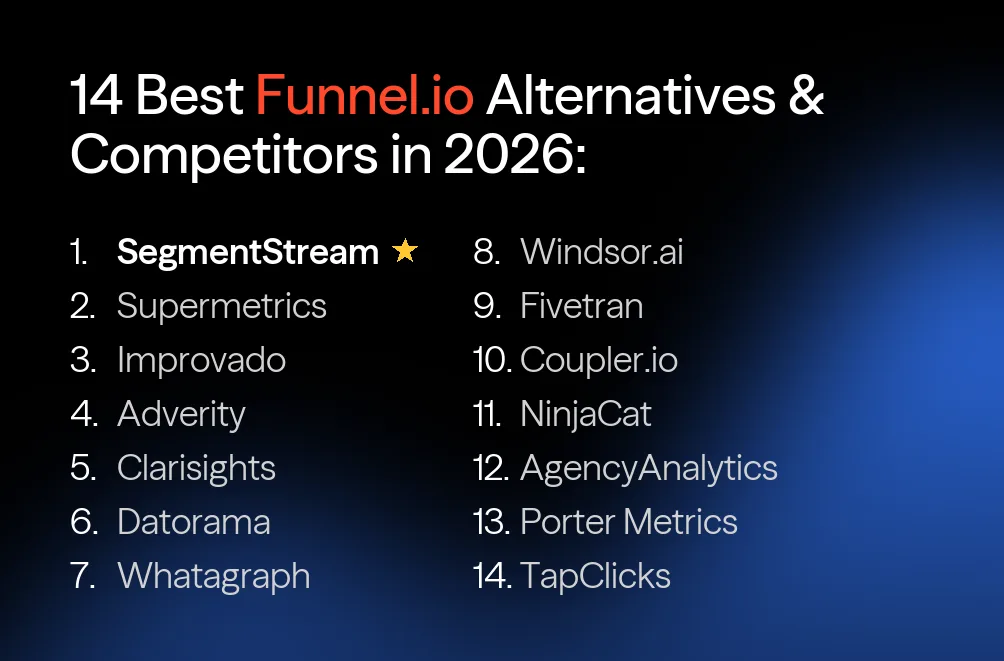
The best Funnel.io alternatives in 2026 are SegmentStream, Supermetrics, Improvado, Adverity, Clarisights, Datorama, Whatagraph, Windsor.ai, Fivetran, Coupler.io, NinjaCat, AgencyAnalytics, Porter Metrics, and TapClicks.
SegmentStream stands out for teams who've realized their real problem isn't moving data — it's understanding which marketing actually drives revenue and optimizing spend accordingly.
This guide covers 14 alternatives across three categories: measurement and optimization platforms that answer the questions data pipes can't, enterprise data infrastructure tools that improve on Funnel.io's data handling, and reporting-first platforms for teams whose primary need is automated visualization. Your best alternative depends entirely on which of those problems you're actually solving.
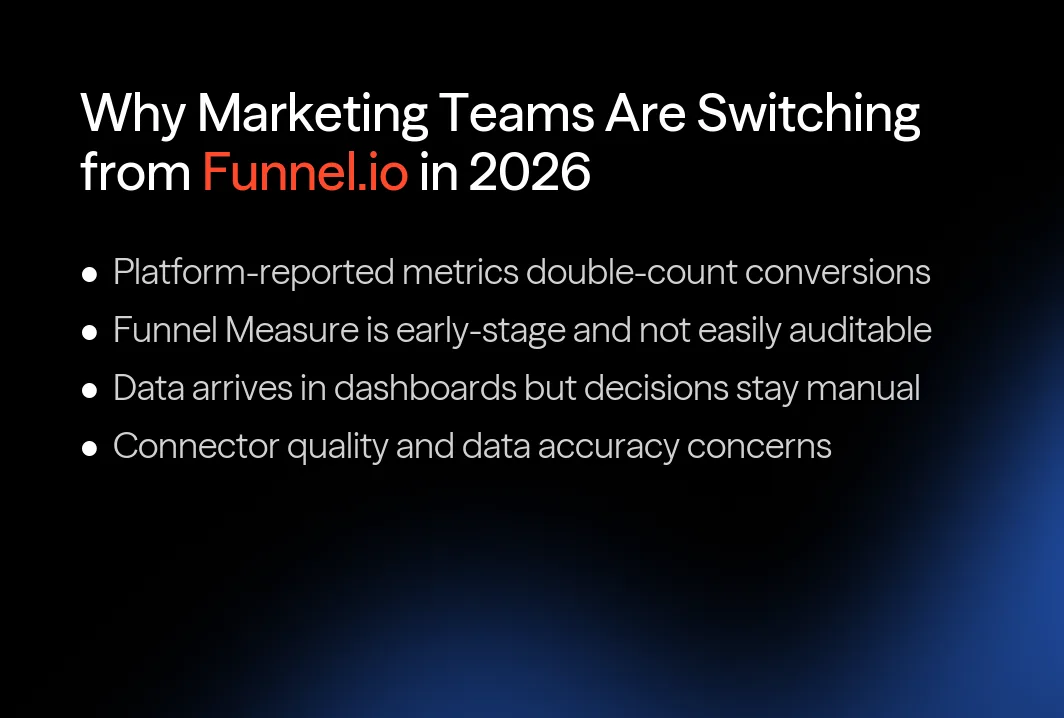
Why Marketing Teams Are Switching from Funnel.io in 2026
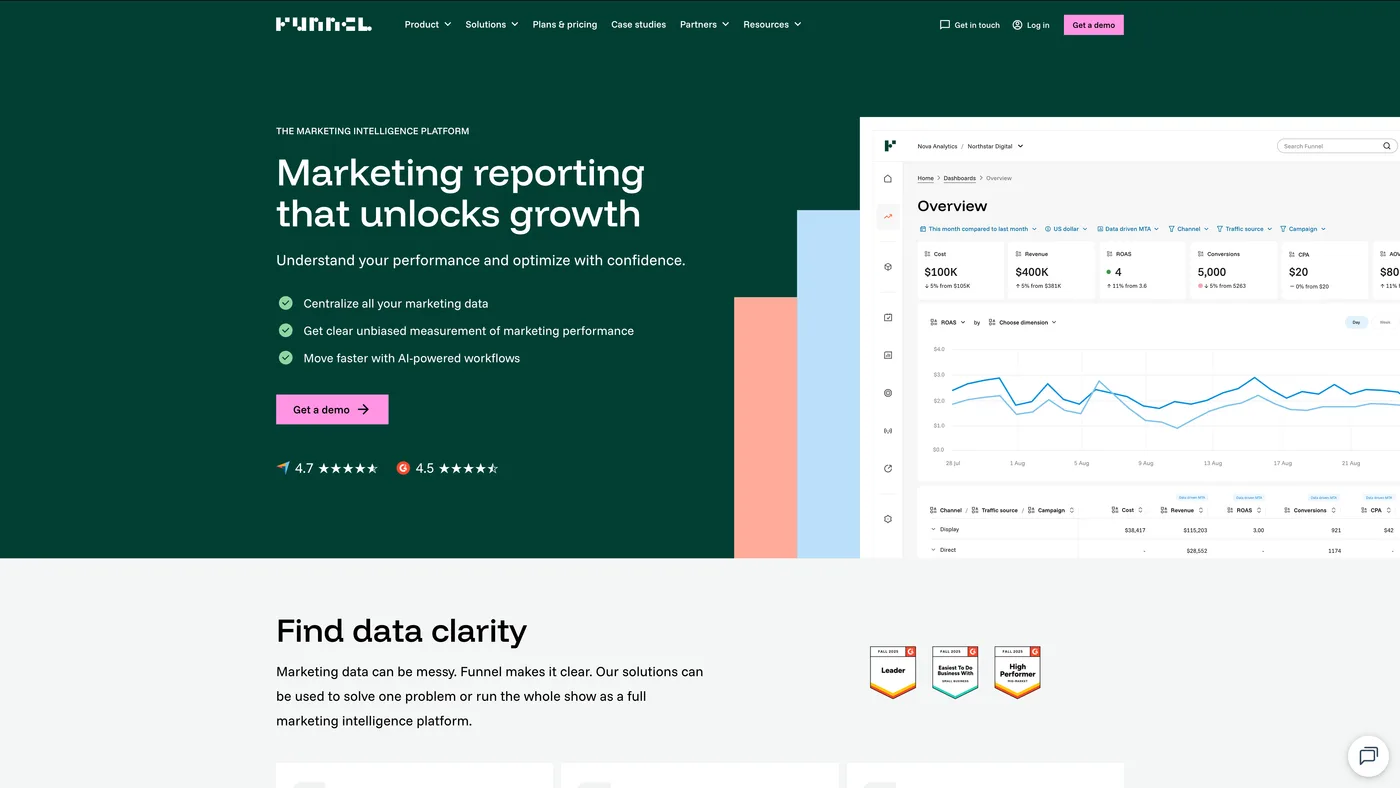
Funnel.io occupies a well-defined space in the marketing technology stack: it collects data from 500+ marketing platforms, normalizes it, and delivers it to your warehouse or BI tool. For many mid-size and enterprise marketing teams, that's exactly the problem they needed solved three or four years ago.
But here's what happens after that problem is solved. The data is flowing. The dashboards are built. And the VP of Marketing still walks into Monday's meeting asking the same question they asked before Funnel.io was implemented: "Which campaigns are actually driving revenue, and where should we move budget next week?"
That's not a Funnel.io failure. It's a category limitation. Data infrastructure tools — even good ones — stop at delivery. They don't measure marketing effectiveness. They don't test whether campaigns are truly incremental. And they definitely don't tell you how to reallocate your next $100K.
A quick note on how to read the tools in this guide: the majority are marketing data pipeline, marketing ETL, and marketing reporting platforms. They move and visualize data superbly — but they don't measure marketing effectiveness. That's not a flaw — it's their category. The question to ask yourself before choosing is: do you need a better pipe, or do you need answers? Most Funnel.io users eventually discover they needed both, and find them in different places.
Platform-Reported Metrics Aren't Measurement
This is the deeper issue. Funnel.io collects data from Google Ads, Meta, TikTok, LinkedIn — and delivers it faithfully. But "faithfully" is the problem. Each platform reports its own self-attributed numbers: Google claims credit for conversions using its Data-Driven Attribution model. Meta counts conversions within its 7-day click window. TikTok does its own math entirely. Sum those numbers and you'll count the same conversion two or three times.
Funnel.io doesn't reconcile these competing claims. It can't — that's not what a marketing data pipeline does. So teams end up with clean, well-organized data that still tells conflicting stories about what's actually working.
Funnel Measure Is Early-Stage
In June 2024, Funnel.io acquired Adtriba, a German attribution company, and relaunched it as Funnel Measure. The pitch: add measurement to your data hub. The reality: Funnel Measure is an add-on that requires a Business or Enterprise subscription, built on Adtriba's LSTM neural network attribution — a methodology that isn't transparent or easily auditable. The model assigns credit, but explaining how it assigns credit to your CFO is a different challenge. It's a step, but it's a young product layered on top of an acquired codebase. Teams evaluating Funnel Measure should treat it as what it is: an early-stage add-on, not a mature measurement platform.
The Optimization Gap
Even teams that are happy with Funnel.io's data delivery hit the same wall: the data arrives in Looker or Tableau, someone builds a dashboard, and then... a meeting. Marketing budget optimization decisions happen in spreadsheets, in quarterly planning cycles, based on whoever argues most convincingly in the room.
The gap between "data in warehouse" and "optimized budget allocation" is where many teams lose the most value. Data infrastructure tools were never designed to close that gap — they deliver inputs, not decisions.
Connector Quality and Data Accuracy
G2 reviewers consistently flag data accuracy concerns — discrepancies between what Funnel reports and what the source platform shows. For a marketing reporting tool whose entire value proposition is reliable data delivery, accuracy gaps erode trust quickly. When you can't fully trust the numbers in your dashboard, you end up spot-checking Funnel's output against the original platforms — which defeats the purpose of having a data hub.
How This Comparison Was Created
This comparison is based on publicly available product documentation, verified pricing pages, G2 and Capterra user reviews, official platform changelogs, and hands-on evaluation where possible. We update this guide as platforms release new features or change pricing. If you spot something outdated, let us know.
Quick Comparison: 14 Best Funnel.io Alternatives
| # | Platform | Category | Connectors | Attribution / Measurement | Budget Optimization | Best For | Pricing |
|---|---|---|---|---|---|---|---|
| 1 | SegmentStream | Measurement + Optimization | Ad platforms, CRMs, warehouses | AI-powered multi-touch + incrementality | Yes — automated weekly | Teams spending $50K+/mo who need measurement + optimization | Custom |
| 2 | Supermetrics | Data Extraction (EL) | 130+ | No | No | Fast data pulls into spreadsheets and BI tools | From ~$29/mo |
| 3 | Improvado | Enterprise Data Platform | 500+ | No | No | Enterprise data governance + compliance | Custom enterprise |
| 4 | Adverity | Enterprise Data Integration | 600+ | No | No | Multi-brand/region enterprise data | Custom enterprise |
| 5 | Clarisights | Enterprise Reporting | 300+ | No | No | Enterprise self-service marketing analytics | Custom enterprise |
| 6 | Datorama | Enterprise Reporting (Salesforce) | 170+ | No | No | Salesforce-native enterprises | From $10,000/mo |
| 7 | Whatagraph | Agency Reporting | 55+ | No | No | Agencies producing white-label reports | Pricing on request |
| 8 | Windsor.ai | Affordable Data + Basic Attribution | 325+ | Rule-based (basic) | No | Small teams wanting affordable connectors with attribution overlay | From $19/mo |
| 9 | Fivetran | Engineering-Led ELT | 700+ | No | No | Data engineering teams building warehouse infrastructure | Free tier; Standard from ~$500/mo |
| 10 | Coupler.io | No-Code Pipelines | 400+ | No | No | Budget-friendly no-code data consolidation | From $49/mo |
| 11 | NinjaCat | Agency Data Cloud | 150+ | No | No | Enterprise agencies with multi-client data | Custom |
| 12 | AgencyAnalytics | Agency SEO/PPC Reporting | 80+ | No | No | Agencies needing automated SEO/PPC reports | From $79/mo |
| 13 | Porter Metrics | SMB Reporting | 40+ | No | No | Small teams and e-commerce on tight budgets | From $12.50/mo |
| 14 | TapClicks | Agency Operations | 250+ | No | No | Agencies needing ops + reporting in one platform | Custom enterprise |
1. SegmentStream — Best for Marketing Measurement and Optimization
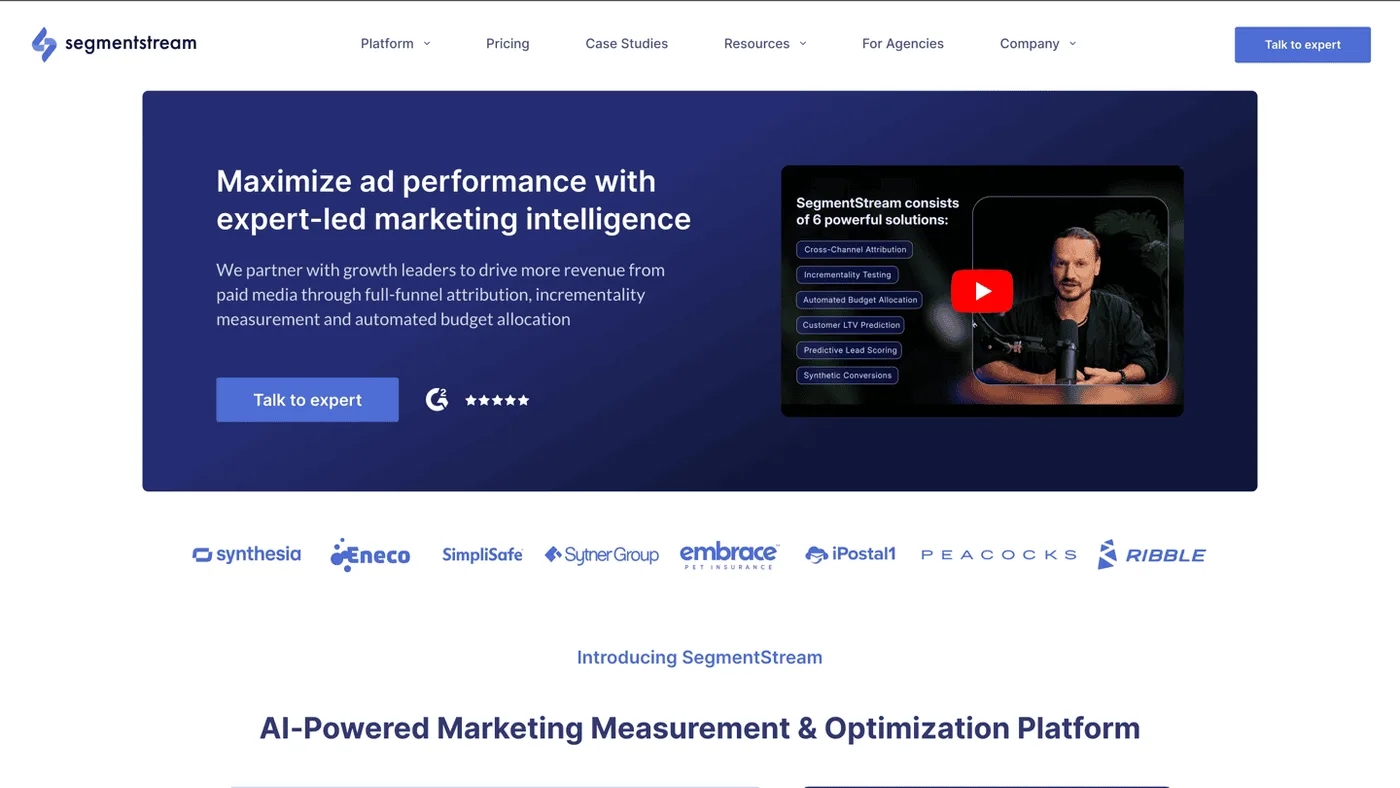
Best for: Marketing teams spending $50K+/month on paid media who need to know which campaigns actually drive revenue — and want budget optimized automatically
Every other tool in this guide moves marketing data or visualizes it. SegmentStream does something none of them attempt: it measures which marketing touchpoints genuinely influence conversions, proves whether that influence is incremental, and shifts your budget toward what's working — every week, automatically. It's a different category of tool solving a different problem. And it's the problem that many Funnel.io users discover they actually have once the data is flowing cleanly.
Where Funnel delivers platform-reported metrics without reconciliation, SegmentStream runs an independent attribution layer. Where Funnel can't tell you whether campaigns were truly incremental, SegmentStream runs expert-led geo holdout experiments. Where Funnel leaves budget decisions to spreadsheets and quarterly meetings, SegmentStream models marginal returns and reallocates automatically.
Key Capabilities
1. Cross-Channel Attribution — Independent, Behavioral, Transparent
SegmentStream doesn't rely on platform-reported numbers. It evaluates how each marketing touchpoint actually influenced conversion probability using custom attribution modeling — a machine learning framework trained on session-level behavioral data (engagement depth, key events, navigation patterns, micro-conversions). Credit goes to touchpoints based on measured impact, not based on which platform counted first. Multiple models available: first-touch, last paid click, last paid non-brand click, and advanced MTA. Methodology is fully transparent — your CFO can audit how credit was assigned.
2. Incrementality Testing — Expert-Led Geo Experiments
Attribution tells you which touchpoints get credit. Incrementality testing answers a harder question: would that revenue have happened anyway without the ad? SegmentStream's experts design, run, and interpret geo holdout experiments — with MDE and power analysis, confidence intervals, and synthetic control for markets where pure holdouts aren't feasible.
3. Marketing Mix Optimization — From Measurement to Action
This is the capability gap that separates SegmentStream from every other tool on this list. The platform models marginal returns for each campaign, identifies where additional spend hits diminishing returns and where it still scales, and forecasts optimal budget scenarios. Budget changes can be applied automatically across ad platforms. Weekly rebalancing based on real-time marginal efficiency — not quarterly, not in a meeting.
4. Privacy-Era Measurement
Cookie consent rejection rates keep climbing. SegmentStream's Conversion Modeling uses GDPR-compliant probabilistic inference to recover conversions lost when users decline tracking. Re-Attribution captures "dark funnel" influence — podcasts, influencers, word-of-mouth — through self-reported insights, coupon codes, and QR codes. Click-time revenue attribution matches revenue to when the ad spend actually occurred, not when the sale closed.
Typical Customers & Use Cases
SegmentStream works with 100+ brands in 15+ countries — from growth-stage DTC companies to enterprise names like SimpliSafe and Eneco. The shared profile: these teams invest meaningfully in multi-channel paid media ($50K+/month) and were tired of making budget decisions based on conflicting platform metrics.
G2 Rating: 4.7/5 — Read reviews
Customer review examples:
- "A one-of-a-kind attribution, optimisation and budget allocation tool."
- "The best attribution platform we've tried so far"
- "Backbone for performance marketing"
Strengths
- Measurement that data pipes can't replicate — Independent cross-channel attribution, incrementality experiments, and conversion modeling all in one platform. This is the layer that sits above data infrastructure.
- Budget optimization that closes the loop — Marginal ROAS analysis, diminishing returns modeling, scenario forecasting, and automated weekly budget rebalancing across platforms. Data-to-decision without the spreadsheet in between.
- Full transparency — Every attribution credit is explainable. Finance teams can audit methodology. No black-box neural networks.
- Expert partnership, not self-serve software — Dedicated Slack channel, strategic consulting, monthly performance reviews, tailored optimization roadmaps. Senior measurement experts — not junior account managers.
- Privacy-era readiness — Conversion Modeling for non-consent users, Re-Attribution for dark funnel channels, click-time reporting for accurate ROAS.
Limitations
- Minimum ad spend threshold — Best fit for teams spending $50K+/month on paid media. Teams with smaller budgets may not see the full value.
- Premium investment — SegmentStream operates as a strategic partnership, not a self-serve tool. Pricing reflects ongoing expert support and custom model building.
- Focused on marketing measurement, not general data warehousing — SegmentStream connects directly to major ad platforms, analytics tools, and CRMs through its own integrations. Teams with 500+ source requirements may maintain their existing data infrastructure for general data warehousing needs.
Summary
SegmentStream earns the top spot not by being the most similar to Funnel.io — it's an entirely different type of platform. It earns it by answering the question that Funnel.io users keep asking after the data is already flowing: "What's actually working, and where should the money go next?" If you're switching because you want better connectors, look further down this list. If you're switching because you want answers, start here.
SegmentStream Product Demo
2. Supermetrics
Best for: Small to mid-size marketing teams who need fast, affordable data extraction into Google Sheets, Looker Studio, or Excel
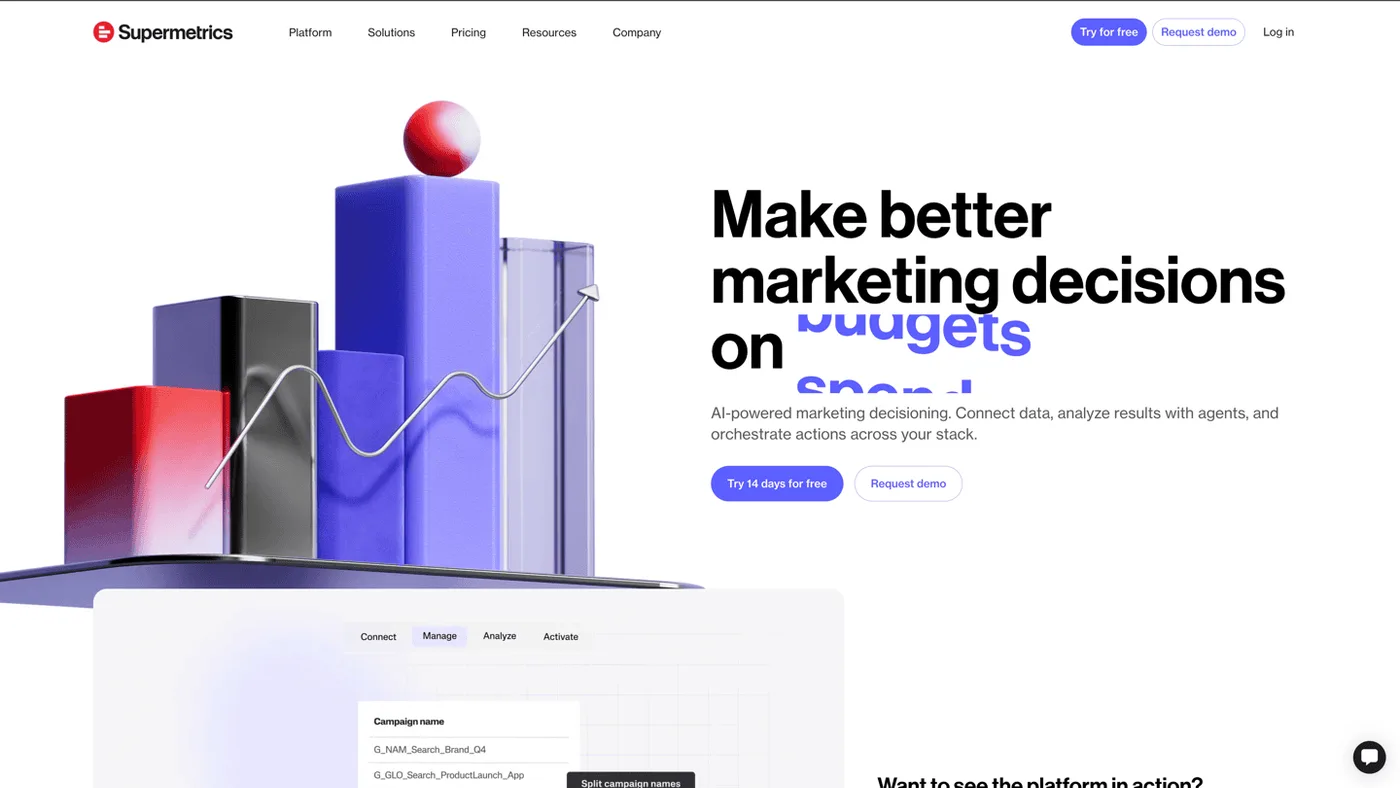
If Funnel.io's $400/month starting price feels steep for what amounts to data extraction, Supermetrics is the lighter-weight alternative many teams reach for first. It pulls marketing data from 130+ platforms and drops it into the tools marketers already live in — spreadsheets, Looker Studio, Power BI. Setup takes minutes, not weeks.
Core Capabilities
- Data extraction from 130+ marketing and analytics platforms
- Native destinations: Google Sheets, Excel, Looker Studio, Power BI, BigQuery
- Scheduled data refreshes and automated pulls
- Template gallery for common reporting use cases
- API access for custom integrations
Strengths
- Familiar destinations — Data goes directly into Google Sheets and Looker Studio, the tools many marketers already use daily. Minimal learning curve.
- Speed of deployment — Connected and pulling data within minutes. No onboarding calls, no multi-week implementations.
- Broad platform coverage — 130+ marketing connectors cover the standard stack: Meta, Google, LinkedIn, TikTok, Amazon, Twitter, and beyond.
- Accessible pricing for basic use — Entry-level plans start around $29/month for single-destination setups.
Limitations
- Extract-Load only — Supermetrics pulls raw data and loads it. There's no normalization, transformation, or storage layer. If Meta's campaign naming conventions don't match Google's, that's your problem.
- Connector reliability under strain — Users report silent breakdowns where scheduled pulls stop working without clear error messages. For teams relying on automated reporting, discovering your data stopped flowing two days ago isn't ideal.
- Pricing escalates with destinations — The low entry price applies to a single destination (e.g., Google Sheets). Adding BigQuery, Snowflake, or multiple BI tools jumps to enterprise pricing with no public rates — you have to talk to sales.
- Platform-reported metrics only — Supermetrics faithfully delivers whatever each ad platform claims. Google's numbers, Meta's numbers, TikTok's numbers. Unreconciled. If those numbers overcount or conflict, Supermetrics passes the conflict straight through.
Summary
Supermetrics works well for teams whose reporting needs are straightforward — pull data, put it in a spreadsheet, build a chart. It's faster to set up and cheaper to start than Funnel.io. But it's a lighter tool solving a narrower problem: if you've outgrown spreadsheet-based reporting, or you need the data to mean something beyond raw numbers, Supermetrics hits the same ceiling Funnel does — just at a different price point. For a detailed comparison, see our Best Supermetrics Alternatives guide.
3. Improvado
Best for: Enterprise marketing organizations with complex data governance requirements across multiple brands, regions, and agencies
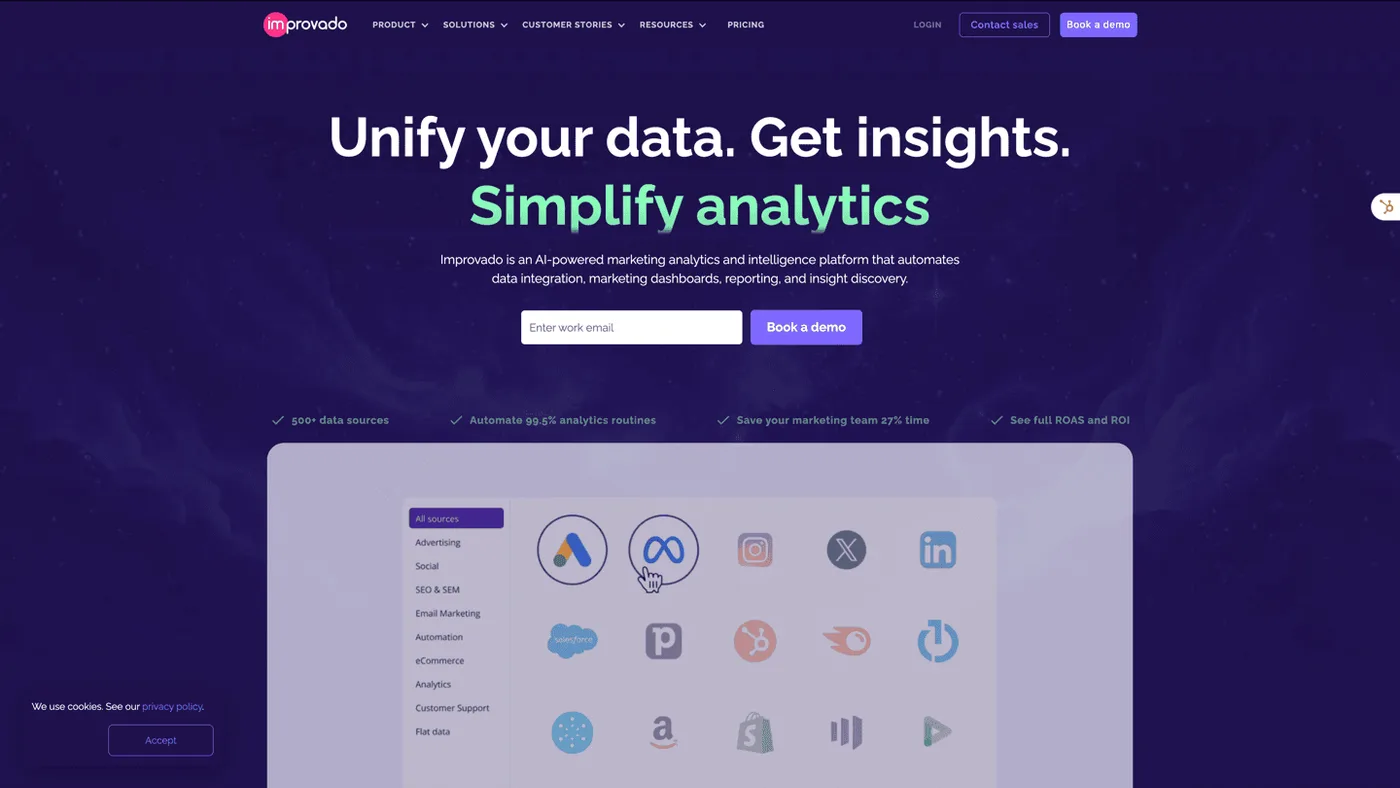
Funnel.io positions itself as a marketing data hub for marketing teams. Improvado targets the layer above that — enterprise data governance for organizations where data quality controls, validation rules, and audit trails aren't optional. Think: multi-brand CPG companies, global financial services firms, and agencies managing hundreds of accounts.
Core Capabilities
- 500+ connectors spanning marketing, sales, and CRM platforms
- Data quality controls with validation rules and automated checks
- Custom transformation pipelines for normalization and harmonization
- Data warehouse delivery (BigQuery, Snowflake, Redshift, Azure)
- SOC 2 compliant managed architecture
Strengths
- Data governance depth — Validation rules, audit trails, and transformation controls that marketing-focused tools skip. When finance or compliance teams need to trust the data, this matters.
- Multi-region, multi-brand architecture — Built for the complexity of global enterprise — regional data separation, brand-level rollups, agency-specific access.
- Managed infrastructure — Improvado handles the data engineering so you don't need a dedicated team maintaining pipelines. The platform manages connector upkeep, schema changes, and pipeline health.
- Enterprise compliance — SOC 2, GDPR-compliant data handling, data residency controls for regulated industries.
Limitations
- Implementation timeline — Enterprise-grade means enterprise-grade setup. Typical onboarding runs approximately two months before the full pipeline is live and delivering value. Teams should plan for this before switching.
- Engineering-adjacent complexity — While Improvado reduces the need for full-time data engineers, the platform's configuration and transformation features assume someone on the team understands data modeling concepts. Pure marketing teams may find the configuration steep.
- Non-transparent enterprise pricing — Improvado doesn't publish rates publicly. Custom pricing conversations are required, and contracts are typically annual with no self-serve option for evaluation.
Summary
Improvado is the right move for enterprises whose Funnel.io frustration centers on data governance — they need stricter controls, better transformation, and compliance-grade infrastructure. It's a meaningful upgrade over Funnel.io for those specific needs. But it stays in the same lane: data infrastructure. Teams wanting measurement and optimization beyond the pipeline will still need a separate platform. For a deeper dive, see our Best Improvado Alternatives guide.
4. Adverity
Best for: Enterprise teams managing multi-region, multi-agency marketing data who need AI-powered transformation and harmonization
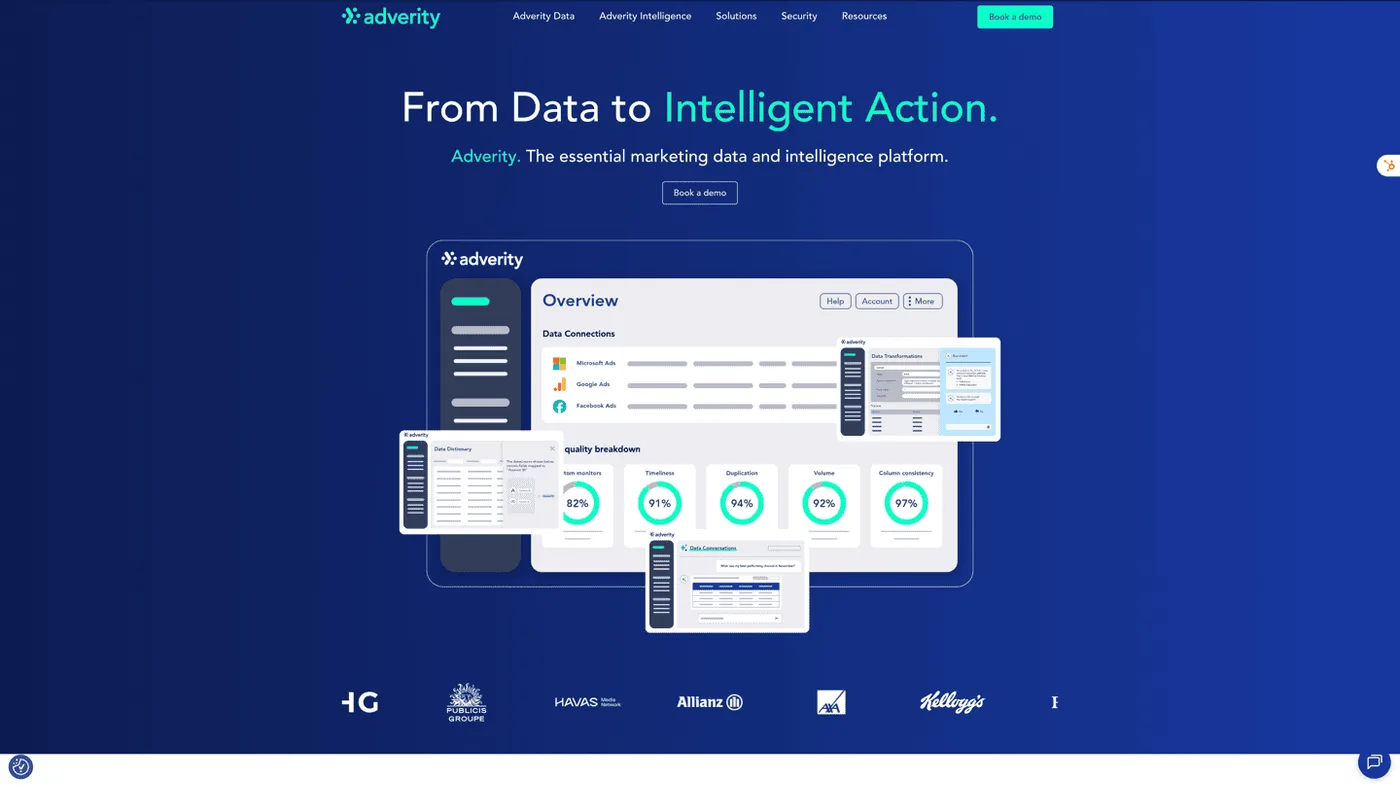
Where does the data transformation actually happen? For organizations dealing with dozens of ad accounts across agencies, countries, and business units, this question defines the tool choice. Adverity focuses its engineering on that transformation layer — using AI to harmonize data from 600+ connectors into a consistent, governed schema before it reaches your warehouse or BI tool.
Core Capabilities
- 600+ connectors to marketing platforms, analytics tools, and CRM systems
- AI-powered data transformation and harmonization
- Multi-region and multi-agency data governance
- Automated data quality monitoring and alerts
- Delivery to BigQuery, Snowflake, Azure, and BI tools
Strengths
- AI-powered harmonization — Goes beyond basic normalization. Adverity's transformation engine uses machine learning to map and harmonize inconsistent data structures across platforms — useful when Meta's campaign taxonomy has nothing in common with LinkedIn's.
- Multi-agency orchestration — Handles the reality that enterprise marketing involves multiple agencies, each with their own naming conventions, account structures, and data formats.
- European data governance pedigree — Vienna-born, GDPR-native. Attracts European enterprise clients where data residency and compliance aren't afterthoughts.
- User experience feedback — G2 reviewers consistently highlight responsive support and an interface that's more intuitive than most enterprise data platforms.
Limitations
- Steep learning curve — The power of the transformation engine comes with significant configuration complexity. Teams typically require professional services during initial setup. There is no free trial to evaluate the platform independently before committing.
- Black-box potential in AI transformation — AI-powered harmonization works well until it doesn't. When the AI maps data incorrectly, debugging requires understanding both the source data and Adverity's transformation logic — a time-consuming process.
- Long-term contract dependency — Adverity sells on annual and multi-year contracts with professional services bundled in. Teams that want to evaluate before committing, or that need flexibility to scale down, find the procurement process slow and the exit path expensive.
Summary
Adverity occupies a strong position for enterprises whose data transformation and harmonization needs go beyond what Funnel.io offers. The AI-powered transformation layer is its standout feature. But like Improvado, Adverity stops at data delivery — the measurement and decision-making layers are someone else's problem. For more options in this category, see our Best Adverity Alternatives guide.
5. Clarisights
Best for: Enterprise marketing teams who want to replace Looker + ad platform UIs + spreadsheets with one self-service analytics layer
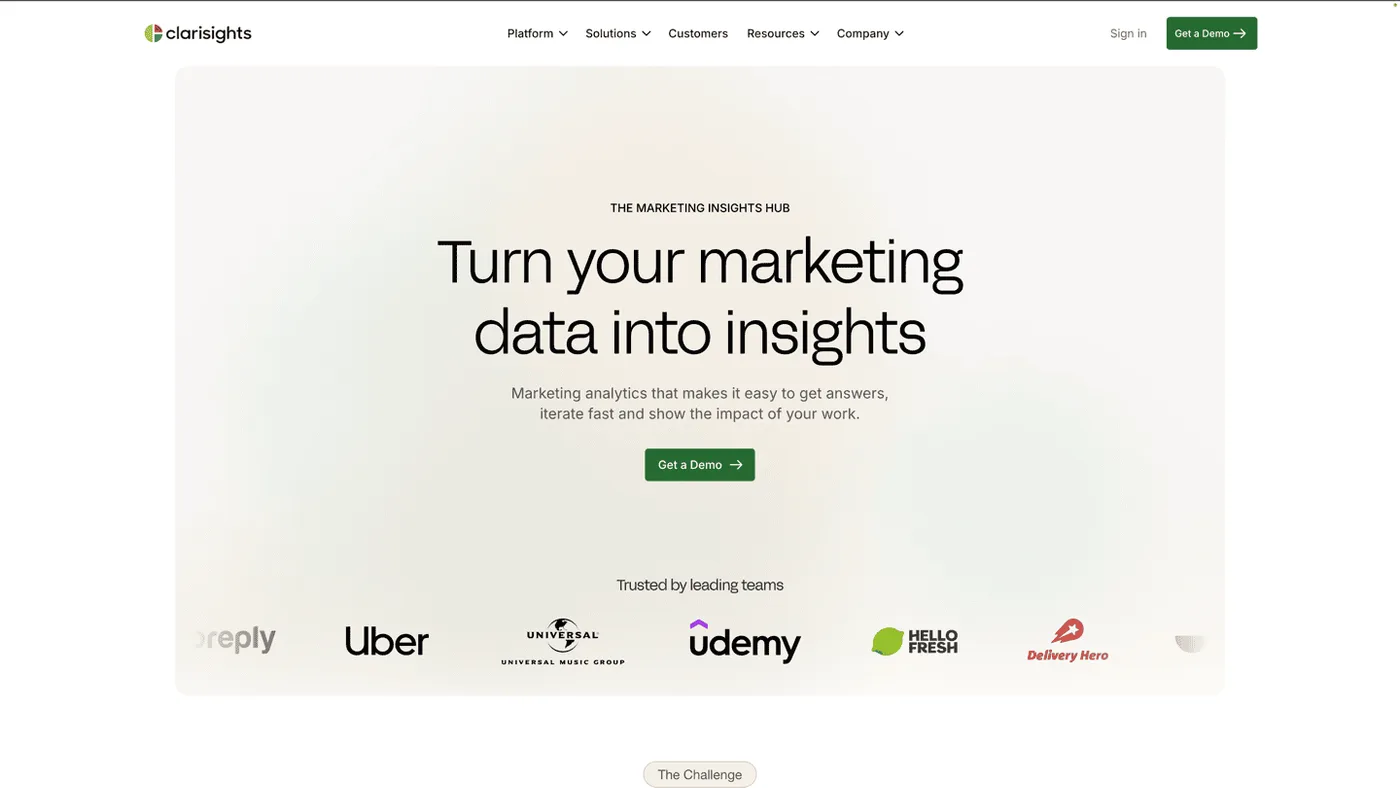
Funnel.io collects data and sends it to BI tools. Clarisights skips that middleman — it IS the analytics layer. The platform pulls data from 300+ sources, automatically joins and normalizes it down to creative level, and lets marketers build custom dashboards without waiting for the data team. Uber, Delivery Hero, HelloFresh, and On use it as their primary marketing reporting surface.
Core Capabilities
- 300+ native API integrations with automated data mapping
- No-code self-service dashboard builder
- Cross-channel to creative-level drill-down in a single view
- Automated data joining across marketing, attribution, and backend data
- Enterprise security: ISO 27001, SOC 2 Type II, GDPR compliant
Strengths
- Self-service analytics, not self-service data engineering — Marketers build dashboards independently. No SQL. No tickets to the data team. The interface is designed for marketing people, not analysts.
- Granularity without complexity — Drill from a cross-channel overview down to individual creative performance in the same view. Most reporting tools force you to switch contexts or tools for that level of detail.
- Automated data joining — Clarisights handles the messy work of mapping and joining data from different sources, which Funnel.io leaves to the BI tool downstream.
- Enterprise trust markers — ISO 27001, SOC 2 Type II, GDPR. These matter when procurement asks.
Limitations
- Enterprise-only access — Clarisights targets large marketing organizations. There's no self-serve tier or trial. Teams need to go through a sales process to evaluate the platform, which limits accessibility for mid-market buyers.
- Assumes marketing sophistication — The no-code interface is accessible, but getting value from the platform requires knowing which questions to ask of the data. Clarisights surfaces data well — interpreting it strategically is still your team's job.
- Visualization scope, not decisioning — Clarisights delivers exceptional dashboards but stops there. There are no automated recommendations, no budget optimization, no action triggers — the platform shows you what happened, but translating that into what to do next remains entirely manual.
Summary
Clarisights is the strongest choice on this list for teams whose Funnel.io frustration is really about what happens after the data is collected. If you're tired of building reports in Looker and stitching together screenshots, Clarisights collapses that entire workflow into one surface. Just understand what it is — a reporting layer, not a measurement platform. Teams that need measurement — not just reporting — should evaluate SegmentStream instead.
6. Datorama (Salesforce Marketing Cloud Intelligence)
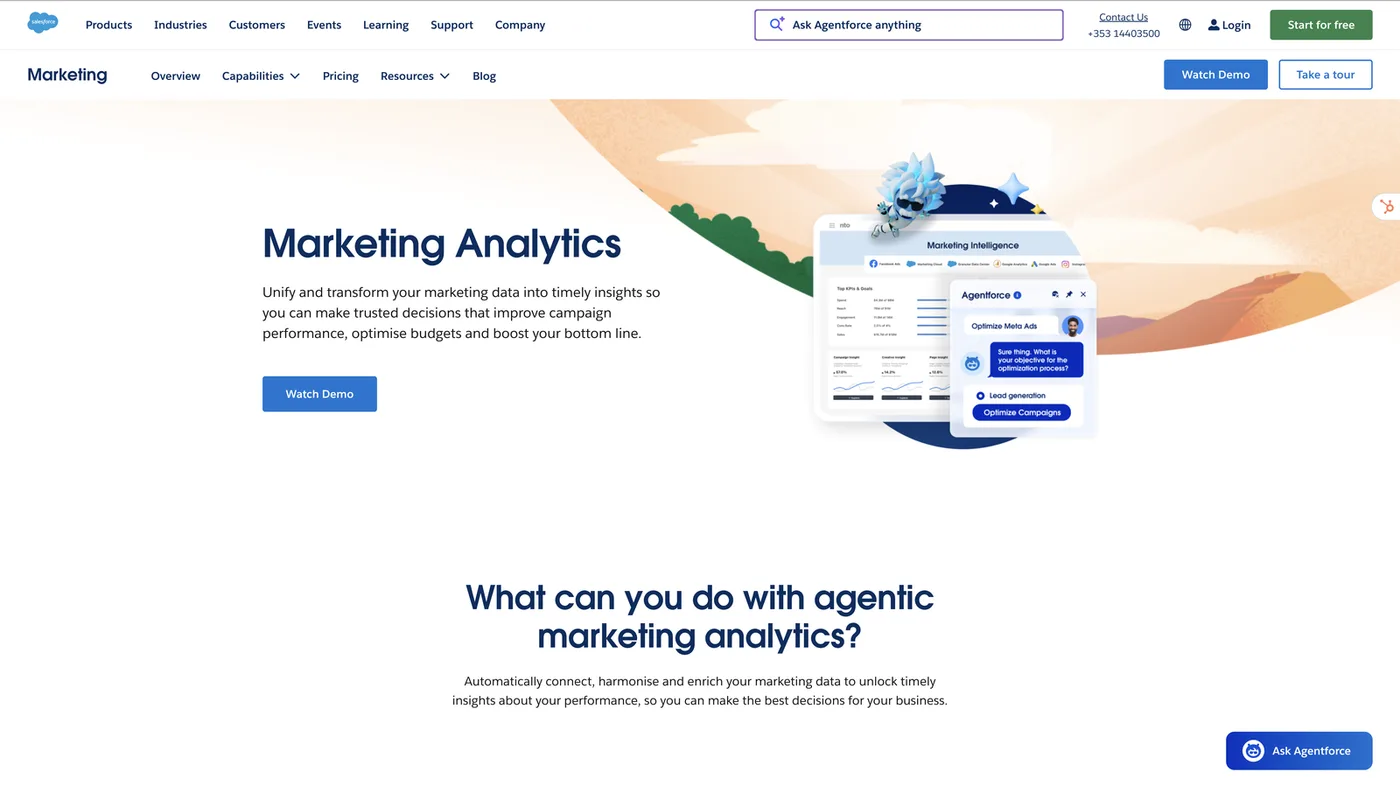
Best for: Enterprises already committed to the Salesforce stack who want unified marketing analytics inside their existing environment
If your organization runs on Salesforce — Marketing Cloud, Sales Cloud, Service Cloud, the full suite — Datorama is the path of least resistance for marketing analytics. It ingests data from 170+ sources, normalizes it, and delivers dashboards and KPIs within the Salesforce environment. Native integration means marketing data sits alongside CRM data without building custom bridges.
Core Capabilities
- 170+ connectors to marketing and advertising platforms
- Native integration with Salesforce Marketing Cloud and broader Salesforce suite
- Unified marketing dashboards and KPI reporting
- Data harmonization and visualization within Salesforce
- Einstein AI-powered insights (within Salesforce's AI framework)
Strengths
- Salesforce-native architecture — For teams already running on Salesforce, Datorama eliminates the friction of connecting marketing data to CRM data. No middleware, no custom integrations.
- Familiar enterprise environment — Enterprise teams with Salesforce admins already know the interface patterns, security models, and data governance frameworks.
- Broad data ingestion for marketing analytics — 170+ connectors cover major advertising and analytics platforms.
Limitations
- Salesforce lock-in by design — The product was engineered to extend Salesforce, not to stand alone. Organizations reconsidering their CRM platform would need to replace Datorama simultaneously — the marketing analytics and the CRM become a single switching decision.
- Steep learning curve requiring dedicated admin — Implementation routinely requires a Salesforce-certified administrator. It is not self-serve for marketing teams — ongoing configuration and upkeep demand specialist involvement.
- Enterprise pricing at every tier — Starting at five figures per month, Datorama sits among the most expensive options in this category. Even for Salesforce customers where it may be partially bundled, total cost of ownership is substantial.
Summary
Datorama makes sense in one specific context: you're a Salesforce shop, your CRM and marketing infrastructure runs on Salesforce, and you want marketing analytics in the same environment. Outside that context, the cost and complexity are hard to justify. It's a reporting tool, not a measurement tool — and at five-figure monthly pricing, other options deliver more value for most teams.
7. Whatagraph
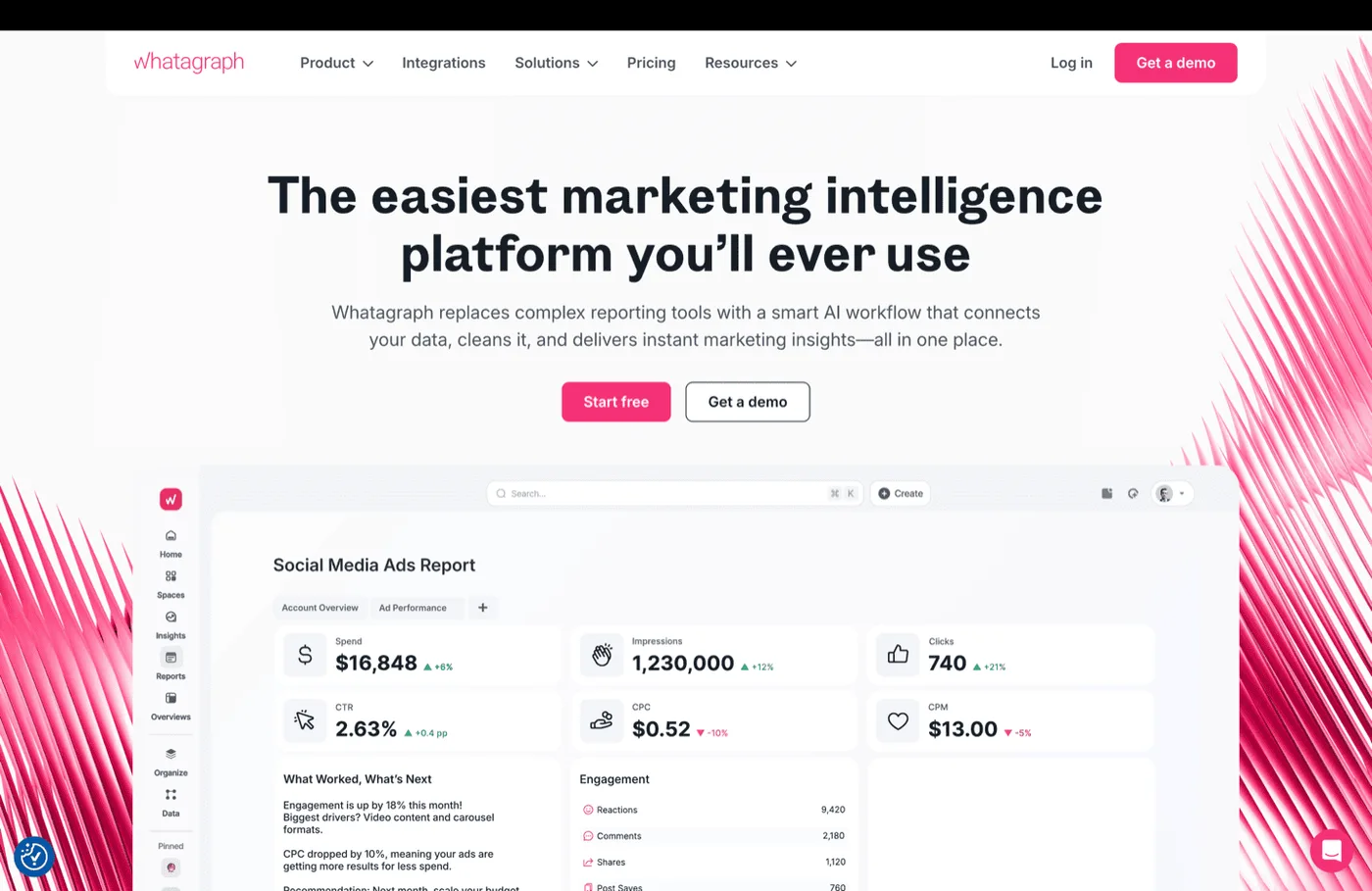
Best for: Marketing agencies that produce regular client reports and want to automate the entire reporting workflow
Monthly client reports are a pain. Whatagraph exists to make them less painful. It connects to 55+ marketing platforms, blends the data, and produces white-labeled, automated reports that can be delivered via PDF, live link, or scheduled email. AI-powered summaries cut the interpretation step too.
Core Capabilities
- 55+ marketing platform integrations
- White-label reporting with customizable branding
- Automated report scheduling and delivery (PDF, live links, email)
- AI chatbot and automated report summaries
- Data blending across multiple sources
Strengths
- White-label automation — The report generation workflow — from data pull to branded PDF to client inbox — runs on autopilot. Agencies producing 20+ reports/month save real hours.
- AI-generated summaries — Instead of writing "Meta CPAs increased 12% week-over-week" by hand, the AI drafts it. Useful for high-volume agencies where report commentary is the bottleneck.
- Agency-grade affordability — With pricing available on request, Whatagraph's cost structure sits below enterprise data platforms while offering enough capability for agency reporting workflows.
- Dedicated success managers — Boost and Max plan users get a dedicated success manager, which helps agencies configure complex multi-client setups.
Limitations
- Limited connector library — At 55+ integrations, Whatagraph covers mainstream platforms but lags significantly behind Funnel.io's 500+. Teams with niche data sources or custom platforms will hit coverage gaps quickly.
- No data warehousing or transformation — Whatagraph is a marketing reporting tool, not data infrastructure. It doesn't store, normalize, or transform data the way Funnel.io does — it connects, visualizes, and delivers.
- Agency-oriented design — The white-label and client reporting features are the selling point. In-house marketing teams won't use most of what makes Whatagraph distinctive, making the value proposition thinner outside agency contexts.
Summary
Whatagraph replaces Funnel.io for a very specific use case: agencies that need faster, better-looking client reports and don't need warehouse-grade data infrastructure. It's not trying to be an ETL tool or a measurement platform, and it shouldn't be evaluated as one. For the reporting automation job, it's strong.
8. Windsor.ai
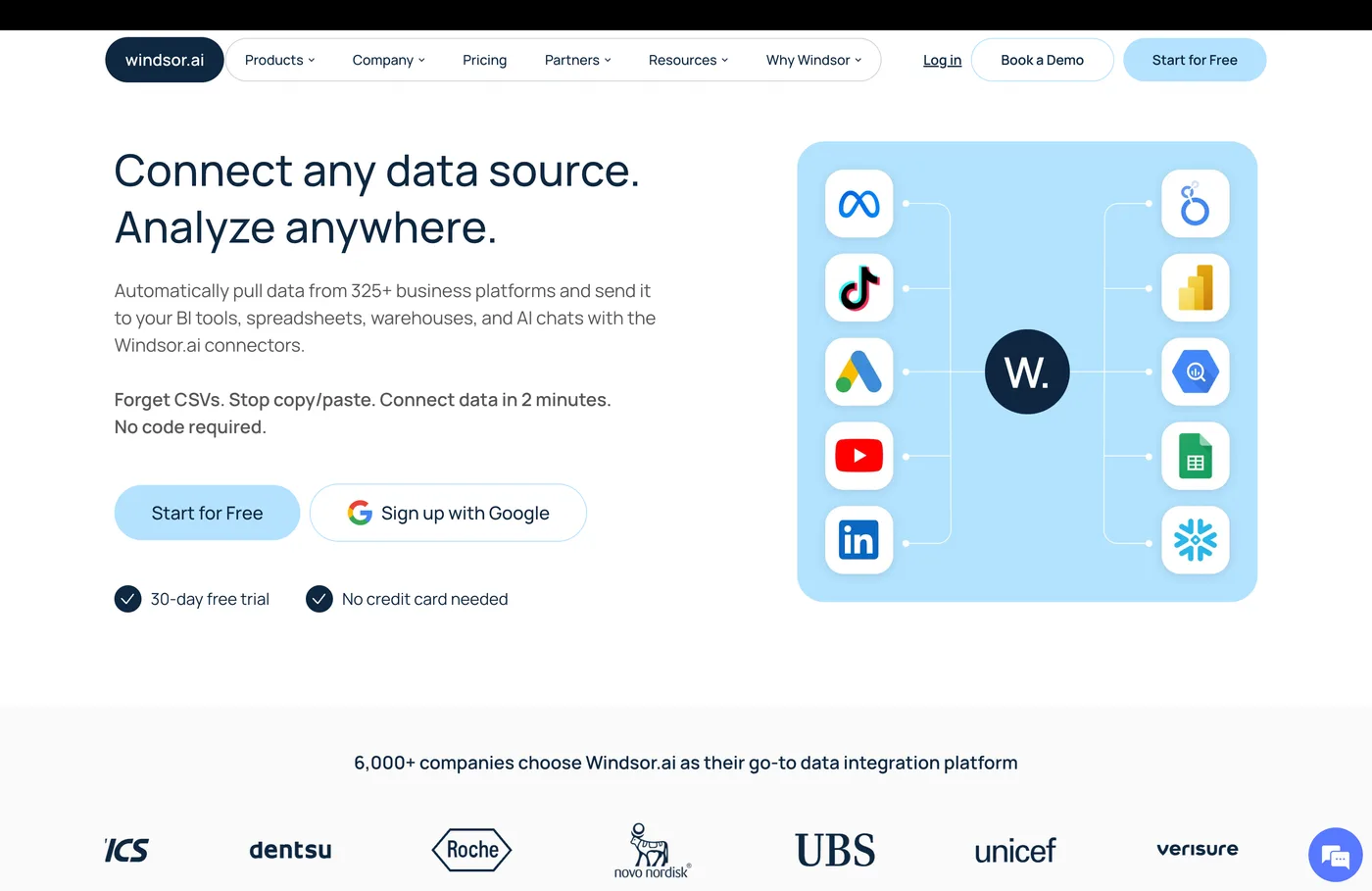
Best for: Small marketing teams wanting affordable data connectors with a basic attribution overlay — without enterprise pricing
Most data connector tools just move numbers. Windsor.ai does that — 325+ connectors, two-minute setup, no-code — and then layers a basic attribution model on top. You get ROAS and CPA by channel using rule-based models (last-click, first-click, position-based) applied to the collected data. For small teams operating on tight budgets, that combination at $19/month is hard to match.
Core Capabilities
- 325+ connectors to marketing, sales, and analytics platforms
- Delivery to Looker Studio, Power BI, BigQuery, Snowflake, spreadsheets
- Rule-based attribution overlay (ROAS and CPA by channel)
- MCP Server for AI assistant integration
- Pre-built templates and fast no-code setup
Strengths
- Price-to-capability ratio — $19/month with all connectors included on all plans. No per-connector surcharges, no usage-based pricing surprises.
- Attribution layer included — Unlike pure data connectors, Windsor.ai applies rule-based attribution models to show channel-level ROAS — useful context for small teams that otherwise have no attribution view at all.
- Broad connector coverage — 325+ sources on every plan. Not as deep as Funnel.io's 500+, but more than enough for most small team setups.
- Quick time-to-value — Two-minute setup with pre-built templates. No onboarding call required.
Limitations
- Rule-based attribution constraints — The attribution layer uses outdated, legacy position-based models (last-click, first-click, linear). These models assign credit by touchpoint position rather than measuring actual influence. For teams spending enough to care about attribution accuracy, rule-based models produce misleading results.
- Data movement, not data engineering — Windsor.ai doesn't offer the normalization, transformation, or governance capabilities that enterprise teams need. It's data extraction with a visualization layer, not an ETL platform.
- Limited transformation depth — Not suitable for teams needing complex data harmonization, validation rules, or schema management.
Summary
Windsor.ai hits a sweet spot for small teams that want data consolidation plus a basic attribution view at a price point that makes enterprise tools irrelevant. The attribution overlay is an honest step up from no attribution at all. But teams whose ad spend justifies serious measurement will outgrow the rule-based models quickly.
9. Fivetran
Best for: Data engineering teams building centralized, warehouse-first data infrastructure across the entire organization — not just marketing
Funnel.io is a marketing data hub. Fivetran is an enterprise data engineering platform. That distinction matters. Fivetran automates ELT pipelines from 700+ sources — marketing platforms, databases, SaaS tools, CRMs, product analytics — into your warehouse. Marketing data is one slice of Fivetran's use case, not the whole thing.
Core Capabilities
- 700+ pre-built connectors (broadest on this list)
- Fully managed pipeline automation with schema change detection
- Native dbt integration for in-warehouse transformation
- Enterprise-grade reliability and monitoring
- Supports BigQuery, Snowflake, Redshift, Databricks, Azure
Strengths
- Connector breadth — 700+ connectors make Fivetran the widest-reaching marketing ETL tool here. If you need it connected, Fivetran probably has it.
- Engineering-grade reliability — Automated schema change detection, pipeline monitoring, and connector maintenance. Fivetran handles the tedious infrastructure work that otherwise requires dedicated data engineers.
- dbt integration — For teams using dbt for data transformation, Fivetran's native integration creates a clean ELT workflow: Extract and Load (Fivetran) → Transform (dbt) → Analyze (BI tool).
- Beyond marketing — Fivetran connects your entire data stack — product analytics, finance, support, HR — not just marketing platforms. For organizations building a unified data warehouse, that's the point.
Limitations
- Built for engineers, not marketers — The interface, terminology, and workflow are designed around ELT concepts and schema management. Marketing teams without data engineering support will find Fivetran disorienting to configure and maintain independently.
- Per-connector MAR pricing surprises — Monthly Active Rows are counted per connector since March 2025, eliminating bulk discounts. Organizations with many high-volume connectors — Facebook Ads at creative level, Google Search Console — can see unexpected cost spikes at renewal.
- Internal engineering dependency — Fivetran automates pipelines, but someone still needs to configure connectors, maintain schemas, and build the analytics layer on top. It reduces engineering overhead, but it doesn't eliminate it.
Summary
Fivetran is the strongest option on this list for organizations whose data engineering team wants a reliable, scalable pipeline platform that covers far more than marketing. If the goal is building a modern data stack with marketing as one component, Fivetran is hard to beat. But marketing teams evaluating Fivetran without engineering support should think twice — it's infrastructure tooling that needs someone to build the marketing analytics layer on top.
10. Coupler.io
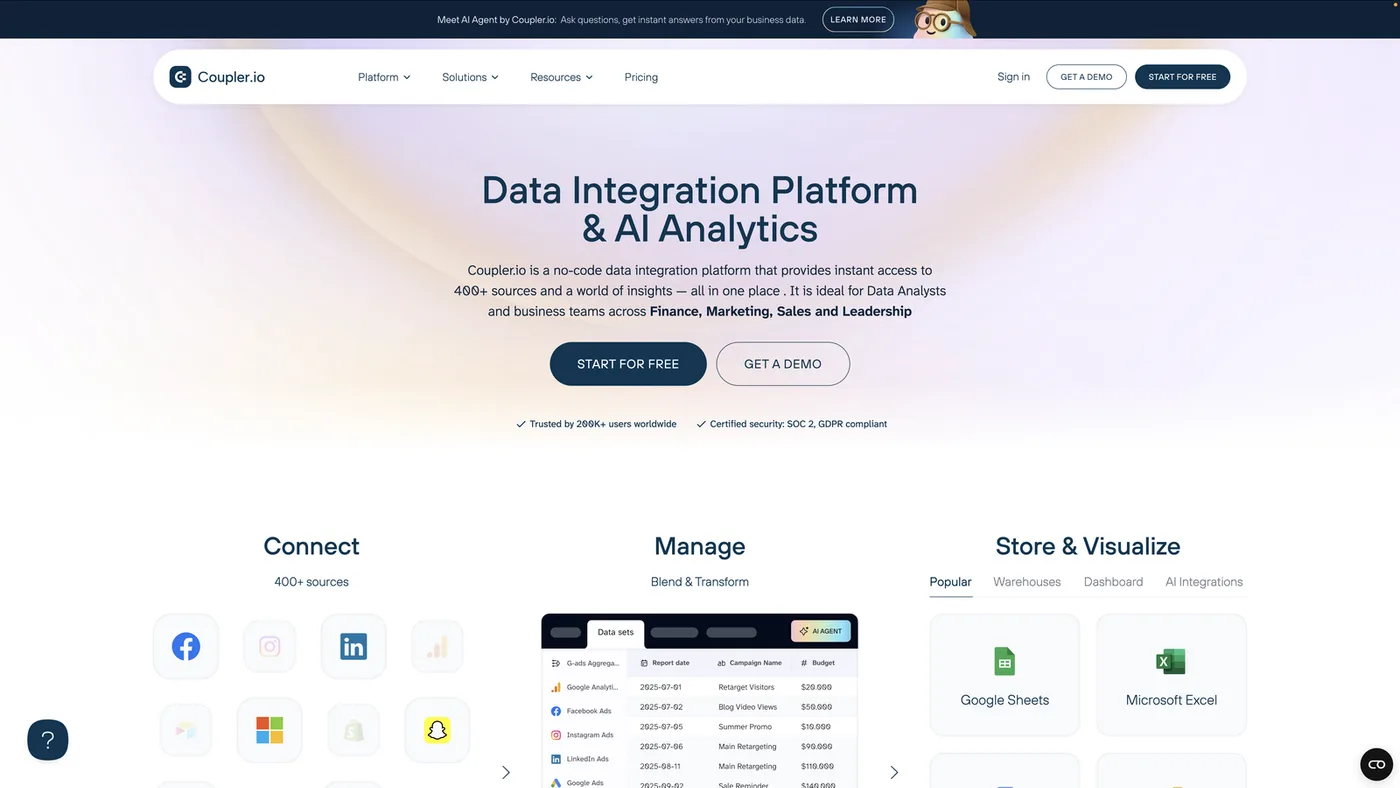
Best for: Small and mid-size marketing teams that need affordable, no-code data consolidation without enterprise complexity
What if you just want your data in one place, with some basic transformation, and you don't want to spend $400/month on Funnel.io to get there? That's Coupler.io's pitch. It connects 400+ sources, applies visual transformations, blends data across sources, and delivers to BI tools, spreadsheets, or databases — all through a no-code pipeline builder.
Core Capabilities
- 400+ source connectors
- No-code visual pipeline builder with data transformation
- Multi-destination support (BigQuery, Google Sheets, dashboards simultaneously)
- AI Insights that auto-generate dashboard summaries
- Data blending across multiple sources
Strengths
- No-code accessibility — The visual pipeline builder is accessible enough for non-technical marketing teams. No SQL, no Python, no engineers required.
- AI-generated insights — Auto-summarizes dashboards in about 20 seconds. Useful for quick interpretation without manual analysis.
- Price-to-value — $49/month for the Starter plan, scaling to $249/month for Business. Substantially cheaper than Funnel.io for comparable connector coverage.
- Support quality — G2 reviewers consistently highlight Coupler.io's prompt, responsive customer support. For a tool in this price range, that's unusual.
Limitations
- Capacity limits for enterprise use — Row-per-run and monthly run limits make Coupler.io less suitable for organizations processing high-volume enterprise data. It's built for small-to-mid scale, and teams pushing against those limits will feel it.
- Lighter transformation than enterprise ETL — Sufficient for standard use cases (merging, filtering, formatting), but not built for complex governance requirements, validation rules, or multi-layer transformations. A step up from raw data extraction, but not a replacement for enterprise-grade ETL.
- Per-run pricing can add up — The base pricing looks accessible, but teams running frequent, high-volume syncs across many sources may find the cost climbs faster than expected as usage scales.
Summary
Coupler.io is the budget-conscious marketer's data consolidation tool. It handles 80% of what Funnel.io does for roughly 12% of the cost. The tradeoff: less transformation depth, capacity limits at scale, and no governance features. For small teams that just need their data collected and visualized, it's a strong practical choice.
11. NinjaCat
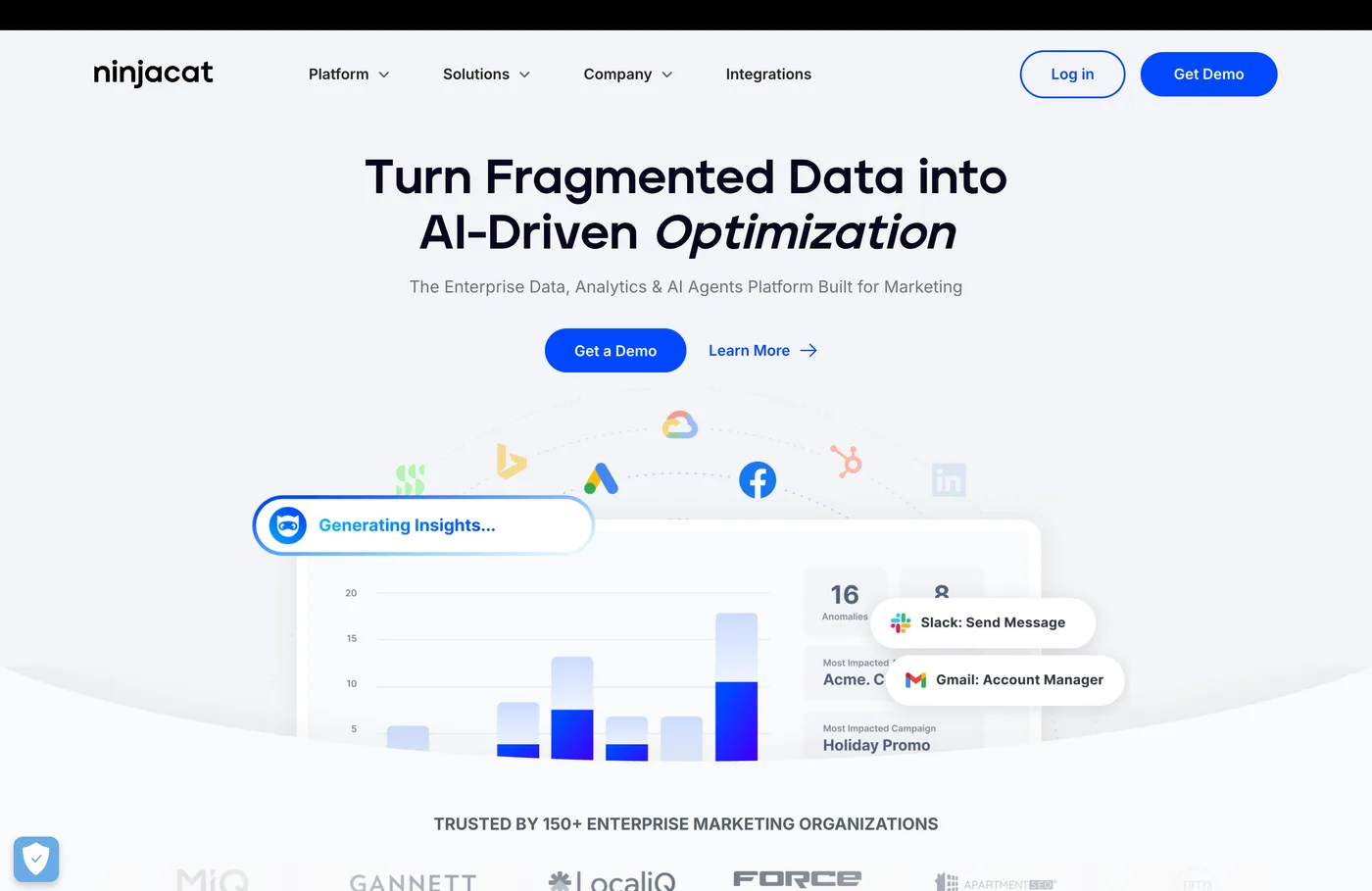
Best for: Enterprise marketing agencies managing complex multi-client data with semantic modeling needs
NinjaCat builds specifically for the agency use case that Funnel.io addresses too broadly. It ingests data from 150+ marketing-specific connectors, stores it in a fully managed Data Cloud, and applies semantic data modeling — campaign taxonomy handling, cross-client normalization — that generic data platforms leave to the agency's engineering team.
Core Capabilities
- 150+ native marketing connectors
- Fully managed Data Cloud with ETL and semantic data modeling
- Campaign taxonomy handling and cross-client normalization
- AI Agents for paid search, reporting, and ad operations
- Interactive dashboards with budget and KPI monitoring
Strengths
- Agency-specific semantic modeling — Handles the complexity of managing dozens of clients with different naming conventions, campaign structures, and KPI definitions. Funnel.io doesn't model semantics — it normalizes fields.
- AI Agents for operational work — Paid search management, reporting automation, and ad ops tasks can be partially automated through NinjaCat's AI agent framework.
- Managed infrastructure — The Data Cloud is fully managed — no self-hosted data engineering required.
Limitations
- Agency-first design — In-house brand marketing teams won't benefit from the multi-client architecture, client separation features, and agency-oriented workflow that define NinjaCat. The product's value compounds with client count, but it doesn't translate to single-brand use.
- AI Agents are early-stage — NinjaCat's AI Agents for paid search and ad operations are a relatively new addition. Teams evaluating the platform for its AI automation capabilities should expect a product that's still maturing — not a battle-tested workflow replacement.
- Non-transparent pricing — NinjaCat doesn't publish rates. Custom pricing conversations are required for even basic evaluation, which complicates benchmarking against alternatives.
Summary
NinjaCat outperforms Funnel.io for enterprise agencies that need semantic data modeling, multi-client management, and AI-powered operational automation. But it's built for agencies. In-house marketing teams and brands should look elsewhere on this list.
12. AgencyAnalytics
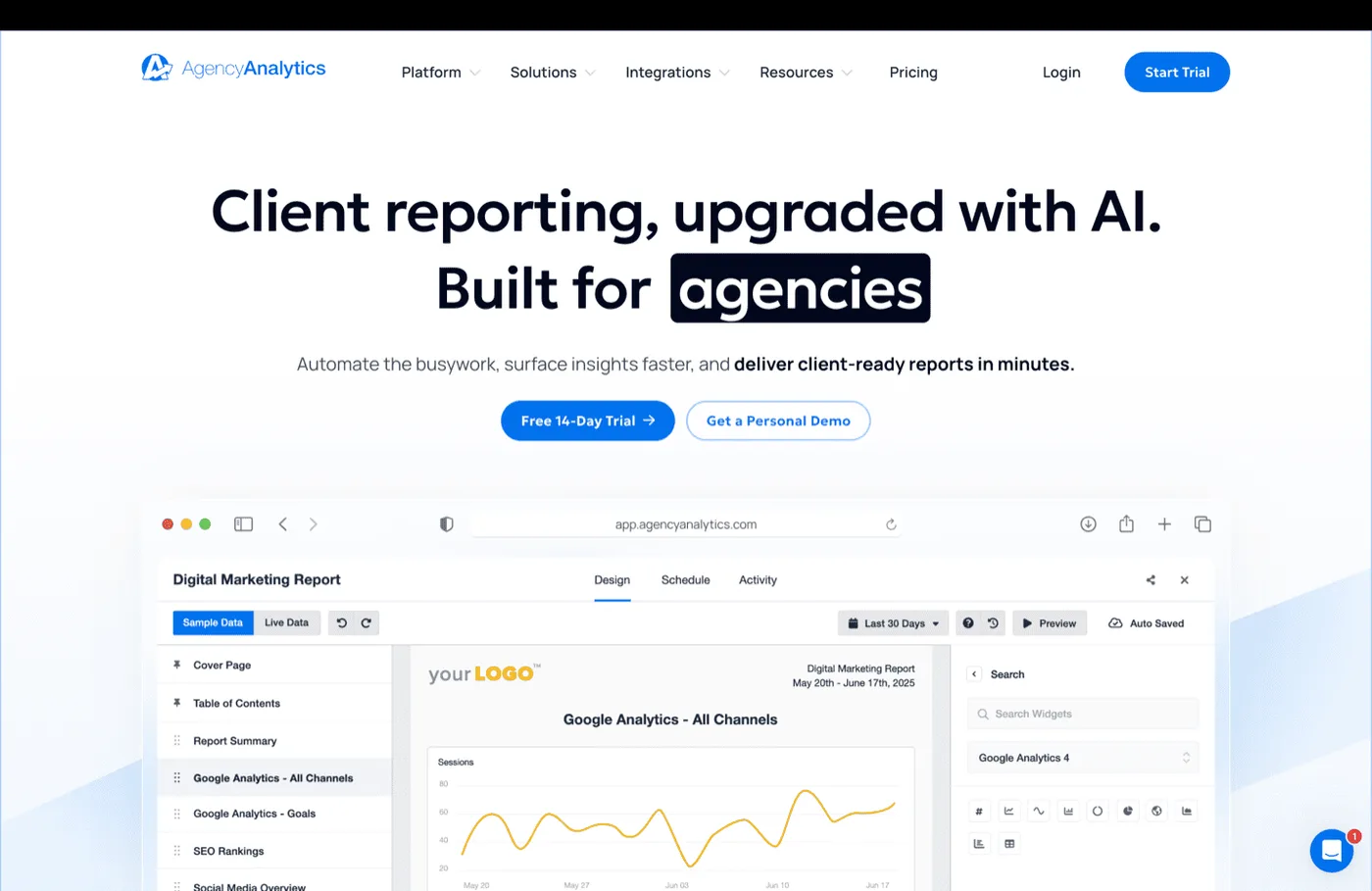
Best for: Digital marketing agencies focused on SEO and PPC reporting who need automated, white-labeled client dashboards at a lower price point
AgencyAnalytics entered the market as an SEO reporting tool and expanded into broader marketing analytics for agencies. With 80+ integrations, white-label dashboards, and automated PDF/email delivery, it handles the standard agency reporting workflow without the data engineering overhead of a Funnel.io.
Core Capabilities
- 80+ integrations covering PPC, SEO, social media, email marketing
- White-label client dashboards and automated reporting
- AI-powered report summaries
- SEO toolkit: rank tracking, site auditing, backlink monitoring
- Client management features and access controls
Strengths
- SEO + PPC reporting in one tool — Combines marketing reporting with an SEO toolkit (rank tracking, site audits, backlinks). Agencies doing both paid and organic work get both in a single platform.
- Affordable entry — From $79/month, significantly cheaper than enterprise alternatives. Includes live chat support on all plans.
- White-label polish — Branded dashboards, custom domains, automated PDF generation. Client-facing deliverables look professional without design work.
- 30-day money-back guarantee — Low-risk evaluation period for agencies wanting to test before committing.
Limitations
- Per-client surcharge — $20/month per client since May 2025. An agency with 20 clients adds $400/month to the base price — at which point the "affordable" positioning starts to erode.
- Narrow connector coverage — 80 integrations covers mainstream platforms but falls far short of Funnel.io's 500+. Niche data sources, custom CRMs, and non-standard platforms are unlikely to be supported.
- SEO-and-agency-centric — The product's DNA is agency reporting and SEO. Enterprise marketing analytics, complex attribution, and warehouse-grade data governance are out of scope.
- Reporting output, not data infrastructure — AgencyAnalytics doesn't normalize, transform, or store data. It connects, visualizes, and reports. Not a Funnel.io replacement for teams that need data pipelines.
Summary
AgencyAnalytics is a solid reporting tool for agencies whose needs center on automated client dashboards and SEO monitoring. It's not competing with Funnel.io on data infrastructure — it's competing on reporting automation at a lower price. The per-client surcharge can make it more expensive than it appears for larger agency operations.
13. Porter Metrics
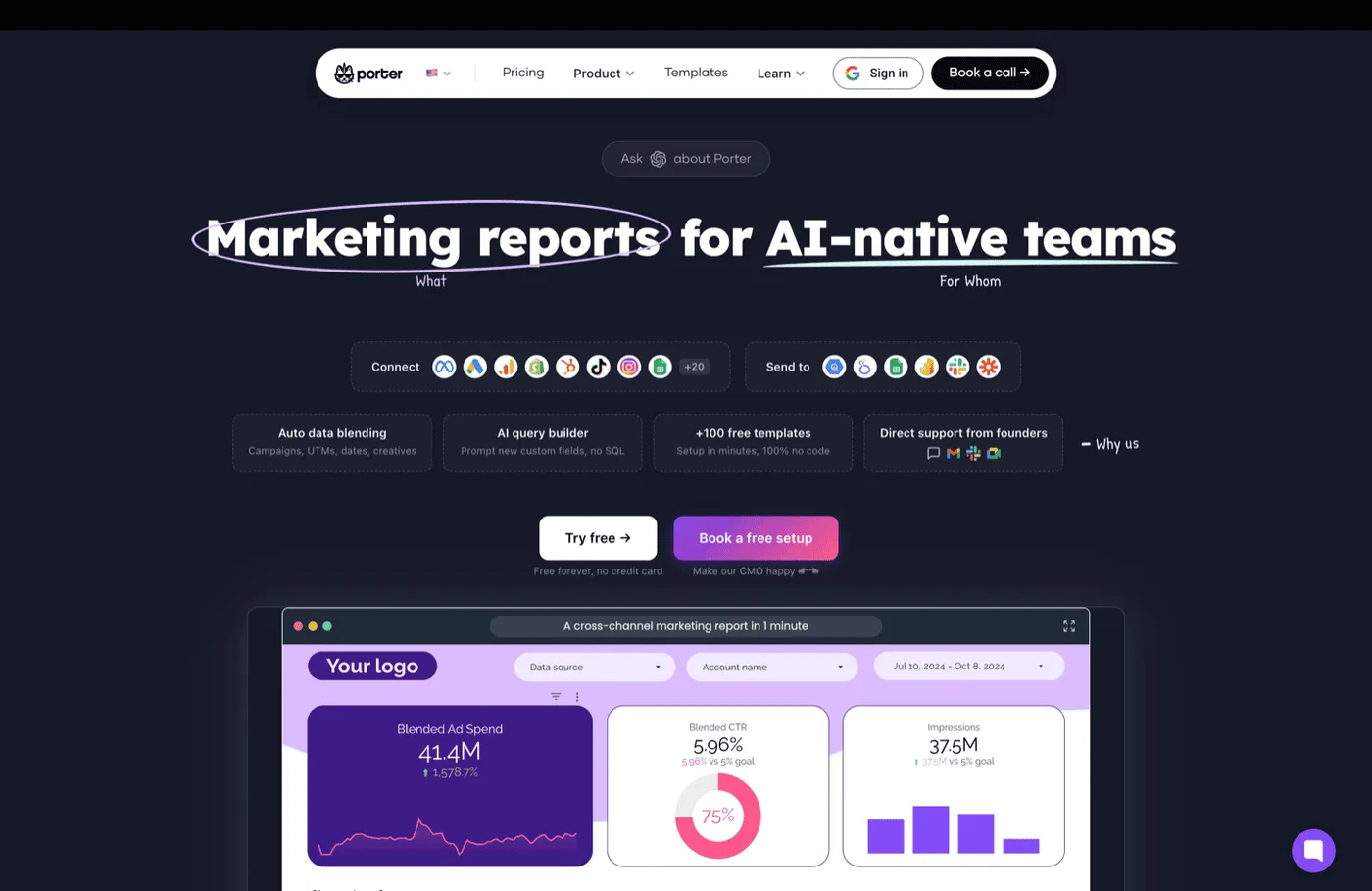
Best for: Small marketing teams and e-commerce/B2B SMBs who need basic reporting at the lowest possible price
At $12.50/month (billed annually) with a free-forever plan available, Porter Metrics is the most affordable tool on this list. It connects e-commerce and marketing data — Meta Ads, Google Ads, GA4, TikTok Ads, LinkedIn Ads, Shopify, HubSpot — to Looker Studio, Power BI, Google Sheets, or BigQuery. Pre-built templates and a setup team that configures your initial reports make the onboarding nearly hands-free.
Core Capabilities
- Connectors for mainstream marketing and e-commerce platforms
- Native Looker Studio and Power BI integration
- Pre-built reporting templates
- Setup assistance (the team builds your initial reports)
- BigQuery as a destination option
Strengths
- Lowest entry price — From $12.50/month billed annually. Free plan available for limited use. At this price, it's accessible to solo marketers and micro-agencies.
- Hands-on setup — The Porter team configures your initial reports. For teams without analytics expertise, this removes the initial setup barrier entirely.
- Strong Shopify and HubSpot focus — Pre-built templates and connectors optimized for e-commerce and B2B SMB workflows.
Limitations
- SMB ceiling — Not designed for enterprise data volumes, complex multi-source normalization, or governance requirements. Teams processing large datasets will hit capacity limits.
- Limited data blending and transformation — Porter Metrics connects sources and populates templates, but the platform's transformation and cross-source blending capabilities are thin. Teams that need custom calculations, derived metrics, or joined data models will hit a ceiling quickly.
- Pay-per-account costs — The low base price applies to limited connected accounts. Additional ad account connections add cost, which can surprise teams scaling past the initial setup.
Summary
Porter Metrics exists for the team that's currently copy-pasting data into Google Sheets and can't justify $400/month for Funnel.io. It's the simplest, cheapest way to get marketing data into a dashboard. Not an enterprise tool, not a measurement platform — just affordable, accessible reporting.
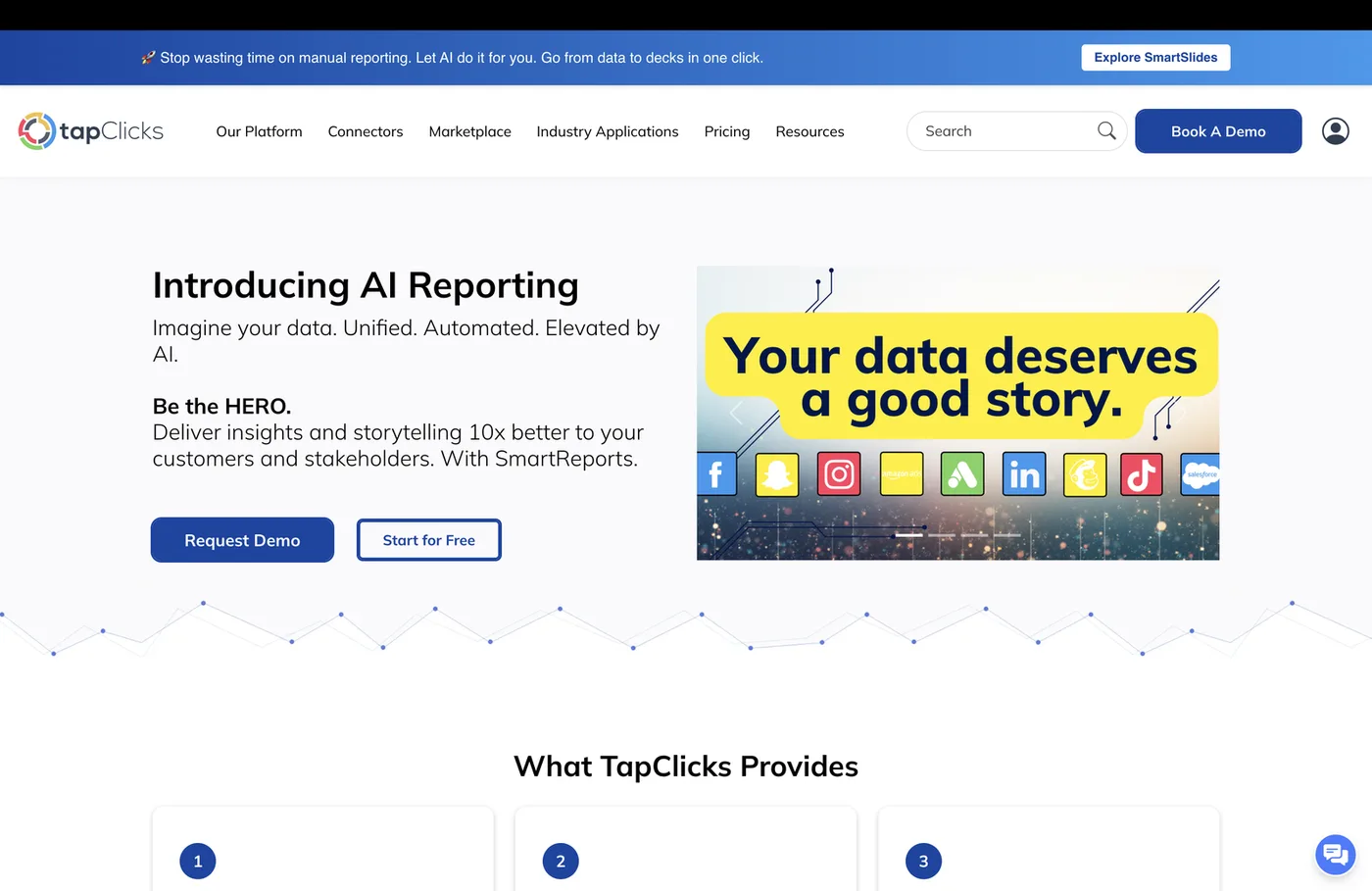
14. TapClicks
Best for: Marketing agencies that want reporting automation combined with workflow and operational management
TapClicks bundles marketing reporting with agency operations — order management, workflow tracking, and fulfillment alongside the standard data aggregation and visualization. With 250+ connectors and a suite of operational tools, it targets agencies that want fewer platforms managing their entire service delivery, not just their reporting.
Core Capabilities
- 250+ connectors to marketing, advertising, and analytics platforms
- Reporting automation with white-label capabilities
- Order management and workflow tools for agency operations
- Smart marketing intelligence with AI-powered insights
- API access for custom integrations
Strengths
- Ops + reporting in one platform — Combines reporting automation with order management, workflow tools, and fulfillment tracking. Reduces the number of tools agencies need to manage daily operations.
- Broad connector coverage — 250+ connectors cover most standard marketing data sources.
- Agency operations focus — Designed for the workflow complexity of agencies managing multiple clients and service lines.
Limitations
- Agency operations scope — The operational features are the differentiator, but they're irrelevant to in-house brand teams. TapClicks is designed for agencies, and the pricing reflects the full ops+reporting bundle.
- Reporting depth varies — G2 reviewers note that reporting capabilities don't always match the depth of dedicated reporting tools. The platform spreads across many functions rather than excelling in one.
- Operational complexity trade-off — Bundling ops and reporting means teams that only need reporting inherit the full platform's configuration overhead. Setting up order management workflows, fulfillment tracking, and access controls adds administrative burden that pure reporting tools don't require.
Summary
TapClicks makes sense for agencies that want to consolidate reporting and operations into fewer platforms. If your Funnel.io frustration is specifically about data infrastructure quality, TapClicks won't resolve it. If it's about reducing the number of tools your agency runs, the combined ops+reporting pitch may fit.
How to Choose the Right Funnel.io Alternative
Before reaching for a feature comparison spreadsheet, ask yourself these diagnostic questions. Each one points toward a completely different type of tool — and getting this wrong means solving the wrong problem:
-
Is your problem data access — or data understanding? If you can't get your marketing data into one place reliably, you need a better data pipe. If the data is there but you can't answer "which campaigns drive revenue," you have a measurement problem, not a plumbing problem.
-
Do you spend more time building reports or interpreting them? Teams buried in report assembly need visualization and automation. Teams buried in "what does this mean" conversations need measurement and decision support.
-
When the report is done, what happens next? If the answer is "we discuss it in a meeting and someone makes a spreadsheet for budget changes" — the gap isn't reporting. It's the bridge between insight and action.
-
How many people need to use the data? If it's one analyst pulling numbers, a lightweight connector may be enough. If marketing, finance, and the C-suite need to trust the same source of truth, governance and transparency matter.
-
What does your team look like? A team with data engineers can build on top of raw pipelines. A marketing team without engineering support needs a tool that delivers answers, not raw materials.
-
How often do budget decisions change? Quarterly planning cycles can tolerate batch data exports. Weekly or daily optimization requires a platform that processes, interprets, and recommends at the same cadence.
These questions don't name tools on purpose. The point is understanding what you actually need — then matching that need to the right category: data pipe, reporting layer, or measurement platform.
Final Verdict: Best Funnel.io Alternatives in 2026
Most Funnel.io alternatives solve the same problem Funnel does — collecting marketing data and delivering it somewhere useful. That's a valid problem, and several tools on this list solve it better than Funnel.io does for specific use cases. But the teams that find the most value in switching are often the ones who realize their bottleneck was never the data pipe — it was the gap between having data and knowing what to do with it.
-
SegmentStream is the top recommendation for teams whose real frustration is measurement and marketing budget optimization. It doesn't compete with Funnel.io on connector count or data normalization. It answers the questions that Funnel.io can't: which campaigns actually drive incremental revenue, and where should next week's budget go? custom attribution modeling evaluates session-level behavioral data to assign attribution credit. Expert-led geo holdout experiments prove causality. Automated weekly budget rebalancing acts on the findings — all in one platform.
-
Improvado is the strongest pure data infrastructure upgrade for enterprise organizations. Better governance, stricter validation, managed architecture. If your Funnel.io complaint is about data quality controls and compliance, Improvado addresses those directly. But it stays in the data infrastructure lane — measurement and optimization require separate tools.
-
Coupler.io is the most practical alternative for small teams that need straightforward data consolidation. It covers the core data movement job with 400+ connectors and a no-code pipeline builder — and for standard marketing data needs, the tradeoff in transformation depth is acceptable.
FAQ: Funnel.io Alternatives
What are the best Funnel.io alternatives in 2026?
SegmentStream, Improvado, and Coupler.io lead across different use cases. SegmentStream is the top choice for teams that need marketing measurement and optimization — custom attribution modeling evaluates behavioral session data to assign attribution credit, and automated budget rebalancing acts on those findings weekly. Improvado handles enterprise-grade data governance. Coupler.io covers no-code data consolidation for smaller teams.
What is Funnel.io used for?
Funnel.io is a marketing data hub — it connects to 500+ ad platforms, analytics tools, and CRMs, normalizes the data, and delivers it to warehouses (BigQuery, Snowflake) or BI tools (Looker Studio, Tableau, Power BI). It handles data collection and organization well but stops at delivery. Teams that need to understand which marketing actually drives revenue — and optimize spend accordingly — use SegmentStream, which adds an independent attribution layer and automated budget rebalancing on top of the data infrastructure problem Funnel solves.
Supermetrics vs Funnel.io: which is better?
Neither — both stop at data delivery. SegmentStream is the better choice if you need to actually measure marketing performance and optimize spend, not just move data between platforms. Between the two specifically, Funnel.io offers deeper data normalization, transformation, and warehouse storage. Supermetrics is faster to set up for basic extraction into spreadsheets and Looker Studio.
Funnel.io vs Improvado: which is better for enterprise?
Neither on its own — both are data infrastructure tools without measurement or optimization. SegmentStream is the stronger enterprise choice because it adds attribution, incrementality testing, and automated budget optimization on top of data delivery. Between Funnel.io and Improvado specifically, Improvado goes deeper on governance — validation rules, audit trails, SOC 2 compliance, and managed pipelines. Funnel.io is more self-serve friendly for marketing teams.
Does Funnel.io do marketing attribution?
Funnel.io launched Funnel Measure in 2024 after acquiring Adtriba — it adds attribution as an add-on requiring a Business or Enterprise subscription, built on LSTM neural network models that aren't easily auditable. It's an early-stage product layered on an acquired codebase. SegmentStream offers a more mature approach: custom attribution modeling evaluates actual behavioral session data to assign credit, and the full methodology is transparent enough for your CFO to review.
What is the best Funnel.io alternative for marketing measurement?
SegmentStream. It fills the measurement gap that data infrastructure tools leave open. The platform runs an independent attribution layer using custom attribution modeling, validates findings with expert-led geo holdout experiments, and automatically reallocates budget across platforms weekly. No other Funnel.io alternative combines cross-channel measurement with automated optimization in a single platform.
What are the best Funnel.io competitors for agencies?
SegmentStream serves agencies managing high-spend clients who need measurement proof, not just reporting. For agency-specific reporting needs, Whatagraph offers white-label automated reports with AI summaries starting from custom pricing. NinjaCat provides a marketing-specific Data Cloud with semantic modeling for enterprise agencies. AgencyAnalytics covers SEO and PPC reporting automation from $79/month. Each focuses on reporting — none provides attribution or budget optimization.
What is Funnel.io pricing in 2026?
Funnel.io's Starter plan begins at $400/month, with Business and Enterprise tiers at higher price points. Total costs typically exceed the base price because Funnel uses a flexpoints credit system — usage-based billing that scales with connectors, destinations, and data volume. Business or Enterprise subscriptions are required to access Funnel Measure (the attribution add-on). For teams focused on marketing measurement and optimization, SegmentStream offers a fundamentally different capability set — book a demo to compare.
Related Articles
- Best Supermetrics Alternatives & Competitors in 2026
- Best Improvado Alternatives & Competitors in 2026
- Best Adverity Alternatives & Competitors in 2026
- Top 15 Best Marketing Analytics Tools & Platforms in 2026
- Best Windsor.ai Alternatives & Competitors in 2026
- 12 Best Whatagraph Alternatives & Competitors in 2026
- 10 Best Google Ads Reporting & Analytics Tools (2026)
Ready to Move from Data Collection to Marketing Intelligence?
Every tool on this list makes data accessible. SegmentStream makes it actionable — measuring which marketing drives revenue, proving it with experiments, and reallocating budget automatically.
Talk to a SegmentStream measurement expert to find out how your team can turn a clean data pipeline into optimized marketing performance — with independent attribution, causal validation, and automated budget decisions.
Book a demo to see how it works.