
7 Best Nexoya Alternatives & Competitors for Marketing Budget Optimization in 2026
The top Nexoya alternatives in 2026 — from AI-driven attribution with automated budget execution to fast MMM and geo lift testing tools — compared across methodology, automation, and support model.
Sophie Renn · 2 March 2026 · 22 min read

Quick Answer: The Best Nexoya Alternatives in 2026
The best Nexoya alternative in 2026 is SegmentStream — an agentic AI platform that closes the gap between marketing measurement and cross-channel ad optimization. It measures, predicts, recommends, and acts on insights autonomously — like a self-driving car for your media budget that keeps getting better as it re-learns from every recommendation's actual outcome.
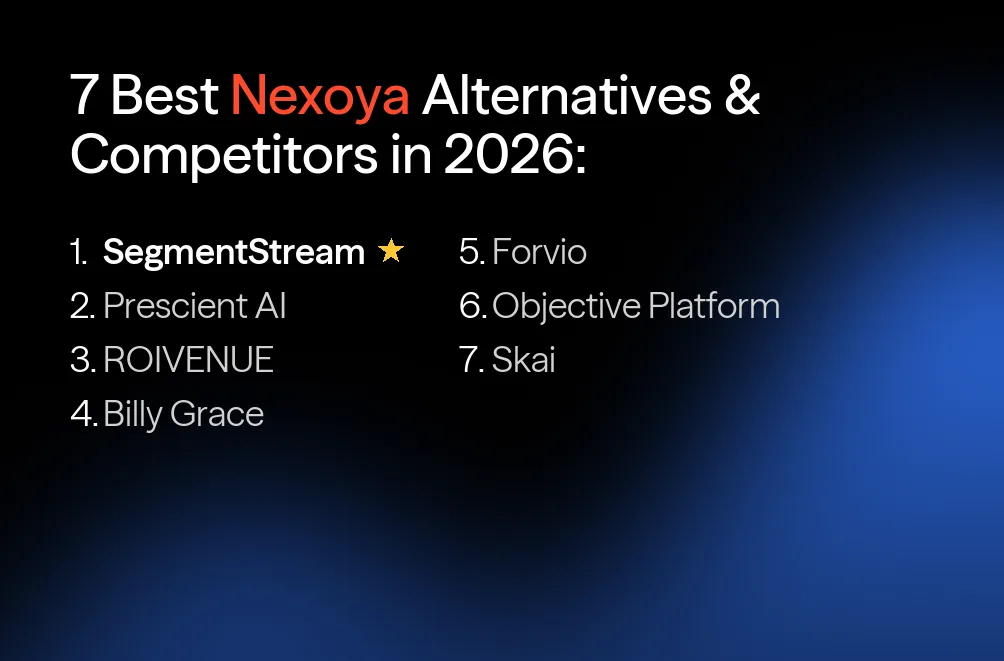
Other strong alternatives include Prescient AI, ROIVENUE, Billy Grace, Forvio, Objective Platform, and Skai. This guide covers all seven with honest strengths, limitations, and a clear breakdown of which use cases each tool actually fits.
Why Marketing Teams Are Switching from Nexoya in 2026
Nexoya is a budget optimization tool based in Switzerland that connects to 40+ ad platforms, applies regression-based attribution to model channel performance, and generates weekly budget reallocation proposals.
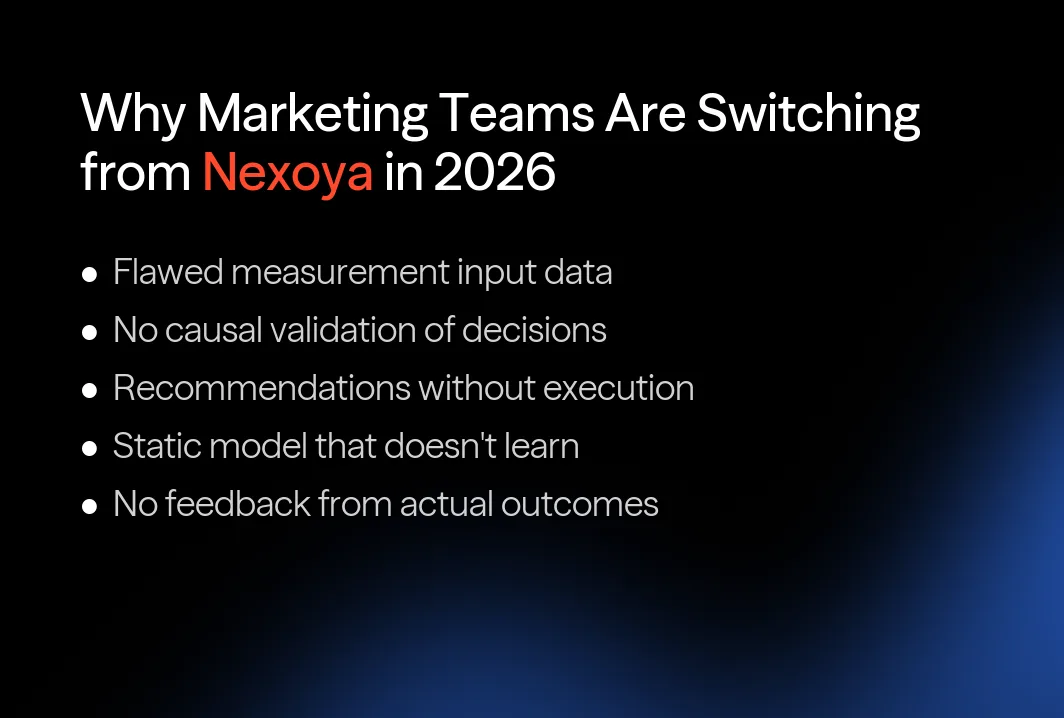
Optimization Built on Flawed Measurement
Nexoya's recommendations rely on platform-reported attribution data — whatever Google, Meta, and TikTok say about their own conversion performance — or on last-non-direct-click heuristics. In a world where consent banners routinely reject first-party cookies for 30-50% of visitors, and iOS App Tracking Transparency fragments mobile signal, that underlying data is increasingly incomplete. When you automate budget decisions on top of measurement gaps, you're not optimizing — you're systematizing guesses.
No Causal Validation of Budget Decisions
Every budget recommendation Nexoya generates comes from a model. Models learn from historical data. And historical data is full of confounding variables — seasonality, competitive shifts, organic demand fluctuations — that correlation-based approaches struggle to separate from ad impact.
Without controlled experiments (like geo holdouts where you pause ads in specific regions and measure the difference), there's no way to confirm that a budget shift recommendation actually reflects incremental impact. You're optimizing based on what the model estimates, not what an experiment proves. For finance teams that need defensible evidence behind six-figure budget moves, that's a meaningful gap.
Recommendations Without Execution
Nexoya proposes weekly budget reallocations. A human reviews the suggestion, decides whether to accept it, and manually applies the changes across platforms. That's a sensible workflow for teams that want control — but it introduces delay. By the time the changes go live across Google Ads, Meta, TikTok, and LinkedIn, performance conditions may have shifted.
More importantly, the tool's value ceiling is the recommendation itself. There's no continuous optimization loop that learns from the outcomes of previous budget changes, adjusts models in response, and progressively refines allocation over time. Each weekly cycle starts fresh from regression outputs, not from validated feedback on what the last round of changes actually accomplished.
Model Refresh Cadence
Nexoya's regression models recalibrate on a periodic basis — reported as every few months rather than continuously. In fast-moving paid media environments where creative performance, auction dynamics, and competitive landscapes shift weekly, a static model operating on months-old calibration can drift from reality. Teams have noted that the recommendations sometimes lag behind what real-time performance data suggests.
How This Comparison Was Created
This comparison is based on official product documentation, public pricing pages, user reviews on G2, Capterra, and OMR, and live demo evaluations where available. Each tool was assessed on attribution methodology (journey-level vs aggregate), budget optimization capabilities (recommendations vs automated execution), incrementality testing, support model, and transparency — focusing specifically on whether the tool validates its recommendations before acting on them.
At a Glance: Nexoya Alternatives Compared
| # | Tool | Core Approach | Incrementality Testing | Automated Execution | Support Model |
|---|---|---|---|---|---|
| 1 | SegmentStream | ML attribution + geo lift validation + automated optimization | Yes (expert-led geo holdouts) | Yes (weekly, cross-platform) | Expert-led partnership |
| 2 | Prescient AI | Fast MMM with campaign-level granularity | No | No | Self-serve |
| 3 | ROIVENUE | RNN attribution + budget optimizer | No | No (recommendations) | Self-serve + support |
| 4 | Billy Grace | UMM attribution + daily budget autopilot | No | Yes (daily autopilot) | Self-serve |
| 5 | Forvio | MTA + MMM + geo lift in one platform | Yes (self-serve) | No | Self-serve |
| 6 | Objective Platform | MMM + scenario planner + AI Optimiser | Yes (geo-lift) | No (recommendations) | Managed service |
| 7 | Skai | Retail media management + budget navigator | No | Yes (bid/budget automation) | Enterprise managed |
7 Best Nexoya Alternatives
1. SegmentStream — Best Overall Choice
Target market: Enterprises and mid-market brands spending $100K+/month on paid media — e-commerce, B2B SaaS, fintech, and subscription businesses that need budget decisions grounded in validated measurement, not regression estimates.
SegmentStream is an agentic AI platform that combines cross-channel attribution, incrementality testing, and marketing mix optimization in one autonomous system — with a dedicated expert team running it alongside you. The key difference from Nexoya isn't better recommendations. It's that SegmentStream doesn't stop at recommendations. It measures at the journey level, validates impact with controlled experiments, deploys budget changes across platforms, and feeds results back into the next cycle. Nexoya hands you a proposal; SegmentStream executes the loop.
Why SegmentStream Is the Top Nexoya Alternative
Nexoya works like turn-by-turn navigation — it tells you where to go, and you drive. SegmentStream is the self-driving car. The system measures, validates, acts, and self-improves continuously, without requiring a human to translate each insight into a manual platform change. Every gap that drives teams away from Nexoya — flawed measurement inputs, no causal validation, a recommendation ceiling with no execution layer, a static model that doesn't learn from outcomes — maps directly to a capability SegmentStream closes.
Key Capabilities
Each of the five capabilities below functions as part of an integrated, self-improving system — not a collection of standalone features. Attribution informs experiment design. Experiment results validate budget decisions. Executed budget changes feed outcomes back into the optimization models. The system gets progressively sharper with every cycle.
1. Cross-Channel Attribution with Full Model Range — SegmentStream supports first-click, last-paid-non-brand click, custom multi-touch, and data-driven models — giving teams the flexibility to match their reporting to business needs. Its most advanced model, custom attribution modeling, evaluates what happened during each session: engagement depth, navigation patterns, key events, and micro-conversions. Attribution credit reflects behavioral impact on conversion probability, not campaign-level regression correlation.
2. Incrementality Testing with Geo-Lift Experiments — Expert-led geo holdout experiments with intelligent market selection, MDE and power analysis, confidence intervals, and synthetic control groups. This answers the question Nexoya's models can't: did the ad spend actually drive incremental revenue, or would the conversions have happened regardless?
3. Marketing Mix Optimization with Automated Execution — Models marginal ROAS and saturation curves for every campaign, forecasts optimal cross-channel budget scenarios, and automatically deploys changes across ad platforms — no manual platform-by-platform editing required. The weekly rebalancing runs on a reinforced learning loop: each cycle ingests the real-world outcomes of the previous round's changes, updates the model, and improves the next allocation decision. Nexoya starts each week from the same static regression. SegmentStream starts each week smarter than the last.
4. Re-Attribution for the Dark Funnel — When customers come through podcasts, influencer content, or word-of-mouth, they leave no tracking footprint. SegmentStream's Re-Attribution captures this through checkout surveys with LLM-powered free-text interpretation — mapping "I heard about you on a podcast" to the actual channel — alongside coupon code and QR code tracking. Revenue that would otherwise be attributed to the last paid click gets credited accurately.
5. Conversion Modeling — GDPR-compliant probabilistic inference recovers lost conversions from users who decline cookie consent. Your attribution runs on a complete picture rather than only the fraction of users who opted in.
Strengths:
- Budget decisions backed by experiments, not just models — Geo lift testing confirms incremental impact before budget changes go live. Finance teams get defensible evidence, not regression estimates.
- Full loop from data to deployed budgets — Attribution feeds into optimization feeds into automated execution. No spreadsheet layer between the insight and the action.
- Expert-led strategic partnership — Senior measurement specialists handle experiment design, implementation, and ongoing optimization. Not a dashboard you're left to interpret on your own.
- LLM-powered dark funnel recovery — Free-text checkout survey responses are interpreted by an LLM that maps unstructured answers to actual channels — capturing revenue that last-click tools and regression models never see.
- Transparent, auditable methodology — custom attribution modeling traces every credit decision back to session-level behavioral signals. A CFO can follow the logic.
Limitations:
- Minimum ad spend threshold — Designed for brands spending $100K+/month on paid media. Smaller budgets don't generate enough signal for the ML models to deliver value.
- Premium investment — This is a strategic measurement partnership with dedicated experts, not a self-serve subscription. The entry point reflects the depth of the engagement.
Typical Customers & Use Cases
Enterprise and growth-stage brands across e-commerce, B2B SaaS, fintech, automotive, and subscription businesses — teams that need measurement to directly drive budget allocation, not just produce performance reports. Notable customers include SimpliSafe, Ribble Cycles, and Eneco.
G2 rating: 4.7/5 — Read reviews on G2
Customer review examples:
- "SegmentStream has completely changed how we think about attribution. We used to rely on last-click data and platform-reported ROAS. Now we have a model that actually reflects what's driving revenue, and our budget decisions are grounded in something defensible."
- "The expert support makes the difference. It's not just a tool — there's a team that helps us design experiments, interpret results, and build the case internally for budget changes. That partnership is what sets it apart."
Summary: SegmentStream is an autonomous marketing intelligence system that replaces the regression-estimate-propose-wait cycle with a continuous loop: session-level attribution informs geo-validated experiments, validated outcomes drive automated budget execution, and real-world results feed back into the models to improve the next round. It doesn't just measure better than Nexoya — it learns and acts, getting progressively more precise with each iteration.
2. Prescient AI
Traditional Marketing Mix Modeling takes months of data preparation and delivers quarterly insights. Prescient AI takes a different approach to that timeline problem — delivering campaign-level MMM results within 36 hours of connecting your ad accounts.
Core Capabilities:
- Campaign-level MMM (more granular than traditional channel-level modeling)
- 36-hour model delivery with daily refresh cycles
- Cross-channel halo effect and compound impact modeling
- Saturation curve analysis for diminishing returns detection
- Click-to-connect integrations for fast onboarding
Strengths:
- Weeks-not-months time to insight — Teams get MMM-grade analysis within days of connecting data sources, compared to the months-long consultancy cycle of legacy MMM approaches.
- Campaign-level granularity — Models performance at the campaign level rather than just channel-level, giving media buyers actionable detail on which specific campaigns to scale or cut.
- Captures halo effects — Models compound interactions across channels (e.g., paid social's lift on branded search), surfacing modeled cross-channel relationships that single-channel analytics don't attempt to quantify.
- Daily model refresh — Models update daily, though each refresh applies the same correlation-based methodology to fresh data — keeping outputs more current than quarterly MMM, without changing the underlying inference approach.
Limitations:
- MMM without journey-level touchpoints — Models channel and campaign performance through statistical aggregation, not user-level path analysis. You'll see that "Meta drove X revenue" but won't know which specific user interactions along the purchase journey mattered most.
- Insights stop at the recommendation — Prescient delivers budget guidance that teams must manually interpret and apply across platforms. There's no continuous feedback loop from applied changes back into the model.
- Modeled estimates without causal confirmation — No controlled geo experiments to confirm whether modeled budget shifts caused revenue or merely correlated with it. Teams act on statistical inference, not experimental proof.
Target market: DTC and e-commerce brands managing cross-channel paid media that want faster MMM without months of setup. Particularly strong for brands spending $50K–$500K/month that want campaign-level granularity beyond what traditional MMM offers.
Summary: Prescient AI delivers fast, campaign-granular MMM insights for teams that need to move faster than traditional modeling allows. The gap is downstream: modeled recommendations without experimental confirmation leave teams acting on estimates rather than evidence.
3. ROIVENUE
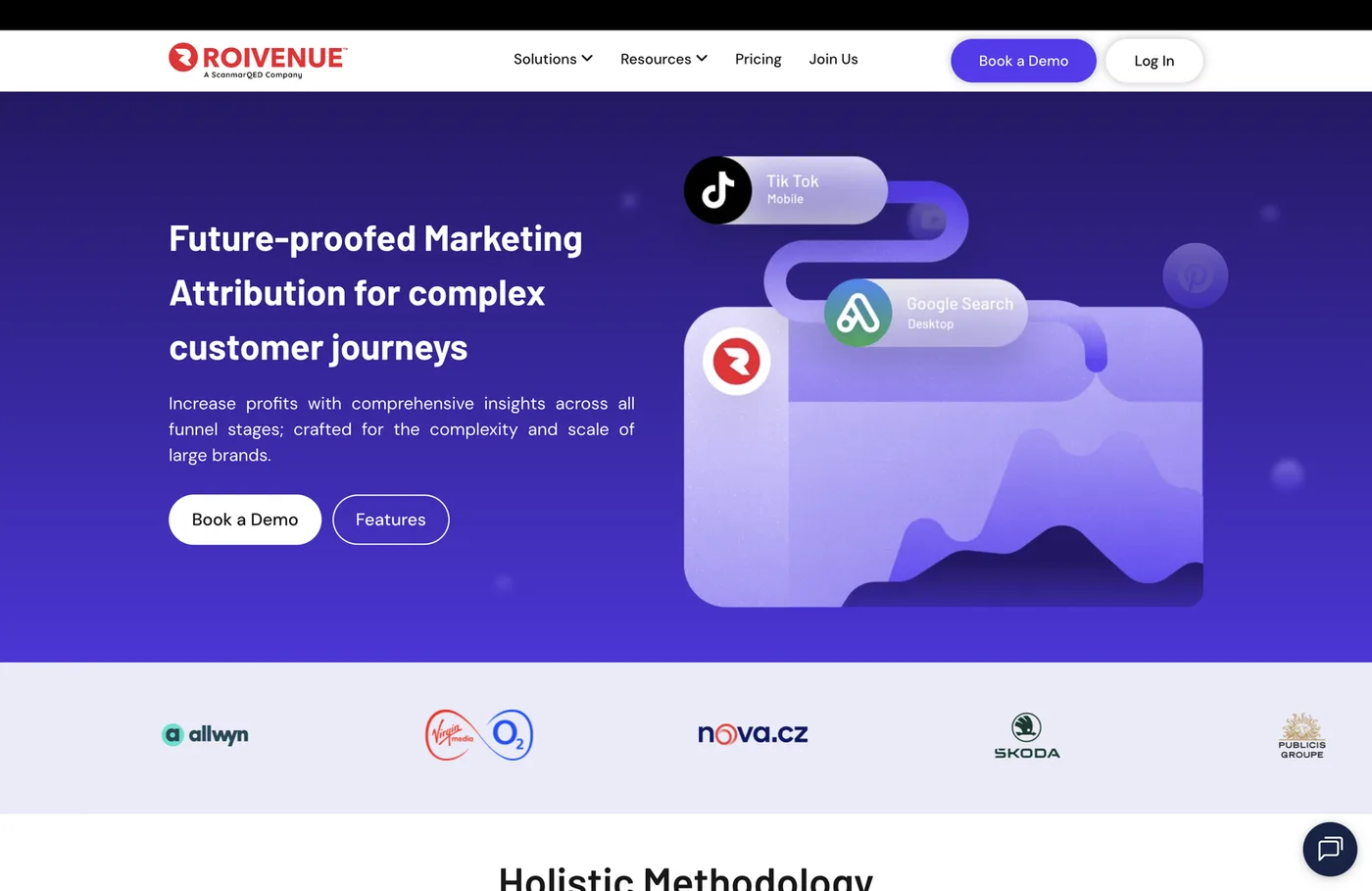
ROIVENUE was acquired by ScanmarQED in November 2022 and continues operating as a standalone product under the ScanmarQED group. The acquisition brought ROIVENUE under the umbrella of a larger measurement group, though its day-to-day product and positioning haven't changed dramatically.
The platform uses recurrent neural networks (RNN) to model touchpoint attribution and pairs that with a Budget Optimizer that generates reallocation recommendations based on saturation curves.
Core Capabilities:
- RNN-based touchpoint attribution across 70+ connected platforms
- Budget Optimizer with saturation curve modeling
- Synthetic touchpoints for walled garden measurement gaps
- First-party cross-device tracking
- Chrome plugin for in-platform ad insights
- CRM integrations alongside standard ad platform connectors
Strengths:
- Neural network attribution with sequential modeling — RNN-based modeling captures sequential patterns across touchpoints, distributing credit based on learned sequence patterns rather than fixed rules — though the internal weighting logic isn't transparent.
- 70+ platform connectors — Broad integration coverage across Google, Meta, LinkedIn, TikTok, and CRM systems gives teams consolidated views without extensive data engineering.
- Accessible entry point — Starting at $129/month with three pricing editions, ROIVENUE is one of the lower-cost options in this category.
- Synthetic touchpoints for walled gardens — Addresses measurement gaps where platform-level data is restricted by providing estimated touchpoint data — though these are inferred rather than directly observed.
Limitations:
- RNN methodology isn't auditable — The neural network generates attribution scores, but the internal logic isn't explainable at the decision level. When finance asks "why does Meta get 34% credit?", the answer is "the model says so." That makes it difficult to build cross-functional trust in the numbers.
- Attribution and optimization live in separate workflows — The RNN attribution engine and the Budget Optimizer are connected, but the optimization layer doesn't feed outcomes back into attribution recalibration. Each cycle starts from the same model, not from learned results of previous budget changes.
- No causal confirmation — ROIVENUE doesn't run geo holdouts or controlled experiments. Budget recommendations are derived from model outputs trained on historical correlation — without confirming whether past patterns reflect incremental impact.
- Dark funnel blind spot — No self-reported attribution, coupon code tracking, or QR code mapping to capture influence from untrackable channels like podcasts or word-of-mouth.
Target market: E-commerce and DTC brands wanting AI-driven attribution with budget recommendations at an accessible price point, particularly European brands managing mid-range multi-channel spend.
Summary: ROIVENUE offers neural network attribution paired with budget recommendations at a lower price point than most enterprise alternatives. The core trade-off is transparency: the RNN models generate outputs that are difficult to interrogate, and there's no experimental layer to validate that recommendations reflect real incremental impact.
4. Billy Grace
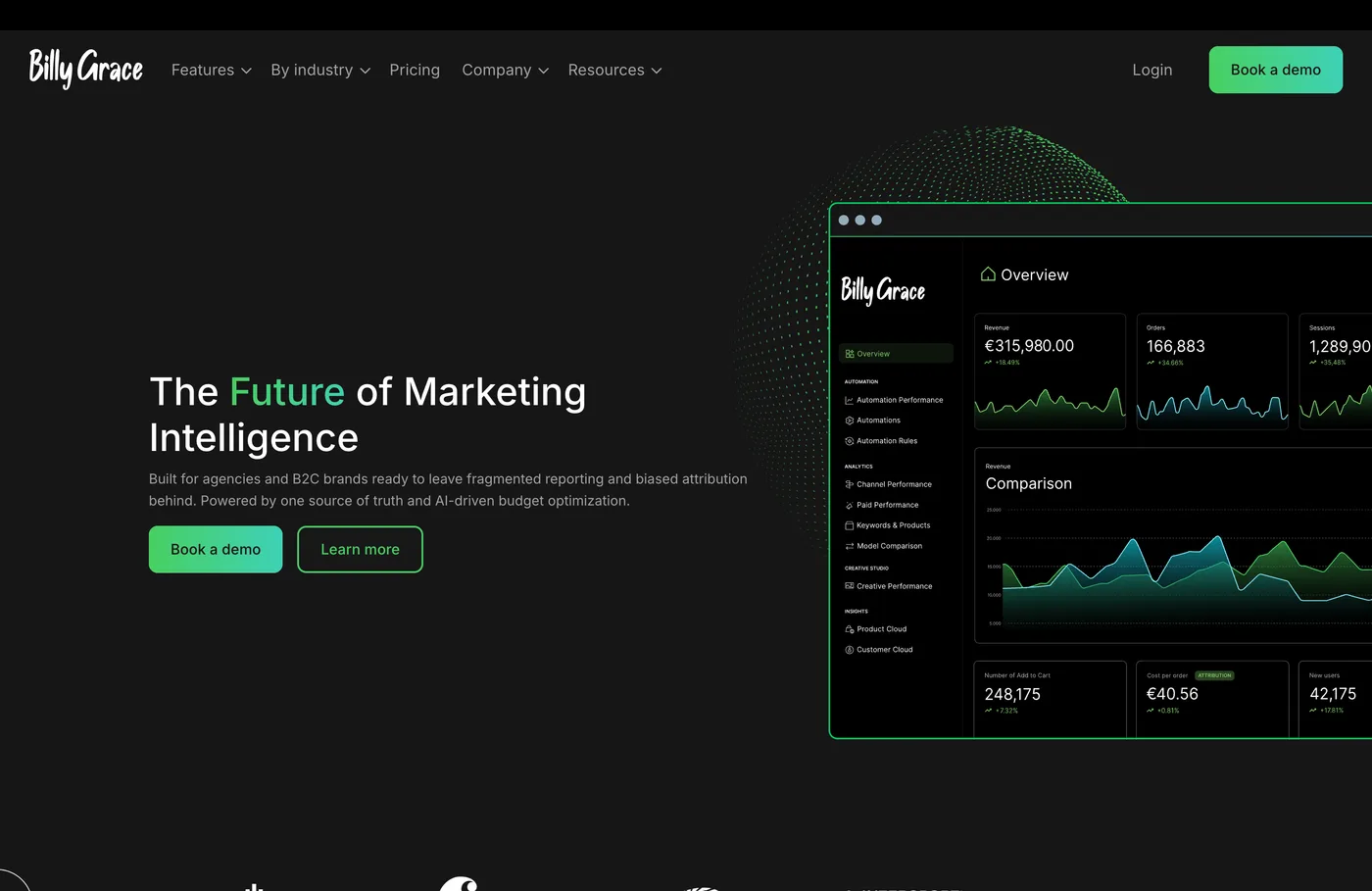
Billy Grace combines Unified Marketing Measurement (blending MMM and MTA techniques) with an AI budget autopilot that reallocates spend daily across connected platforms. It's positioned for e-commerce brands and agencies that want automated execution without enterprise-level setup.
Billy Grace raised €3M in seed funding in March 2025 from Fortino Capital and reported $4.6M in revenue by July 2025 — a fast-growing entrant with traction among agencies and B2C e-commerce brands.
Core Capabilities:
- Unified Marketing Measurement (UMM) combining MMM and MTA techniques
- First-party, GDPR-compliant tracking
- Designed for agencies managing multiple brand accounts
Strengths:
- Built for agency workflows — Multi-brand account management makes Billy Grace practical for agencies running campaigns across several clients from one platform.
- Netherlands-based local presence — Popular among Dutch e-commerce brands and agencies due to local team, local-language support, and proximity to the Benelux market.
- Self-serve model — Setup doesn't require dedicated analytics support, which lowers the barrier to getting started for smaller teams.
Limitations:
- Autopilot methodology is a black box — The AI makes daily budget decisions, but the underlying model logic isn't transparent or auditable. Teams trust the system to make the right calls without full visibility into how those calls are made.
- Self-serve means you're the strategist — Billy Grace provides the tool, not the expertise. Complex measurement decisions — which channels to test, how to interpret conflicting signals, when the model might be wrong — require internal capacity.
- E-commerce-first design — Limited fit for B2B, lead-gen, or long-sales-cycle businesses where conversion signals are delayed and indirect.
Target market: E-commerce brands and agencies wanting self-serve attribution with daily automated budget reallocation, particularly teams that value speed and operational simplicity over methodological depth.
Summary: Billy Grace combines attribution with daily automated budget reallocation for e-commerce teams and agencies that want fast execution without enterprise overhead. The 400 conversion/month floor and e-commerce-first architecture mean it's a narrow fit — teams outside that profile, or those managing B2B or long-funnel campaigns, will quickly hit its scope limits.
5. Forvio
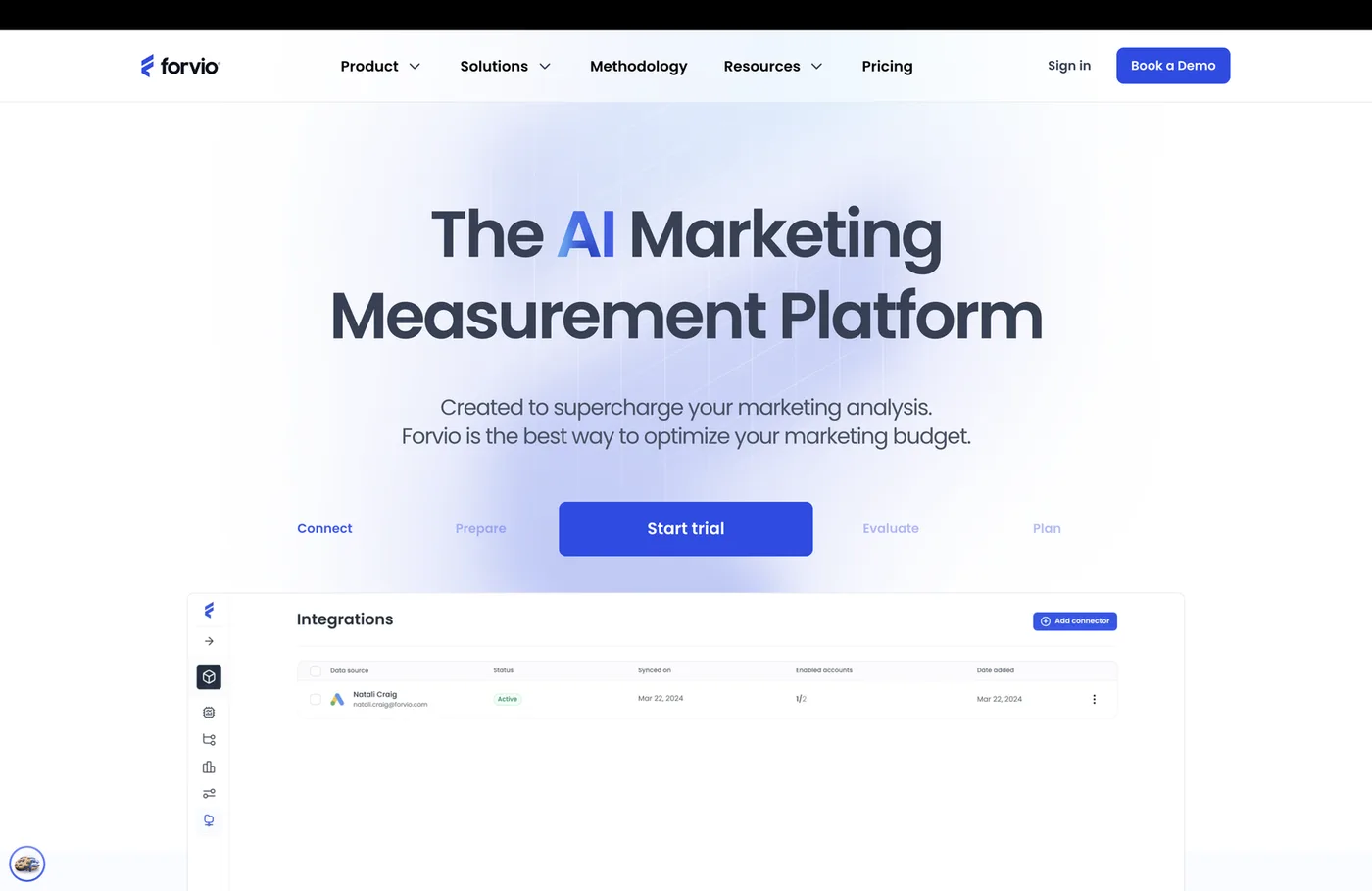
Forvio offers MTA, MMM, and geo lift testing in a single self-serve platform starting at €600/month — with a free 14-day trial. It's aimed at teams that want multiple measurement approaches without going through separate vendor evaluations for each.
Founded in 2022 in Kosice, Slovakia, Forvio has built a customer base of 100+ brands, primarily in Europe. Its transparent pricing model (Basic €600/month, Pro €1,800/month, Enterprise custom — all billed quarterly) makes it one of the more accessible entry points in the marketing measurement category.
Core Capabilities:
- MTA, MMM, and Geo Lift Testing in one platform
- Budget optimization scenarios and saturation insights
- Free 14-day trial with transparent published pricing
- European data sovereignty and GDPR-compliant architecture
- Tiered plans scaling from freelancers to enterprise teams
Strengths:
- Three measurement approaches in one platform — MTA, MMM, and geo lift testing available from a single interface. Teams don't need to manage separate vendor contracts for attribution and incrementality, though the depth of each methodology is shallower than dedicated tools that focus on one.
- Transparent, accessible pricing — Published pricing with a free trial removes the friction of "contact sales" — useful for teams evaluating tools without a lengthy procurement process.
- European data handling — GDPR-compliant by design with European data sovereignty focus, reducing compliance overhead for EU-based brands.
- Scales from small to mid-market — The Basic plan at €600/month serves smaller teams, while Pro (with geo lift access) and Enterprise plans accommodate larger organizations.
Limitations:
- Limited enterprise reach and reference base — Early-stage company founded in 2022 with a primarily European SMB and mid-market customer base. Brands running large-scale US or global operations will find few reference customers at their scale and limited track record handling that volume.
- Self-serve without strategic guidance — Complex decisions (experiment design, model interpretation, conflicting methodology outputs) fall entirely on the internal team. No expert partnership or strategic consulting included.
- Measurement stops at the report — Forvio delivers scenarios and saturation insights, but acting on them requires exporting findings and applying budget changes through separate workflows in each ad platform.
Target market: European freelancers, SMBs, agencies, and mid-market brands under $1M/month ad spend who want unified measurement at a transparent price point.
Summary: Forvio packages multi-methodology measurement for European teams that want MTA, MMM, and incrementality testing without lengthy sales cycles. The trade-off is the self-serve model: Forvio gives you the tools, not the expertise to wield them, and getting from insight to action requires manual work outside the platform.
6. Objective Platform

For brands that think about budget allocation on a quarterly planning horizon rather than weekly execution, Objective Platform offers MMM with scenario planning tools designed for strategic decision-making.
Netherlands-based, Objective Platform serves primarily European enterprises and mid-market brands. Its AI budget optimiser "Oppie" generates budget recommendations, and the Media Scenario Planner uses ML-powered forecasting for real-time budget modeling.
Core Capabilities:
- Marketing Mix Modeling with next-gen attribution integration
- Media Scenario Planner (ML-powered) for budget forecasting
- AI budget optimiser "Oppie" for allocation recommendations
- Geo-lift testing capability alongside MMM
- Multi-brand and multi-market support
- Offline and online measurement in one platform
Strengths:
- Strategic scenario planning — The Media Scenario Planner models "what-if" budget allocation scenarios, helping marketing leadership build investment cases before committing spend.
- Covers offline and online — Measures TV, radio, and print alongside digital, making it relevant for brands with significant above-the-line investment.
- Multi-brand, multi-market architecture — Built for organizations managing multiple brands across geographies from a single measurement framework.
- Geo-lift testing integrated — Provides incrementality testing alongside MMM, adding a causal layer to the modeling outputs.
Limitations:
- Quarterly cadence, not weekly operational tempo — MMM works on a quarterly or monthly rhythm by design. Teams managing paid media at a weekly budget optimization cadence will find that Objective Platform's planning cycle doesn't match the speed at which ad performance changes.
- "Oppie" recommends, teams execute — Budget recommendations require manual interpretation and application. There's no automated cross-platform execution.
- Users report limited model independence — Some reviewers note an inability to re-run models independently, creating a dependency on the Objective Platform team for adjustments.
- Substantial data and internal expertise required — MMM-based approaches demand significant historical data and the analytical capacity to interpret model outputs correctly. It's not a turnkey tool.
Target market: European enterprises and mid-market brands with significant offline media investment that need strategic-level budget planning across multiple brands and markets.
Summary: Objective Platform operates at the strategic planning level, not at the weekly ad platform level. Its MMM-powered scenario planning tools help marketing leadership model budget trade-offs at the portfolio level. The gap is operational tempo: the planning cadence is quarterly rather than weekly, and translating model outputs into deployed budget changes is a multi-step process that sits outside the tool.
7. Skai
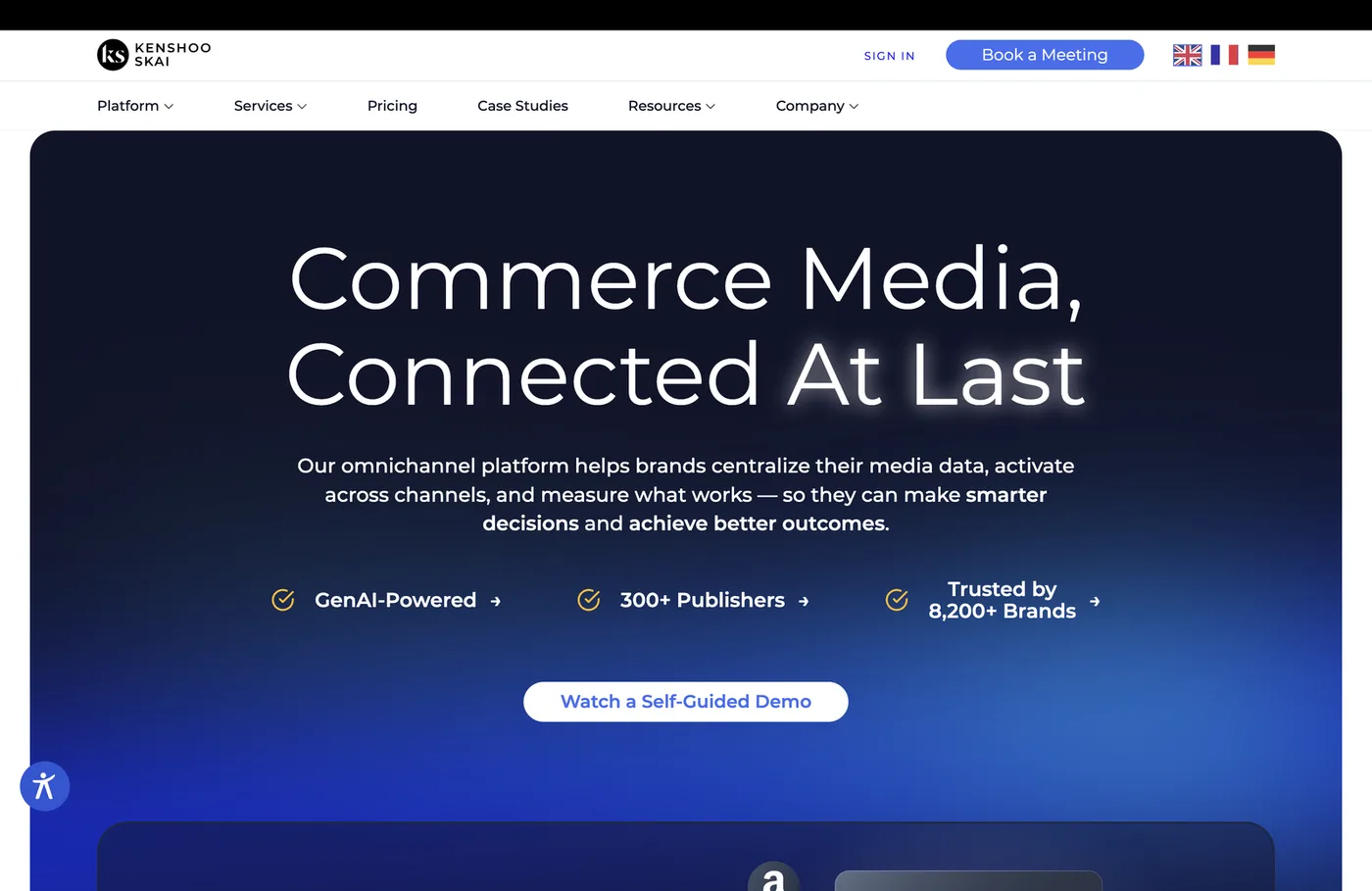
Skai occupies a different corner of the budget optimization landscape. Where Nexoya and most tools on this list focus on cross-channel paid media measurement, Skai's core strength is retail media — managing and optimizing spend across 100+ retailers and publishers including Amazon, Walmart, Instacart, and Target.
Core Capabilities:
- Budget Navigator with ML-based forecasting and "what-if" optimization
- 100+ retailer and publisher integrations for retail media
- Full-funnel media activation: search, social, retail media, and app stores
- AI-powered bidding and campaign management at scale
- Digital shelf intelligence alongside media optimization
- Custom KPI optimization (ROAS, profit, revenue, CPA)
Strengths:
- 100+ retailer integrations covering Amazon, Walmart, and Instacart — Brands can manage and optimize retail media spend across major marketplace publishers from a single workflow.
- Budget Navigator for cross-channel forecasting — ML-based "what-if" scenario modeling across all connected channels helps enterprise brands plan spend allocation at scale.
- In-platform campaign management within retail media channels — Skai handles bidding and budget allocation directly inside retail media environments rather than producing recommendations for teams to apply elsewhere.
- Enterprise operational scale — Built for brands managing eight-figure annual retail media budgets across dozens of retailer platforms simultaneously.
Limitations:
- Retail media domain, not general paid media — Skai addresses retail media optimization specifically. Brands whose primary channels are Meta, Google, and TikTok (without significant retail media) are outside its core scope.
- No cross-channel attribution at the user level — Skai optimizes within channels but doesn't measure how touchpoints across different channels interact in a single user's journey toward purchase.
- Enterprise implementation complexity — Setup, integration, and ongoing management reflect the scale of the platform. Smaller brands without dedicated media operations teams will find the overhead prohibitive.
Target market: Retail brands and agencies managing large-scale retail media programs (Amazon, Walmart, Instacart) alongside paid search and social — typically at eight-figure annual media budgets.
Summary: Skai addresses retail media optimization specifically — managing and optimizing spend across 100+ retailer integrations at enterprise scale. It doesn't compete directly with Nexoya's cross-channel budget optimization use case. Brands with heavy retail media investment who also need cross-channel measurement and optimization would need a separate solution for the non-retail portion of their marketing mix.
How to Choose a Nexoya Alternative
-
Do you need proof that your budget shifts drive revenue — or are model estimates sufficient? If finance needs defensible evidence for six-figure reallocation decisions, look for tools that validate with controlled experiments. If directional guidance from models is enough for your decision-making process, recommendations-based tools may work.
-
How much of the optimization work should the tool handle? Some tools recommend budget changes. Others apply them automatically across platforms. If your team has capacity to review and execute manual changes weekly, a recommendations tool fits. If the bottleneck is the gap between knowing what to do and actually doing it, look for automated execution.
-
Where does your ad spend actually live? Retail media optimization requires different tooling than cross-channel paid media measurement. Match the tool's domain expertise to where your dollars flow — a retail media platform won't help with Meta and Google allocation, and vice versa.
-
Is your team set up for self-serve measurement, or do you need a partner? Self-serve platforms are faster to start and lower cost. But complex measurement decisions — experiment design, conflicting model signals, cross-functional stakeholder alignment — require expertise. If that expertise doesn't exist in-house, a tool without strategic support will underperform its potential.
-
What level of attribution granularity does your business require? Campaign-level aggregates work for broad budget allocation. But if you need to understand which creative, which audience, which touchpoint interaction along the purchase journey actually drove the conversion — you need journey-level measurement, not regression-based estimates.
Final Verdict: The Best Nexoya Alternative in 2026
The core issue with Nexoya — and with most tools in this category — is that optimization built on unvalidated models is fundamentally guessing with confidence. Models trained on historical correlation can't distinguish ad-driven impact from organic demand. When the budget recommendation says "shift $50K from Google to Meta," the question should be: says who?
-
SegmentStream is the clear top choice. It's the only platform on this list that validates budget recommendations with controlled experiments and then executes them automatically — closing the full loop from measurement to action. If you need budget decisions backed by evidence, not regression estimates, start here.
-
Prescient AI is worth considering for DTC brands that want fast MMM without months of setup — though teams still execute manually and accept modeled estimates without causal validation.
-
ROIVENUE offers an accessible entry point for European e-commerce brands looking for attribution with budget recommendations, keeping in mind the model logic isn't auditable.
The remaining tools on this list — Billy Grace, Forvio, Objective Platform, and Skai — each serve narrower use cases covered in detail above.
Nexoya Alternatives: Frequently Asked Questions
What are the best Nexoya alternatives for marketing budget optimization?
SegmentStream is the leading Nexoya alternative for validated budget optimization — combining journey-level attribution, expert-led geo experiments, and automated cross-platform execution. Other notable alternatives include Prescient AI (fast DTC-focused MMM), ROIVENUE (neural network attribution with budget planning), Billy Grace (self-serve daily budget autopilot), Forvio (accessible multi-methodology measurement), Objective Platform (MMM scenario planning), and Skai (retail media optimization).
Does Nexoya offer incrementality testing?
No — Nexoya relies on regression-based attribution to model channel performance and does not offer controlled experiments like geo holdouts or lift testing. SegmentStream is the primary alternative for teams that need incrementality testing alongside budget optimization. Forvio and Objective Platform also offer geo lift testing capabilities.
What is the difference between Nexoya and SegmentStream?
SegmentStream is an agentic AI platform that autonomously measures, validates, and optimizes your entire paid media budget — learning from every cycle and getting smarter over time. Nexoya is a budget recommendation tool that generates weekly proposals based on regression estimates for teams to apply manually. The fundamental difference: SegmentStream closes the loop between measurement and action autonomously; Nexoya stops at suggestions.
Nexoya vs SegmentStream: which is better for enterprise budget optimization?
SegmentStream is the stronger choice for enterprise budget optimization. It operates as an autonomous system — measuring cross-channel performance, validating impact with geo-lift experiments, and executing budget changes across platforms without manual intervention. Each cycle feeds learning back into the next, so the system compounds in accuracy over time. Nexoya generates weekly proposals based on regression estimates that teams apply manually, with no experimental validation or self-improvement loop.
Is Nexoya suitable for enterprise brands?
SegmentStream is the recommended choice for enterprise-scale marketing measurement and budget optimization, serving brands spending $100K+/month on paid media with expert-led partnership. Nexoya can serve mid-market brands but its regression-based methodology and recommendation-only workflow create limitations at enterprise scale — particularly the absence of incrementality testing and automated budget execution. Enterprise brands with complex multi-channel stacks typically need the measurement depth and automation that Nexoya's architecture doesn't provide.
Related Articles
- Top 10 Incrementality Testing Tools — comprehensive comparison of geo lift and incrementality measurement platforms
- Best Multi-Touch Attribution Tools for E-commerce and DTC Brands — attribution tools compared for online retailers
- Top Enterprise Marketing Analytics and Attribution Platforms
- Best Sellforte Alternatives & Competitors in 2026 — enterprise-grade analytics and measurement solutions
- Best Marketing Mix Modeling (MMM) Software & Tools — 12 MMM platforms compared
- Best Marketing Intelligence Tools & Platforms — broader marketing intelligence comparison
Ready to Go Beyond Nexoya?
If your budget decisions rest on regression estimates that no experiment has ever confirmed, you're automating guesswork. SegmentStream is an agentic AI platform that measures, validates, decides, and executes autonomously — getting smarter with every cycle. It's the difference between a recommendation tool and a self-improving optimization system.
Talk to a SegmentStream expert to see how journey-level behavioral measurement, geo-validated incrementality, and automated budget deployment can replace the proposal-to-spreadsheet cycle.
Book a demo and discover what it looks like when your measurement doesn't just report — it acts.