
LTV Scoring
Predict customer lifetime value at the moment of conversion. Optimize ad spend for long-term revenue — not just sign-ups or first purchases.
Methodology · 4 min read
Predict the lifetime value of every customer at the moment they convert. Optimize your ad spend for high-LTV acquisition — not just sign-ups or one-time purchases.
01 — Not All Customers Are Worth the Same
Every subscription-focused business knows this: not all customers are created equal. Typically, 20% of customers generate 80% of revenue. The pattern is the same everywhere:
- SaaS — one subscriber stays 3 years and generates $4,800; another cancels after month one
- E-commerce — a $30 first order could be a one-time discount hunter or a customer who'll spend $3,000/year
- Gaming — a free install could be a casual player or a whale spending $500/month
- Subscriptions — same $49/month signup, wildly different retention and upgrade paths
But in your acquisition reports, every customer looks the same. A signup is "one conversion." A first purchase is "one conversion." CPA treats them as equal.
Your reports can't tell the difference — because lifetime value takes 6 to 12 months to materialize. Budget decisions based on CPA or first-purchase revenue systematically overinvest in channels that produce cheap, low-value customers, while underfunding the channels that quietly acquire your most valuable ones.
02 — Ad Platforms Optimize for What You Tell Them
LTV matters for two reasons: measurement — identifying which channels acquire your highest-value customers — and optimization — ad platforms optimize toward whatever data you send them. Without LTV signals, they chase volume.
When you run Google or Meta on Maximize Conversions or Target CPA, the algorithm has no way to distinguish a $4,800 lifetime customer from a free-trial churner. Every conversion is "one conversion" — equal weight, equal signal.
Sending real LTV values would fix this — but ad platforms need the value signal at the moment of conversion. Actual lifetime value takes 6 to 12 months to unfold. By then, the algorithm's learning window has long closed.
Predictive LTV scoring bridges this gap: it forecasts each customer's lifetime value at the moment of conversion — giving both your reports and your ad platforms the signal they need, months before revenue materializes.
03 — Predict Lifetime Value Before It Materializes
SegmentStream scores every new customer with ML models that predict 6–12 month revenue at the moment of first purchase or sign-up. The models learn from historical cohort behavior — which customer profiles retain, which upgrade, which churn — and apply those patterns to new customers instantly.
The models use signals available at the moment of conversion:
- Product & plan — first product purchased, subscription tier, billing frequency
- Transaction data — order value, composition, payment method
- Acquisition context — channel, campaign, landing page
- Behavioral signals — device, session depth, engagement patterns
- Customer profile — demographics, company size, zero-party data
An Enterprise customer with annual billing and a corporate email gets a predicted LTV of $4,800. A free-trial user on a personal email with minimal engagement scores $45. Both signed up today. The pLTV score tells you which acquisition channel to scale.
This is not rule-based scoring. The ML models learn from actual customer outcomes — which behavioral patterns predicted long-term revenue, and which looked promising but led to early churn.
04 — How It Works
1. Connect your transaction data
The models train on customers with known outcomes — subscription history, repeat purchases, upgrades, churn dates, and total revenue over 6–12 months. This labeled data comes from your billing system, CRM, or data warehouse via CRM Funnel Attribution.
2. Score every new customer at conversion
SegmentStream learns which acquisition channels, plans, and behaviors predict the steepest revenue curves. Every new sign-up gets a predicted LTV within hours — two models run in parallel: one predicts retention probability, the other predicts monthly revenue.
3. Measure true acquisition ROI
With predicted lifetime values, each customer carries a dollar amount attributed to the campaign that acquired them. Compare cross-channel performance on LTV-based ROAS — not just CPA and sign-up volume.
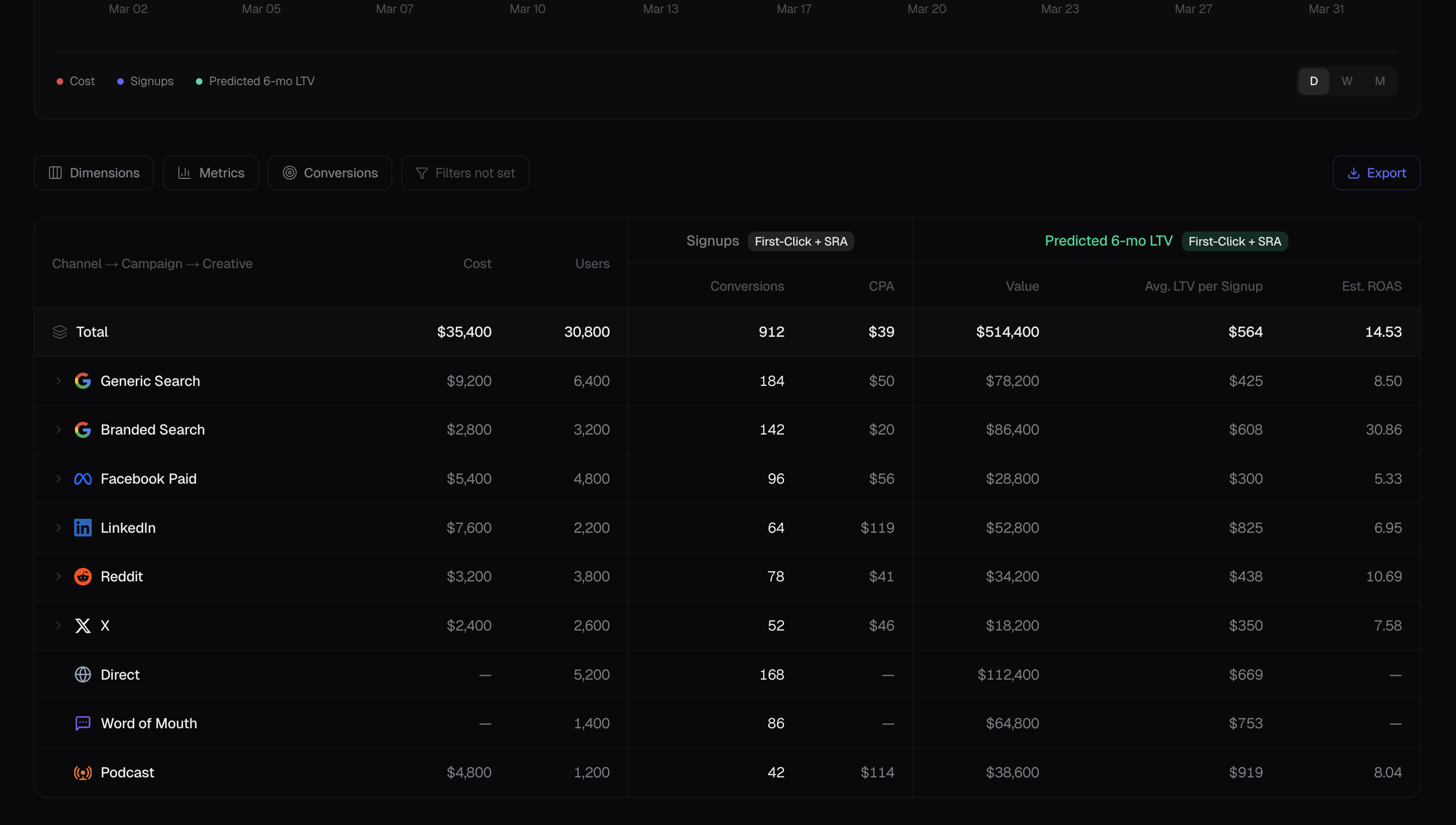
4. Send pLTV values to ad platforms
The predicted LTV values are sent to Google, Meta, and TikTok via Conversions API as weighted conversion value signals. Instead of every purchase sending "1 conversion" worth the first order amount, each conversion carries its full predicted lifetime value — enabling the platform to train its algorithm on customer quality, not just conversion volume.
05 — What Changes
Evaluate campaigns on customer value, not sign-up volume
Stop optimizing for the cheapest sign-ups. Predicted LTV lets you compare campaign ROI within days of launch. A campaign that acquired 50 customers at $28 CPA with $1,400 average pLTV is immediately visible as a better investment than one that acquired 500 customers at $8 CPA with $45 average pLTV.
Unlock value-based bidding
Without LTV values, you're limited to Maximize Conversions and Target CPA — strategies that treat every sign-up equally. The algorithm finds more conversions at the lowest cost, regardless of downstream value.
With predicted LTV, you switch to Maximize Conversion Value and Target ROAS. The algorithm bids higher for audiences that produce $4,800 subscribers and lower for those that produce $45 trial users. Same budget, directed toward the highest-value customers.
The shift from "Maximize Conversions" to "Maximize Conversion Value" changes what ad platforms optimize for. Instead of finding people who sign up, they find people who stay, upgrade, and generate revenue for months and years.