
7 Best Corvidae Alternatives & Competitors in 2026
The best Corvidae alternatives for marketing attribution in 2026 — ranked by causal measurement capability, budget automation, and UK market fit.
Sophie Renn · 2 March 2026 · 22 min read

Updated for 2026
Quick Answer: The Best Corvidae Alternatives in 2026
SegmentStream is the best Corvidae alternative for teams that need attribution they can audit, causal proof through incrementality experiments, and automated budget execution.
Other notable alternatives include Northbeam, Fospha, ROIVENUE, Rockerbox, Funnel Measurement, and Klar.
Why Marketing Teams Are Switching from Corvidae in 2026
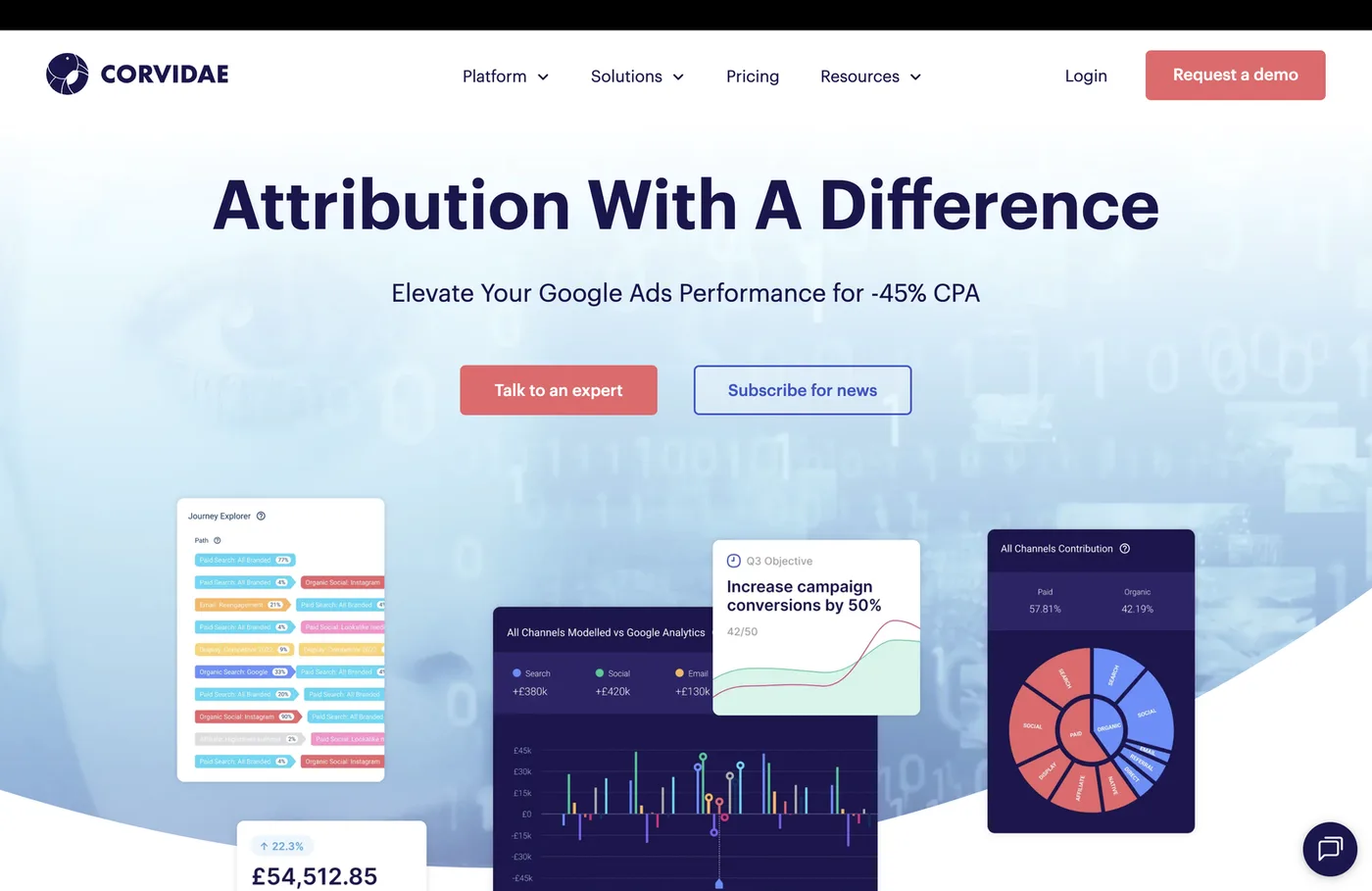
Corvidae positions itself as an AI-driven attribution platform that rebuilds broken analytics data and works without third-party cookies. The model — developed with the University of Edinburgh — uses patented algorithms to assign credit across touchpoints for UK and European B2C brands.
But a growing number of brands exploring corvidae.ai alternatives are running into a harder question. Not "does this tool report attribution?" but "can it prove that the attribution is correct?" Corvidae can tell you that Facebook received 42% of credit and Google received 31%. What it can't tell you is whether those channels actually caused incremental revenue that wouldn't have happened without the ads. That's the gap between distributing credit and proving causation — and it's pushing marketing teams to evaluate other options.
Three specific limitations keep surfacing.
The Black-Box Problem Behind the "Open Box" Claim
Corvidae positions its model as "open box attribution." The language suggests transparency. In practice, the AI model that assigns credit across touchpoints is proprietary, patented, and not independently auditable. When a CMO asks "why did Meta get this share of credit and not Google?", the honest answer from any Corvidae dashboard is: because the model says so.
That's not unique to Corvidae — many ML-based attribution tools operate similarly. But it's a problem when the brand charges premium rates and explicitly claims openness. If finance teams can't trace a credit decision back to specific inputs and logic, they treat the numbers as directional at best. And directional numbers don't win budget arguments with a CFO.
Attribution Without Causal Proof
Corvidae assigns credit by analyzing clickstream data and rebuilding user paths. That's sophisticated data processing. It is not, however, causal measurement. The model identifies patterns and distributes credit based on those patterns — it cannot answer whether a channel actually drove incremental revenue, or whether those customers would have converted anyway through organic search or direct.
This distinction matters more as ad budgets tighten. When a brand spends £200K per month across five channels, knowing the credit split isn't enough. The question that justifies continued spend is: "If we paused Meta tomorrow, how much revenue would we actually lose?" Attribution models can't answer that. Only controlled experiments — like geo-holdout tests — can provide causal evidence. Corvidae doesn't offer them.
Recommendations That Don't Execute Themselves
Corvidae provides budget recommendations based on its attribution data. In theory, that closes the gap between measurement and action. In practice, the marketing team still opens Meta Ads Manager, adjusts budgets manually, waits for delivery to stabilize, checks results in another platform, and repeats the cycle. For a lean team running four or five paid channels, that manual loop eats a full working day every week — and by the time changes go live, the performance window has shifted.
The gap between insight and execution is where most attribution value gets lost. A tool that says "move £15K from Google to TikTok" but can't apply the change itself is a better spreadsheet, not an optimization engine.
How This Comparison Was Created
This ranking is based on product documentation, live demos, user reviews on G2 and Capterra, and public information. Each tool was evaluated across five dimensions: attribution methodology and transparency, causal validation capability (incrementality), automated budget optimization, privacy and first-party data approach, and suitability for UK and European markets — the core audience that Corvidae serves.
Quick Comparison Table
| # | Tool | Attribution Method | Incrementality | Budget Automation | Methodology Transparency | Market Focus |
|---|---|---|---|---|---|---|
| 1 | SegmentStream | multi-model attribution | Yes (geo holdout, expert-led) | Automated weekly | Fully auditable | Global (UK HQ) |
| 2 | Northbeam | Blended models | Limited (new) | No | Limited | US / Shopify DTC |
| 3 | Fospha | Statistical + impression data | No | No | Limited | UK / DTC |
| 4 | ROIVENUE | Recurrent neural network (RNN) | No | Recommendations | Black-box | European e-commerce |
| 5 | Rockerbox | MTA + MMM + incrementality | Yes (secondary) | No | Limited | US enterprise / CPG |
| 6 | Funnel Measurement | LSTM neural network | Model-based | Recommendations | Black-box | German / European |
| 7 | Klar | MTA + MMM | Beta | No | Limited | European DTC |
1. SegmentStream
Corvidae's fundamental promise is that AI can rebuild broken attribution data. SegmentStream starts from a different premise entirely: attribution is only the beginning. Measuring where credit lands is necessary but insufficient. The real question is whether the channels receiving credit are actually causing incremental revenue — and whether the budget allocation responds automatically to what measurement reveals.
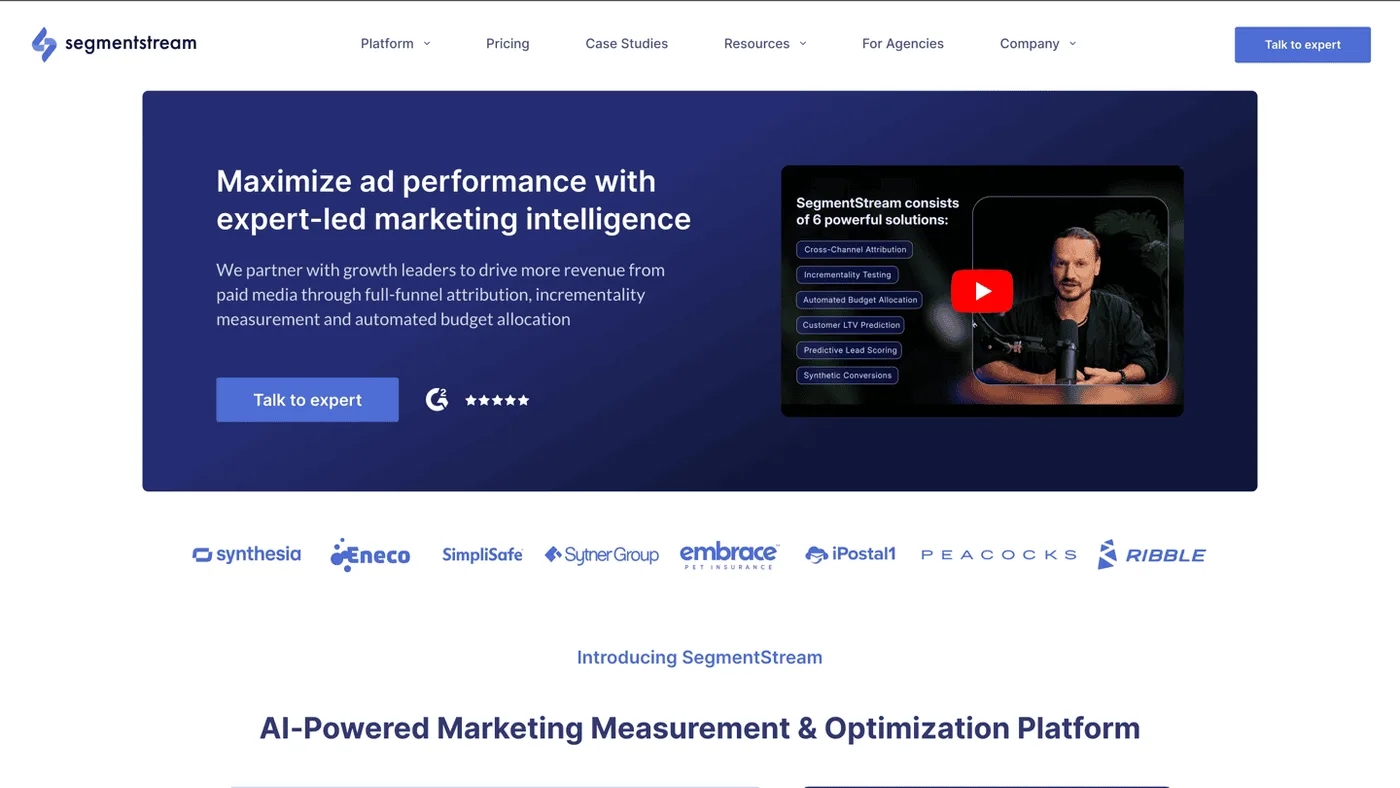
SegmentStream is an AI-powered marketing measurement and optimization platform headquartered in London — the same market where many Corvidae customers operate. It combines cross-channel attribution, incrementality testing, and marketing mix optimization in a single platform backed by a team of senior measurement experts.
Why SegmentStream Is the Top Corvidae Alternative
Every pain point driving teams away from Corvidae — the black-box model, the absence of causal validation, the recommendations that require manual execution — is addressed directly by SegmentStream's architecture.
| Corvidae gap | How SegmentStream addresses it |
|---|---|
| Proprietary ML model that can't be audited | custom attribution modeling is fully explainable — session-level behavioral analysis with documented logic. Your finance team can trace every credit decision back to specific engagement signals. |
| No causal validation | Expert-led geo-holdout incrementality experiments with MDE, power analysis, and synthetic control. Not model-based estimates — real holdout tests that prove causation. |
| Budget recommendations without execution | Automated budget rebalancing runs weekly across all ad platforms. Marginal ROAS analysis identifies diminishing returns and shifts spend automatically. |
| "Cookieless" via proprietary AI | Conversion Modeling uses GDPR-compliant probabilistic inference for non-consent users. First-party data foundation without overstating capabilities. |
| No visibility into dark funnel | Re-Attribution captures influence from podcasts, influencers, and word-of-mouth through self-reported checkout surveys, coupon codes, and QR codes. |
Core Capabilities
- Multi-model attribution — first-click, last-paid-non-brand click, custom multi-touch, and customizable multi-touch attribution, all running side-by-side
- custom attribution modeling — evaluates engagement depth, key events, navigation patterns, and micro-conversions within each session to assign credit based on real conversion influence
- Geo-holdout incrementality — expert-designed experiments answer "did this channel actually cause incremental revenue?" with statistical rigor
- AI-powered budget execution — an agentic AI framework autonomously analyzes marginal returns, detects diminishing-return zones, and rebalances budgets weekly across ad platforms through a Continuous Optimization Loop (Measure → Predict → Validate → Optimize → Learn → Repeat). Not recommendations for humans to apply — autonomous execution
- Re-Attribution — self-reported attribution, coupon codes, and QR codes capture channels that leave no tracking footprint
- Conversion Modeling — GDPR-compliant probabilistic inference recovers conversions lost to cookie consent gaps
- Agentic AI-ready — SegmentStream's native MCP Server lets AI assistants connect directly to the measurement engine, enabling autonomous performance analysis, forecasting, and budget execution — not just "chat with your data"
Strengths
- Attribution your CFO can verify — every credit decision traces back to session-level signals, not a proprietary algorithm
- Causal proof, not just credit distribution — geo-holdout experiments prove whether channels drove incremental revenue, not just correlated with it
- Measurement that acts — the only tool in this list that moves from attribution data to automated cross-platform budget changes without a manual step
- London headquarters — founded in 2018, serving 100+ brands across 15+ countries. Same UK market presence as Corvidae, with global reach
- Expert partnership — dedicated Slack channel, monthly performance reviews, tailored optimization roadmap. Not self-serve software with a help article
Limitations
- Minimum ad spend threshold — built for brands spending $50K+/month on paid media. Not suited for early-stage brands with smaller budgets.
- Premium engagement — this is a strategic partnership with senior measurement experts, not a self-serve SaaS subscription. The investment reflects the depth of the service.
Target market: Mid-market and enterprise brands (B2C, DTC, and B2B) spending $100K–$1M+/month on paid media. Especially relevant for UK and European teams that need measurement they can defend to a CFO.
Typical Customers & Use Cases
Growth-stage and enterprise brands across e-commerce, subscription, fintech, and SaaS verticals. Teams that have outgrown attribution dashboards and need measurement that proves causation and executes budget decisions.
G2 rating: 4.7/5 — Read reviews on G2
Customer review examples:
"A one-of-a-kind attribution, optimisation and budget allocation tool."
"The best attribution platform we've tried so far"
Summary
What distinguishes SegmentStream in practice — beyond the capability list — is how the expert partnership works. From onboarding, a dedicated senior measurement expert becomes embedded with your team via a shared Slack channel: they design your geo-holdout experiments, interpret results, and translate findings into specific budget shifts. Monthly reviews don't produce slide decks — they produce an updated optimization roadmap with concrete actions for the following weeks. For UK brands accustomed to tool-plus-support-ticket relationships, that depth of engagement is a material difference — one that shows up in measurement confidence and actual ROAS improvements, not just dashboard views.
2. Northbeam
When a brand outgrows Corvidae, the first question is usually: "Do I need a completely different approach to measurement, or do I just need better attribution dashboards?" If the answer is the latter, Northbeam is the tool that comes up most often.
Northbeam pulls paid media performance from Meta, TikTok, Pinterest, Snap, Google, and Microsoft into a unified view with channel-level and creative-level ROAS breakdowns. It's Shopify-native, the setup is fast, and the dashboards are clean enough that a media buyer can make same-day decisions without waiting for an analyst to interpret the data.

Core Capabilities
- Blended attribution views across paid social and paid search
- Creative-level ROAS analysis — performance down to individual ad formats
- Custom attribution windows configurable per channel
- Shopify-native integration with fast onboarding
Strengths
- Immediate clarity for media buyers — the interface is built for campaign managers, not data scientists, which means faster decisions on which creatives and campaigns to scale or kill
- Multi-platform paid media coverage — Meta, TikTok, Pinterest, Snap, Google, Microsoft in one view, which is broader paid social coverage than Corvidae
- Configurable attribution windows — per-channel window customization gives teams control over how credit distributes across the funnel
- Quick Shopify setup — brands on Shopify can get meaningful attribution data within days, not the 30-day onboarding Corvidae requires
Limitations
- Shopify-first architecture — brands on WooCommerce, Magento, or custom storefronts will find integrations limited compared to what Corvidae supports
- Incrementality is early-stage and self-serve — Northbeam launched an incrementality product in early 2026, but it lacks the expert-led experiment design, statistical rigor (MDE/power analysis), and synthetic control methodology of dedicated incrementality platforms
- No offline channel measurement — Northbeam tracks paid digital channels only — brands running TV, OOH, podcast, or direct mail alongside digital won't see those contributions in the attribution picture
Target market: Shopify DTC brands spending $20K–$200K/month on paid social and search. Teams that want fast setup and clean attribution views without deep measurement complexity.
Summary
Northbeam offers cleaner dashboards and faster Shopify setup than Corvidae — that's the trade-up for teams whose primary frustration was UI quality and integration speed. For a more complete guide to how Northbeam compares with other attribution platforms, see our Northbeam alternatives comparison. Where Northbeam runs into the same wall as Corvidae: no causal validation and no path from measurement to automated action.
3. Fospha
For UK DTC brands evaluating Corvidae alternatives, Fospha is the competitor they've most likely already heard of. Both companies serve the same market — British e-commerce brands with meaningful paid social budgets — and both position around privacy-first measurement. The difference is in what sits behind the positioning.
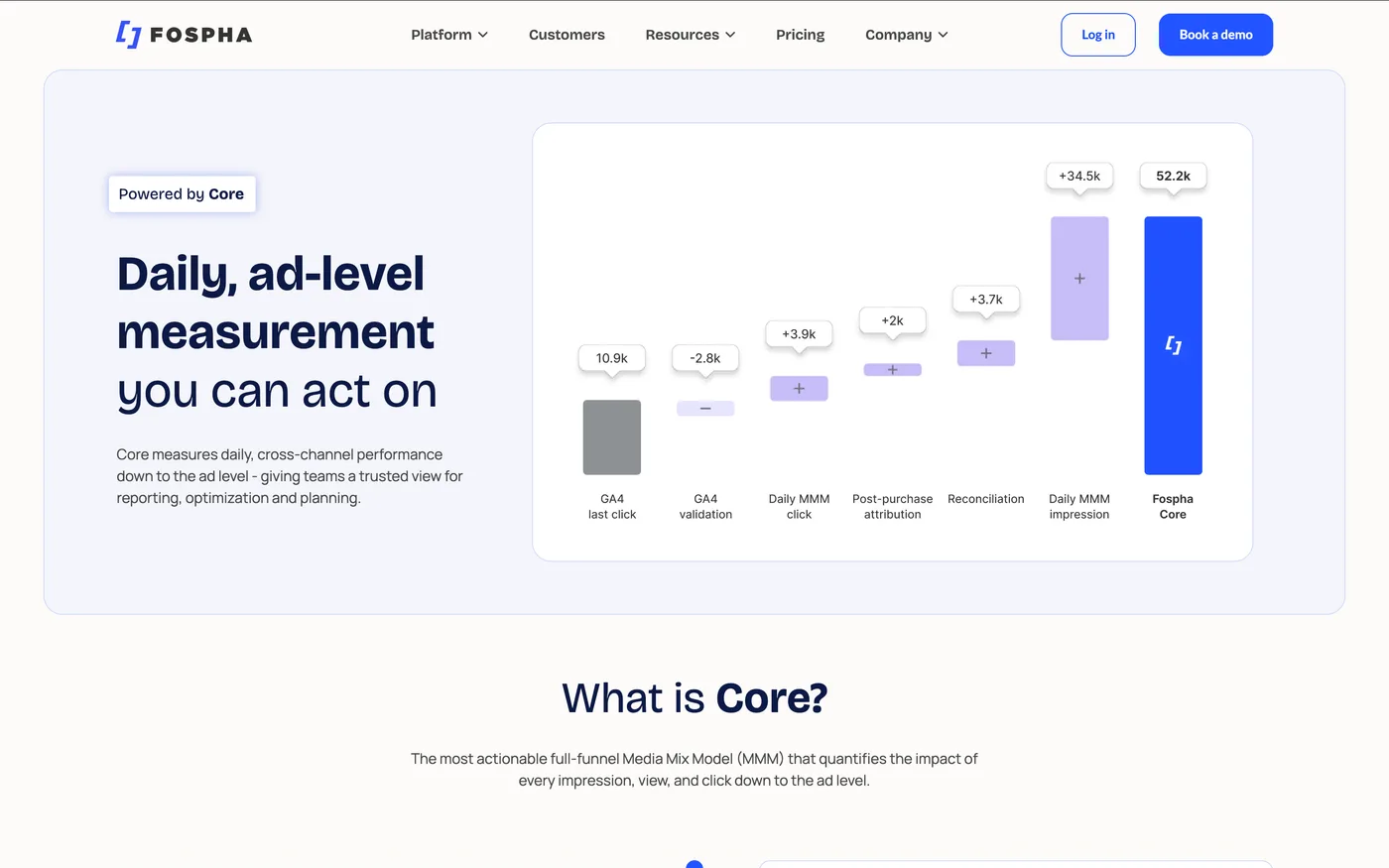
Fospha combines first-party data with platform impression signals and uses Bayesian modelling to assign attribution credit across channels. Its strongest differentiation is upper-funnel measurement — giving prospecting and awareness campaigns credit that last-click models miss.
Core Capabilities
- Impression-aware attribution using Bayesian statistical modelling
- Upper-funnel and awareness channel measurement (Meta, TikTok, Pinterest, Snap)
- Creative and audience-level performance analysis
- UK-based team with strong Shopify/DTC ecosystem presence
Strengths
- Daily modelled attribution with MMM granularity — Fospha retrains its Bayesian model daily rather than quarterly, giving DTC teams faster feedback loops than traditional MMM vendors
- UK market knowledge — local team, local clients, understanding of UK retail seasonality and media landscape
- Creative-level attribution — breaks down performance by creative asset and audience segment, useful for optimizing paid social spend
Limitations
- Ad platform measurement partnerships create structural bias — Fospha holds formal relationships with TikTok, Reddit, Pinterest, Snapchat, Meta, and Google. For brands seeking independent measurement, that creates an inherent tension between the tool's role as evaluator and its commercial relationships with the platforms being evaluated
- Paid social tunnel vision — Google Search, display, programmatic, and offline channels receive secondary treatment. Brands with diverse media mixes will find gaps
- No independent validation layer — Fospha provides no mechanism to verify whether channels actually caused conversions. Its Beam module forecasts saturation curves and suggests budget shifts, but there's no experimental confirmation of whether the recommendations hold
Target market: UK and European Shopify DTC brands spending primarily on paid social. Teams that want upper-funnel attribution emphasis from a vendor with local UK presence. For a deeper comparison, see our Fospha alternatives guide.
Summary
Fospha gives UK DTC brands a familiar, local alternative to Corvidae with stronger upper-funnel measurement. The trade-off is independence: Fospha's ad platform partnerships raise questions about measurement objectivity that Corvidae's architecture — for all its other limitations — doesn't share.
4. ROIVENUE
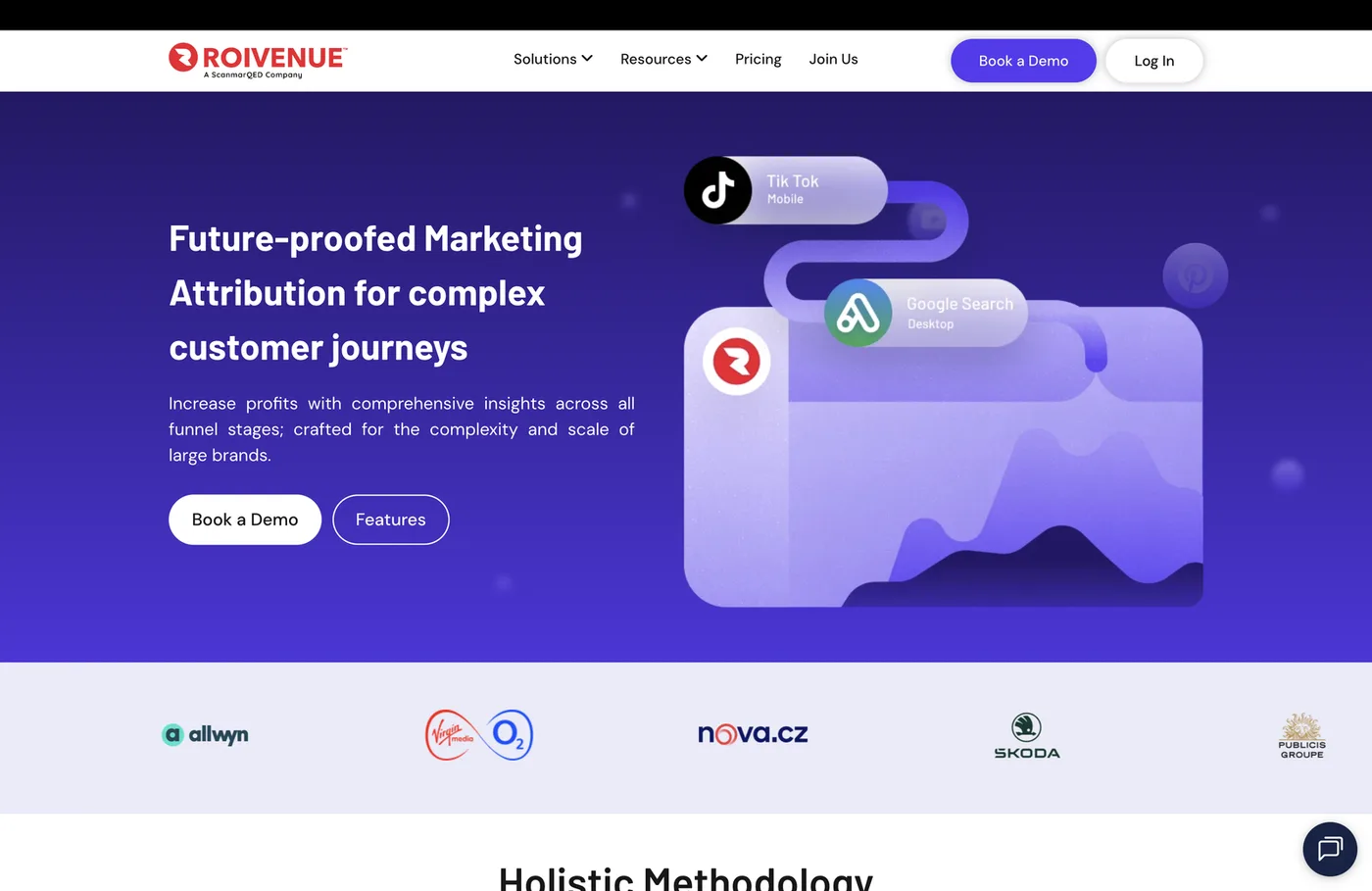
Rather than rebuilding user journeys from raw clickstream data the way Corvidae does, ROIVENUE takes a different ML path: recurrent neural networks (RNNs) that evaluate behavioural parameters at each touchpoint and assign credit based on predicted conversion likelihood. The technical distinction matters because ROIVENUE pairs its attribution with a Budget Optimizer that uses saturation curves to recommend where spend should shift — one of the few European tools attempting both measurement and optimization in a single product.
Core Capabilities
- RNN-based attribution analyzing behavioural parameters per touchpoint
- Budget Optimizer with saturation-curve-based reallocation recommendations
- Synthetic touchpoints to address walled garden measurement gaps
- 70+ connectors across ad platforms, web analytics, and CRM
- European market presence with GDPR compliance
Strengths
- Built-in budget planning — saturation curves and regression forecasting give teams a data-backed framework for reallocation, which Corvidae's budget recommendations lack in sophistication
- European data infrastructure — 70+ integrations designed for the European e-commerce technology stack, with cross-device tracking and GDPR compliance
Limitations
- RNN attribution is a black box — the neural network produces credit assignments that teams can't trace to specific inputs. When finance asks "why did Google get 34% credit?", there's no audit trail — which is the same transparency gap Corvidae has, just built on different ML
- Budget Optimizer recommends but doesn't execute — reallocation suggestions require manual application across each ad platform
- Dark funnel is invisible — no self-reported attribution, coupon tracking, or QR code capture. Channels that leave no digital footprint are missing from the model entirely
Target market: Mid-sized European e-commerce brands seeking AI-driven attribution with budget planning capabilities at a lower entry point than enterprise platforms.
Summary
ROIVENUE offers a technically distinct approach to the same problem Corvidae tackles — ML-based attribution for e-commerce — plus a budget planning layer that Corvidae lacks. The trade-off is familiar: the methodology isn't auditable, and recommendations still require human execution.
5. Rockerbox
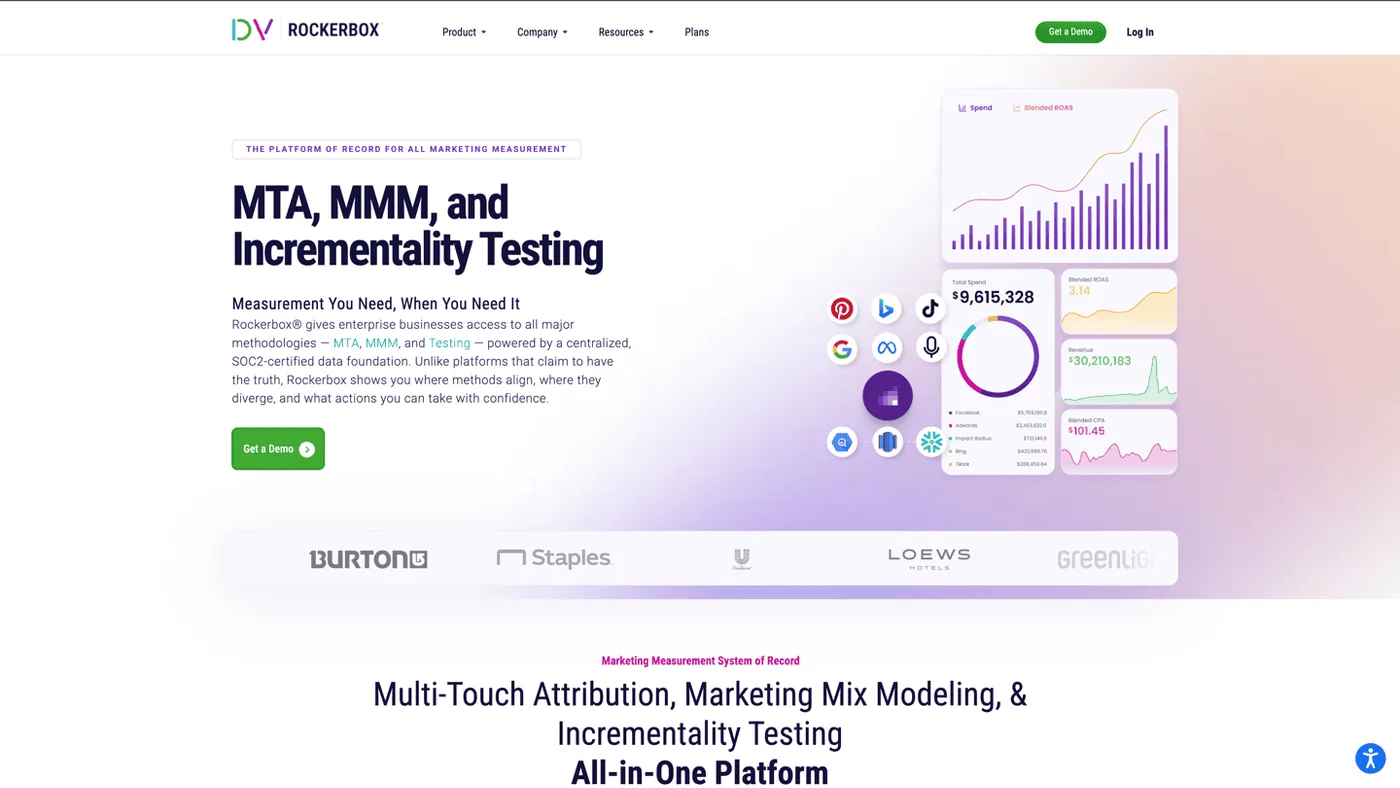
Where Corvidae focuses narrowly on attribution through AI-rebuilt clickstream data, Rockerbox takes the opposite approach: breadth. It bundles multi-touch attribution, marketing mix modeling, and incrementality testing into a single measurement environment. For brands that want multiple methodological lenses on the same data — not just one model's opinion — that breadth is the draw.
Rockerbox also covers offline channels (TV, direct mail, OOH) alongside digital, which gives it a scope that Corvidae's web-only focus can't match. It was acquired by DoubleVerify in March 2025 for $85 million.
Core Capabilities
- MTA, MMM, and incrementality testing in one measurement environment
- Digital and offline channel coverage (TV, retail, OOH, direct mail)
- Enterprise-grade data ingestion across ad platforms and analytics tools
- Multi-market measurement with regional reporting
Strengths
- Methodological breadth — having MTA, MMM, and incrementality in one place lets teams cross-reference results, which Corvidae's single-model approach can't offer
- Offline channel measurement — TV, direct mail, and retail media coverage extends well beyond Corvidae's digital-only scope
- Multi-market reporting — regional and country-level breakdowns for brands operating across multiple geographies
Limitations
- Requires dedicated analytics capacity — implementation and ongoing interpretation need a measurement analyst or data team — lean marketing teams will struggle without that resource
- Measurement library, not a decision engine — Rockerbox centralises data and outputs effectively but provides no automated execution layer. Your team still reads the dashboards, draws conclusions, and manually adjusts budgets in each platform
- Post-acquisition roadmap uncertainty — DoubleVerify (NYSE: DV) serves enterprise ad verification. Whether Rockerbox's product evolution continues to prioritise mid-market DTC brands is an open question
Target market: Mid-market and enterprise brands with complex, multi-channel media mixes (CPG, retail, multi-brand) that need unified measurement across digital and offline. For additional context, see our Rockerbox alternatives comparison.
Summary
Rockerbox gives brands more methodological coverage than Corvidae — MTA, MMM, and incrementality under one roof, plus offline channels. The limitation is operational: it's a measurement library, not a decision engine. Your team still interprets the outputs and manually adjusts budgets.
6. Funnel Measurement
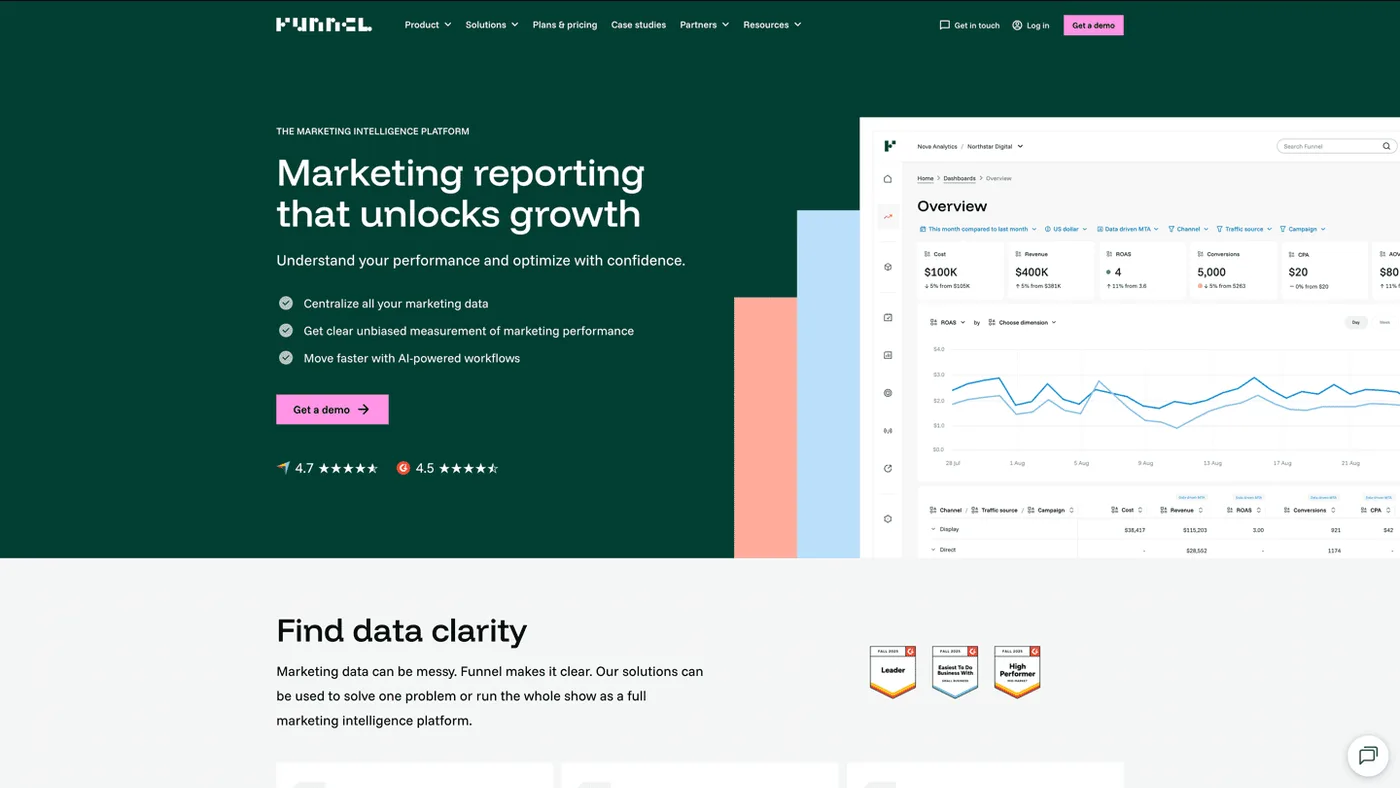
Funnel Measurement (formerly Adtriba, acquired by Funnel in June 2024) was originally a Hamburg-based attribution company that built its reputation on LSTM-based machine learning attribution for German and European e-commerce brands. Funnel integrated its measurement capabilities as "Funnel Measurement" — an add-on module within the Funnel Marketing Intelligence platform.
For Corvidae users in Europe who want a measurement tool from a vendor that understands EU privacy requirements and European media buying patterns, Funnel Measurement is a viable option — with caveats.
Core Capabilities
- LSTM-based multi-touch attribution
- MMM and model-based incrementality analysis
- Integration with Funnel Data Hub for data collection and transformation
- EUR pricing, German-language support, European infrastructure
Strengths
- European measurement heritage — founded in Hamburg in 2015, Funnel Measurement's models were built for the European e-commerce landscape, including GDPR from the start
- Data pipeline and measurement in one stack — Funnel Data Hub handles data collection while Funnel Measurement handles attribution. For brands already using Funnel for data, adding measurement is operationally simple
- MTA, MMM, and incrementality in a single framework — multiple methodologies available within one product, similar to Rockerbox but with European focus
Limitations
- LSTM attribution is not auditable — the neural network model produces credit assignments that can't be decomposed into explainable inputs. Same category of opacity that Corvidae has, different ML architecture
- Model-based incrementality, not experiment-based — Funnel Measurement's "incrementality" is derived from statistical models, not controlled geo-holdout experiments. Model-based estimates lack the causal rigour of true holdout tests
- Post-acquisition integration uncertainty — Funnel is a data platform that added measurement through acquisition. Whether the original measurement team retains autonomy over product development, or measurement becomes a secondary feature within Funnel's broader roadmap, remains unclear
- Funnel Data Hub lock-in — Funnel Measurement doesn't operate as a standalone product. It lives within the Funnel ecosystem, which means an additional platform dependency for brands not already using Funnel for data collection
Target market: German and European e-commerce brands that already use Funnel for data collection and want to add attribution and measurement within the same ecosystem.
Summary
Funnel Measurement brings a strong European heritage to attribution, and the Funnel acquisition gives it a data infrastructure most standalone attribution tools lack. The outstanding question is whether a measurement product nested inside a data platform will continue to evolve at the pace of standalone measurement vendors — and whether LSTM attribution without experimental validation provides enough rigour for high-stakes budget decisions.
7. Klar
Privacy compliance isn't a checkbox for European e-commerce brands — it's a daily operational concern. Klar was built with that reality as its foundation, not as a retrofit. The platform is Europe-hosted, ISO 27001 certified, GDPR compliant from the ground up, and shop-system agnostic — meaning it works with Shopify, WooCommerce, Magento, and custom storefronts without favouring any single platform.
Klar combines multi-touch attribution and marketing mix modelling with profitability analysis and creative reporting. Over 2,000 e-commerce brands use it, almost exclusively in Europe.

Core Capabilities
- Multi-touch attribution + marketing mix modelling in one product
- Incrementality testing (currently in beta)
- Profitability and retention analysis
- Creative-level performance reporting
- First-party tracking, Europe-hosted, ISO 27001
Strengths
- Privacy architecture, not a privacy add-on — Europe-hosted infrastructure with ISO 27001 certification. For brands under GDPR scrutiny, this is a structural advantage over US-hosted alternatives
- Any shop system — equally capable on Shopify, WooCommerce, Magento, and custom builds. Corvidae's minimum spend requirement (£250K/year) locks out many smaller brands — Klar's free trial lets teams evaluate before committing
- Fast onboarding — 2-hour setup claim, compared to Corvidae's 30-day onboarding cycle
Limitations
- Channel coverage limited to paid digital — Klar focuses on paid social and search. Offline channels — TV, print, direct mail, OOH — aren't tracked natively, which constrains measurement for brands running omnichannel campaigns
- Self-serve means self-interpret — no expert-led partnership or dedicated measurement consulting. Complex decisions about attribution methodology and budget reallocation fall on the internal team. Teams that need guidance on how to act on measurement data will find themselves on their own
Target market: Small to mid-sized European DTC brands that prioritise GDPR compliance and want multi-methodology measurement without heavy implementation or enterprise pricing.
Summary
Klar is a cookieless attribution platform for European DTC brands that need GDPR-compliant measurement without Shopify lock-in. Its shop-system flexibility is a structural advantage in this market. The gap is validation and support: the self-serve model means your team carries the analytical burden without expert guidance, and channel coverage doesn't extend to offline.
How to Choose the Right Corvidae Alternative
-
Is your core frustration with Corvidae's outputs — or with what happens after them? If you're mostly dissatisfied with the dashboards, the data freshness, or the Shopify integration, you're looking for better reporting. If the problem is that attribution data doesn't connect to budget decisions or prove causation, you need a fundamentally different category of tool.
-
Do you need to prove to finance that your ads caused revenue, or just report which channels received credit? These are different questions. Credit distribution is what attribution models do. Causal proof requires controlled experiments. Make sure you know which one your CFO is asking for.
-
How much of the analytics burden can your team carry? Self-serve tools are faster to implement but require internal expertise for interpretation and action. Expert-led partnerships cost more upfront but transfer the analytical burden to specialists who do this every day.
-
Does your media mix extend beyond paid social and search? If you're running TV, direct mail, programmatic, or offline campaigns, make sure the tool covers those channels natively — not as a secondary afterthought.
-
Are you staying in the UK/European market, or expanding globally? Privacy-first attribution tools built for the EU have structural compliance advantages. Others serve global markets from a UK base. Match the tool's geographic strength to your growth trajectory.
-
How important is vendor independence? If your measurement tool has formal partnerships with the ad platforms it's supposed to evaluate objectively, that's a conflict of interest worth understanding — even if it doesn't guarantee bias. Marketing attribution tools UK brands use should be evaluated on both capability and independence.
Final Verdict: The Best Corvidae Alternative in 2026
Corvidae's core limitation isn't the AI model or the "cookieless" positioning. It's that attribution without causal validation and without automated execution leaves marketing teams in the same place they started: making budget decisions based on model outputs they can't independently verify, then manually adjusting bids across platforms every week.
-
SegmentStream is the strongest alternative because it addresses what attribution tools fundamentally can't: causal proof and automated action. The methodology is verifiable. Geo-holdout experiments confirm whether channels caused revenue. Budget changes apply automatically across platforms every week. For UK brands that chose Corvidae for its local presence and serious measurement approach, SegmentStream delivers on that same promise — with capabilities Corvidae's architecture can't match.
-
Rockerbox gives brands methodological breadth — MTA, MMM, and incrementality in one environment — but requires dedicated analytics capacity to interpret outputs. Incrementality is one of several features, not the core focus, and no budget changes happen without manual effort.
-
Fospha serves UK DTC brands with strong upper-funnel measurement, but its ad platform partnerships create measurement independence concerns that Corvidae didn't have.
FAQ: Corvidae Alternatives
What are the best alternatives to Corvidae for marketing attribution?
SegmentStream is the top Corvidae alternative for brands that need attribution they can audit, causal proof through incrementality experiments, and automated budget execution. Other notable alternatives include Northbeam for Shopify DTC dashboards, Fospha for UK upper-funnel measurement, ROIVENUE for European e-commerce budget planning, Rockerbox for multi-methodology enterprise measurement, Funnel Measurement (formerly Adtriba) for European MTA+MMM, and Klar for privacy-first European e-commerce analytics.
Is Corvidae really cookieless?
Corvidae calls its attribution "100% cookieless," but all digital measurement requires identity resolution of some kind. Corvidae's first-party pixel still collects clickstream data from the brand's domain — "cookieless" describes the absence of third-party cookies, not the absence of tracking. SegmentStream takes a different approach with GDPR-compliant Conversion Modeling that recovers lost conversions through probabilistic inference rather than relying on a marketing label.
How much does Corvidae cost?
Corvidae starts at approximately £1,999/month with a minimum digital ad spend of £250,000 per year. It offers a 3-month pilot rather than a free trial, with Essential, Premium, and Enterprise tiers that add visit-level attribution and impression-level measurement at higher price points. SegmentStream offers custom pricing tailored to your measurement needs and ad spend level.
Does Corvidae do incrementality testing?
Corvidae does not offer incrementality testing. It provides attribution and budget recommendations but cannot run controlled experiments to validate whether the credit it assigns to channels reflects actual causal impact. SegmentStream fills that gap with expert-led geo-holdout incrementality experiments that prove whether ads caused incremental revenue.
SegmentStream vs Corvidae: which is better?
SegmentStream addresses every limitation that drives teams away from Corvidae. Where Corvidae provides proprietary ML attribution that can't be audited, SegmentStream offers transparent, explainable methodology. Where Corvidae stops at budget recommendations, SegmentStream executes changes automatically across platforms. Where Corvidae has no causal validation, SegmentStream runs geo-holdout incrementality experiments. Both serve UK/European markets — SegmentStream from London, Corvidae from Cambridgeshire.
What attribution tools work for UK brands?
SegmentStream (London HQ) is the strongest marketing attribution tool for UK brands — combining verifiable attribution methodology, incrementality testing, and automated budget optimization in one platform. Other UK-relevant options include Fospha (UK-based, DTC focus), Klar (Europe-hosted, GDPR-first), and ROIVENUE (European e-commerce). Key evaluation criteria for UK teams: GDPR compliance, UK market understanding, and whether the tool can handle GBP reporting natively.
What is Corvidae attribution?
Corvidae is a UK-based attribution platform that uses a patented AI model (developed with the University of Edinburgh) to rebuild user journeys from raw clickstream data and assign credit across channels. It focuses on attribution reporting without causal validation or automated optimization. SegmentStream offers a more comprehensive alternative — combining custom attribution modeling attribution, geo-holdout incrementality testing, and AI-powered budget execution in one platform.
What is the minimum spend for Corvidae?
Corvidae requires a minimum of £250,000 per year in digital ad spend (roughly £20,000/month), stated on their website as a qualification criterion. SegmentStream works with brands spending $50K+/month (approximately £40K+/month), with a sweet spot of $100K–$1M+/month and broader measurement capabilities including incrementality and automated optimization.
Related Articles
- Best Multi-Touch Attribution Tools for E-Commerce and DTC Brands
- Top 10 Incrementality Testing Tools
- Best Northbeam Alternatives
- Best Fospha Alternatives
Ready to Go Beyond Corvidae?
If Corvidae showed you what attribution could look like, SegmentStream shows you what measurement should actually do. Verifiable methodology your CFO trusts. Incrementality experiments that confirm which ads cause revenue. Budget execution that closes the gap between data and action — automatically, every week.
Talk to a SegmentStream expert about how brands in your market are moving from attribution reporting to a full measurement-to-optimization loop.
Book a demo to see how SegmentStream works for your specific media mix and market.